

Outbound Sales Training: Why Most Programs Fail (and How to Build One That Doesn't)
Your VP just approved $15,000 for outbound sales training. Six months from now, your reps will have forgotten almost everything they learned. 85-90% of sales training has no lasting impact after 120 days, and reps forget 70% of what they learned within a single week. The problem isn't the content. It's the reinforcement, the coaching cadence, and the data your reps work with after training ends.
The Business Case for Training
Effective outbound programs deliver 353% ROI - $4.53 back for every $1 invested - plus a 19% lift in win rates. Meanwhile, average SaaS ramp time has climbed to 5.7 months, the total cost to ramp a new rep runs roughly 3x their base salary, and 20% of reps churn within their first 45 days because onboarding was a mess.
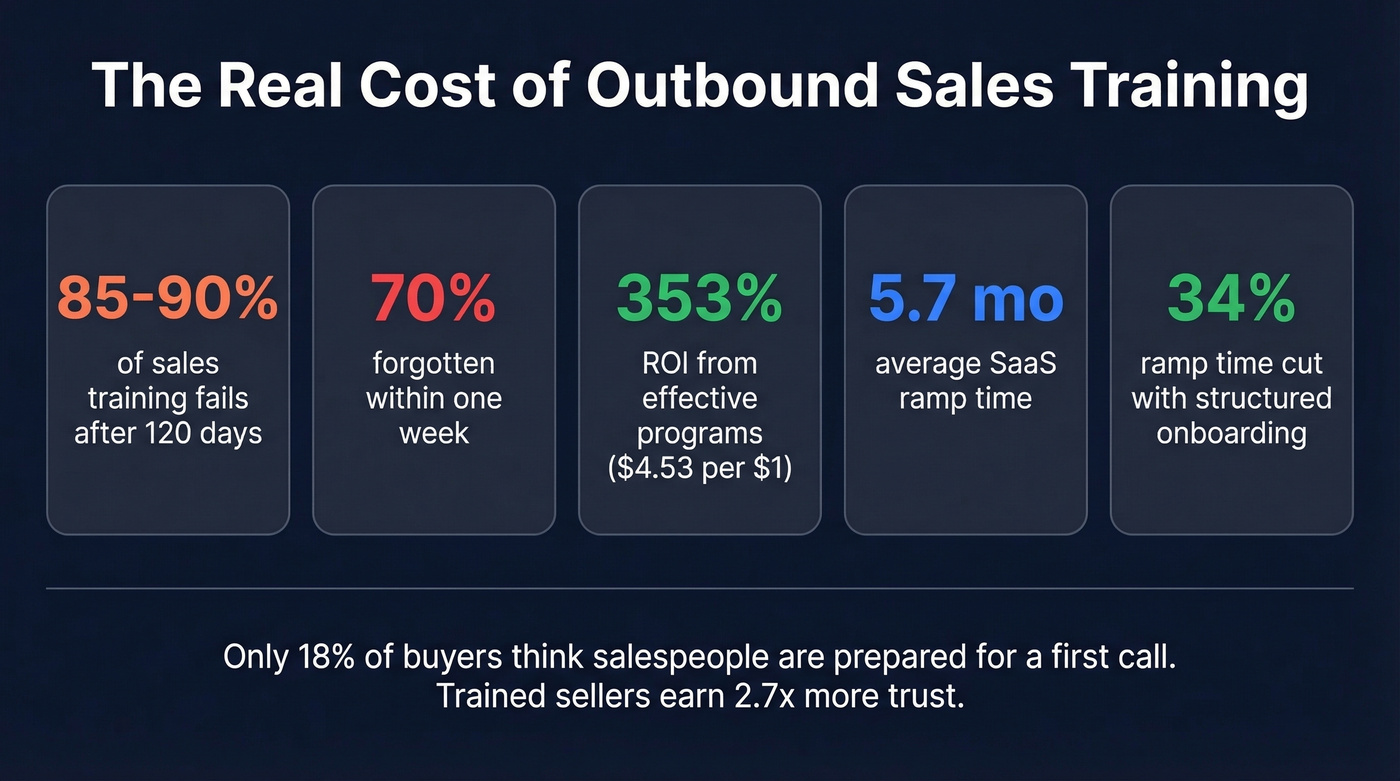
Here's the stat that should haunt every sales leader: only 18% of buyers believe salespeople are well-prepared for a first call. Trained sellers earn 2.7x more trust. Structured onboarding programs cut ramp time by up to 34% and retain 50% more new hires. That's not a training expense - it's an insurance policy against a $150K hiring mistake.
Why Most Programs Fail
Stop buying more programs. One good program with weekly coaching beats three expensive workshops with no follow-up.
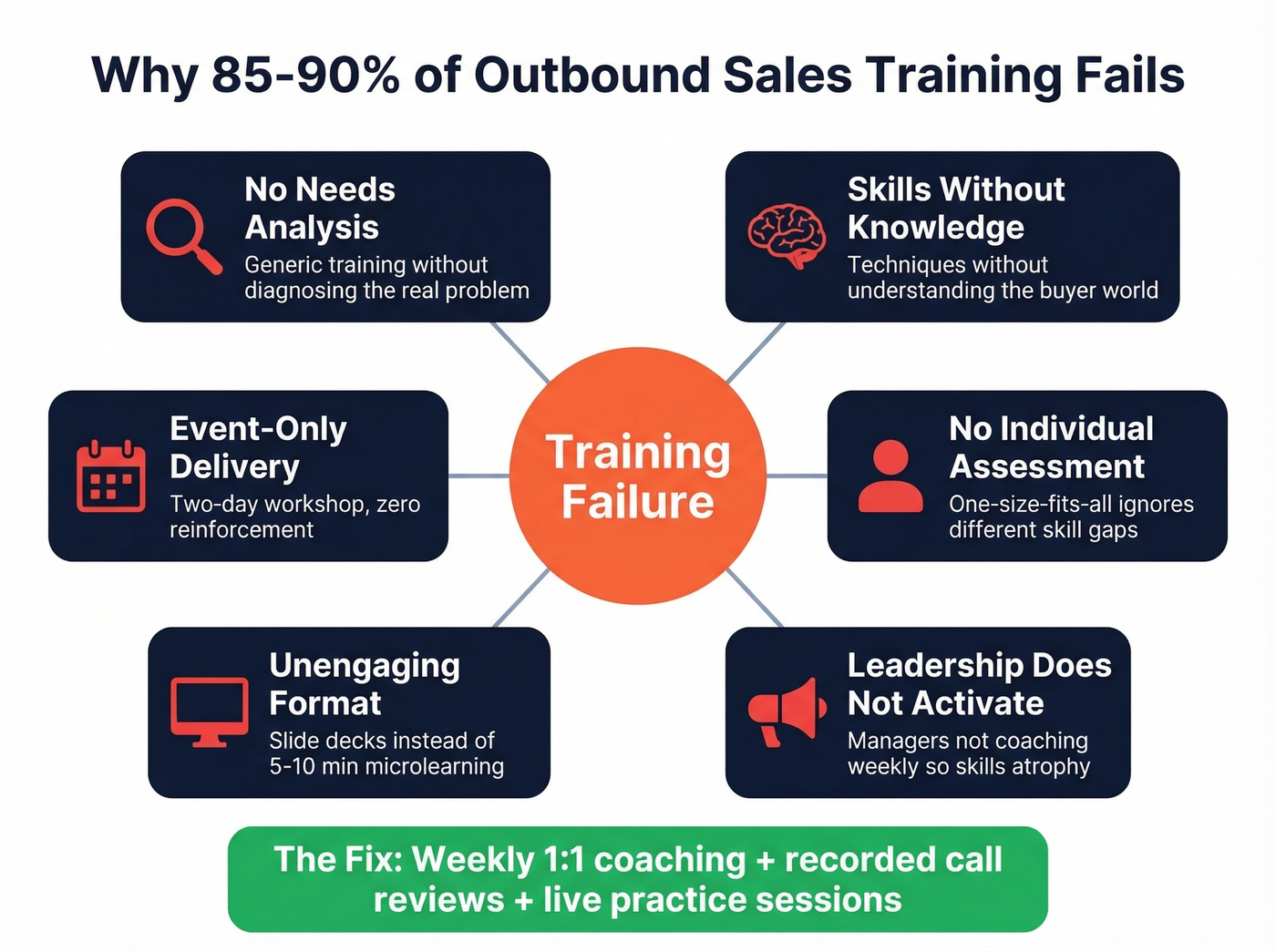
- No needs analysis. Teams buy generic training without diagnosing what's actually broken - messaging, objection handling, pipeline discipline, or all three.
- Skills without knowledge. Reps learn techniques but don't understand the buyer's world deeply enough to apply them.
- Event-only delivery. A two-day workshop with no reinforcement is entertainment, not training.
- No individual assessment. One-size-fits-all coaching ignores that your top rep and your struggling rep need completely different interventions.
- Unengaging format. Adults learn by doing. Slide decks don't build muscle memory - microlearning sessions of 5-10 minutes tend to outperform hour-long modules.
- Leadership doesn't activate. As Blanchard's research puts it: "training teaches skills, leadership activates them." If managers aren't coaching weekly, skills atrophy fast.
The fix isn't complicated: weekly 1:1 coaching, recorded call reviews, and live practice sessions. That cadence alone separates teams where training sticks from teams where it evaporates.
What Good Outbound Training Covers
Cold calling fundamentals. 70% of sales agents still reach out by phone, and 49% of buyers actually prefer it. But contact rates have dropped to roughly 3 per 100 call attempts, which means fundamentals matter more than ever. Train on opener structure - credibility plus curiosity in under 15 seconds - objection handling frameworks (not scripts), and tone control. The consensus on r/sales is pretty consistent: at least two data sources, a power dialer, and 200+ dials a day is table stakes. If you're rebuilding your call motion, start with a repeatable cold calling system.
Cold email and sequencing. Reps need to understand deliverability, not just copywriting. A perfectly written email that lands in spam is worthless. Train on subject line testing, send volume management, and reply-rate benchmarks. Expect 2-5% for cold outbound. For copy and testing ideas, pull from these cold email subject line examples and tighten your email deliverability basics.
Qualification frameworks. BANT works for transactional deals. MEDDIC is the standard for enterprise cycles. CHAMP flips the script by leading with challenges instead of budget. Train reps on all three and let them adapt based on deal complexity. If you're standardizing enterprise discovery, use a consistent MEDDIC sales qualification approach.
The data quality prerequisite. This is the piece most training programs completely ignore, and honestly it drives us nuts. If your contact data bounces above 5%, reps waste time, burn morale, and lose momentum. We've seen teams invest $20K in training only to hand reps a list where a third of the emails bounce. Audit your contact data before you invest in coaching - Prospeo delivers 98% email accuracy on a 7-day refresh cycle, so reps actually reach the prospects they're trained to sell to. If you're evaluating vendors, compare options in our guide to data enrichment services.


85% of outbound training fails because reps can't reach the prospects they're trained to sell to. Prospeo delivers 98% email accuracy on a 7-day refresh cycle, so your $15K training investment actually converts into booked meetings - not bounced emails.
Stop training reps to sell, then handing them dead leads.
The 30-60-90 Day Ramp Plan
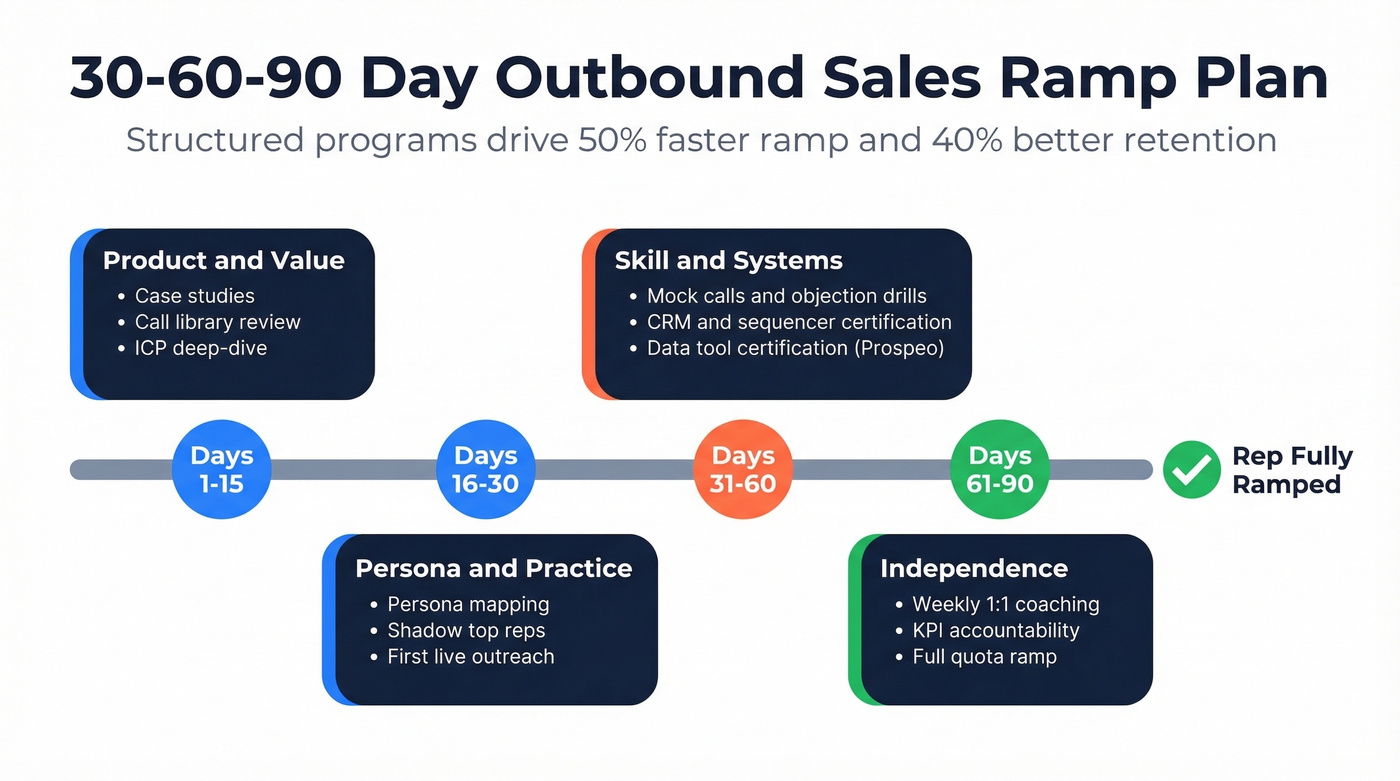
Structured 90-day programs drive 50% faster ramp times and 40% better retention. Here's a template you can adapt immediately. (If you want a deeper version, use this 30-60-90 day plan as a baseline.)
| Phase | Focus | Activities |
|---|---|---|
| Days 1-15 | Product & value | Case studies, call library, ICP deep-dive |
| Days 16-30 | Persona & practice | Persona mapping, shadowing, first live outreach |
| Days 31-60 | Skill + systems | Mock calls, objection drills, CRM + sequencer certification |
| Days 61-90 | Independence | Weekly 1:1 coaching, KPI accountability |
During Days 31-60, certify reps on their data tools alongside their sequencer and CRM. Building the habit of pulling verified contact info before every session - rather than manually hunting mid-call block - is a skill that compounds fast. Teams using Prospeo's Chrome extension cut list-building from hours to minutes, which means reps spend more time practicing the skills they just learned. If you're tightening your stack, start with a shortlist of SDR tools.
Best Outbound Sales Training Programs
We use a 3-part rubric: was it built by people who've actually sold, can you use it on your next call, and does it include triggers for when to deploy each tactic?
| Program | Best For | Format | Price |
|---|---|---|---|
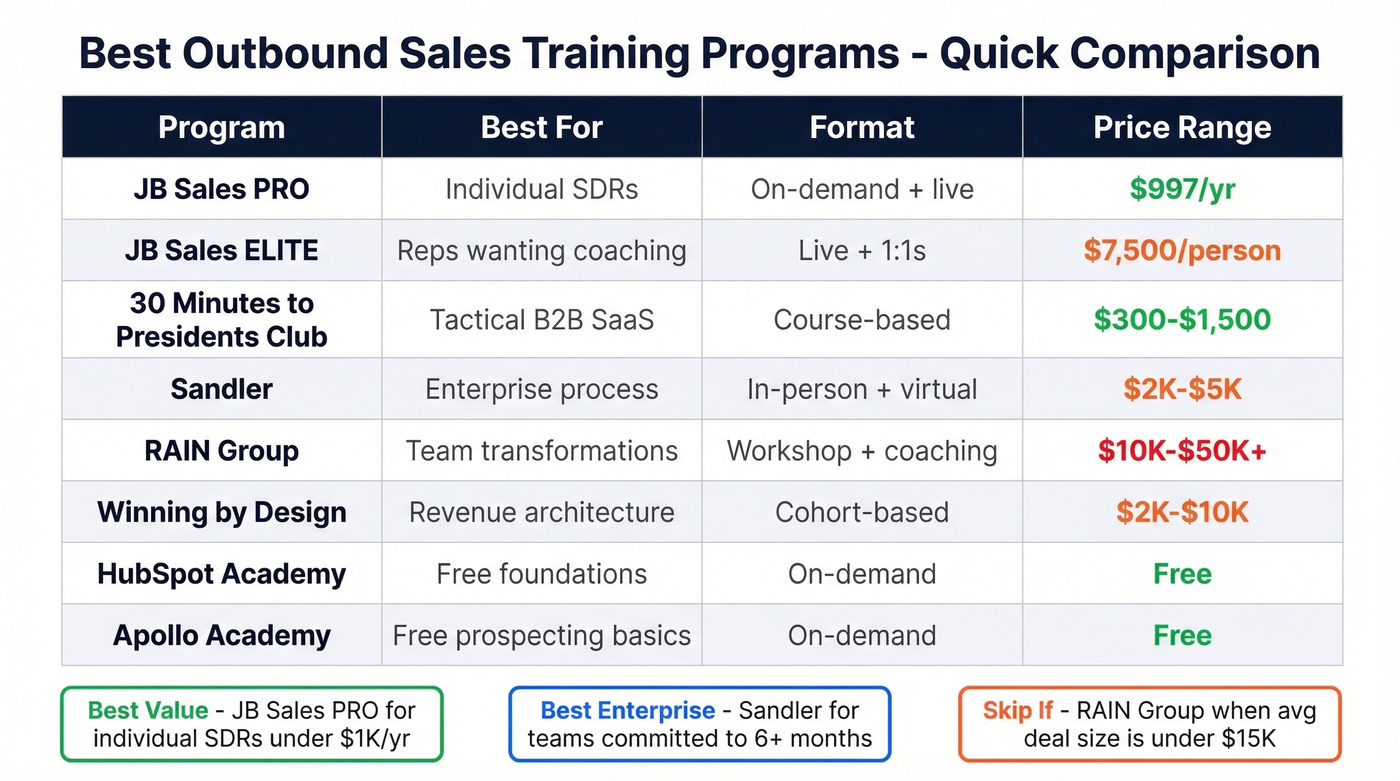
| JB Sales PRO | Individual SDRs | On-demand + live | $997/yr |
| JB Sales ELITE | Reps wanting coaching | Live + 1:1s | $7,500/person |
| 30MPC | Tactical B2B SaaS | Course-based | ~$300-$1,500/course |
| Sandler | Enterprise process | In-person + virtual | ~$2,000-$5,000/person |
| RAIN Group | Team transformations | Workshop + coaching | ~$10,000-$50,000+ |
| Winning by Design | Revenue architecture | Cohort-based | ~$2,000-$10,000/person |
| HubSpot Academy | Free foundations | On-demand | Free |
| Apollo Academy | Free prospecting basics | On-demand | Free |
JB Sales is the best value for individual SDRs who need to get sharper fast - the PRO tier gives you on-demand content plus live sessions for under a grand a year, which is hard to beat. Sandler is right for enterprise teams willing to commit six-plus months to a methodology. Winning by Design stands out for revenue teams that want a systems approach, not just call coaching.
HubSpot Academy and Apollo Academy are fine for concepts, but neither will teach you what to say when a prospect hits you with "we're already working with someone." If you want more tactical reinforcement ideas, borrow from these sales training tips.
Skip RAIN Group if your average deal size is under $15K. You probably don't need a $10K-$50K+ engagement. Invest in a $1,000 course, a conversation intelligence tool, and a weekly coaching cadence instead. That combination will outperform any big-ticket workshop without follow-through.
AI Tools and Sales Enablement
AI roleplay solves the "forgotten in a week" problem by making practice continuous instead of episodic. Let's break this down by category, because the distinctions matter.
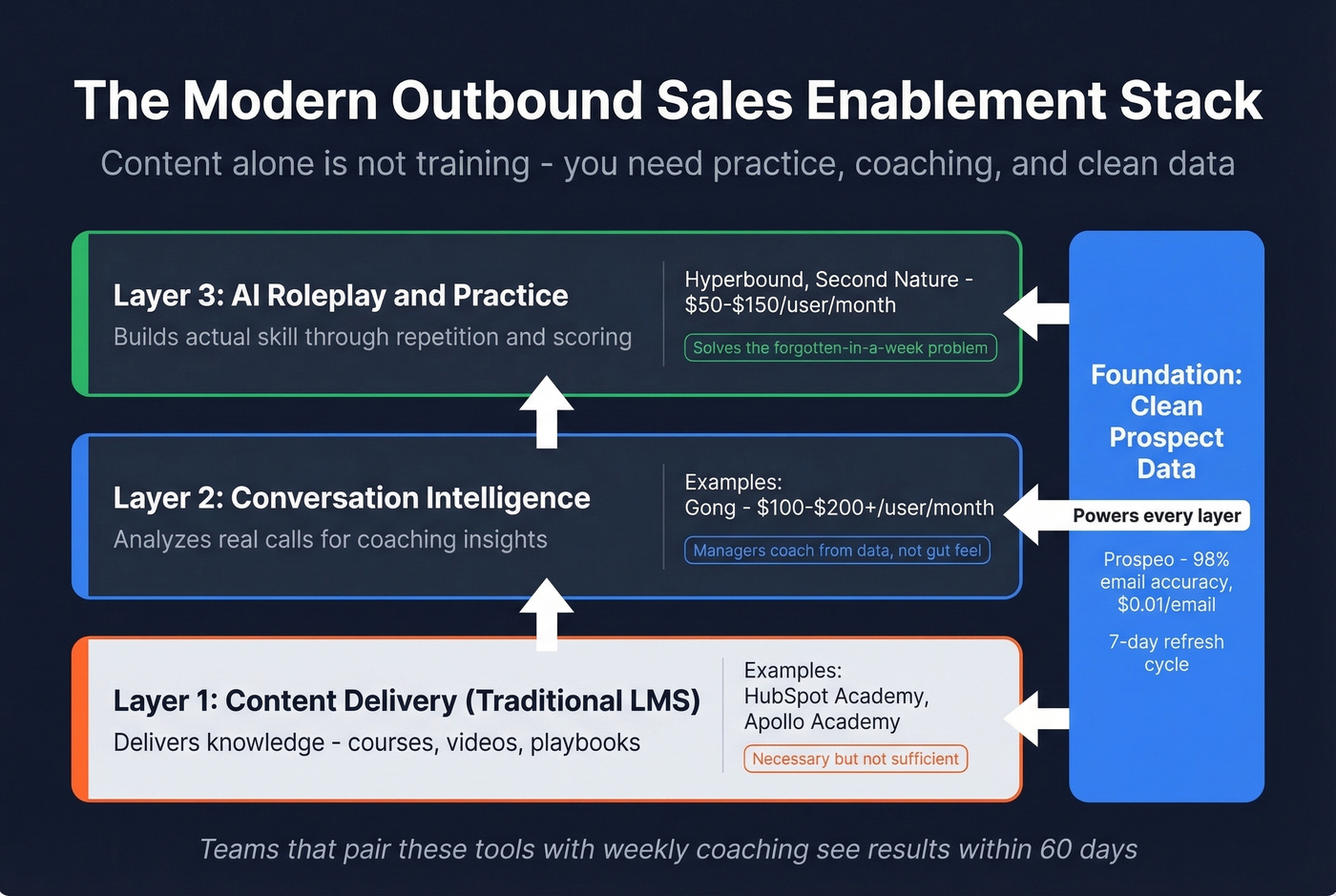
Hyperbound does AI roleplay with real-call scoring and coaching feedback. Typically $50-$150/user/month. Best for teams that want structured practice without scheduling live sessions.
Gong is the conversation intelligence standard. It analyzes real calls for coaching insights, typically runs $100-$200+/user/month sold annually, and it's best for managers who coach from data rather than gut feel.
Second Nature focuses purely on AI roleplay with structured scoring. Typically $50-$150/user/month. Worth evaluating if your team needs high-volume repetition on specific objection patterns.
The distinction between these categories matters more than the specific tool you pick: traditional LMS platforms deliver content, enablement platforms put content in workflow, and AI-native tools build actual skill through repetition. If a program doesn't include live practice and coaching, it's content, not training. In our experience, the teams that pair any of these tools with clean prospect data and a weekly coaching rhythm see results within 60 days - the ones that just buy software and hope for the best don't. If you're building a repeatable outbound motion, align training with proven sales prospecting techniques.
Your 30-60-90 ramp plan falls apart when new reps spend hours hunting for contact info instead of practicing outreach. Prospeo's Chrome extension cuts list-building to minutes - 40,000+ users already prospect this way. At $0.01 per email, it costs less than the coffee your SDR drinks during one call block.
Ramp reps faster with data that's already verified.
FAQ
How long does outbound sales training take to show results?
Average SDR ramp is 3.2 months with structured onboarding, which cuts ramp time by up to 34% and retains 50% more new hires compared to ad-hoc programs. The biggest accelerators are weekly coaching, live call practice, and clean contact data from day one.
What's the ROI of a structured program?
Effective outbound sales training delivers 353% ROI - $4.53 for every $1 invested - plus a 19% lift in win rates. Only 37% of companies measure outcomes beyond completion rates, so most never see the return because they never track it.
Why does training stop working after a few months?
Because 85-90% of programs are delivered as a one-time event with no reinforcement - reps forget 70% within a week. The fix is weekly coaching, AI practice tools for continuous repetition, and verified contact data so reps aren't demoralized by bounced calls and dead emails.