

Outbound SDR Metrics: What to Track, What to Drop, and 2026 Benchmarks
Average SDR quota attainment sits at 43%. More than half your team is underwater every month, and 83.4% of SDRs fail to hit quota consistently. Most outbound SDR metrics dashboards stack activity numbers on top of vanity numbers and call it "visibility," when what leadership actually needs is a clear line from rep behavior to revenue.
The fix isn't more metrics. It's fewer, better ones - and honest benchmarks to measure them against.
Start Here: The Three Metrics That Matter
If you're rebuilding your SDR dashboard from scratch, start with three metrics:
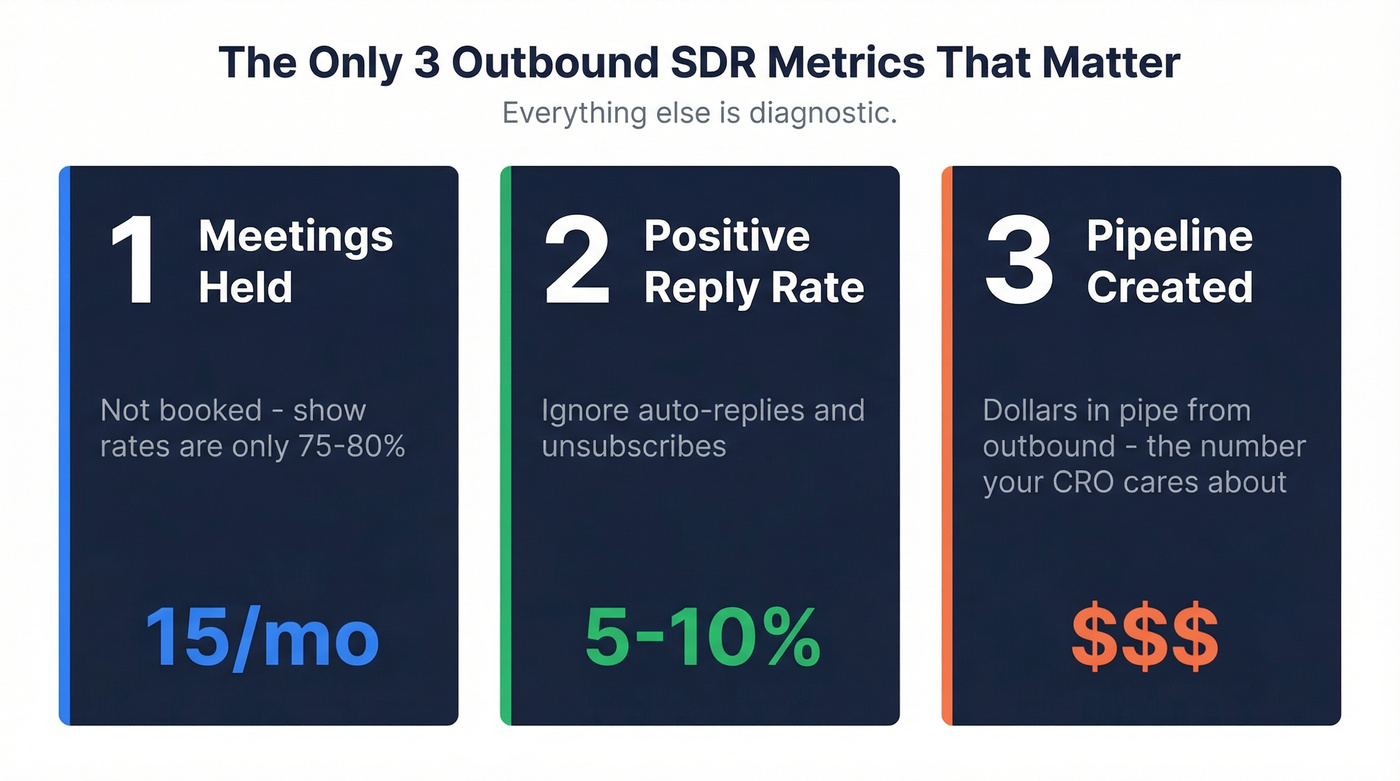
- Meetings held (not booked). With outbound show rates typically 75-80%, "meetings booked" overstates pipeline input fast.
- Positive reply rate. Total replies include "remove me" and auto-responders. Positive replies tell you whether messaging actually lands.
- Pipeline created. Dollars in pipe attributed to outbound. This is the number your CRO cares about.
Everything else is diagnostic. The median outbound SDR produces about 15 meetings per month - inbound SDRs typically hit 20-25. Use those as your baselines, then dig into the diagnostics below.
The Metrics That Actually Drive Revenue
We organize SDR prospecting KPIs into three tiers: executive, operator, and rep. Each tier answers a different question, and mixing them up is how dashboards get bloated.
Executive Metrics
Executives need to know whether outbound is a profitable channel - not how many dials happened yesterday. Four metrics matter here: pipeline created, revenue attributed to outbound, quota attainment, and CAC:LTV ratio. Pipeline coverage should run 3-5x your target. In most orgs, SDRs influence 46-73% of pipeline conversion, so if your outbound team isn't contributing at least half of new pipe, something's structurally off.
Here's the thing about quota benchmarks: 6sense's BDR benchmark shows ~88% average quota achievement, which looks wildly different from that 43% SDR attainment figure. One is an average attainment number; the other is a harsher "consistent month-over-month" lens. Plan for the reality you see in your own CRM, not the number that makes your board deck look better.
Operator Metrics
This is where you diagnose what's working and what's broken. Operators should track meetings held, positive reply rate, connect rate, show rate, bounce rate, and SAL-to-SQL conversion.
| Metric | Benchmark | Segment Notes |
|---|---|---|
| Connect rate | 5-15% | Enterprise 5-7%, mid-market 8-12%, SMB 12-15% |
| Show rate | 75-80% | Outbound; inbound runs 80-85% |
| Reply rate | 5-10% | Cold email; 10-15% is excellent |
| Bounce rate | <2% | >3% = list problem, >5% = domain damage |
| Spam complaints | <0.3% | Gmail/Yahoo enforcement threshold |
| SAL-to-SQL | ~50-55% | Below 40% = qualification gap |
Connect rates are the metric most teams get wrong because they don't segment. A 6% connect rate is terrible for SMB outbound but perfectly normal for enterprise B2B tech. Benchmarking your enterprise team against SMB numbers leads to bad decisions every time.
Rep Metrics
Reps need activity guardrails, not activity mandates. Bridge Group's 2025 data puts daily medians at 44 dials, 41 emails, and 4.1 quality conversations. Those are medians, not targets - flex based on segment and deal size.
6sense's 2025 data shows BDRs now average 21 attempts per contact across a 53-day cadence, up from 17 the prior year. Multithreading has expanded too, with reps reaching out to an average of 9 contacts per account, up from 6.4. High-performing reps convert 25-30% of connects into meetings. Below 20%? That signals a talk-track problem, not an activity problem. Track leads prospected at the rep level to understand volume, but always pair it with conversion data - raw counts without context are pure noise.
Reverse-Engineer Your Numbers
The most useful thing you can do with these benchmarks is work backward from revenue.
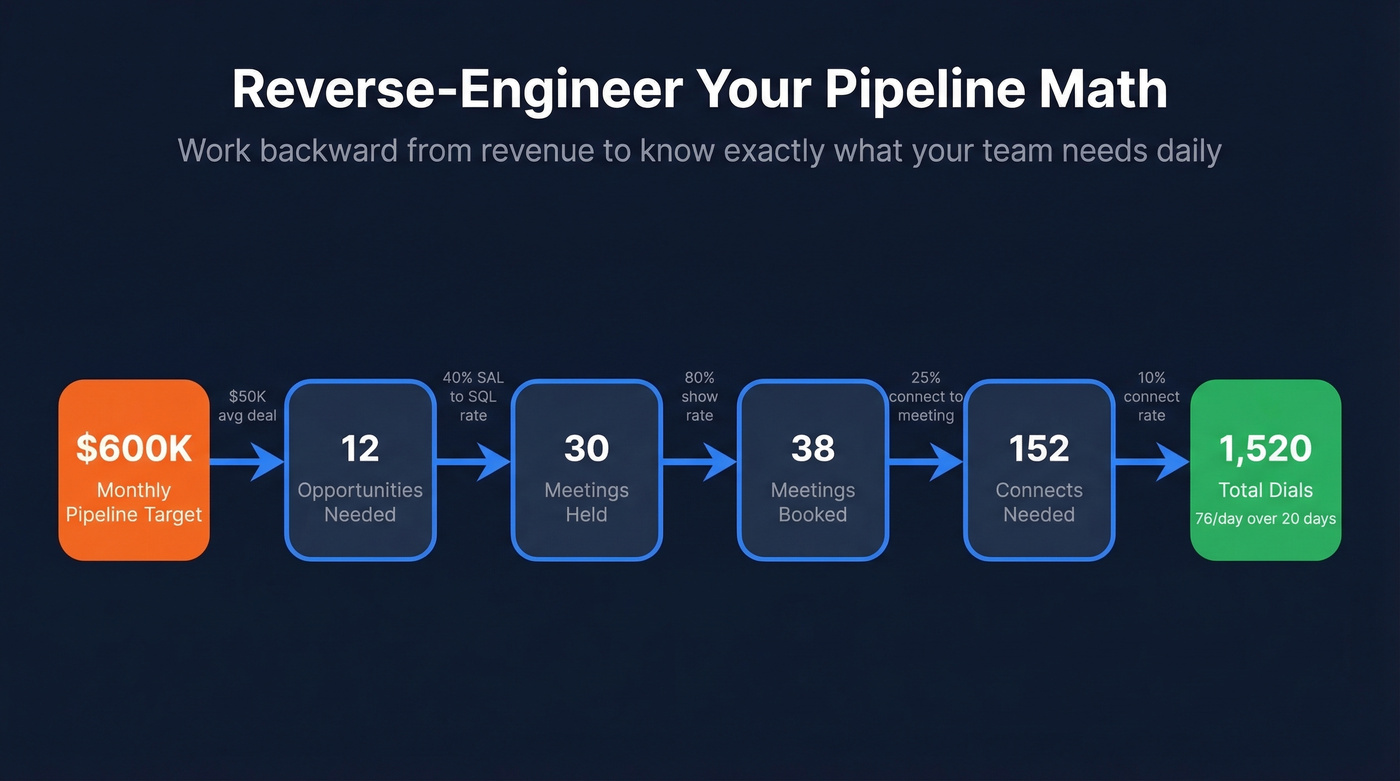
Say your average deal is $50K and you need $600K in monthly pipeline. That's 12 opportunities. At a 40% SAL-to-SQL rate, you need 30 meetings held. At an 80% show rate, that's 38 booked. At a 25% connect-to-meeting conversion, you need 152 connects. At a 10% connect rate, that's 1,520 dials - or about 76 per day across a 20-day month. Now you know whether your team is sized right or your expectations are delusional.
This exercise also reveals your pipeline per prospecting hour - the single most telling efficiency metric for outbound teams. If a rep spends 4 hours prospecting daily and generates $15K in pipeline per week, that's roughly $750 per prospecting hour. Compare that across reps and you'll quickly spot who's efficient versus who's just busy.
Setting Prospecting KPIs That Drive Pipeline
Most teams set goals around activity - dials made, emails sent, LinkedIn touches logged. That's backwards.
Start with the pipeline number your team owes the business, then decompose it into the activity inputs that feed it: connects needed, conversations required, and meetings held. Activity targets should be outputs of the math, not arbitrary mandates from a manager who read a blog post. When you frame prospecting KPIs this way, reps understand why each activity matters. A rep who sees that 50 quality dials feed 5 connects which feed 1.5 meetings which feed $75K in pipeline has a fundamentally different relationship with their daily workflow than a rep who's told "hit 80 dials or else."

You just calculated the dials, connects, and meetings your team needs. Now ask: what happens when 5%+ of those emails bounce? Domain damage tanks every metric downstream. Prospeo delivers 98% email accuracy with a 7-day refresh cycle, so your SDRs spend prospecting hours on real conversations - not cleaning lists.
Keep bounce rates under 2% and protect every metric on that dashboard.
2026 Benchmark Table
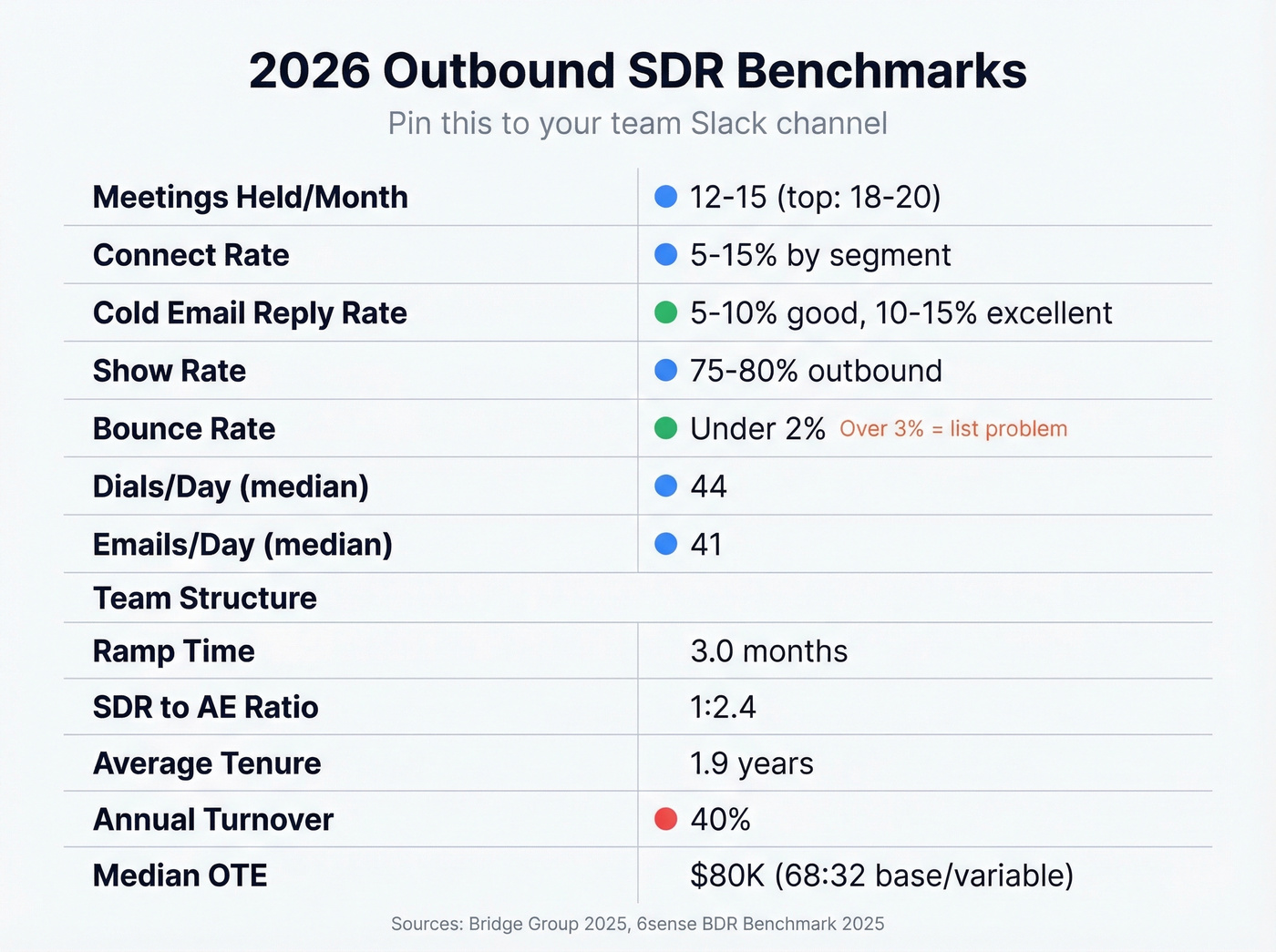
Pin this to your team's Slack channel. Based on the latest available data from Bridge Group and 6sense's 2025 BDR study.
| Metric | Benchmark |
|---|---|
| Meetings held/month | 12-15 (top performers: 18-20) |
| Connect rate | 5-15% by segment |
| Cold email reply rate | 5-10% good, 10-15% excellent |
| Show rate | 75-80% outbound |
| Bounce rate | <2% |
| Spam complaints | <0.3% |
| Dials/day | 44 (median) |
| Emails/day | 41 (median) |
| Quality conversations/day | 4.1 |
| Ramp time | 3.0 months |
| SDR:AE ratio | 1:2.4 |
| Average tenure | 1.9 years |
| Annual turnover | 40% |
| Median OTE | $80K (68:32 base/variable split) |
Metrics to Stop Tracking
Open rates are dead. Apple Mail Privacy Protection and bot pre-fetching mean you're measuring server behavior, not human interest. Click rates actively hurt you - links in cold emails tank deliverability. Total replies inflate your numbers with "not interested" and out-of-office responses; track positive replies only.
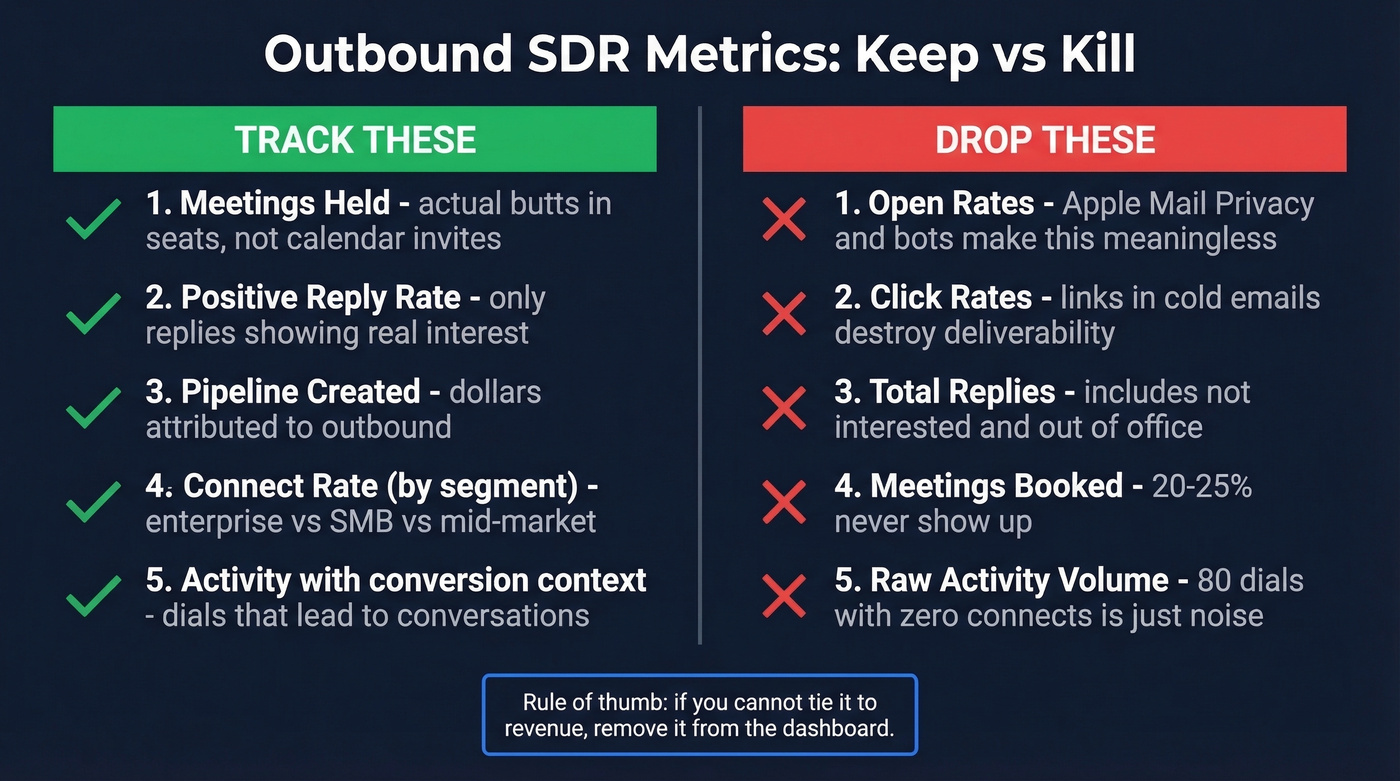
And raw activity volume without conversion context? Pure noise. 80 dials with zero connects is worse than 40 dials with 4 conversations.
The consensus on r/coldemail is blunt: if you can't tie a metric to revenue, drop it from the dashboard. Positive reply rate thresholds worth memorizing - 25%+ means messaging is working, below 15% means targeting, offer, or message-market fit is broken.
Pitfalls That Inflate Your Numbers
Three measurement traps we see constantly.
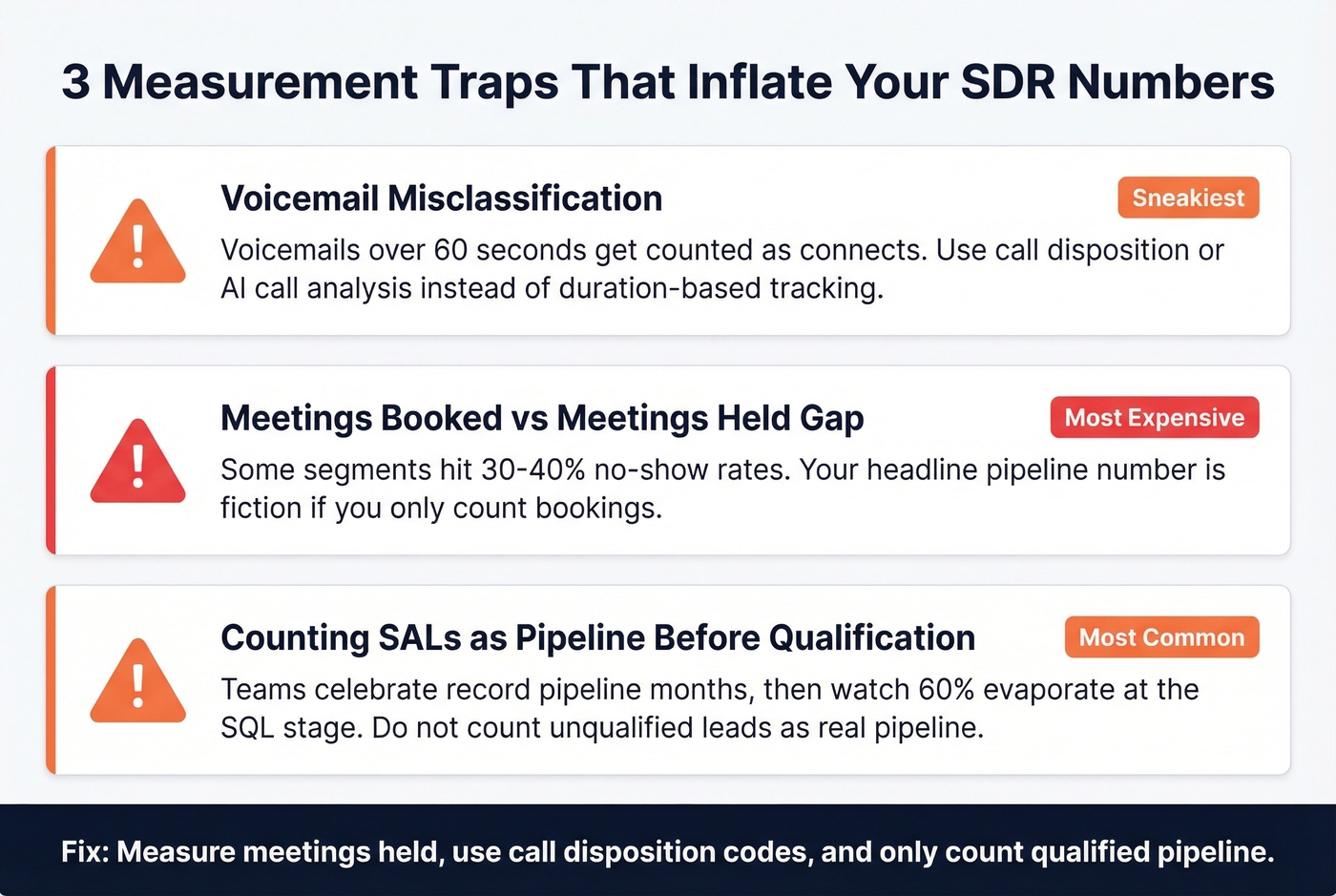
Voicemail misclassification is the sneakiest. If you define "meaningful conversation" by call duration, a voicemail plus a voicemail message can exceed 60 seconds and count as a connect. Use call disposition or LLM-based call analysis instead.
The "meetings booked" vs. "meetings held" gap is the most expensive. With some segments hitting 30-40% no-shows, your headline number is fiction.
Counting SALs as pipeline before qualification makes your CRO look good until the quarter closes. We've watched teams celebrate record pipeline months only to see 60% of it evaporate at the SQL stage. Don't be that team.
Data Quality: The Hidden Metric Multiplier
Every metric above gets poisoned by bad data. A 5% bounce rate doesn't just mean wasted sends - it actively damages your sending domain, which tanks reply rates, which tanks meetings, which tanks pipeline. It's a cascade, and it starts with the contact data you feed your reps.

Most teams treat data quality as a procurement problem. It's an operational metric. Prospeo's 98% email accuracy and 7-day data refresh cycle fix the upstream input so every downstream metric improves - the industry average refresh cycle is 6 weeks, which means most teams are prospecting with stale data for five out of every six weeks. Real results: Meritt dropped their bounce rate from 35% to under 4% after switching, connect rates tripled to 20-25%, and pipeline went from $100K to $300K per week.
If your bounce rate is above 3%, your SDR performance problem is a data problem. (If you need a deeper breakdown, start with email deliverability and email bounce rate.)
Connect rates are the metric most teams get wrong - and bad phone data makes it worse. Prospeo gives your reps 125M+ verified mobile numbers with a 30% pickup rate, so those 44 daily dials actually reach decision-makers instead of dead lines. At $0.01 per email and 10 credits per mobile, scaling outbound doesn't require a ZoomInfo budget.
Turn dial volume into real conversations at 90% less cost.
AI's Impact on SDR Performance
60% of BDRs now use AI tools, and sellers using AI effectively are 3.7x more likely to hit quota. 84% of allbound teams run a sales engagement platform, and 82% use contact data or account intelligence tools. AI-assisted personalization and call analysis are changing how fast reps get productive - and the gap between teams that adopt and teams that don't is widening every quarter.
Let's be honest: the teams still running manual list-building and generic sequences in 2026 aren't just slower. They're structurally disadvantaged. AI doesn't replace the SDR - it compresses ramp time and amplifies the reps who already have good instincts.
FAQ
How many meetings should an outbound SDR book per month?
The median is 12-15 qualified meetings held per month, with top performers hitting 18-20. Enterprise reps targeting $200K+ deals may book 8-10 high-quality meetings and still outperform on pipeline value. Always measure meetings held - outbound show rates land around 75-80%, so booked numbers overstate reality by 20-25%.
What's a good cold call connect rate in 2026?
Enterprise B2B tech runs 5-7%, mid-market 8-12%, and SMB 12-15%. If you're below these ranges, check data quality first - outdated phone numbers are the most common cause of low connect rates. Verified mobile data with strong pickup rates is the fastest fix.
How long should an outbound cadence be?
The 2026 benchmark shows BDRs average 21 attempts per contact across a 53-day cadence, up from 17 the prior year. Bridge Group puts 9-12 attempts as the sweet spot for many segments. A first follow-up alone adds 40-50% more replies, so front-load your sequence accordingly.
What are the most important outbound SDR metrics?
Three metrics give you 80% of the picture: meetings held, positive reply rate, and pipeline created. Everything else - dials, emails sent, connect rate - is diagnostic. Track those to fix problems, but report the big three to leadership. For a single efficiency number, pipeline per prospecting hour captures both volume and quality in one ratio.