

Outreach AI Agents: What Works in 2026 (And What Doesn't)
An SDR team I know flipped on their shiny new outreach AI agent on a Monday. By Wednesday, they'd sent 500 emails, hit a 12% bounce rate, and their primary domain was flagged. The AI wrote perfect messages - personalized, well-timed, contextually relevant - to email addresses that didn't exist. That's the gap nobody talks about when vendors pitch you "autonomous pipeline generation."
AI outreach agents are real, improving fast, and some genuinely work. But the difference between a tool that books meetings and one that torches your sender reputation comes down to decisions you make before you turn anything on.
What You Need (Quick Version)
Three paths, depending on budget and team size:
- Enterprise with budget (50+ reps): Outreach.io AI Agents. Full platform, ISO 42001 governance, deep CRM integration. Expect $15k-$60k/year.
- Mid-market, transparent pricing: Reply.io + Jason AI SDR. Multichannel from $89/user/mo, clear feature tiers, solid deliverability tooling.
The one thing every setup needs: verified contact data before you turn anything on. An agent sending to a dirty list isn't automation - it's domain suicide.
What Is an Outreach AI Agent?
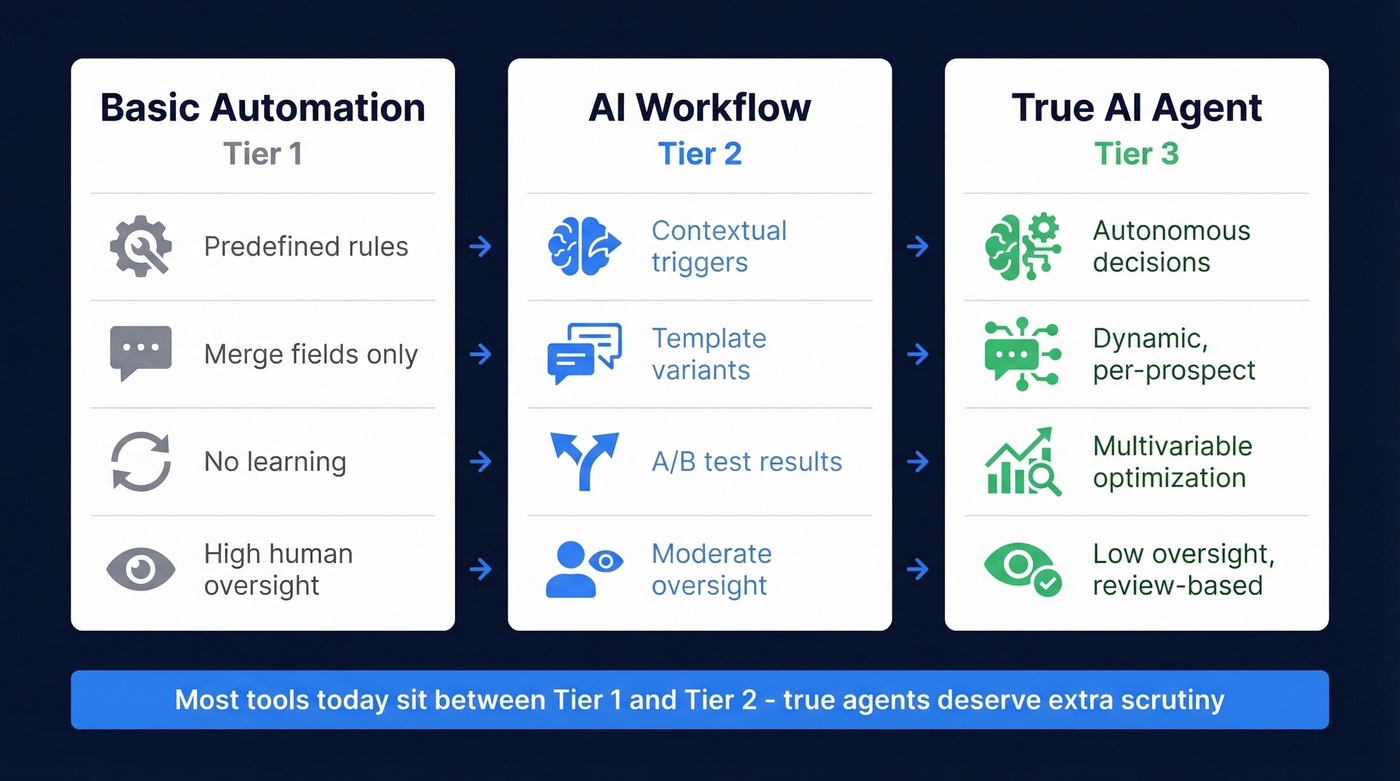
"AI agent" gets thrown around loosely enough that it's almost meaningless. There are three distinct tiers of outreach automation, and most tools marketed as "agents" sit in tier one or two.
| Capability | Basic Automation | AI Workflow | AI Agent |
|---|---|---|---|
| Decision-making | Predefined rules | Contextual triggers | Autonomous |
| Personalization | Merge fields | Template variants | Dynamic, per-prospect |
| Learning | None | A/B test results | Multivariable optimization |
| Human oversight | High | Moderate | Low (review-based) |
Basic automation is your classic sequence tool - if/then logic, merge fields, fixed cadences. AI workflows add intelligence: they pick template variants based on engagement signals, adjust send times, and score leads. True AI agents go further. They research prospects independently, compose original messages, decide which channel to use, adjust timing and tone based on cohort performance, and manage follow-ups without a human touching the sequence. The most advanced agents run multivariable optimization across timing, length, tone, and channel simultaneously.
Most tools on the market today sit between tier one and tier two. The ones claiming full autonomy deserve extra scrutiny.
Core Agent Capabilities
When an outreach AI agent works properly, it handles six things:
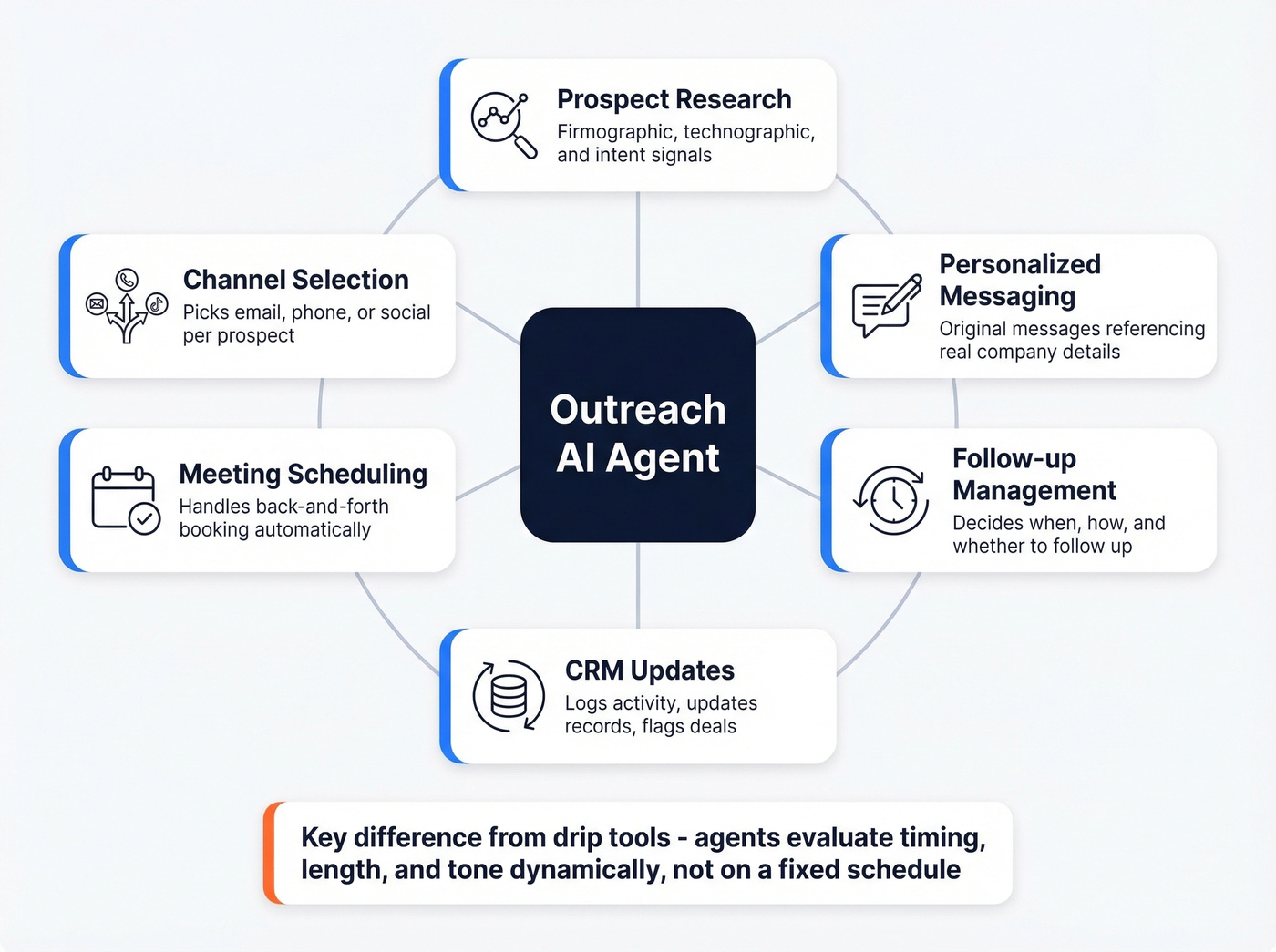
- Prospect research - pulling firmographic, technographic, and intent signals to build context before composing a message
- Personalized messaging - writing first touches that reference specific company details, not just {first_name} merge fields
- Follow-up management - deciding when, how, and whether to follow up based on engagement signals
- CRM updates - logging activity, updating contact records, and flagging deal progression
- Meeting scheduling - handling the back-and-forth of booking calls once a prospect shows interest
- Channel selection - evaluating whether email, phone, or social is the right first touch for a given prospect
Here's where a capable AI prospecting assistant separates itself from a basic drip tool: agents evaluate timing, length, and tone dynamically. A sequence sends email #3 on day 7 regardless of context. An agent might skip email #3 entirely because the prospect opened email #2 three times and visited the pricing page - and instead trigger a phone task for the rep.
Tools Worth Evaluating
Outreach.io AI Agents
Use this if you're running a 50+ rep org that needs governance, CRM depth, and enterprise-scale compliance. Outreach's agent lineup - Revenue Agent, Research Agent, Deal Agent, and Personalization Agent - covers far more than top-of-funnel prospecting. The ISO 42001 certification is a differentiator for teams with AI governance requirements.

Outreach reports a 44% reduction in forecast prep time, 10x seller productivity improvements, and 15% more pipeline coverage. Those are vendor-reported numbers, so calibrate accordingly - but the platform's depth is undeniable. If you're already in the Outreach ecosystem, the AI layer is a natural extension.
Skip this if you're a team of five trying to get outbound off the ground. Pricing isn't public. Expect $15k-$60k/year depending on seats and modules.
Reply.io + Jason AI SDR
This is the platform we'd point most teams toward if they want AI-powered outreach without the enterprise price tag or the opacity. The multichannel plan starts at $89/user/mo billed annually, with the Jason AI SDR agent available from $500/mo. LinkedIn automation runs $69/mo per account as an add-on.
The deliverability stack is strong: Google Postmaster integration, Gmail API sending, plain text mode, free warm-ups, and a built-in email health checker. With a 4.6/5 on G2 across 1,480 reviews, it's the most battle-tested mid-market option. For teams that want clear pricing and a multichannel agent that actually works across email, phone, and social, Reply.io is hard to beat.
Skip this if you need deep CRM workflow automation on par with Outreach.io's enterprise suite, or if your team is large enough that per-seat pricing becomes prohibitive.
Prospeo - The Data Layer
Every agent in this list needs verified contact data to function. Prospeo is the layer that provides it - 300M+ professional profiles, 143M+ verified emails, and 125M+ verified mobile numbers, all refreshed on a 7-day cycle. At roughly $0.01 per email with a free tier of 75 emails/month, it's accessible at any budget.
Beyond email, Prospeo provides intent data tracking 15,000 topics - signals that help agents prioritize who to contact, not just how to reach them. Native integrations with Instantly, Smartlead, Lemlist, HubSpot, Salesforce, Clay, Zapier, and Make mean verified data flows directly into whatever sending tool you're using. Stack Optimize built to $1M ARR using Prospeo as their data backbone, maintaining 94%+ deliverability and zero domain flags across all clients.
Apollo.io
Apollo is the fastest zero-to-sending path in outbound. Its 275M-contact database with a generous free tier means you can go from nothing to live sequences in an afternoon. Paid plans run around $49-$99/user/mo.
The trade-off is accuracy. Apollo's all-in-one approach means the database, sequencing, and enrichment are all decent - but none are best-in-class. We've seen teams use Apollo for prospecting and layer a dedicated verification tool on top for the emails that actually matter. If your average deal size is modest and speed matters more than precision, Apollo is a reasonable starting point.
Instantly
Picture this: you've got 5,000 verified contacts, five warmed domains, and a message sequence that's been tested manually. You need a sending engine that won't trip spam filters at scale. That's Instantly's sweet spot. Multi-domain rotation and deliverability-first architecture make it the best pure sending infrastructure for cold email, with plans starting around $30/mo.
Instantly is a sending engine, not a data provider. Pair it with a verified data source for the best results.
Other Agents to Know
dealcode AI operates as a fully autonomous sales agent with a free tier available. Worth testing if you want hands-off prospecting, though the platform is still maturing.
Reachy.ai is LinkedIn-focused. Free plan covers one account and 50 contacts; the Sales Agent add-on runs $49/month. Niche, but useful for teams where LinkedIn is the primary channel.
Artisan (Ava) positions itself as a full AI SDR replacement. Custom pricing, typically $2k-$5k/mo. The "fully autonomous" pitch is ambitious - test extensively before committing.
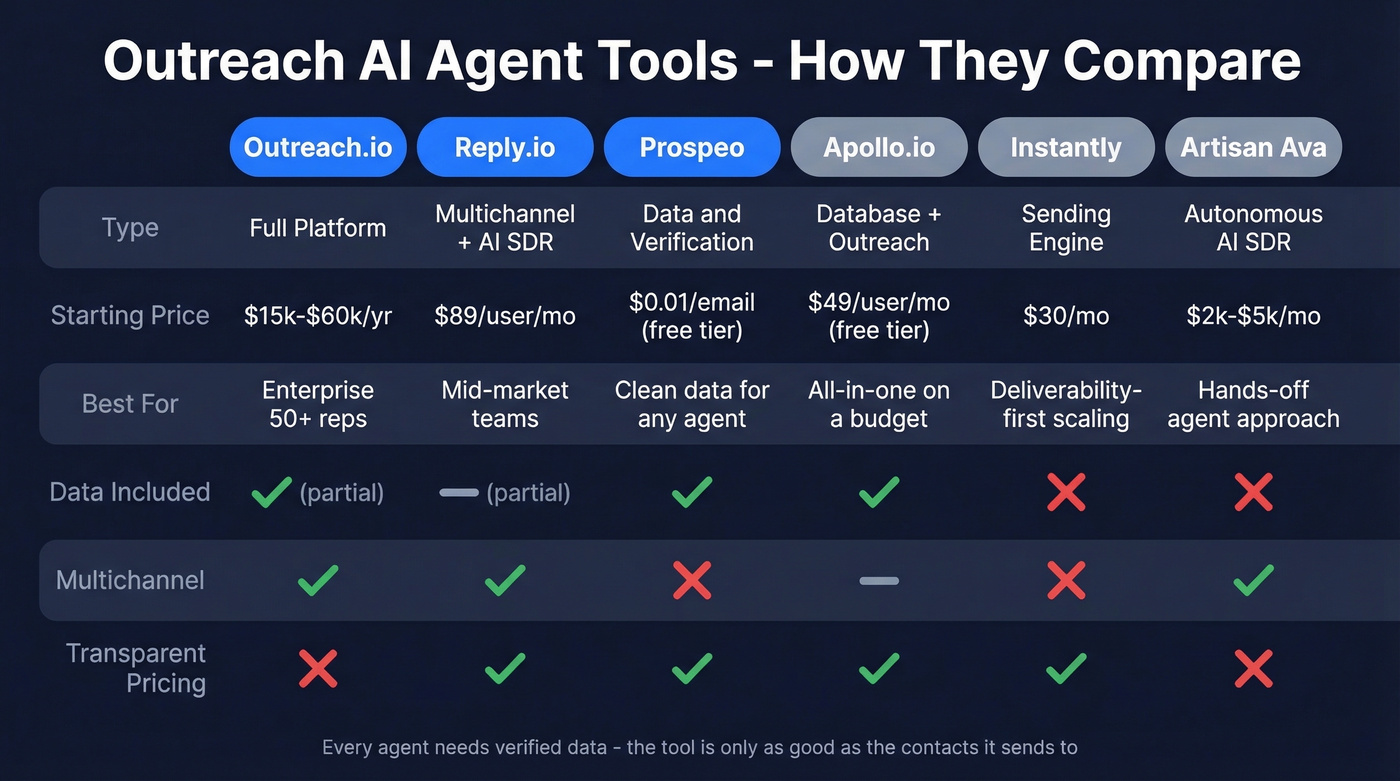
Comparison Table
| Tool | Type | Starting Price | Best For |
|---|---|---|---|
| Outreach.io | Full platform | ~$15k-$60k/yr | Enterprise (50+ reps) |
| Reply.io | Multichannel + AI SDR | $89/user/mo | Mid-market, transparent pricing |
| Prospeo | Data / verification | $0.01/email (free tier) | Clean data for any agent |
| Apollo.io | Database + outreach | ~$49/user/mo (free tier) | All-in-one on a budget |
| Instantly | Sending infrastructure | ~$30/mo | Deliverability-first scaling |
| Artisan (Ava) | Autonomous AI SDR | ~$2k-$5k/mo | Hands-off agent approach |

That 12% bounce rate from the intro? It happens when AI agents send to unverified data. Prospeo's 5-step verification delivers 98% email accuracy on 143M+ emails - refreshed every 7 days, not every 6 weeks. Native integrations with Instantly, Smartlead, and Lemlist mean verified contacts flow straight into your agent's sequences.
Fix the data before you flip the agent on.
Real Performance Benchmarks
A Snov.io case study ran 3,000 personalized emails through their AI agent and tracked results on a 200-email subset: 61% open rate, 3.2-7.1% reply rate depending on ICP segment, 2.5% positive replies, and a 0.5% bounce rate. Each campaign saved roughly four hours of manual work.
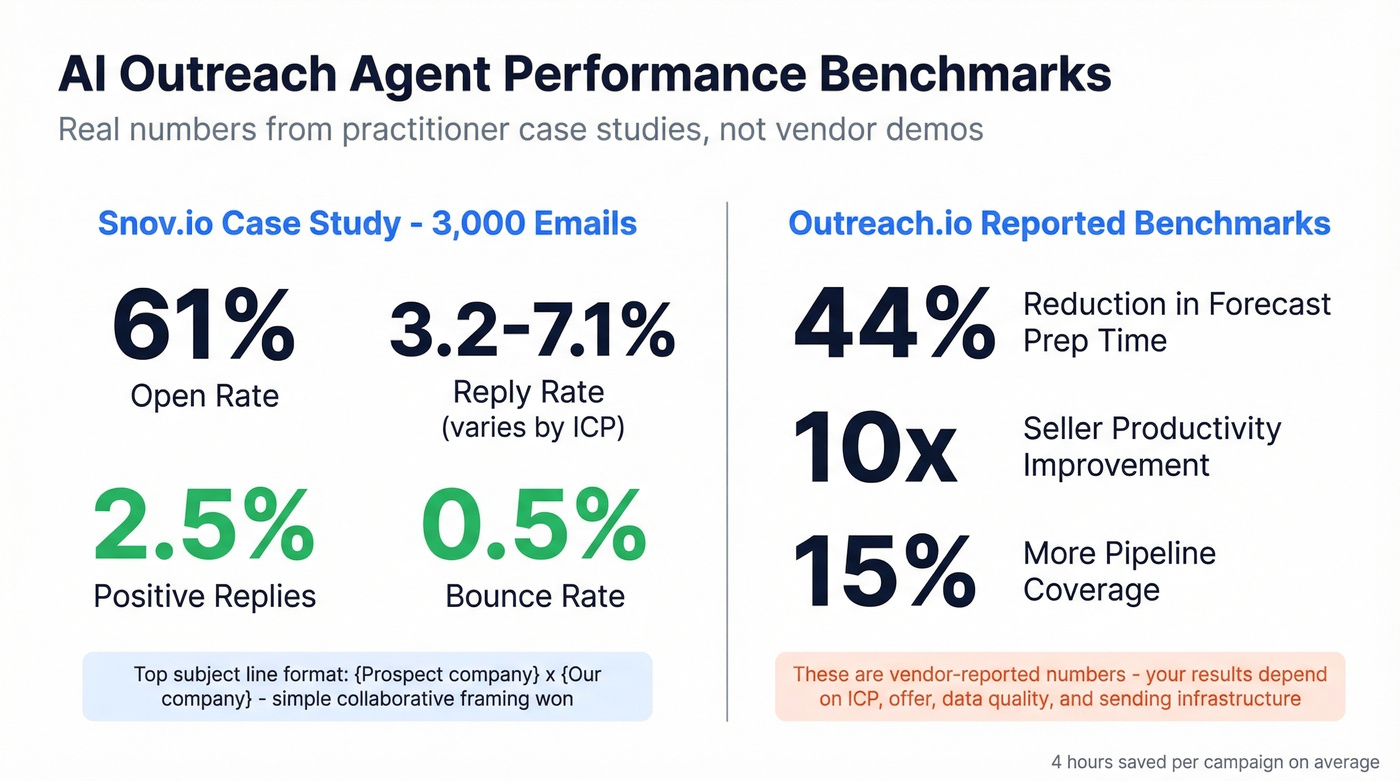
The best-performing subject line format? {Prospect company} x {Our company}. Simple, collaborative framing outperformed clever hooks.
Compare that to Outreach.io's benchmarks: 44% reduction in forecast prep time and 15% more pipeline coverage. These are useful directional signals, not guarantees. Your numbers will depend on your Ideal Customer Profile, your offer, your data quality, and how well you've warmed your sending infrastructure.
Data Quality Kills Agents
The AI agent isn't the hard part. The data is.
B2B contact data decays fast - people change jobs, companies restructure, email servers get reconfigured. An agent sending to a list with a high bounce rate doesn't just waste credits. It triggers throttling and blacklisting risk. And once your sender reputation is damaged, you're spending weeks rebuilding it instead of booking meetings.

I've watched this play out repeatedly: a VP of Sales gets excited about a vendor demo showing 47 meetings booked in a month. They ask about bounce rate and spam complaint rate. Crickets. The demo numbers came from a curated list, not from the messy reality of a 50,000-contact database that hasn't been cleaned in six months. Meritt's bounce rate dropped from 35% to under 4% after switching their data layer - that's the difference between an agent that books meetings and one that destroys your domain. The consensus on r/sales is the same: data quality is the bottleneck, not the agent itself.
Deliverability Rules for 2026
No matter which outreach AI agent you choose, these rules are non-negotiable.
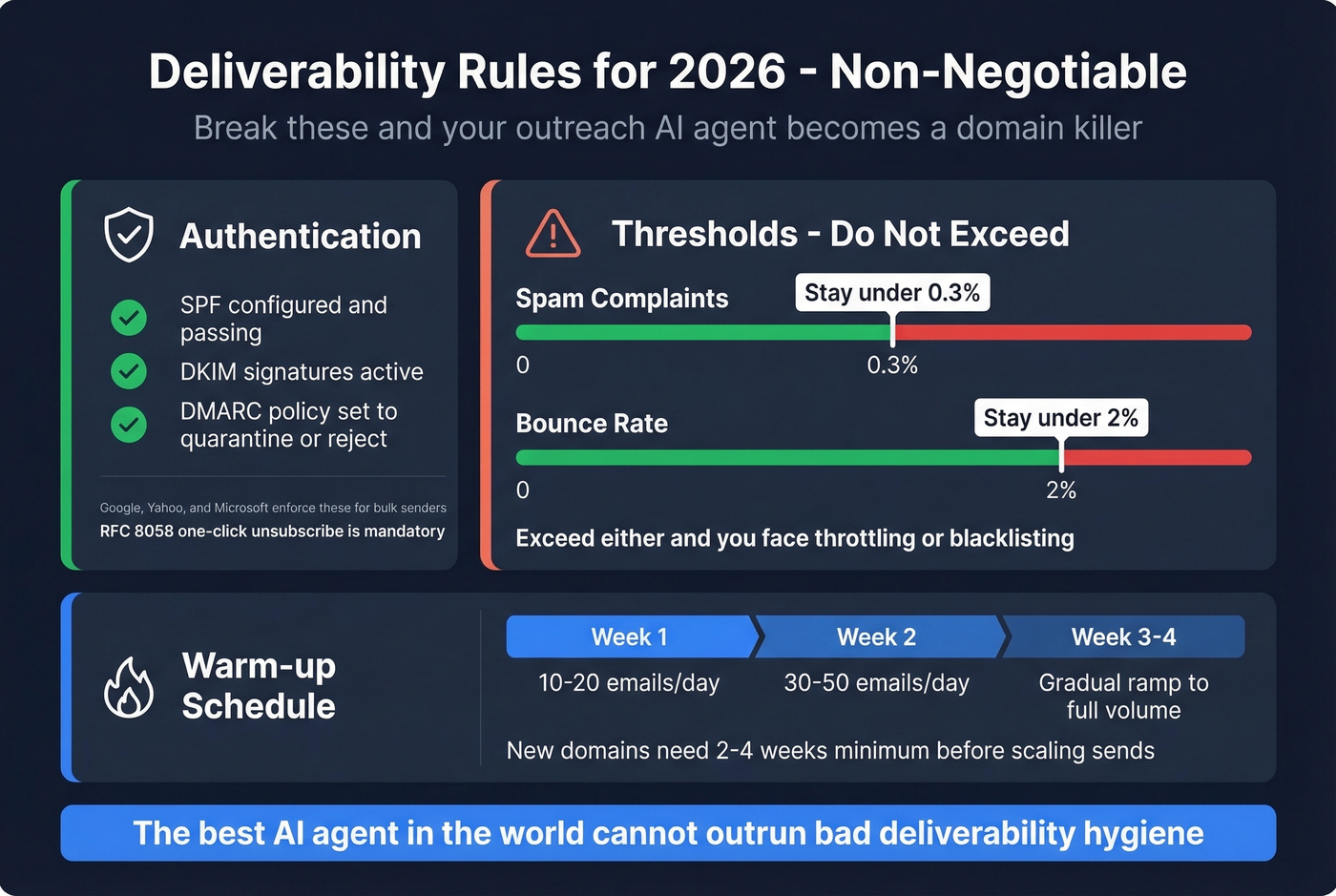
Authentication: SPF, DKIM, and DMARC must be configured before you send a single cold email. Google, Yahoo, and Microsoft enforce these for bulk senders, and RFC 8058 one-click unsubscribe is mandatory.
Thresholds: Keep spam complaints under 0.3% and bounces under 2%. Exceed either and you're looking at throttling or blacklisting.
Warm-up schedule: New domains need 4-6 weeks of gradual ramp-up. If you need a step-by-step, follow a proven Gmail warm-up plan.
| Week | Daily Volume |
|---|---|
| Week 1 | 5-10 emails |
| Week 2 | 20-40 emails |
| Week 3 | 40-60 emails |
| Week 4 | 60-80 emails |
Safe sending limits vary by provider:
| Provider | Daily Cold Email Limit |
|---|---|
| Google Workspace | 100-150 |
| Microsoft 365 | 100-150 |
| GoDaddy | 50-75 |
| Free Gmail | Don't. |
Scaling safely means going multi-domain: five domains sending 100 emails/day each gives you 500/day without tripping any single provider's limits. Start with 100-200 test accounts, monitor bounce rates and reply quality daily for two weeks, then scale. Run your list through real-time verification before your agent sends a single email - a 2% bounce rate is the ceiling, and you want to be well under it. If you’re troubleshooting, start with a quick email reputation check and a domain reputation audit.
Hype vs. Reality
Let's be honest about the economics. A fully loaded human SDR costs $75k-$100k/year. An AI SDR platform runs $500-$2,000/month. The math looks obvious - until you realize 50-70% of AI SDR tools churn customers within a year. 11x.ai lost 70-80% of its customer base within months of launch. The broader "agent washing" critique explains why: the fully autonomous AI SDR doesn't exist yet.
What exists is AI handling roughly 80% of prospecting grunt work so reps can focus on the 20% that requires a human brain: nuanced replies, objection handling, relationship building.
Every vendor claims "10x productivity." The fine print assumes clean data, a warmed domain, a well-defined ICP, and 40-60 hours of setup work before launch. The ROI timeline is 3-6 months with clean data, 6-9 months if you're building from scratch.
That doesn't mean these tools aren't worth it. They are - when you set expectations correctly. The teams that succeed treat AI agents as force multipliers for good reps, not replacements for a broken process. If your ICP is undefined, your data is stale, and your messaging hasn't been tested manually, an agent will just automate your failures faster. If you want a broader view of what to buy (and skip), start with the best AI sales tools breakdown.
For technical teams considering building their own agent with LangChain or Make.com: it's possible, but budget 3-6 months of engineering time and expect to rebuild the deliverability and compliance guardrails that platforms like Reply.io and Outreach.io have already solved.
An outreach AI agent choosing the right channel means nothing if the email bounces or the phone number is dead. Prospeo gives your agents 300M+ profiles, 125M+ verified mobiles with a 30% pickup rate, and intent data across 15,000 topics - so your agent reaches real buyers who are actually in-market. All at $0.01 per email.
Stack Optimize built to $1M ARR with zero domain flags using this data.
FAQ
Can an AI agent fully replace an SDR?
Not yet. AI handles research, first touches, and follow-ups - roughly 80% of repetitive work - but humans still outperform on nuanced replies and relationship building. The best setups use agents for volume and reps for conversion. Expect hybrid models to dominate through at least 2027.
How much does an outreach AI agent cost?
Reply.io starts at $89/user/mo for multichannel; Outreach.io runs $15k-$60k/year for enterprise. Bootstrapped teams can pair Prospeo ($0.01/email, free tier) with Instantly (~$30/mo) for a complete stack under $200/month.
What's the biggest risk?
Sending to unverified email addresses. A bounce rate above 2% triggers spam filters and can blacklist your domain within days. Always run your list through a dedicated verification layer before any agent sends a single message.
How long until I see ROI?
With verified data and a defined ICP, expect measurable pipeline impact in 3-6 months. Building from scratch with no existing outbound motion: 6-9 months. Budget 40-60 hours of data prep and domain warm-up before launch.
Do I need separate verification if my agent has a built-in database?
Yes. Built-in databases decay fast - the industry average refresh cycle is six weeks. A dedicated verification layer with weekly refreshes catches invalid addresses before they damage your sender reputation, regardless of how sophisticated your agent is.