

Outreach CRM: What It Actually Means and How to Choose in 2026
Your SDR manager just told the team it needs "an outreach CRM." The problem? That phrase means three completely different things depending on who's saying it. One person means Outreach.io - the enterprise sales engagement platform. Another means a CRM with built-in email sequences and calling. And the third just wants their outreach tools to actually sync with their CRM without creating 4,000 duplicate records.
Let's untangle this. The CRM market is projected to hit $262.74B by 2032, and 91% of companies with 11+ employees already run CRM software. But the line between CRM and outreach tool keeps disappearing. Some CRMs now ship with sequencing. Some outreach platforms are bolting on deal pipelines. And some teams are duct-taping five tools together when two would do.
Most teams need three decisions, not one: a CRM, an outreach layer, and a data source. The trick is knowing which combination fits your team size, budget, and existing stack.
Quick Picks
If you don't want to read 2,000 words, here's the short version:
- Best CRM with built-in outreach: Close - $9-$139/seat/mo on annual billing (monthly is $19-$149), email + calling + SMS on every plan
- Best enterprise sales engagement platform: Outreach.io - $100+/user/mo, annual contracts, deep CRM integration for Salesforce-heavy teams
The 4 Types of Outreach CRM
The confusion around this category exists because it's splintered into four distinct tool types. Understanding which one you actually need saves you months of trial-and-error.
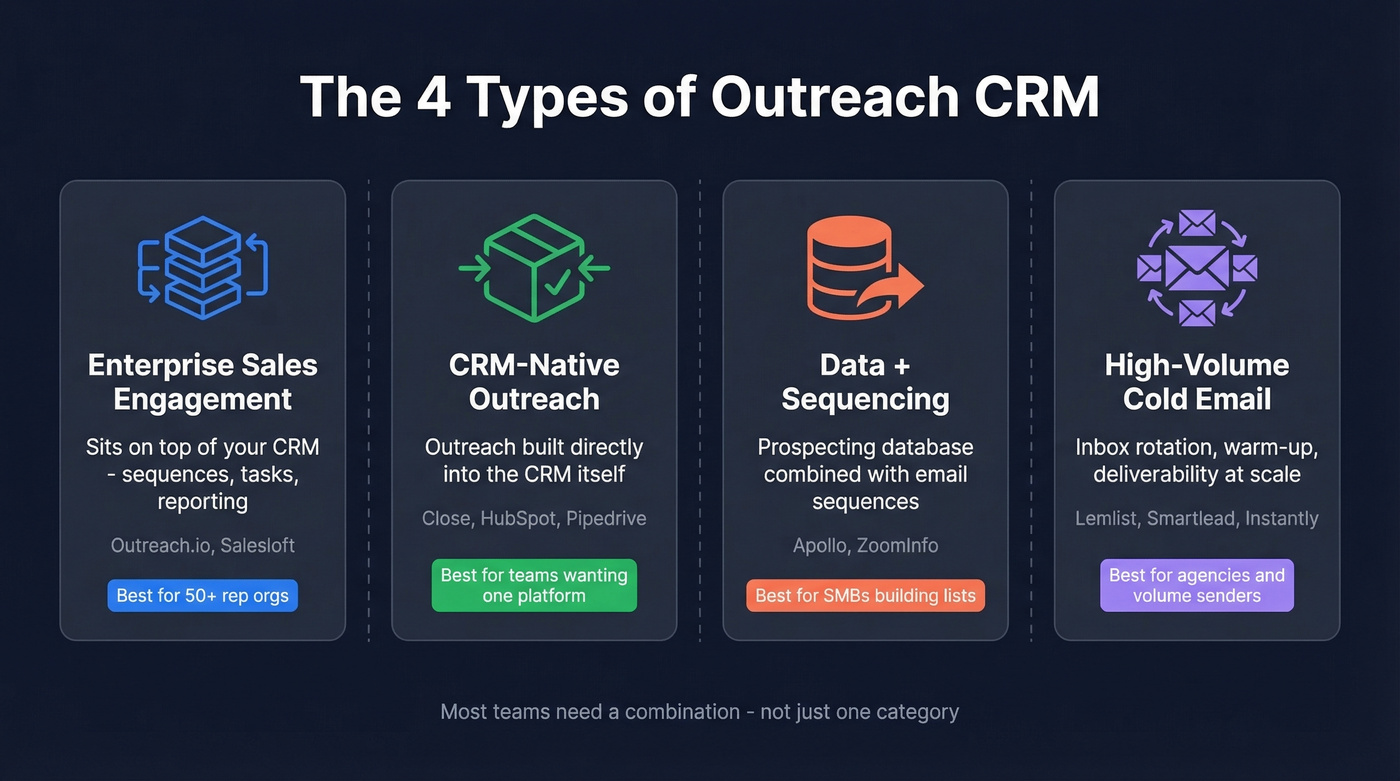
| Category | What It Does | Examples | Best For |
|---|---|---|---|
| Enterprise Sales Engagement | Multichannel sequences + deep CRM sync | Outreach.io, Salesloft | 50+ rep orgs on Salesforce |
| CRM-Native Outreach | Outreach built into the CRM | Close, HubSpot, Pipedrive | Teams wanting one platform |
| Data + Sequencing | Prospecting database + sequences | Apollo, [ZoomInfo](https://www.destinationcrm.com/BuyersGuide/ZoomInfo-B2B-Database-%7C-Company-Contacts - Intelligence-6429.aspx) | Teams building lists + sending |
| High-Volume Cold Email | Inbox rotation, warm-up, scale | Lemlist, Smartlead, Instantly | Agencies, high-volume outbound |
Enterprise sales engagement platforms like Outreach.io and Salesloft don't replace your CRM - they sit on top of it. They standardize how reps execute sequences, manage tasks, and report on activity. The tradeoff is complexity and cost. These tools are typically deployed alongside Salesforce or HubSpot, with tight syncing between systems.
CRM-native outreach tools collapse the stack. Close is the clearest example: email, calling, and SMS are built into every plan. You don't need a separate sequencing tool because the CRM is the sequencing tool. The tradeoff is that these tend to max out around 25-50 reps before you hit scaling limits.
Data + sequencing hybrids like Apollo combine a contact database with built-in email sequences. They're popular with SMBs because you get prospecting and outreach in one place. The risk is data accuracy - when the same vendor owns the database and the sequencer, there's less incentive to flag bad contacts.
High-volume cold email tools are purpose-built for sending at scale. Inbox rotation, domain warm-up, deliverability monitoring - and increasingly, dedicated sending infrastructure with domain diversification has become its own micro-category. If you're an agency running campaigns for multiple clients, this is your lane.

Every outreach CRM on this list has the same weakness: garbage in, garbage out. Prospeo feeds your CRM 98% verified emails and 125M+ direct dials - refreshed every 7 days, not every 6 weeks. Native integrations with Salesforce, HubSpot, Smartlead, Instantly, and Lemlist mean your data flows clean into whatever stack you choose.
Fix the data layer and your entire outreach stack performs.
Best Options Compared
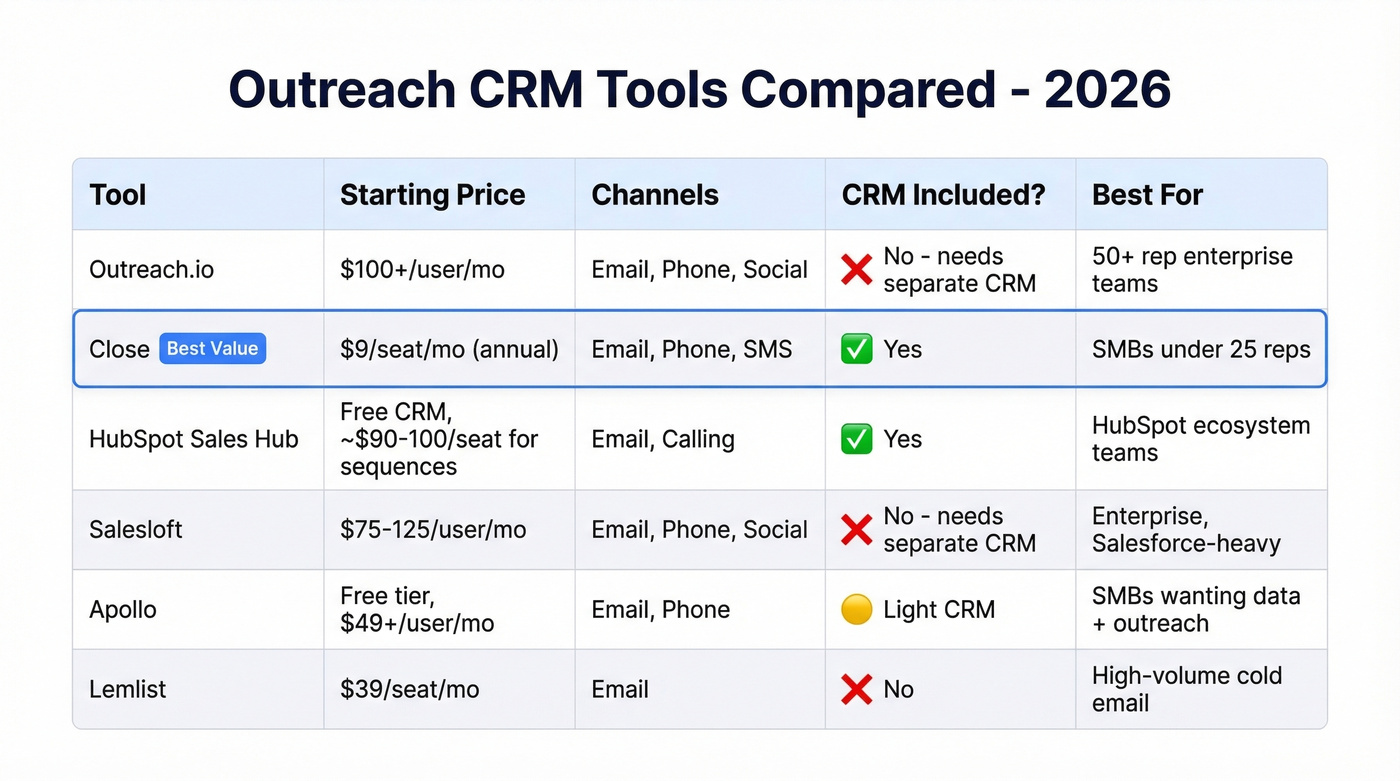
| Tool | Starting Price | Channels | CRM Included? | Best For |
|---|---|---|---|---|
| Outreach.io | ~$100/user/mo | Email, phone, social | No (needs CRM) | 50+ rep enterprise teams |
| Close | $9/seat/mo (annual) | Email, phone, SMS | Yes | SMBs under 25 reps |
| HubSpot Sales Hub | Free CRM; paid sequencing ~$90-$100/seat/mo | Email, calling | Yes | HubSpot ecosystem teams |
| Salesloft | ~$75-$125/user/mo | Email, phone, social | No (needs CRM) | Enterprise, Salesforce-heavy |
| Apollo | Free tier; paid from ~$49/user/mo | Email, phone | Light CRM | SMBs wanting data + outreach |
| Lemlist | $39/seat/mo | No | High-volume cold email |
Outreach.io
Use this if: You have 50+ reps on Salesforce, a dedicated RevOps team to manage implementation, and the budget for a $70K+ annual commitment. Outreach's workflow automation and reporting depth are genuinely best-in-class for enterprise sales orgs.
Skip this if: You're under 25 reps, don't have a full-time admin, or need to see pricing before talking to sales. The fact that Outreach doesn't publish pricing tells you everything about who this product is built for.

Standard plans start at roughly $100/user/month with annual contracts required. That's the floor. Onboarding fees run $1,000-$8,000 depending on complexity. Per Vendr's procurement data, a 50-user Engage contract typically lists at $72,000/year, though negotiated prices land between $65,000-$85,000. For larger deployments, a 200-user, 3-year Engage contract lists at $864,000 but typically closes between $386,000-$787,000 - that's a massive negotiation window, and you should use it. Renewal discounts of 15-35% are common if you push.
On G2, Outreach holds a 4.3/5 across 3,535 reviews. The top praise is automation and task management. The top complaint? Steep learning curve. G2's average time to implement is 1 month.
Close
Close is the CRM we'd recommend to any team under 25 reps that doesn't want to manage three separate tools. Every feature and price is published on their pricing page - no "talk to sales" gates, no surprise add-ons.
Four plans cover every team size: Solo at $9/seat/mo (annual), Essentials at $35, Growth at $99, and Scale at $139. Every plan includes built-in email, calling, and SMS - you don't hit a paywall to unlock channels. The Solo plan caps at 10K leads and one user, but Essentials and above remove those limits.
Here's the thing: Close at $35/seat/mo gives you more outreach functionality than HubSpot at $100/seat/mo. The tradeoff is ecosystem breadth - HubSpot connects to marketing, service, and CMS. Close stays focused on sales execution. If all you need is to prospect, call, email, and close deals, Close wins on value by a wide margin.

HubSpot Sales Hub
HubSpot's free CRM is genuinely useful for early-stage teams, but sequencing is a paid feature in Sales Hub tiers that typically start around $90-$100 per seat/month. That's where you get sequences, which are solid but not as flexible as dedicated tools like Outreach.io or Salesloft.
If your marketing team already runs HubSpot, adding Sales Hub keeps everything in one database - and that unified data model is worth real money in reduced sync headaches. Just don't buy a paid tier solely for sequences if you aren't using the rest of the ecosystem.
SalesLoft
Salesloft is the enterprise alternative to Outreach.io. Custom pricing typically lands in the $75-$125/user/mo range for mid-market teams, though enterprise deals go higher.
The platform covers email, phone, and social sequences with strong Salesforce integration. Users consistently praise its cleaner UI and faster onboarding compared to Outreach.io. Where Outreach still wins: deeper analytics and a larger integration ecosystem. For teams evaluating both, it often comes down to which vendor's sales team gives you a better deal - and at this price point, you should absolutely negotiate.
Apollo
Apollo is the obvious starting point for SMB teams that want data and sequencing in one tool. Paid plans start at $49/user/mo. The database covers a large B2B contact set, and the built-in sequencer handles email and phone tasks.
The catch: we've run bake-offs where Apollo's email accuracy fell noticeably below dedicated verification tools. It's a great all-in-one, but if deliverability matters to your team, pair it with a verification layer. Good enough data at scale still means thousands of bounced emails per month.
Others Worth Knowing
Pipedrive starts around $15-$25/seat/mo, with sequencing on higher tiers - a solid CRM that's lighter on outreach features. Lemlist at $39/seat/mo is purpose-built for high-volume cold email with built-in warm-up and deliverability tools. Folk ($20/member/mo) and Attio (free up to 3 seats, $29/seat on Plus) are the modern lightweight CRMs that Reddit keeps recommending for teams that find HubSpot bloated. Revenue.io is worth a look if you're a Salesforce-native team wanting conversation intelligence baked into your dialer - custom-priced, with mid-market deployments often landing around $50-$100/user/mo depending on modules.
Why Your Setup Needs Clean Data
Here's a pattern we see constantly: a team spends $70K on Outreach.io, builds beautiful multichannel sequences, launches - and campaign performance falls apart because the contact data was garbage before the first email ever sent.
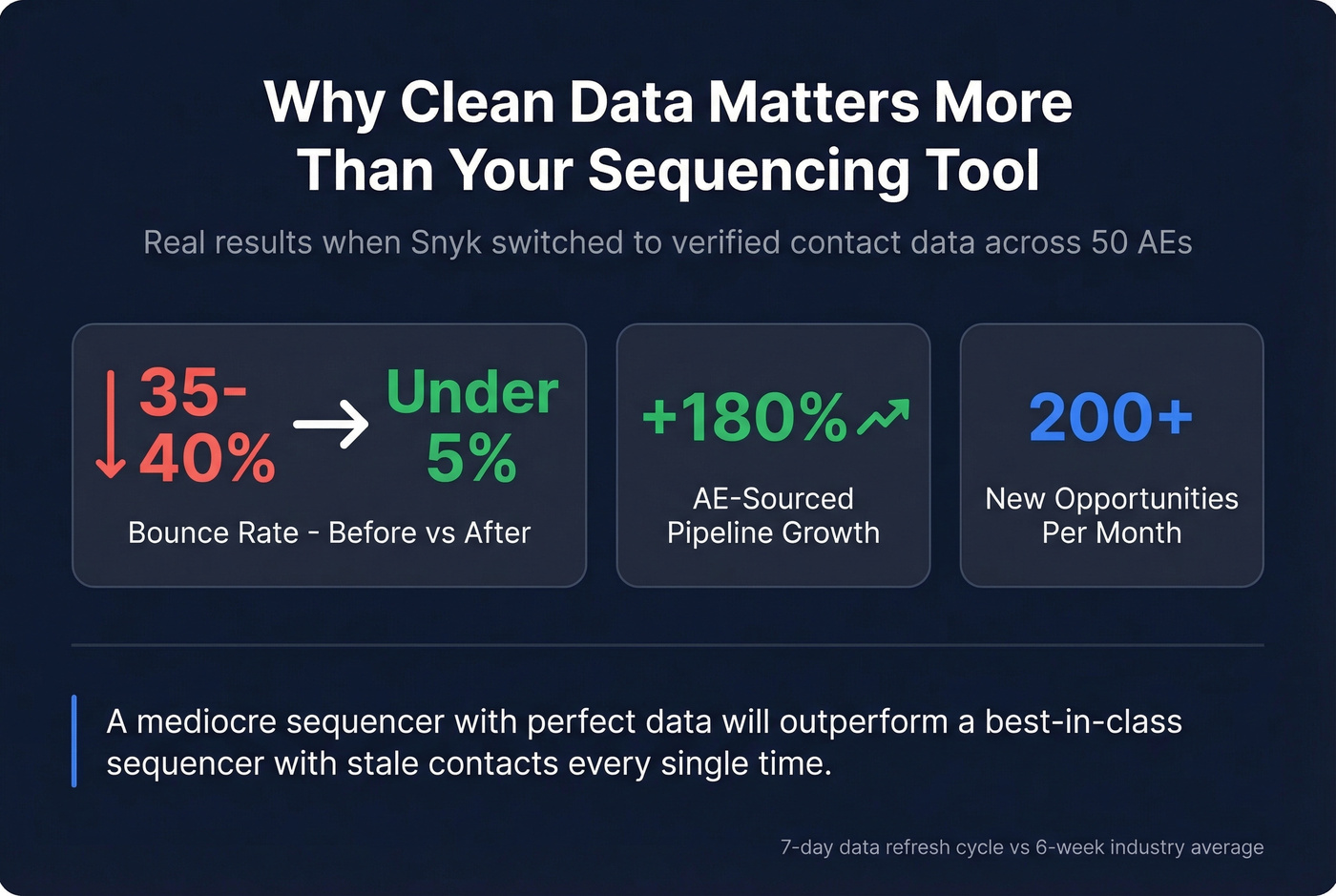
If your average deal size is above $5K and you're running outbound, the data layer matters more than the sequencing tool. A mediocre sequencer with perfect data will outperform a best-in-class sequencer with stale contacts every single time. When Snyk rolled out Prospeo across 50 AEs, their bounce rate dropped from 35-40% to under 5%, and AE-sourced pipeline jumped 180% - generating 200+ new opportunities per month. That isn't a marginal improvement. That's a fundamentally different outbound motion.
Whatever combination of CRM and engagement platform you pick from the list above, make sure your data layer integrates cleanly. Prospeo connects natively to Outreach.io, Salesloft, HubSpot, Salesforce, Lemlist, Smartlead, Instantly, and Clay, plus Zapier and Make for custom workflows. With 300M+ professional profiles refreshed on a 7-day cycle versus the 6-week industry average, it catches stale contacts before they tank your sender reputation. Pricing starts free with 75 verified emails/month and scales at roughly $0.01 per email.
Choosing between Outreach.io at $100/user/mo and Close at $35/seat isn't the hard part. The hard part is making sure the contacts you load actually connect. Prospeo delivers verified emails at $0.01 each with a 30% mobile pickup rate - so your reps spend time selling, not bouncing.
Stop paying for sequences that hit dead inboxes.
How to Choose the Right Setup
The right outreach CRM setup depends on three variables: team size, existing stack, and outreach volume.
Under 25 reps, no CRM yet. Go with Close. You get a full CRM plus email, calling, and SMS in one platform. Start on Essentials at $35/seat/mo and upgrade as you scale.
Already on Salesforce or HubSpot. Don't rip out your CRM. Add a sequencing layer - Salesloft or Outreach.io for enterprise, or HubSpot's native sequences if you're already on a paid tier that includes them. The key is avoiding duplicate data across systems.
Enterprise, 50+ reps. Outreach.io or Salesloft as your engagement platform, your existing CRM for pipeline management, and a dedicated data layer for contact accuracy. At this scale, bad data costs you more in wasted rep time than the data tool costs to license.
One Reddit thread captures what most early-stage teams actually want: a CRM that auto-reads your inbox, creates leads from conversations, and nudges you when follow-ups go stale. That's Close or Attio territory - not Outreach.io territory.
FAQ
Is Outreach.io a CRM?
No. Outreach.io is a sales engagement platform that layers on top of your existing CRM - Salesforce, HubSpot, or Dynamics 365. It handles sequence execution and activity tracking, but you still need a CRM for pipeline management, deal forecasting, and your system of record.
What's the Cheapest CRM With Built-In Outreach?
Close starts at $9/seat/month (annual billing) with email, calling, and SMS included on every plan. Attio offers a free tier for up to 3 seats. For teams that need full sequences, Close Essentials at $35/seat/mo delivers the best value per dollar of any tool in this category.
How Do I Keep Contact Data Clean Across My Stack?
Use a dedicated verification layer that integrates with both your CRM and engagement platform. Bad data is the #1 reason outreach sequences underperform - fix the data first and reply rates follow.
Do I Need a Separate Outreach Tool If My CRM Has Sequences?
CRM-native sequences work fine for under roughly 500 emails per week. Above that threshold, dedicated platforms like Outreach.io or Lemlist offer better deliverability management, inbox rotation, and multichannel automation that built-in CRM features can't match.