

Outside Sales: The Practitioner's Guide to Thriving in the Field
You're sitting in a parking lot at 10:47 AM, recalculating your route because your 11 o'clock just cancelled via text. The meeting after that is across town. You've got a prospect two blocks away you've been meaning to drop in on, but you're not sure the contact is still there.
This moment - the parking lot recalculation - is where outside sales careers are won or lost. Not in the pitch. In the planning.
What You Need (Quick Version)
Outside sales means selling face-to-face at the buyer's location instead of from a desk. It's a common model in pharma, medical devices, industrial manufacturing, and enterprise SaaS - anywhere the deal size justifies the drive. The single biggest predictor of success isn't charisma or product knowledge. It's daily visit volume combined with prospecting discipline. Top 10% reps average 13.9 visits per day while the bottom 10% barely crack two. The BLS overall median salary sits at $74,100, but that splits sharply by product type - $66,780 for non-technical reps and $100,070 for technical/scientific products, with top performers clearing well past $150K OTE.
Stop obsessing over your pitch. Start obsessing over your route.
What Is Outside Sales?
Outside sales - also called field sales - is any selling done primarily in person, at the buyer's location. You're the one traveling. The buyer stays put.
It shows up in three main flavors. B2B territory reps cover a geographic region, visiting existing accounts and prospecting new ones. Enterprise field reps handle fewer, larger deals with longer cycles and deeper relationships. B2C door-to-door still exists in solar, pest control, and home services, though it's a different animal entirely.
The industries where field selling shows up most share a common trait: high-value, complex products where trust and technical expertise matter more than speed. Pharmaceutical reps visiting physicians. Medical device reps scrubbing into operating rooms to demo equipment. Industrial sales engineers walking factory floors. Enterprise SaaS reps flying to Fortune 500 headquarters for multi-stakeholder presentations. If the product needs explaining and the deal needs a handshake, this is the model.
Outside Sales vs. Inside Sales
The debate isn't really "which is better" anymore - it's "which blend is right for your market." But the performance differences are real.
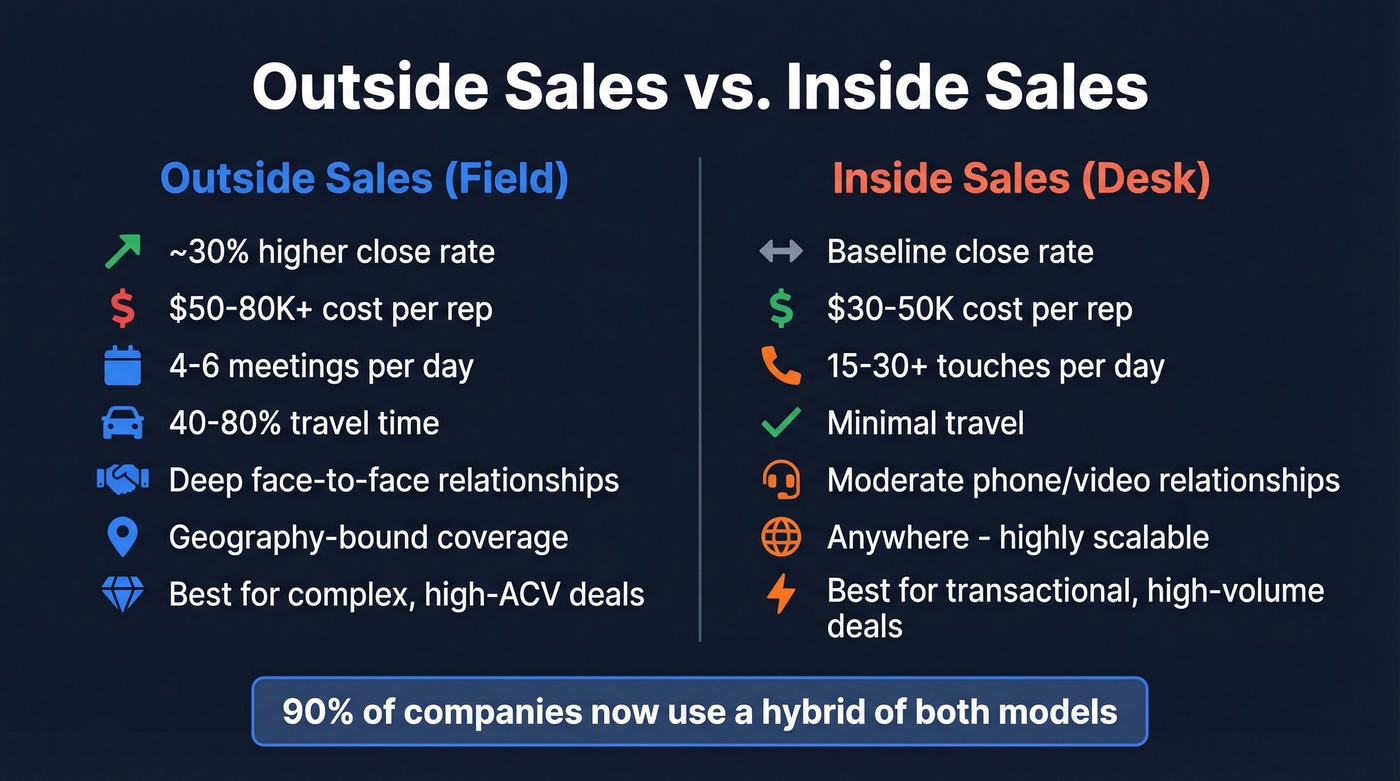
Outside sales teams close at roughly 30.2% higher rates than inside sales peers. That's not because field reps are better salespeople. It's because face-to-face interactions build trust faster, and outside reps tend to work larger, more qualified deals. They also receive 25% more calls and 50% more email activity - buyers engage more when there's a face behind the pitch.
| Dimension | Outside Sales | Inside Sales |
|---|---|---|
| Close rate | ~30% higher | Baseline |
| Cost per rep | $50-80K+ (travel, car, meals) | $30-50K (tech stack only) |
| Daily structure | Route-based, 4-6 meetings | Desk-based, 15-30+ touches |
| Travel | 40-80% of time | Minimal |
| Relationship depth | High (face-to-face) | Moderate (phone/video) |
| Scalability | Lower (geography-bound) | Higher (anywhere) |
| Best for | Complex, high-ACV deals | Transactional, high-volume |
The cost differential is significant. A field rep's fully loaded cost - salary, car allowance or mileage reimbursement, hotels, meals, client entertainment - can run 1.5-2x an inside rep. That math only works when deal sizes justify it. Inside sales reps now make up roughly 40% of high-growth B2B teams, up from just 10% in 2017. But that growth hasn't killed field selling. It's reshaped it.
The Hybrid Reality
Here's the thing: pure field-only selling barely exists anymore. 80% of B2B sales interactions now happen virtually, and outside reps spend almost half their time working remotely - doing video calls, sending proposals, running demos from their home office between field days.

Nine out of ten companies plan to stick with hybrid sales models, and the ones doing it well see up to 50% higher revenue growth than single-channel teams. The hybrid model also expands hiring pools by about 30%, giving companies a genuine competitive advantage in recruiting since they're no longer limited to reps who already live in the territory.
AI copilots are entering the field stack fast - 88% of reps using AI agents say it increases their odds of hitting quota. Expect route optimization, meeting prep summaries, and real-time coaching to become standard within the next 12-18 months.
Outside sales didn't disappear. It merged with digital. The best field reps in 2026 run their territories like a blend of road warrior and inside AE - face-to-face for the moments that matter, virtual for everything else. Reps who insist on driving to every interaction leave money on the table. Reps who never leave their desk lose deals they'd win in person.
A Great Field Sales Day
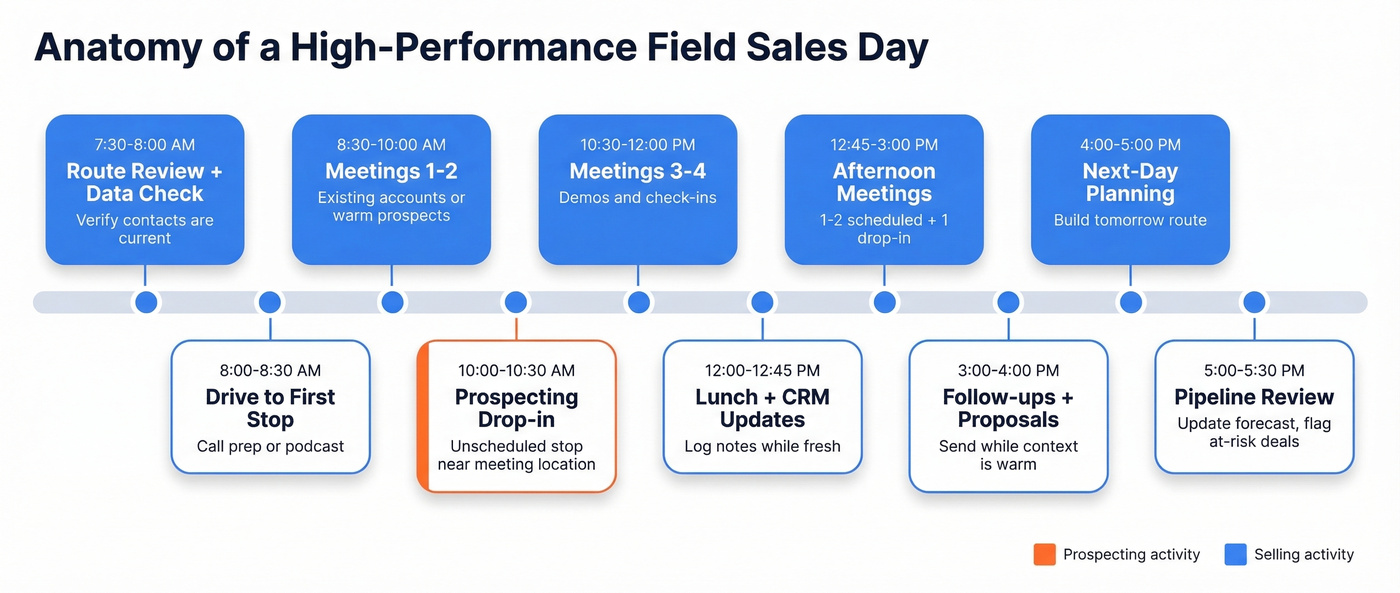
The parking lot recalculation we opened with? Top reps don't have that problem often, because they've already planned for cancellations. Here's what a well-structured day actually looks like.
| Time Block | Activity | Notes |
|---|---|---|
| 7:30-8:00 | Route review + data check | Confirm contacts are current; verify emails and mobiles before leaving |
| 8:00-8:30 | Drive to first stop | Podcast or call prep |
| 8:30-10:00 | Meetings 1-2 | Existing accounts or warm prospects |
| 10:00-10:30 | Prospecting stop | Unscheduled drop-in near meeting location |
| 10:30-12:00 | Meetings 3-4 | Mix of demos and check-ins |
| 12:00-12:45 | Lunch + CRM updates | Log notes while they're fresh |
| 12:45-3:00 | Afternoon meetings | 1-2 scheduled + 1 drop-in |
| 3:00-4:00 | Follow-ups + proposals | Send while context is warm |
| 4:00-5:00 | Next-day planning + admin | Build tomorrow's route |
| 5:00-5:30 | Pipeline review | Update forecast, flag at-risk deals |
The average outside rep logs 5.1 visits per day. The top 10% hit 13.9. That gap isn't about working harder - it's about route density, pre-qualification, and eliminating wasted drives. The 30 minutes you spend at 7:30 AM verifying that your contacts are still at the company and their phone numbers work is the highest-ROI block of your day.
One practitioner tip that sounds trivial but isn't: keep your briefcase in your left hand so your right is always free for a handshake. Carry extra business cards in your jacket pocket, not buried in your bag. Small details signal professionalism before you say a word.
Notice the prospecting stops wedged between scheduled meetings. Top performers dedicate 38% of their visits to new prospects. The bottom 10%? Just 2%. If you're only visiting existing accounts, you're a customer success rep with a car allowance.

That 7:30 AM data check only works if your data is accurate. Prospeo's 300M+ profiles refresh every 7 days - not every 6 weeks - so the contact you're driving 45 minutes to visit is still there. 98% email accuracy. 125M+ verified mobile numbers with a 30% pickup rate. At $0.01 per email, one cancelled meeting costs more than a month of verified leads.
Stop driving to dead leads. Verify every contact before you start your route.
Salary and Career Outlook
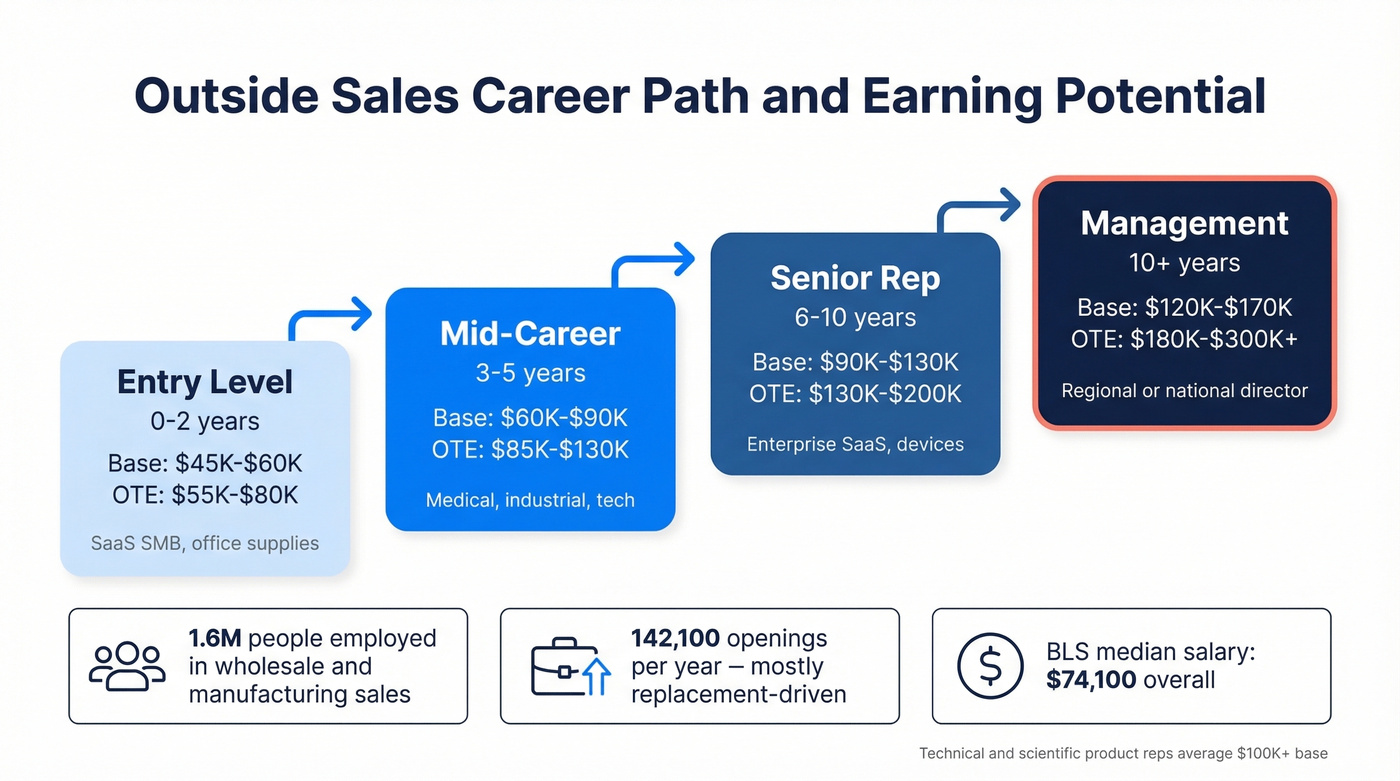
Let's talk money. The Bureau of Labor Statistics puts the overall median at $74,100 for wholesale and manufacturing sales reps, splitting to $66,780 for non-technical products and $100,070 for technical/scientific products. RepMove's Indeed-based data shows an average base of $87,380 plus $22,560 in commissions.
| Experience Level | Base Range | OTE Range | Typical Industries |
|---|---|---|---|
| Entry (0-2 yrs) | $45K-$60K | $55K-$80K | SaaS SMB, office supplies |
| Mid (3-5 yrs) | $60K-$90K | $85K-$130K | Medical, industrial, tech |
| Senior (6-10 yrs) | $90K-$130K | $130K-$200K | Enterprise SaaS, devices |
| Management (10+ yrs) | $120K-$170K | $180K-$300K+ | Regional/national director |
A common career path runs SDR to AE to field rep to territory manager to regional director. Some reps skip the AE step entirely if they start in an industry like medical devices or industrial distribution where field selling is the default entry point. The traits that predict success - curiosity, accountability, and genuine empathy - matter more than industry experience.
There are roughly 1.6 million people employed in wholesale and manufacturing sales roles, with about 142,100 openings per year. Growth is projected at just 1% through 2034 - slower than average - but that's misleading. The openings are almost entirely replacement-driven. People retire, get promoted, or leave the field. Demand isn't shrinking; it's churning.
If your average contract value is under $15K, you probably don't need a field sales team. The fully loaded cost of a traveling rep makes the unit economics brutal on small deals. Invest in inside sales and save field visits for expansion conversations with your biggest accounts.
Top Reps vs. Everyone Else
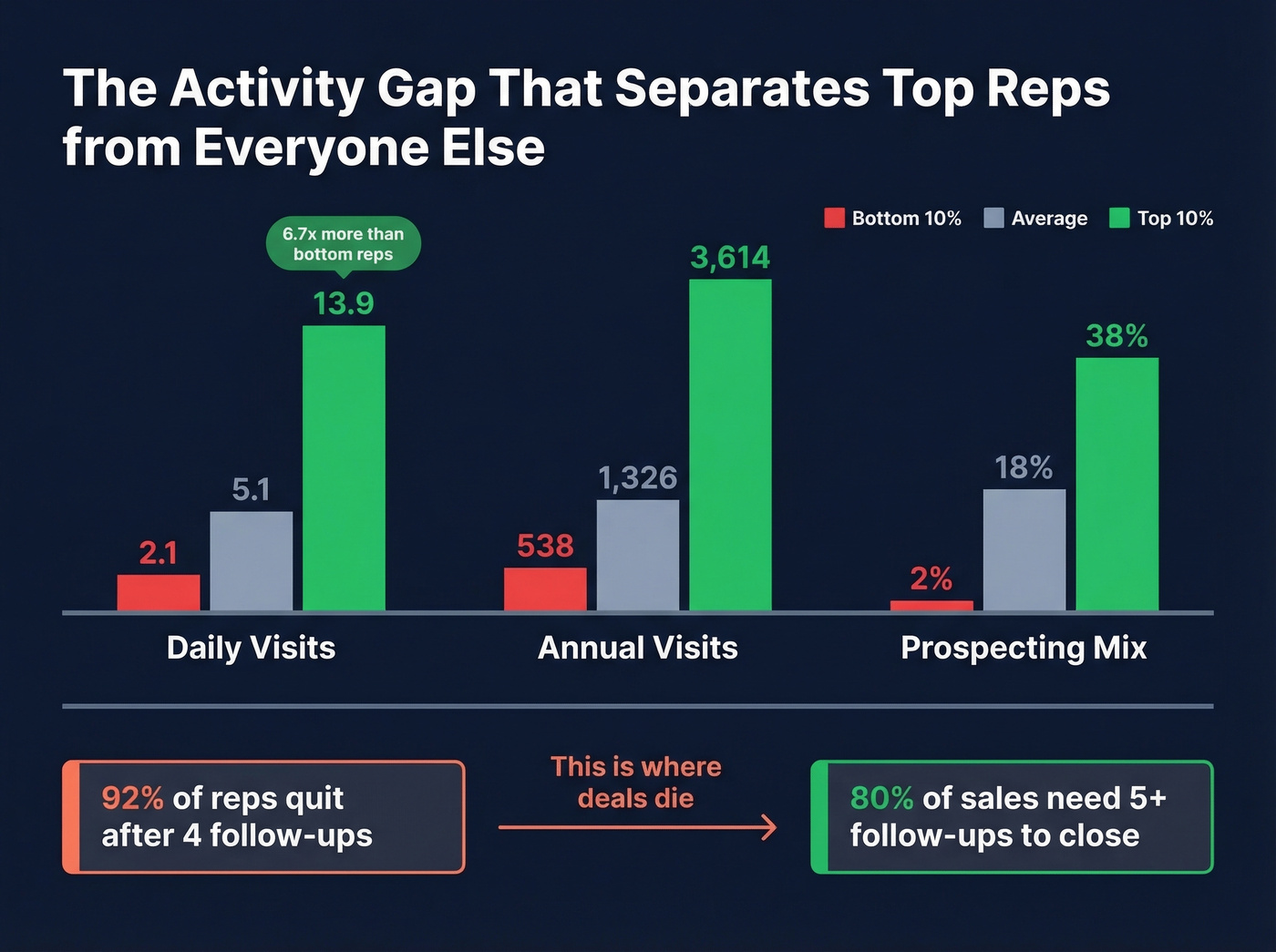
We've seen this pattern across dozens of sales orgs: the gap between top performers and average reps isn't talent. It's activity volume and prospecting discipline.
| Metric | Bottom 10% | Average | Top 10% |
|---|---|---|---|
| Visits/day | 2.07 | 5.1 | 13.9 |
| Visits/week | ~10 | ~25 | ~69 |
| Prospecting mix (%) | 2.04% | 18.1% | 38% |
| Annual visits | ~538 | ~1,326 | ~3,614 |
Let's reverse-engineer what this means for quota. Say you carry a $500K annual target with a $25K average deal size - that's 20 closed deals. At a 25% close rate, you need 80 qualified meetings. At the average pace of 5.1 visits per day, that's roughly 16 weeks of pure selling time.
Except reps spend 60% of their time on non-selling tasks. So you're really looking at 40 weeks to hit those 80 meetings, assuming every visit is a qualified opportunity. It's not. Factor in prospecting visits, check-ins, and no-shows, and suddenly the math gets tight.
This is why the top 10% win. They don't just visit more - they prospect more aggressively and they follow through relentlessly. 80% of sales require five or more follow-ups, but 92% of reps quit after four attempts. The persistence gap is where deals die.
Territory Planning and Routes
Your route is your strategy. Not your pitch deck, not your demo script - your route. How you carve up your territory and sequence your visits determines how many conversations you get per day, and conversations are the only thing that generates revenue.
Territory segmentation goes beyond geography. Forma.ai's framework breaks it into industry, customer size, sales channel, agent expertise, and market potential. A rep covering "the Northeast" is working a map. A rep covering "mid-market manufacturing companies in the Northeast with active expansion signals" is working a strategy.
Route planning itself comes in several flavors: dynamic routing that adjusts in real-time based on cancellations, multi-stop optimization that minimizes drive time between appointments, and closed-path routes that start and end at the same point for maximum efficiency. Open-path routes work better for reps who cover long corridors and don't return to a home base each night. The Michelin sales team saw a 20% reduction in unplanned downtime and added extra customer visits every day after implementing intelligent route planning through Salesforce Maps.
Look, imbalanced territories are a retention killer. When one rep has a goldmine zip code and another has a barren stretch of highway, the second rep leaves. We've watched reps double their visit count just by switching from generic maps to purpose-built route planners. Good territory planning isn't just a revenue exercise - it's a people exercise.
The Field Sales Tech Stack
The right tools don't make a bad rep good, but they make a good rep significantly more productive. Here's what the stack looks like in 2026.
CRM
Salesforce typically runs $25-$165+ per user/month depending on edition and add-ons. HubSpot has a free tier; paid seats start around $20-$50+ per user/month depending on the hub and tier. Skip HubSpot if you have more than 50 reps or need advanced territory management - many teams outgrow it fast.
Route Planning
RepMove has a free tier and paid plans. Badger Maps typically runs $50-$70/user/mo. Both integrate with your CRM data to build optimized routes based on account priority, not just proximity. Generic map tools get you from A to B. These get you from A to B to C to D in the order that maximizes revenue potential.
Prospecting and Data Verification
The most expensive mistake in outside sales is driving 45 minutes to a dead contact. The person left the company three months ago. The phone number goes to a general line. The email bounces. You just burned $50-100 in time and gas on a ghost. 73% of B2B buyers actively avoid sellers who send irrelevant outreach - and showing up to a meeting with outdated information is the in-person equivalent.
Prospeo covers 300M+ professional profiles with 98% email accuracy and 125M+ verified mobile numbers, all refreshed on a 7-day cycle compared to the 6-week industry average. The Chrome extension lets you verify a contact's details in seconds before you leave the house. The free tier gives you 75 email verifications per month, which covers a solid week of pre-meeting checks. At roughly $0.01 per verified email on paid plans, it's trivially cheap insurance against wasted windshield time.
If you're building lists from scratch, start with a tight ideal customer profile and then use data enrichment to keep accounts current as people change roles.
Sales Engagement and Intelligence
Outreach and Salesloft typically run ~$100-$150+/user/mo. Gong runs ~$100-$200+/user/mo depending on volume. In our experience, reps who review their own Gong recordings weekly improve close rates faster than reps who rely on manager feedback alone.
Five Mistakes That Kill Careers
1. Not qualifying properly. Investigating the buyer's needs before quoting a price isn't optional - it's the difference between consultative selling and order-taking. Reps who lead with price attract price shoppers. Reps who lead with discovery attract partnerships.
2. Skipping rapport in the first minutes. You drove 30 minutes to get face time. Don't waste it by launching into a slide deck before you've established that the person across the table trusts you enough to listen. The first two minutes set the tone for the entire meeting.
3. Never asking for the order. It sounds absurd, but it's shockingly common. Reps deliver great presentations, build genuine rapport, and then leave without a clear next step or close attempt. Ask. The worst they can say is not yet.
4. No daily or weekly planning discipline. The reps who wing it - who wake up and figure out their day over coffee - consistently underperform reps who plan their routes and priorities the night before. Planning is a compounding advantage. 57% of reps say sales cycles are getting longer, which means every wasted day compounds into missed quarters.
5. Showing up with stale data. Wrong phone numbers. Contacts who left months ago. Email addresses that bounce. Every wasted visit is a meeting you could've had with someone who's actually there. A 30-second data check before you leave saves a 45-minute round trip. Verify contacts the night before during your planning block, not when you're already in the car.
If you need a repeatable system for drop-ins, pipeline touches, and admin blocks, build it into a 30-60-90 day plan and track it as a set of sales activities.
Top field reps dedicate 38% of visits to new prospects. That only works when you can identify drop-in targets on the fly. Prospeo's Chrome extension - used by 40,000+ reps - pulls verified emails, direct dials, and 40+ data points from any company website or LinkedIn profile in one click. Find the right contact two blocks away before your next meeting starts.
Turn every cancelled meeting into a prospecting opportunity with verified data.
FAQ
What does outside sales mean?
Outside sales is any selling done primarily face-to-face at the buyer's location rather than from a fixed office. You're the one traveling - visiting prospects, running demos on-site, and building relationships through in-person meetings. The term is interchangeable with "field sales."
Is outside sales a good career in 2026?
Yes. Median pay runs $66K-$100K+ depending on product type, with 142,100 annual openings driven by replacement demand. High autonomy, uncapped commissions, and a clear path to management make it one of the better sales career tracks, especially for reps who build hybrid selling skills.
How many meetings should a field rep have per day?
The average is 5.1 visits per day; top 10% performers hit nearly 14. Aim for 4-6 quality visits mixing existing accounts and new prospects. Route density and pre-call data verification matter more than raw volume - one confirmed meeting beats three drives to empty offices.
What tools do outside sales reps need?
At minimum: a CRM (Salesforce or HubSpot), a route planner (RepMove or Badger Maps), and a data verification tool for contact accuracy. Add sales engagement software (Outreach or Salesloft) and conversation intelligence (Gong) as your operation scales and the hybrid selling component grows.