

Pain Funnel Questions: How to Run the Sandler Pain Funnel Without Sounding Scripted
You asked the prospect what's not working. They said "yeah, it's been a problem for a while." Then silence. You panicked, jumped into your demo, and spent 30 minutes pitching features to someone who never told you what actually hurts.
That's the gap. Knowing the eight pain funnel questions isn't enough - without delivery tactics and a way to quantify what you've uncovered, they're just words on a page.
The quick version: The pain funnel is 8 questions in a specific sequence across three levels: surface, business impact, and personal. The sequence matters more than the exact wording. Most reps fail because they skip the emotional layer or jump to a demo after hearing the first symptom. Below you'll find the questions, delivery tactics, and the quantification formula that turns "interested" prospects into signed contracts.
What Is the Sandler Pain Funnel?
David Sandler built the pain funnel as a progressive narrowing technique - broad questions at the top, deeply specific ones at the bottom. It sits in stage 3 (Pain) of Sandler's 7-stage selling system, and the structure moves from surface symptoms to business cost to personal, emotional impact.
A common discovery benchmark is that reps perform best when they ask 11-14 targeted questions on an intro call. The pain funnel gives you 8 of those, with the rest coming from qualification and context-setting.
The 8 Sandler Pain Funnel Questions by Level
Don't memorize these word-for-word - internalize the progression. You're moving the prospect from describing symptoms to quantifying damage to feeling the weight of inaction. Sandler training emphasizes adapting these to your personality. Authenticity beats memorization every time.
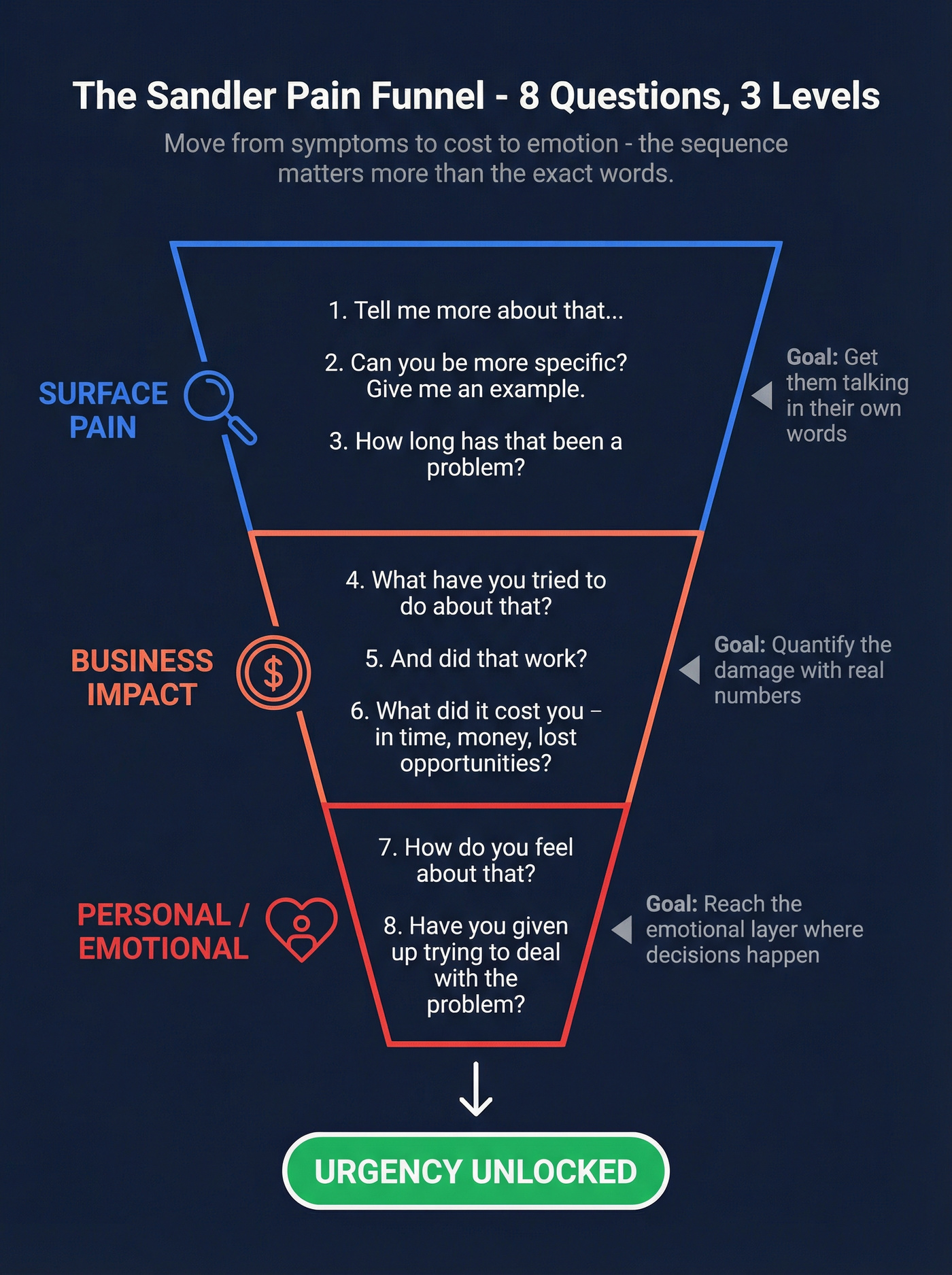
Surface Pain (Questions 1-3)
These open the door. You're getting the prospect to describe what's broken in their own words.
- "Tell me more about that..."
- "Can you be more specific? Give me an example."
- "How long has that been a problem?"
The goal isn't depth - it's permission to keep digging. If the prospect gives you a vague answer to question 1, question 2 forces specificity. Question 3 establishes that this isn't new, which sets up the business impact layer.
A SaaS rep might hear "onboarding takes forever" and follow with "Give me an example - what does 'forever' look like for a new customer?" A cybersecurity seller might hear "we keep failing audits" and push for which audits, how many, and since when. The specifics matter because they become the ammunition for your business case later in the conversation, and vague pain produces vague urgency, which produces vague timelines, which produces ghosting.
Business Impact (Questions 4-6)
Now you're quantifying. This is where the prospect starts to realize the problem is bigger than they thought.
- "What have you tried to do about that?"
- "And did that work?"
- "What did it cost you - in time, money, lost opportunities?"
Questions 4 and 5 are devastating together. Prior failed attempts create urgency because the prospect has already invested resources and gotten nowhere. Question 6 forces a number onto the pain, which becomes your ROI argument later.
Personal / Emotional Pain (Questions 7-8)
This is where deals are won. Business impact quantifies, but emotional pain drives urgency.
- "How do you feel about that?"
- "Have you given up trying to deal with the problem?"
Most reps never get here. That's the gap between average and elite discovery.
Delivery Without Sounding Scripted
Use labels, not interrogation. Instead of bluntly asking "How do you feel about that?", try Chris Voss-style labeling: "It sounds like this has really beaten you up" or "It sounds like this has prevented you from delivering on your strategy." An enterprise cybersecurity rep shared that using labeling like this made the emotional layer feel natural rather than forced.
Ask permission before going deep. A simple "Would it be okay if I asked about the financial impact?" disarms resistance. It signals respect and gives the prospect control, which paradoxically makes them share more.
Build from their words, not your script. If the prospect says "our reps are wasting hours on bad data," your next question should reference "wasting hours" - not pivot to a pre-written follow-up. Mirroring their language builds trust faster than any technique.
Here's the thing: the pain funnel only works if you're actually listening to the answers. We've seen reps run technically perfect discovery calls and still lose deals because they were mentally rehearsing the next question instead of hearing the answer. Aim for a 40/60 talk-to-listen ratio, max.

Great discovery questions don't matter if you're running them on the wrong person. Prospeo gives you verified emails and direct dials for actual decision-makers - 98% email accuracy, 125M+ verified mobiles, 30% pickup rate. Stop wasting your best pain funnel on gatekeepers.
Reach the decision-maker before you rehearse your first question.
How to Quantify Pain After Discovery
This is the step most reps skip entirely. You ran great pain funnel questions, the prospect opened up, and then... they ghosted. Why? Because pain without a number attached doesn't survive the internal buying committee.
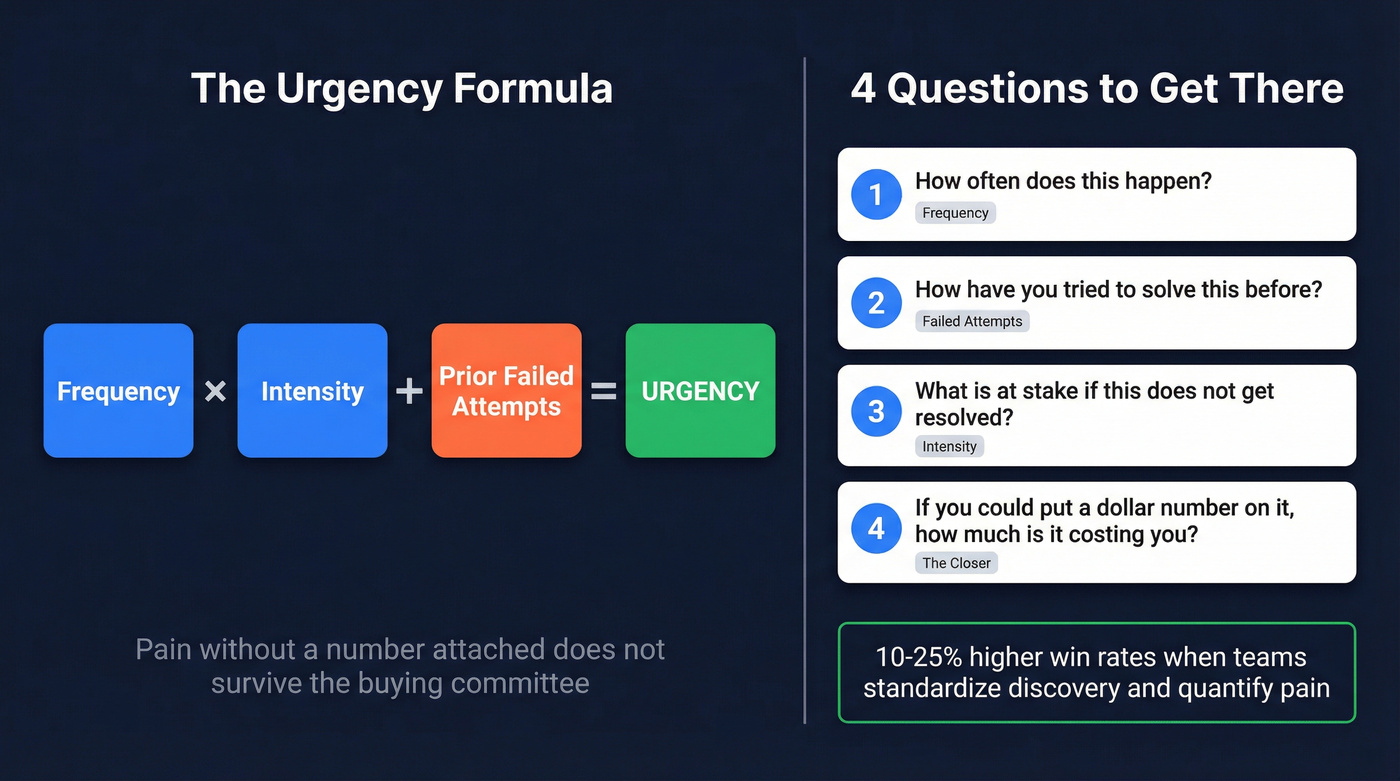
Use this urgency formula: (frequency x intensity) + prior failed attempts = urgency.
Four questions get you there:
- "How often does this happen?"
- "How have you tried to solve this before?"
- "What's at stake if this doesn't get resolved?"
- "If you could put a dollar number on it, how much is it costing you?"
Teams that standardize discovery and quantify pain typically see 10-25% higher win rates and shorter sales cycles. A rep on r/sales described quantifying pain as the "biggest improvement in my sales game" over the last 90 days - deals started feeling "a lot heavier" and "not flaky."
That's the difference between a prospect who says "we should probably do something" and one who says "we need to fix this by Q3." In our experience, the second version closes. The first version ghosts after the third follow-up email.
Why Reps Fail at the Pain Funnel
Jumping to demo after the first symptom. The prospect mentions one problem and the rep launches into a 20-minute feature walkthrough. It's like a doctor prescribing treatment before running tests. Your job is to help them realize the problem is serious - not to show off your product's settings page. (If you want a tighter structure, use a product demo checklist so you don’t rush the “why.”)
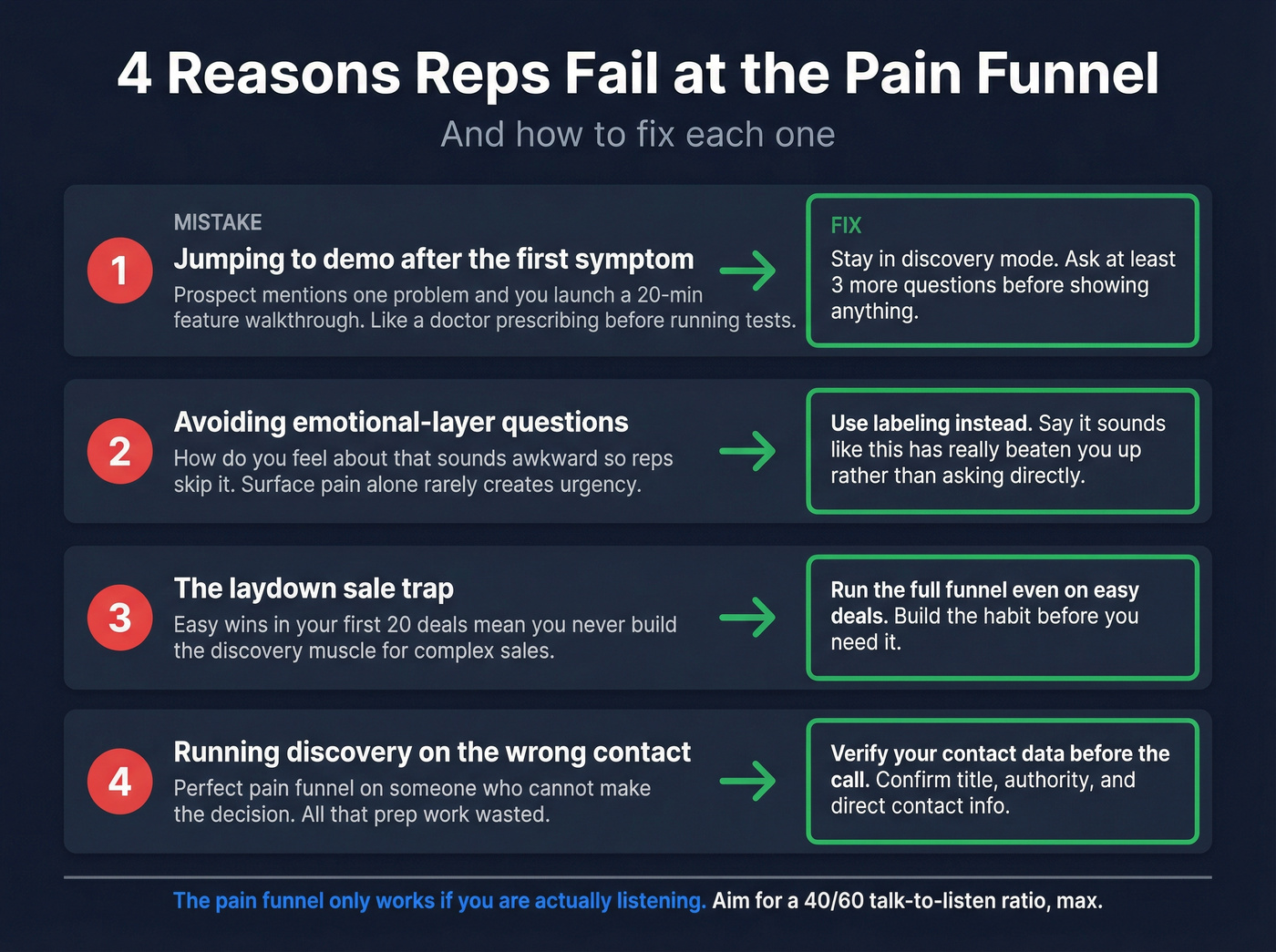
Avoiding emotional-layer questions. "How do you feel about that?" feels awkward to say out loud. So reps skip it. But surface pain and business impact alone rarely create enough urgency to change behavior. The emotional layer is uncomfortable - and that's exactly why it works.
The "laydown sale" trap. Easy wins don't build skill. If your first 20 deals close without real discovery, you never develop the muscle for complex sales. Then you hit a tough quarter and wonder why nothing converts.
Running great discovery on the wrong contact. None of this matters if you're talking to someone who can't make the decision. Verify your contact data before the call - bad numbers and outdated emails waste the prep work. Prospeo gives you verified emails and direct dials for decision-makers, with 98% email accuracy and 125M+ verified mobile numbers, so your discovery call actually connects with someone who has authority. (If you’re building a repeatable outbound motion, start with sales prospecting techniques and a clean list.)
Pain Funnel vs. SPIN vs. BANT
Let's be honest: if you're selling low-ACV transactional deals, you probably don't need a full pain funnel. BANT qualification and a sharp demo will get you there. But the moment you're selling into buying committees, Sandler is one of the clearest frameworks for reaching the emotional layer where decisions actually happen. (For a more formal qualification layer, compare it to MEDDIC.)
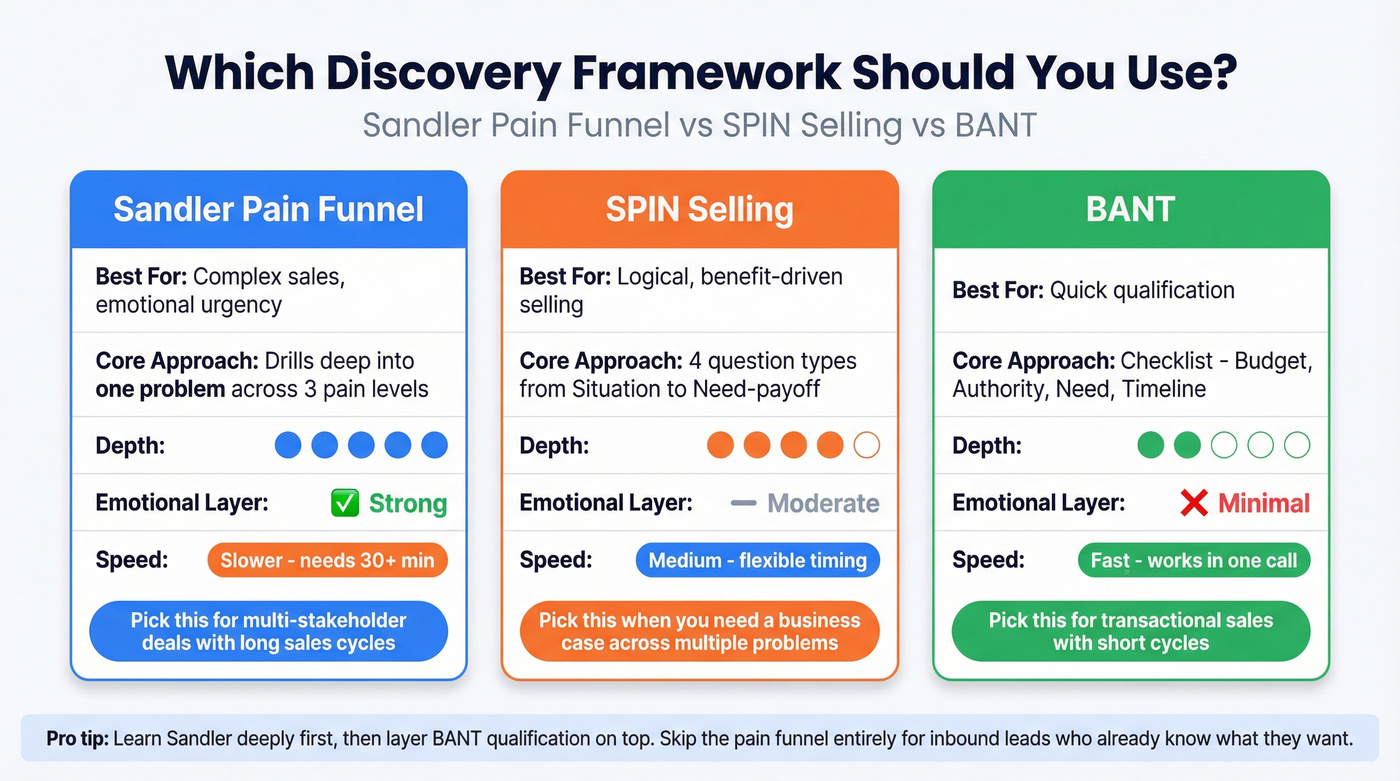
| Framework | Best For | Core Approach | Pick This When... |
|---|---|---|---|
| Sandler Pain Funnel | Complex sales, emotional urgency | Drills deep into one problem across 3 pain levels | Multi-stakeholder deals with long sales cycles |
| SPIN Selling | Logical, benefit-driven selling | 4 question types (Situation to Need-payoff) | You need to build a business case across multiple problems |
| BANT | Quick qualification | Checklist: Budget, Authority, Need, Timeline | Transactional sales with short cycles |
SPIN builds a logical business case. BANT qualifies. Neither is designed to consistently reach the emotional layer the way Sandler does. If you learn one methodology deeply, make it Sandler - you can always layer BANT qualification on top.
Skip the pain funnel entirely for inbound leads who already know what they want and just need pricing. Don't force a 30-minute discovery process on someone who's ready to buy. Read the room.
You just quantified your prospect's pain at $200K/year. Now imagine losing that deal because your next 15 follow-up emails bounced. Prospeo's 5-step verification and 7-day data refresh mean your contact data is as sharp as your discovery skills - for about $0.01 per email.
Don't let bad data ghost you after a perfect discovery call.
FAQ
How many questions should I ask on a discovery call?
Discovery benchmarks suggest 11-14 targeted questions produce the best outcomes. The Sandler pain funnel gives you 8. The remaining 3-6 come from qualification and context-setting at the top of the call. Don't count questions - focus on depth over volume.
What are the three levels of pain in Sandler?
Surface pain covers visible symptoms the prospect mentions first. Business impact quantifies cost in time, money, and lost opportunities. Personal or emotional pain - stress, job security, missed goals - is where urgency lives. Decisions are often made at the personal level, even when buyers justify them with business numbers.
Does the pain funnel work for short sales cycles?
Yes, but compress it. For transactional sales, focus on the business impact layer - quantify the cost quickly and skip deep emotional probing. Questions 4 through 6 do the heavy lifting in shorter cycles. You don't need all eight questions when the deal closes in one call.
How do I find the right decision-maker before running discovery?
Use a B2B data platform with verified contact info so you're not wasting discovery prep on the wrong person. Prospeo returns 98%-accurate emails and verified direct dials across 300M+ profiles, with data refreshed every 7 days - so you reach the actual budget holder, not a gatekeeper.