

Persuasion in Sales: What Actually Works (and What Backfires)
A top-performing rep on r/sales put it bluntly: "Your sales job is not a persuasion job." After shifting away from convincing, they closed three deals in two weeks and said prospects just "opened up." Meanwhile, Salesforce research shows 84% of reps missed quota last year, and 67% don't expect to hit it this year. On the buyer side, 96% of prospects research on their own before ever talking to a rep.
That Reddit rep nailed the real insight: you can't convince anyone of anything. You can only uncover the correct outcome and remove the friction standing in its way. The most persuasive salespeople already know this. They spend more time listening than pitching.
The Short Version
Persuasive selling isn't convincing - it's guiding a buyer who's already deep into their decision toward a conclusion they feel good about. Start with three high-leverage Cialdini principles (social proof, reciprocity, Unity) and pair them with real scripts you can use tomorrow. But none of it works if your emails bounce or you're calling the wrong person. Fix your data first.
Before You Persuade, Reach the Right Person
SDRs tell us constantly that success is "90% luck." You happened to call the right person at the right time with the right pain point. That's not luck - that's targeting precision dressed up as randomness.
Gartner projects that 80% of B2B sales interactions now happen in digital channels. Buyers spend just 17% of their buying time meeting suppliers. You don't get many swings, so every one needs to land on a real person at a real email address with a real problem.
Here's the thing: you can spend a week studying Cialdini, crafting the perfect cold email sequence, nailing your social proof angles - then 23% of your list bounces. All that training evaporates into spam folders and dead inboxes. We've watched it happen to teams that had genuinely great messaging but garbage data underneath it. Prospeo solves this unglamorous prerequisite: 98% email accuracy, a 7-day data refresh cycle, and 125M+ verified mobile numbers that keep contacts current while competitors refresh every six weeks.

7 Cialdini Principles That Actually Close Deals
Robert Cialdini's Influence has sold 7 million copies in 44 languages. The framework endures because Cialdini didn't build it in a lab - he spent three years undercover with used car dealers, telemarketers, and fundraisers, studying what actually worked on real people.
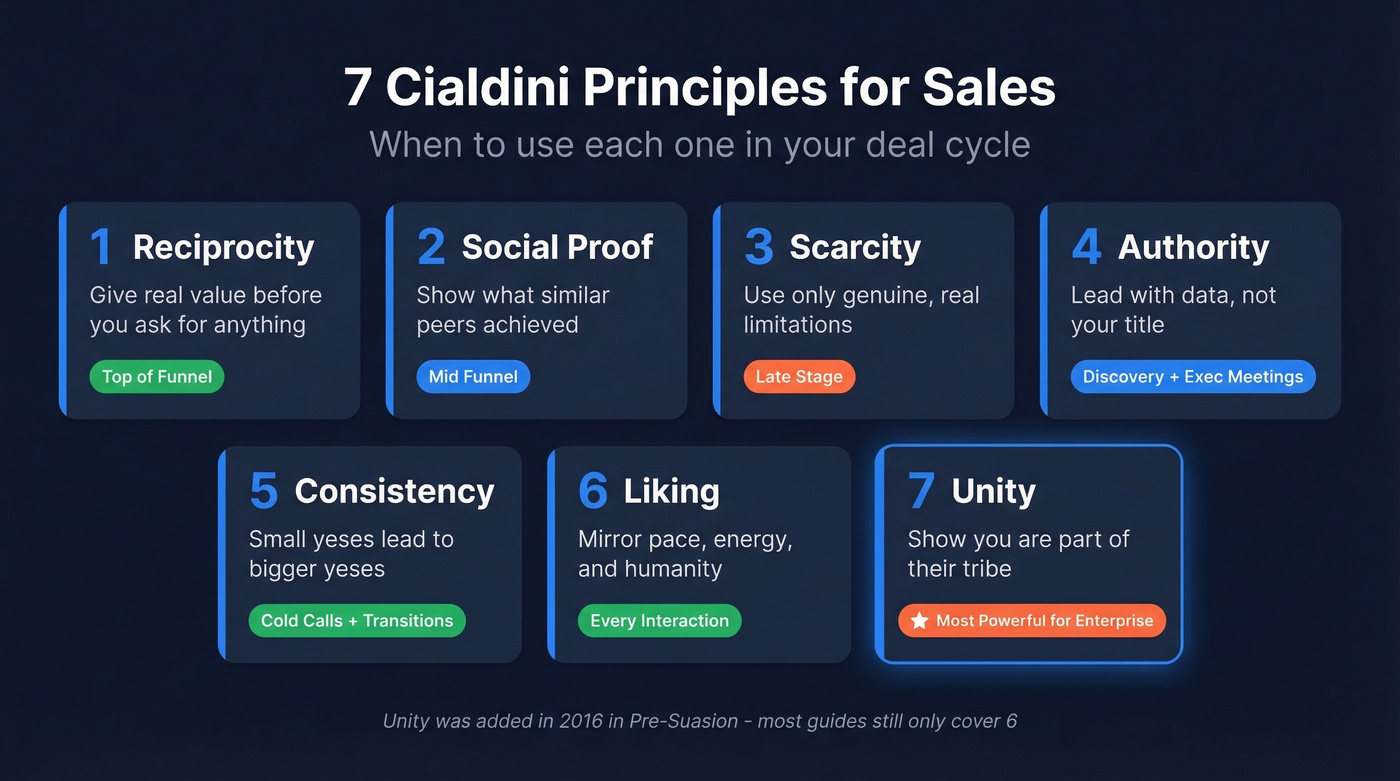
Many guides still focus on the original six principles. There are seven. Unity was added in 2016 in Pre-Suasion, and in B2B it's often the most important one.
Reciprocity
Give before you ask. Not a branded PDF nobody reads - an actual insight about their business.
"I noticed [Company] is expanding into [market]. We ran an analysis for a similar team at [peer company] and found they were leaving ~$X on the table with their current [process]. Happy to share the framework - no strings."
Use this on first touch, top of funnel, anytime you need to earn the right to a conversation.
Social Proof
People follow the behavior of similar peers, especially under uncertainty. Social proof boosts conversion nine times out of ten in digital contexts. The key word is similar - a Fortune 500 case study won't move a 50-person startup.
"Companies like [peer in their vertical] saw a [specific metric] improvement within [timeframe]. Their setup was almost identical to yours - same team size, same [tool/process]."
Best mid-funnel, when the prospect is evaluating options and looking for validation.
Scarcity
Only use genuine scarcity. Fake urgency ("Only 3 left!" when stock is unlimited) is manipulation, and buyers see through it instantly.
"We're onboarding 5 new accounts this quarter for [program/pilot], and we've filled 3. If the timing works, I can hold a slot through Friday."
Save this for late-stage deals that need a nudge. Never on a first call.
Authority
Skip this if you lead with your title instead of data. The real authority move is framing and anchoring: position cost as time saved, or contextualize a $25,000 program against $250,000 in missed revenue. Statistics backfire when they feel manipulative - the key is presenting data that serves the buyer's decision, not your pitch.
"Gartner's latest data shows [industry trend]. We've helped [X] teams navigate that shift - here's what the top performers did differently. For context, the average team losing [Y hours/month] on this problem is leaving roughly [$Z] on the table annually."
Use this in discovery calls, executive presentations, any conversation where credibility is in question.
Consistency
Small yeses lead to bigger yeses. The classic cold call technique - "Does that sound fair?" - works because it gets a verbal commitment before the real ask. Some trainers call this verbal judo: redirecting resistance into agreement through small, low-stakes commitments rather than head-on confrontation.
"I know I'm catching you cold, so I'll be upfront. In just three minutes, I can share one insight about [specific challenge]. Does that sound fair?"
Works on cold calls, discovery transitions, any moment where you need the prospect to opt in to the next step.
Liking
Quick tip for video calls: mirror the prospect's pace and energy. If they're casual, don't show up in presentation mode. If they're analytical, bring data. Research on mirroring and pacing shows this isn't about being fake - it's about meeting people where they are. Nod when they make a point. Match their speaking speed. Open with something human:
"I saw you're based in [city] - I was just there for [event]. How's the [local reference]?"
This applies to every interaction, but especially first meetings where rapport hasn't been established yet.
Unity
Let's start with the script on this one, because it shows the principle faster than any definition:
"We're in the same boat here - I work with [vertical] teams every day, and the [specific challenge] you're describing is the exact problem that keeps coming up. Let me show you what's actually working."
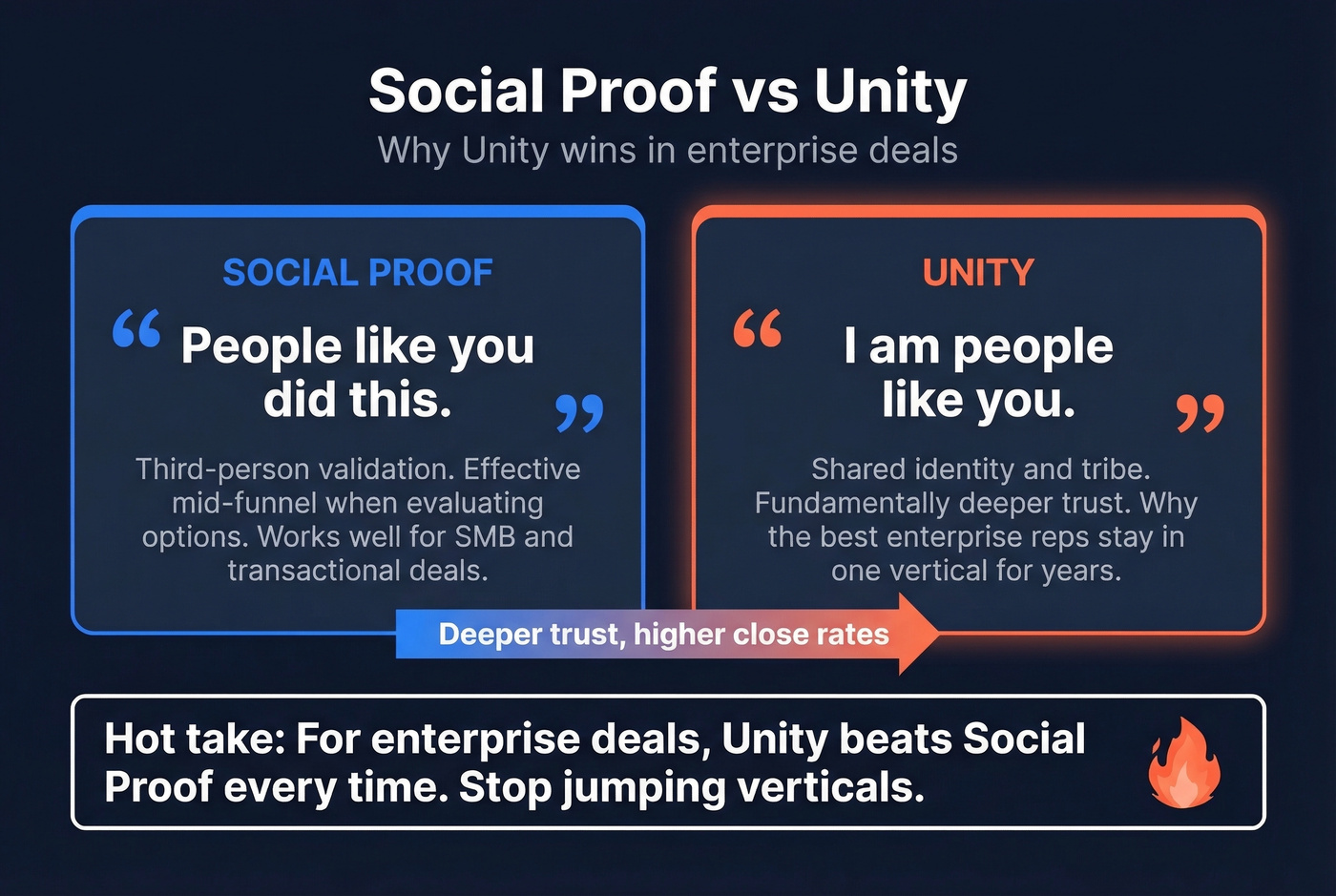
Unity is the principle nobody covers, and it's the one that matters most in B2B. When a prospect feels you're part of their tribe - same industry, same challenges, same stakes - resistance drops. This is where Cialdini's Pre-Suasion concept becomes critical: what you say in the 60 seconds before your ask determines whether it lands. Every script above opens with a priming statement - a shared identity, a relevant data point, a time-box - before the actual request.
Knowing all seven principles without context leads to spray-and-pray influence. The real skill is diagnosing which principle fits the moment. One consultancy we spoke with redesigned their onboarding using reciprocity and commitment together, and early attrition fell by a third.
Our hot take: Unity is more powerful than social proof for enterprise deals. Social proof says "people like you did this." Unity says "I am people like you." That's a fundamentally different level of trust, and it's why the best enterprise reps spend years in one vertical instead of jumping across industries.

Every Cialdini principle above assumes one thing: your message actually reaches a real person. With 23% of emails bouncing on average lists, even perfect social proof and reciprocity scripts vanish into spam folders. Prospeo's 98% email accuracy and 7-day refresh cycle ensure your carefully crafted persuasion lands in the right inbox every time.
Stop perfecting scripts that bounce. Fix the data underneath them.
Scripts You Can Copy
Cold Call (Consistency + Reciprocity)
You: "Hi [Name], this is [Your Name] from [Company]. I know I'm catching you cold - in just three minutes, I can share one thing we found about [their specific challenge]. Does that sound fair?"
[If yes]: "Great. We worked with [peer company] on [problem], and they found [specific result]. I think the same approach could work for [their company]. Worth a 15-minute deep dive next week?"
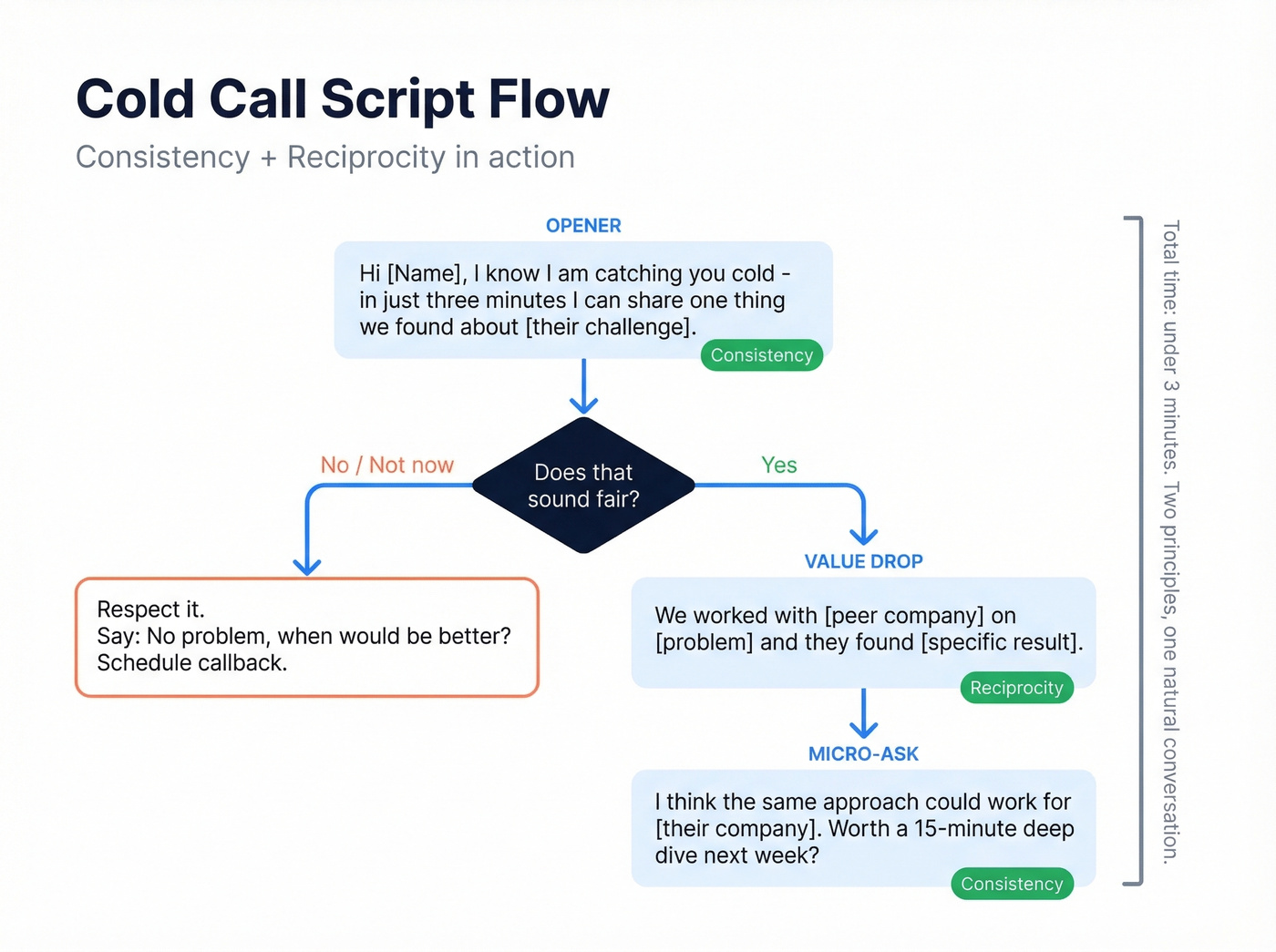
Zendesk's cold calling scripts popularized this time-box + micro-commitment opener: "In just three minutes..." + "Does that sound fair?"
Follow-Up Email (Social Proof + Reciprocity)
Subject: [Peer company] cut [metric] by [X]% - relevant for [their company]?
Body: [Name], quick follow-up. [Peer company] was dealing with the same [challenge] you mentioned. They [specific action] and saw [specific result] in [timeframe]. I put together a one-page breakdown - want me to send it over?
The average prospect needs 5 touches to engage; reaching executives takes roughly 9 versus 4 for lower-level contacts. Don't give up after two emails. If you want more plug-and-play options, use these sales follow-up templates.
Objection Response (LAER Model)
When a prospect says "We're happy with our current solution," most reps either argue or fold. The LAER framework - Listen, Acknowledge, Explore, Respond - gives you a middle path:
Prospect: "We're happy with what we have."
You: "That makes sense - sounds like you've invested time getting it right. Can I ask - how are you measuring ROI on that right now? The reason I ask is that [peer company] thought the same thing until they benchmarked [specific metric]."
When Persuasion Becomes Manipulation
There's a clean line between ethical influence and manipulation, and MarTech draws it well: ethical persuasion guides informed decisions and removes friction. Manipulation preys on insecurities, shame, or panic.
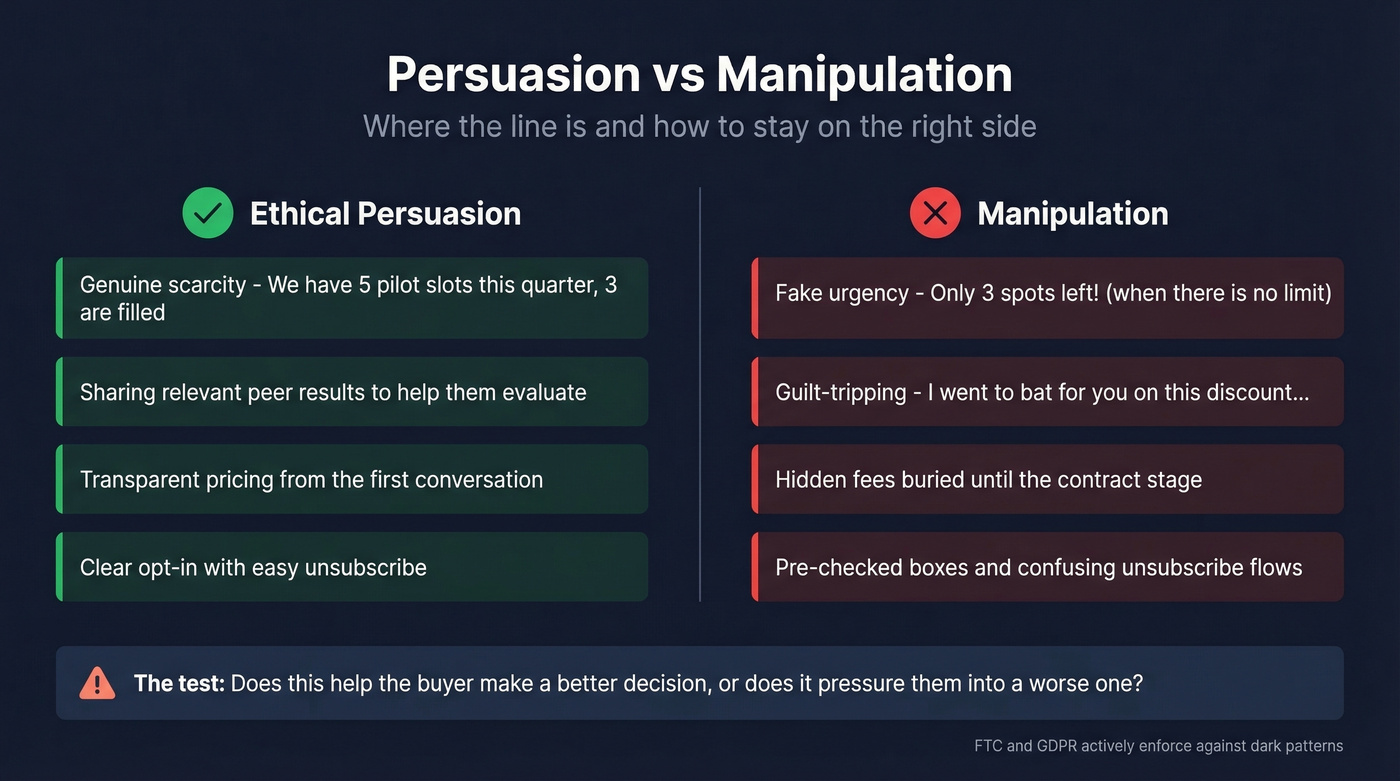
Watch for these dark patterns in your own team's playbook, not just competitors':
- Fake urgency: "Only 3 spots left!" when there's no limit
- Guilt-tripping: "I went to bat for you on this discount..."
- Hidden fees: Burying implementation costs until the contract stage
- Shady opt-ins: Pre-checked boxes, confusing unsubscribe flows
This isn't just an ethics question. The FTC has been actively enforcing against junk fees, and GDPR makes certain opt-in practices flatly illegal in the EU. The test is simple: does this help the buyer make a better decision, or does it exploit a vulnerability? (If you want a deeper framework, see ethics in sales.)
Mistakes That Destroy Trust
We've seen teams torpedo deals with tactics that feel persuasive in the moment but erode credibility over time.
Overly tight limited-time discounts. "This price expires at midnight" on a $50k enterprise deal insults the buyer's intelligence. Refusing to accept "no." A qualified no is as good as a yes - it cleans your pipeline and frees up time for real opportunities. Aggressive competitor trashing. Buyers trust reps who acknowledge competitors' strengths. Trashing the incumbent makes you look insecure, not confident.
Look, reps get roughly 5% of the buyer's total decision-making time. Opportunities closed within 50 days show a 47% win rate; after that threshold, win rates drop to 20% or lower. Speed matters more than pressure. If you're using influence tactics to drag out a deal that should've closed or died weeks ago, you're doing it wrong. Tighten your sales process optimization and keep an eye on pipeline health.
The Unity principle works when you reach the right person in the right vertical with the right pain point. Prospeo's 30+ search filters - buyer intent, technographics, job changes, headcount growth - let you target prospects who already share your tribe. That's not luck. That's precision at $0.01 per lead.
Turn targeting precision into persuasion power for every cold touch.
FAQ
What is persuasion in sales?
Persuasion in sales means guiding a buyer toward a decision they feel good about using psychology-backed principles like social proof, reciprocity, and consistency. It's not pressuring or manipulating - it's removing friction from a decision the buyer is already leaning toward.
What are the 7 principles of persuasion?
Reciprocity, Scarcity, Authority, Consistency, Liking, Social Proof, and Unity. Many guides still list only six - Unity was added in 2016 in Cialdini's Pre-Suasion, making shared identity the seventh and often most powerful principle in B2B contexts.
Is persuasive selling ethical?
Yes, when it guides informed decisions and removes friction. It crosses into manipulation when it exploits insecurities, creates fake urgency, or hides costs. The FTC and GDPR both draw hard lines around deceptive practices - violating them carries real legal risk.
How do you improve your sales influence skills?
Start by mastering two or three Cialdini principles rather than all seven at once. Practice on real calls, record yourself, and review which techniques landed. Pair that with clean contact data so your outreach actually reaches decision-makers - you need enough at-bats to build the skill.
Why do persuasion techniques fail?
Usually because targeting is wrong, not technique. If 23% of your emails bounce or you're calling someone with no buying authority, no Cialdini principle helps. Start with verified contact data on a short refresh cycle, then layer influence on top of a clean foundation.