

Phone Sales Techniques That Actually Close (Scripts + Data)
You just heard "I need to think about it" for the fifth time today. You're not alone - 36% of salespeople say closing is the hardest part of their job, and most advice boils down to "be confident" and "create urgency." That's not a technique. That's a fortune cookie.
Here's what actually works - word-for-word scripts, the data behind them, and the one upstream fix most reps ignore entirely. The backbone of everything below is Gong's analysis of 326K sales calls, one of the clearest datasets we have on what separates closers from everyone else.
The Quick Version
- Talk less. Won calls average 57% rep talk time vs. 62% on lost calls.
- Pick one closing line and practice it until it's muscle memory. Scripts are below.
- Fix your data before your pitch. If 30% of your numbers are dead, no technique saves you.
What a Good Close Rate Actually Looks Like
You might not be as bad as you think. The average B2B close rate sits around 29%. But that number hides massive variance:
| Industry | Close Rate Range |
|---|---|
| SaaS / Software | 15-22% |
| Enterprise Software | 5-15% |
| Insurance | 20-30% |
| Financial Services | 20-25% |
| Real Estate | 20-25% |
| Medical Devices | 3-5% |
| Heavy Equipment | 2-3% |
If you're in enterprise software and closing 12%, you're actually performing well. Context matters more than vanity benchmarks.
What Winning Calls Sound Like
The 326K-call analysis delivers the clearest picture of what separates closers from everyone else. The headline finding: reps on closed-won deals talked 57% of the call. Reps on lost deals talked 62%. Five percentage points doesn't sound like much - until you realize it compounds across every call in your pipeline.
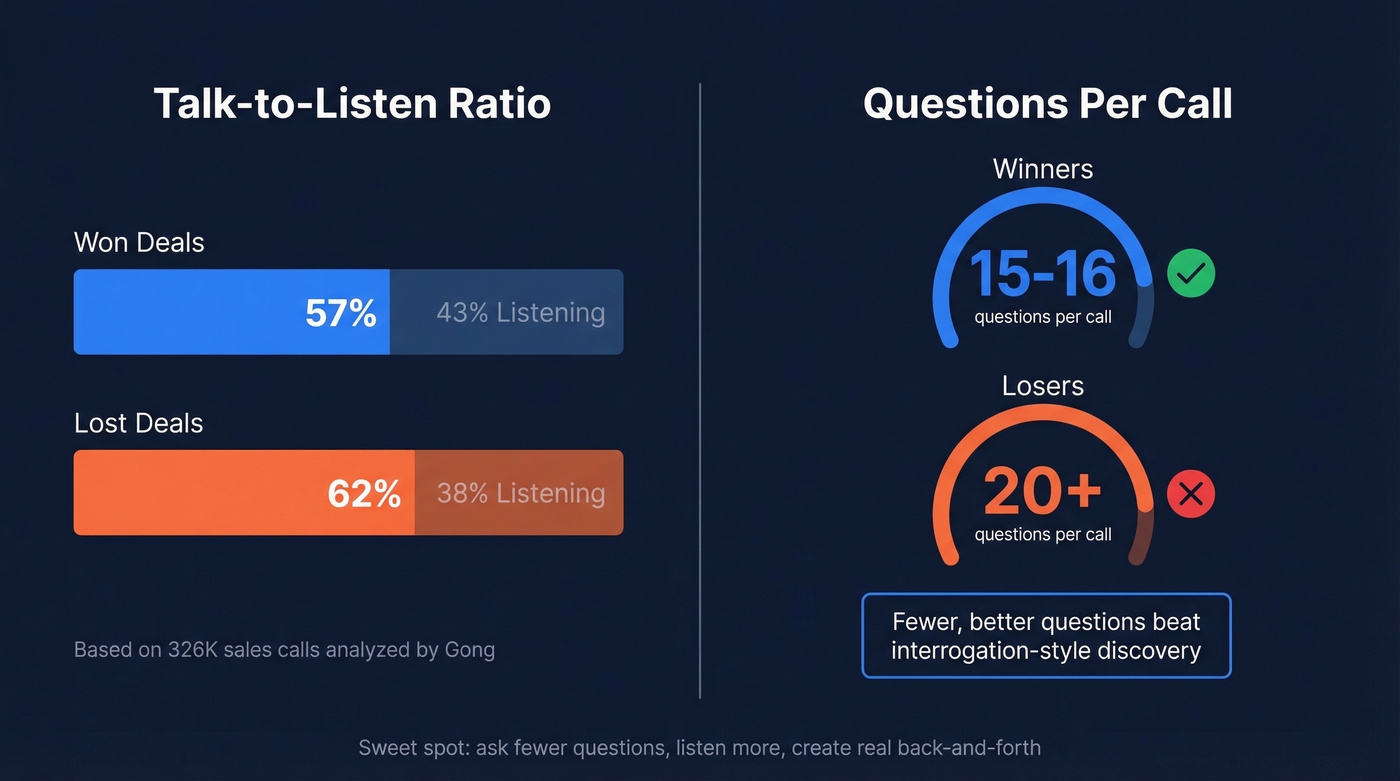
The question count data is equally revealing. Winning reps asked 15-16 questions per call. Losing reps asked around 20. Too many questions turns discovery into an interrogation, and the prospect shuts down. The sweet spot is fewer, better questions that create genuine back-and-forth rather than a checklist you're marching through.
Here's what separates top performers from everyone else: low performers' talk time swings wildly - 54% on won calls, 64% on lost ones. High performers stay consistent regardless of outcome. That consistency isn't a personality trait. It's a skill you can train.
One more data point worth internalizing: an analysis of 1.8M opportunities found that closed-won deals have roughly 2x as many buyer contacts as lost deals. If you're only talking to one person, you're not closing - you're hoping.

No closing technique saves a call that never connects. Prospeo's Mobile Finder gives you 125M+ verified mobile numbers with a 30% pickup rate - so every dial session starts with real conversations, not voicemails on disconnected lines.
Fix your data before you fix your pitch. Start for free.
Win Before You Dial
The fastest way to improve your close rate has nothing to do with your pitch. It's calling verified numbers at the right time.
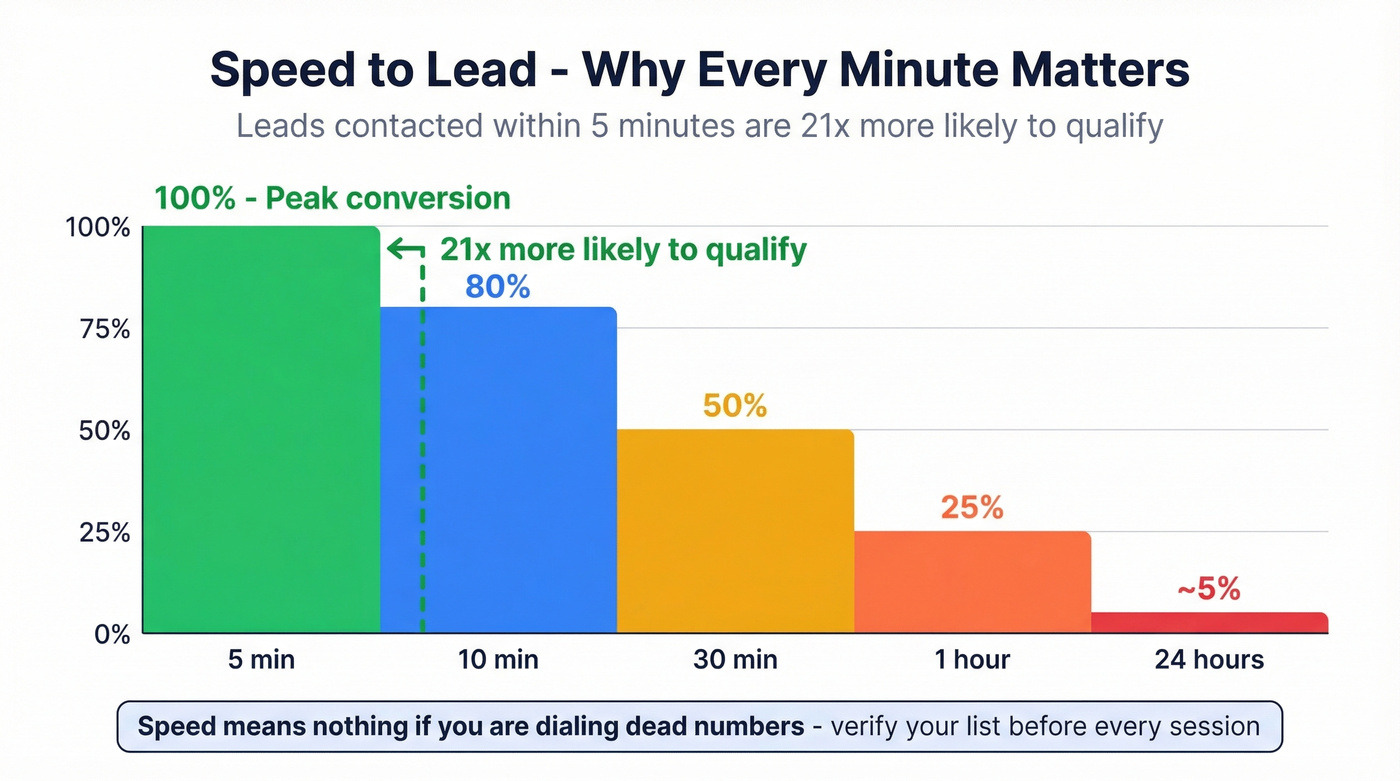
The Lead Response Management Study found that leads contacted within 5 minutes are 21x more likely to qualify than those contacted after 30 minutes. The falloff is steep: between 5 and 10 minutes you're at 80% of peak conversion, by 30 minutes you're at 50%, and after an hour you're at 25%.
But speed means nothing if you're dialing dead numbers. We've seen teams burn entire call blocks reaching voicemails on disconnected lines - reps grinding through 80 dials to get 6 conversations. That's not a technique problem. It's a data problem.
Run your list through Prospeo's Mobile Finder before your next dial session. It covers 125M+ verified mobile numbers with a 30% pickup rate, so you're spending more dials reaching real prospects instead of burning through disconnected lines.
7 Closing Techniques (With Exact Scripts)
Every technique below includes the exact words to say. If a technique doesn't come with a script, it doesn't belong in this article.
1. The Assumptive Close
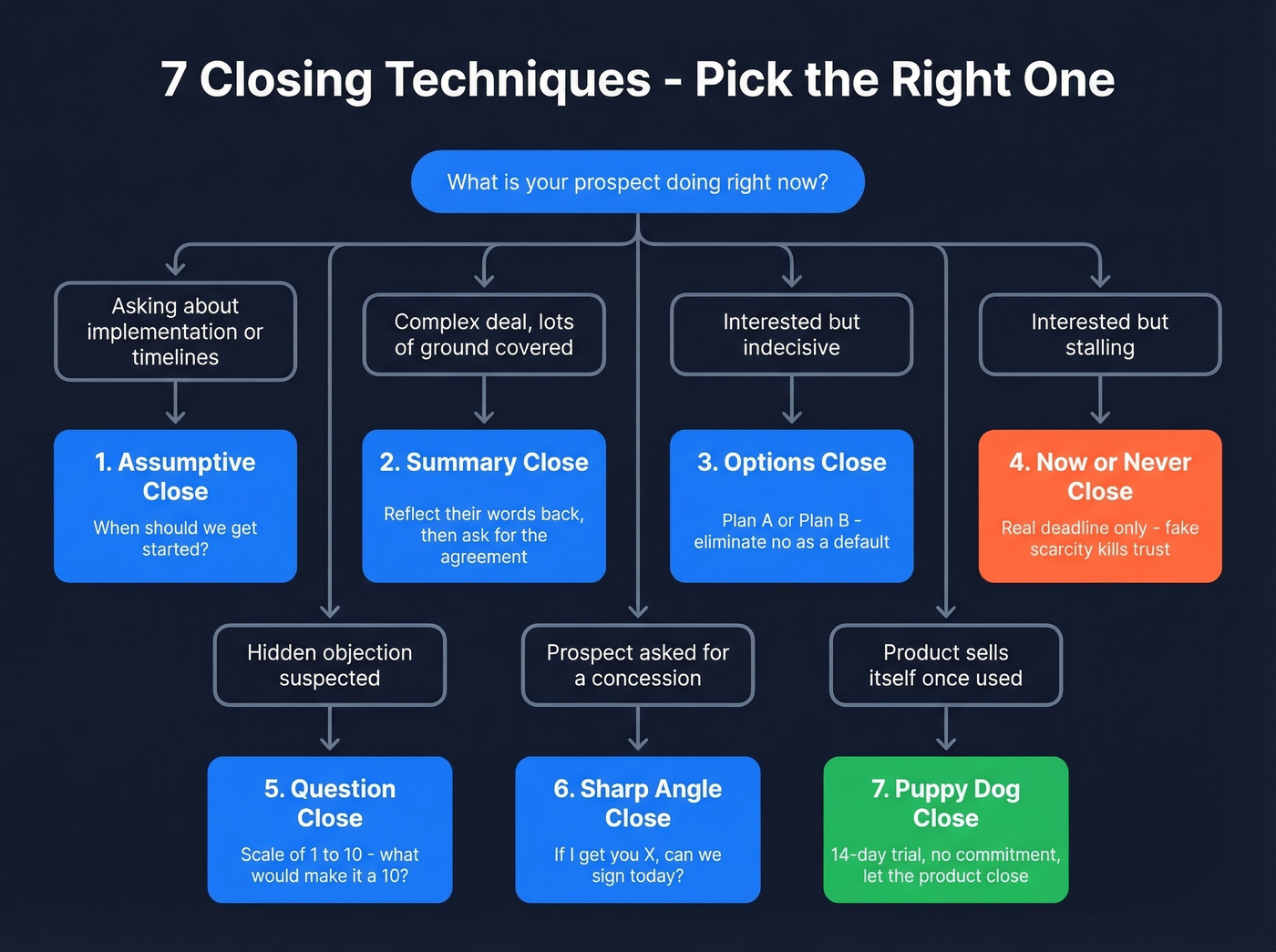
Use when you've heard clear buying signals throughout the call - the prospect's asking implementation questions, discussing timelines, or nodding along to pricing.
"When should we get started on implementation?" "To whose name should I make the invoice?"
This works because it skips the "should we?" question entirely. You're treating the decision as already made, which it often is. The prospect just needs someone to move them forward.
2. The Summary Close
This one earns its keep in complex, multi-stakeholder deals where the conversation has covered a lot of ground. You're not selling - you're reflecting their own words back at them.
"So we've covered [benefit 1], [benefit 2], and [benefit 3]. Based on what you've told me, [product] checks every box. Shall I send the agreement?"
3. The Options Close
Works when a prospect is interested but indecisive.
"Would you like to go with Plan A or Plan B?"
This eliminates "no" as a default response. One of the most consistently recommended techniques across sales methodologies because it reframes the decision from "yes or no" to "which one."
4. The Now-or-Never Close
Works when they're interested but stalling.
"We have a [X%] discount for those who sign by [date]. After that, standard pricing applies."
Only use this when the time-limited offer is real. Fake scarcity kills trust. Research shows that teams replacing manipulation tactics with data-backed proposals saw a 20% win-rate lift over two quarters. Real urgency works. Manufactured urgency backfires every time.
5. The Question Close
"Is there anything stopping us from moving forward today?" "On a scale of 1-10, how confident are you this solves [their problem]?"
The scale question is particularly useful. Anything below an 8 gives you an opening: "What would make it a 10?" Use this when you sense a hidden objection lurking beneath surface-level agreement.
6. The Sharp Angle Close
Your prospect just asked for a discount, an extra feature, or faster implementation. Don't give it for free.
"If I can get you [their request], can we sign today?"
This turns their ask into a commitment device. Trade concessions for a close. Every single time.
7. The Puppy Dog Close
"Let me set you up with a 14-day trial - no commitment. If it doesn't deliver [specific outcome], we part ways. Fair?"
This works best for products with strong activation metrics. If your product sells itself once people use it, lower the barrier to entry and let the experience do the closing.
Handling the 5 Stalls That Kill Deals
Before you rebut, diagnose. Cognism's framework draws a useful line between objections and obstructions. An objection is genuine uncertainty about your product - it deserves a thoughtful answer. An obstruction is an excuse to avoid action - it needs to be named and redirected.
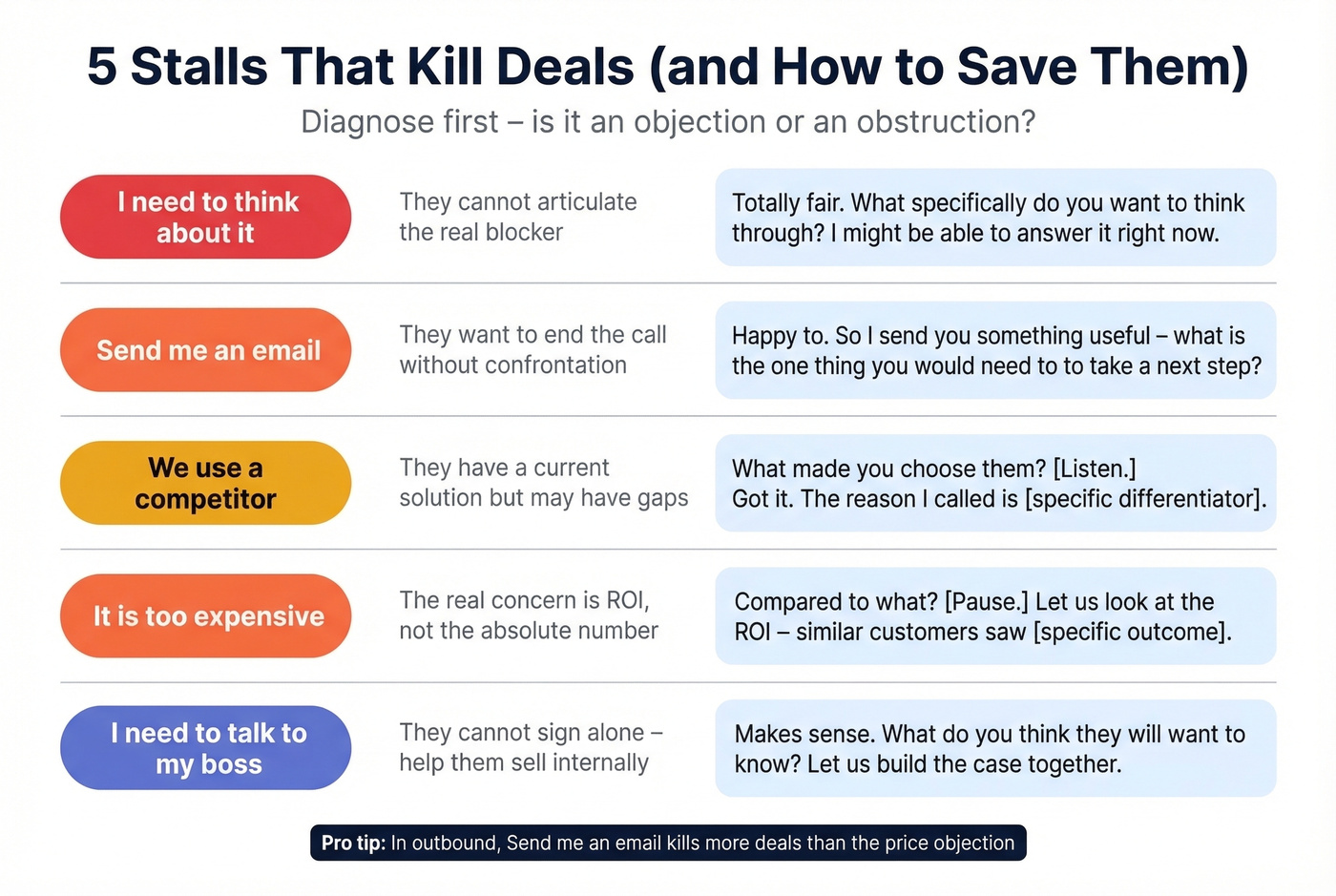
Here's the thing: in outbound, "send me an email" kills more deals than the price objection. Here are the five stalls we see most often, with exact rebuttals:
"I need to think about it." The buyer usually can't articulate what's holding them back. Try: "Totally fair. What specifically do you want to think through? I might be able to answer it right now."
"Send me an email." This almost always means "I want to end this call without confrontation." Try: "Happy to. So I send you something useful - what's the one thing you'd need to see to take a next step?"
"We're using a competitor." Try: "What made you choose them? [Listen.] Got it. The reason I called is [specific differentiator]."
"It's too expensive." The real concern is rarely the absolute number - it's whether the ROI justifies it. Try: "Compared to what? [Pause.] Let's look at the ROI - similar customers saw [specific outcome]." The pause after "Compared to what?" is critical. Silence forces the prospect to articulate their actual concern instead of hiding behind the sticker price.
"I need to talk to my boss." The prospect is telling you they can't sign alone. Help them sell internally. Try: "Makes sense. What do you think they'll want to know? Let's build the case together."
Mistakes That Tank Your Close Rate
In our experience working with outbound teams, these four mistakes destroy close rates more than any missing technique:
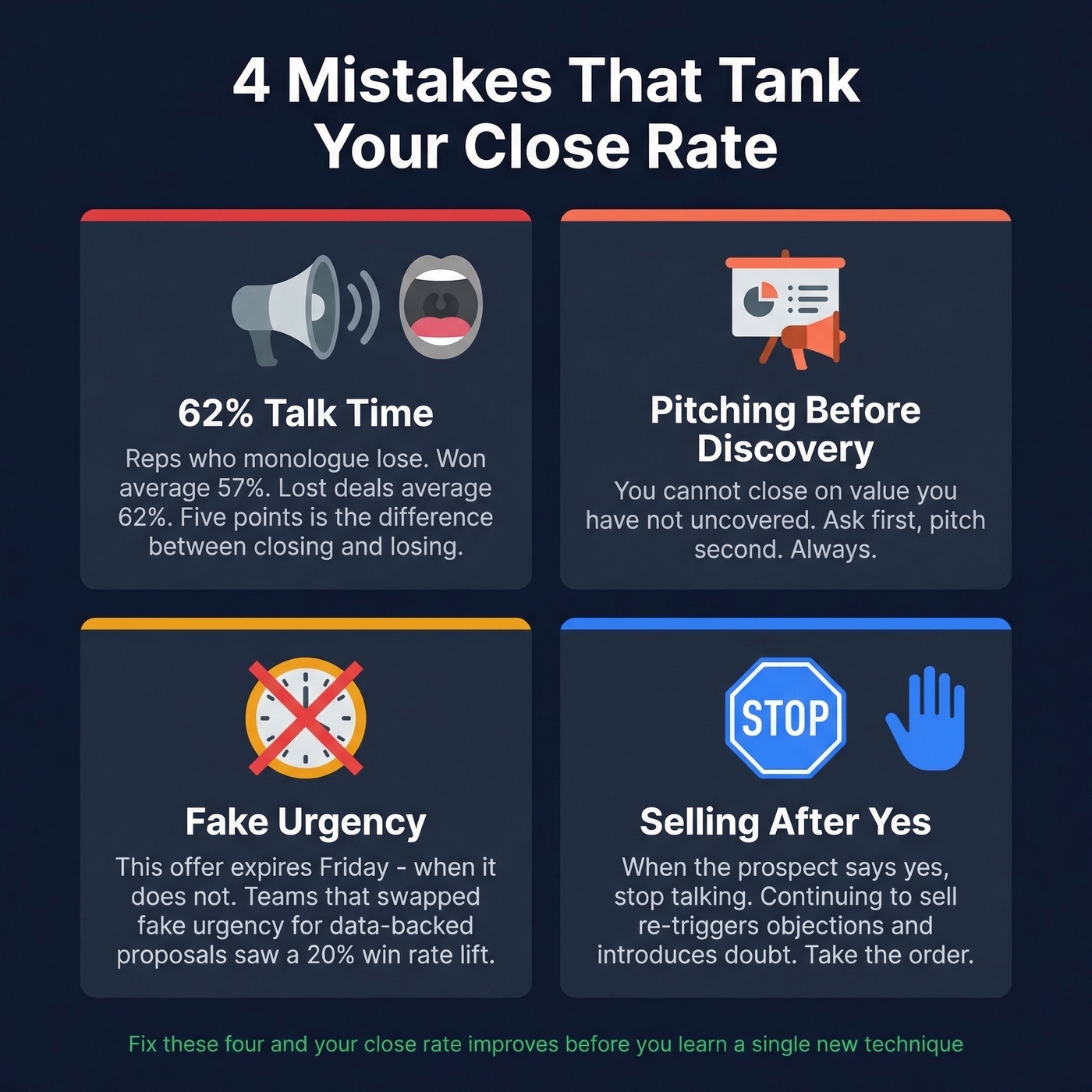
Talking too much. The 326K-call dataset is unambiguous - 62% talk time correlates with lost deals. If you're monologuing, you're losing.
Pitching before discovery. You can't close on value you haven't uncovered. Ask first, pitch second. (If you want a tighter structure, use a set of discovery questions that map to outcomes.)
Fake urgency. "This offer expires Friday" when it doesn't expire Friday. Buyers talk to each other. One documented case showed a 20% win-rate lift simply by swapping urgency-based CTAs for data-backed proposals.
Selling after yes. When the prospect says yes, stop talking. Continuing to sell re-triggers objections and introduces doubt. Take the order and shut up.
Let's be honest about something: if your average deal size is under $10K, you probably don't need a 7-step closing framework. You need faster speed-to-lead and better data. Most deals at that price point are lost before the call even starts - to slow follow-up, wrong numbers, and reps who never reach a decision-maker. Fix the upstream problem and the close takes care of itself.
If you're building a repeatable outbound motion, start with a real cold calling system and a consistent lead generation workflow so reps aren't improvising every day.
The 326K-call study proves it: more buyer contacts = more closed deals. Prospeo's 300M+ database with 30+ filters helps you map every stakeholder - direct dials and verified emails - so you're multi-threading deals instead of hoping one contact says yes.
Reach every decision-maker on the deal for $0.01 per email.
FAQ
How do I close a cold call?
The assumptive close works best when you've earned buying signals during discovery - use it to skip the "should we?" question entirely. For hesitant prospects, try the options close to reframe the decision from "yes or no" to "which option." On cold calls specifically, the sharp angle close converts a prospect's request into immediate commitment.
How many calls does it take to close a sale?
B2B deals typically require 5-8 touches before closing. The key variable isn't call count - it's speed. Leads contacted within 5 minutes are 21x more likely to qualify than those reached after 30 minutes, so prioritize response time over follow-up volume.
How do I improve my phone connect rate?
Start with data quality. If 30% of your numbers are disconnected, no dialing strategy helps. Verify numbers before you dial - tools that cross-reference mobile databases can cut your dead-number rate dramatically. Fix the data upstream and your connect rate improves immediately.
Which closing technique converts best?
The assumptive close and the sharp angle close consistently produce the highest conversion rates because both assume forward motion. But technique selection matters less than most reps think - the 326K-call dataset shows that talk-to-listen ratio and question quality predict outcomes more reliably than any single closing line.