

Pipeline and Launch Strategy: The Unified Playbook Nobody Wrote
You launched. The Product Hunt spike hit. Traffic surged for 72 hours - and then nothing converted.
Gartner research shows 84% of businesses struggle converting MQLs to SQLs, and the root cause is almost always the same: launch and pipeline are treated as separate problems when they're actually one motion. A unified pipeline and launch strategy fixes that disconnect by making the launch feed directly into pipeline creation, qualification, and conversion - not just brand awareness.
Here's the thing: if your average deal sits below $15K, you don't need a 90-day launch campaign. You need a tight 30-day sprint with verified data and three channels. The framework below scales in both directions.
What Is a Unified Pipeline and Launch Strategy?
Pipeline generation moves prospects from awareness through qualification to closed revenue. A product launch is a concentrated burst of attention around something new. Most teams run these on separate tracks with separate owners.
That's exactly where deals die.
A unified approach treats the launch as an accelerant for pipeline, not a marketing moment. The launch creates attention; the pipeline motion converts it. When both share the same ICP definition, the same messaging, and the same CRM tracking from day one, you stop losing the 72-hour attention window to handoff confusion between marketing and sales.
Right-Size Your Launch Effort
The biggest waste of pipeline resources is teams running a full-scale GTM motion for a minor feature update. We've seen companies burn six figures on webinar series for what should've been a changelog entry. Use a tiering model to match effort to impact.
| Tier | Launch Type | Pipeline Effort | Example |
|---|---|---|---|
| P0 | New product / major | Full GTM campaign | New platform launch |
| P1 | Significant feature | Customer-focused | Key integration release |
| P2 | Enhancement / fix | Low-touch comms | UI improvement, bug fix |
P2 launches need an email and a changelog entry. Save the heavy pipeline motion for P0s where the revenue upside justifies the investment.
The 30/60/90-Day Framework
This framework draws from the ARISE GTM methodology and what we've seen work across dozens of launch cycles.
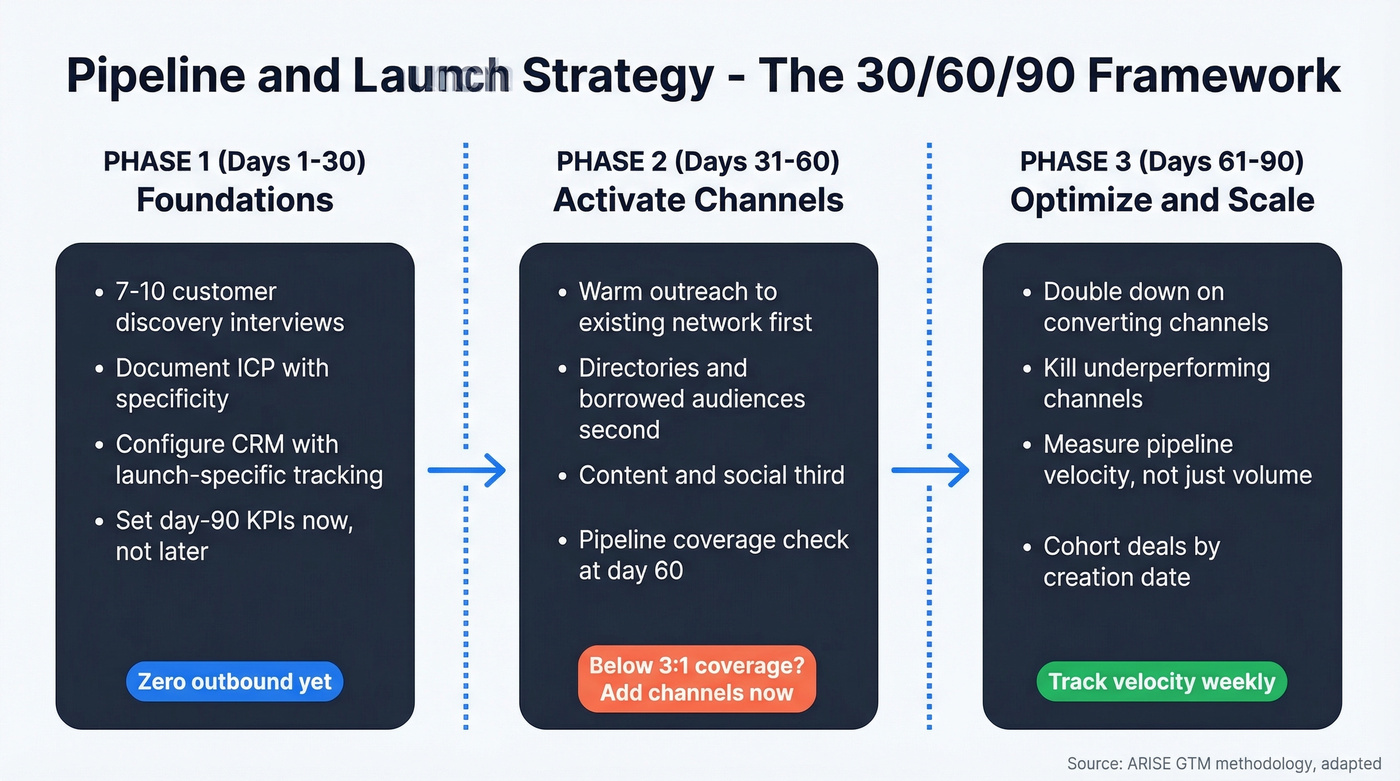
Days 1-30: Foundations
Research and setup, not outbound. Run 7-10 customer discovery interviews to validate messaging before spending a dollar on distribution. Document your ICP with enough specificity that a new SDR could build a target list without asking questions.
Get your CRM configured to track launch-specific pipeline from day one and set your day-90 KPIs now: target sign-ups, pipeline created, activation rate. Skip this step and you'll spend week six arguing about what "success" means instead of optimizing toward it.
Days 31-60: Activate Channels
Most teams blast one channel and hope. Instead, sequence your activation: warm outreach to your existing network first, then directories and borrowed audiences like podcast guesting and partner webinars, then content and social.
Build your launch prospect list using a verified data source - bad data is the fastest way to kill a launch campaign. One practitioner on r/startups described going from zero to 30 sign-ups in two months using exactly this sequence, adding early users to a community channel to create brand ambassadors who drove organic referrals.
Run a pipeline coverage check at day 60. Below 3:1 coverage against your launch quarter target? Activate additional channels immediately.
Worked example: A B2B SaaS team running a P0 launch with a $26K average deal size and a $780K quarterly target needs 3:1 coverage - that's $2.34M in pipeline by day 60. Assuming a 25% win rate, that $2.34M implies roughly 360 qualified opportunities ($2.34M / $26K / 0.25). If your warm outreach generated 30 by day 45, you need directories and borrowed audiences to do the heavy lifting fast.
Days 61-90: Optimize and Scale
By day 61, you've got enough data to know which channels convert and which burn budget. Double down on what's working. Kill what isn't - even if someone on the leadership team is emotionally attached to that webinar series nobody attends.
Measure pipeline velocity, not just volume. Using the same deal size and win rate, cutting your sales cycle from 90 days to 45 days doubles velocity even if opportunity volume stays flat. Cohort your deals by creation date so you see real conversion patterns, not snapshot metrics.

Your 30/60/90 framework falls apart without verified contact data. Prospeo's 300M+ profiles with 98% email accuracy and 7-day refresh cycle mean your launch outreach hits real buyers - not job-changers from six weeks ago. Meritt used it to triple pipeline from $100K to $300K/week.
Stop losing your launch window to bounced emails and dead leads.
Benchmarks That Matter
Most teams track vanity metrics during launches. These stage conversion benchmarks, drawn from Salesforce's State of Sales research, tell you if your pipeline is actually healthy.
| Stage | Benchmark |
|---|---|
| Lead to MQL | 39% |
| MQL to SQL | 38% |
| SQL to Opportunity | 42% |
| SQL to Closed Won | 37% |
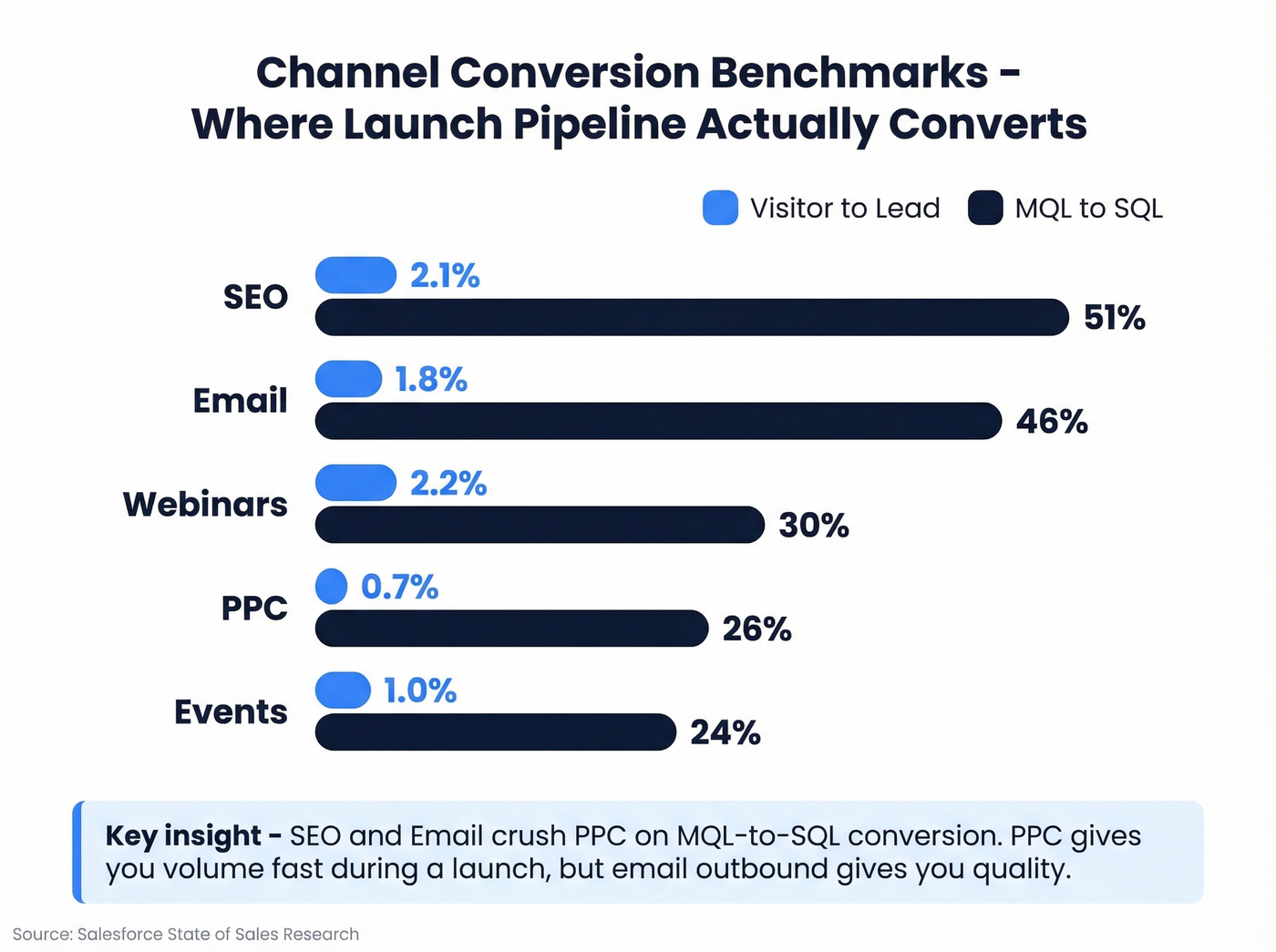
| Channel | Visitor to Lead | MQL to SQL |
|---|---|---|
| SEO | 2.1% | 51% |
| 1.8% | 46% | |
| Webinars | 2.2% | 30% |
| PPC | 0.7% | 26% |
| Events | 1.0% | 24% |
SEO and email crush PPC on MQL-to-SQL conversion. During a launch, PPC gives you volume fast, but email outbound gives you quality. Plan accordingly.
Pipeline Velocity Formula: (Opportunities x Avg Deal Value x Win Rate) / Sales Cycle Days
Example: (50 opps x $26,000 x 25%) / 75 days = $4,333/day
Track this weekly during your launch window. If velocity drops, you've got a conversion problem - not a volume problem. Pipeline coverage should sit at 3:1 to 4:1. Below 2.5x, you're in emergency generation mode.
Five Mistakes That Kill Launch Pipeline
These come from practitioners who've run B2B launches and watched them fail:
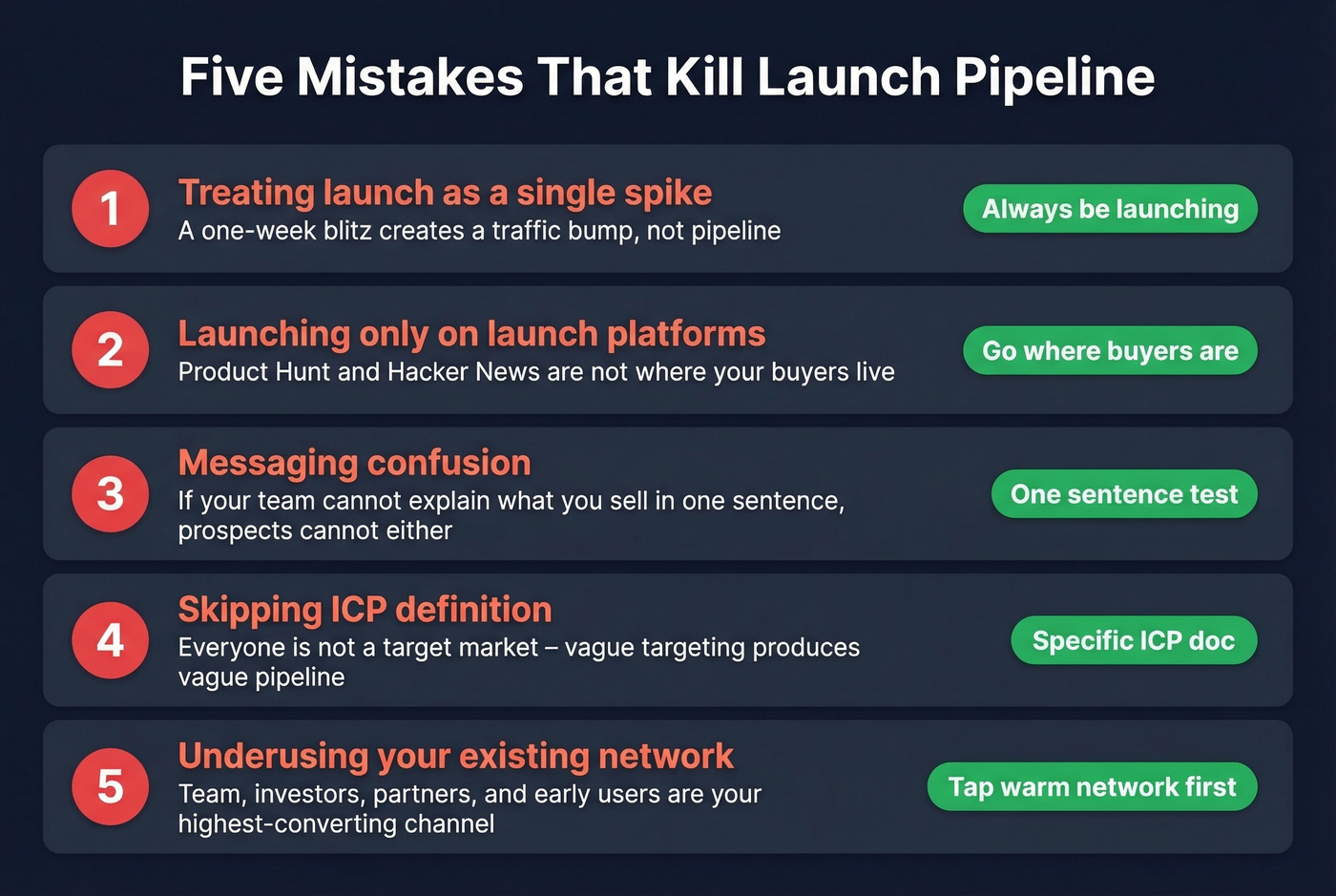
- Treating launch as a single spike. "Always be launching" beats a one-week blitz every time.
- Launching only on launch platforms. Product Hunt and Hacker News aren't where your buyers live.
- Messaging confusion. If your own team can't explain what you sell in one sentence, prospects can't either.
- Skipping ICP definition. "Everyone" isn't a target market. Vague targeting produces vague pipeline.
- Underusing your existing network. Your team, investors, partners, and early users are your highest-converting channel. Most teams barely tap them.
Build Your Launch Pipeline Stack
Your pipeline is only as good as your contact data. After switching to verified data, Meritt tripled their pipeline from $100K to $300K/week and dropped bounce rates from 35% to under 4%.
If you're seeing bounce rates creep up, fix deliverability before scaling volume (start with email bounce rate and a proper email deliverability guide).
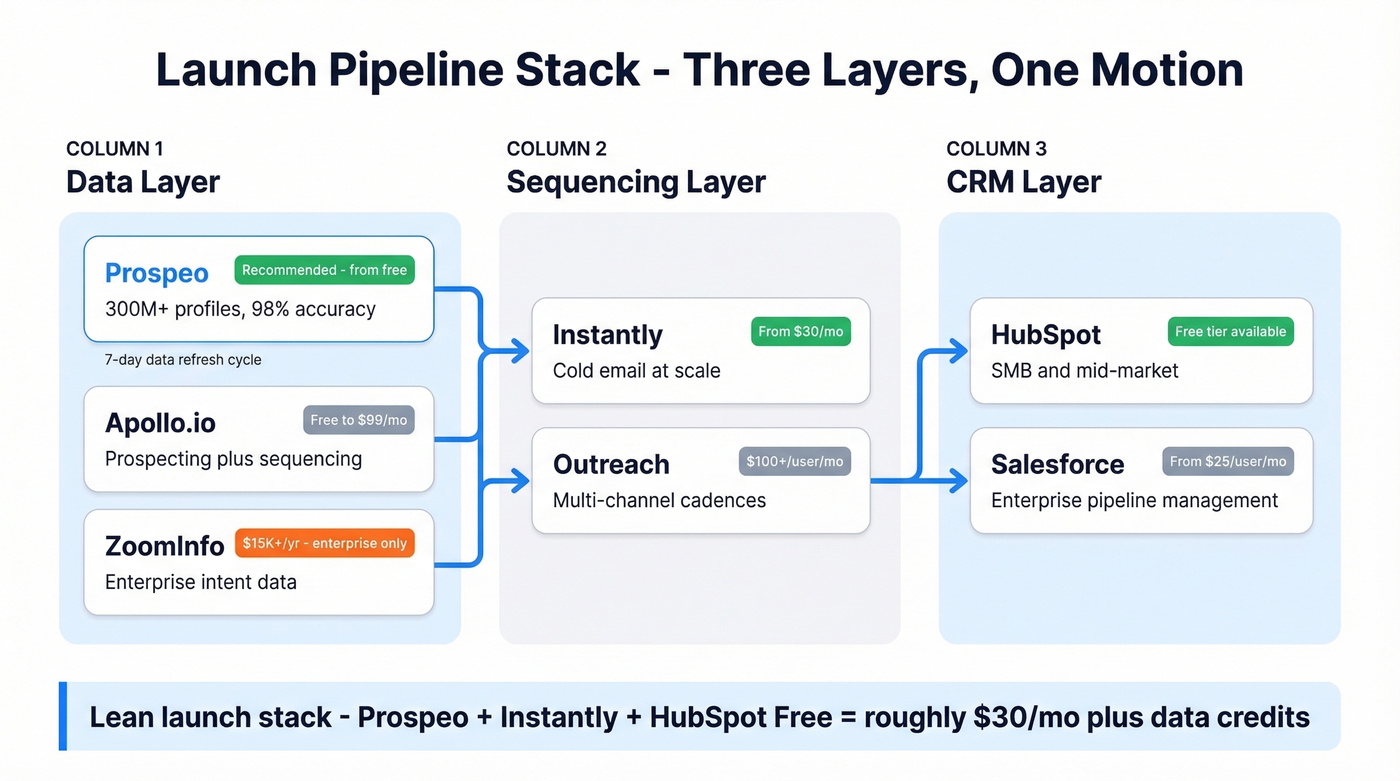
The stack breaks into three layers. For the data layer, Prospeo covers 300M+ professional profiles with 98% email accuracy and a 7-day refresh cycle. That refresh matters during a launch because stale data from a provider updating monthly means you're emailing people who changed jobs six weeks ago. The free tier gives you 75 verified emails per month to test, and paid plans run about $0.01 per email with no contracts.
| Layer | Tool | Starting Price | Best For |
|---|---|---|---|
| Data | Prospeo | Free; ~$0.01/email | 98% accuracy, launch lists |
| Data | Apollo.io | Free-$99/mo | Prospecting + sequencing |
| Data | ZoomInfo | $15K+/yr | Enterprise intent data |
| Sequencing | Instantly | From $30/mo | Cold email at scale |
| Sequencing | Outreach | ~$100+/user/mo | Multi-channel cadences |
| CRM | HubSpot | Free; paid from ~$20/mo | SMB/mid-market |
| CRM | Salesforce | From ~$25/user/mo | Enterprise pipeline mgmt |
You don't need all seven tools. A lean launch stack is Prospeo for data, Instantly for sequencing, and HubSpot's free CRM. Many teams run that for around $30/month plus usage-based data credits and still cover the full pipeline and launch strategy end to end. If you want more options, compare free lead generation tools and broader outbound lead generation tools. Skip ZoomInfo unless you're enterprise-scale with budget to match - for most launch teams, it's overkill.
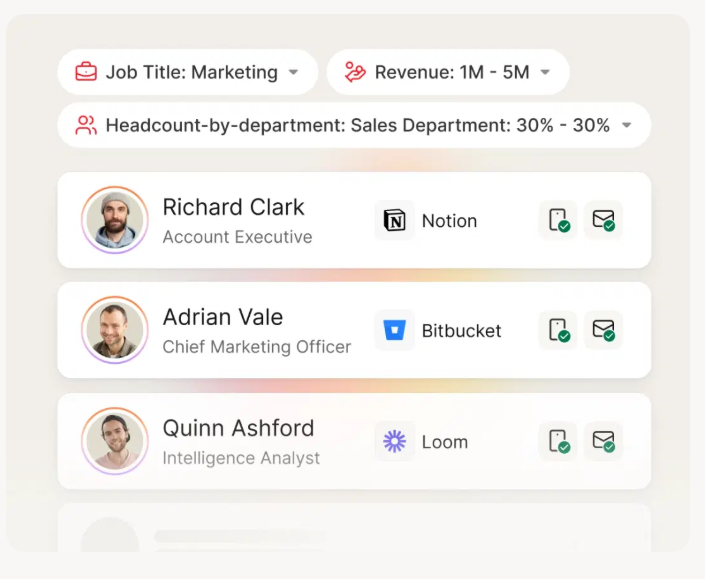
Hitting 3:1 pipeline coverage by day 60 requires volume and precision. Prospeo's 30+ ICP filters - buyer intent, technographics, headcount growth, funding - let you build launch-ready prospect lists at $0.01/email instead of burning budget on unqualified volume.
Build your 360-opportunity target list in minutes, not weeks.
FAQ
What's the difference between pipeline generation and lead generation?
Lead generation fills the top of the funnel with names. Pipeline generation qualifies and converts those leads through MQL, SQL, and opportunity stages into revenue. It's where deals actually close, not where lists get built.
How much pipeline coverage do I need for a launch?
Target 3:1 to 4:1 pipeline-to-quota coverage. Enterprise deals with six-month cycles often need 4-5x. Below 2.5x, activate additional outbound channels immediately - email outbound with verified data is the fastest lever you can pull.
How do I build a prospect list for a product launch?
Define your ICP first, then use a verified B2B database to filter by job title, industry, company size, and buyer intent. Verify every email before sending. A 35% bounce rate will torch your domain reputation and kill the campaign before it starts.