

How to Run Pipeline Calls That Don't Waste Everyone's Time
71% of senior managers say their meetings are unproductive. Pipeline calls are some of the worst offenders - they devolve into status updates nobody needs. The consensus on r/sales is blunt: "Just read the CRM." Here's the fix: a complete operating manual for pipeline calls that actually move deals forward.
Why Most Pipeline Calls Are Broken
The typical pipeline call goes like this: a manager opens Salesforce, picks a deal, asks "what's the latest?" The rep narrates for five minutes. The manager says "sounds good, keep me posted." Repeat for 90 minutes. Nothing changes.
This is the "CRM Police" trap - managers interrogating reps on data they could've read themselves. One Reddit thread from a former CRO put it bluntly: these meetings are "busywork" that exist because leaders don't want to read CRM entries. Reps over-commit to hit board numbers, managers feel informed without actually helping, and the deals themselves don't move an inch.
The fix isn't fewer meetings. It's better ones.
What Is a Pipeline Call?
A pipeline call is a coaching conversation about deal health - not a forecast call. This distinction matters more than most teams realize, and collapsing the two into one meeting is the single fastest way to ruin both.
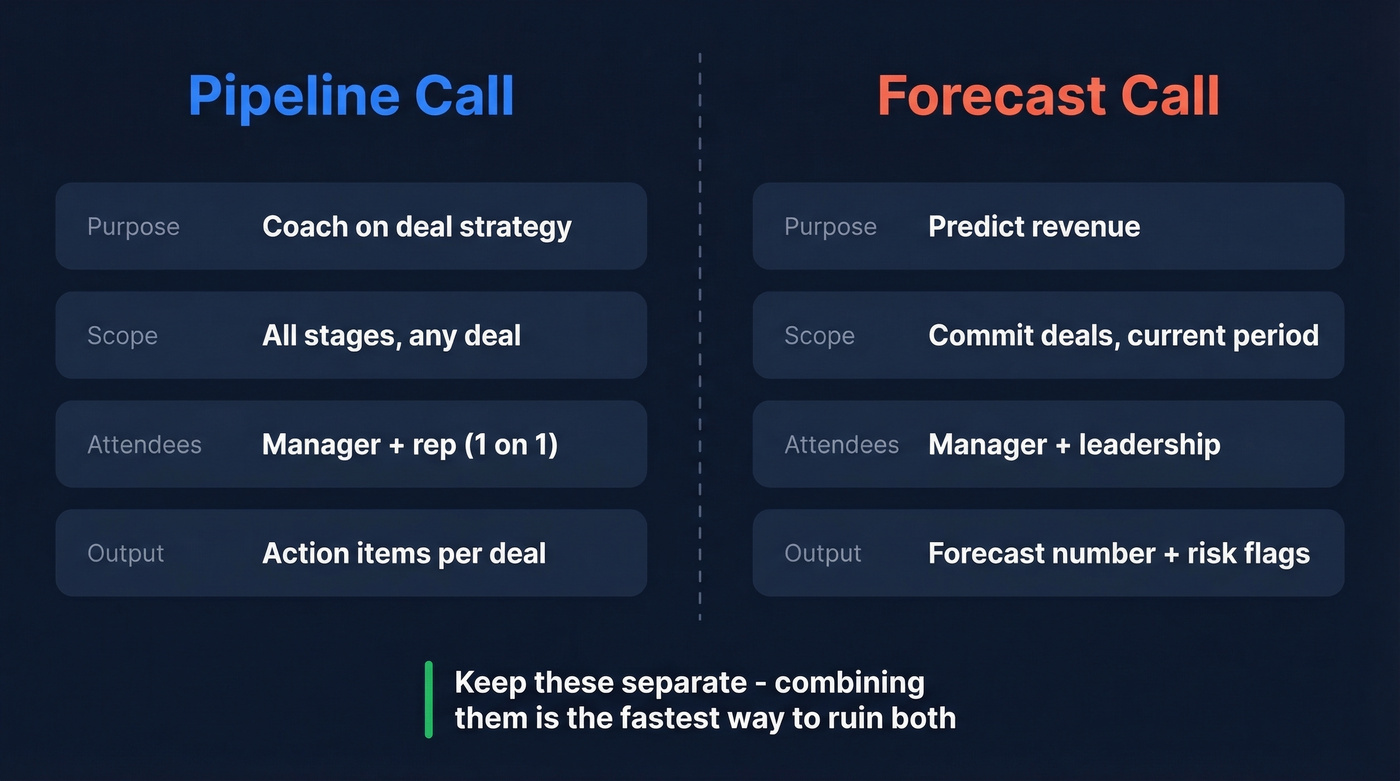
| Pipeline Call | Forecast Call | |
|---|---|---|
| Purpose | Coach on deal strategy | Predict revenue |
| Scope | All stages, any deal | Commit deals, current period |
| Attendees | Manager + rep (1:1) | Manager + leadership |
| Output | Action items per deal | Forecast number + risk flags |
Pipeline call = coaching. Forecast call = numbers. Keep them separate.
The Operating Rhythm
Not every pipeline conversation needs the same format. Here's the cadence that works for most B2B teams:
| Cadence | Duration | Attendees | Focus |
|---|---|---|---|
| Weekly 1:1 | 30-45 min | Manager + rep | 3-5 deals deep, action items |
| Bi-weekly team | 60-90 min | Full team | 2-3 shared deals, peer learning |
| Monthly forecast | 90-120 min | Leadership + managers | Commit + coverage |
| Quarterly planning | Half-day | Sales leadership + RevOps | Strategic health + capacity |
Early-stage companies should run weekly 1:1s and a bi-weekly team review. Mature orgs add the monthly forecast and quarterly planning layers. Don't collapse these into one mega-meeting - each cadence has a different purpose, and combining them is exactly how reviews become two-hour marathons that accomplish nothing.
How to Run a 30-Minute Review
This structure draws from the 30 Minutes to President's Club playbook. Pipeline reviews "are not story time." Done right, you can rip through 10 deals in half an hour.
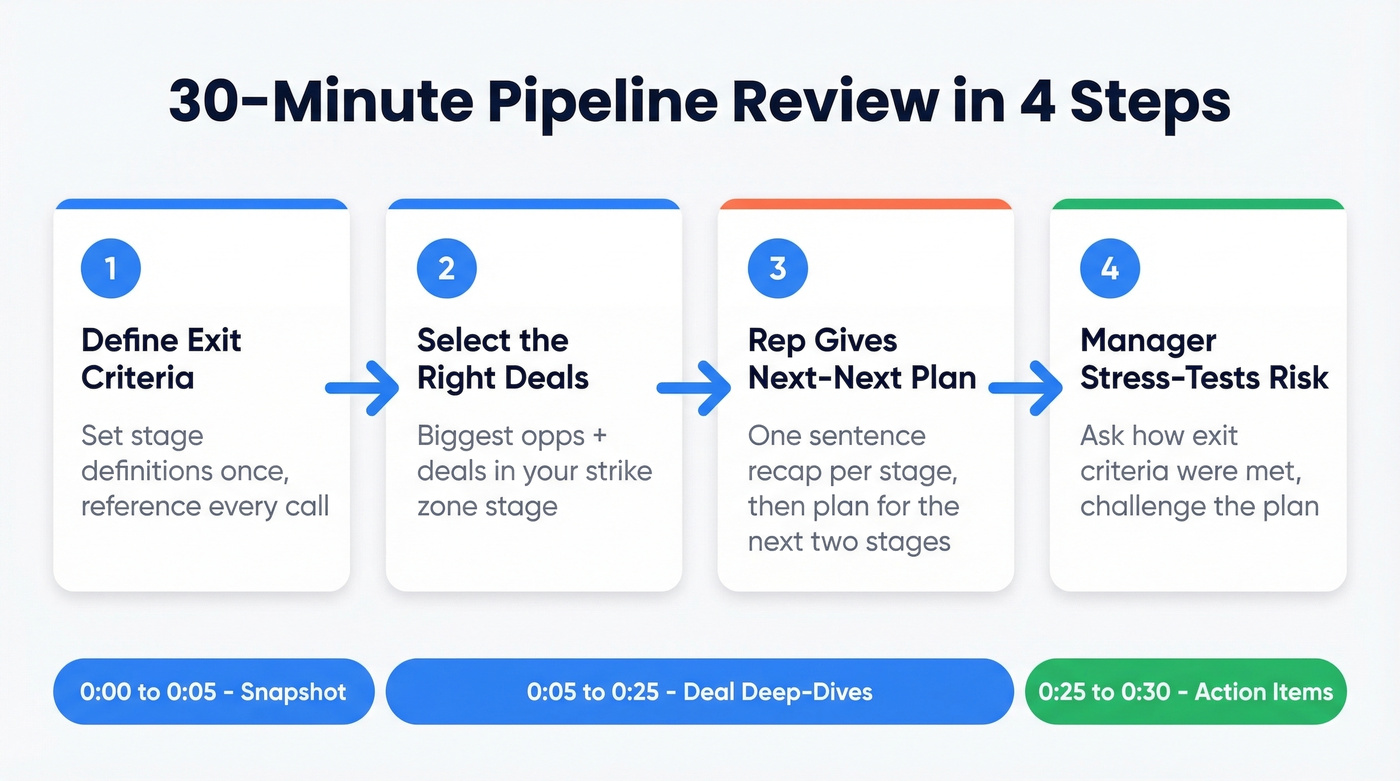
Step 1: Define your sales stages and exit criteria once, then reference them every call.
Step 2: Select the right deals - biggest opportunities plus deals in your "strike zone" stage where deals are won or lost.
Step 3: Rep gives a one-sentence recap per stage, then explains the plan for the next two stages ("next-next").
Step 4: Manager asks questions focused on risk - how exit criteria were met and whether the next-stage plan holds up.
Copy-Paste Agenda Template
0:00-0:05 - Pipeline snapshot: new deals, moved stages, stalled deals since last week
0:05-0:25 - Deal deep-dives: 3-5 deals, one-sentence recap + next-next plan, manager questions on risk
0:25-0:30 - Action items: one clear next step per deal reviewed, owner assigned
Exit Criteria by Stage
Without shared exit criteria, every rep defines "Stage 2" differently. We've seen teams where one rep's "Proposal" is another rep's "Discovery." Pin it down.
| Stage | Exit Criteria |
|---|---|
| Discovery | Qualified persona, problem agreement, next step booked |
| Demo | Solution agreement from the evaluator |
| Multithreading | Problem-solution agreement from economic buyer |
| Proposal | Agreement the problem is worth the price |
| Vendor Review | Legal + security complete, signed contract |
The Create-Advance-Close Balance
Most pipeline reviews obsess over closing. That's how you end up with a great Q3 and an empty Q4.
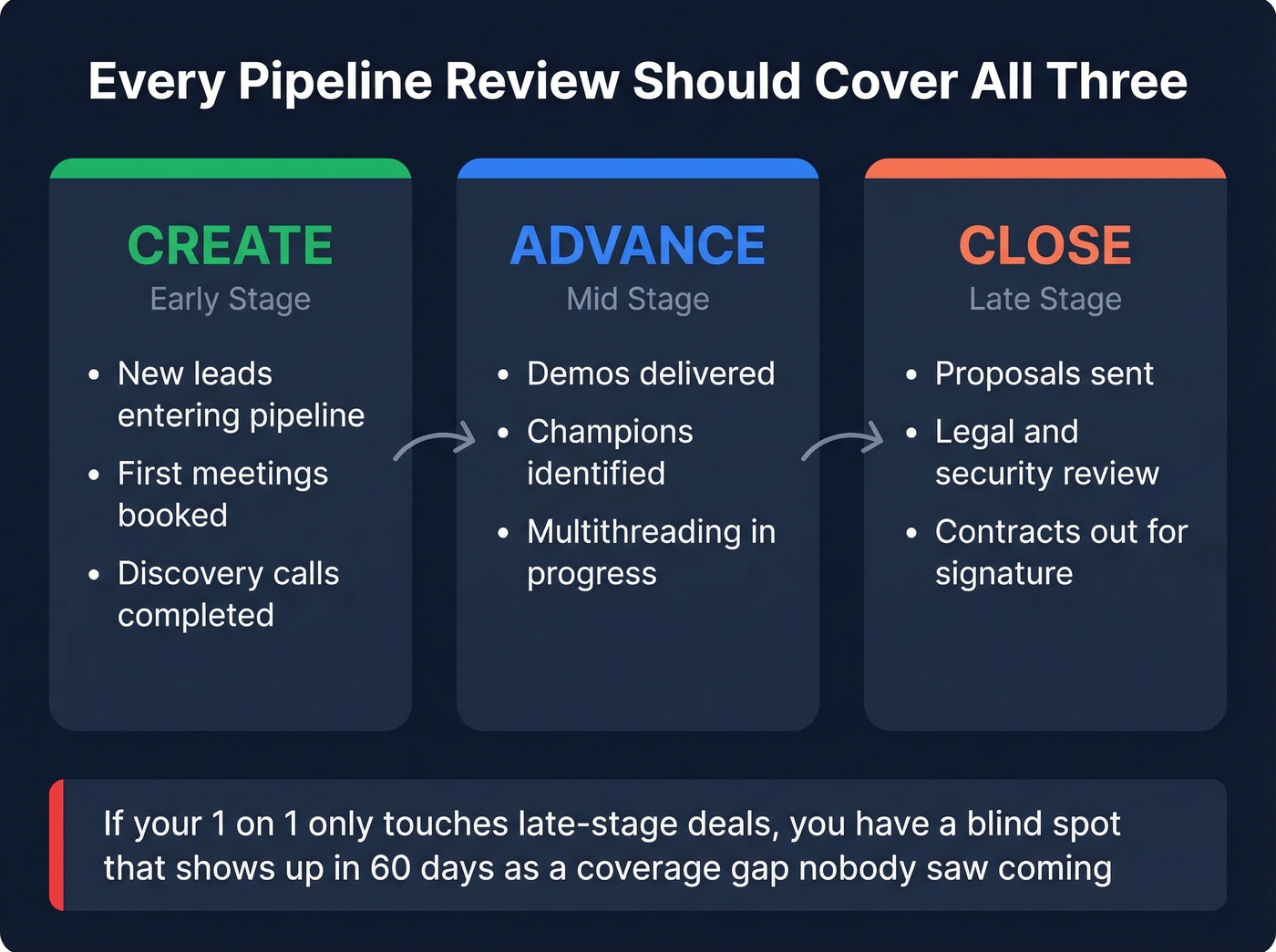
Every review should cover deals you're creating (early stage), advancing (mid-stage), and closing. If your 1:1 only touches Stage 3+ deals, you've got a blind spot that'll show up in 60 days as a coverage gap nobody saw coming.

Your pipeline review is only as good as the data behind it. Prospeo's 7-day refresh cycle eliminates phantom pipeline - no more coaching on deals where the contact left the company six weeks ago. 98% email accuracy means the leads in your CRM are real buyers, not dead ends.
Stop reviewing pipeline built on stale data.
20 Questions That Actually Help
Stop Asking These
These are "CRM Police" questions - the kind that make reps dread pipeline calls:
- "Is the close date up to date?"
- "Did you email them back?"
- "What stage is the deal in?"
- "Do we have a champion?"
- "What's the probability of this closing?"
If you need these answers, read the CRM before the call.
Start Asking These
Validation: Why would they buy now rather than do nothing? What business problem are they solving - in their own words? Who loses political capital if this project fails?
Process: Walk me through legal/procurement step-by-step. Have they bought software like this before? What's the mutual action plan for this week?
Risk: What's the one objection they haven't said out loud yet? If we lose, who do we lose to and why? These risk-focused questions are where the real coaching happens - you're stress-testing assumptions rather than confirming what you already believe.
Commitment: Has the economic buyer explicitly said yes to the price? What's the next micro-commitment we're asking for today?
Weekly pulse: Where's real momentum vs. stuck? What changed in the buyer's context since last week? What cross-functional help do you need?
Benchmarks to Reference
These numbers give your pipeline calls a shared baseline so conversations aren't just vibes:
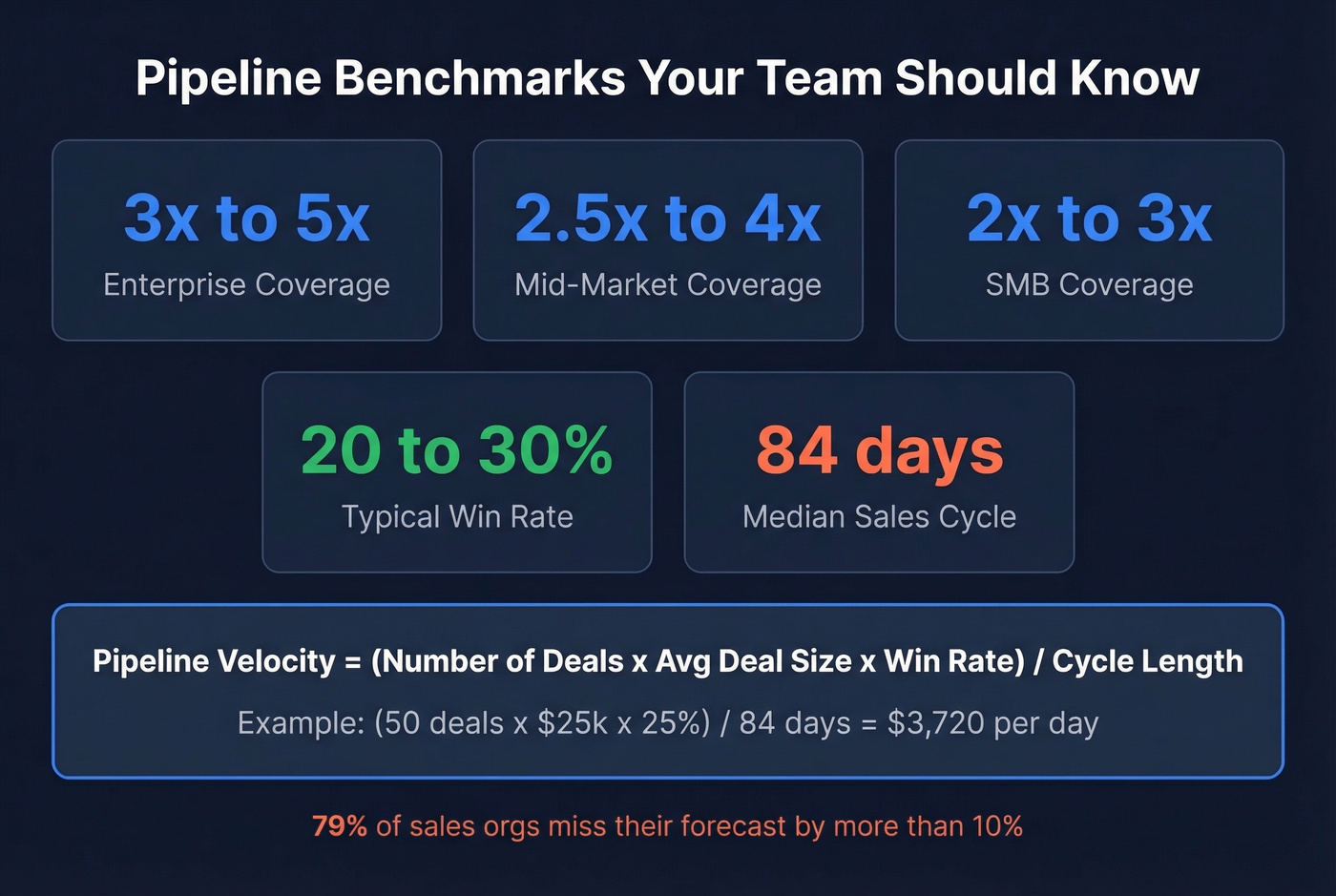
| Metric | Benchmark |
|---|---|
| Pipeline coverage (Enterprise) | 3x-5x |
| Pipeline coverage (Mid-market) | 2.5x-4x |
| Pipeline coverage (SMB) | 2x-3x |
| Typical win rate | 20-30% |
| Median sales cycle | 84 days |
Pipeline velocity formula: (# deals x avg deal size x win rate) / cycle length. A team with 50 deals at $25k average, 25% win rate, and 84-day cycle runs about $3,720/day in pipeline velocity. If that number drops week over week, something's broken - and your weekly review should surface what.
Let's be honest: 79% of sales orgs miss their forecast by more than 10%. Weekly pipeline inspection won't eliminate that gap. But in our experience, teams that run disciplined reviews catch problems 2-3 weeks earlier than teams that don't - and in B2B sales, 2-3 weeks is the difference between saving a deal and writing a post-mortem.
Why Bad Data Kills Pipeline Calls
You can run a perfect 30-minute framework and still waste everyone's time if the underlying data is garbage. People change jobs, get promoted, leave companies. That creates phantom pipeline: deals that look alive in your CRM but are actually dead because the champion left, the email bounces, or the direct dial is disconnected.
I've watched teams spend entire pipeline calls strategizing on deals where the primary contact hadn't been at the company for three months. Nobody checked. The CRM showed green.
The fix is running your open deals through enrichment before Monday's call. Upload your open opportunity contacts as a CSV, verify who's still there, flag the ones who've moved. Prospeo returns contact data on 83% of leads with 98% email accuracy and a 7-day data refresh cycle - that 10-minute pre-call step eliminates phantom deals and gives your reps real intelligence to work with instead of stale records. If you want options, compare data enrichment services before you commit.

Five Common Mistakes to Avoid
1. The CRM Police trap. You're interrogating, not coaching. Fix: ban data-validation questions. If it's in the CRM, read it before the call.
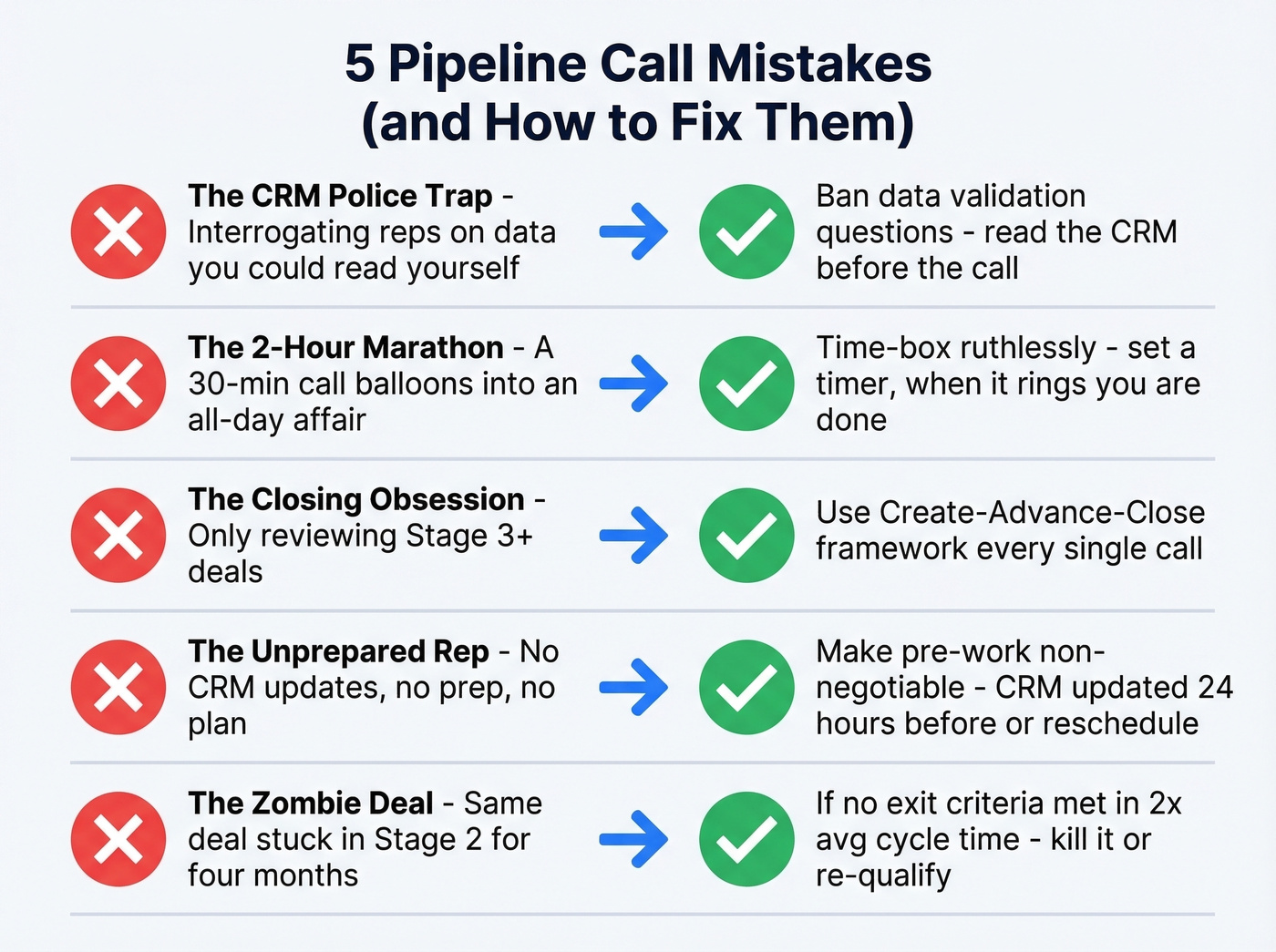
2. The 2-hour marathon. A 30-minute 1:1 balloons into an all-day affair. Fix: time-box ruthlessly. Set a timer. When it rings, you're done.
3. The closing obsession. You only review Stage 3+ deals and ignore early pipeline. Fix: use the Create-Advance-Close framework every call.
4. The unprepared rep. No CRM updates, no prep, no plan. Fix: make pre-work non-negotiable. If the CRM isn't updated 24 hours before the call, reschedule. No exceptions. (If your team needs structure, use a 30-60-90 day plan to set expectations.)
5. The unchallenged stale deal. Same account sitting in Stage 2 for four months and nobody questions it. Fix: if a deal hasn't met exit criteria in 2x the average cycle time, it's dead. Kill it or re-qualify it. Keeping zombie deals around just inflates your coverage ratio and gives everyone a false sense of security.
If you're seeing this pattern across the board, it's usually one of the classic sales pipeline challenges (not a rep problem).
Bad data creates phantom pipeline that wastes every minute of your weekly 1:1. Prospeo verifies 300M+ profiles through a 5-step process and refreshes records every 7 days - not every 6 weeks like competitors. Your reps coach on real deals with real contacts.
Kill phantom pipeline before your next review.
FAQ
How often should you run pipeline calls?
Weekly 1:1s at 30 minutes for deal coaching, bi-weekly team reviews for shared learning, monthly forecast reviews for leadership. Don't combine them - each cadence serves a distinct purpose.
How many deals should you review per call?
Three to five for a 30-minute 1:1. If you're covering 10+, use the one-sentence-per-stage format and deep-dive on only two or three high-risk opportunities.
What's the difference between a pipeline call and a forecast call?
Pipeline calls coach on deal strategy at any stage. Forecast calls predict revenue for the current period. Combining them is the single most common reason both feel useless.
How do you prevent stale data from derailing reviews?
Run open opportunity contacts through a data enrichment tool before each call. A 10-minute CSV upload flags job changes and bounced emails, eliminating phantom deals from your CRM before anyone wastes time strategizing on them.