

Pipeline Risk Management: What Every Integrity Engineer Needs in 2026
In 2010, a 30-inch pipeline ruptured near Michigan's Kalamazoo River and dumped nearly 3 million liters of heavy crude into the watershed. The operator's safety management system was later found deficient - a textbook case of pipeline risk management failure that cost over a billion dollars in cleanup alone. Fifteen years later, the fundamentals haven't changed: roughly a third of pipeline threats still go undetected until something breaks, and the average significant U.S. pipeline incident exceeds $1.3M in direct costs.
Analysis of 12,182 U.S. pipeline incidents from 1970-2023 confirms that time-independent hazards - third-party damage, equipment failure - remain as dangerous as corrosion. If your program hasn't evolved past index scoring, you're running out of runway.
The Short Version
Know the four methodology tiers (qualitative through probabilistic) and honestly assess where your program sits today. Understand the three 2025 PHMSA regulatory actions that directly affect your compliance posture. And start with semi-quantitative modeling broadly, then invest in probabilistic analysis for HCAs. Data quality is the #1 bottleneck. Not software.
What Is Pipeline Risk Management?
Pipeline risk management is the systematic process of identifying, quantifying, and mitigating threats to pipeline integrity across the full asset lifecycle - from design and construction through operations and eventual decommissioning. The core equation: Risk = Probability of Failure (PoF) x Consequence of Failure (CoF). Outputs range from failures per mile per year to dollars per mile per year, depending on model sophistication.
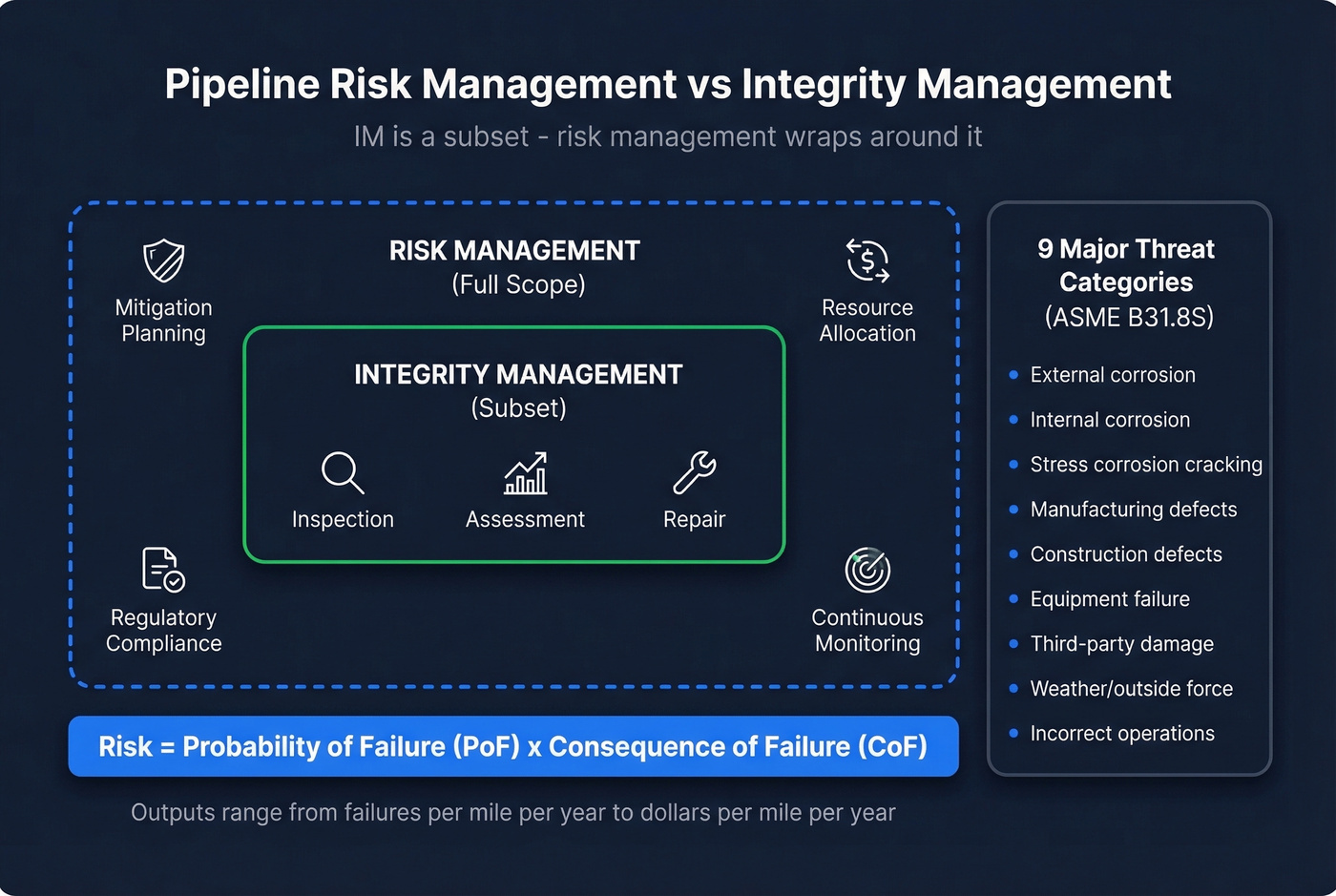
Don't confuse this with integrity management. IM is a subset - it covers inspection, assessment, and repair. Risk management wraps around IM and adds mitigation planning, resource allocation, regulatory compliance, and continuous monitoring. Most credible programs cover nine major threat categories aligned with ASME B31.8S.
Risk Assessment Methodologies
Four tiers of risk modeling exist. Most operators sit in the middle two.
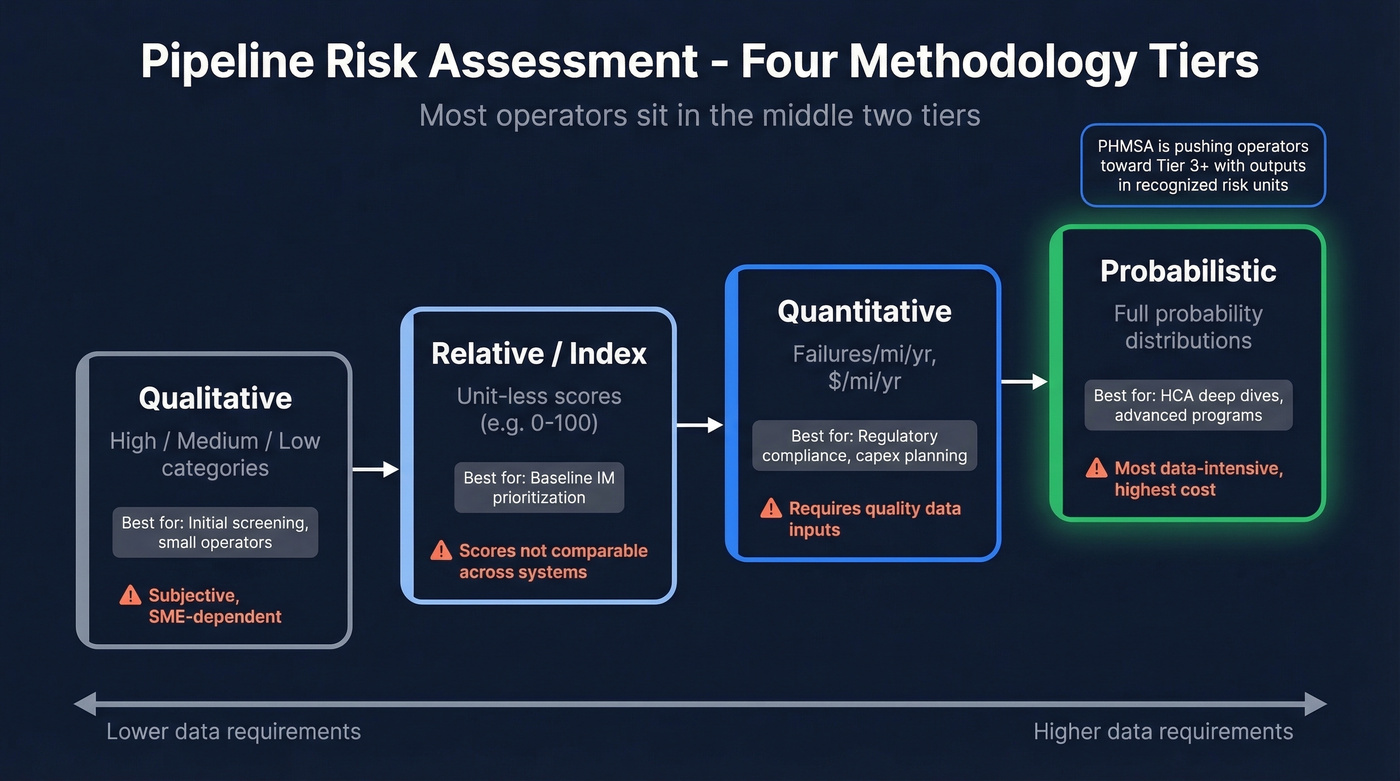
| Method | What It Produces | Best For | Limitation |
|---|---|---|---|
| Qualitative | High/medium/low categories | Initial screening, small operators | Subjective, SME-dependent |
| Relative/Index | Unit-less scores | Baseline IM prioritization | Not true risk units; can't compare across systems |
| Quantitative | Failures/mi/yr, $/mi/yr | Regulatory compliance, capex planning | Requires quality data inputs |
| Probabilistic | Probability distributions | HCA deep dives, advanced programs | Most data-intensive, highest cost |
Index models were the workhorse for baseline IM rule compliance, and many operators still rely on them. The problem: unit-less scores don't translate to actual risk. You can't compare a "score of 78" on one system to a "score of 62" on another and make a defensible capital allocation decision.
Quantitative models fix this. One operator received an ILI report flagging roughly 1,400 features as "required repair." After updating their fitness-for-service methodology - moving from Charpy V-notch toughness to direct fracture toughness inputs - they reduced the repair plan to a manageable number of genuinely active threats. That's the difference between spending millions on unnecessary digs and targeting real risk.
Here's a useful gut check for any model: can you point to a spot on the map and explain why it's high-risk in terms an operator would accept? If your model can't pass that test, it isn't ready for decision-making.
PHMSA's technical guidance on pipeline risk modeling is consistent on this point: operators are being pushed toward more rigorous, quantitative risk assessment with outputs in recognized risk units, not just relative scores.

Reaching pipeline integrity engineers and PHMSA compliance decision-makers starts with accurate contact data. Prospeo gives you 300M+ verified profiles with 30+ filters - search by job title, company size, technographics, and even buyer intent across 15,000 topics. At 98% email accuracy, your outreach actually lands.
Stop guessing who manages pipeline risk - find them in seconds.
2026 Regulatory Picture
Three PHMSA actions in 2025 reshaped the compliance landscape for this year.
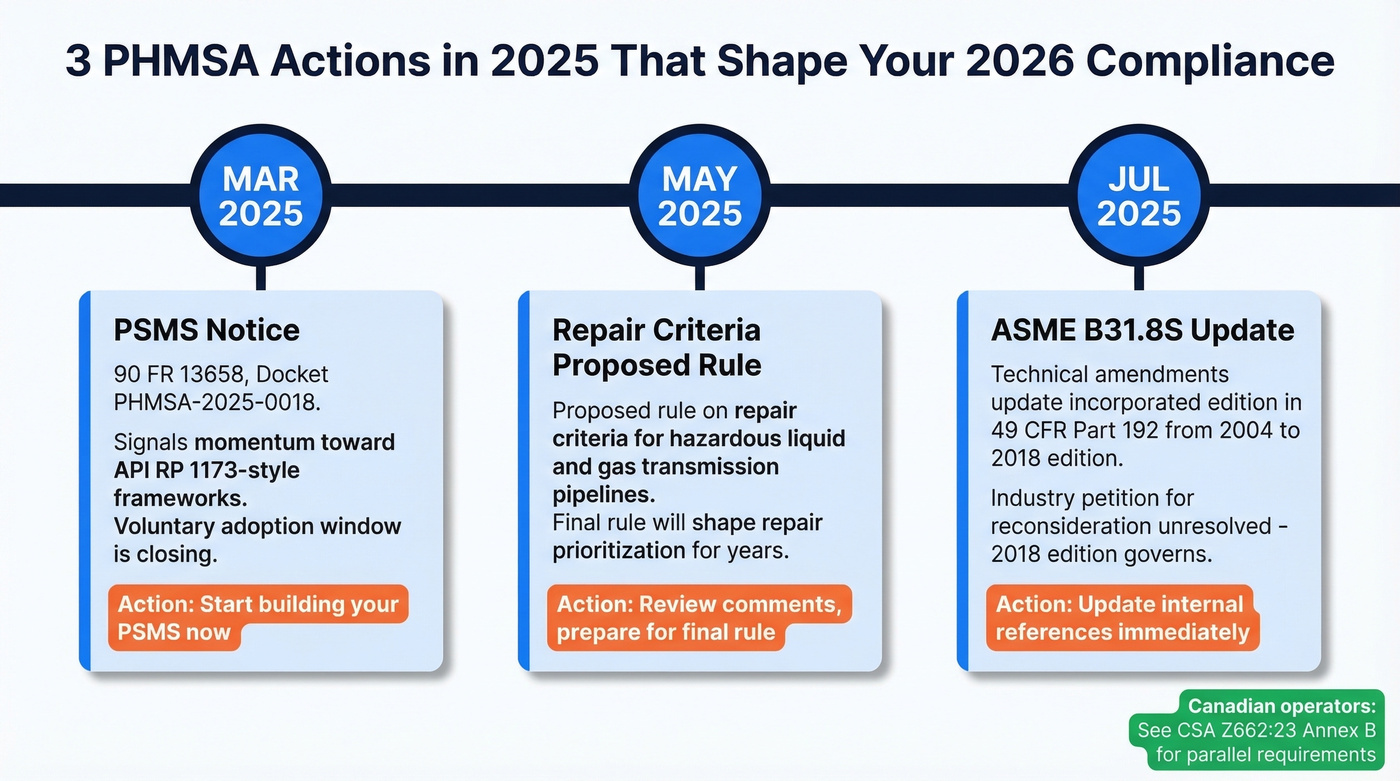
PSMS notice. PHMSA published a Pipeline Safety Management System notice in March 2025 (90 FR 13658, Docket PHMSA-2025-0018), signaling continued momentum toward API RP 1173-style frameworks. If you haven't started building a PSMS, the window for voluntary adoption is closing.
ASME B31.8S update. In technical amendments dated July 1, 2025 (amending PHMSA's April 29, 2024 final rule), the incorporated edition of ASME B31.8S in 49 CFR Part 192 was updated from 2004 to the 2018 edition, with references including SS192.714 and SS192.933 updated for consistency. INGAA, GPA Midstream, and API filed a petition for reconsideration dated May 29, 2024, but until that's resolved, the 2018 edition governs. Update your internal references now.
Repair criteria proposed rule. PHMSA issued a proposed rule on repair criteria for hazardous liquid and gas transmission pipelines in May 2025. The comment period drew significant industry attention, and the final rule will likely shape repair prioritization frameworks for years.
Canadian operators face parallel requirements under CSA Z662:23 Annex B, which follows a similar data-to-assessment-to-treatment workflow.
Moving From Qualitative to Quantitative
You don't need to go fully probabilistic overnight. The practical path is semi-quantitative modeling applied broadly across your system, with probabilistic deep dives reserved for HCAs and high-consequence segments.
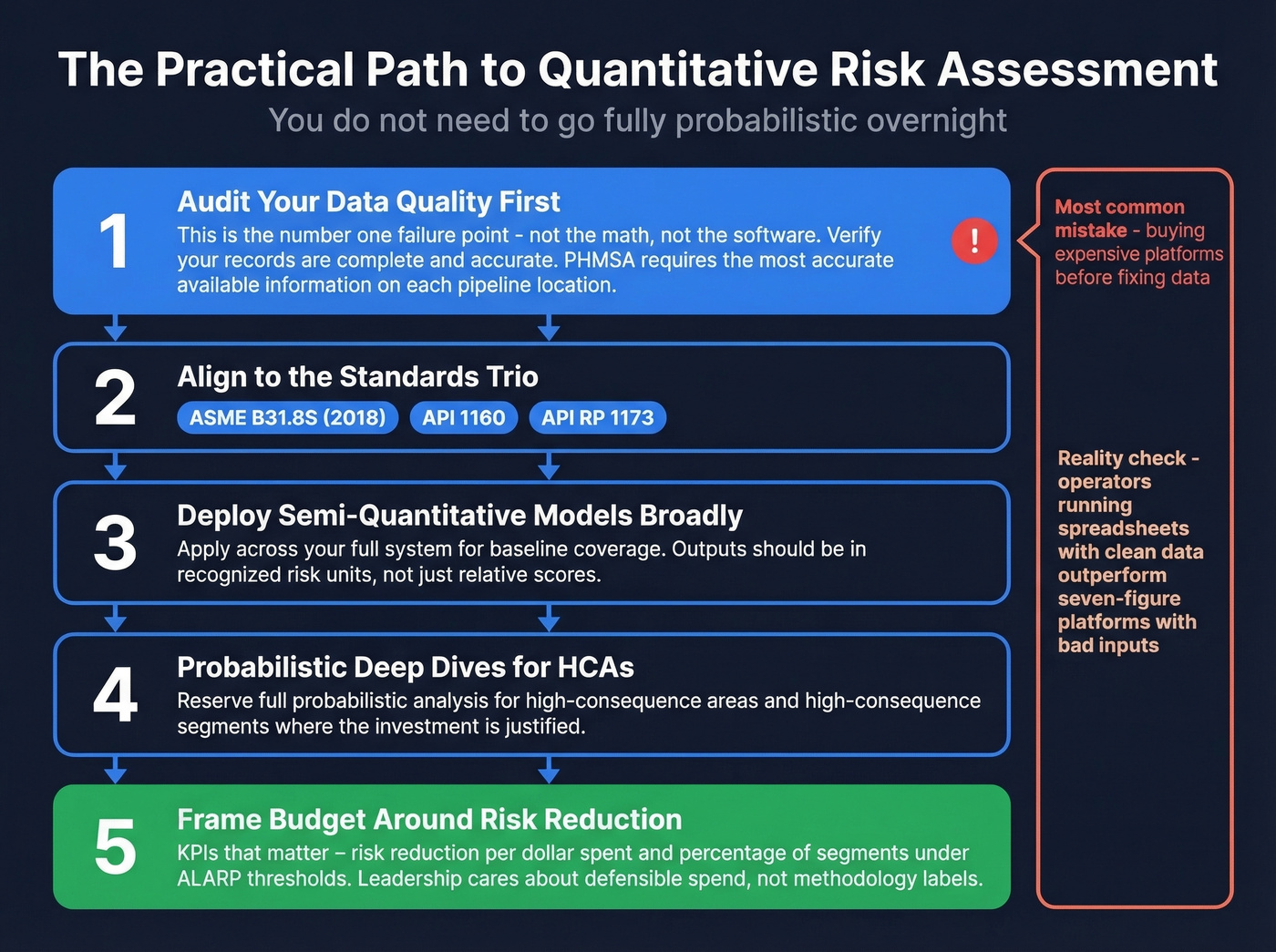
Audit your data quality first. PHMSA requires model inputs to represent "the most accurate available information on each pipeline location." This is the #1 failure point we've seen in program upgrades - not the math, not the software, the data. Operators we've talked to say the same thing: they bought expensive platforms and got garbage outputs because the underlying records were incomplete.
Align to the standards trio: ASME B31.8S (2018 edition), API 1160, and API RP 1173.
Frame your budget around risk reduction per dollar and percentage of segments under ALARP thresholds. Leadership doesn't care about methodology tiers. They care about defensible spend.

Learn from failure patterns. A $4M corrosion rupture traced to a CP anode bed disconnected for 3+ years. A $2.8M fatigue failure near a compressor station with no vibration monitoring. A $1.8M weld defect that would've been caught with post-weld NDT. Every one of these was preventable with a functioning risk program, and the common thread isn't exotic failure modes - it's gaps in monitoring and communication across contractor networks.
Let's be honest about something: most operators don't have a software problem. They have a data discipline problem. I've seen programs running on spreadsheets outperform seven-figure platforms because the people behind them actually maintained their input data. Buy the fancy tool if you want, but fix your data hygiene first or you're just generating prettier garbage.
Software and Tools
The enterprise pipeline integrity software market is dominated by a handful of platforms.
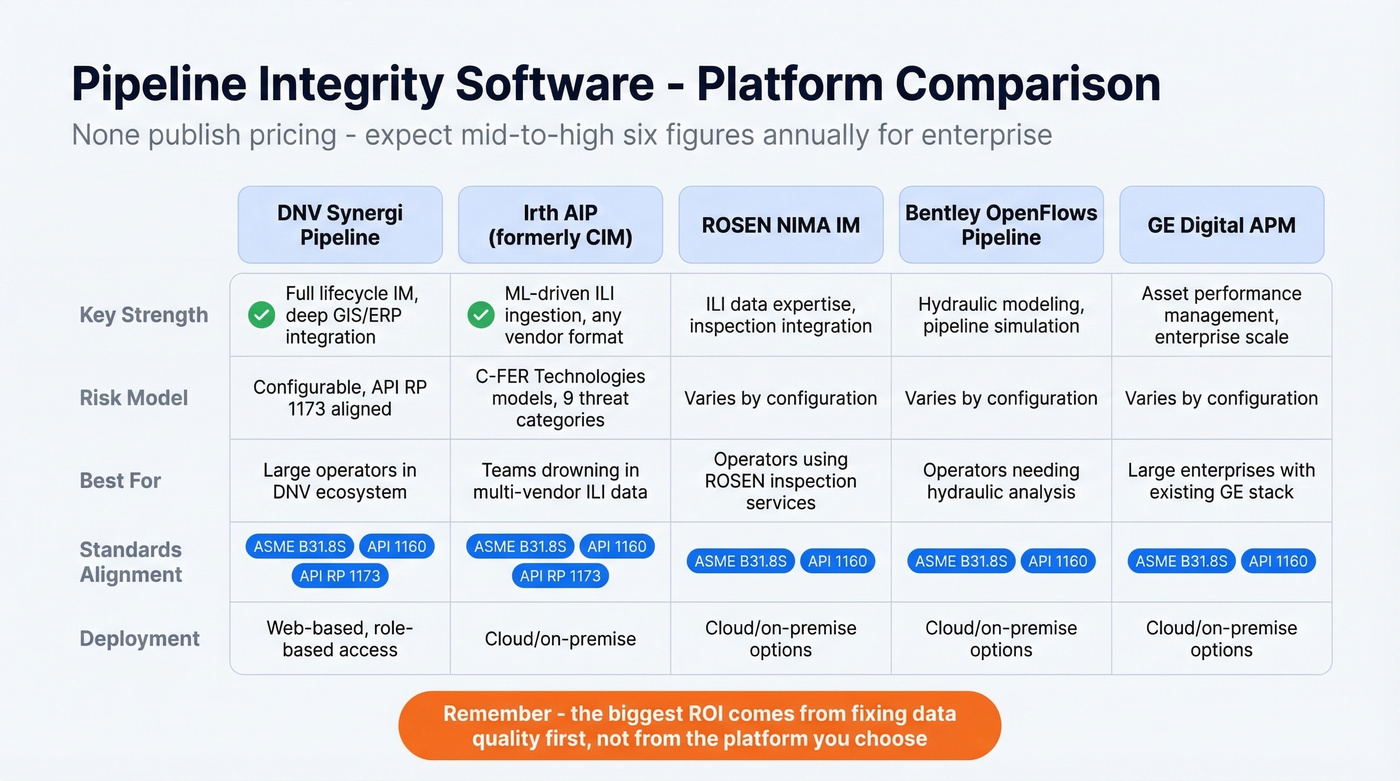
DNV Synergi Pipeline is the incumbent - web-based, role-based access, API RP 1173 alignment, and deep integration with GIS/ERP systems. It's the safe choice for large operators already embedded in the DNV ecosystem, and it handles the full integrity management lifecycle from risk assessment through remediation tracking.
Irth AIP (formerly CIM) takes a different approach with ML-driven ILI ingestion that handles any vendor format, plus risk models designed by C-FER Technologies covering nine major threat categories aligned with ASME B31.8S. In our experience, operators spending the most time on manual ILI data normalization see the biggest ROI from Irth's ML ingestion approach. If you're drowning in multi-vendor ILI data, give it a hard look.
ROSEN NIMA IM, Bentley OpenFlows Pipeline, and GE Digital APM are also commonly evaluated, though they tend to serve slightly different niches within the integrity management stack.
None publish pricing. Expect mid-to-high six figures annually for enterprise platforms once you factor in licensing, implementation, and ongoing services.
For teams managing extensive contractor networks - ILI vendors, CP specialists, NDT providers - reliable contact data for safety-critical communications matters more than most people realize. A missed notification to the wrong email address during a repair window isn't just inconvenient; it's a compliance risk. Prospeo handles B2B contact verification at 98% email accuracy on a 7-day refresh cycle, which is useful when the right person needs to receive the right notification on time.
If you’re building lists for outreach, pair verification with data enrichment so records stay usable.
And if you’re running outbound to operators, keep an eye on email deliverability so critical messages don’t disappear.
If you sell pipeline integrity software, inspection services, or risk assessment tools, your buyers are buried inside midstream and transmission operators. Prospeo's 125M+ verified mobile numbers and 30% pickup rate mean you skip the gatekeeper and reach the decision-maker directly - for $0.01 per email, no contract required.
Connect with pipeline operators before your competitors do.
FAQ
What's the difference between risk assessment and risk management?
Risk assessment quantifies probability and consequence of failure per segment. Risk management is the broader program: assessment plus mitigation planning, resource allocation, compliance, and continuous monitoring. Think of assessment as one step inside the full management lifecycle.
Which ASME B31.8S edition applies in 2026?
The 2018 edition. PHMSA technical amendments dated July 1, 2025 updated the incorporated edition in 49 CFR Part 192 from 2004 to 2018. Update your internal references immediately - the industry petition for reconsideration remains unresolved, so the 2018 edition governs until further notice.
How do I justify risk program investment to leadership?
Lead with incident cost data: the average significant U.S. pipeline incident exceeds $1.3M in direct costs, and that's before regulatory penalties and reputational damage. Frame KPIs as risk reduction per dollar spent and percentage of segments under ALARP thresholds - executives respond to defensible financial metrics, not methodology labels.
Skip this if your program is already probabilistic
If you're already running probabilistic models across your HCAs with clean, well-maintained data inputs, most of this guide covers ground you've already walked. Where we'd still push: make sure your contractor communication chain is airtight and your B31.8S references are updated to the 2018 edition. Those are the two gaps we see even in mature programs.