


Power Almanac vs ZoomInfo: Which One Do Government Sales Teams Actually Need?
You're a GovTech startup CEO and you need every city CIO in Texas by Friday. You open ZoomInfo - slick filters, intent data - and search for local government contacts. Half the phone numbers ring reception desks. Now you're wondering if that $20k contract was the right call, or if the niche database your competitor swears by would've been smarter.
Here's the thing about comparing Power Almanac vs ZoomInfo: most government sales teams don't use them the same way at all. One is a specialized local government contact database. The other is a general-purpose B2B intelligence platform. Picking between them isn't about which is "better." It's about where you sell.
30-Second Verdict
- Sell exclusively to local government? Power Almanac. Nothing else touches its local gov org charts.
- Sell to government AND commercial accounts? Power Almanac for local gov, plus a verification and enrichment layer for commercial - you can skip the ZoomInfo spend entirely.
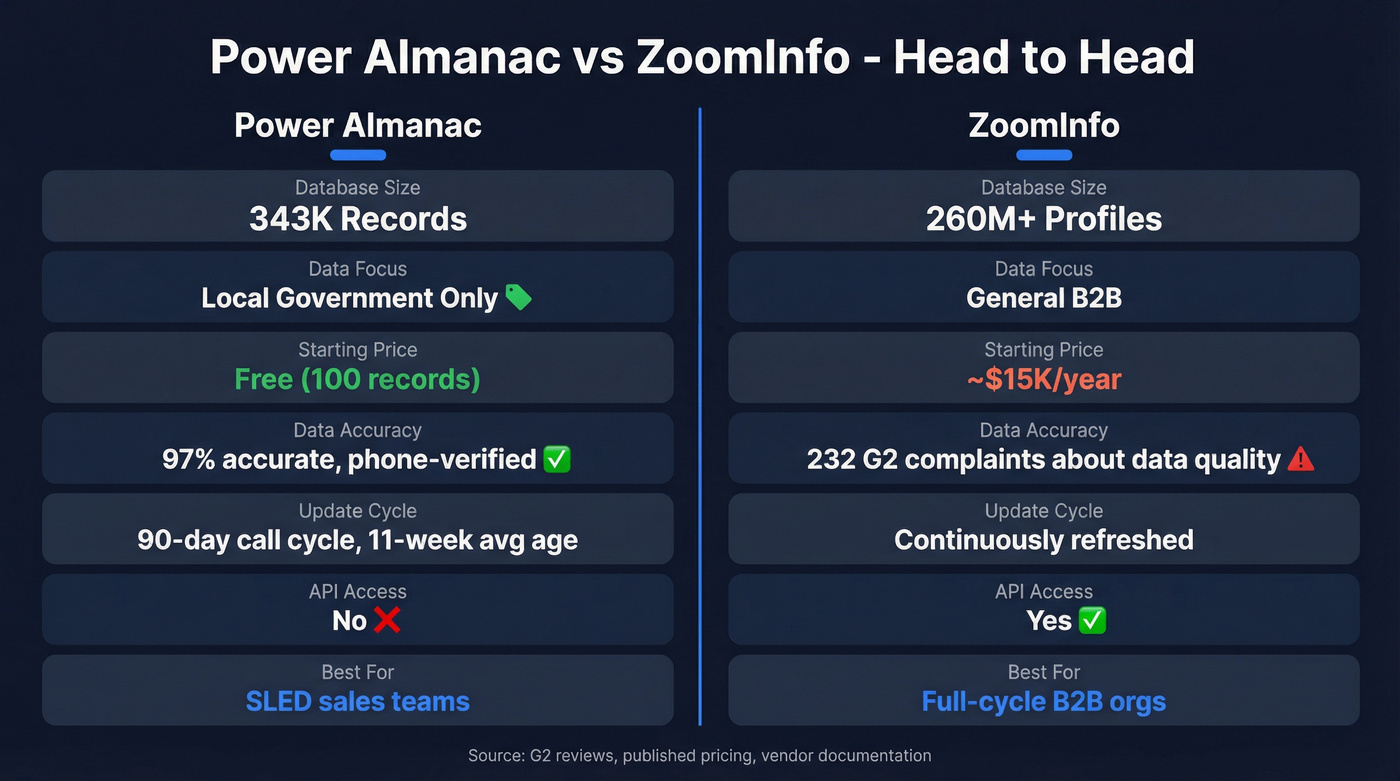
Side-by-Side Comparison
| Feature | Power Almanac | ZoomInfo |
|---|---|---|
| Database size | 343K records | One of the largest general B2B databases |
| Data focus | Local gov only | General B2B |
| Starting price | Free (100 records/credits) | ~$15K/yr |
| Data quality signal | 97% accurate, 100% phone-verified | 232 G2 data complaints |
| API | No | Yes |
| Update cadence | 90-day call cycle | Continuously refreshed |
| Ideal buyer | SLED sales teams | Full-cycle B2B orgs |
| G2 rating | 4.7/5 (10 reviews) | 4.5/5 (9,036 reviews) |
Power Almanac - What You Get

Use this if: You sell software, services, or infrastructure to cities, counties, and townships.
Power Almanac covers 22,000 local governments with 343,000 records organized around 22 decision-maker roles - not job titles, but functional roles like "IT Director" or "Finance Manager." That distinction matters more than you'd think. A 16-person research team calls those governments on a 90-day cycle, and the average record age is just 11 weeks. Records are anchored to U.S. Census Bureau Government IDs, giving every local government a unique, persistent identifier that survives personnel turnover and reorganizations.
One detail we appreciate: the team starts calling in the month following elections to avoid capturing outgoing officeholders. If you've ever blasted a campaign to a list full of people who left office three months ago, you know why that matters. Emails run through a 4-level validation stack, and about 85% of records include email addresses. The GovExec acquisition gives them a credible parent company in the public-sector media space.
Skip this if: You prospect outside local government. There's no API, no mobile app, and zero commercial B2B data. Exports are manual CSVs.

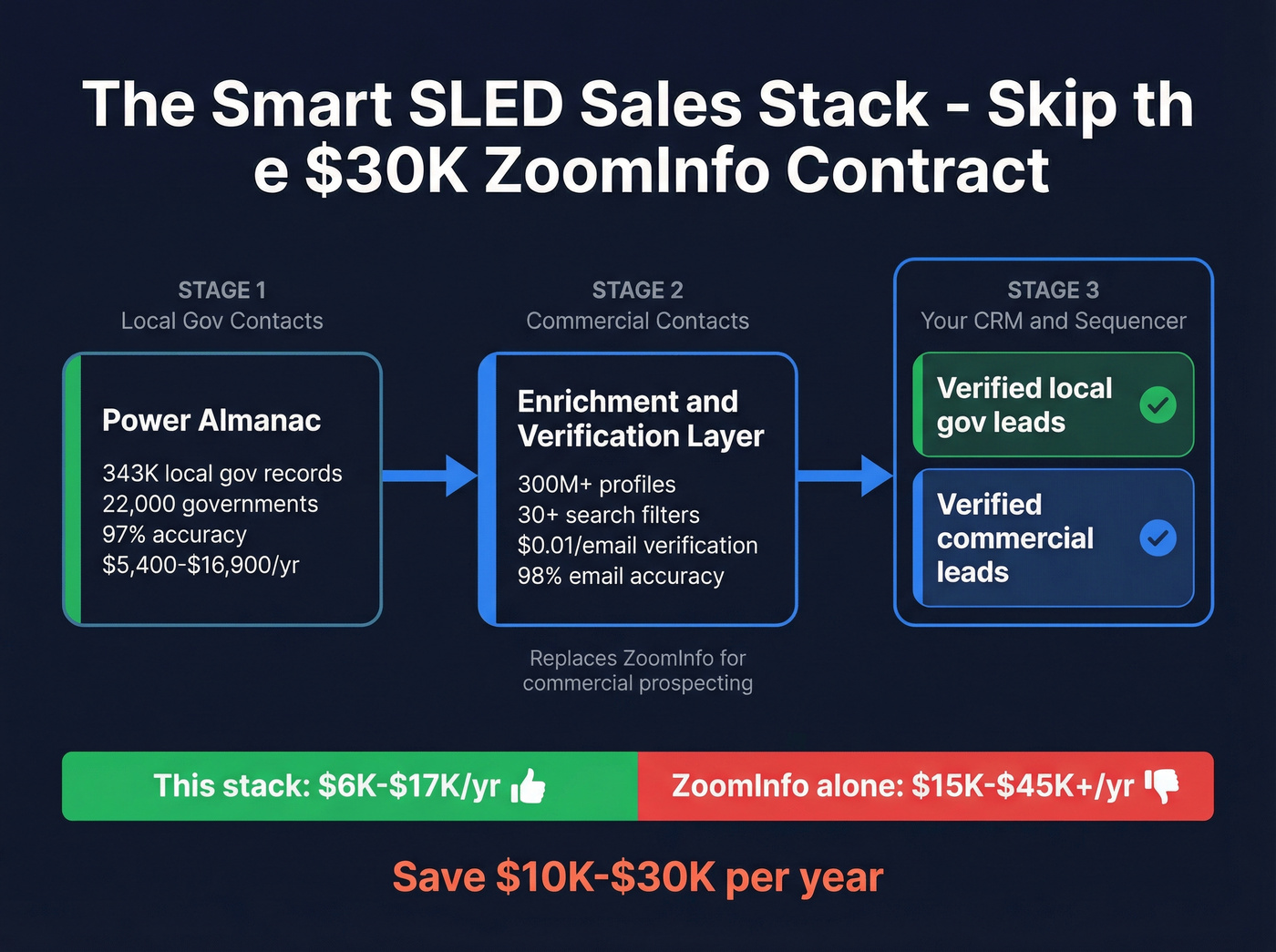
Power Almanac gives you local gov contacts. But who covers your commercial pipeline? Prospeo's 300M+ profiles with 30+ filters - intent data, technographics, headcount growth - replace ZoomInfo for SLED teams that also sell to the private sector. At $0.01/email vs ZoomInfo's $1/lead, you save $10K-$30K/year.
Cover every account type without the enterprise contract.
ZoomInfo - What You Get
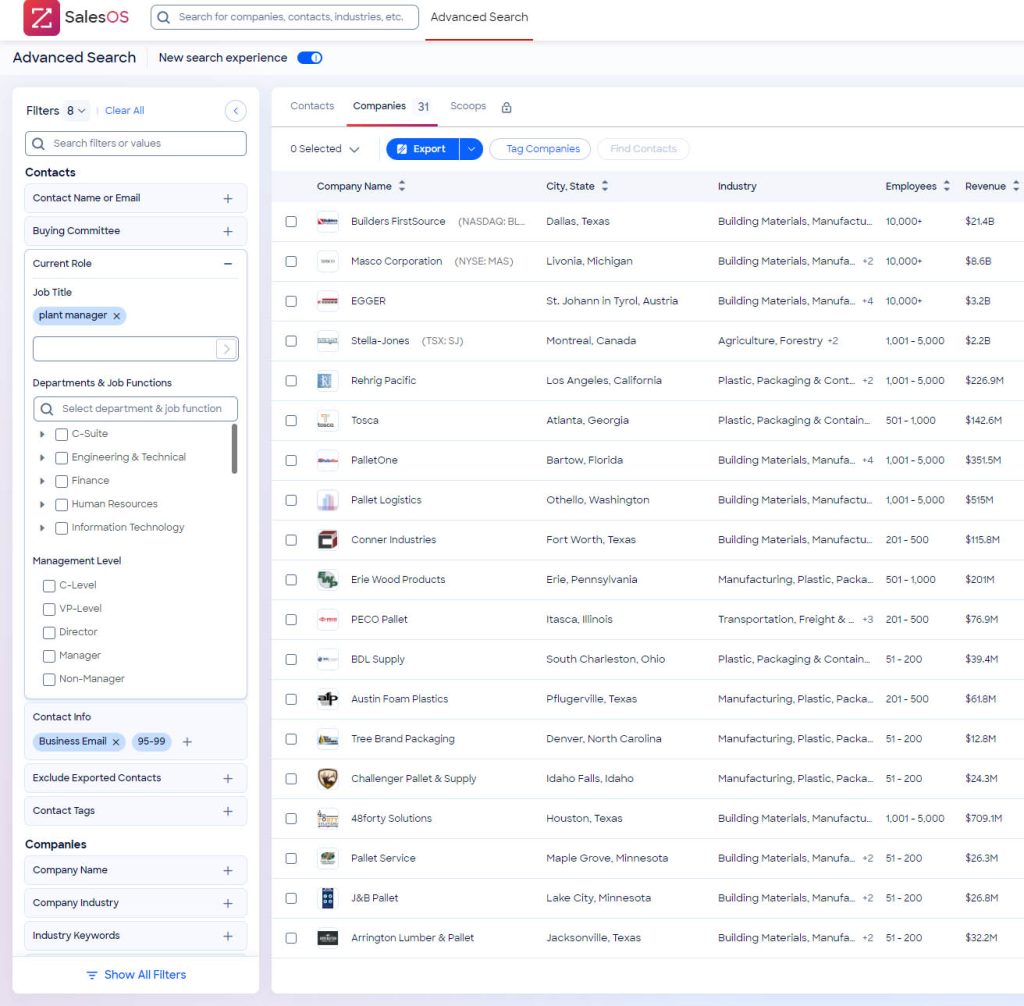
Use this if: You sell across sectors - commercial, federal, state, local - and want a single platform with intent data, technographics, org charts, and CRM integrations. ZoomInfo is also available for federal procurement via GSA Schedule through Winvale.
Skip this if: Your entire pipeline is local government. On G2, 232 reviews flag inaccurate data and another 232 flag outdated data. The consensus on r/sales threads echoes this - phone numbers routing to reception desks is a recurring complaint. You'd be paying for a Ferrari to drive to the corner store.
Pricing Breakdown
Power Almanac publishes its pricing. ZoomInfo doesn't. That alone tells you something.
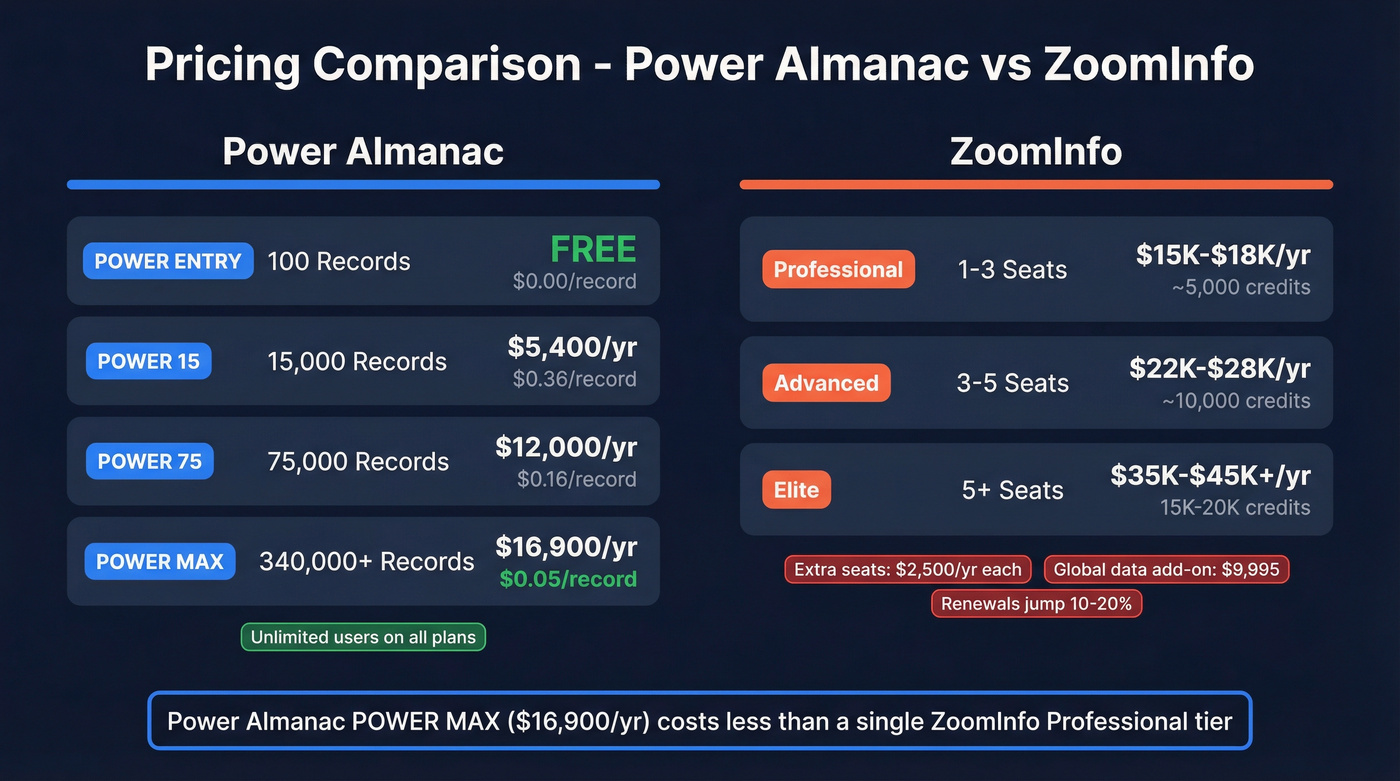
Power Almanac tiers:
| Plan | Records | Annual Cost | Per Record |
|---|---|---|---|
| POWER ENTRY | 100 | Free | Free |
| POWER 15 | 15,000 | $5,400 | $0.36 |
| POWER 75 | 75,000 | $12,000 | $0.16 |
| POWER MAX | 340,000+ | $16,900 | $0.05 |
All plans include unlimited users and free updates on downloaded records.
ZoomInfo typical ranges:
| Tier | Typical Annual Cost | Seats | Credits |
|---|---|---|---|
| Professional | $15K-$18K | 1-3 | ~5,000 |
| Advanced | $22K-$28K | 3-5 | ~10,000 |
| Elite | $35K-$45K+ | 5+ | 15K-20K |
The sticker price is just the start. Additional seats run $2,500/year each. Global data is a $9,995 add-on. Credit overages cost $0.20-$0.60 per credit. Renewals typically jump 10-20%, so always negotiate before signing - discounts of 30-65% off list price are common if you push.
For a team selling exclusively to local government, Power Almanac's POWER MAX at $16,900/year gets you every record in the database with unlimited users. That's often less than a single ZoomInfo seat tier.
Let's be honest: if your average government deal size is under $25k, ZoomInfo's total cost of ownership will eat your margins alive. Power Almanac paired with a lean data enrichment tool is the smarter play for SLED-focused teams.
When You Need Both

Many gov-focused teams sell to both local government and commercial accounts. Power Almanac for local gov contacts plus ZoomInfo for everything else works, but it's expensive. And here's what both tools miss: neither guarantees that the emails in your export will actually land in inboxes today. Email decay doesn't wait for your next campaign.
In our experience, running exports through real-time verification catches decayed addresses the database hasn't flagged yet - that's the difference between healthy deliverability and a blacklisted domain. We've seen teams using Prospeo's verification handle this at roughly $0.01/email with 98% accuracy and a 7-day data refresh cycle. Its 300M+ profile database with 30+ search filters covers commercial prospecting gaps without a ZoomInfo contract, and the self-serve pricing means no sales calls or annual lock-ins.
If you're building a repeatable outbound motion, it also helps to standardize your sales prospecting techniques so your data, messaging, and sequencing stay aligned.
Neither Power Almanac nor ZoomInfo guarantees your exported emails still work today. Prospeo's 7-day data refresh and 5-step verification catch decayed addresses before they torch your domain. 98% email accuracy, 92% API match rate - run your gov exports through real-time verification for ~$0.01 each.
Don't let stale data blacklist your sending domain.
Final Verdict
Three buyer profiles, three answers.
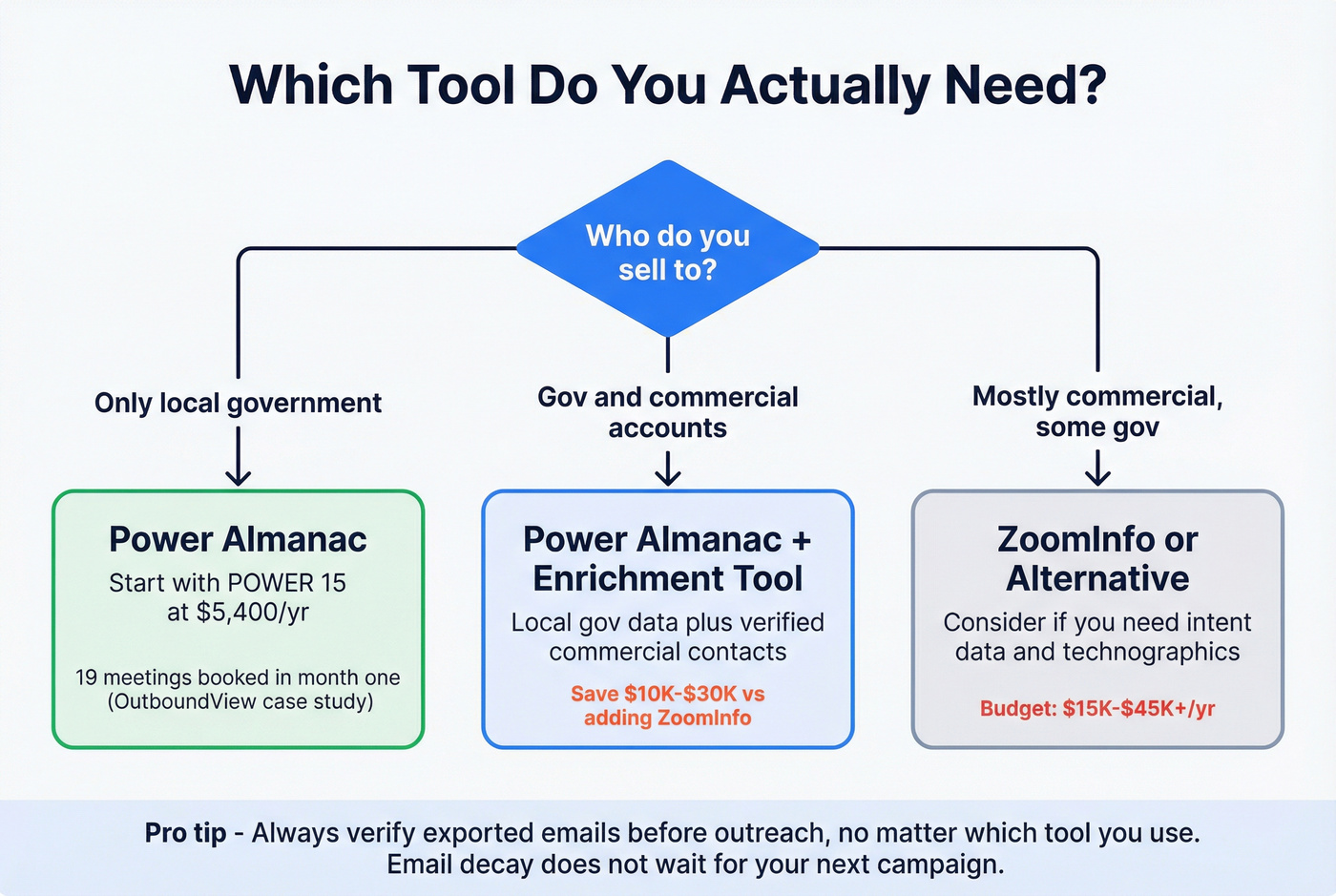
You sell exclusively to local government. Power Almanac. Start with POWER 15 at $5,400/year. One case study from OutboundView showed a team booking 19 meetings in month one and 16 in month two using Power Almanac data for local gov outreach.
You sell to gov + commercial accounts. Pair Power Almanac with an enrichment and verification layer for commercial prospecting. You'll save $10K-$30K/year versus adding ZoomInfo on top.
You're budget-conscious and need verified emails across sectors. Skip the enterprise contracts. A self-serve platform with a free tier - 75 emails plus 100 Chrome extension credits per month, no sales call required - gets you started without the commitment.
The Power Almanac vs ZoomInfo decision isn't really either/or for most gov sales teams. You need specialized local data AND a broader enrichment layer. Pick the combination that matches your pipeline, not the one with the biggest logo on the trade show floor.
If you're tightening the rest of your stack, compare options in our guide to the best sales prospecting databases and keep an eye on lead generation metrics so you can spot data-quality issues early.
FAQ
Does ZoomInfo cover local government contacts well?
ZoomInfo is strongest as a broad commercial B2B platform, not a local gov specialist. On G2, 232 reviews flag inaccurate data and 232 flag outdated data. Power Almanac's 16-person team calling 22,000 governments every 90 days produces more reliable local gov contacts with an average record age of 11 weeks.
Can Power Almanac replace ZoomInfo entirely?
Only if you sell exclusively to local government. Power Almanac has no API, no mobile app, and zero commercial B2B data. For teams that prospect outside local gov, pairing it with a verification-first enrichment tool covers the gap at a fraction of ZoomInfo's cost.
How do I verify emails from either tool before outreach?
Export your list as a CSV and run it through a real-time verification tool before loading it into your sequencer. At roughly $0.01 per lead, catching decayed addresses protects your sender reputation and keeps bounce rates under 4%. Look for a provider with catch-all handling and spam-trap removal - those are the two biggest sources of silent deliverability damage.