

Predictive Sales Forecasting: What Actually Works (and What Doesn't)
Only 20% of sales organizations forecast within 5% of their projections. Four in five sales and finance leaders missed a quarterly forecast in the past year, and over half missed it twice or more. The typical response is buying a fancier tool. The actual fix is almost always the data feeding it.
Here's what improves accuracy - and what's just expensive noise.
Quick Recs by Company Size
- Enterprise (500+ reps): Clari or Aviso
- Mid-market: Gong Forecast or Salesforce Einstein
- SMB: HubSpot or Zoho Zia
Here's the thing: if your average deal size is under $15k, you almost certainly don't need Clari or Gong-level tooling. HubSpot plus clean CRM data gets you 80% of the way there at a fraction of the cost.
What Predictive Forecasting Actually Is
Traditional forecasting relies on rep gut feel, weighted pipeline stages, and a spreadsheet someone built three years ago. Predictive sales forecasting replaces all of that with ML models trained on historical deal data, buyer behavior signals, and engagement patterns. The model scores every opportunity and projects outcomes - no more waiting for reps to update their commit column on Friday afternoon.
Gartner's supply-chain forecasting vision - "touchless forecasting" - maps cleanly to sales: reduce manual inputs to near zero. They predict 70% of large organizations will adopt AI-based forecasting by 2030. We're not there yet. Most teams are stuck between "we have a forecast" and "we trust our forecast," and the gap between those two states is enormous.
What Data Feeds the Model
The biggest misconception is that predictive forecasting runs on CRM fields alone. The richest signals live in unstructured data most teams ignore.
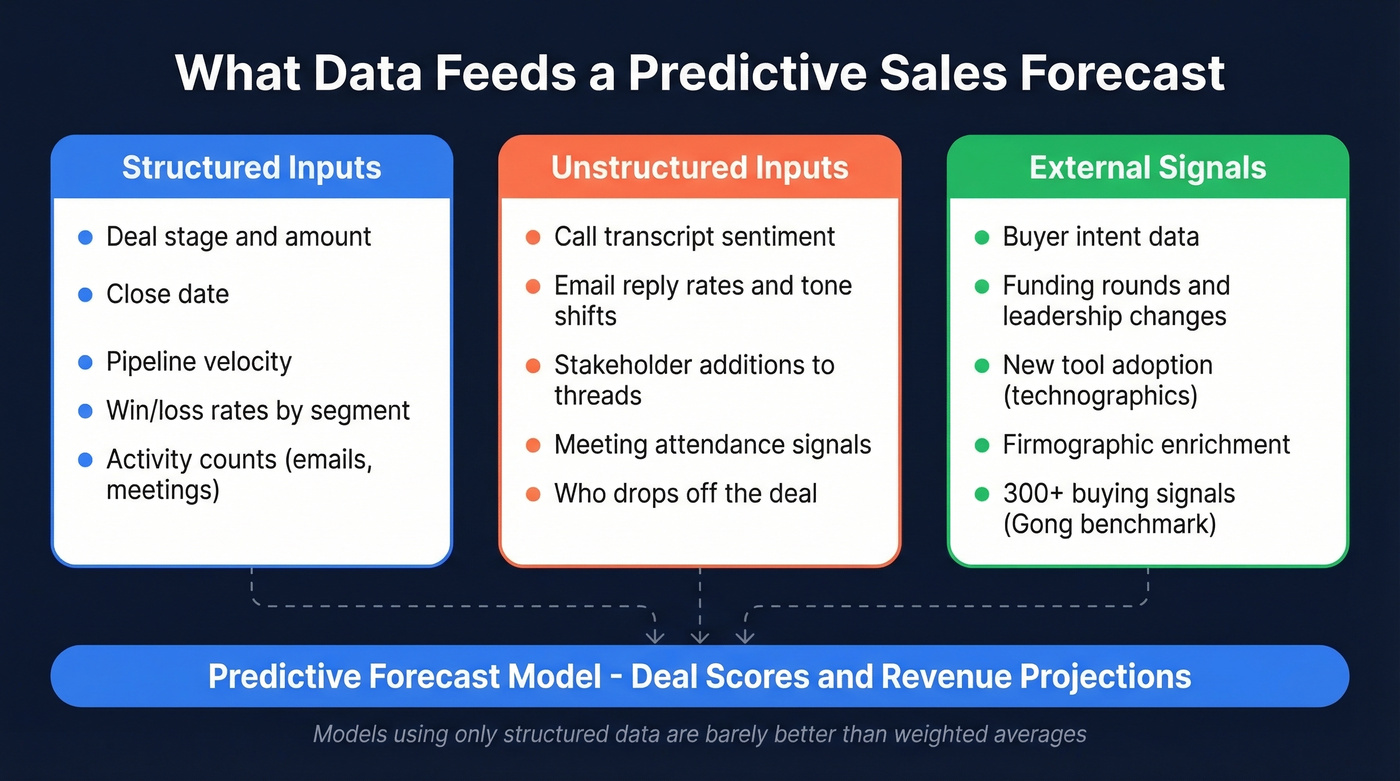
Structured inputs form the baseline: deal stage, amount, close date, pipeline velocity, historical win/loss rates by segment, and activity counts like emails sent and meetings booked. These are table stakes for any sales prediction model.
Unstructured inputs are where models gain their edge. Call transcripts with sentiment analysis, email thread engagement patterns (reply rates, tone shifts, stakeholder additions), and meeting attendance signals all feed meaningfully into deal scoring. Who shows up matters. Who drops off matters more. This is where deal prediction separates itself from simple weighted averages.
External signals round out the picture: buyer intent data, firmographic changes like funding rounds or leadership turnover, and technographic shifts such as new tool adoption. Gong captures 300+ buying signals across these categories. A model that only sees pipeline stage and close date is barely better than a coin flip with extra steps. Enrichment data - verified contacts, firmographics, technographics - fills the gaps your CRM misses and dramatically improves your ability to predict outcomes.
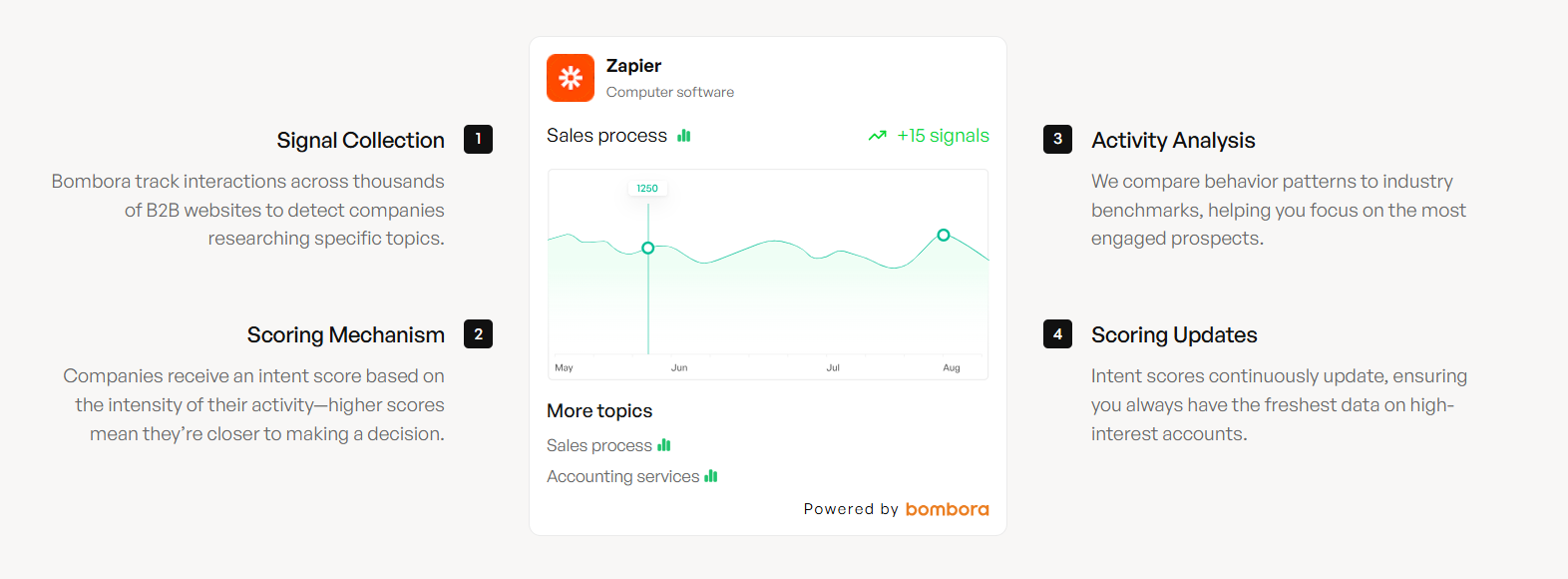

Dirty CRM data drops forecast accuracy by 10-15 points. Prospeo's enrichment returns 50+ data points per contact at a 92% match rate - with 98% email accuracy and a 7-day refresh cycle. Fix your inputs before you buy a forecasting tool.
Clean data costs $0.01 per email. Missed forecasts cost millions.
Measuring Forecast Accuracy
Most teams skip this step entirely. They adopt a tool and never define what "accurate" means.
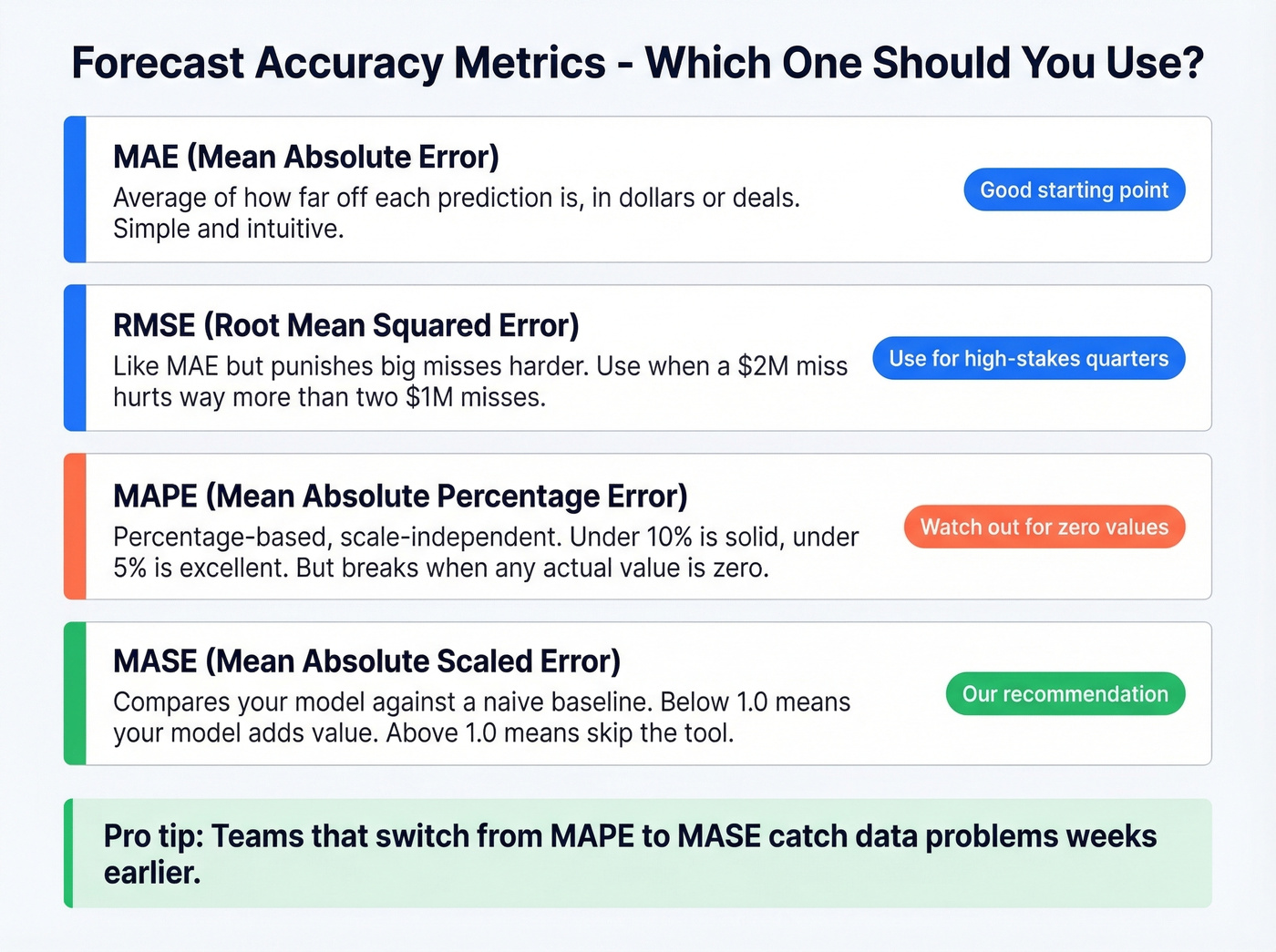
MAE (Mean Absolute Error) gives you the average of absolute differences between predicted and actual values, in the same units as your target - dollars, deals, whatever you're counting. Use it for a straightforward "how far off are we" number.
RMSE (Root Mean Squared Error) penalizes large misses more heavily. Use it when a $2M miss matters disproportionately more than two $1M misses.
MAPE (Mean Absolute Percentage Error) is scale-independent, which sounds great. Under 10% is solid for B2B; under 5% is excellent. But MAPE breaks when any actual value is zero, and that happens more often than you'd think in quarterly segment forecasts.
MASE (Mean Absolute Scaled Error) is the better alternative. It scales your forecast's MAE against a naive baseline - "what if we just predicted last period's number every time?" Below 1.0 means your model beats the baseline. Above 1.0 means you'd be better off not forecasting at all. In our experience, teams that switch from MAPE to MASE catch data problems weeks earlier. This is the metric we recommend to every RevOps team we talk to.
Look - if your MAPE is above 15%, the problem isn't your model. It's your inputs.
Why Implementations Fail
43% of organizations miss forecasts by over 10%. The tools aren't the bottleneck.
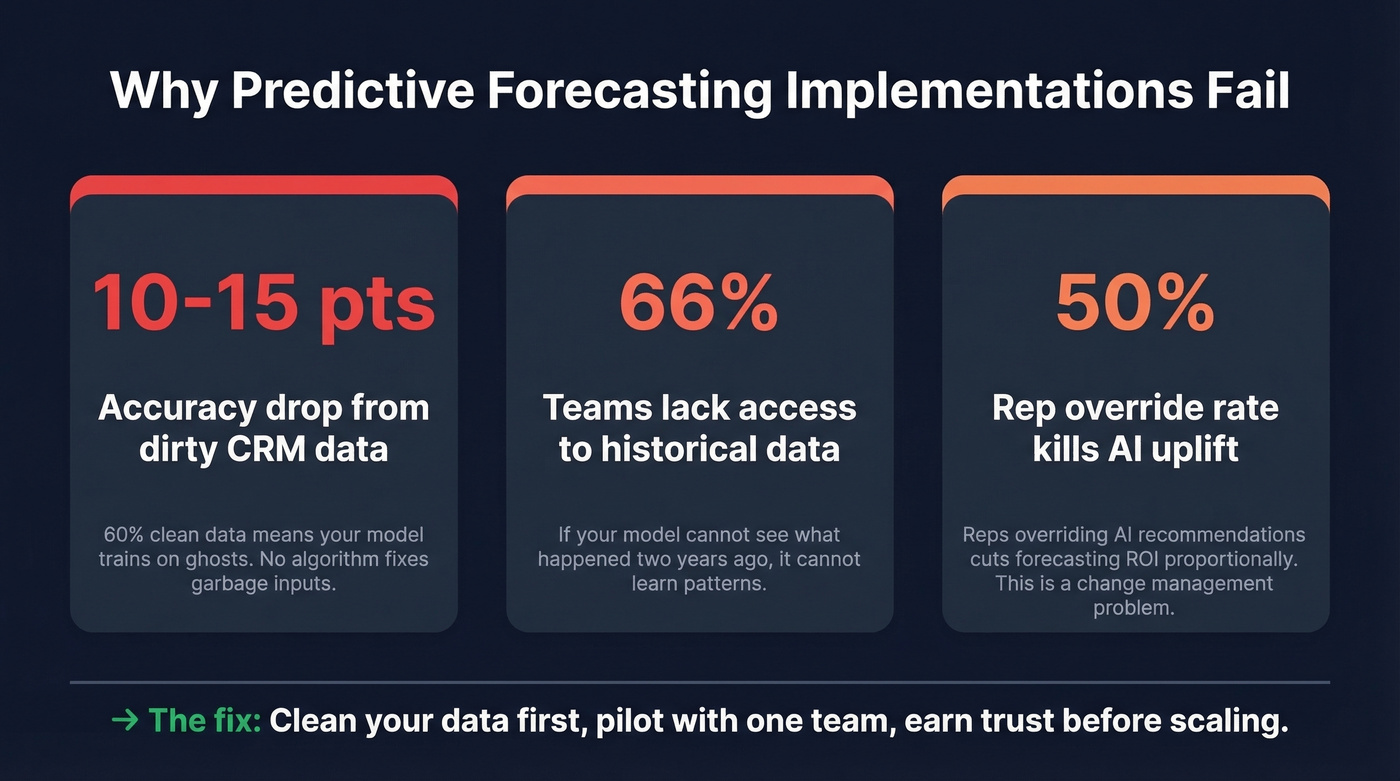
Dirty CRM data is the number one killer. If your CRM data is 60% clean, model accuracy drops 10-15 points. Your model is training on ghosts, and no amount of analytical sophistication compensates for garbage inputs. The most common complaint from RevOps teams evaluating forecasting tools: the model looked great in the demo, then fell apart on their actual data. That's almost always a data quality issue, not a model issue.
No access to historical data. 66% of teams cite reporting systems that can't access historical CRM or performance data as their biggest roadblock. If your model can't see what happened two years ago, it can't learn patterns.
Rep overrides destroy ROI. I've seen teams where reps override AI recommendations half the time, cutting uplift proportionally. This is a change management problem, not a technology problem. If you haven't invested in rep buy-in, save your money.
The data quality problem is the one you can fix fastest. Prospeo's CRM and CSV enrichment returns 50+ data points per contact, delivers a 92% match rate, and refreshes records every 7 days versus the industry average of six weeks - with 98% email accuracy. Fix this before you buy a forecasting tool.
Tools for AI-Driven Forecasting
| Tool | Starting Price | Best For | Our Take |
|---|---|---|---|
| Clari | ~$100-200/user/mo | Enterprise revenue ops | Best all-in-one for 500+ rep orgs |
| Gong Forecast | ~$250/user/mo + fee | Conversation-led teams | Best if you already use Gong for calls |
| Aviso | ~$100/seat/mo | AI-native forecasting | Best pure forecasting engine |
| SF Einstein | ~$50-220/user/mo | Salesforce-native orgs | Skip if you're not on Salesforce |
| HubSpot | ~$45-150/user/mo | SMB/mid-market | Best value under 200 people |
| Zoho Zia | ~$14-40/user/mo | Budget-conscious teams | Hard to beat at $14/mo |
| Forecastio | ~$49-99/user/mo | Pipeline analytics | Niche; good for pipeline-heavy teams |
Clari and Aviso compete head-to-head at the enterprise level. Aviso models a 2,476% first-year ROI for a 10-rep team - aggressive, but the assumptions are transparent and worth benchmarking against. Aviso differentiates on being CRM-hierarchy-independent, pulling from data warehouses, Outlook, Teams, and Snowflake. Clari is the more established name with deeper revenue operations workflows. Both require sales conversations to price.
For sub-200 person companies, we've seen mid-market teams get 80% of Clari's value from HubSpot plus clean data. Zoho Zia is the budget pick if you're already in the Zoho ecosystem. The consensus on r/sales leans the same way - most reps say the tool matters less than the data discipline behind it. Either way, the goal is the same: use a forecast model that fits your team's maturity, not one that overwhelms it.
Implementation Roadmap
Phase 1: Data audit + enrichment. Run your CRM through an enrichment tool. Identify decay rates, duplicate records, and missing fields. You can't skip this - every reliable revenue prediction method starts with clean inputs.

Phase 2: Model selection + baseline. Pick a tool from the table above. Benchmark it against a naive forecast (last quarter's numbers repeated). If the model can't beat that baseline, something's wrong with your inputs. This step also reveals whether your data is rich enough to project future revenue with any confidence.
Phase 3: Pilot with one team. Don't roll out company-wide. Pick your most data-complete team, run the model alongside your existing process for one full quarter, and compare. Focus on one segment - new business or expansion - so you can isolate variables. When budget is tight, this is where you prove ROI before asking for a larger commitment.
Phase 4: Scale + governance. Gartner's 2026 CSO guidance is clear: tie AI to commercial outcomes, not AI for AI's sake. Bain reports 30%+ win-rate improvement when AI is paired with process redesign - the process part matters as much as the technology. Predictive models your team trusts are built through transparency, not black-box scores.
Intent data, firmographics, and technographics are the external signals that separate real forecasting from guesswork. Prospeo tracks 15,000 intent topics and layers them with 30+ filters - so your model sees what your CRM can't.
Feed your forecast the signals it's been starving for.
FAQ
How accurate should a predictive forecast be?
A MAPE under 10% is solid for most B2B teams; under 5% is excellent. If you're consistently above 15%, your data inputs are the problem, not your model. Benchmark against a naive forecast first - any prediction that can't beat "repeat last quarter" isn't worth the license fee.
What's the biggest reason forecasting implementations fail?
Dirty CRM data. If you don't enrich or verify contacts regularly, your model trains on noise. Teams chasing insights without fixing data quality are building on sand, and no tool - regardless of price - fixes that for you.
Do I need an enterprise tool like Clari or Gong?
Not if your average deal size is under $20k and your process is still maturing. HubSpot (~$45-150/user/mo) and Zoho (~$14-40/user/mo) cover the basics. Clean data does more for forecast accuracy than another dashboard.
Can predictive sales forecasting eliminate uncertainty?
No model eliminates uncertainty entirely. But AI-driven forecasting, when fed clean data and measured against proper baselines like MASE, consistently outperforms gut-feel methods. The teams that treat it as a discipline rather than a magic tool are the ones that actually hit their numbers.