

Product Knowledge Training: The Practitioner's Playbook for 2026
A frontline sales rep posted on Reddit that they felt "under qualified" and "not actually helping customers" - despite hitting quota. Their fix? Googling answers while the customer waited. That's not a training gap. That's a system failure. And it's expensive: Gallup pegs global employee disengagement at $8.8 trillion in lost productivity, with only 21% of employees worldwide actually engaged at work. Product knowledge training - done right - is how you close that gap.
The Short Version
- Your curriculum needs four pillars: product knowledge, industry/customer knowledge, competitor analysis, and product value statements. Miss one and reps default to feature-dumping.
- Microlearning is the default delivery method. It hits 80-90% completion rates versus ~30% for long-form eLearning. That's not a marginal improvement - it's a different category of outcome.
- Measure with Kirkpatrick, mapped to product KPIs. Reaction surveys aren't enough. You need pre/post quizzes, behavioral observation at 30/60/90 days, and business metric tracking like win rate, CSAT, and first-call resolution.
- The biggest mistake: treating training as a one-time onboarding event. Products change quarterly. Training that doesn't change with them creates misinformed reps selling last quarter's product.
Think of this as a system, not a program.
What Product Knowledge Training Actually Is
It isn't product documentation. It's not the onboarding deck your product team threw together for the last launch. And it's definitely not generic sales enablement with a product slide bolted on.
Product knowledge training is an ongoing system that ensures every customer-facing employee can explain what your product does, who it's for, why it wins, and how it compares - in language the buyer actually uses. The "ongoing" part matters. A one-week bootcamp during onboarding decays fast without reinforcement.
Why It Drives Revenue
This is where investing in product education earns its budget.
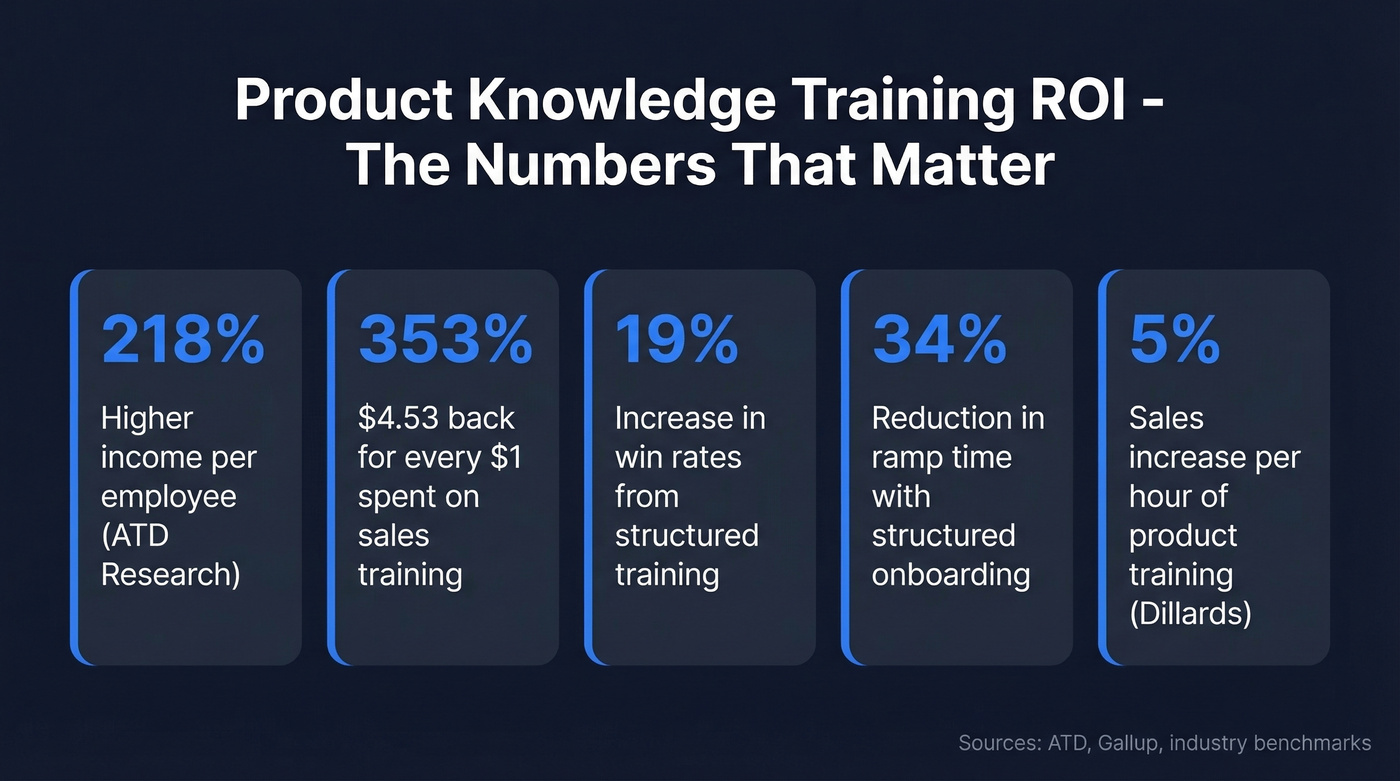
Companies with structured training programs achieve 218% higher income per employee and 24% greater profit margins, per ATD research. Effective sales-focused product training delivers a 353% ROI - $4.53 back for every $1 spent. Sales training benchmarks also show a 19% increase in win rates and a 57% boost in sales effectiveness. Structured onboarding retains 50% more new hires, drives 54% higher engagement, and cuts ramp time by up to 34%.
Here's the stat that makes the case on its own: Dillard's found a 5% increase in sales rate for every hour of product training. Not every quarter - every hour. That kind of per-hour ROI justifies even small time investments.
When reps understand the product deeply enough to handle objections without escalating, connect features to specific buyer pain points, and articulate ROI in the customer's language, deals close faster and churn drops.
The Four Pillars of Your Curriculum
Every program worth running covers four areas. Skip one and you'll feel the gap on sales calls within a month.
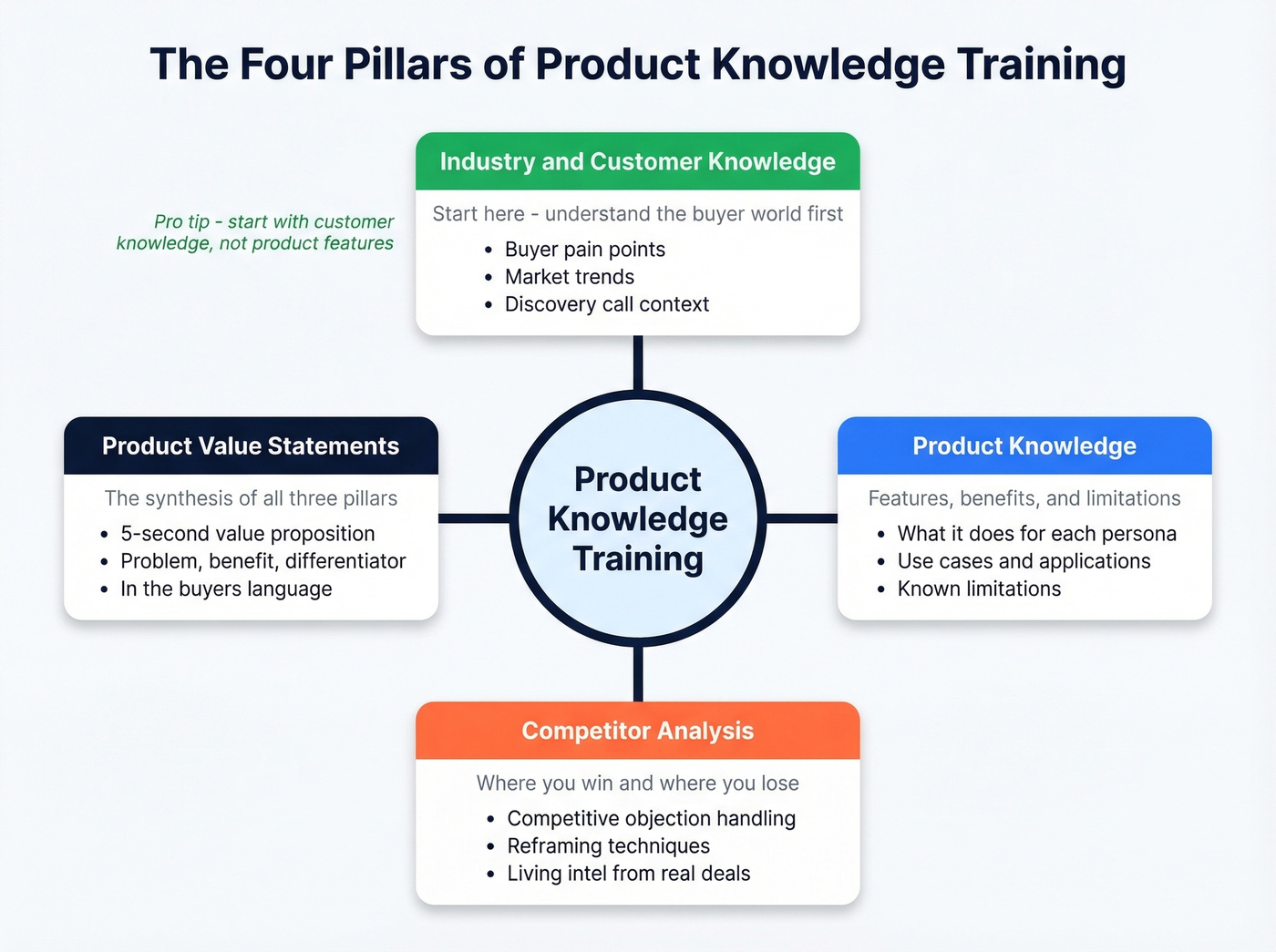
Most four-pillar frameworks put product knowledge first. In our experience, starting with customer knowledge produces better results - reps who understand the buyer's world learn product features faster because they have context for why each feature matters.
1. Product knowledge. Features, benefits, applications, and limitations. Reps need to know what the product does, but more importantly, they need to know what it does for specific buyer personas. Feature knowledge without context is trivia.
2. Industry and customer knowledge. What problems does your buyer actually face? What trends are reshaping their market? Reps who understand the buyer's world lead conversations instead of reacting to them. Training on product and market context together - rather than in isolation - produces reps who can navigate discovery calls without a script.
3. Competitor analysis. Your reps will face competitive objections on every other call. They need to know where you win, where you lose, and how to reframe. Create a shared space - a Notion doc, a Slack channel, a wiki page - where the team logs competitive intelligence from live deals. This becomes a living document that's often more valuable than any formal training module.
4. Product value statements. This is the synthesis: a clear articulation of the problem you solve, the benefits you deliver, and what makes you different. Can a rep communicate your value proposition in a way a prospect understands in five seconds? If not, the value statement needs work.
Tailoring Training by Role
One-size-fits-all training is the fastest way to waste everyone's time.
| Role | Focus Areas | How to Evaluate |
|---|---|---|
| New hires | Simple product explanation, client stories, "three cool things" | 30-day feedback surveys, manager observation |
| Sales | Customer language, pain-point questioning, objection handling, ROI | Quizzes, call observation, win rate |
| Support | Troubleshooting, FAQs, communication skills | CSAT, first-call resolution, ticket volume |
| Marketing | Value messaging, competitive positioning, customer journey | Content quality, campaign alignment |
New hires don't need deep pricing and technical architecture on day one. Start with a simple explanation of what the product does, who it's for, and three things that differentiate you. Share client stories that make the product real. Save the complexity for month two.
Sales teams need to speak the customer's language, not the product team's. Product education for salespeople should be trained through case studies, not spec sheets - teach pain-point questioning, ROI communication, and objection handling with real scenarios from your pipeline.
Support reps need technical depth: troubleshooting workflows, FAQ mastery, and communication skills for frustrated customers. A support rep who can resolve issues without escalation is worth their weight in pipeline.
Marketing needs enough product depth to create accurate, compelling content - value messaging, competitive positioning, and the customer journey end-to-end.
Only 37% of organizations evaluate training outcomes beyond completion rates. If you're only tracking who finished the course, you're measuring attendance, not impact.

You just read that reps who understand the buyer's world close deals faster. Prospeo gives your team 50+ data points per contact, buyer intent signals across 15,000 topics, and 30+ filters to build prospect lists by technographics, funding, and headcount growth. That's not a training supplement - it's the live intelligence layer your product knowledge program is missing.
Stop training reps on theory. Give them real buyer data.
Delivery Methods That Work
Microlearning Is the Default
This isn't a trend. It's the proven baseline. Microlearning modules hit 80-90% completion rates versus roughly 30% for traditional long-form eLearning. They're 3x faster to develop and 50% cheaper to produce. 72% of organizations have already embedded microlearning into their sales enablement and training programs.
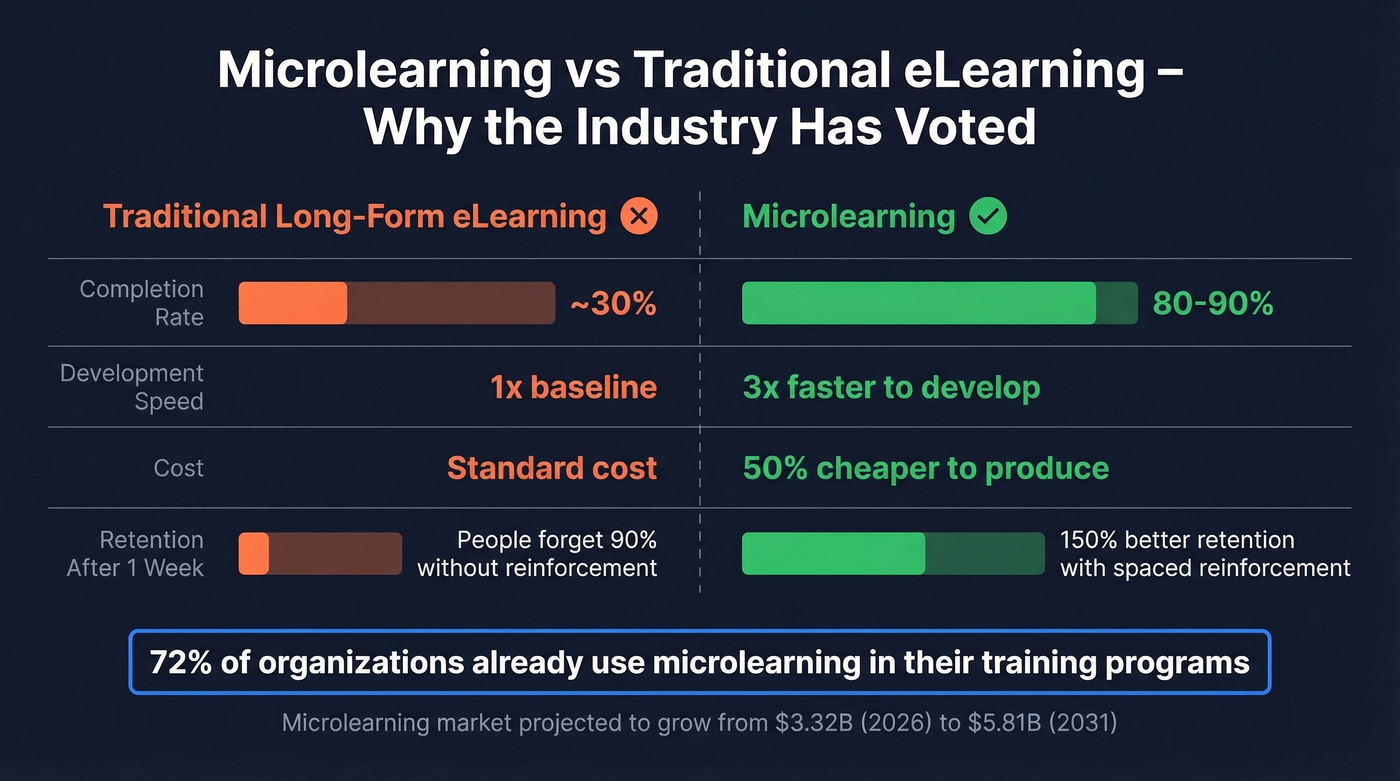
People forget ~90% of new information within a week without reinforcement. Spaced reinforcement - short modules delivered over time - yields 150% better retention. The microlearning market is projected to grow from $3.32B in 2026 to $5.81B by 2031. The industry has voted.
AI, VR, and the Shiny Object Trap
AI-personalized learning paths can drive 2-2.5x higher course completion rates and learning gains. VR training boosts learning effectiveness by 76%. These numbers are real, and for enterprise teams with the budget, they're worth exploring.
But let's be honest: most teams should start with microlearning plus live role-plays before investing in VR headsets. A thread in r/instructionaldesign captured this perfectly - an L&D owner had a working classroom program but faced exec pressure to adopt AR and simulations. Their manager's advice? Ignore the novelty push. The scope and budget didn't match. We've seen this pattern repeatedly: teams chase format over function and ship nothing while the "boring" microlearning program would've been live in two weeks.
Skip VR and AI-driven learning paths if your team is under 50 people or your training budget is under $50K/year. Start simple, measure what works, then invest in fancier formats once you've proven the basics.
Mistakes That Kill Results
Here's the thing - most of these mistakes aren't about budget. They're about assumptions.
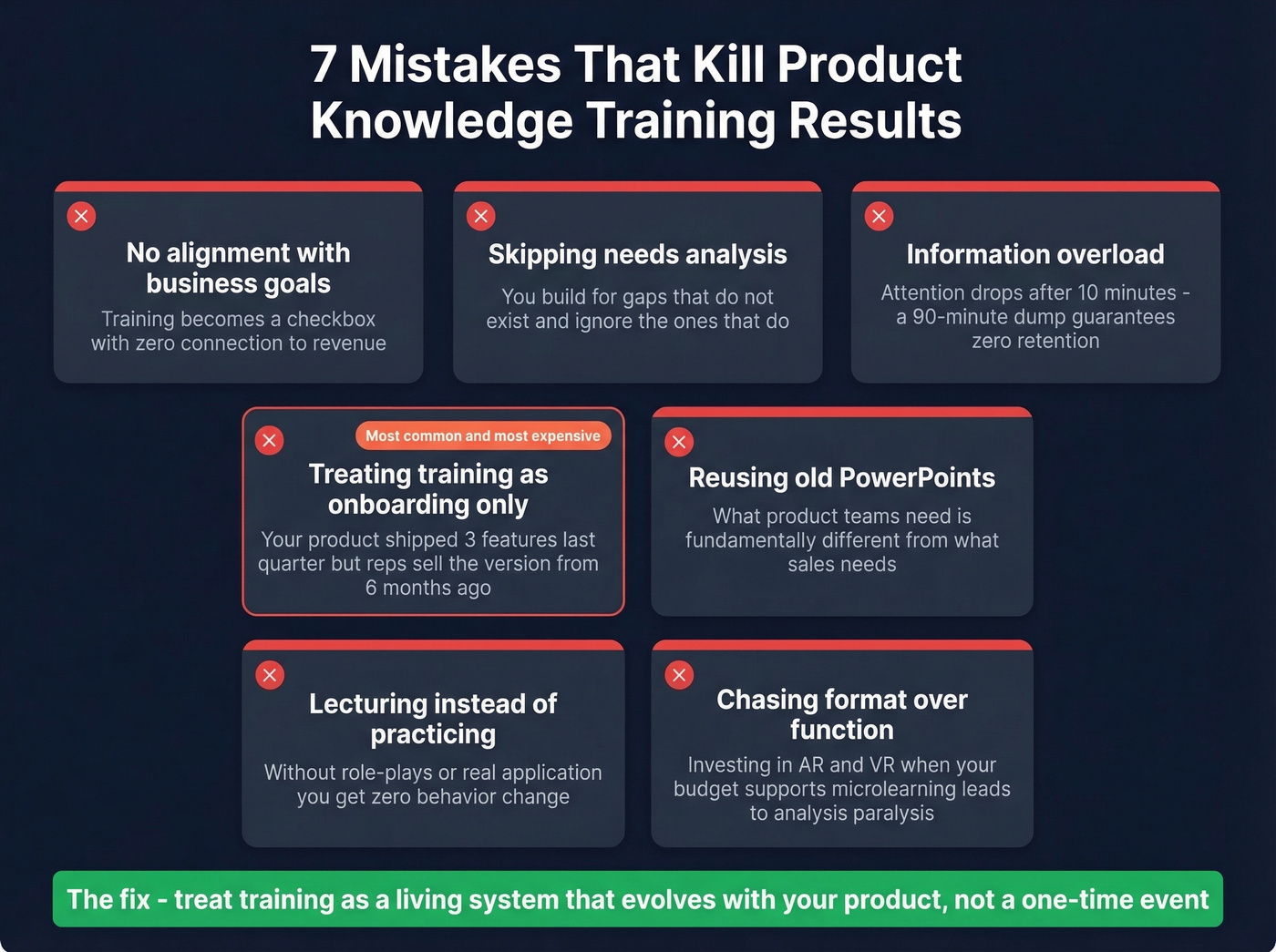
No alignment with business objectives. Training becomes a checkbox exercise with no connection to revenue, retention, or customer satisfaction goals. We once audited a team's training program and found zero overlap between their curriculum and their actual sales objections. Zero.
Skipping training needs analysis. You build content for gaps that don't exist while ignoring the ones that do.
Information overload. In virtual settings, attention drops after 10 minutes. A 90-minute product dump guarantees reps retain almost nothing.
Treating training as onboarding-only. This is the most common mistake - and the most expensive. Your product shipped three features last quarter. Your reps are still selling the version from six months ago. Training that doesn't evolve with the product creates reps who confidently sell outdated information, which erodes buyer trust faster than no training at all.
Reusing old PowerPoints not tailored to the audience. What the product team needs to know is fundamentally different from what sales needs to know.
Lecturing instead of practicing. Without role-plays, simulations, or real-world application, you get zero behavior change.
Chasing format over function. Investing in AR/VR when your budget supports microlearning leads to analysis paralysis. Nothing ships, nobody learns.
How to Measure Training Impact
The Kirkpatrick model, extended with Phillips' ROI level, is the measurement framework that works.
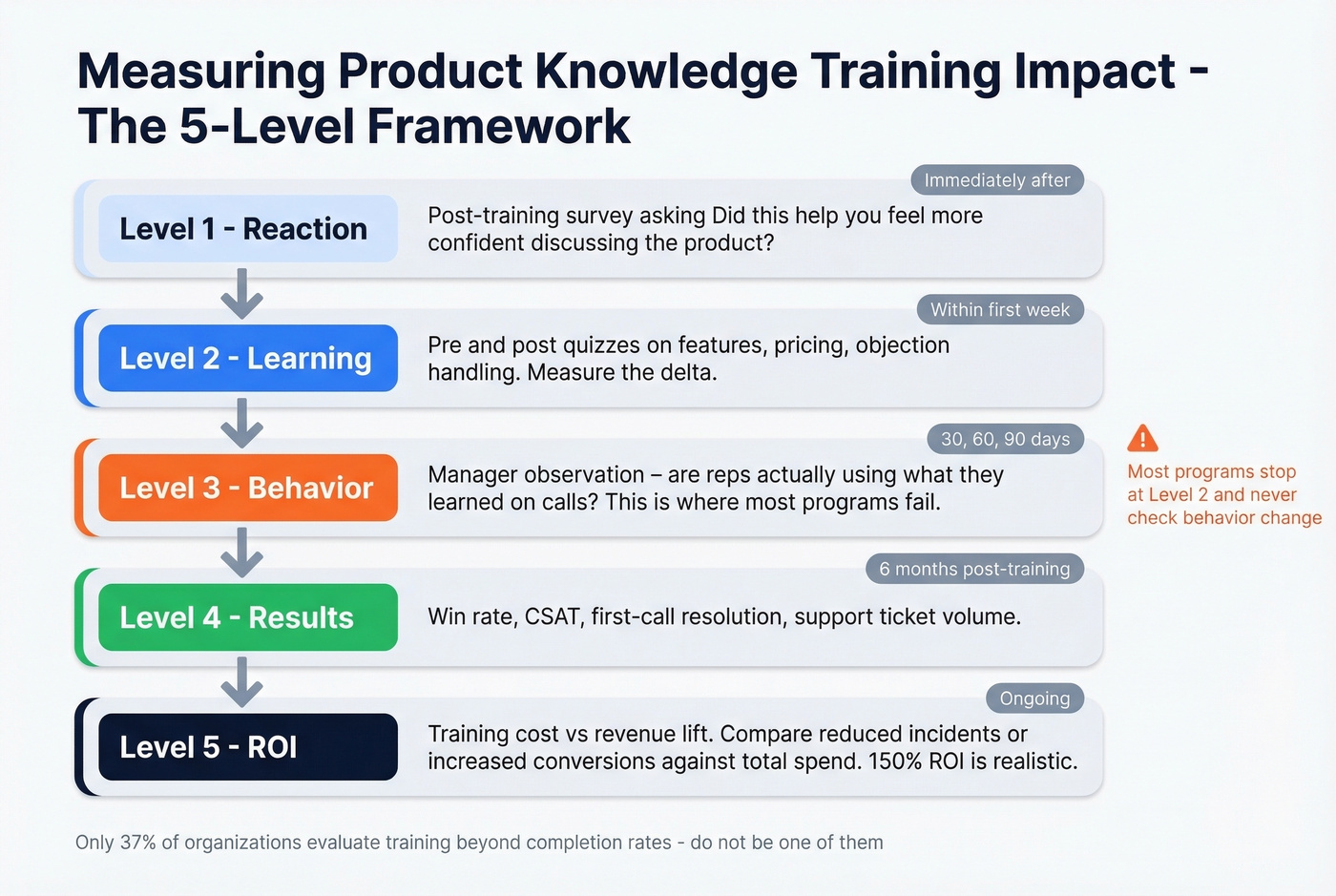
Level 1 - Reaction. Post-training survey: "Did this help you feel more confident discussing the product?" Simple, fast, catches content that misses the mark early.
Level 2 - Learning. Pre/post quizzes on features, pricing, objection handling. Run within the first week. The delta tells you what stuck.
Level 3 - Behavior. Manager observation at 30/60/90 days. Are reps actually using what they learned on calls? This is where most programs fall apart - they measure knowledge but never check whether behavior changed.
Level 4 - Results. Win rate, CSAT, first-call resolution, support ticket volume. These are the business metrics that justify the program. Measure at six months post-training.
Level 5 - ROI. Training cost versus revenue lift. A 150% ROI is realistic for well-designed programs - compare reduced incidents or increased conversions against total training spend.
Beyond Kirkpatrick, track these six additional metrics:
- Time to competence - how fast reps reach baseline performance
- Ramp-to-baseline vs. a control cohort - A/B over 4-8 weeks
- Behavioral change - observation checklists on live calls
- Business metric uplift - before/after attribution on pipeline and revenue
- Manager confidence scores - pulse surveys on rep readiness
- Capability heatmaps - gaps across roles and skills, updated quarterly
Assessment Questions Your Team Should Answer
Steal this checklist. If your reps can't answer these confidently, your training has gaps. Use them in hiring interviews, deal coaching sessions, and quarterly readiness reviews - they double as a practical benchmark for whether your curriculum actually sticks.
ICP & Customer:
- Who's our ideal customer, and why do they need our solution?
- What's the typical budget range for our buyers?
- What does the customer journey look like from first touch to renewal?
Brand & Mission:
- Which recognizable customers use our product, and what results did they get?
- How does our product support the company's core values?
Pricing & ROI:
- What are our pricing plans, and how is pricing calculated?
- Which plan fits which customer segment?
- How does our pricing compare to the top two competitors?
Competition & Industry:
- What differentiates us from our top three competitors?
- What industry trends are reshaping our buyers' priorities?
Features & Objections:
- What's the single most valuable feature for each persona?
- What are the three most common objections, and how do you handle each?
Best Tools for Product Training
Formal customer training programs drive 30-50% fewer support tickets and 12% higher renewal rates - the right learning management system makes that scalable. We've evaluated dozens of platforms; these seven consistently deliver.
| Tool | Best For | Starting Price | Verdict |
|---|---|---|---|
| TalentLMS | SMBs starting out | $69/mo (40 users) | Clean, affordable, free tier available |
| 360Learning | Collaborative learning | $8/user/mo | Peer-driven; great for fast-moving teams |
| LearnUpon | Mid-market | ~$800-$1,000/mo | Solid for 50-200 person orgs |
| Absorb LMS | Enterprise | ~$25K/yr | Feature-rich, heavier implementation |
| Skilljar | Customer education | ~$30K/yr + per-user | Built for external training |
| SC Training | Mobile microlearning | Free (up to 10 users) | Lightweight, fast to deploy |
| SkyPrep | Simple admin | $500-$1,500/mo | No-frills, gets the job done |
TalentLMS is the obvious starting point for SMBs. Free plan to test, Starter at $69/mo for 40 users, and it scales to Pro at $449/mo. The interface is clean and the learning curve is minimal - we've recommended it to teams that had a working training program within a single afternoon.
360Learning takes a different approach - collaborative, peer-driven content creation at $8/user/mo. If your product knowledge lives in your team's heads rather than a central wiki, this is how you extract it. The consensus on r/sales is that peer-created content often outperforms top-down training because it reflects how reps actually talk about the product.
LearnUpon fits mid-market teams that need more structure at $800-$1,000/mo for up to 100 users. Absorb LMS and Skilljar are enterprise plays at $25-30K/year minimums. SC Training is excellent for mobile-first microlearning with a generous free tier. SkyPrep keeps admin simple at $500-$1,500/mo.
These tools teach your reps what to say. But product knowledge is wasted if reps can't reach the right prospects. Prospeo's 300M+ professional profiles with 98% verified email accuracy means your trained reps actually connect with the people they're targeting - not bounced inboxes.
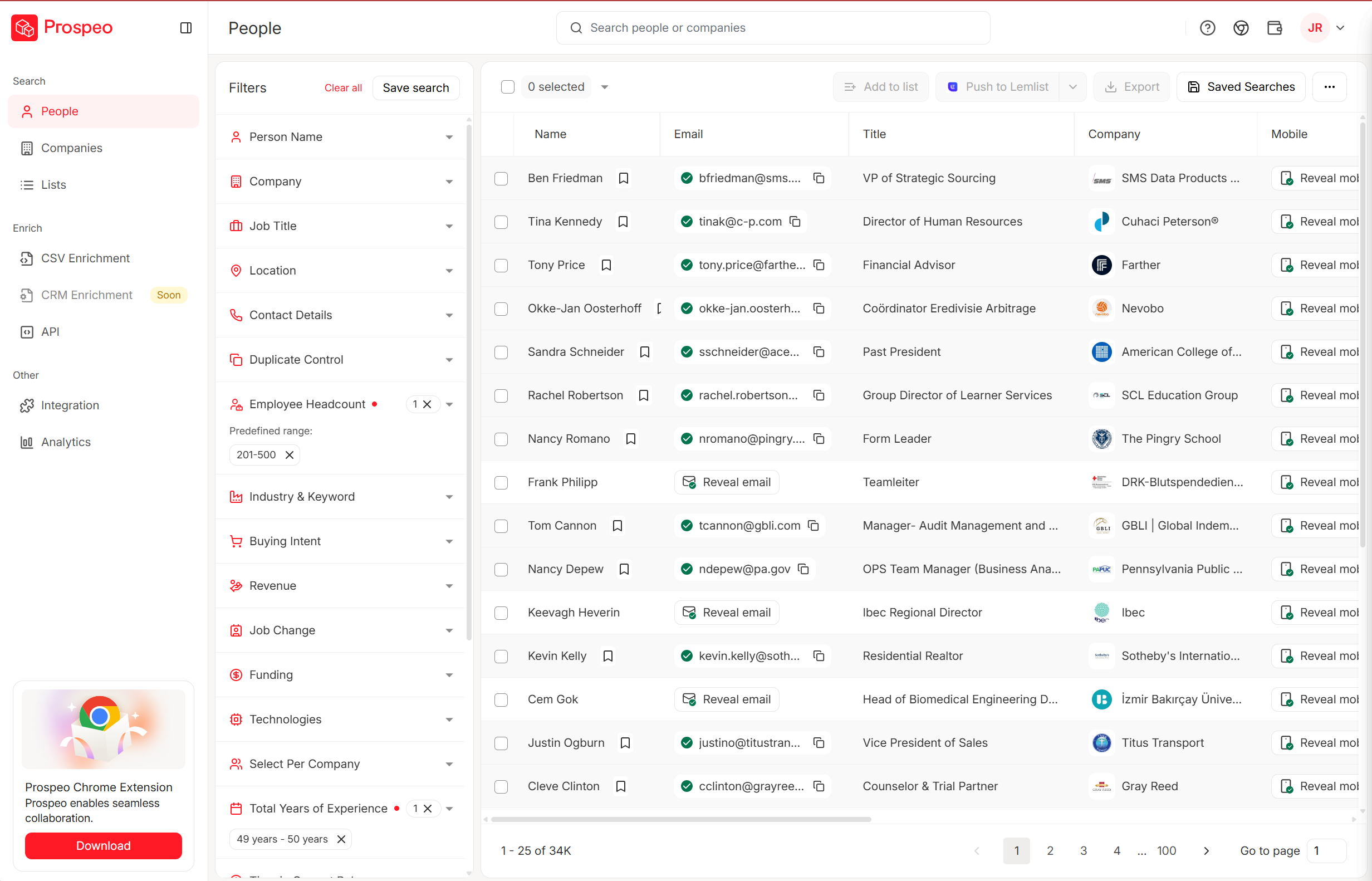
Your competitor analysis pillar is only as good as the data behind it. Prospeo's 300M+ profiles refresh every 7 days - not every 6 weeks - so reps always prospect with current job titles, company signals, and verified contact info. At $0.01 per email with 98% accuracy, your team spends less time bouncing and more time selling.
Reps trained on stale data sell last quarter's story.
FAQ
How long should product knowledge training take?
Initial training should run 2-4 weeks of microlearning at 15-20 minutes per day, followed by monthly refreshers aligned to product updates. The one-week-and-done approach guarantees most knowledge is lost within days - spaced reinforcement yields 150% better retention than single-session formats.
How often should you update training content?
Every time a feature ships, pricing changes, or a new competitor emerges - at minimum, quarterly. Training that doesn't evolve with the product creates reps who confidently sell outdated information, which erodes buyer trust faster than no training at all.
What's the fastest way to measure if training is working?
Compare pre/post quiz scores within the first week, then track win rate, first-call resolution, and CSAT at 30/60/90 days. If you're seeing knowledge gains on quizzes but no movement in business metrics, the gap is usually in application - reps know the material but aren't using it on calls. That's a coaching problem, not a content problem.
Can small teams run effective product training without an LMS?
Yes. Start with a shared doc of value statements, weekly 15-minute role-plays, and a competitive intelligence channel in Slack. SC Training offers a free tier for up to 10 users, and TalentLMS has a free plan as well. Structure matters more than software at this stage.