


Propane Alternatives: What Actually Works in 2026 (and What Doesn't)
A homeowner on r/homeowners posted about spending $700 on a partial propane refill - going from 30% to 85% tank capacity - with the thermostat set at 64°F in a 5,000 sq ft house. That's not an outlier. Roughly 6.3 million U.S. households heat primarily with propane, and most of them run the same miserable math every winter. We dug into the numbers on every common propane alternative, talked to contractors, and read way too many Reddit threads about frozen pipes and $3/gallon fill-ups. Here's what actually pencils out.
Our Picks (TL;DR)
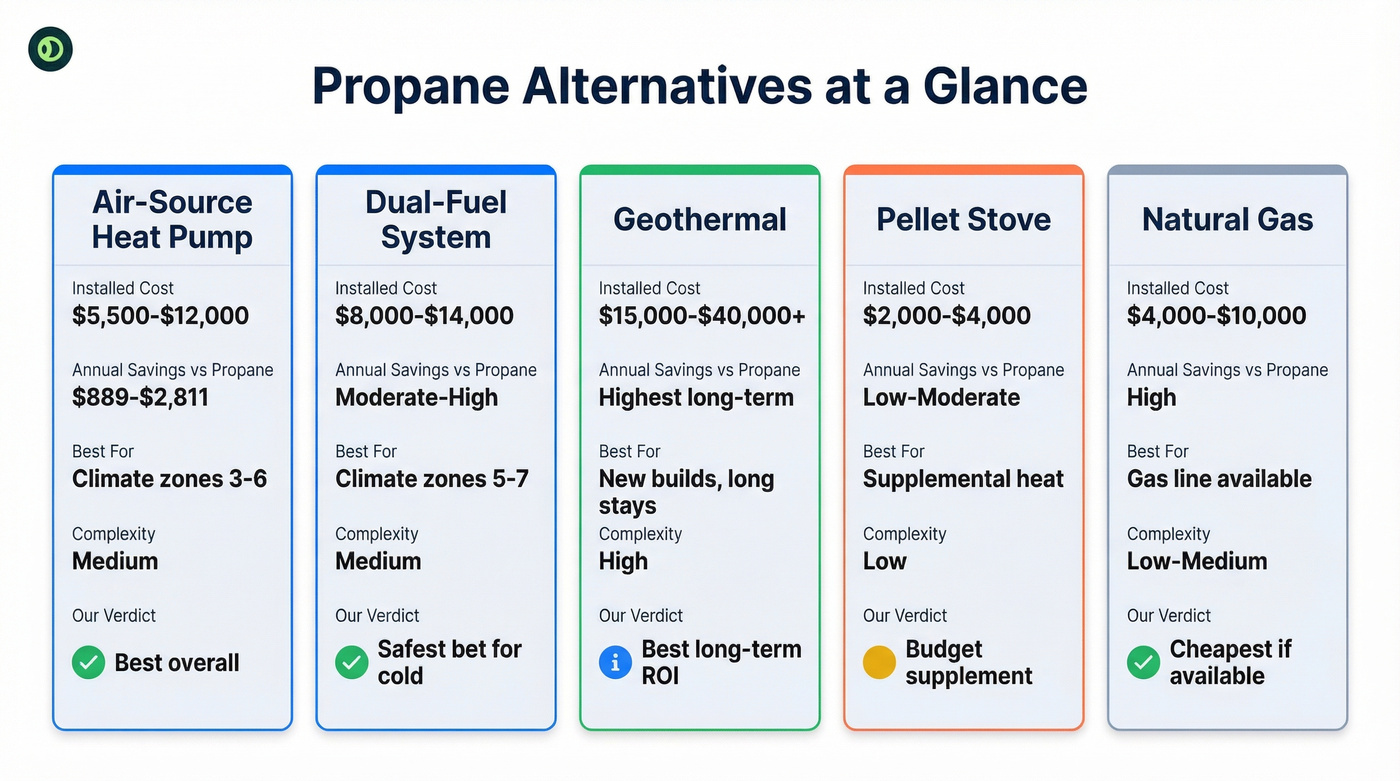
- Cold-climate air-source heat pump - best all-around, with $889-$2,811/year in estimated savings.
- Dual-fuel system (heat pump + propane backup) - best for extreme cold zones.
- Geothermal - best long-term ROI, highest upfront cost.
- Pellet stove - best supplemental/budget option.
- Natural gas conversion - best if a pipeline runs to your street.
What Propane Costs Right Now
LP Gas Magazine's winter 2025-2026 outlook, summarizing EIA forecasts, puts the average retail propane price at $2.46/gal - about 7% less than last winter. A typical propane-heated household spends roughly $1,210 over the heating season, ranging from $1,116 in a mild year to $1,355 in a cold one. U.S. propane inventories hit 103.4 million barrels heading into winter, roughly 12 million barrels above the five-year average.
That surplus keeps prices soft for now. But propane remains volatile and regionally expensive - and about 85% of residential propane goes to space heating, so there's no hiding from the bill.
Fuel Cost Comparison
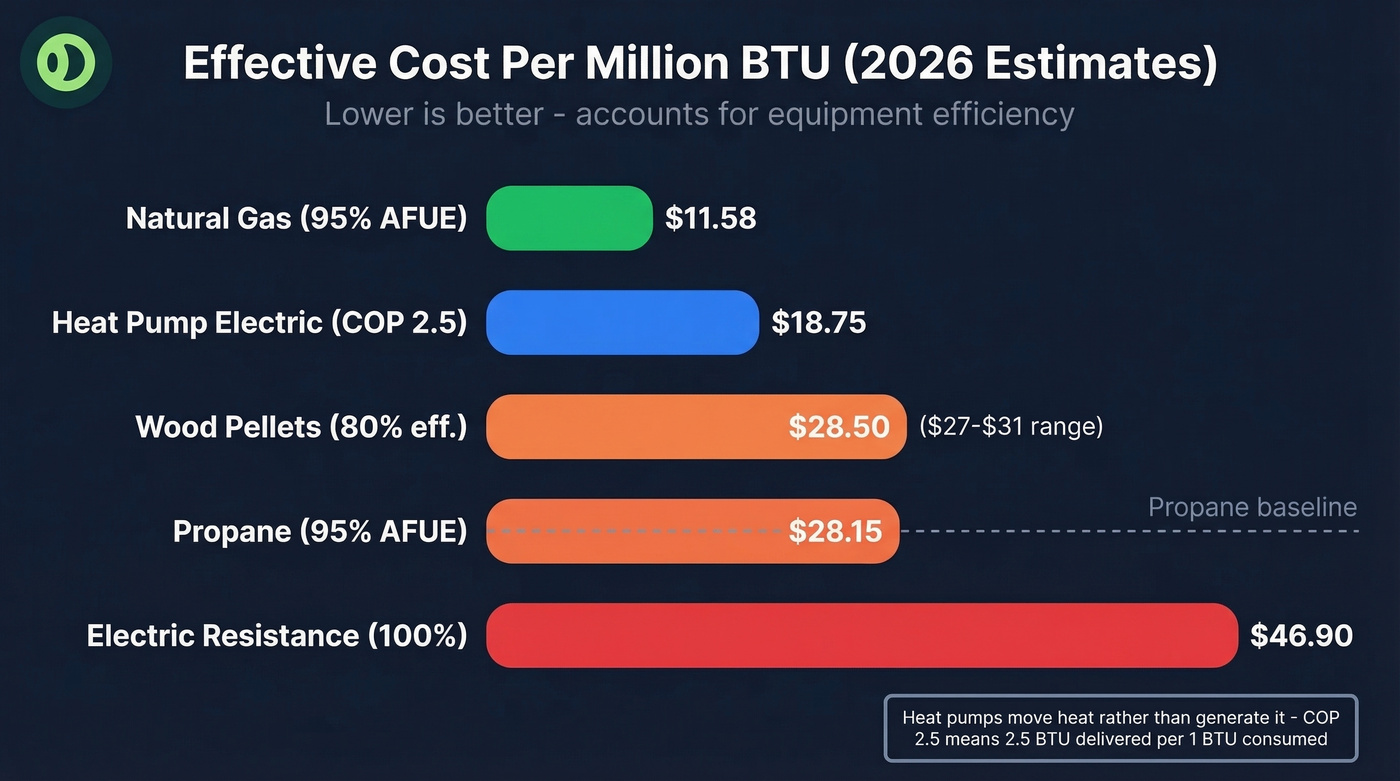
This table normalizes every fuel to the same unit - dollars per million BTU of delivered heat - so you're comparing apples to apples. The key variable is equipment efficiency: a heat pump with a COP of 2.5 effectively multiplies each kWh by 2.5, which is why electricity looks expensive on paper but cheap through a heat pump.
| Fuel | Unit Price (2026 est.) | BTU/Unit | Typical Efficiency | Effective $/MMBtu |
|---|---|---|---|---|
| Propane | $2.46/gal | 92,000 | 95% AFUE | ~$28.15 |
| Electricity (heat pump) | $0.16/kWh | 3,413 | COP 2.5 | ~$18.75 |
| Electricity (resistance) | $0.16/kWh | 3,413 | 100% | ~$46.90 |
| Natural gas | $1.10/therm | 100,000 | 95% AFUE | ~$11.58 |
| Wood pellets | $350-$400/ton | ~16M BTU/ton | 80% | ~$27-$31 |
The formula is straightforward: (unit price / BTU per unit) x 1,000,000 / efficiency = effective $/MMBtu. Heat pumps win because they move heat rather than generate it - a COP of 2.5 means 2.5 BTU of heat delivered per BTU of electricity consumed.

You just ran the numbers on propane vs. heat pumps. Now run the numbers on your sales data. Prospeo delivers 98% verified emails at $0.01 each - 90% cheaper than ZoomInfo with higher accuracy.
Stop overpaying for bad data the way you overpay for propane.
Best Replacements for Propane Heating
Air-Source Heat Pumps
Use this if: You're replacing an aging furnace or AC unit anyway, or you want the single biggest cut to your heating bill.
Skip this if: You're in an extreme cold zone without access to a cold-climate model, or your electrical service needs a 200A upgrade that triggers major rewiring.
Installed cost runs $5,500-$12,000 depending on whether you go standard or high-efficiency inverter. The DOE pegs annual savings at $889-$2,811 versus propane, and a heat pump replaces both your furnace and your AC, so the real cost gap is smaller than the sticker suggests.
Modern cold-climate heat pumps still deliver a COP of 2.2 at 17°F and 1.9 at 5°F. At 50°F, you're looking at a COP of 3.8 - nearly four units of heat for every unit of electricity. In our analysis, this is the single best option for most homeowners in climate zones 3-6 looking to ditch propane. The consensus on r/hvacadvice backs this up: cold-climate mini-splits from Mitsubishi and Fujitsu get recommended constantly, even in northern New England.
Dual-Fuel Systems
A dual-fuel setup pairs a heat pump with your existing propane furnace. The heat pump handles the shoulder-season and mild-winter load, then propane kicks in automatically when temperatures drop and the heat pump becomes less economical.
Installed cost is $8,000-$14,000. You can cut propane use dramatically without betting everything on electrification. For climate zones 5-7, we think this is consistently the smartest move - you get most of the savings without any of the "what if it hits -20°F" anxiety. It's also the easiest sell if your spouse isn't ready to rip out the furnace entirely.
Geothermal Heat Pumps
Geothermal is the long game. Installed cost runs $15,000-$40,000+, but the underground loop lasts 50+ years and the indoor components go 20-25 years. The DOE puts payback at 10-15 years.
Here's where it gets interesting. A Minnesota homeowner building a 3,100 sq ft house got quoted $42,500 for conventional propane HVAC and $59,000 for geothermal. After the 30% federal tax credit and a $2,500 utility rebate, that gap shrank to under $1,000. On a new build, geothermal is almost a no-brainer if you plan to stay in the house. On a retrofit, the math is tighter - you need to factor in drilling costs, which vary wildly by soil type and lot size.
Pellet Stoves
The upfront cost is low at $2,000-$4,000 installed, pellets run about $300-$400/ton, and a good stove can heat a main living area effectively. The tradeoff is maintenance. You're cleaning ash weekly, scheduling annual vent cleanings, and hauling 40-lb bags from your garage all winter.
A pellet stove isn't a whole-home solution. It's a way to keep the propane furnace from running constantly, and for some households that's enough to make the economics work.
Natural Gas Conversion
Natural gas is the cheapest fuel per BTU if a pipeline runs to your property. At roughly $11-$12/MMBtu delivered with a high-efficiency furnace, it's less than half the cost of propane. A gas furnace install typically runs $4,000-$10,000 depending on efficiency tier and ductwork.
The catch is obvious: many propane households are outside gas service areas. That's usually why they're on propane in the first place. But if you do have a line available, this is the simplest switch with the fastest payback.
Space Heaters (Don't)
Here's the thing - we get it. Space heaters seem like a cheap fix. They're not a real alternative. Using portable electric heaters as primary heat is a fire hazard, and dropping your thermostat to 55°F to compensate risks freezing pipes. Space heaters are a stopgap for a single room, not a heating strategy.
One more thing worth dismissing: renewable propane exists as a drop-in replacement, but it isn't widely available at residential scale and costs significantly more per gallon. Don't count on it.
Should You Switch from Propane?
Switch if propane is consistently above the winter forecast average in your area, your AC or furnace is due for replacement anyway, or you qualify for federal tax credits.
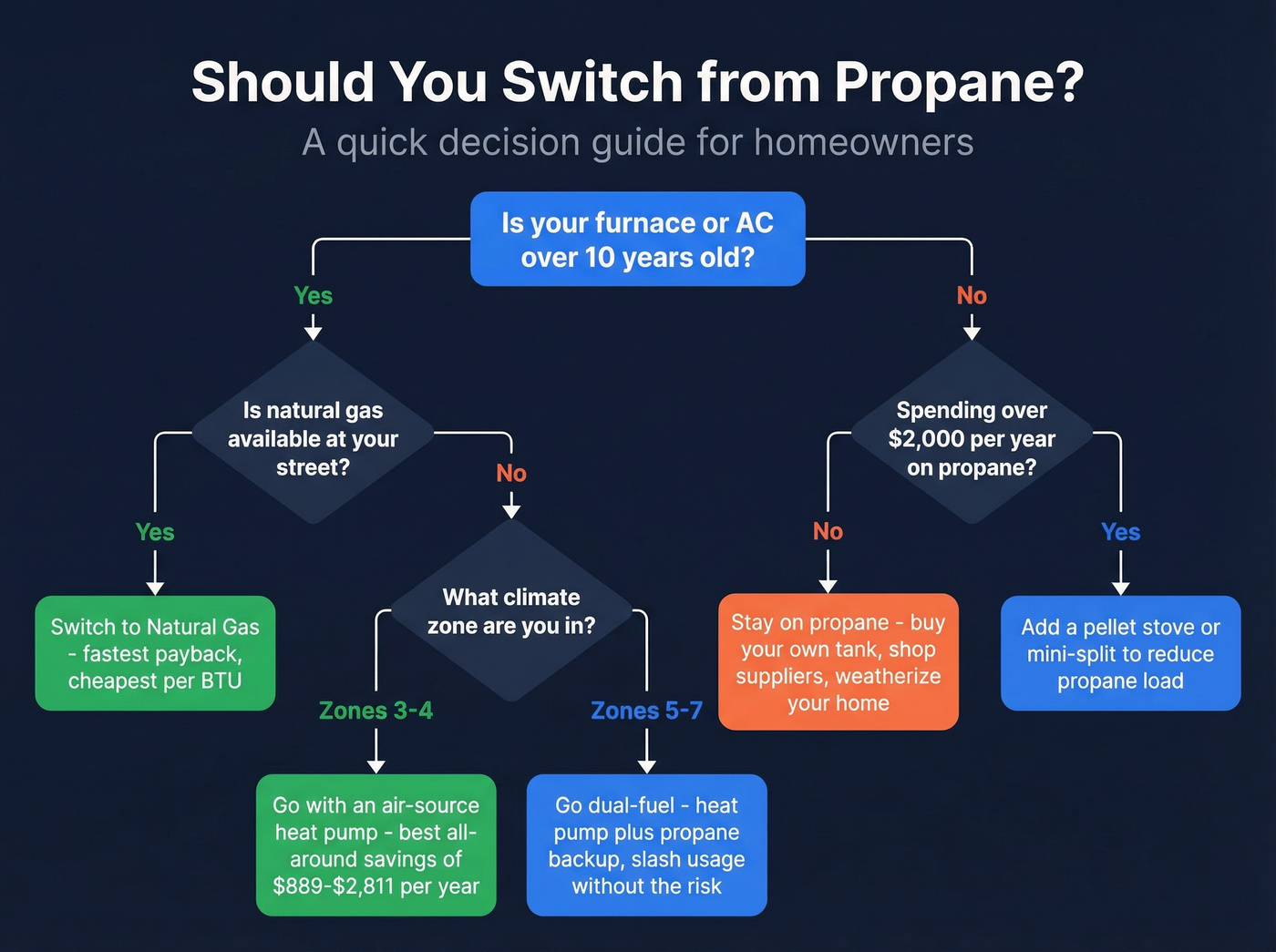
Stay if your propane system is under 5 years old, you're in an extreme cold climate with no cold-climate heat pump access, or you own your tank and can shop suppliers freely. On that last point - if you're leasing a tank from your propane company, you typically have to buy from that supplier. Buying your own tank ($1,500-$3,500 for a 500-gallon unit) lets you get quotes from multiple suppliers. For homeowners staying on propane, this is one of the highest-ROI moves you can make.
Go dual-fuel if you're in climate zone 5-7 and want to slash propane use without fully committing to electrification.
Let's be honest: you probably don't need to quit propane entirely. A dual-fuel system or even a pellet stove supplement can cut your bill dramatically without a $30,000 geothermal install. The goal isn't zero propane - it's stopping the $700 refill cycle.
Incentives Snapshot
Qualifying air-source heat pumps earn up to $2,000/year in federal tax credits - confirm eligibility via IRS Form 5695. Geothermal systems qualify for a 30% credit on installed cost with no cap.
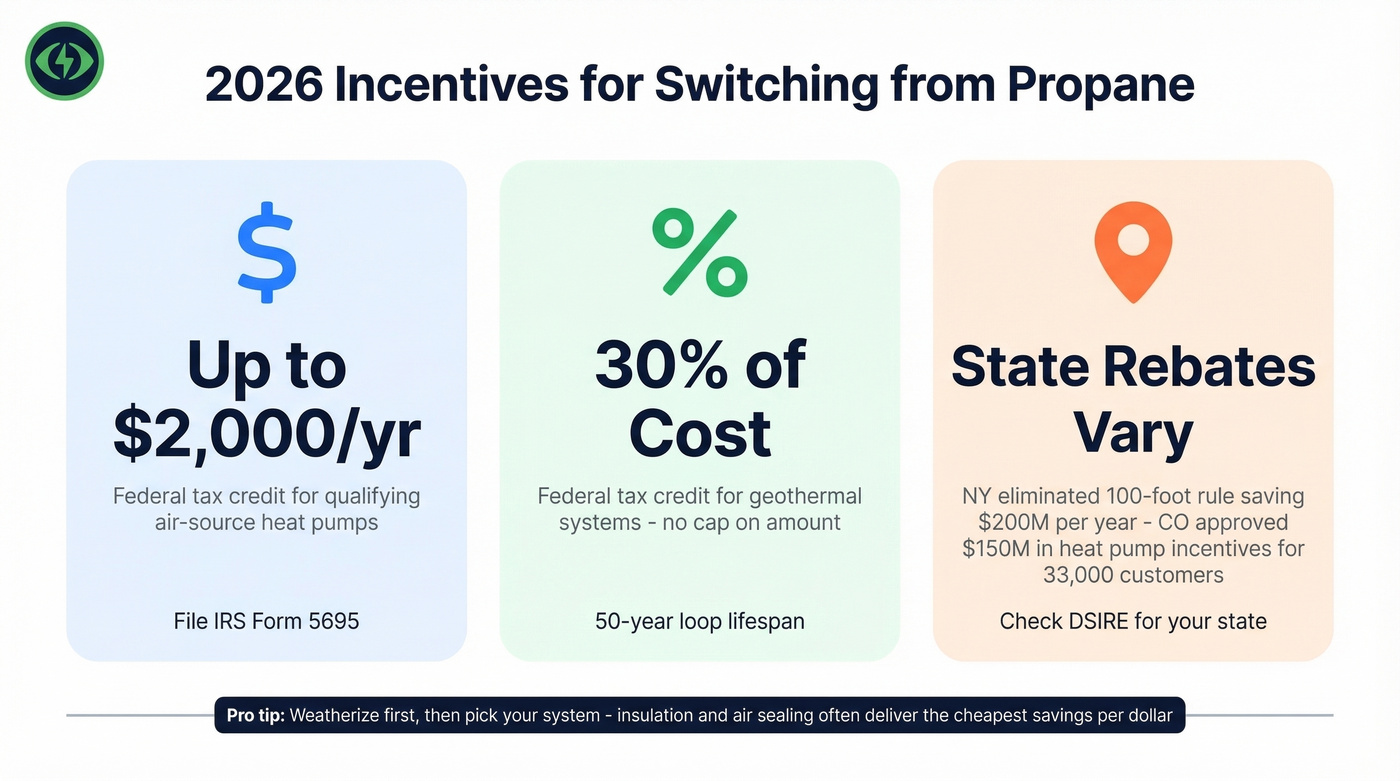
At the state level, New York eliminated the "100-foot rule" for gas line extensions, saving ratepayers roughly $200M/year. Colorado approved Xcel's NPA portfolio with about $150M in projected savings and heat pump incentives affecting approximately 33,000 customers. Check DSIRE for your state's specific rebates and programs.
Next Steps
Get three HVAC quotes - not one. Schedule a home energy audit before committing to any system, because insulation and air sealing often deliver the cheapest savings per dollar. Weatherize first, then pick your system. Among all the propane alternatives we've covered, a heat pump - standalone or dual-fuel - offers the best balance of upfront cost, long-term savings, and available incentives for most households. If you're sourcing quotes from local HVAC contractors, Prospeo's B2B database can help you find verified contact details for installers in your area.
If you want a cleaner way to get three HVAC quotes and compare bids, treat it like a mini procurement process.
Selling HVAC systems, heat pumps, or energy solutions to homeowners ditching propane? Prospeo's 300M+ profiles and 30+ filters - including technographics and buyer intent - connect you to decision-makers actively in-market.
Find the contractors and homeowners ready to buy - before your competitors do.