

Prospect vs Opportunity: When a Prospect Becomes a Deal
A sales leader managing 150 reps recently shared that their pipeline was inflated by roughly 60% - wrong dollar values, outdated close dates, deals without real buyer intent. The prospect vs opportunity distinction isn't academic. It's the difference between a forecast your CFO trusts and one that collapses in the last week of the quarter.
The 30-Second Fix
Teams where sales and marketing agree on when a lead becomes an opportunity convert 65% more prospects into pipeline. The fix is a shared definition with binary gates - no judgment calls, no "I think this deal is real."
- Prospect: Fits your ICP, has shown interest, and there's evidence of intent.
- Opportunity: Problem confirmed, champion identified, budget and timeline known, next step scheduled.
If your team can't agree on these two bullets, nothing downstream - forecasting, quota setting, resource allocation - will work.
Lead vs Prospect vs Opportunity
| Lead | Prospect | Opportunity | |
|---|---|---|---|
| Definition | Showed interest, not qualified | Lead vetted against your ICP | Qualified prospect, real buying potential |
| Owner | Marketing / SDR | SDR / AE | AE |
| What must be true | Contact info exists | ICP fit + interest + intent | Problem, champion, budget, timeline, next step |
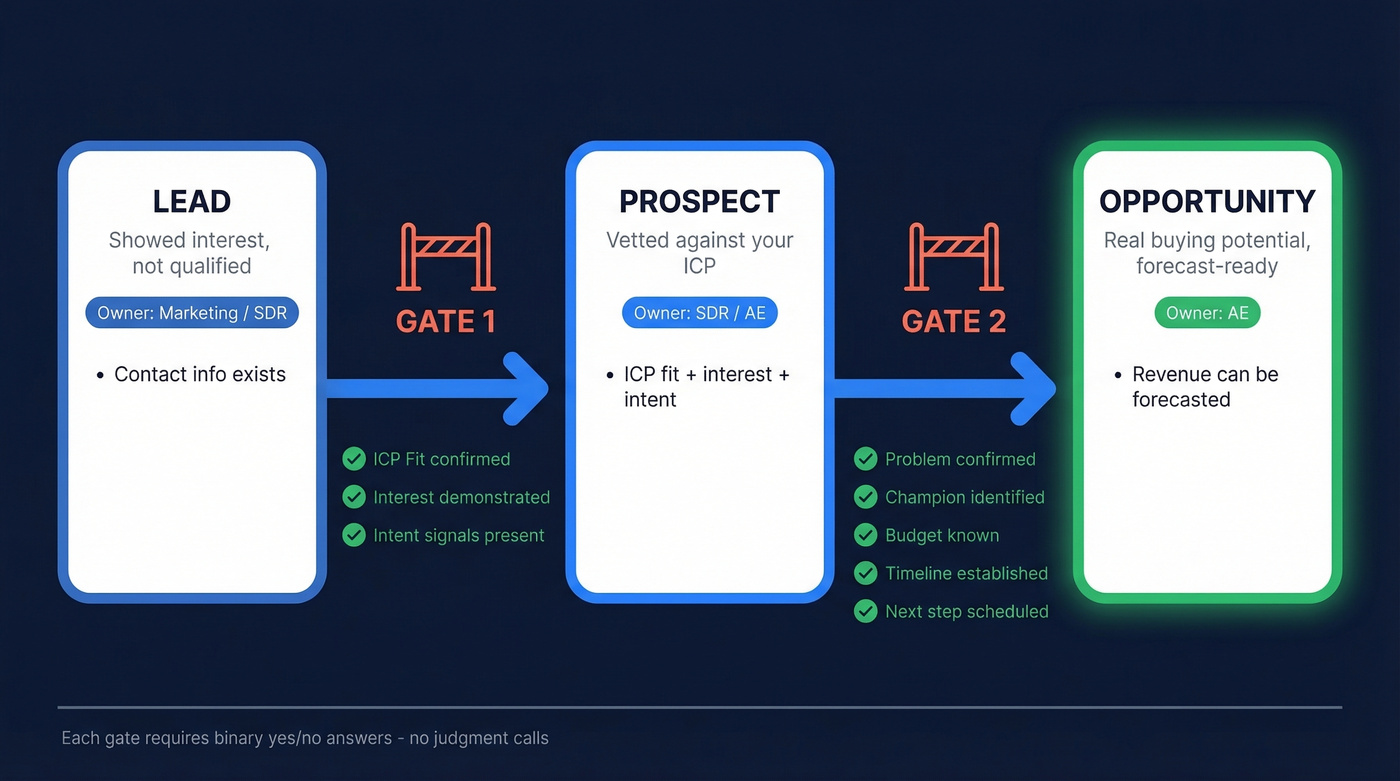
The progression is linear: Lead, then Prospect, then Opportunity. Each transition requires clearing a gate. Salesforce defines a prospect as a lead qualified via interest, budget, authority, and timeline. An opportunity goes further - it's where you can forecast revenue with confidence.
Here's the thing: 32% of sales teams waste time on unqualified leads. Crisp definitions fix that.
The Real Difference Explained
A prospect is someone you're evaluating. An opportunity is a deal you're working.
Call it a prospect when you've confirmed ICP fit and the person has engaged - replied to an email, attended a webinar, taken a meeting. You're still in discovery mode. You don't know if there's budget, a timeline, or even a real problem yet.
Call it an opportunity when the buyer has confirmed a problem, there's a champion internally, budget exists, there's a timeline, and you have a next step on the calendar.
The pain point that surfaces constantly on r/salesforce: someone mentions a "far-off project next year" and a rep logs it as an opportunity. That's not an opportunity. It shouldn't touch your forecast until there's a concrete next step.
Promotion Rules: Stage Gates
Copy these gates into your CRM documentation.

Lead to Prospect Gate
All three must be true:
- Fit: Matches your ICP - industry, company size, title, geography
- Interest: Has engaged with your brand, whether that's opening emails, visiting your pricing page, or attending an event
- Intent: Shows buying signals like requesting a demo, asking about pricing, or downloading comparison content
Prospect to Opportunity Gate
All five must be true:
- Problem confirmed: Buyer has articulated a specific pain your product solves
- Champion identified: Someone internal is advocating for your solution
- Budget known: Allocated budget or a clear path to securing one
- Timeline established: Target implementation or decision date
- Next step scheduled: A concrete meeting, demo, or proposal review on the calendar
If an AE can't answer "yes" to all five, the deal stays in prospect status. No exceptions. Scale the rigor to your deal size - SMBs might gate at "meeting booked + pain confirmed," while enterprise deals warrant full MEDDPICC validation before anything enters the pipeline.

Your stage gates demand proof - ICP fit, intent signals, a real champion. But 32% of teams waste time on unqualified leads because their contact data is wrong. Prospeo's 300M+ profiles with 98% email accuracy and 7-day refresh cycles mean every prospect you promote to opportunity is backed by verified, current data.
Stop promoting ghosts to your pipeline. Verify every prospect first.
Stages Must Be Observable
Every stage should reflect a clear activity, not just a status. Don't move to "Proposal Sent" before you've delivered a formal quote. Don't mark "Negotiation" because someone asked for a discount - that stage means terms and legal are actively being discussed. Build stages around verifiable actions, then audit them monthly. We've seen teams cut pipeline inflation by half just by adding a monthly "stage accuracy" review to their ops cadence.
How CRMs Map It
| Stage | Salesforce | HubSpot | Pipedrive |
|---|---|---|---|
| Unqualified | Lead object | Contact + lifecycle stage | People / Organizations |
| Qualified | Convert to Contact + Account | Lifecycle stage change | People / Organizations |
| Deal in progress | Opportunity object | Deal object | Deal object |
One common mistake in Salesforce: creating a "Prospecting" stage inside the Opportunity object. This muddies the line and inflates your pipeline. Keep prospecting activity on the Lead or Contact object. The Opportunity should only exist once your gate is cleared.
Benchmarks to Sanity-Check Your Pipeline
Full-funnel benchmarks from MarketJoy's latest data:
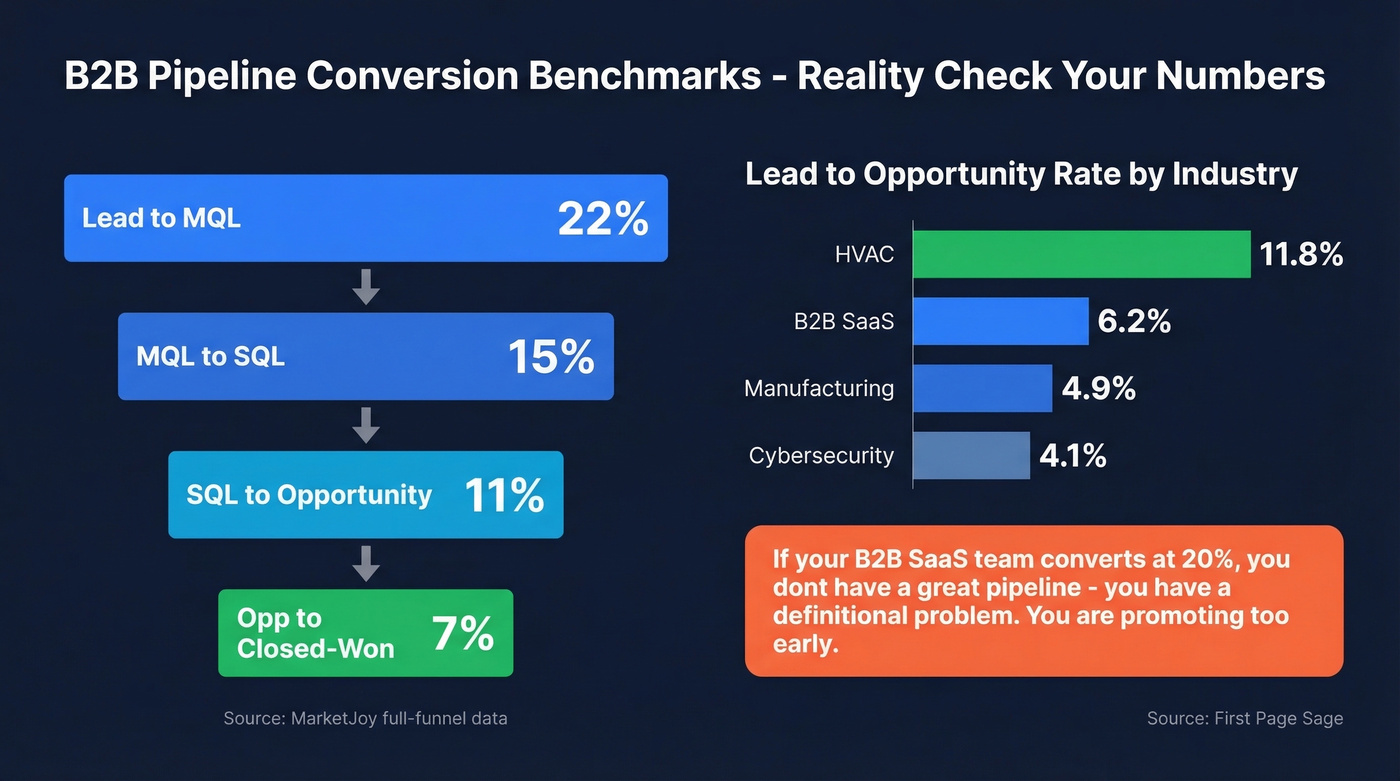
| Stage | Conversion Rate |
|---|---|
| Lead to MQL | 22% |
| MQL to SQL | 15% |
| SQL to Opportunity | 11% |
| Opp to Closed-Won | 7% |
Lead-to-opportunity rates by industry from First Page Sage:
| Industry | Lead to Opp Rate |
|---|---|
| B2B SaaS | 6.2% |
| Cybersecurity | 4.1% |
| Manufacturing | 4.9% |
| HVAC | 11.8% |
Let's be honest: if your B2B SaaS team converts leads to opportunities at 20%, you don't have a great pipeline. You have a definitional problem. You're promoting too early. And if you're at 2%, your qualification criteria are too strict or your lead quality needs work.
What Breaks in Real Life
Premature opportunity creation inflates pipeline by 60%, leadership loses trust, and quotas get set on fiction. CRM object misuse compounds it - one Salesforce thread describes a team routing free trials as Opportunities, then struggling to separate real revenue from trial noise. Tool sprawl doesn't fix visibility either. Teams running Salesforce, Outreach, Gong, and five other tools still find forecasting is a nightmare.
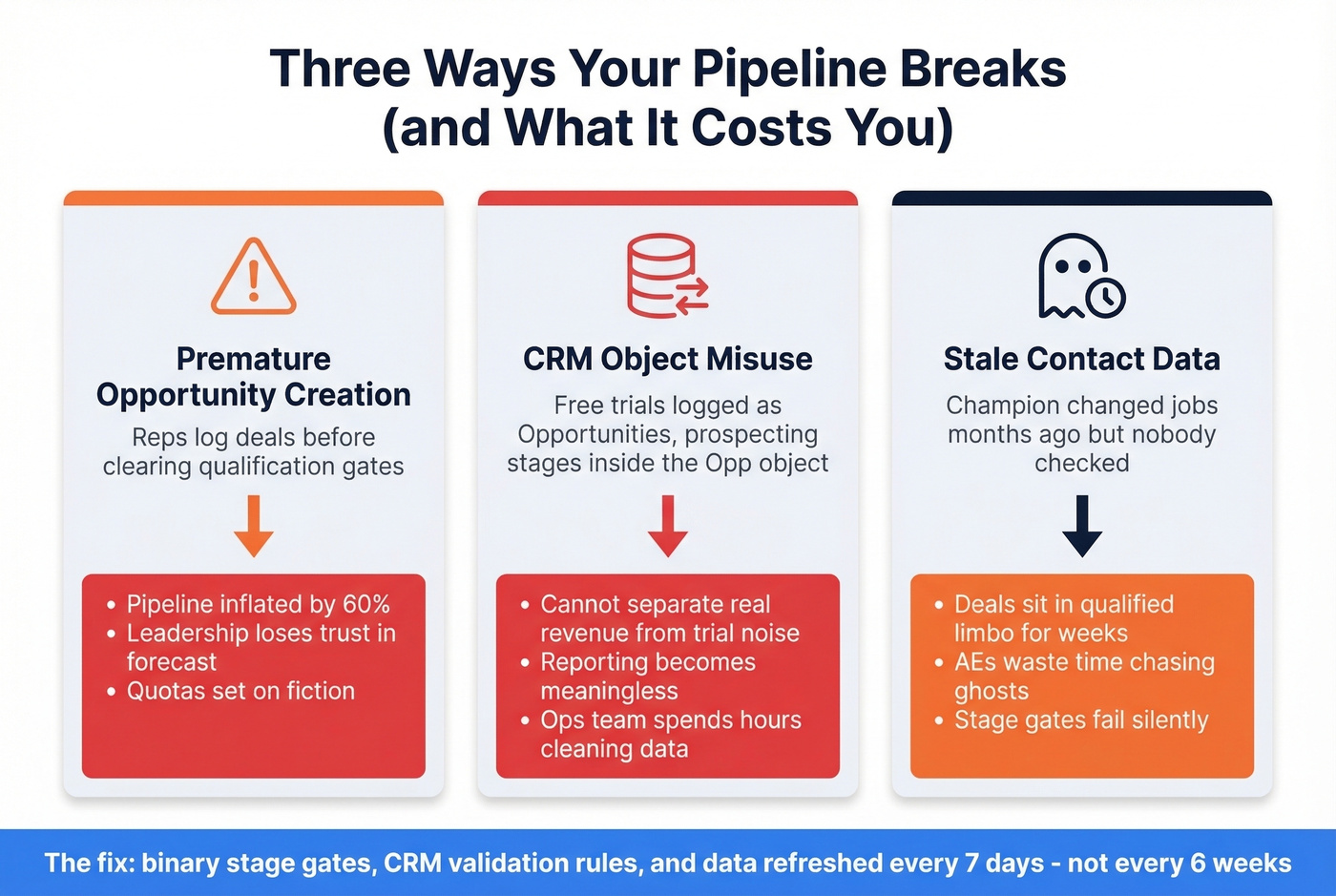
And here's one that doesn't get enough attention: stage gates fail when contact data is stale. You can't confirm a champion if the person changed jobs three months ago. We've watched deals sit in "qualified" limbo for weeks because the supposed champion had already left the company - and nobody checked.
Clean Data Powers Accurate Promotion
Your stage gates are only as reliable as the data behind them. A high prospect-to-opportunity conversion rate means nothing if those records carry outdated emails and wrong titles - the deals stall the moment an AE tries to validate the five qualification gates. Before promoting any prospect, run the account's contacts through Prospeo's enrichment to verify the champion's email is still active, confirm their title, and pull a verified mobile number. With a 7-day data refresh cycle, you're working with current information instead of hoping last quarter's records are still accurate.
If you’re building a repeatable qualification motion, pair this with a simple lead scoring model and a documented lead status workflow so reps can’t “skip” gates.

Deals stall in qualified limbo when your champion changed jobs three months ago and nobody checked. Prospeo refreshes data every 7 days - not the 6-week industry average - so your CRM reflects reality. Layer in buyer intent tracking across 15,000 topics to know which prospects actually deserve opportunity status.
Kill pipeline inflation with data that's never more than a week old.
FAQ
When should you create an opportunity in Salesforce?
Create an opportunity only when the buyer has confirmed a problem, you've identified a champion, budget and timeline are known, and a next step is scheduled. If any of those five gates aren't met, keep the record as a Lead or Contact to avoid inflating your pipeline.
What's the difference between a prospect and an opportunity in a CRM?
A prospect is a qualified lead you're still evaluating - ICP fit is confirmed and engagement exists, but buying readiness hasn't been validated. An opportunity is a deal with a confirmed problem, champion, budget, timeline, and scheduled next step. Keeping these stages distinct is what makes your forecast trustworthy.
Can a prospect become an opportunity?
Yes - a prospect becomes an opportunity once it clears your five-point qualification gate. They're sequential stages, not interchangeable labels. Every opportunity was once a prospect, but not every prospect earns that promotion.
How do you stop reps from creating opportunities too early?
Enforce required fields via CRM validation rules: block opportunity saves without Amount, Close Date, Stage, and Champion. Add auto-stale rules that flag deals with no activity for 14+ days. And verify champion contact data before the record advances - there's no point promoting a deal if the champion's email bounces.
Is a free trial a lead or an opportunity?
A free trial is a lead until the user demonstrates buying intent - engaging with sales, discussing pricing, or requesting a proposal. Skip this stage gate and you'll flood your pipeline with trial noise that never converts. Require a sales conversation before creating the opportunity record.