


Prospeo vs QuickEnrich: Which Enrichment Tool Gives You Better Data?
Two enrichment tools, two different approaches. Prospeo runs a proprietary 5-step verification pipeline across 300M+ profiles. QuickEnrich offers high found-email/phone volumes at rock-bottom per-unit pricing across 130M+ contacts. The real question isn't cost per credit - it's which tool delivers data that won't torch your sender reputation.
The Single-Source Enrichment Problem
Single-source enrichment leaves 40-60% of qualified prospects unreachable. Teams stack providers to close the gap, but stacking bad data on bad data solves nothing. Contact databases decay at roughly 2.5% per month, so verification methodology and refresh cycles matter more than raw database size.
On r/coldemail, you'll find threads where teams describe losing thousands of credits to a tool bug and then scrambling for alternatives that can keep outreach moving without wrecking deliverability. It's a common enough story that it should make anyone think twice about choosing a provider based on price alone.
30-Second Verdict
Choose Prospeo if you care about email accuracy (98%), data freshness (7-day refresh), mobile coverage (125M+ verified numbers), and intent data. It's the stronger single-source enrichment tool for teams that can't afford bounces.
Choose QuickEnrich if you're on a tight budget, need high volume, and you're willing to layer a separate verification tool on top.
Skip both if you want a waterfall aggregator - look at FullEnrich (15+ vendors, ~90% find rate) or BetterContact (20+ sources) instead.
Feature-by-Feature Comparison
| Feature | Prospeo | QuickEnrich |
|---|---|---|
| Database size | 300M+ profiles | 130M+ contacts |
| Verified emails | 143M+ | Not specified |
| Verified mobiles | 125M+ | ~25% of enriched contacts include mobile |
| Email accuracy | 98% | Double verified (no published rate) |
| Mobile pickup rate | 30% | Not published |
| Verification method | 5-step proprietary | SMTP + catchall + multiple verification tools |
| Data refresh cycle | 7 days | Not published |
| Intent data | 15K topics (Bombora) | None |
| Chrome extension | 40K+ users | Unclear |
| Starting price | Free / $49/mo | $29/mo |
| Integrations | Salesforce, HubSpot, Clay, Lemlist, + more | Clay, API |
| Third-party reviews | Established (G2, etc.) | Limited |
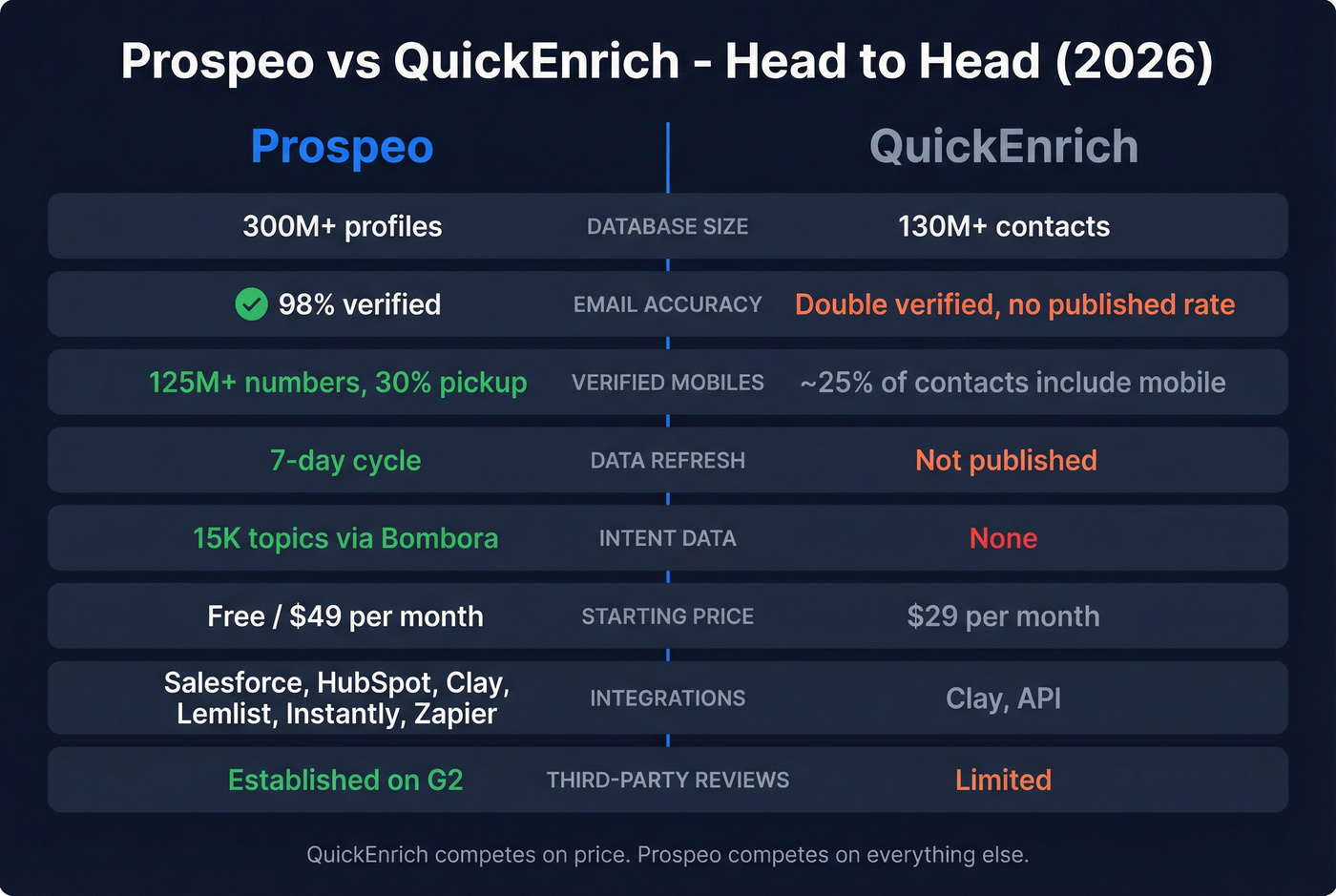
QuickEnrich competes on price per found email. Prospeo competes on everything else.
Email Accuracy and Verification
This is where the gap is widest.
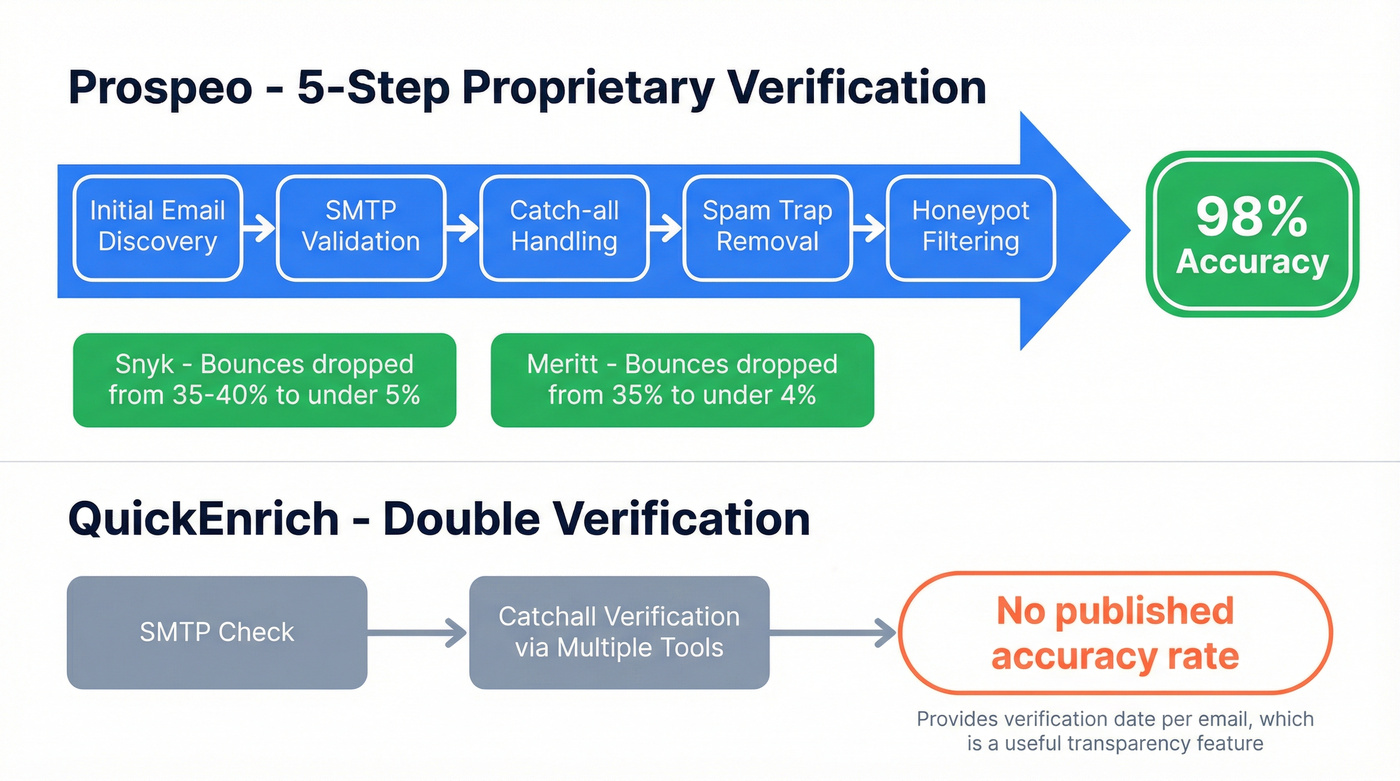
Prospeo's 5-step verification includes catch-all handling, spam-trap removal, and honeypot filtering - all on proprietary infrastructure independent of third-party email providers. The result: 98% email accuracy. Customer results show what that looks like in practice. Snyk cut bounce rates from 35-40% to under 5%, and Meritt went from 35% bounces to under 4%.

QuickEnrich positions itself around "Double Verified Emails," running SMTP checks and catchall verification through multiple tools. They also provide a verification date per email, which is a genuinely useful transparency feature. But "double verified" still doesn't tell you what happens when you actually send 10,000 emails. We've tested enough enrichment tools to know that verification labels and real-world bounce rates are often very different things.

Verification labels don't protect your sender reputation - real accuracy does. Prospeo's 5-step proprietary verification delivers 98% email accuracy on a 7-day refresh cycle. Snyk cut bounces from 35-40% to under 5%. Meritt went from 35% to under 4%.
Stop paying for emails that bounce. Start with 75 free verified contacts.
Pricing Breakdown
| Prospeo | QuickEnrich | |
|---|---|---|
| Free tier | 75 verified emails + 100 Chrome extension credits/mo | None (free trial) |
| Entry paid | $49/mo (2,000 email credits) | $29/mo (up to 6,000 found emails or phone) |
| Mid-tier | Scales with credits | $99/mo (up to 25,000 found emails or phone) |
| Annual discount | Available | $24/mo Starter / $83/mo Growth |
| Per-email cost | ~$0.025 (entry); scales to ~$0.01 at volume | ~$0.005 |
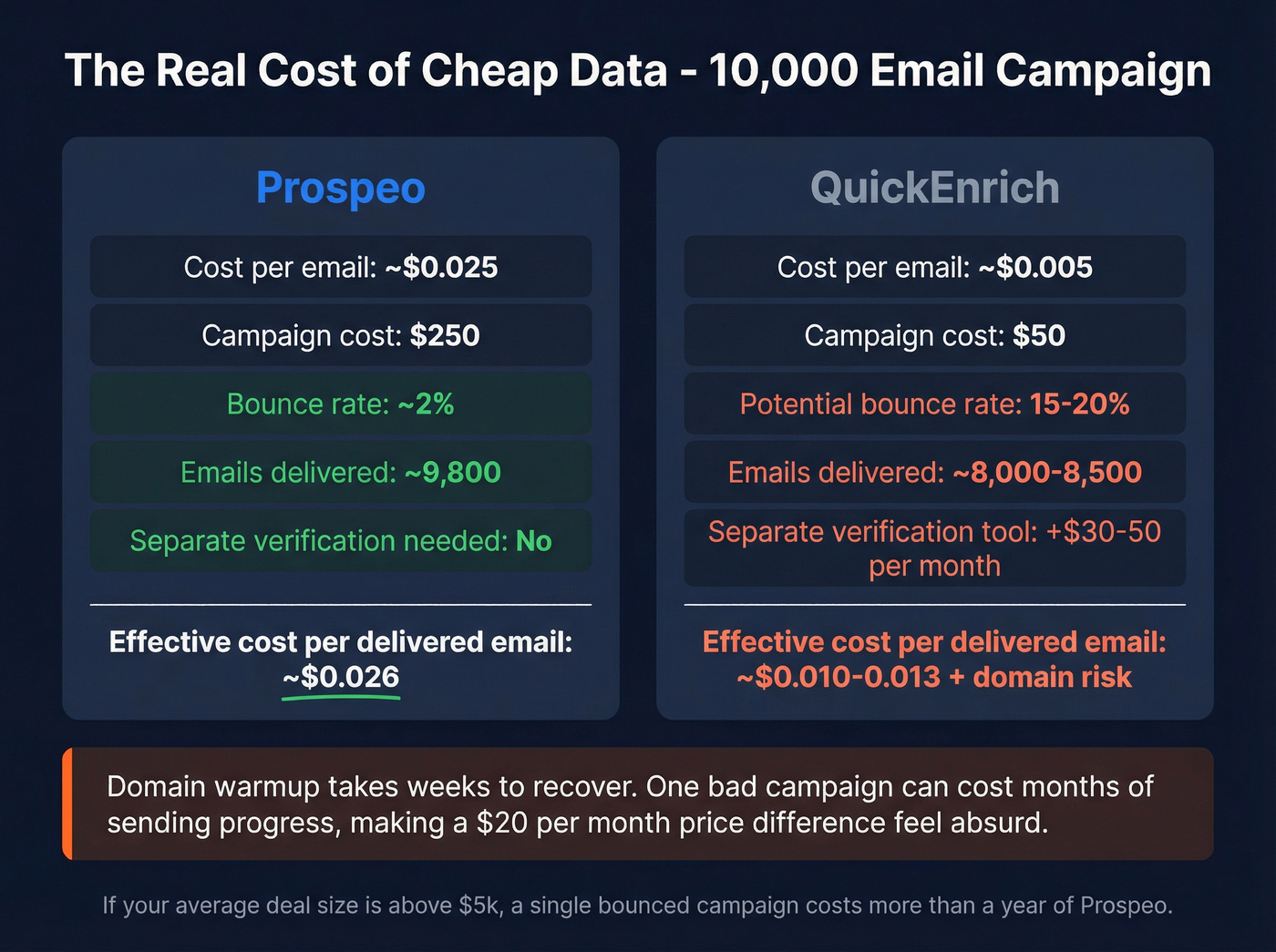
On paper, QuickEnrich is cheaper per email. Here's the thing: credits that bounce aren't savings. If 15-20% of a 10,000-email campaign bounces because the data wasn't properly verified, you've wasted credits and damaged your domain reputation. Domain warmup takes weeks to recover. We've seen teams lose months of sending progress over a single bad list - the kind of setback that makes a $20/month price difference feel absurd in hindsight.
One note: QuickEnrich's pricing page displays both "6,000" and "3,000" email figures in the same Starter block. We're using the higher number, but confirm before you buy.
Mobile Numbers and Data Freshness
Prospeo covers 125M+ verified mobile numbers with a 30% pickup rate across regions. QuickEnrich includes mobile numbers and direct lines when available, estimating ~25% of enriched contacts will include a mobile number. No pickup rate published.
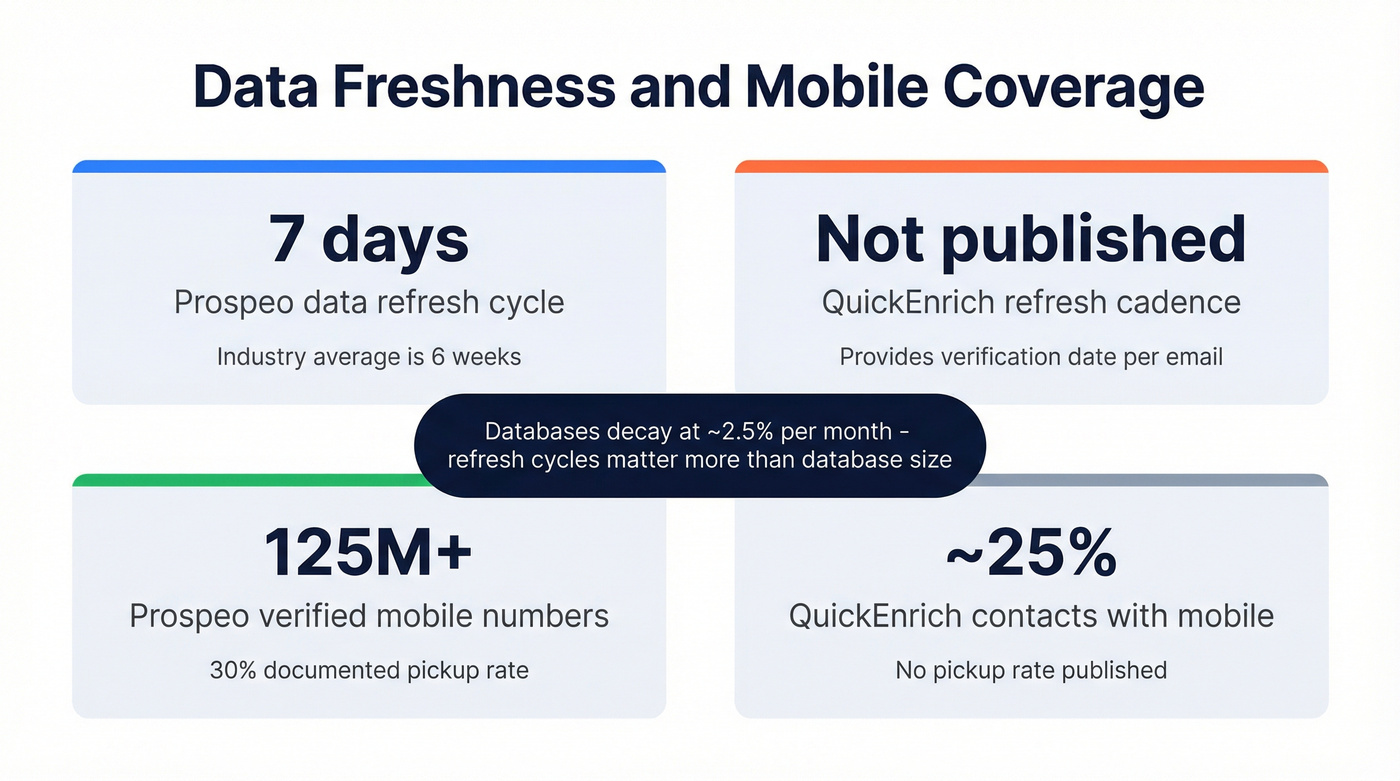
On freshness, Prospeo refreshes all records on a 7-day cycle - the industry average is 6 weeks. QuickEnrich provides a verification date per email but no published refresh cadence. With databases decaying at ~2.5% per month, a tool without a clear refresh cycle is a tool where data quality degrades silently. For teams running cold-call sequences alongside email, that combination of mobile coverage and weekly refresh is hard to match.
Integrations
Prospeo connects natively to Salesforce, HubSpot, Smartlead, Instantly, Lemlist, Clay, Zapier, and Make. It also includes intent data tracking 15,000 topics via Bombora and a Chrome extension with 40K+ users.
QuickEnrich integrates with Clay and offers API access. No native Salesforce or HubSpot integrations are listed, and there's no intent data layer.
If you're running outbound sequences through Instantly or Lemlist, Prospeo plugs in directly. QuickEnrich is positioned around API and Clay, so CRM and outbound workflows typically run through middleware. That's not a dealbreaker for technical teams, but it adds friction for anyone who just wants data flowing into their existing stack without extra setup.
The Verdict
Choose Prospeo for verified accuracy, fresh data, mobile coverage, intent signals, and native integrations with your outbound stack.
Consider QuickEnrich if budget is the primary constraint and you're comfortable adding a separate email verification step before sending.
Consider a waterfall aggregator like FullEnrich or BetterContact for maximum find rates across 15+ providers.
Let's be honest about the math here. QuickEnrich's per-credit pricing looks great in a spreadsheet. But if your average deal size is above $5k, a single bounced campaign that tanks your domain costs more than a year of Prospeo. Cheap data is the most expensive mistake in outbound.
If you're trying to reduce bounces systematically, start with email deliverability fundamentals and track your email bounce rate like a KPI, not an afterthought.
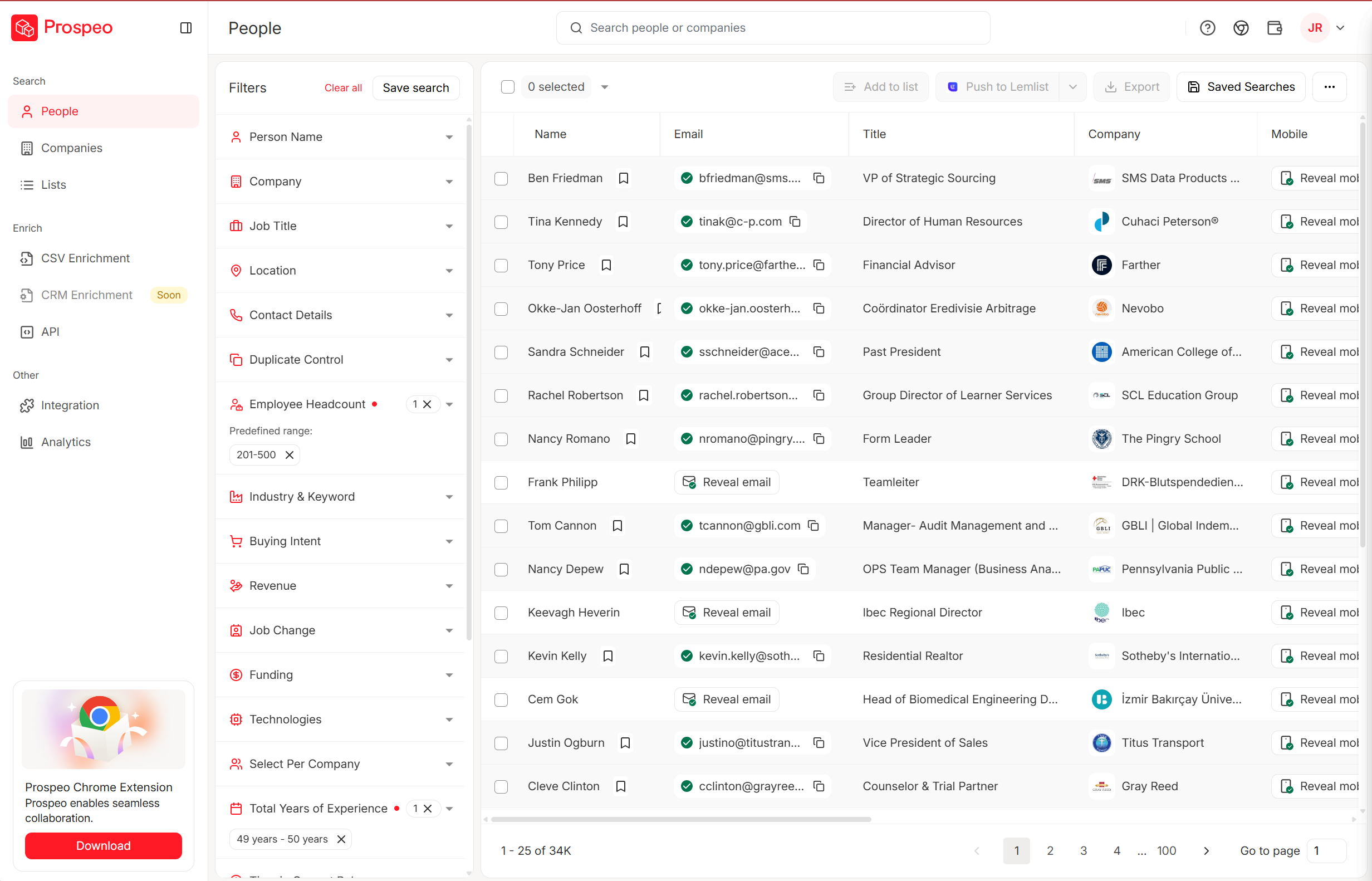
Cheap per-credit pricing means nothing when bounced campaigns tank your domain for weeks. Prospeo gives you 98% accurate emails, 125M+ verified mobiles, and native integrations with Instantly, Lemlist, and HubSpot - no middleware required.
Run it side by side with QuickEnrich. The bounce rates tell the whole story.
FAQ
Is QuickEnrich cheaper than Prospeo?
Per unit, yes - roughly $0.005 per found email versus ~$0.025 at Prospeo's entry tier. But unverified emails that bounce cost domain reputation and wasted sends. Factor in a separate verification tool and the effective price gap narrows fast.
Does QuickEnrich offer intent data?
No. Prospeo tracks 15,000 intent topics via Bombora, letting you prioritize prospects actively researching your category. For ABM teams, that's a meaningful difference that directly impacts pipeline quality.
Can I try Prospeo for free?
Yes - 75 verified emails plus 100 Chrome extension credits per month, no credit card required. Paid plans start at $49/mo with self-serve signup and no sales calls needed.
Which tool has better mobile number coverage?
Prospeo provides 125M+ verified mobile numbers with a documented 30% pickup rate. QuickEnrich estimates ~25% of enriched contacts include a mobile number but publishes no pickup rate. For teams running cold-call sequences, that gap matters.