

Purchase Intent: The Complete Guide for Revenue Teams
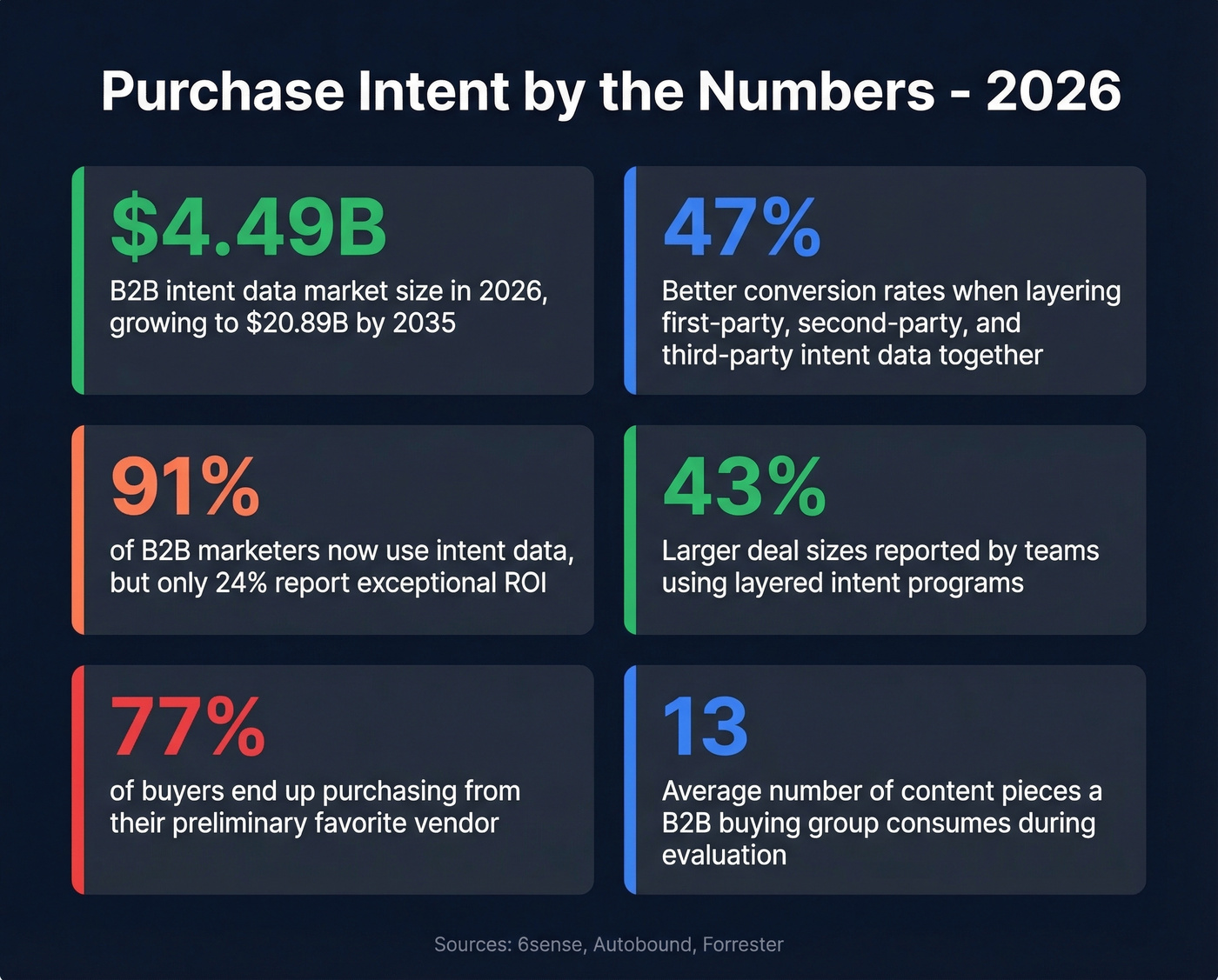
A sales leader with 20+ years of experience put it bluntly on r/sales: "90% of the intent triggers we pay for are useless." That's a damning verdict on purchase intent data - a category where 91% of B2B marketers now use it but only 24% report exceptional ROI. The gap between adoption and results is almost always an activation problem.
What You Need (Quick Version)
Purchase intent is the measured likelihood that a person or company will buy. You infer it from behavior - pricing page visits, demo requests, content consumption - or from stated preferences like surveys and form fills. The concept is simple. Execution is where teams burn money.
Most intent programs fail because teams treat a topic-surge score like a qualified lead. It isn't. What works is combining first-party signals with concrete trigger events - job changes, funding rounds, hiring sprees - then activating within 48 hours. Not next week. Not when the SDR gets around to it.
Here's the thing: if your average deal size sits below $10K, you probably don't need a $40K intent platform. You need verified contacts, a few strong trigger signals, and speed.
Defining Purchase Intent
Purchase intent - also called buying intent, buyer intent, or purchase intention - describes how likely someone is to buy a product or service within a given timeframe. In B2C, it's measured through surveys and shopping behavior. In B2B, it's inferred from digital signals: what companies are researching, how intensely, and who's involved.
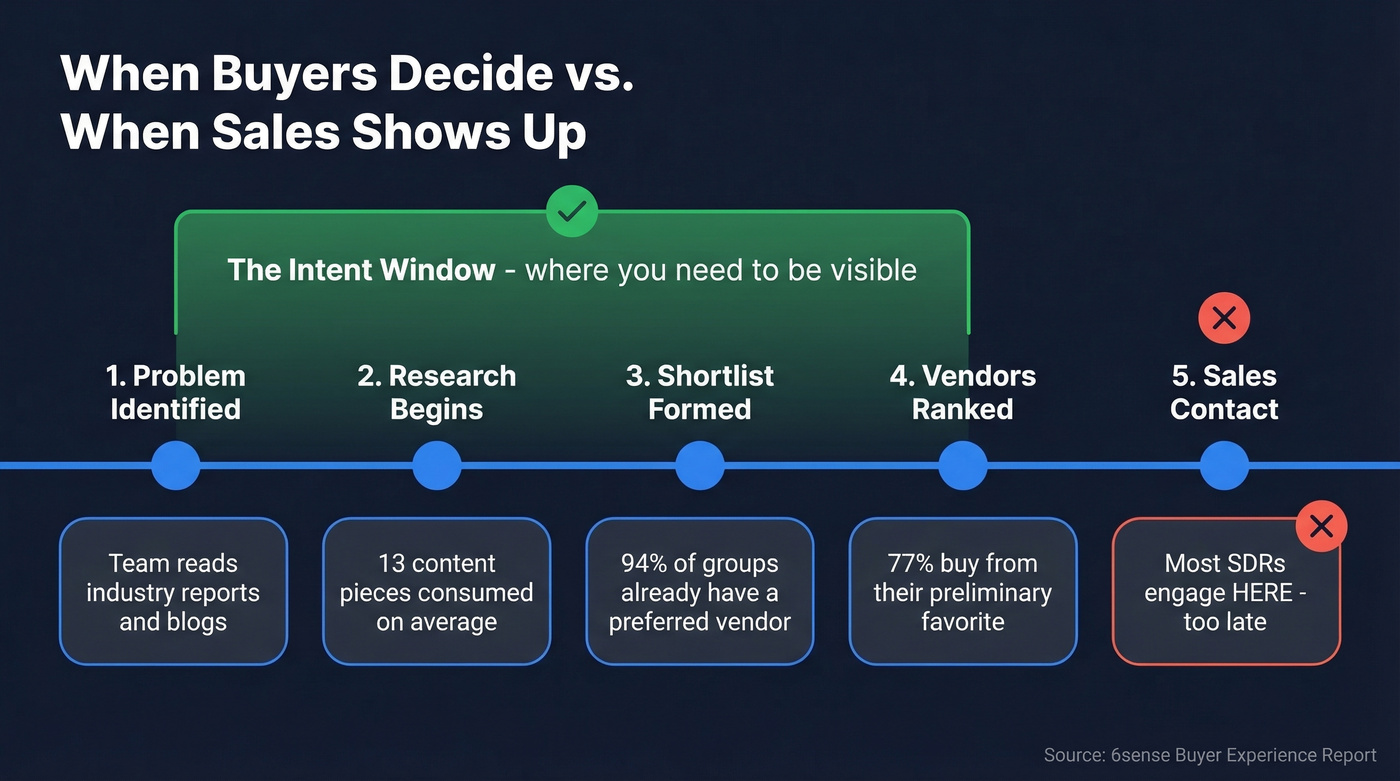
The distinction matters because B2B buying behavior is almost never about a single person. It's a buying group. The 6sense Buyer Experience Report, which surveyed over 4,000 buyers, found that 94% of buying groups have already ranked their preferred vendors before talking to sales. The average group consumes 13 content pieces during evaluation.
By the time your SDR gets a "hand-raiser," the decision is largely made. That's why measuring intent earlier in the journey matters - you're not trying to catch someone at the finish line. You're trying to be on the shortlist before the race starts. And 77% of buyers end up purchasing from their preliminary favorite.
Why It Matters in 2026
The B2B intent data market hit $4.49B in 2026 and is projected to reach $20.89B by 2035 at a 16.6% CAGR. That's not hype money - it reflects how fundamentally the buying process has shifted.
Conversion velocity. Teams that identify in-market accounts early compress deal cycles. Layering intent with trigger events can cut cycle times by 30%+. Layered intent programs - first-party plus second-party plus third-party - deliver 47% better conversion rates and 43% larger deal sizes.
Resource allocation. Most sales teams can't work every account equally. Intent data tells you which 200 accounts out of your TAM of 5,000 are actually researching your category right now. That's the difference between spray-and-pray and precision outbound.
Competitive timing. If 77% of buyers purchase from their preliminary favorite, the team that shows up first with relevant messaging wins. Not the team with the best product - the team with the best timing.
Types of Intent Data
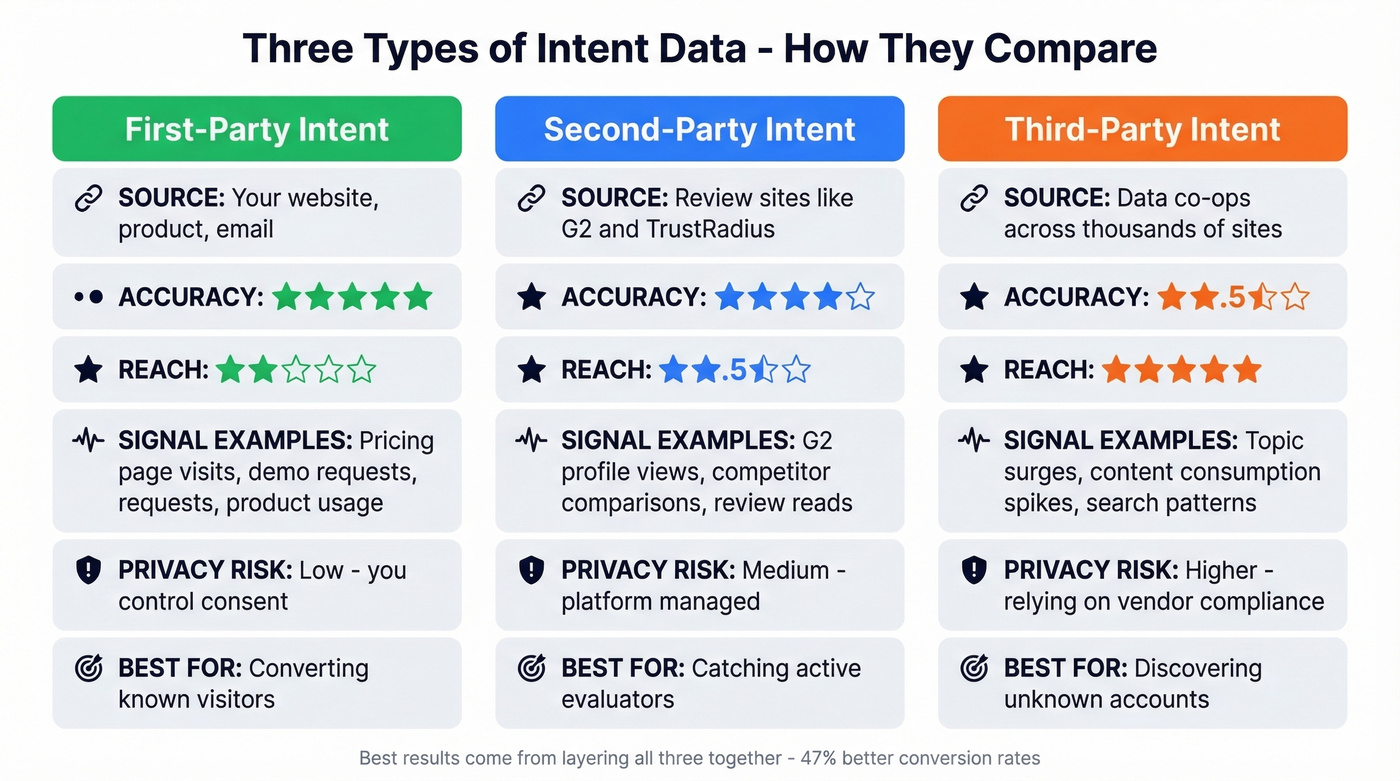
Not all intent data is created equal. The source determines reliability, reach, and privacy implications.
First-Party Intent
This is data you collect directly: GA4 analytics, product usage patterns, email engagement, chatbot interactions, form fills. It's the most accurate signal you'll get because you control the collection and know exactly what the behavior means. A prospect who visits your pricing page three times in a week is showing real intent.
The limitation is reach - you only see people who've already found you. First-party intent is privacy-friendly since you control storage, consent, and processing with no reliance on third-party compliance.
Second-Party Intent
Review-site signals from platforms like G2 and TrustRadius fall here. When a buyer reads your G2 profile, compares you to competitors, or checks pricing on a review site, that's strong lower-funnel intent. These signals are powerful because the behavior is explicitly purchase-oriented - nobody browses G2 for fun. The tradeoff is limited top-of-funnel discovery.
Third-Party Intent
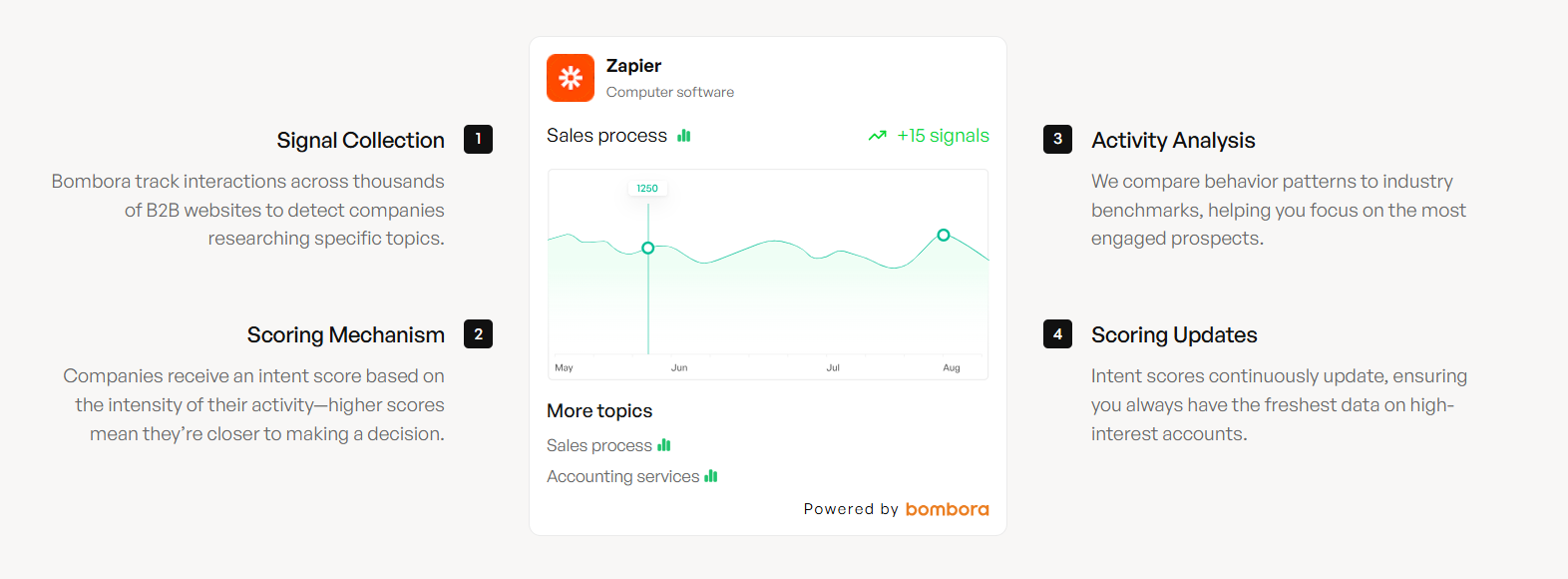
This is the broadest category and the noisiest. Providers like Bombora aggregate content consumption signals across thousands of websites through data co-ops. When a company's employees suddenly consume a spike of content about "CRM migration," that registers as a topic surge.
Third-party intent gives you market-wide visibility, but it's less reliable than first-party data. A topic surge might mean active buying behavior - or it might mean one analyst wrote a report and the whole team read it. Signal types break down further into behavioral patterns, contextual signals from search queries and page context, and social engagement on professional networks.
Privacy is different here too. You're relying on the provider's GDPR/CCPA compliance for data you didn't collect. Forrester is explicit: it's never enough to rely on vendor compliance alone.

You don't need a $40K intent platform to act on purchase intent. Prospeo tracks 15,000 Bombora intent topics and layers them with job changes, funding rounds, and headcount growth - so you reach in-market buyers with 98% verified emails at $0.01 each.
Stop paying for intent signals you can't activate. Start reaching buyers.
Signals by Buying Stage
Intent signals mean different things depending on where the buyer sits in their journey.
| Stage | Signal Examples | What It Means | Action |
|---|---|---|---|
| Awareness | Blog visits, category research, industry reports | Early exploration | Monitor, add to nurture |
| Consideration | Comparison pages, case studies, repeat visits | Evaluating options | Personalized outreach |
| Decision | Pricing page, demo request, ROI calculator | Ready to buy | Immediate sales touch |
A single blog visit and a pricing page visit aren't the same signal. Treating them equally is one of the fastest ways to waste your intent budget.
How to Measure Purchase Intent
Survey-Based Measurement
The traditional approach uses purchase probability scales. The Juster 11-point scale, ranging from "no chance" (0) to "certain" (10), has higher predictive validity than simple 5-point Likert scales because it forces finer-grained probability estimates.
The catch is the intent-behavior gap. People overstate their likelihood to purchase due to social desirability bias and hypothetical optimism. Top-box scores often overpredict actual conversion. Always calibrate survey intent against historical conversion data.
If your "definitely will buy" cohort converts at 35%, that's your real baseline - not the 100% the survey implies. A useful example question: "On a scale of 0 to 10, how likely are you to purchase [product category] in the next 90 days?" This forces a concrete timeframe and probability estimate, which is far more predictive than "Would you consider buying?"
Digital / Behavioral Measurement
Behavioral measurement sidesteps the stated-preference problem entirely. Instead of asking what someone will do, you observe what they're already doing - website analytics via GA4 event tracking, search query patterns, content engagement depth, product usage telemetry, and chatbot interactions all generate intent signals.
Third-party providers layer on cross-site behavioral data: topic surges, competitive research patterns, technology evaluation signals. Well-instrumented B2B propensity models often land in the 0.70-0.85 AUC range, which is meaningful lift over random targeting.
Scoring and Activating Intent Leads
Signal Hierarchy
We've seen teams treat a single blog visit the same as a pricing page session - and then wonder why their "intent-qualified" pipeline doesn't convert. Build a three-tier hierarchy.
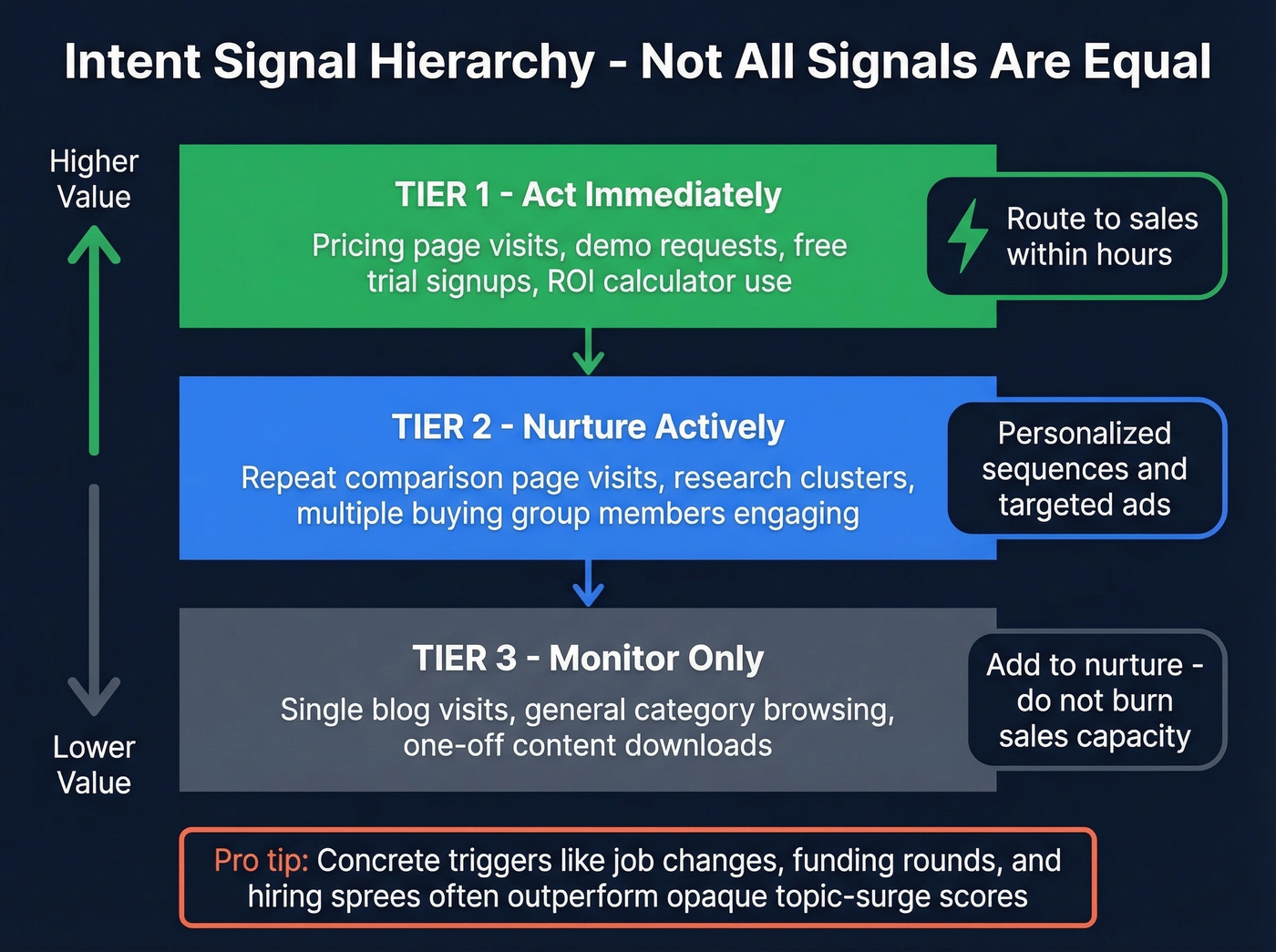
Tier 1 - Act immediately. Pricing page visits, demo requests, free trial signups, ROI calculator engagement. Route to sales within hours. These are your highest-value leads - accounts showing active buying intent through concrete, verifiable actions.
Tier 2 - Nurture actively. Repeat engagement with comparison content, topic-specific research clusters, multiple visits across a buying group. Personalized sequences and targeted ads work here.
Tier 3 - Monitor. One-off blog visits, general category browsing, single content downloads. Add to nurture, but don't burn sales capacity on them.
Experienced practitioners on r/sales consistently prefer concrete trigger events - job changes, new funding, hiring sprees, tech stack changes - over opaque topic-surge scores. Those triggers are verifiable. You can confirm a VP of Sales just started at a target account. You can't confirm that "someone at Acme read about CRM software."
Decay Windows and Activation Timing
Intent signals have a shelf life. Without decay rules, every account in your database eventually looks like it's showing intent - which means nothing is.
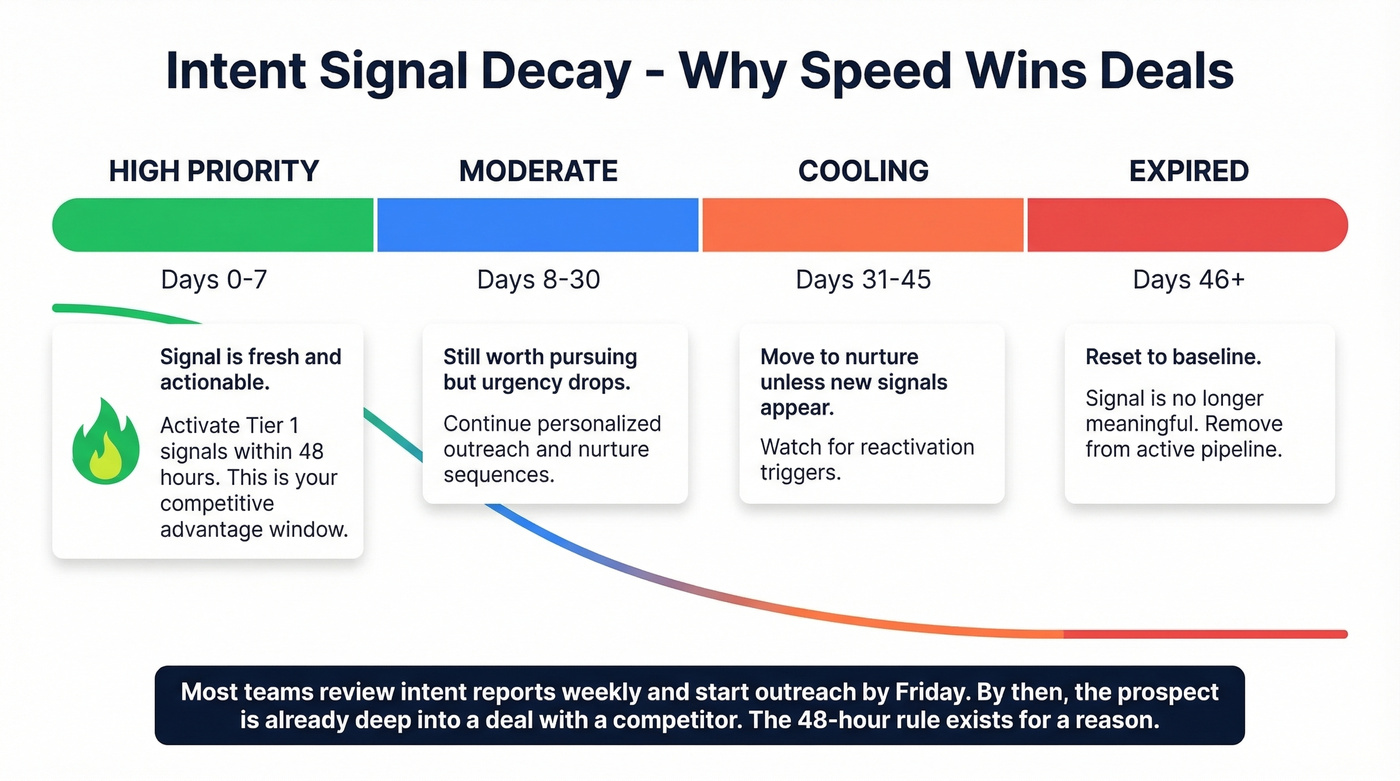
- Days 0-7: High priority. The signal is fresh and actionable.
- Days 8-30: Moderate. Still worth pursuing, but urgency drops.
- Days 31-45: Cooling. Move to nurture unless new signals appear.
- Days 46+: Expired. Reset to baseline.
The 48-hour rule is critical for Tier 1 signals. Most teams operate on weekly cadences - reviewing intent reports every Monday, building lists by Wednesday, starting outreach by Friday. That's too slow. By then, the prospect is already deep into a deal with a competitor.
Identifying an in-market account is step one. Reaching the right person with a verified email is step two. Prospeo bridges that gap - filter by intent topic and job title in one search, get the decision-maker's verified contact, and push to your sequencer the same day.

Seven Mistakes That Kill Intent ROI
1. Treating intent as qualification. An intent signal means an account is researching, not that they're ready to buy. Forrester flags this as the most common mistake.
2. Ignoring data decay. Without expiration rules, your "in-market" list grows until it includes everyone. Apply the 7/30/45-day rubric above.
3. Relying on a single source. First-party alone misses accounts that haven't found you. Third-party alone is noisy. Layer sources for confidence.
4. Prioritizing volume over relevance. A list of 10,000 "intent-showing" accounts is useless if your team can only work 200. Filter by ICP fit first, then apply intent.
5. Undervaluing first-party intent. Your own website and product data is the highest-fidelity signal you have. Many teams chase third-party data while ignoring the GA4 goldmine sitting in their own analytics.
6. Outsourcing privacy compliance to vendors. GDPR and CCPA require you to maintain lawful basis for processing prospect data. Your vendor's compliance doesn't automatically cover your use case.
7. No closed-loop reporting. In our experience, this is the #1 reason teams can't justify renewal. If you can't trace intent signals through to closed revenue, you can't prove ROI - and you can't optimize. Skip the fancy dashboards until this feedback loop is airtight.
What Intent Data Actually Costs
No vendor will tell you this on their website, so let's lay it out. Intent data pricing ranges from free to $150,000+ annually depending on the provider, data volume, and modules. Budget 15-25% above the quoted license for implementation, integration, and optimization.
| Provider | Pricing | What You Get |
|---|---|---|
| Prospeo | Free tier -> ~$0.01/email | 15,000 intent topics + 300M+ profiles + 143M+ verified emails |
| ZoomInfo Streaming Intent | $7,200-$36,000/yr | Intent add-on to ZoomInfo platform |
| G2 Buyer Intent | $10,000-$87,000+/yr | Review-site buyer signals |
| Bombora | $12,000-$80,000/yr | Topic-surge data co-op |
| 6sense | $35,000-$150,000+/yr | Full ABM + intent platform |
| Demandbase | $40,000-$120,000/yr | ABM + intent + advertising |
For teams under $25K ARR per deal, the full ABM suites are overkill. Start with first-party signals, layer in one affordable intent source, and invest the savings in faster activation workflows.
If you want a tighter operational system, map your intent signals into a repeatable lead scoring model and enforce it in your CRM.
The article says it: 77% of buyers purchase from whoever shows up first. Prospeo's 7-day data refresh means you're working with this week's signals, not last month's. Combine intent surges with 125M+ verified mobiles and 30% pickup rates to beat competitors to the conversation.
First to call wins. Get verified direct dials for in-market accounts.
FAQ
Is purchase intent the same as buying intent?
Yes - they're interchangeable terms. "Purchase intent," "buying intent," "buyer intent," and "purchase intention" all describe the measured likelihood that someone will buy. The underlying data, methodology, and scoring frameworks are identical regardless of which label a vendor uses.
What counts as high purchase intent?
High purchase intent describes accounts showing strong, repeated Tier 1 signals - pricing page visits, demo requests, or ROI calculator engagement. These behaviors indicate active solution evaluation, not casual browsing. When you see three or more Tier 1 actions from a single buying group within seven days, that account should be routed to sales immediately.
How accurate is third-party intent data?
It's the broadest source but also the noisiest, with well-instrumented propensity models landing in the 0.70-0.85 AUC range. Layer it with first-party signals and validate against closed-loop conversion data. Relying on a single third-party provider without calibration is one of the fastest ways to burn budget.
How fast should you act on an intent signal?
Within 48 hours for Tier 1 signals like pricing page visits or demo requests. After 7 days, priority drops significantly. After 45 days without new activity, the signal is expired and the account should reset to baseline.
What's a good affordable tool for acting on intent signals?
Prospeo starts free with 75 emails/month and includes Bombora-powered intent across 15,000 topics layered with 300M+ profiles and 98% email accuracy - strong for teams that need intent-to-contact in one workflow. Standalone intent platforms like Bombora start around $12K/year, while full ABM suites run $35K-$150K+.