

QuickEnrich vs ZoomInfo: Enrichment Tool or Enterprise Platform?
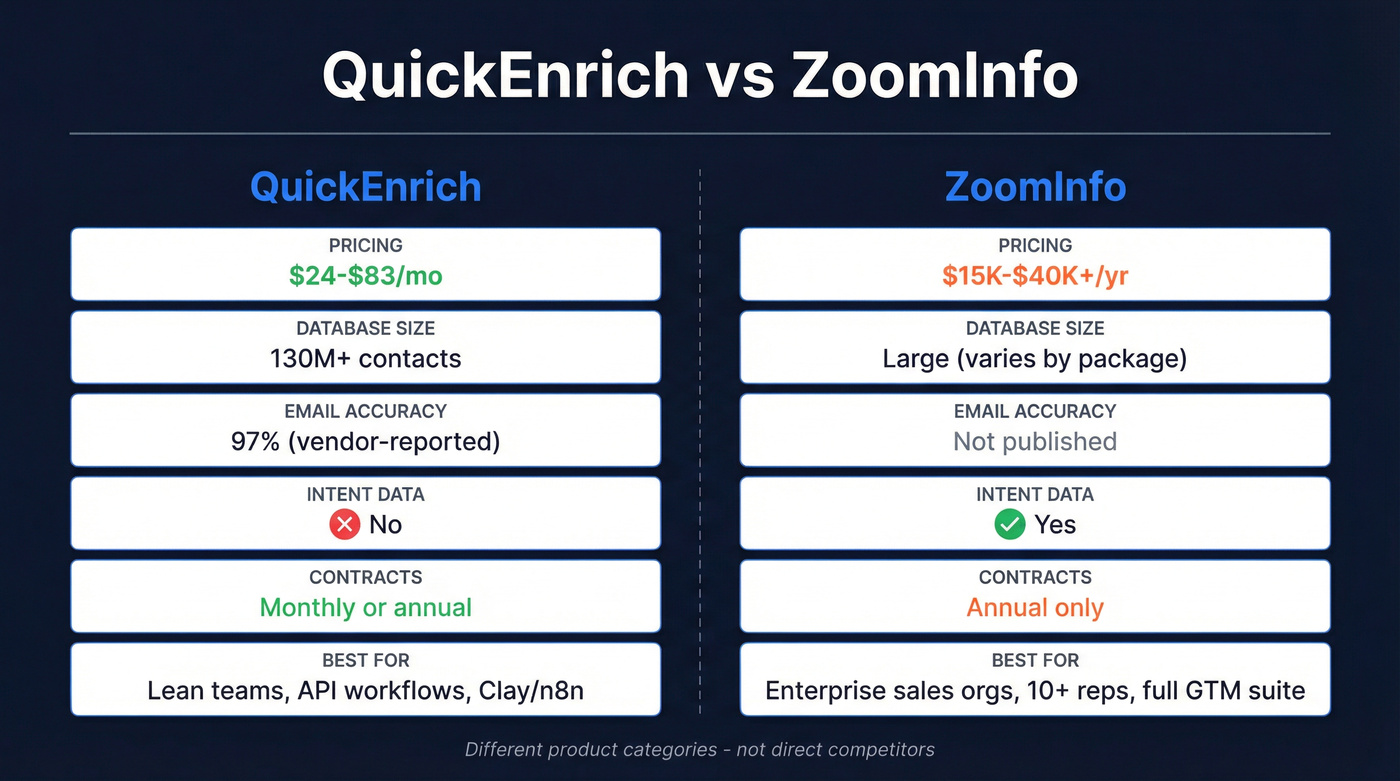
QuickEnrich costs $24-$83/mo. ZoomInfo starts at ~$15,000/yr. You're not comparing competitors here - you're comparing different product categories that happen to overlap on one feature: finding work emails.
This comparison only makes sense if you know exactly which problem you're solving. Let's break it down.
30-Second Verdict
QuickEnrich is a budget email enrichment API for developers and lean teams running Clay or n8n workflows. ZoomInfo is an enterprise GTM platform with intent data, org charts, and deep CRM integrations. If all you need is verified emails and phone numbers, QuickEnrich handles that at roughly 1/15th the cost. If you need a full sales intelligence stack, ZoomInfo remains the category leader.
Side-by-Side Comparison
| Feature | QuickEnrich | ZoomInfo |
|---|---|---|
| Database | 130M+ contacts | Large B2B database (size varies by package) |
| Email accuracy | 97% (vendor-reported) | Not published |
| Mobile numbers | Included where available | Often packaged as higher-tier access or add-ons |
| Intent data | No | Yes |
| Pricing | $24-$83/mo (annual) | ~$15K-$40K+/yr |
| Contracts | Monthly or annual | Annual only |
| Workflow integrations | Clay, n8n | Salesforce, HubSpot, broad ecosystem |
| Cost model | Usage-based enrichment | Contract + seats + credits |
QuickEnrich Overview
Use this if you're a technical team running enrichment through Clay or n8n, your budget is under $100/mo, and you only need emails plus phone numbers. QuickEnrich's single-endpoint API handles 1,000 requests/minute and returns double-verified emails with verification dates. At $83/mo on an annual plan, you get 132,000 emails - roughly $0.0075 per email. On r/salesdevelopment, users describe it as "the cheapest email vendor on the market right now."
Skip this if you need intent data, org charts, or CRM integrations beyond Clay/n8n. QuickEnrich does one thing. It also doesn't have a major G2 or Capterra listing that we could find - for comparison, waterfall enrichment tools like FullEnrich have 170+ G2 reviews at 4.8/5. That doesn't mean QuickEnrich's data is bad, but you're leaning on vendor-reported numbers rather than independent reviews.

QuickEnrich gives you emails but no intent data. ZoomInfo gives you intent data but costs $15K/yr. Prospeo delivers 98% email accuracy, 125M+ verified mobiles, and Bombora intent data across 15,000 topics - all refreshed every 7 days. Starting at roughly $0.01/lead with no annual contract.
Get enterprise-grade enrichment without the enterprise price tag.
ZoomInfo Overview
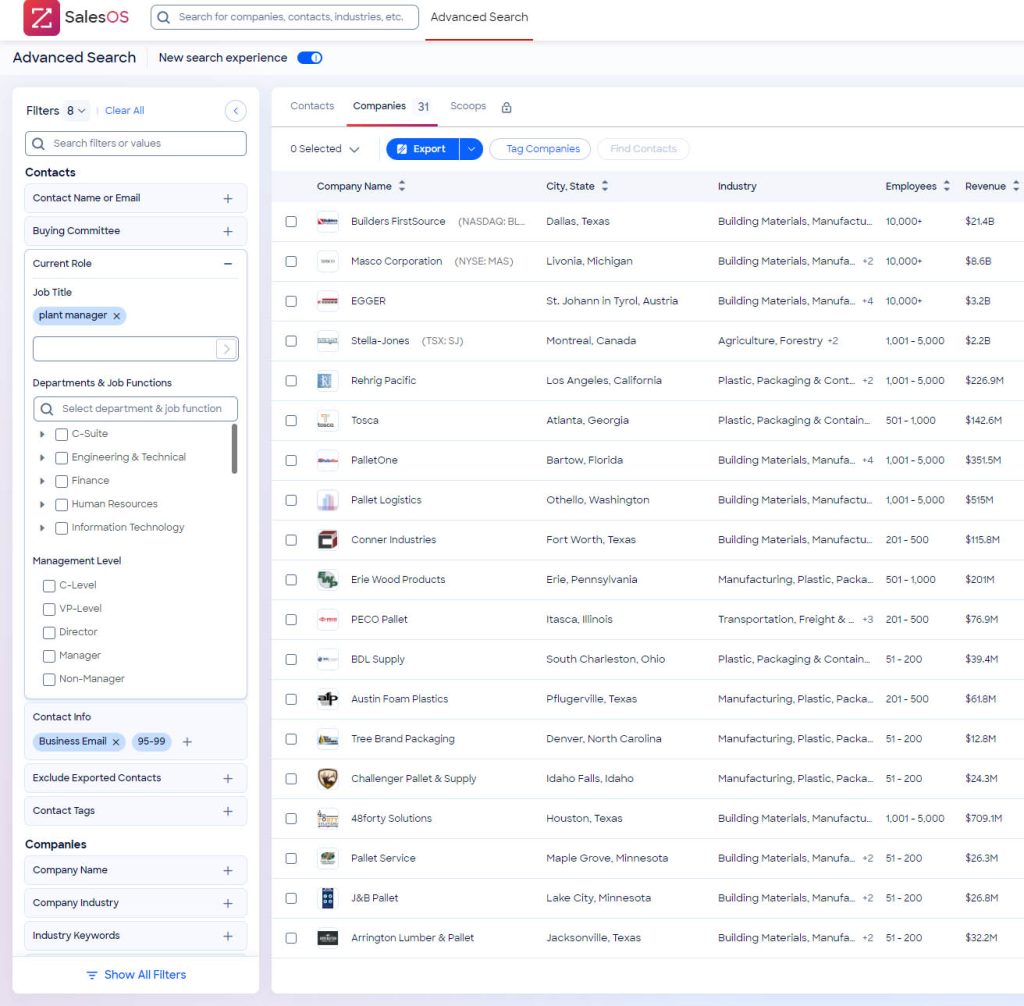
Use this if you're an enterprise sales org with 10+ reps, you need intent signals and technographics layered into prospecting, and your budget supports $15K-$40K+/yr. Professional is commonly benchmarked at ~$14,995/yr and often bundled with 3 seats. Advanced typically lands around ~$25K-$30K/yr. Elite runs ~$36K-$40K+/yr and can climb higher with add-ons.
The platform earns its price when multiple teams actually use the full suite - intent data, org charts, and automated workflows across Salesforce, HubSpot, Outreach, and Salesloft. When three departments share one ZoomInfo contract and use it daily, the per-user math starts making sense.
Skip this if you only need email enrichment. Paying $15K+ to look up work emails is like buying a commercial kitchen to make toast. The most common complaint in user communities? Paying for modules you never touch. Annual contracts with auto-renewal make it worse.
Key Differences That Matter
Pricing Math
QuickEnrich Growth on an annual plan runs ~$996/year for 132,000 emails. ZoomInfo Professional starts at ~$14,995/year - 15x more before you add seats or credits.
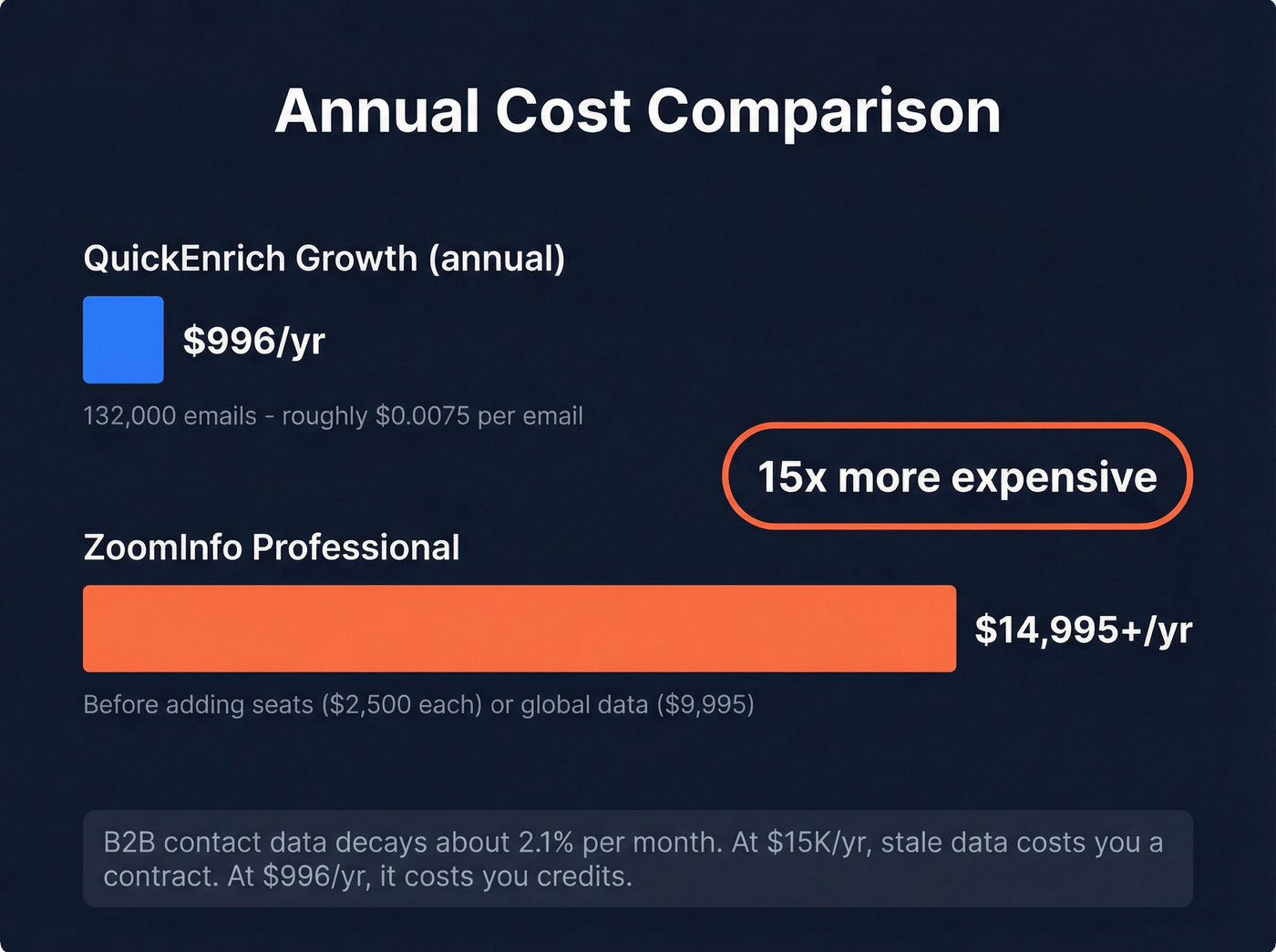
Here's the thing: B2B contact data decays roughly 2.1% per month. In tech, annual staleness hits 40%. Paying $15K+ for a database on an industry-standard 4-6 week refresh cycle stings. At QuickEnrich's price point, stale data costs you credits, not a five-figure contract.
Data Quality
QuickEnrich reports 97% accuracy with double-verified emails. ZoomInfo doesn't publish accuracy rates. Industry benchmarks say you want total bounces below 2% and hard bounces under 1%.
We've seen enrichment tools with high find rates produce surprisingly low validity in independent testing - one provider hit validity as low as 15% in certain segments across a 9,806-contact sample. High coverage doesn't mean high accuracy.
Our recommendation: run both tools on the same 100 contacts before committing. Compare bounce rates and valid-email percentages, not just find rates. That pilot will tell you more than any vendor's accuracy claim ever could.
Features Beyond Enrichment
QuickEnrich offers email enrichment, phone numbers, and a single-endpoint API. That's it.
ZoomInfo offers intent data, technographics, org charts, automated workflows, and native integrations with dozens of sales tools. If you're using ZoomInfo exclusively for email lookup, you're paying for an enterprise platform and using it as a phone book - a $14,000/yr mistake.
Look, most teams with fewer than 10 reps and deal sizes under $20K don't need ZoomInfo-level infrastructure. A focused enrichment tool plus a standalone intent data source will get you 80% of the value at 20% of the cost.
When to Pick Each
Pick QuickEnrich if your budget is under $100/mo, you're running API-driven enrichment through Clay or n8n, and you only need emails and phone numbers. It's a sharp, cheap tool for a narrow job.
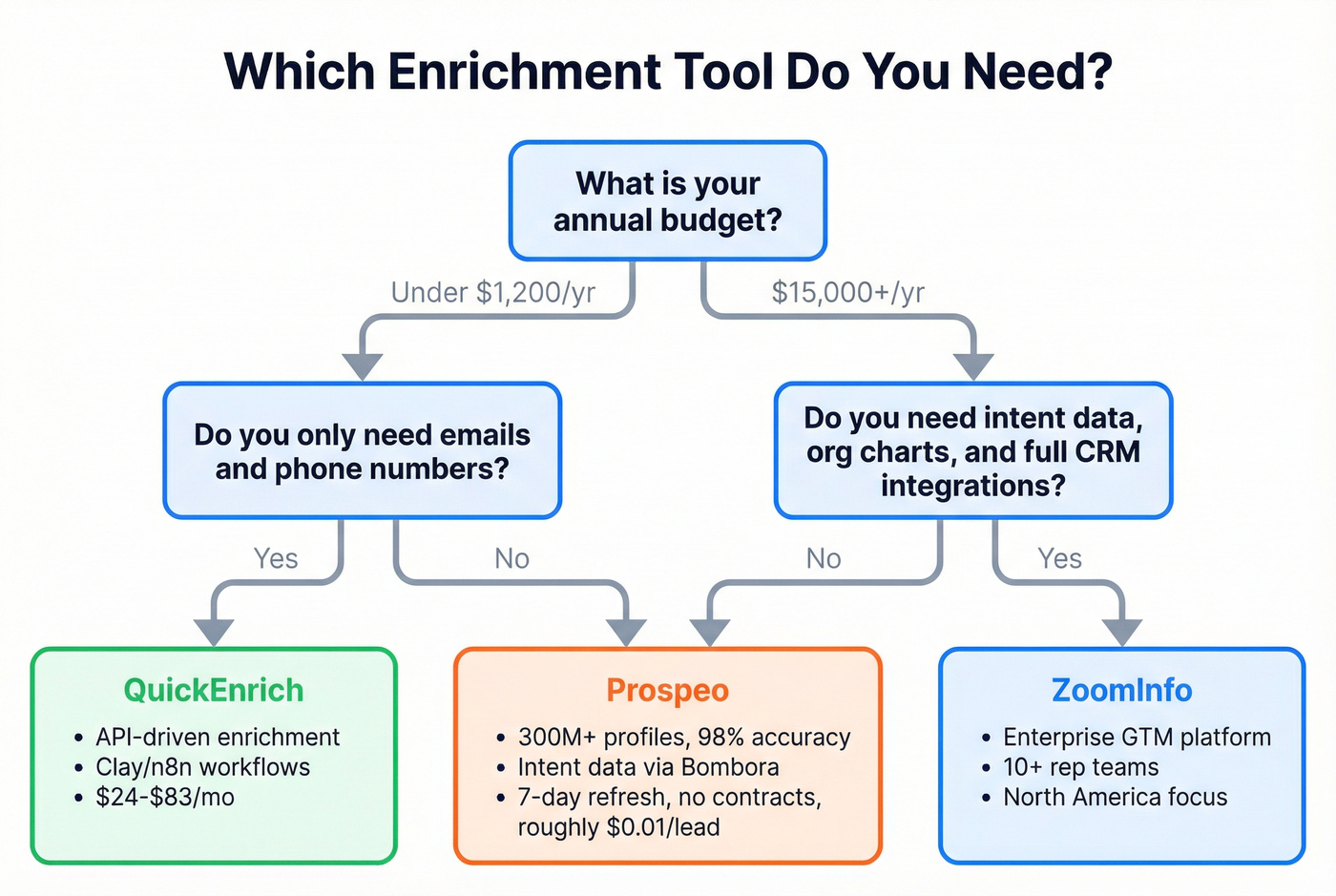
Pick ZoomInfo if you're an enterprise team with $15K+/yr to spend, you need intent signals and org charts baked into your prospecting, and your focus is North America. The platform justifies its cost when multiple teams use the full suite daily.
A Stronger Third Option
If QuickEnrich feels too thin and ZoomInfo feels too expensive, Prospeo covers the gap. The database spans 300M+ professional profiles with 98% email accuracy, 143M+ verified emails, and 125M+ verified mobiles hitting a 30% pickup rate. Intent data tracks 15,000 topics via Bombora, and the entire dataset refreshes every 7 days - compared to the 4-6 week industry average. Self-serve, no contracts, roughly $0.01/lead, with a free tier to test it.
If you’re evaluating other options in the same category, start with these data enrichment services and sales prospecting databases to benchmark coverage and pricing.
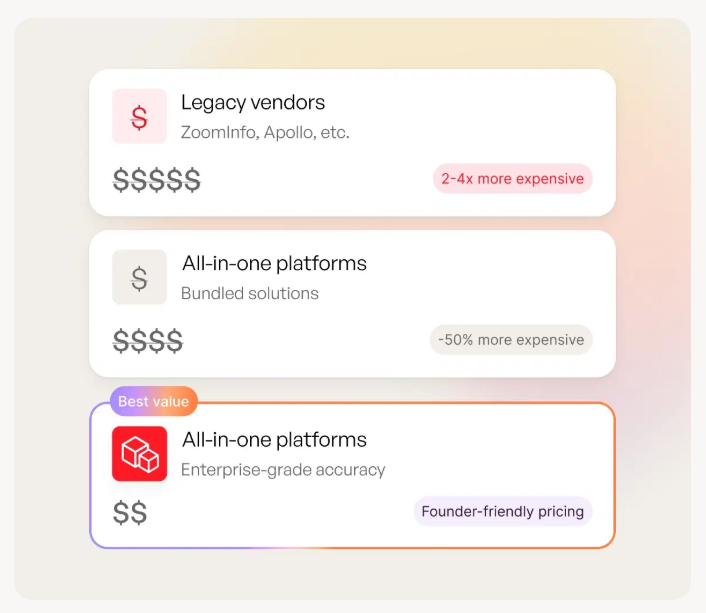
Running a 100-contact pilot to compare bounce rates? Start with data that's actually fresh. Prospeo refreshes its 300M+ profiles every 7 days - not the 4-6 week industry average that causes the 2.1% monthly decay this article warns about. 75 free emails/month, no credit card required.
Stop paying for stale data. Test Prospeo's 7-day refresh yourself.
FAQ
Is QuickEnrich a real ZoomInfo replacement?
Only if you use ZoomInfo exclusively for email enrichment. QuickEnrich doesn't offer intent data, org charts, or CRM integrations beyond Clay and n8n. It replaces one feature at a fraction of the cost - not the platform.
Why is ZoomInfo so expensive?
ZoomInfo bundles intent data, technographics, automated workflows, and a massive sales intelligence platform into annual contracts starting at ~$15K/year. You're paying for the full suite whether you use it or not, plus add-ons for extra seats (~$2,500 each) and global data (~$9,995).
What if neither tool fits?
For teams that need more than bare-bones enrichment but can't justify enterprise pricing, Prospeo offers 300M+ profiles with 98% verified email accuracy, intent data via Bombora, and a 7-day refresh cycle - all self-serve at ~$0.01/lead. It bridges the gap between QuickEnrich's narrow feature set and ZoomInfo's enterprise pricing, with native integrations for Salesforce, HubSpot, Clay, and more.