

Quo Review 2026: Pricing, Reviews, Pros and Cons
Most Quo reviews get the pricing wrong. They quote $15/user/month and move on. The real number - once you add Sona credits, messaging fees, extra numbers, and carrier registration - runs about 35-43% higher. We've dug through the plan details, user complaints, and hidden costs so you don't have to.
30-Second Verdict
Quo works best for small teams (3-15 people) who want modern, affordable VoIP with AI call handling. The Starter plan is a trap if you need CRM integrations - you'll upgrade to Business within a month. Call quality complaints are real but not universal. Budget roughly 35-43% above the pricing page once you factor in Sona credits, messaging fees, and extras. Need desk phones, video conferencing, or 24/7 phone support? Skip Quo entirely and look at RingCentral or Nextiva.
What Is Quo?
Quo is the rebranded OpenPhone. The name changed in September 2025 alongside $105M in growth financing and the launch of Sona, an AI agent that answers calls around the clock. The company serves nearly 90,000 businesses, and Sona has handled over 200,000 calls since its April launch. Quo claims businesses using Sona have 3x more meaningful conversations compared to traditional voicemail - a bold number, but the product is genuinely different from a standard auto-attendant.
Ten free AI-handled calls per month is a taste, not a meal.
Quo Pricing Breakdown
Plan Comparison
| Plan | Monthly | Annual | Billed Annually |
|---|---|---|---|
| Starter | $19/user/mo | $15/user/mo | $180/user/yr |
| Business | $33/user/mo | $23/user/mo | $276/user/yr |
| Scale | $47/user/mo | $35/user/mo | $420/user/yr |
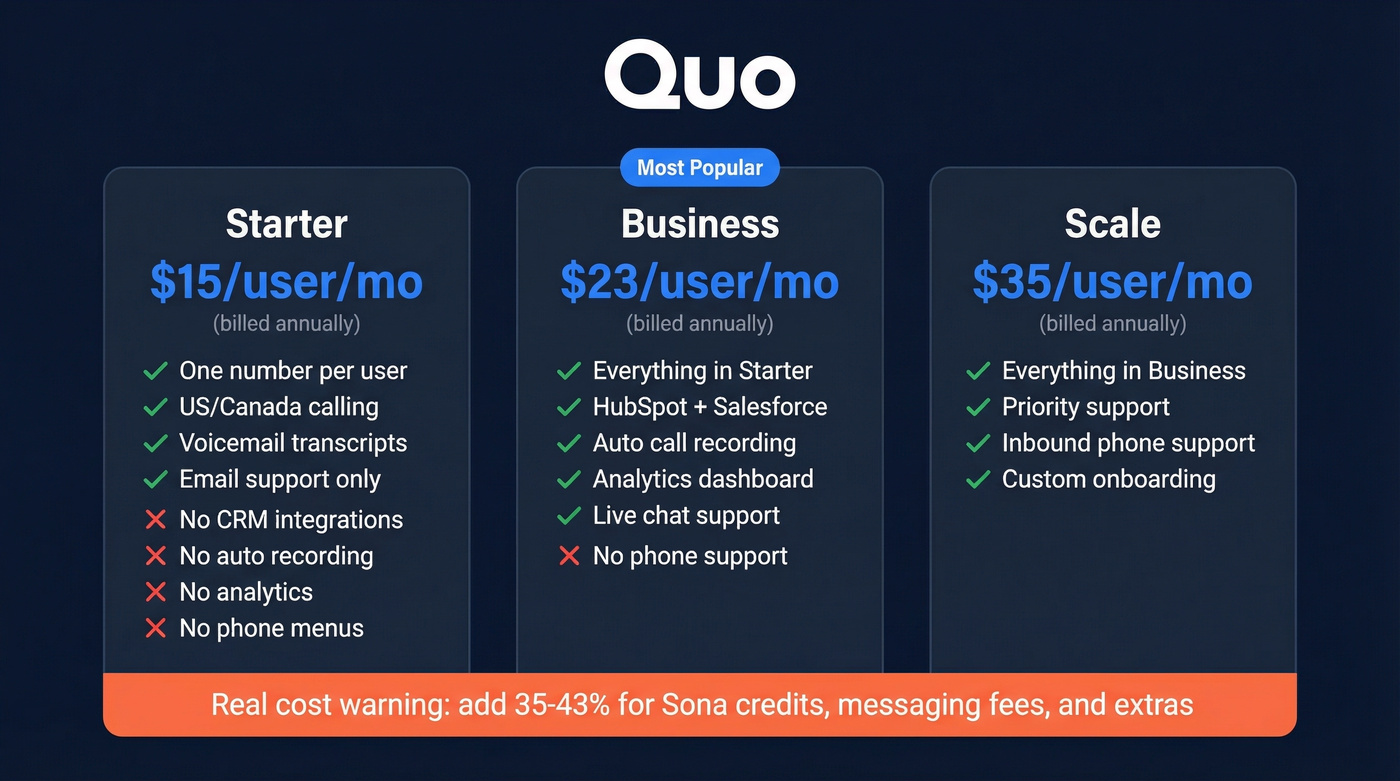
Annual billing saves roughly 21% on Starter, 30% on Business, and 26% on Scale versus monthly.
Every plan includes one local or toll-free number per user, US/Canada calling and messaging (subject to fair use), voicemail transcripts, and email ticket support. For context, Nextiva and Dialpad both start at $15/user/month annually, and RingCentral at $20 - but those include features Quo locks behind Business.
Here's the thing: Starter lacks HubSpot and Salesforce integrations, phone menus, auto call recording, and analytics. For any team running a CRM-connected workflow, Business is the real starting line. If you're comparing options, see our breakdown of Dialpad alternatives.
Sona AI Credit Costs
| Tier | Monthly Cost | Credits | Calls | Cost/Call |
|---|---|---|---|---|
| Free (all plans) | $0 | 1,000 | 10 | $0.00 |
| Tier 2 | $25 | 4,000 | 40 | $0.63 |
| Tier 3 | $49 | 10,000 | 100 | $0.49 |
| Tier 4 | $99 | 25,000 | 250 | $0.40 |
| Tier 5 | $199 | 60,000 | 600 | $0.33 |
One call equals 100 credits. Calls under 15 seconds are free. If you're using Sona for lead qualification or after-hours coverage, Tier 2 at $25/month is the realistic minimum.
Hidden and Variable Costs
These don't show up in the headline per-user price:
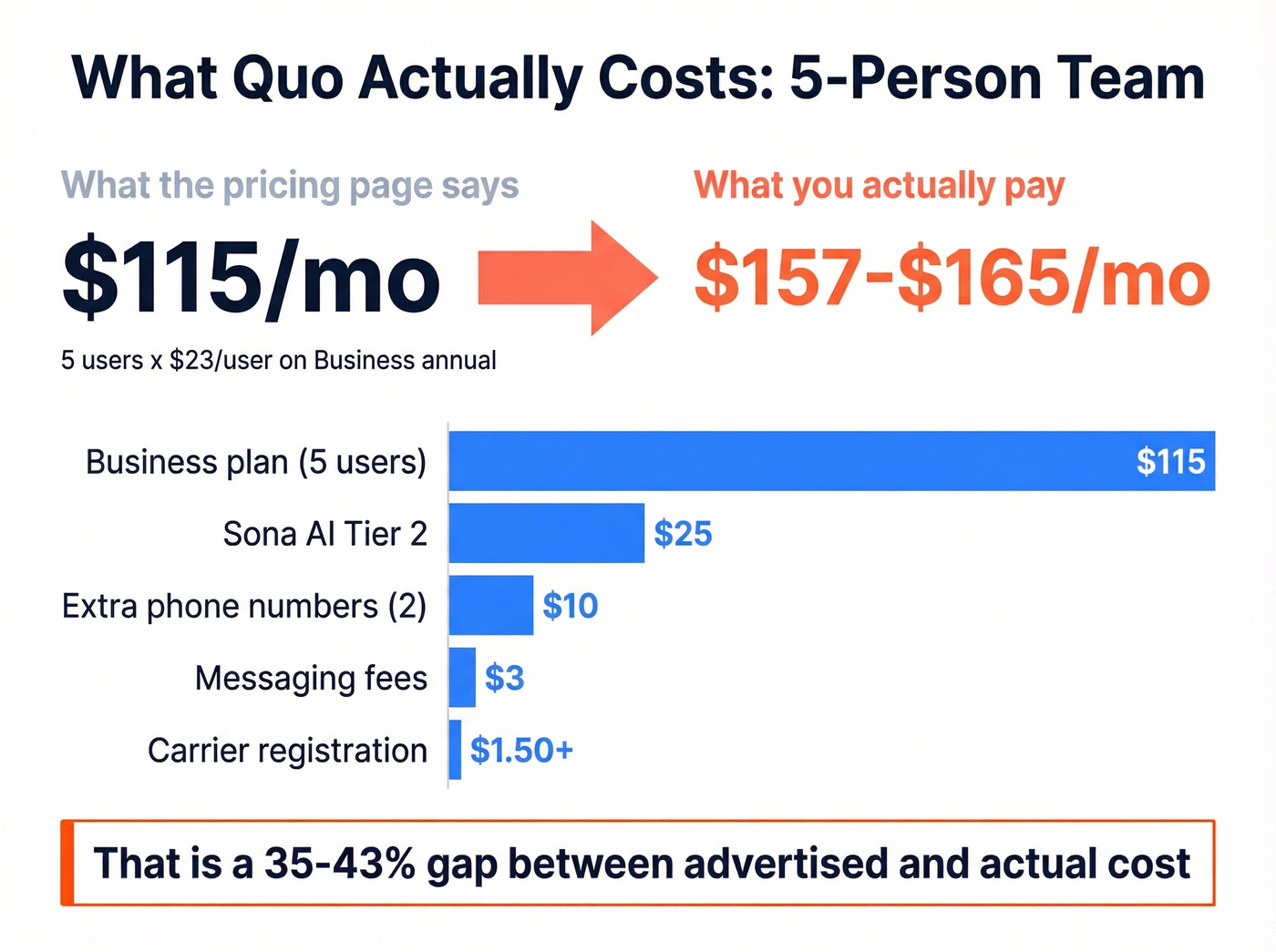
- Extra phone numbers: $5/month each
- Carrier review/setup fee: $19.50 one-time for US messaging registration
- Monthly messaging fee: $1.50-$3/month per campaign
- International calling: $0.01-$0.30/min depending on destination
- New account limit: 3 outgoing conversations per day until payment and identity are verified
SMS for U.S. numbers can only be enabled after completing the required A2P registration process. Some BBB complaints report paying $130+ across repeated registration rejections. That's a frustrating loop nobody warns you about upfront.
We ran the numbers on a 5-person team: Business annual ($23/user) plus Tier 2 Sona ($25) plus 2 extra numbers ($10) plus messaging fees (~$3) comes to roughly $157-$165/month. The pricing page suggests $115/month before Sona and messaging fees. That's a 35-43% gap. If you're trying to reduce waste across your outbound stack, start with data enrichment before you scale calling volume.

Quo's hidden costs add 35-43% to your bill - don't let bad contact data inflate it further. Every wrong number burns Sona credits and wastes rep time. Prospeo's mobile finder delivers 125M+ verified numbers with a 30% pickup rate, so your team connects with real buyers on the first dial.
Stop burning Sona credits on wrong numbers. Start with verified data.
Pros and Cons
Pros
- Modern UI and fast setup. Most teams are running without IT involvement in under an hour.
- Sona AI agent. The "jobs" system lets you configure specific instructions for different call scenarios - after-hours routing, lead qualification, FAQ handling.
- Shared inbox collaboration. Internal threads, conversation assignment, and presence visibility make this feel like Slack for phone calls.
- Affordable entry point. $15/user/month on annual undercuts RingCentral by $5.
- HIPAA BAA available. Relevant for healthcare and education teams.
Cons
- Call reliability is the #1 issue. Review data shows 215 mentions of connection issues and 101 mentions of call disconnections across 3,294 reviews. That's a pattern, not noise.
- Audio quality inconsistency. Trustpilot reviews flag distortion and dropouts in recordings, and the Trustpilot rating sits at 3.7/5 from 738 reviews - well below the 4.7/5 on G2.
- Support is limited on lower tiers. Starter is email tickets only. Live chat starts on Business. Inbound phone support doesn't arrive until Scale.
- No desk phones or video conferencing. Softphone only. You'll still need Zoom or Meet.
- No published uptime SLA. Nextiva publishes 99.999%. Quo doesn't list one.
- Feature gating pushes you to Business. CRM integrations, analytics, and auto recording are all locked behind the $23/user tier.
- Reddit moderation concerns. Multiple users on r/OpenPhone have reported posts critical of the service being removed or locked - worth knowing if you rely on community forums for troubleshooting.
What Users Actually Say
| Platform | Rating | Reviews | Key Theme |
|---|---|---|---|
| G2 | 4.7/5 | 3,294 | 87% five-star; smooth onboarding |
| Trustpilot | 3.7/5 | 738 | Audio quality, support delays |
| Capterra | 4.2/5 | 60 | Small sample, mixed |
| BBB | - | 25 complaints (3 yrs) | A2P registration, billing |
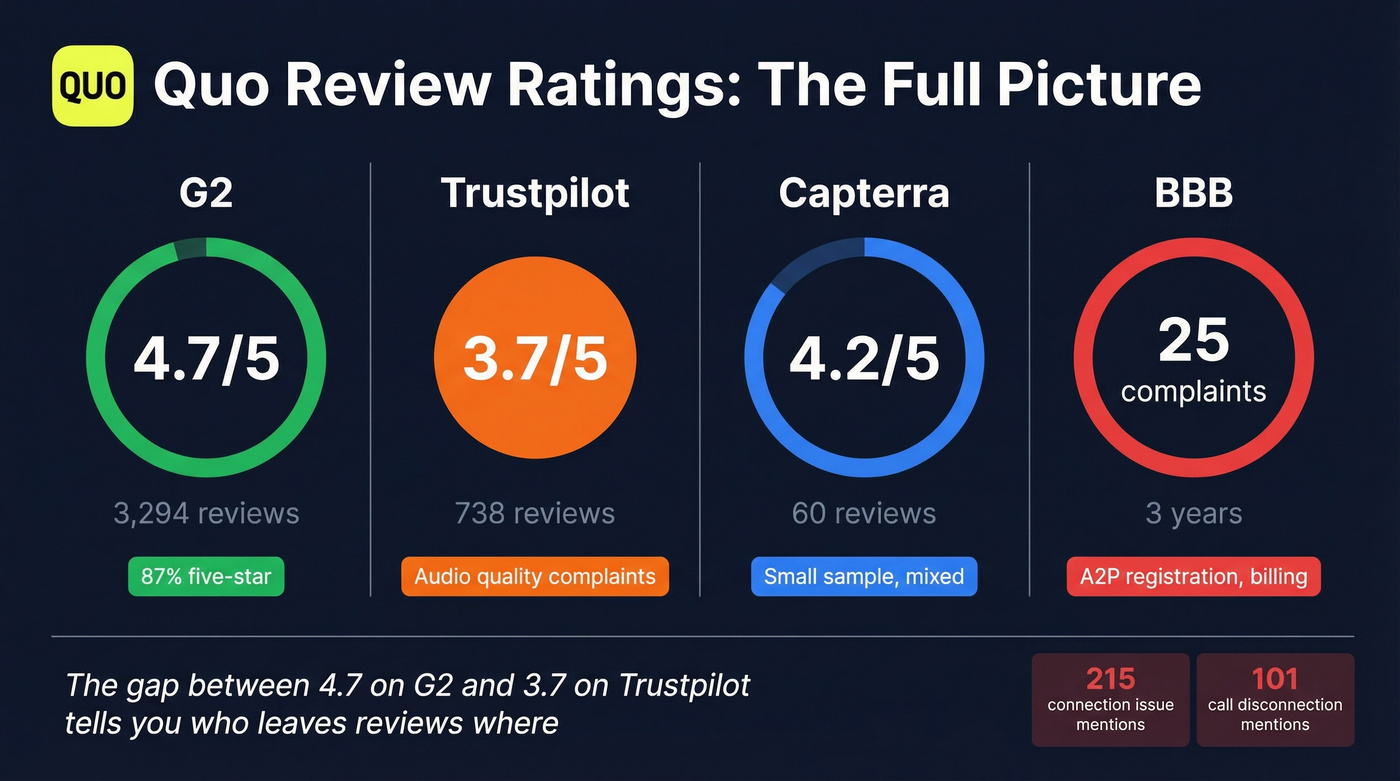
The G2 review base skews toward users who had smooth onboarding and stuck around. Trustpilot captures more frustrated users who hit call quality walls or support delays. Both are real, and the gap between 4.7 and 3.7 tells you something about who bothers to leave reviews where.
In our analysis, the BBB complaints reveal a specific pattern: users paying setup fees and discovering SMS doesn't work until A2P registration is completed - sometimes after multiple paid rejections. One Reddit user reported A2P approval in under 24 hours versus two-plus weeks on Dialpad, so experiences vary wildly.
Let's be honest: Quo is the best-designed VoIP for small teams. But "best-designed" and "most reliable" aren't the same thing, and the call quality data makes that gap impossible to ignore. If you're building a repeatable outbound motion, pair your phone stack with proven sales prospecting techniques.
Who Should (and Shouldn't) Use Quo
Use Quo if:
- You're a team of 3-15 who primarily need calls and texts
- You run a HubSpot workflow and want a phone system that plugs in natively
- Sona's AI call handling fits your after-hours needs
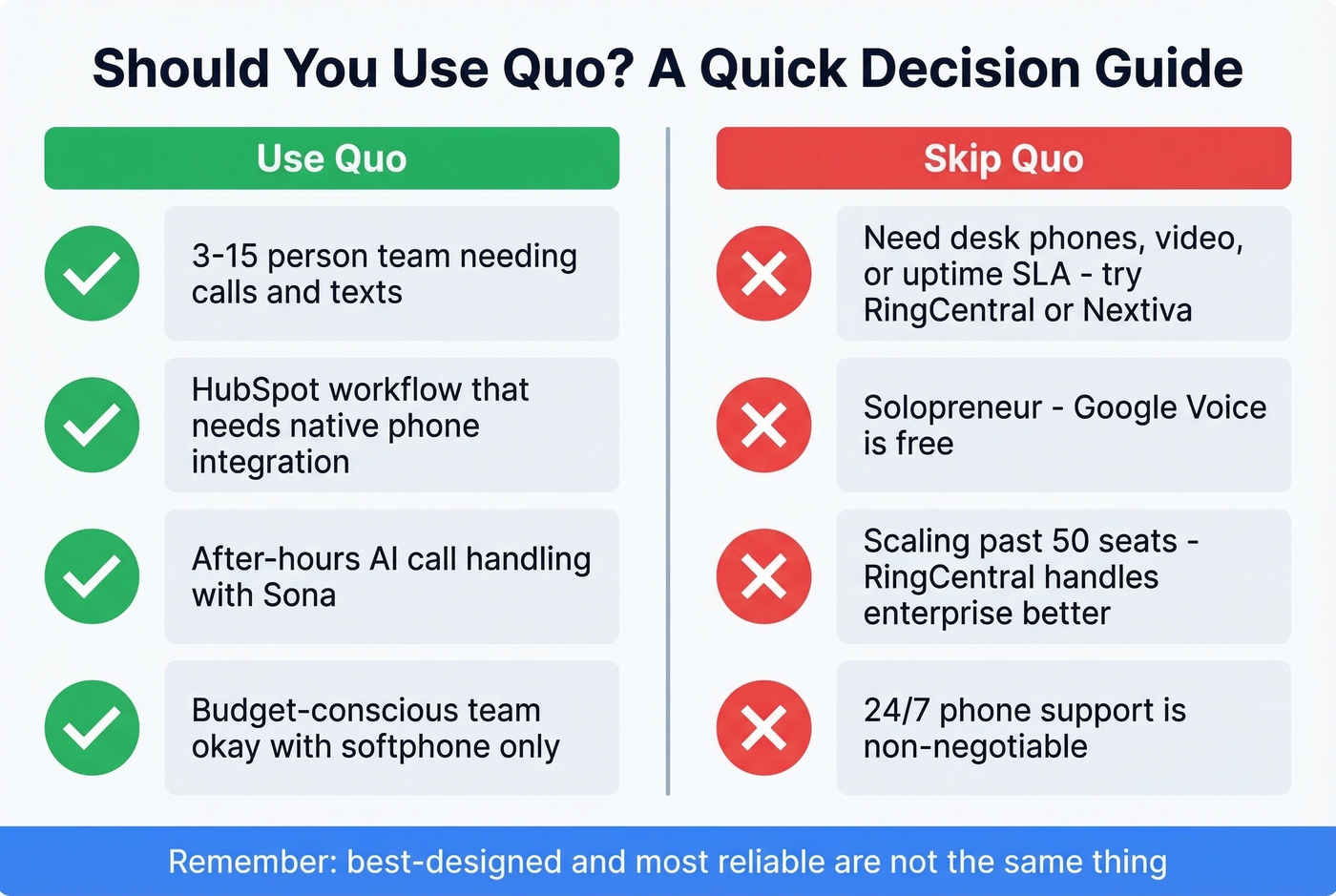
Skip Quo if:
- You need desk phones, video, or a published uptime SLA
- You're a solopreneur - Google Voice is free and sufficient
- You're scaling past 50 seats - RingCentral handles enterprise complexity better
- 24/7 phone support is non-negotiable for your operation
For outbound calling teams, your phone system is only as good as the numbers you're dialing. Bad data burns through Sona credits fast - every wrong number is a wasted call. We've seen teams pair Quo with Prospeo's mobile finder to make sure they're connecting with real prospects instead of dead lines, since verified numbers with a 30% pickup rate beat guessing every time. To tighten your process end-to-end, map your lead generation workflow and track the right lead generation metrics.
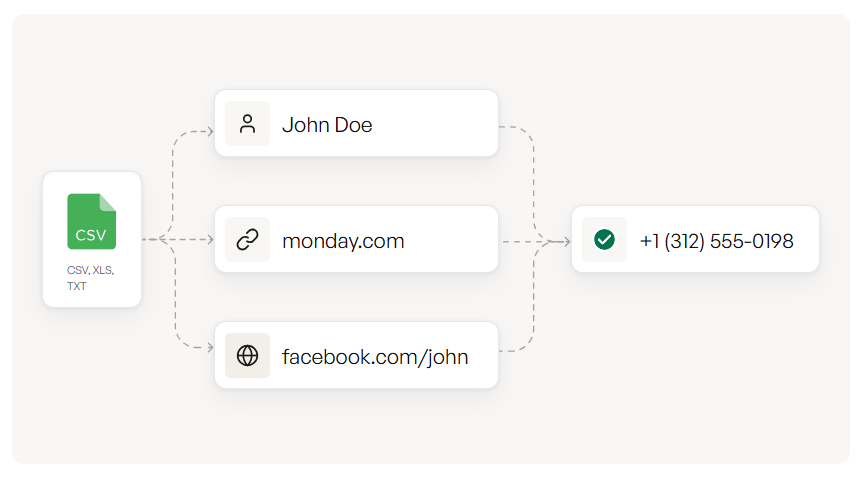
You're pairing Quo with HubSpot for a CRM-connected workflow - make sure the contacts flowing in are actually reachable. Prospeo enriches your CRM with 98% accurate emails and verified direct dials at $0.01/lead. That's 90% cheaper than ZoomInfo with a 7-day data refresh cycle.
Feed your Quo + HubSpot workflow with data that actually connects.
FAQ
Is Quo the same as OpenPhone?
Yes. OpenPhone rebranded to Quo in September 2025, adding Sona AI and tiered credit pricing. Same product, same team. Existing accounts carry over unchanged.
Does Quo offer a free plan?
No free plan exists. All paid plans include a 7-day trial and 10 free Sona calls per month. Budget for Business ($23/user/month annual) if you need CRM integrations - Starter locks them out entirely.
Is Quo reliable enough for a primary business line?
For most small teams, yes - but with caveats. G2's 4.7/5 across 3,294 reviews reflects strong satisfaction, while 215 connection-issue mentions and a 3.7/5 Trustpilot score signal real call quality inconsistency. Test during your 7-day trial before porting your main number.