

ReachStream vs Scrubby: A Comparison That's More Complicated Than It Looks
You're comparing a B2B contact database to a catch-all email validator. That's like asking whether a hammer is better than a screwdriver - they don't do the same job.
Weighing ReachStream vs Scrubby only makes sense once you understand what each tool actually does. ReachStream finds contacts. Scrubby validates a specific type of email that other tools can't handle. The real question isn't which one wins; it's whether you need one, the other, or something that does both.
30-Second Verdict
- Need to build prospect lists from scratch? ReachStream.
- Already have a list with unresolved catch-all emails? Scrubby.
Side-by-Side Feature Comparison
| ReachStream | Scrubby | |
|---|---|---|
| Core function | B2B contact database | Risky + catch-all email validator |
| Database size | 200M+ contacts | N/A (validation only) |
| Verification | Built-in email verification | Risky + catch-all validation (24-72h) |
| Accuracy claim | 95% | 98% |
| Free tier | 200 email views + 100 exports/mo | 7-day free trial + 100 credits |
| Entry price | $29/mo (annual) | $27/mo (1,000 credits) |
| G2 rating | 4.8/5 (52 reviews) | 4.8/5 (45 reviews) |
| Key integrations | HubSpot, Salesforce | Clay, Instantly, NeverBounce, ZeroBounce, MillionVerifier |
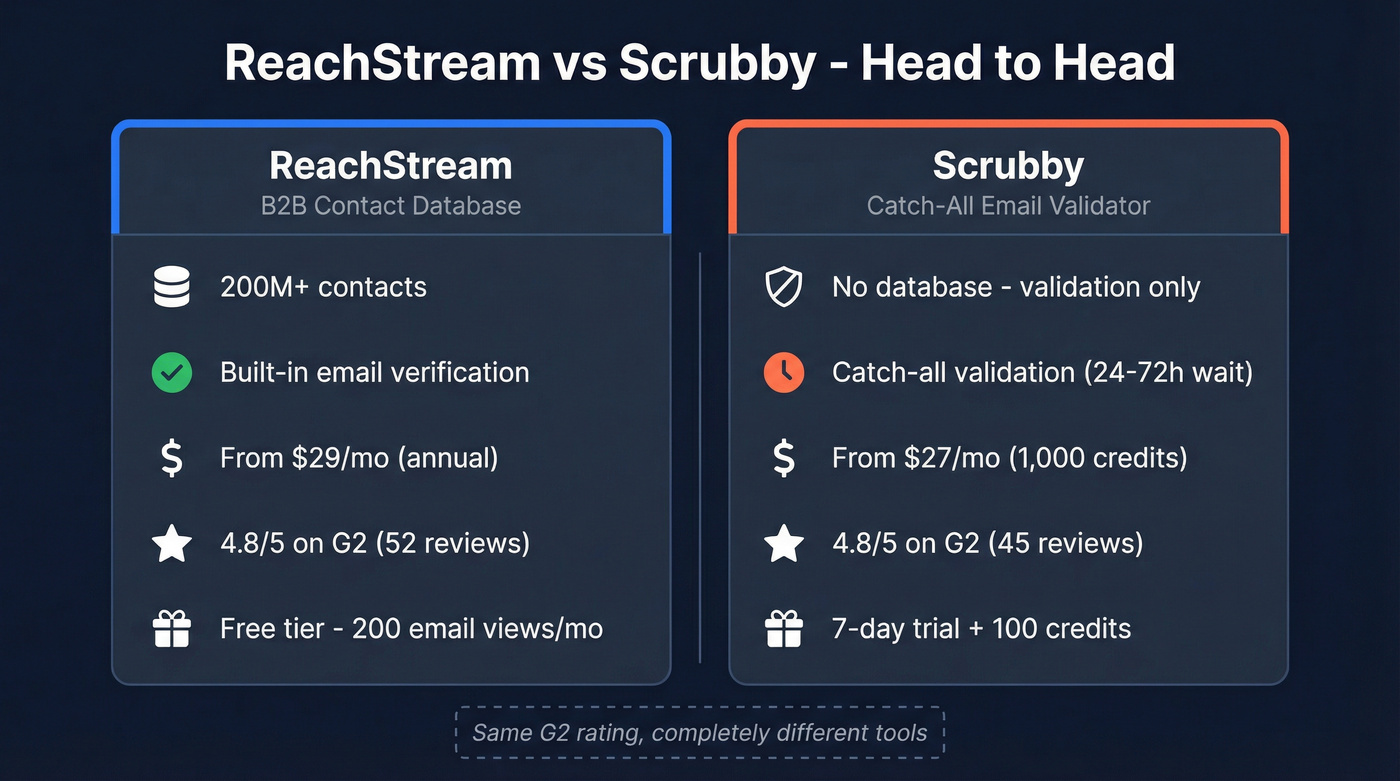
Identical G2 ratings, completely different review themes. ReachStream users talk about filtering and data quality. Scrubby users talk about deliverability and bounce rates.
ReachStream: What It Does and What It Costs
Use this if you're building outbound lists and need a self-serve database with decent coverage and a real free tier.
ReachStream's 200M+ contact database covers standard B2B filters - job title, industry, company size, technographics, location. The Chrome extension works for prospecting on professional profiles, and built-in verification means credits only get deducted for valid emails. That's a nice touch most databases don't offer, and it keeps your cost-per-lead predictable even when data quality varies across industries.

Pricing is straightforward: Icebreaker (free), Glacier ($29/mo annual), Ice Floe ($49/mo annual), and Polar Peak ($79/mo annual) with unlimited Chrome extension downloads. Paid plans also include unlimited email views for both contacts and companies.
Skip this if you need deep integrations. G2 reviews flag CRM sync problems repeatedly - five separate mentions call it out. It's a solid mid-market database, but don't expect enterprise-grade workflow automation. If you're building a full outbound stack, it helps to map this against your SDR tools and CRM needs.

ReachStream finds contacts but can't resolve catch-alls. Scrubby validates catch-alls but can't find contacts. Prospeo's 300M+ database includes 5-step verification with built-in catch-all handling - no 72-hour wait, no second subscription.
One platform. 98% email accuracy. Zero bounced-email surprises.
Scrubby: What It Does and What It Costs
Use this if your email validator left you with a pile of "catch-all" or "unknown" addresses and you need a definitive answer before hitting send.
Here's the thing: standard SMTP validators confirm a domain is active but can't verify whether a specific mailbox exists on a catch-all server. Scrubby solves this by sending blank emails from burner accounts and waiting 24-72 hours for bounces. That wait time is the tradeoff for 98% accuracy. Catch-all emails represent up to 42% of potential leads that traditional tools just discard, and validated catch-all emails reportedly show 67% higher engagement rates than unverified ones. Those numbers make the case for catch-all validation pretty clearly - the question is whether Scrubby's approach is the right way to get there.
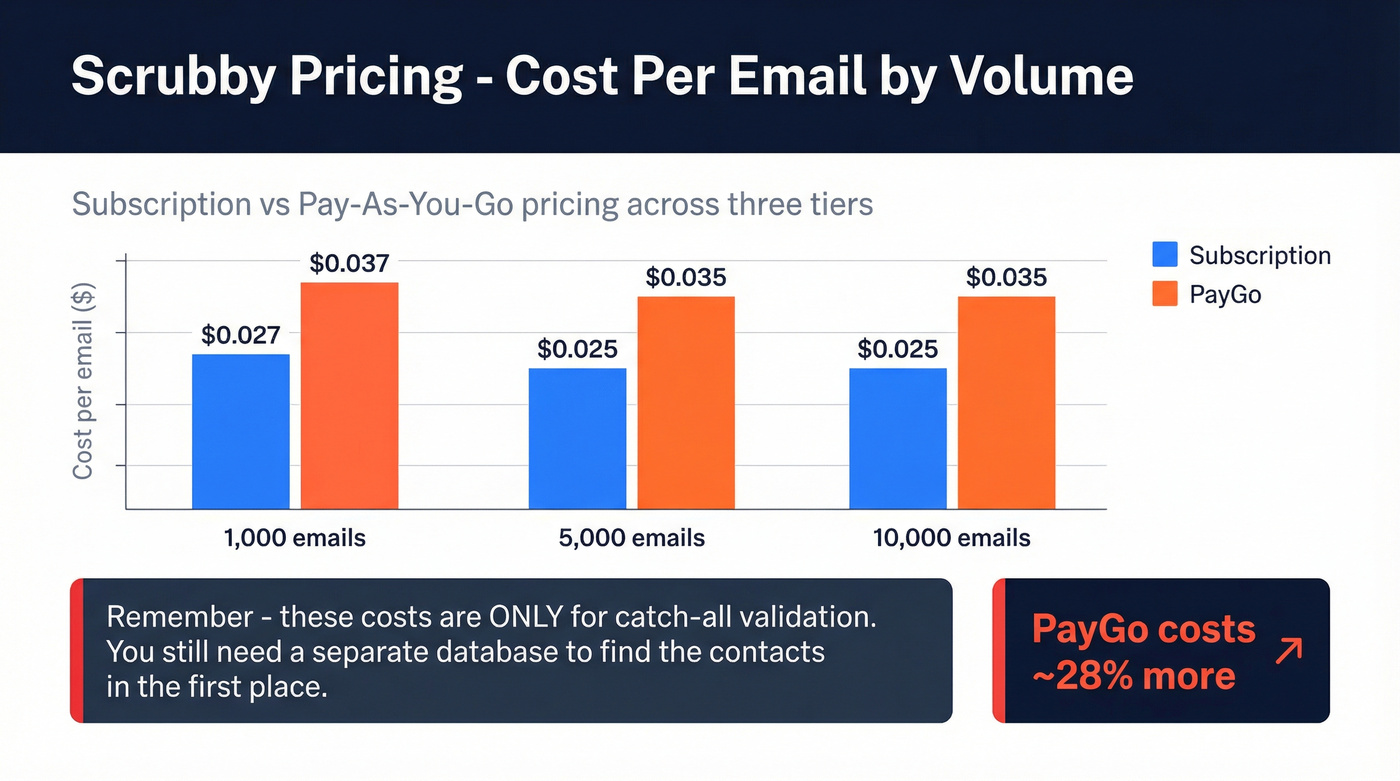
Subscription pricing runs $27/mo for 1,000 credits, $127/mo for 5,000, and $247/mo for 10,000. PayGo costs roughly 28% more - $177 for the same 5,000 emails you'd get at $127 on a subscription. Enterprise plans drop to 1 cent per credit at 10M+ volumes.
Here's the cost curve that matters:
| Volume | Subscription $/email | PayGo $/email |
|---|---|---|
| 1,000 | $0.027 | $0.037 |
| 5,000 | $0.025 | $0.035 |
| 10,000 | $0.025 | $0.035 |
Skip this if you're price-sensitive or working with small lists. The consensus on Reddit is blunt: "awesome but very expensive" for a tool that only handles one email type. There are also reliability concerns - one user reported Scrubby flagged 700 out of 1,700 emails as invalid, but manual spot checks showed many were actually deliverable. That's a frustrating outcome when you're paying per credit.
When to Use Which
Use ReachStream when you're starting from zero and need to build prospect lists with verified contacts. It's a data sourcing tool - the verification is a bonus, not the core product. If you're still dialing in your targeting, start with an ideal customer profile and then build lists from there.
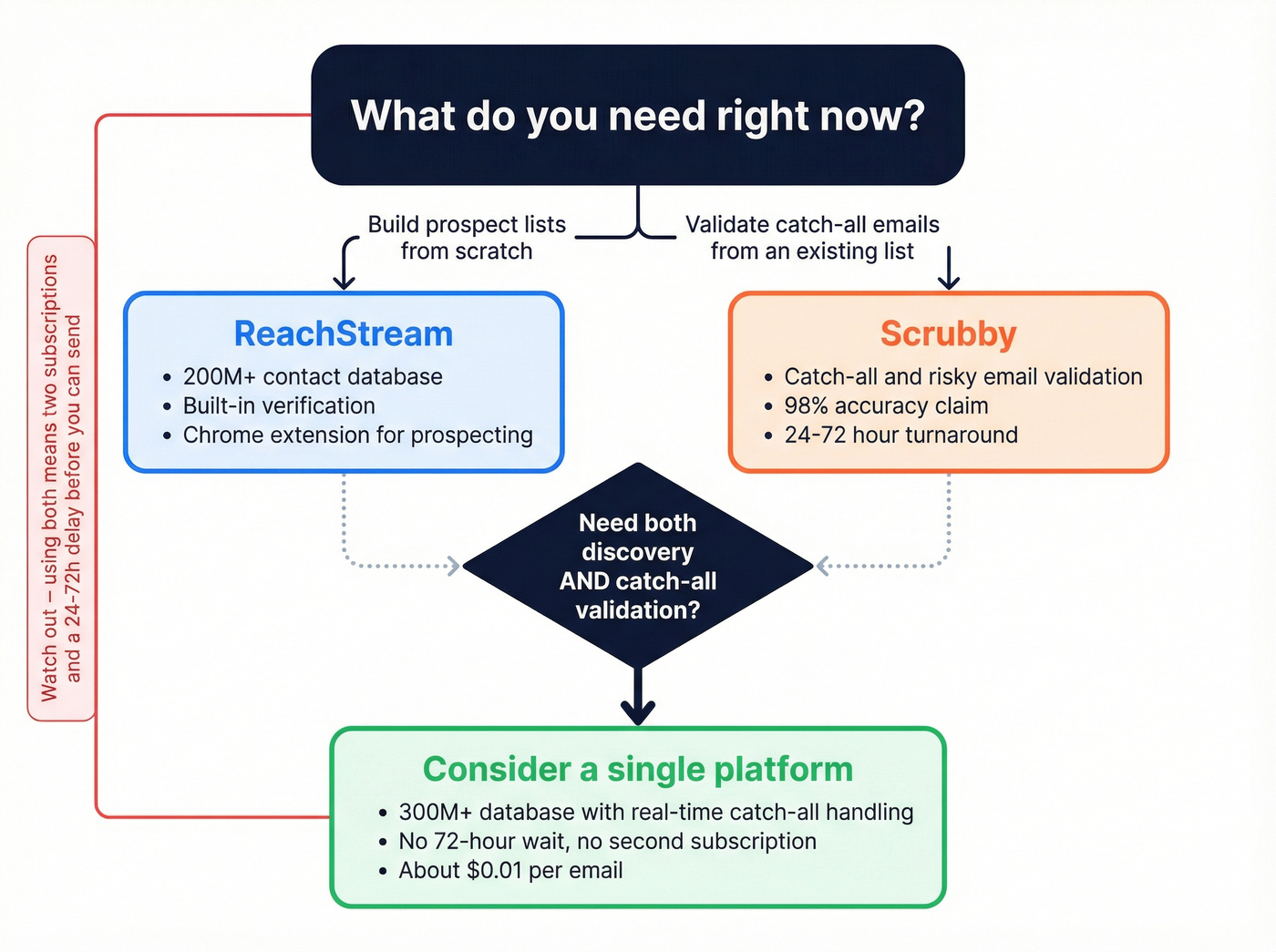
Use Scrubby when you've already run your list through a primary validator like NeverBounce or ZeroBounce and you're left with catch-all addresses you can't afford to skip or blindly send to. If you're trying to protect deliverability, it’s worth understanding email bounce rate benchmarks and what actually drives them.
Some teams use both - ReachStream for discovery, Scrubby for the catch-all cleanup pass. But that means two subscriptions and a 24-72 hour delay before you can actually send. We've seen teams underestimate that 72-hour lag badly; by the time your list clears validation, your competitors have already booked the meeting.
Let's be honest: if your average deal value sits below five figures, the cost of a dedicated catch-all validator on top of a separate database rarely pays for itself. You need one tool that does both.
Why We'd Skip Both
Prospeo handles both jobs in one platform. The database covers 300M+ professional profiles with 30+ search filters, and the 5-step verification process includes catch-all handling, spam-trap removal, and honeypot filtering - all in real time. No 72-hour wait. No second subscription. Data refreshes every 7 days, compared to the 6-week industry average, so you're not emailing stale contacts.

The results are measurable. Snyk's 50-person AE team saw bounce rates drop from 35-40% to under 5% after switching, and AE-sourced pipeline climbed 180%. The free tier gives you 75 emails and 100 Chrome extension credits per month. Paid plans start around $0.01 per email with no contracts. If you want to pressure-test the economics, compare it to your lead generation metrics and downstream conversion rates.
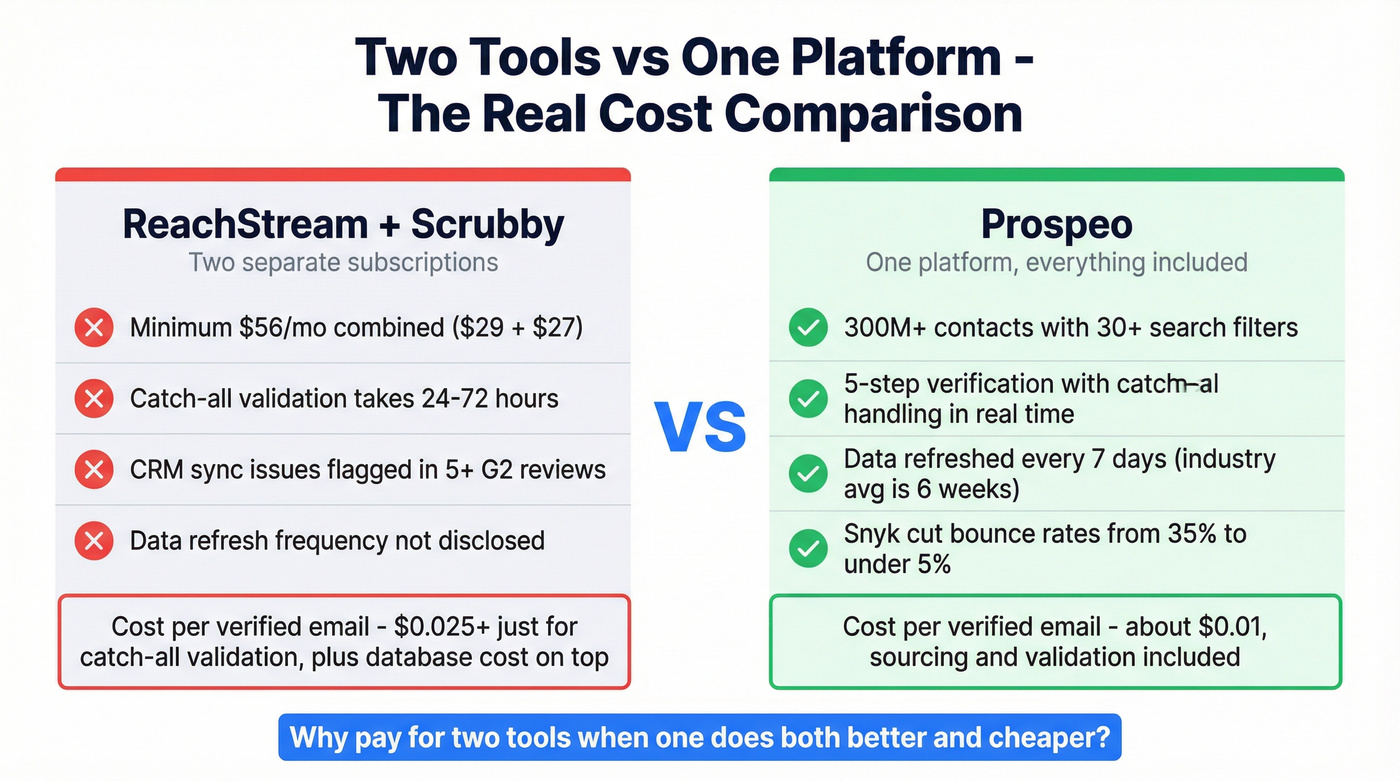
Paying $0.025/email just to validate catch-alls - on top of your database cost - adds up fast. Prospeo sources and verifies contacts in real time for ~$0.01/email, with data refreshed every 7 days. Snyk cut bounce rates from 35% to under 5% and grew pipeline 180%.
Stop duct-taping two tools together. Get one that actually works.
FAQ
Can I use ReachStream and Scrubby together?
Yes - ReachStream for contact discovery, Scrubby to validate the catch-all emails ReachStream's verifier flags as unknown. The downside is two subscriptions and a 24-72 hour delay before you can launch sequences. Most teams find a single platform with built-in catch-all handling more practical once they do the math on time and cost.
Is Scrubby worth it for small lists?
At $27/mo for 1,000 credits, you're paying 2.7 cents per email - and only for catch-all addresses. If catch-alls make up less than 20% of your list, the per-useful-email cost climbs above 10 cents fast. For lists under 2,000 contacts, a platform that bundles verification into sourcing will save you money and headaches.
What's the cheapest way to get verified B2B emails including catch-alls?
Prospeo's free tier includes 75 emails per month with 5-step verification - catch-all handling included. Paid plans run about $0.01 per email with no annual contracts. That's the lowest entry point we've found for a platform combining data sourcing with real-time catch-all verification.