

Real-Time Call Coaching: How It Works in 2026
A rep on their third week gets a competitor question they've never heard before. The battle card appears on screen instantly. They handle it cleanly, and the deal moves forward.
That's real-time call coaching working as promised. It doesn't always work that way.
Quick picks: Trellus for cold calling, Balto for contact centers, Dialpad if you're already on their platform. And the prerequisite most teams skip - clean contact data. Coaching software can't help if reps never reach a live prospect.
What Real-Time Coaching Actually Is
Three things get lumped together, and they're not the same. Conversation intelligence (Gong, Chorus) records calls and analyzes them after the fact. Live coaching surfaces prompts during the call - battle cards, compliance warnings, suggested responses - triggered by what the prospect just said. Post-call analytics scores calls and generates summaries for review.
We've seen teams try ChatGPT and Notion AI mid-call. Too slow. Gong only works after the fact. Real-time sales call guidance is the only category that operates within the live conversation window.
Most teams need both conversation intelligence and in-call coaching. Post-call tells you what to train on. Live prompts help reps execute the training. Analysts project the conversation intelligence market at $61B+ by 2033, with real-time coaching as the fastest-growing segment.
How the Technology Works
Four stages, and every one adds latency.
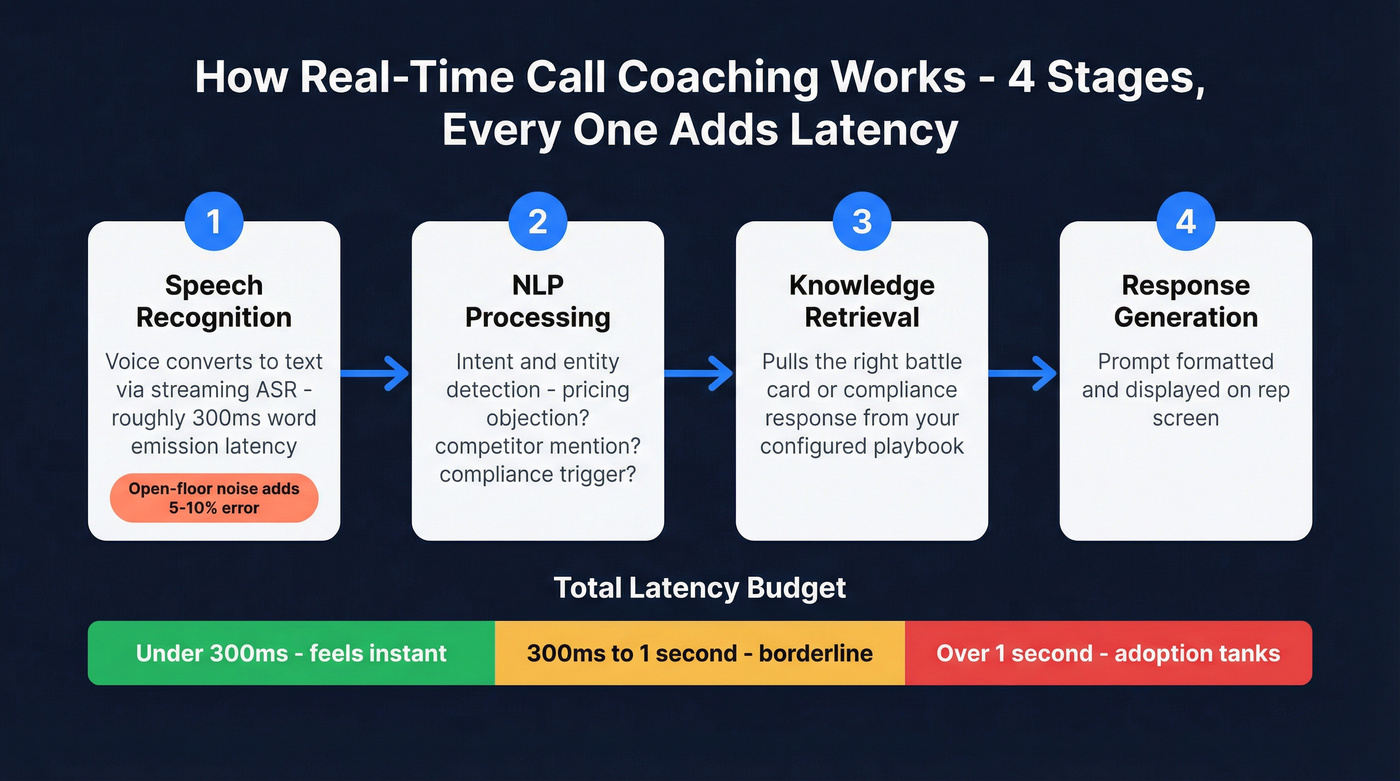
Stage 1: Speech Recognition. Speech converts to text via streaming transcription. Leading ASR systems hit roughly [300ms word emission latency](https://picovoice.ai/blog/complete-guide-to-streaming-speech-to-text/). [Background noise adds 5-10%](https://journals.sagepub.com/doi/pdf/10.1177/154193120004403716) to word error rates - a real problem in open-floor sales pits.
Stage 2: NLP. Text gets parsed for intent and entities. Pricing objection? Competitor mention? Compliance-sensitive moment? (If you're building scripts for these moments, start with objection handling techniques.)
Stage 3: Knowledge Retrieval. The system pulls the relevant battle card or compliance response from the configured playbook.
Stage 4: Response Generation. The prompt gets formatted and displayed. Around 300ms is the target if you want to influence the conversation in the moment. Once you're past a second, it disrupts flow and adoption tanks.
When It Works - and When It Doesn't
Teams using live coaching report 15-20% higher win rates and 30-40% more volume capacity. A QJE study found roughly 15% productivity gains from in-flow suggestions. New reps benefit enormously. Compliance-heavy environments - healthcare, financial services, collections - see massive value from automated guardrails.
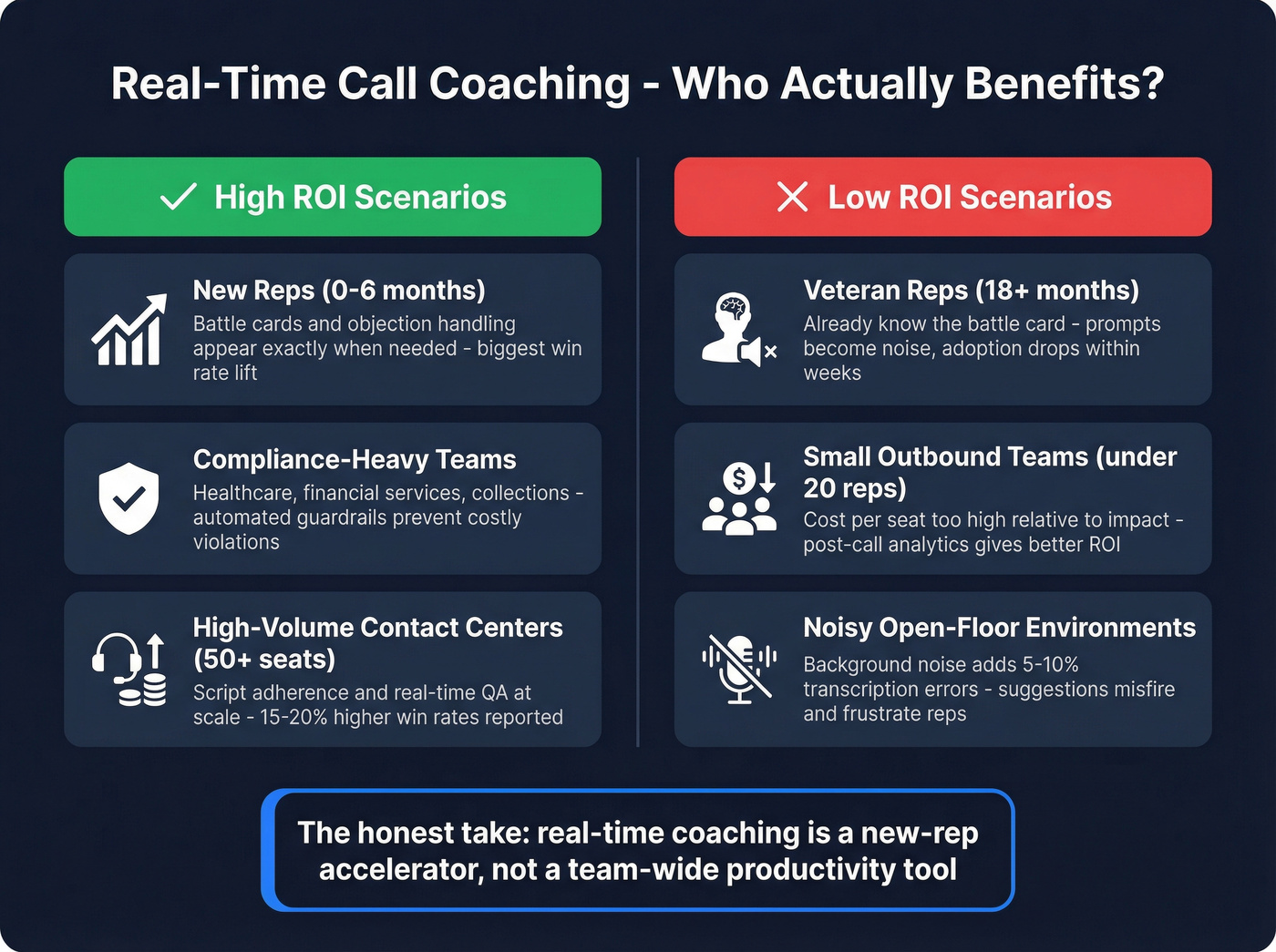
But the consensus on r/sales is lukewarm. One practitioner rated the category 5/10 and compared it to someone handing you a post-it note mid-conversation. The two core objections are legitimate: Cognitive load - experienced reps already know the battle card, so the prompt is just noise. Latency - by the time the tool generates a suggestion, the moment has passed.
Here's the thing: real-time call coaching is a new-rep accelerator, not a team-wide productivity tool. If your average rep has 18+ months of experience, you'll get more ROI from better post-call analytics than from live prompts most of your team will ignore within weeks.

Real-time coaching optimizes the conversations that happen. But with average pickup rates under 12%, most dials never become conversations. Prospeo's 125M+ verified mobile numbers deliver a 30% pickup rate - turning your 200-dial session into 60+ live conversations instead of 30.
Double your live conversations before you optimize them.
Tools Worth Evaluating
The fact that Balto and Aircover don't publish list pricing in 2026 is exhausting. Here's what we've gathered.
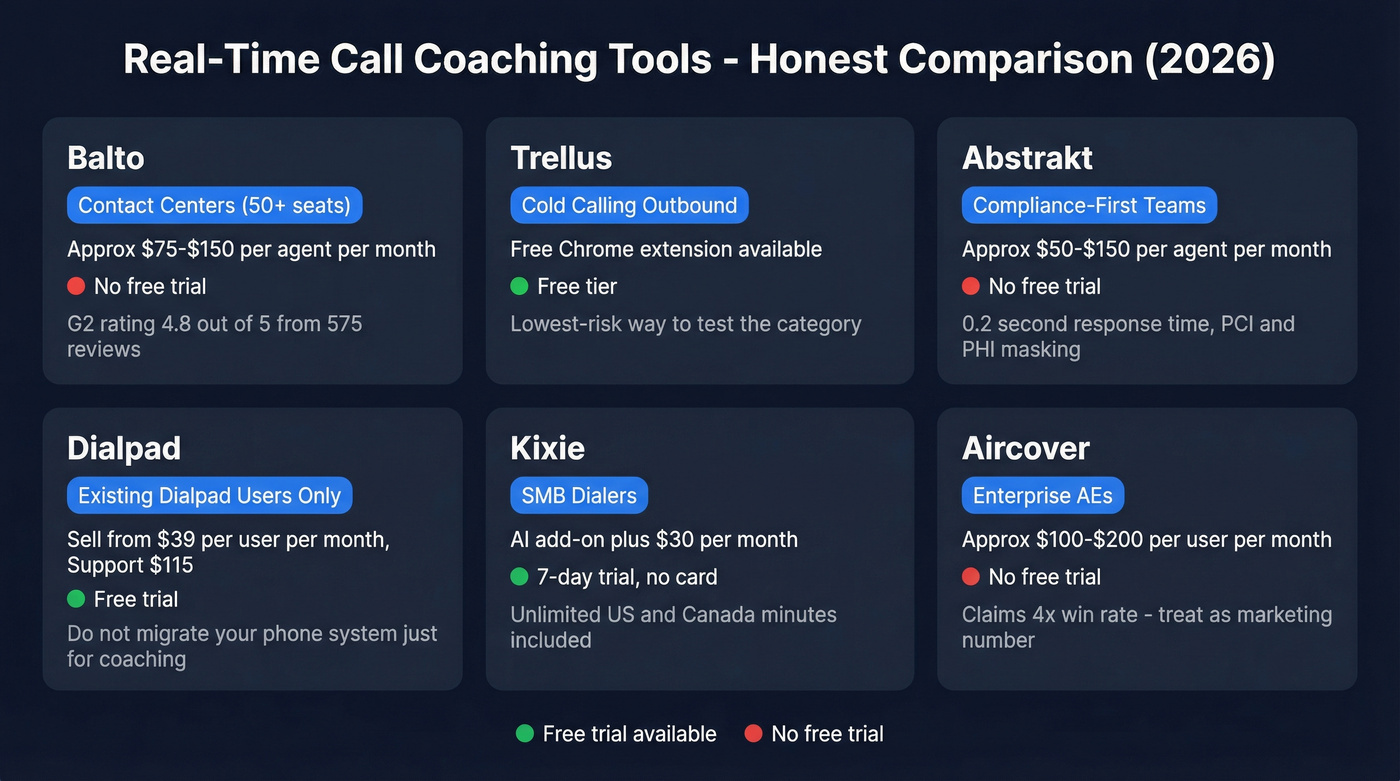
| Tool | Best For | Real-Time Feature | Pricing | Free Trial? |
|---|---|---|---|---|
| Balto | Contact centers | Live prompts + scripts | Custom quote (~$75-$150/agent/mo) | No |
| Trellus | Cold calling | In-call coaching | Free Chrome extension; paid plans available | Yes |
| Abstrakt | Compliance teams | Playbook-only prompts | Custom quote (~$50-$150/agent/mo) | No |
| Dialpad | Existing Dialpad users | AI Live Coach Cards | Sell from $39/user/mo; Support Advanced $115/user/mo | Yes |
| Kixie | SMB dialers | Live call coaching | AI add-on +$30/mo | Yes (7-day) |
| Aircover | Enterprise AEs | AI meeting copilot | Custom quote (~$100-$200/user/mo) | No |
Balto
One of the best-known contact center coaching tools, with a 4.8/5 on G2 across 575 reviews. Users praise real-time script surfacing. Complaints center on keyword triggers misfiring and filler words getting misattributed. Implementation averages about two months. If you're running a 50+ seat contact center with strict compliance requirements, Balto is the first tool to demo - but skip it if your team is under 20 reps doing outbound sales, because the ROI math doesn't work at that scale.
Trellus
Purpose-built for cold calling outbound. The free Chrome extension is enough to evaluate whether live AI coaching fits your workflow before committing to paid plans. In our experience, this is the lowest-risk way to test the category.
Abstrakt
The compliance-first option - nothing reaches the agent unless it's been approved in the configured playbook. It delivers recommended responses within 0.2 seconds and supports PCI/PHI/PII masking for transcript and audio. If you're in healthcare or financial services, evaluate this one first.
Dialpad
Makes sense only if you're already on their platform. AI Live Coach Cards trigger battle cards based on detected phrases. Support Advanced runs $115/user/month and includes AI live coach; Dialpad Sell starts at $39/user/month. Don't migrate your phone system just for coaching.
Kixie
Includes live coaching across plans with unlimited US/Canada minutes. The 7-day free trial requires no credit card, and AI Human Detection (Premium) is +$30/month. Solid for SMBs that want coaching without a separate vendor.
Aircover
Targets enterprise AEs with a meeting copilot approach. They claim 4x win rate improvement - treat that as a marketing number until you see it in your own pipeline.
Compliance Isn't Optional
If your coaching tool records or transcribes calls, the exposure is real. PCI non-compliance runs $5,000-$100,000/month. HIPAA violations can hit $2M per incident category. GDPR penalties reach 4% of global turnover.
The minimum: pause recording during payment capture, encrypt all recordings, require a BAA for HIPAA-covered data, and implement role-based access controls. Don't assume your vendor handles this - ask specifically. For a deeper framework, use our B2B compliance checklist.
The Prerequisite Most Teams Skip
Let's be honest about something the coaching vendors won't tell you.
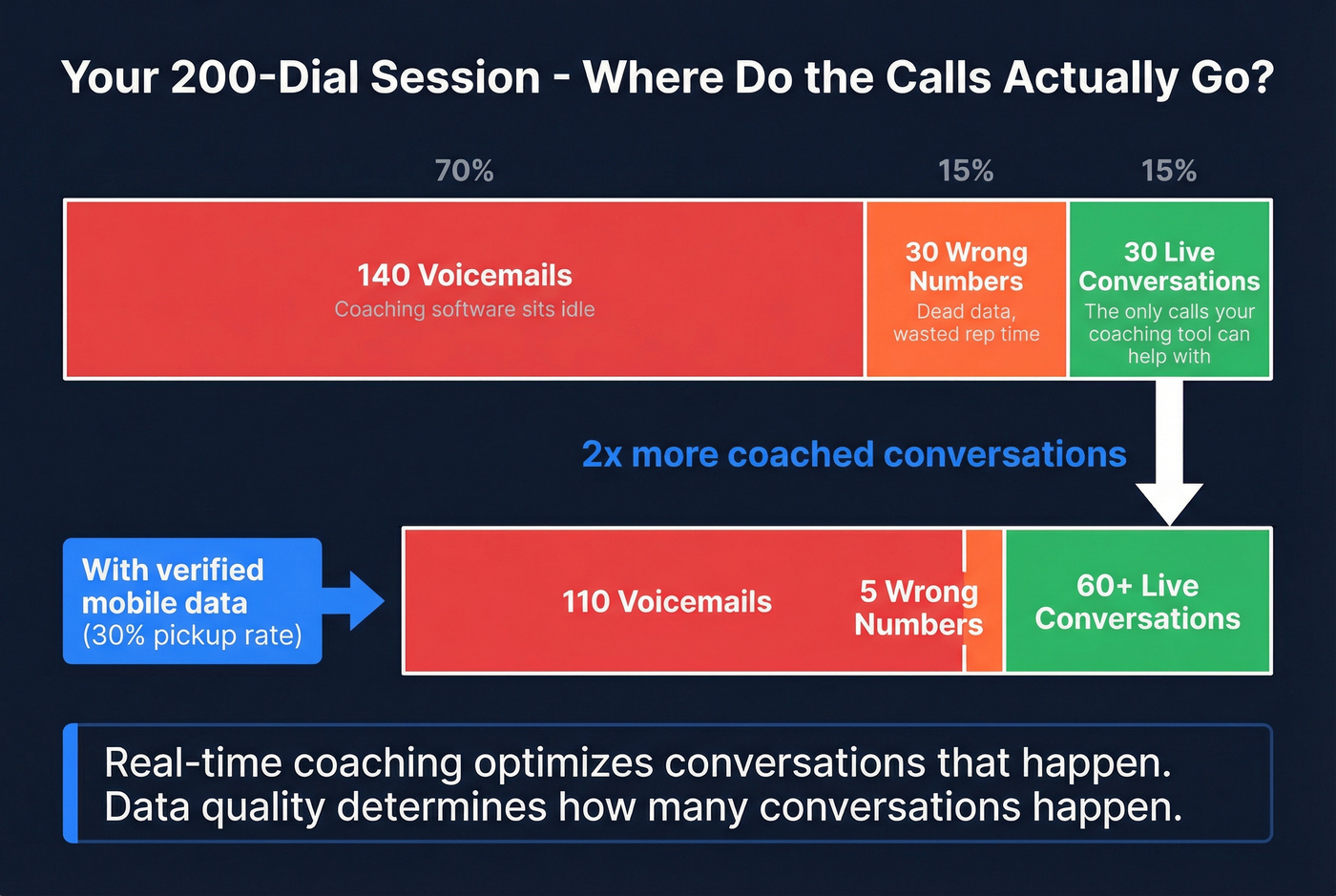
Picture a 200-dial session. 140 go to voicemail. 30 hit wrong numbers. 30 connect to a live human. Real-time call coaching optimizes those 30 conversations. Nobody's asking why 30 numbers were dead.
If 15-30% of your dial list is stale, your coaching investment is wasted before it starts. We've seen teams spend $50k+ on coaching platforms while feeding reps contact lists that bounce 20% - it's like buying a race car and filling it with the wrong fuel. Prospeo's mobile database covers 125M+ verified numbers with a 30% pickup rate, refreshed on a 7-day cycle instead of the 6-week industry average. Fix the data upstream, and every coached conversation counts. (If you're auditing vendors, start with the best B2B database and best verified contact databases roundups.)
Your coaching tool can't help reps who never reach a decision-maker. Prospeo's 98% accurate emails and verified direct dials - refreshed every 7 days - mean reps spend less time dialing wrong numbers and more time in conversations worth coaching.
Stop coaching voicemails. Start reaching real buyers at $0.01 per lead.
FAQ
Does live call coaching improve close rates?
Industry benchmarks show 15-20% higher win rates, but results depend on rep experience. New reps see the biggest lift. Veterans often find prompts distracting, and adoption drops within weeks if prompts aren't tuned to their deal complexity.
What latency is acceptable for in-call coaching?
Under 500ms feels real-time. Between 500ms and one second is borderline. Over one second tanks adoption - reps stop looking at the screen. Background noise compounds the problem by adding 5-10% to transcription errors.
What should I fix before investing in coaching software?
Your contact data. If phone numbers are stale and emails bounce, reps never reach calls worth coaching. A 7-day data refresh cycle and 98% email accuracy keep dial lists clean so reps spend coached time on live conversations, not voicemail boxes.