

How to Reduce Revenue Leakage: The Formula, the Causes, and the Fix
Revenue leakage quietly drains 1-5% of EBITDA from companies that think their billing is fine - and most never catch it. Here's the uncomfortable part: 73% of businesses have no automated revenue assurance, which means three-quarters of organizations rely on someone manually catching errors that, by definition, go unnoticed. A BCG survey of 2,000+ business leaders found 45% call leakage a systemic problem, and well-designed programs generate returns within 1-3 months.
Run the leakage formula below against last quarter's numbers. Fix the biggest leak first - usually billing automation or failed payment recovery. Then clean your contact data, because if dunning emails bounce, no process fix will help.
What Revenue Leakage Actually Is
Revenue leakage is the gap between contractually obligated revenue and what you actually collect - money you earned but never captured, caused by systemic failures across your quote-to-cash cycle. In B2B, it's especially insidious because longer sales cycles and complex contracts create more surface area for errors to compound undetected.
It's not churn, approved discounts, or pipeline losses. Those are business decisions. Leakage is operational failure. You fix churn with product strategy; you fix leakage with process, automation, and data quality.
How to Measure Revenue Leakage
The formula, per Zuora's revenue leakage guide:
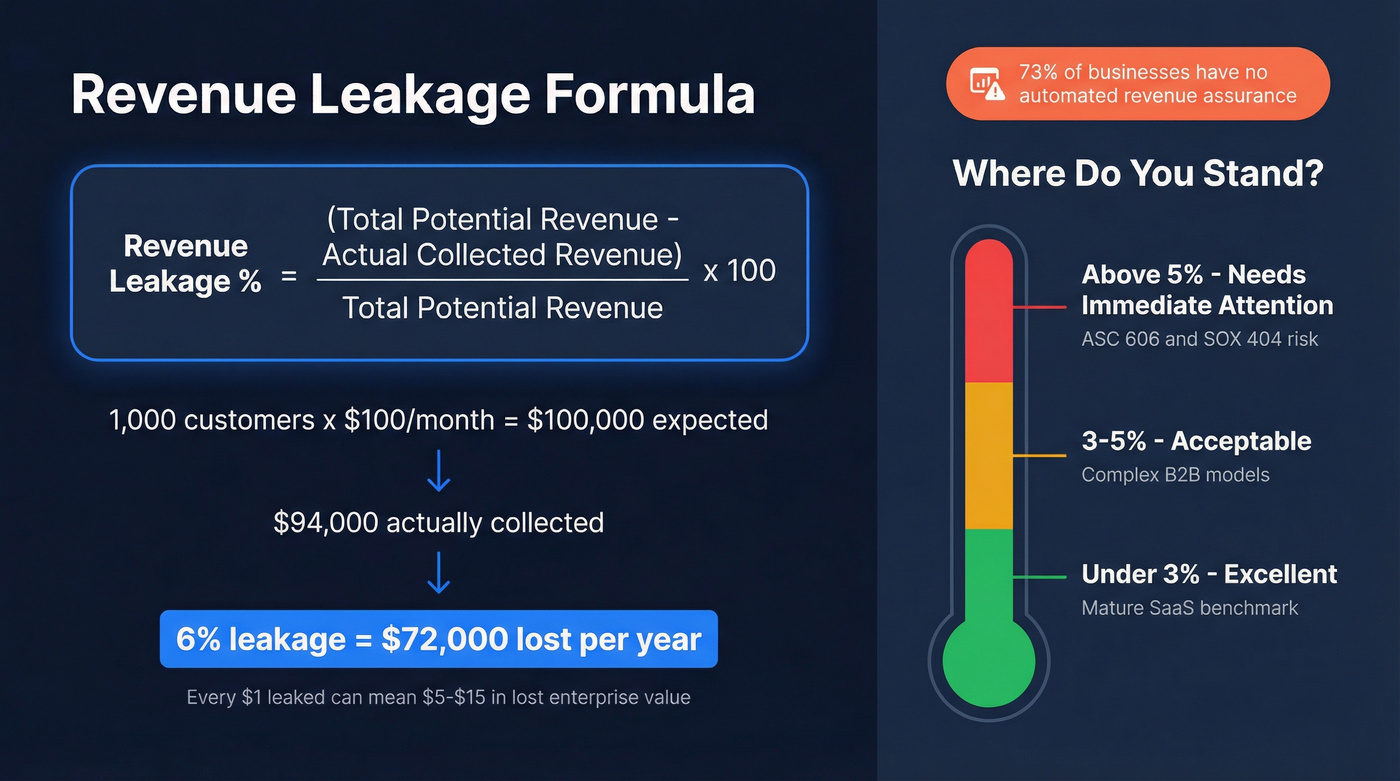
Revenue Leakage % = (Total Potential Revenue - Actual Collected Revenue) / Total Potential Revenue x 100
Say you've got 1,000 customers at $100/month - $100,000 in expected revenue. Between expired cards, late billing after upgrades, and failed invoice collection, you actually collect $94,000. That's 6% leakage: $72,000 walking out the door every year. For high-growth companies, every $1 of leaked revenue can translate to $5-$15 in lost enterprise value.
Under 3% is excellent. Between 3-5% is acceptable. Above 5% needs immediate attention. For public companies, leakage that rises to common materiality thresholds - often framed as ~5% of revenue or ~10% of EBITDA - creates ASC 606 compliance risk and SOX 404 exposure. Most companies don't know where they stand until someone actually runs the numbers.

Stale billing contacts are a silent revenue leak. If your dunning emails bounce and renewal outreach hits dead inboxes, no automation can save you. Prospeo refreshes 300M+ contact records every 7 days - not every 6 weeks - with 98% verified email accuracy.
Stop leaking revenue into inboxes that no longer exist.
6 Common Causes of Revenue Leaks
1. Billing errors and manual invoicing. Manual invoice creation is the single largest leakage vector we see. Typos, missed line items, incorrect rates - they compound fast. If client-facing roles have invoicing discretion without validation, you're leaking.
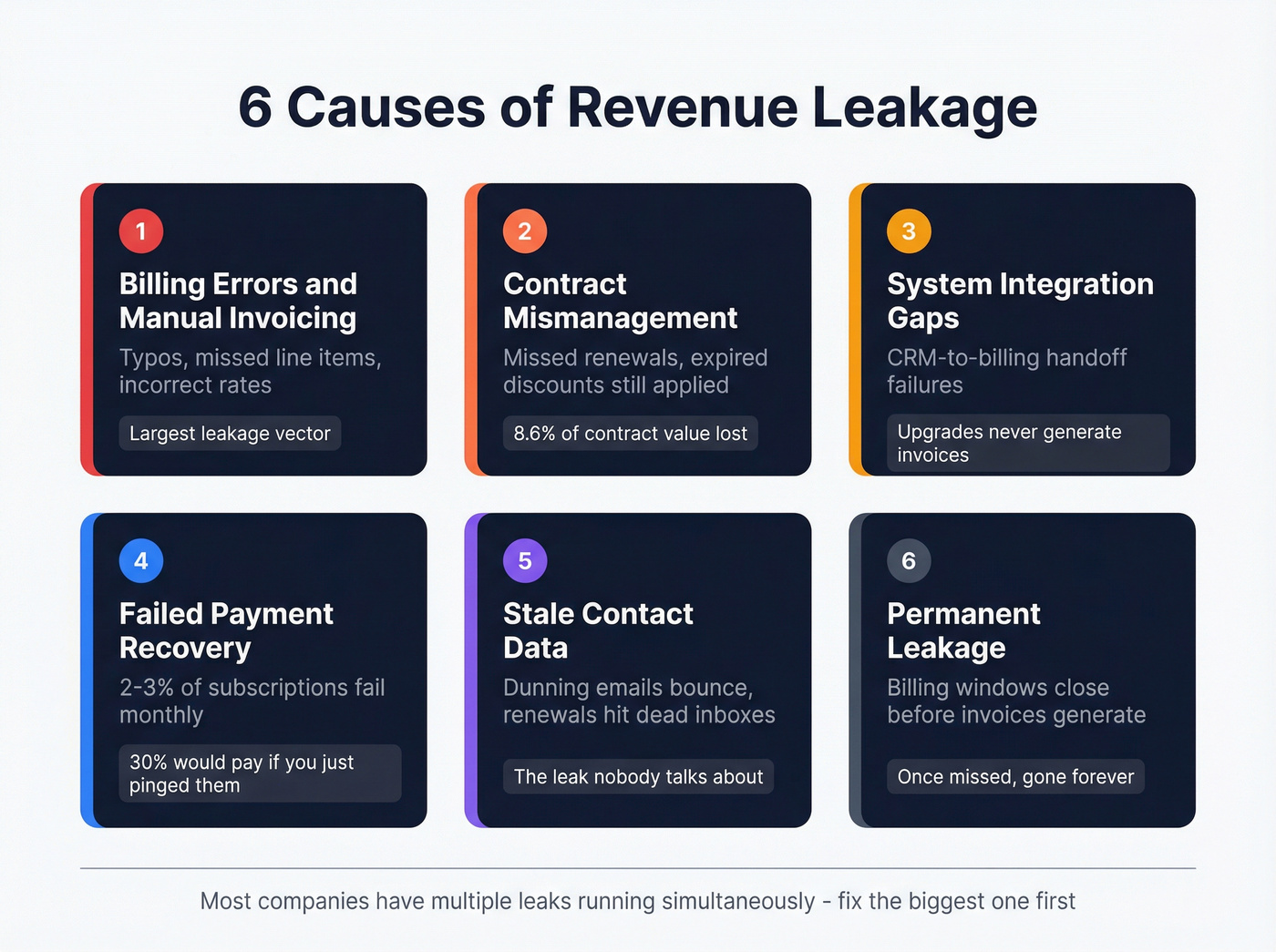
2. Contract mismanagement. Renewals slip, amendments don't propagate to billing, unauthorized discounts persist past expiration. The World Commerce & Contracting Association puts the damage at 8.6% of total contract value lost annually. In tech services, out-of-scope charges go unbilled due to contract complexity. In logistics, discounted rates get applied even when contract terms aren't met.
3. System integration gaps. The CRM-to-billing handoff is where revenue disappears. A rep closes a deal in Salesforce, but the billing system doesn't reflect the correct tier. An upgrade triggers in the product but never generates an invoice. These gaps stay invisible until someone reconciles - and most teams don't reconcile often enough.
4. Failed payment recovery. Roughly 2-3% of subscriptions fail every month due to expired cards, insufficient funds, or bank declines. The consensus on r/indiehackers is that about 30% of those customers would pay if you simply pinged them. That's recoverable revenue sitting on the table.
5. Stale contact data. Here's the leakage source nobody talks about: your billing contacts changed jobs, your dunning emails bounce, and your renewal outreach lands in a dead inbox. You can automate every billing workflow perfectly, but if the email address attached to the account is six months stale, none of it matters. Prospeo verifies and refreshes B2B contact records on a 7-day cycle with 98% email accuracy, which is why we've seen teams pair it with their billing stack to keep invoices and dunning emails reaching someone who can actually act.
6. Permanent leakage. Some revenue, once missed, is gone forever. Billing windows close before invoices generate. Contractual barriers prevent retrospective billing. Speed matters here more than anywhere - the longer leakage goes undetected, the less recoverable it becomes.
Warning Signs You Need Revenue Assurance
If any of these sound familiar, run the formula:
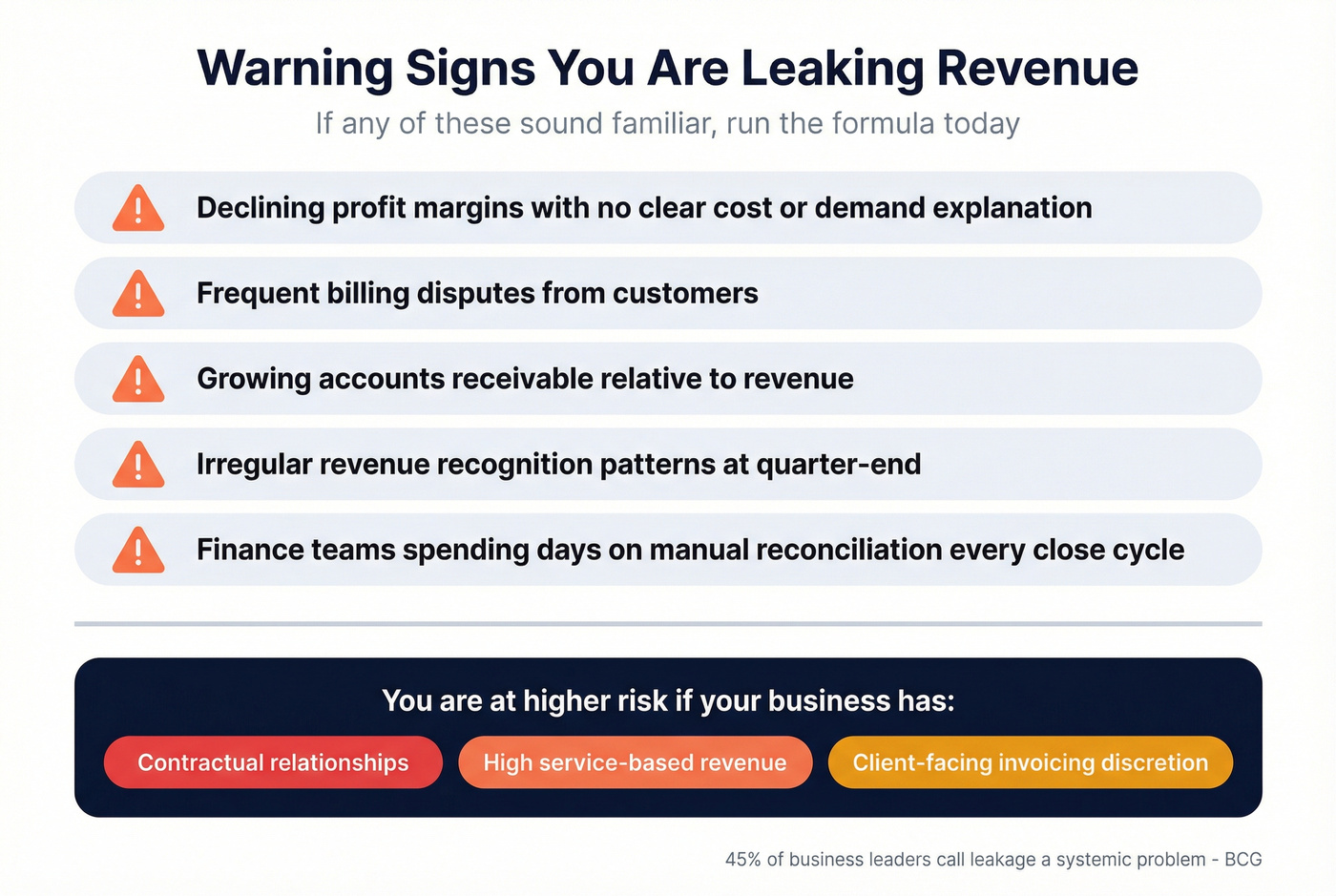
- Declining profit margins without a clear cost or demand explanation
- Frequent billing disputes from customers
- Growing accounts receivable relative to revenue
- Irregular revenue recognition patterns at quarter-end
- Finance teams spending days on manual reconciliation every close cycle
You're at higher risk if your business relies on contractual relationships, has high service-based revenue, or gives client-facing teams invoicing discretion.
How to Stop Revenue Leaks - A Phased Approach
Phase 1: Diagnostic (4-8 Weeks)
Run the leakage formula against the last two quarters. Then do what many finance teams call "staple yourself to an order" - follow a single transaction from quote through contract, billing, collection, and recognition. In our experience, every team that does this exercise finds at least one leak they didn't know existed. One company we spoke with discovered their upgrade-to-invoice lag was averaging 11 days, which meant nearly half their mid-cycle upgrades never billed in the correct period.
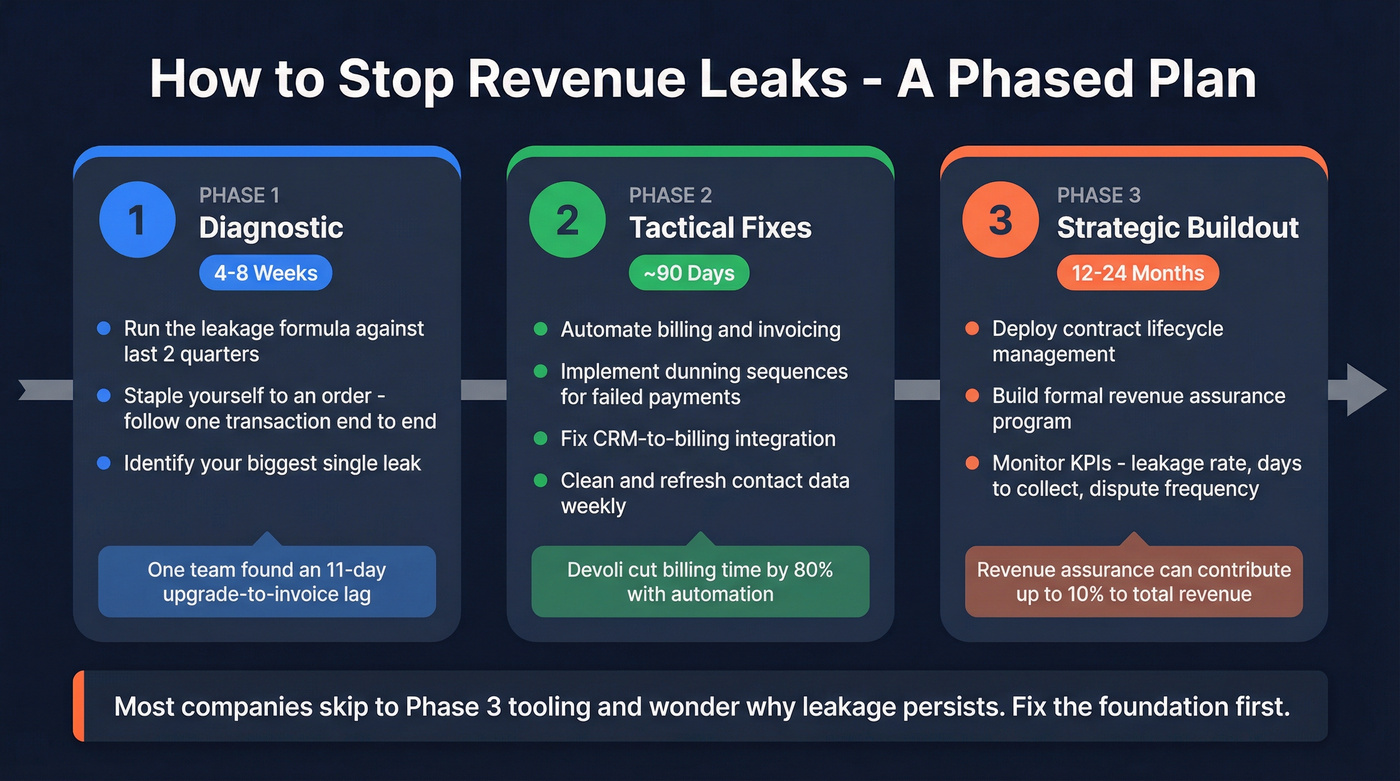
Phase 2: Tactical Fixes (~90 Days)
This is where you stop the bleeding.
Automate billing and invoicing. New Zealand broadband startup Devoli cut billing time by 80% after implementing automated billing during nearly 1,000% growth. Implement dunning sequences for failed payments. Fix the CRM-to-billing integration so upgrades actually trigger invoices.
Then clean your contact data so dunning emails and renewal outreach reach real people at current addresses. We've watched companies automate their entire billing stack and still leak revenue because their contact records were six months stale. If you skip this step, you're building a perfect machine that sends messages into the void.
Phase 3: Strategic Buildout (12-24 Months)
Deploy contract lifecycle management. Build a formal revenue assurance program with dedicated ownership. Establish ongoing KPI monitoring - leakage rate, days-to-collect, billing dispute frequency. BCG's research suggests revenue assurance can contribute as much as 10% to total revenue without selling additional products. That's not a rounding error. It's the equivalent of a new product line without building anything.
Let's be honest: most companies skip straight to Phase 3 tooling and wonder why leakage persists. The expensive CLM platform doesn't help if your Phase 1 diagnostic never happened and your Phase 2 data hygiene is nonexistent. Fix the foundation first. Automation isn't optional anymore, but it's also not sufficient on its own - companies serious about plugging revenue gaps need to treat assurance as an ongoing discipline, not a one-time project.
If you're building a repeatable process, treat this like sales process optimization: document the handoffs, define validation rules, and measure exceptions weekly.
You just built the perfect billing stack. But 83% of your CRM records enrich back with current contact data through Prospeo - meaning your invoices, dunning sequences, and renewal outreach actually reach someone who can pay. At $0.01 per email, fixing stale data costs less than a single leaked invoice.
The cheapest revenue recovery tool is an accurate email address.
FAQ
What's a good revenue leakage rate?
Under 3% is excellent - most mature SaaS companies land here. Between 3-5% is acceptable for complex B2B models. Above 5% means you're losing the equivalent of a product line's margin and need immediate intervention. Run the formula quarterly to track trends.
How is revenue leakage different from churn?
Churn is a customer choosing to leave. Leakage is money contractually owed but never collected - an operations failure entirely within your control. You fix churn with product and retention strategy; you fix leakage with billing automation, system integration, and data quality.
How long does it take to reduce revenue leakage?
Diagnostics take 4-8 weeks. Tactical fixes - billing automation, dunning sequences, contact data cleanup - run about 90 days. A full revenue assurance program is a 12-24 month buildout, but the first two phases typically pay for themselves within one quarter.
Can stale contact data cause revenue leakage?
Absolutely - it's one of the most overlooked causes. When billing contacts change roles and email addresses go stale, dunning sequences and renewal notices bounce. Keeping contact records on a weekly refresh cycle with verified emails ensures payment recovery messages actually land.