

Relationship Selling: What the Data Actually Says (And What Most Guides Get Wrong)
[96% of buyers](https://blog.hubspot.com/sales/sales-statistics) research your company before they'll talk to a rep. 67% prefer self-service over speaking to anyone at all. So when someone tells you "just build relationships and the deals will come," they're skipping the part where the buyer already decided whether you're worth a conversation before you ever showed up.
Relationship selling isn't dead. But the version most people practice is.
What You Need (Quick Version)
Modern relationship-based selling comes down to three things:
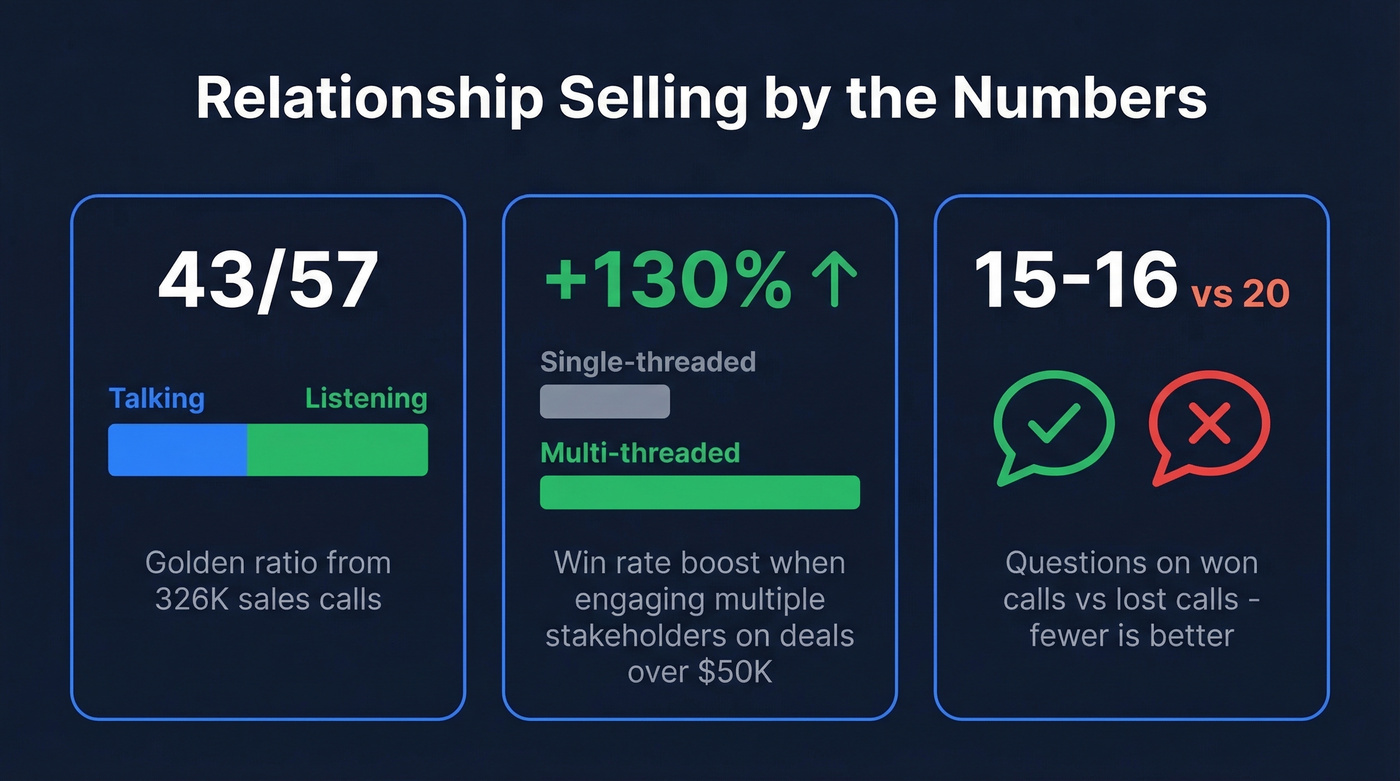
- Listen more than you talk. A 326K-call dataset puts the golden ratio at 43% talking, 57% listening. Reps who talk more than 65% of the call lose more deals.
- Multi-thread every deal over $50K. Win rates jump 130% when you engage multiple stakeholders instead of riding a single champion.
- Treat it as a layer, not a standalone methodology. It amplifies consultative and value-based approaches. It doesn't replace them.
If your version of relational selling feels like pretending you're not selling, you're doing it wrong.
What Is Relationship Selling?
This approach prioritizes trust, rapport, and long-term connection over one-time transactions. The seller invests in understanding the buyer as a person - their goals, pressures, preferences - and earns the right to advise rather than pitch. The principles apply anywhere trust drives repeat business, from enterprise software to a barber who remembers your kid's name, but the stakes are highest in B2B where deal sizes justify the time investment.
That sounds nice. It's also incomplete without context.
| Relationship | Transactional | Consultative | |
|---|---|---|---|
| Trust source | Personal rapport | Price/convenience | Expertise/diagnosis |
| Scalability | Low-medium | High | Medium |
| Best-fit deals | Enterprise, long-cycle | SMB, commodity | Mid-market, complex |
The best sellers in 2026 don't pick one column. They blend relationship and consultative approaches - rapport opens doors, expertise closes deals. Pure rapport-building without a strong business case is just expensive friendship.
Why It's Making a Comeback
Mass automation broke outbound. Teams blasting 10,000+ emails per month are hitting deliverability walls and watching reply rates crater under 1%.
The pendulum is swinging back. In the low-volume, high-personalization world, sellers are seeing 15-30% reply rates on micro-lists with 1:1 personalization - even handwritten letters are making a comeback, just with modern data infrastructure behind them.
When scaled blasts produce sub-1% replies and personalized outreach produces 15%+, the ROI flips toward fewer, better touches. Relational selling is the framework that makes those touches compound over time.
Data Behind the Techniques
Let's move past vibes. Gong's analysis of 326K sales calls gives us the clearest signal on what separates winners from losers in conversation-driven selling.
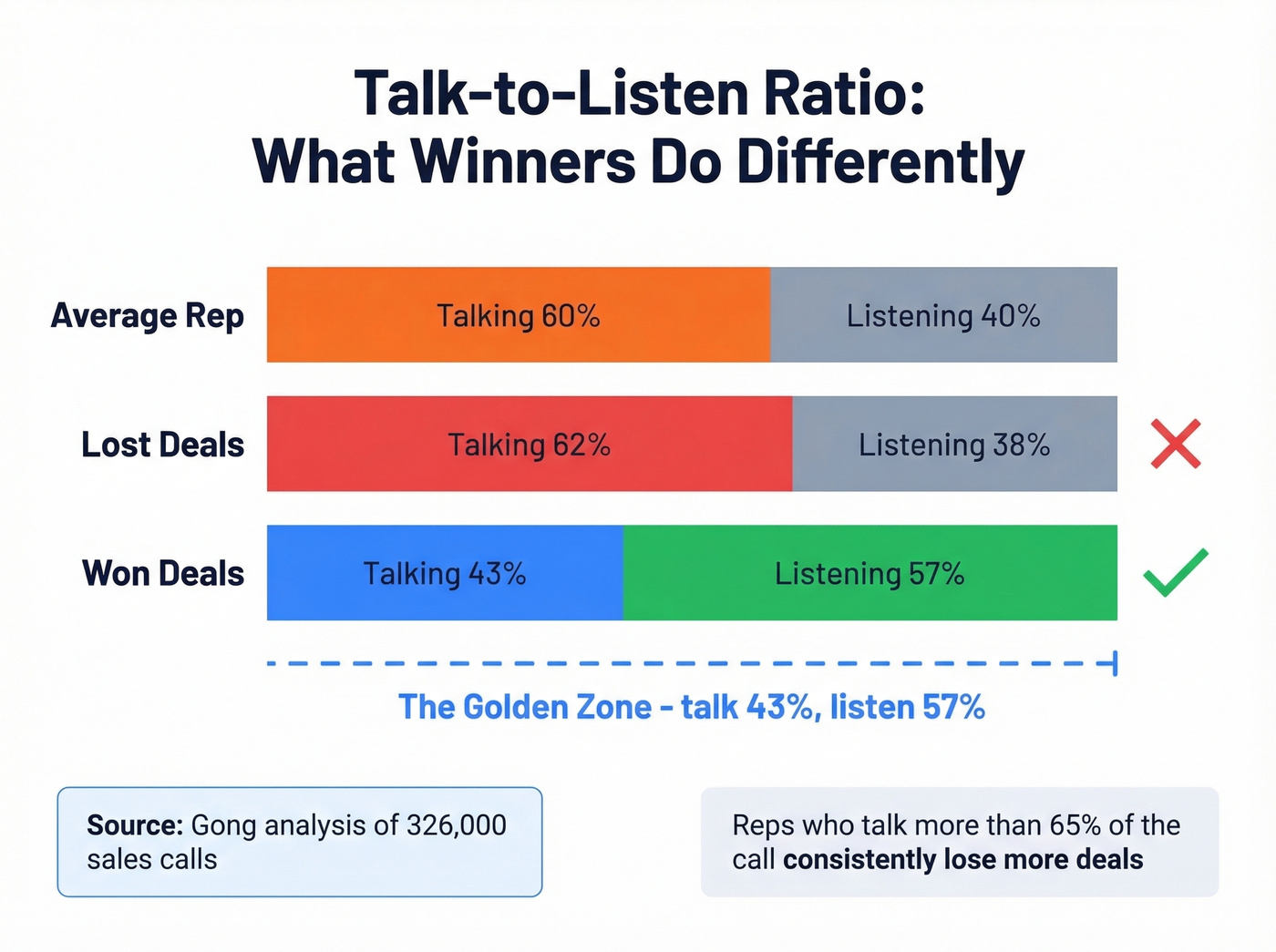
The talk-to-listen ratio is the headline finding. Average reps talk 60% of the call and listen 40%. But closed-won deals look different: winners talk about 57% of the time. Lost deals? Reps talked 62%. The golden ratio - 43% talk, 57% listen - consistently correlates with higher close rates.
Here's the counterintuitive part: winning reps ask fewer questions. Closed-won calls averaged 15-16 questions versus roughly 20 on lost deals. More questions doesn't mean better discovery. It means the rep is interrogating instead of conversing.
The multi-threading data is even more striking. An analysis of 1.8M opportunities found that 77% of deals involve multiple contacts on the buyer side, and deals that close successfully have twice as many buyer contacts as those that don't. For enterprise deals, the average is 17 contacts. For deals over $50K, multi-threading boosts win rates by 130%.
In our experience, multi-threading is the single highest-leverage change a team can make - more impactful than any script rewrite or cadence tweak.
That's the modern version of this approach. It's not one rep and one champion grabbing coffee. It's systematic stakeholder mapping across the entire buying committee.

Multi-threading boosts win rates 130%, but only if you can actually reach every stakeholder. Prospeo's 300M+ profiles with 30+ filters let you map entire buying committees - job title, department, seniority - and get 98% accurate emails for each one.
Stop riding a single champion. Reach the full committee for $0.01 per email.
The "It Feels Fake" Problem
A lot of sellers hate relational selling because they've seen it done badly. They're right to be skeptical.
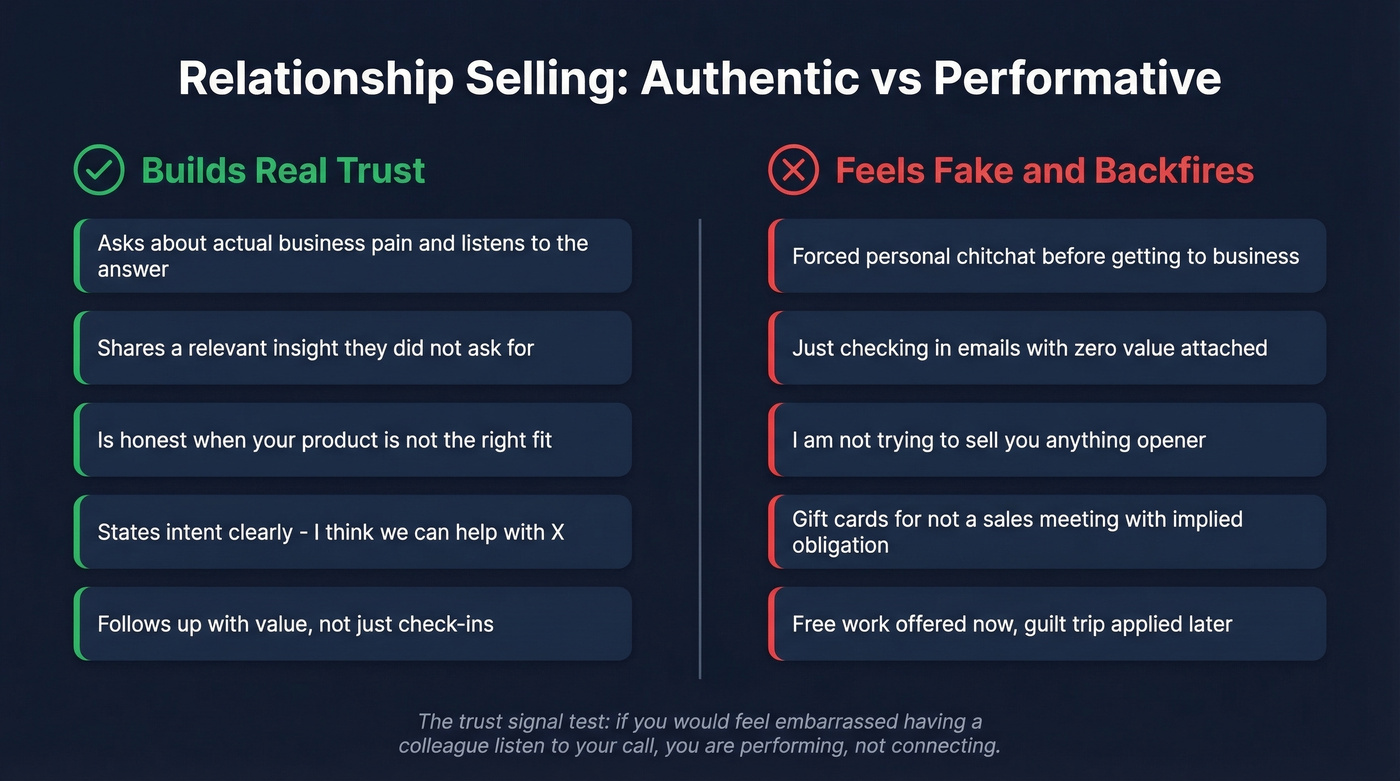
A thread on r/sales nails the problem. The OP describes getting gift cards for "not a sales meeting" and offers of "free work" with an obvious implied obligation to buy later. Their take? "Give me your sales pitch. Tell me what problems you fix." They had more success with a Sandler-style direct approach than with the soft-chat motion.
The issue isn't the methodology. It's the performative version - where sellers pretend they're not selling, create fake friendship, and then act surprised when buyers ghost them. Buyers aren't stupid. They know you want their business. Pretending otherwise insults their intelligence.
Here's a useful trust-signal test: if you'd feel embarrassed having a colleague listen to your call, you're performing instead of connecting. Green flags include asking about actual business pain, sharing a relevant insight they didn't ask for, and being honest when your product isn't the right fit. Red flags? Forced personal chitchat, "just checking in" emails with no value, and the classic "I'm not trying to sell you anything" opener.
The fix is straightforward. Be direct about your intent while being genuinely curious about their situation. "I think we can help with [specific problem] - can I show you how?" That's not pushy. That's respectful.
Techniques That Actually Work
1. Maintain the 43/57 talk-to-listen ratio. Record your calls and measure. If you're above 60% talk time, you're monologuing. The 326K-call dataset makes this the single most actionable benchmark in sales.
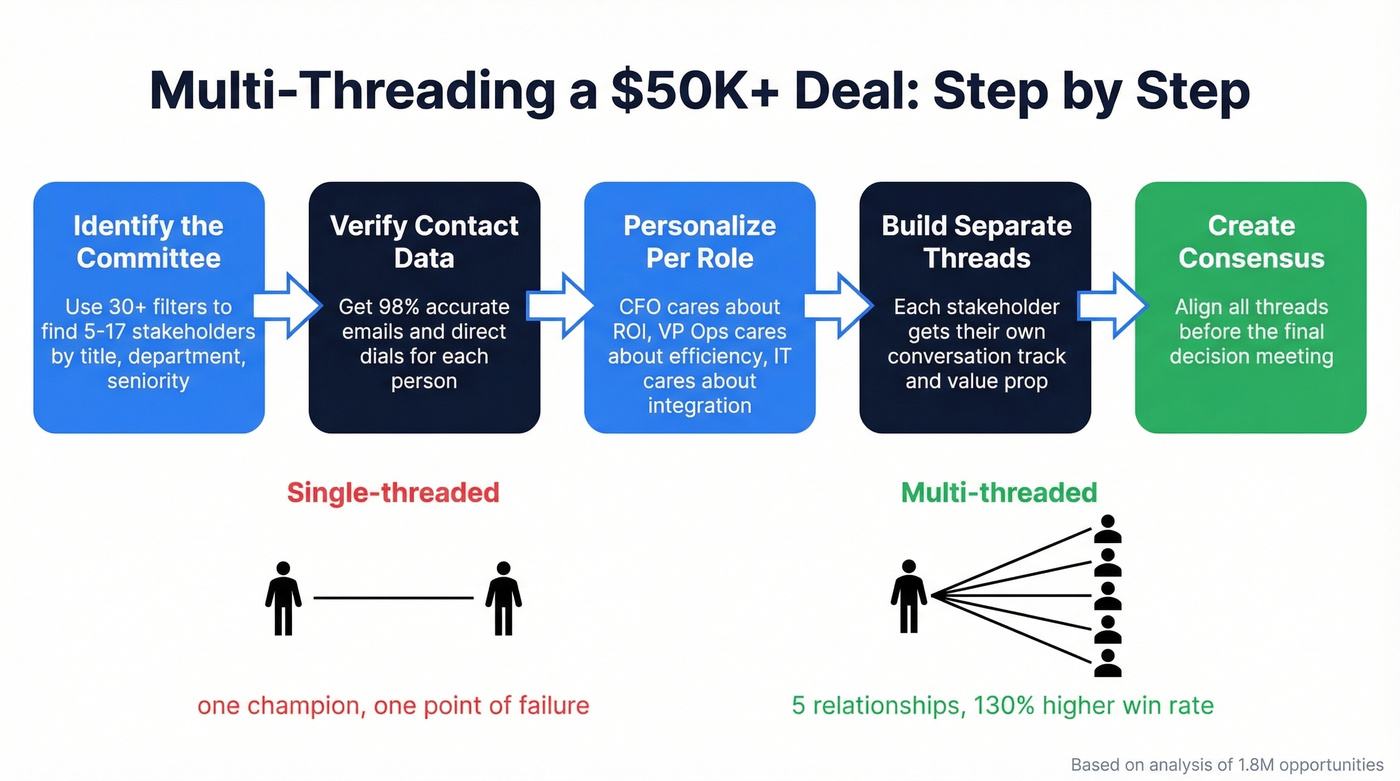
2. Multi-thread every deal over $50K. Map the buying committee early, build separate relationships with 3-5 stakeholders, and create consensus before the final decision.
3. Send one non-business personal touch per quarter to your top 20 accounts. A sales leader on r/sales had reps learn personal details about dormant high-spend accounts - kids, pets, sports teams. They discovered many customers had dogs and sent handwritten cards with dog bones. No business mention. Those accounts reactivated and started spending hundreds of thousands of dollars. That's the kind of story that sounds too simple to work, but the numbers backed it up.
4. Qualify before investing. Accounts with deal sizes over $50K, 3+ stakeholders, and long sales cycles get the full relationship motion. Smaller, transactional deals get a direct pitch. Both sides benefit.
5. Ask fewer, better questions. The data shows 15-16 questions on won calls vs. ~20 on lost calls. Prepare 5-6 high-quality discovery questions instead of running through a 20-item checklist.
6. Build trust through competence, not rapport alone. Modern B2B is 70% science, 30% art. Quantify the value you deliver - make money, cut costs, reduce risk. Rapport opens the door, but a strong ROI story closes it.
Common Mistakes
Talking more than 65% of the call. You've crossed from conversation into lecture. The data says you're losing deals.
Single-threading enterprise deals. One champion leaves, gets promoted, or loses internal influence - and your deal dies with them.
Applying the relationship motion to every prospect. Low-intent, small-deal prospects don't want a relationship. They want a quick answer and a fair price. Skip this if your average deal is under $15K and your cycle is under 30 days.
Confusing friendship with professional trust. Your buyer doesn't need a new friend. They need someone who understands their business and can help them look good internally.
Sending personalized outreach to bad data. Look, we've all been there - you craft the perfect personal email, hit send, and it bounces. Now your domain reputation takes a hit and the relationship never starts. Verify contacts before you send. Prospeo checks emails in real time with 98% accuracy so your first impression actually reaches the inbox.
Here's a hot take: if your average contract value is under $15K, you probably don't need a full relationship motion at all. A tight value prop, a clean demo, and a fast close will outperform months of rapport-building on deals that small. Save the high-touch approach for accounts where the lifetime value justifies the time investment.
Tools That Enable the Motion
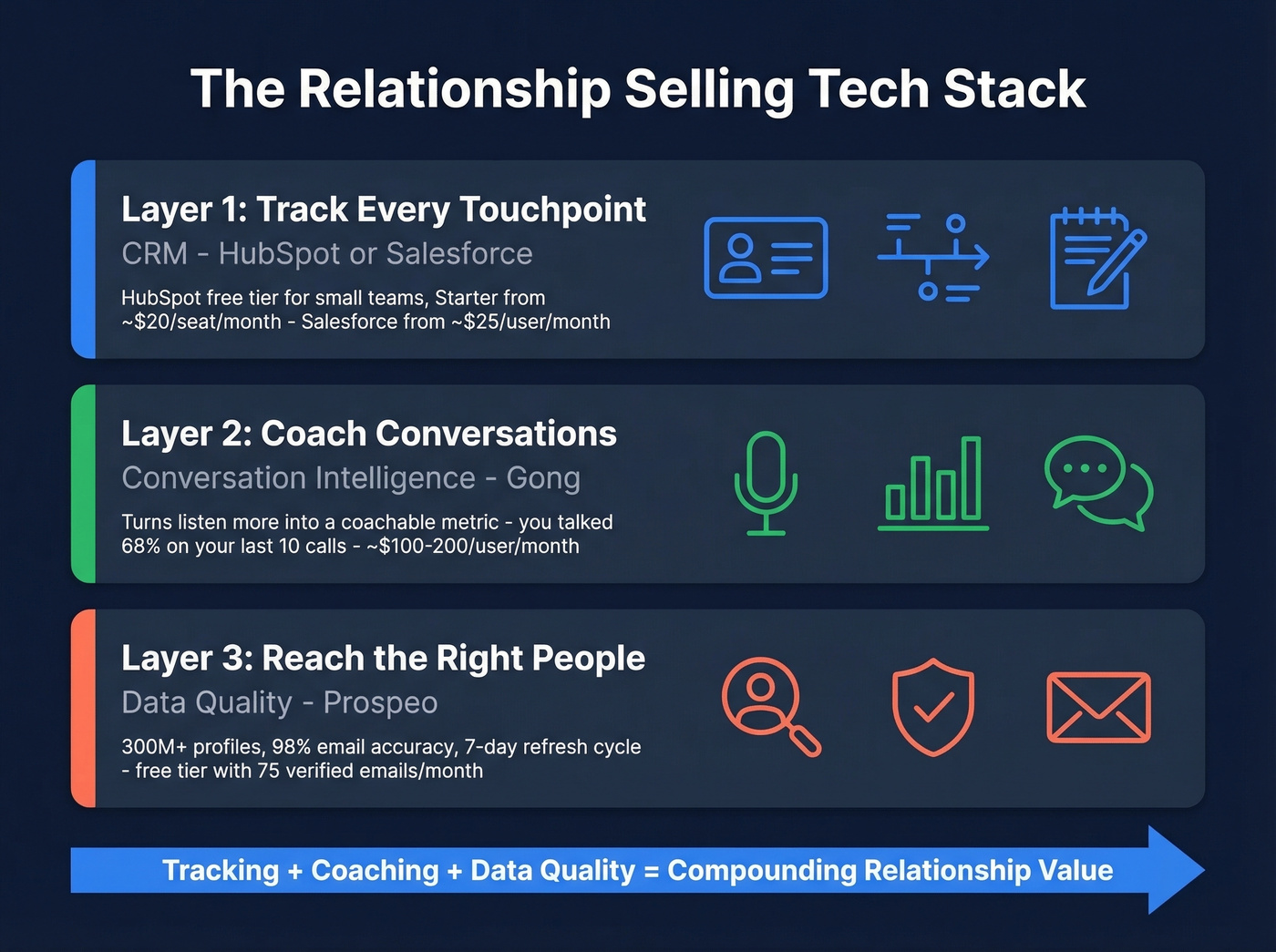
Relationship selling runs on three layers: tracking interactions, coaching conversations, and reaching the right people. Not every team needs all three, but the combination is where the real compounding happens.
CRM: HubSpot or Salesforce
HubSpot's free CRM handles basic contact tracking for small teams; Sales Hub Starter begins around $20/seat/month, typically billed annually. Salesforce entry plans start around $25/user/month and scale up to enterprise editions. Either works - the key is that every touchpoint gets logged so you aren't relying on memory when you've got 50+ active relationships.
Conversation Intelligence: Gong
Call recording and analysis typically runs ~$100-200/user/month, often sold annually. It turns "listen more" from vague advice into "you talked 68% on your last 10 calls" as a coachable, measurable fact. We've seen teams cut their talk ratio by 10+ points within a quarter just by making the number visible.
Data Quality: Prospeo
When multi-threading requires reaching 5+ stakeholders per account, having verified direct dials and accurate emails means you're building real connections instead of chasing bounces. The B2B database covers 300M+ professional profiles with a 7-day refresh cycle, and the free tier gives you 75 verified emails per month to test the workflow before committing.

Relationship selling runs on personalization, not volume. Prospeo's 50+ data points per contact - including job changes, company growth signals, and intent data across 15,000 topics - give you the context to make every touch relevant.
Turn data into the personal touches that reactivate six-figure accounts.
How to Measure It
Track these metrics to know whether your relationship selling motion is actually working:
- Talk/listen ratio per call - target 43/57 or better
- Stakeholder contacts per deal - aim for 3+ on deals over $50K
- Reply rate on personalized outreach - 15%+ means your targeting and messaging are landing
- Account expansion revenue - relationship-led accounts should expand faster than others
- Referral pipeline percentage - healthy relational selling generates inbound referrals over time
- Email bounce rate on outreach - above 5% means your data is undermining the whole motion (see email bounce rate)
If those metrics trend up over a quarter, your motion is compounding. If they're flat, something in the execution is off - usually it's data quality or single-threading.
FAQ
Is relationship selling dead in 2026?
No. Mass automation backlash is pushing sellers back toward high-touch, personalized outreach. But the "steak dinner" version is dead. Modern relationship selling is data-informed, multi-threaded, and backed by conversation intelligence.
How does it compare to consultative selling?
Relationship selling builds trust through rapport; consultative selling builds trust through expertise and diagnosis. The best sellers blend both - rapport opens doors, a strong business case closes deals. Neither works in isolation for complex B2B cycles.
Which accounts are worth the relationship investment?
Focus on accounts with deal sizes over $50K, 3+ stakeholders, and sales cycles longer than 60 days. For smaller, transactional deals under $15K, a direct pitch is more efficient for both buyer and seller.
What's the single highest-leverage technique?
Multi-threading. Deals over $50K see 130% higher win rates when sellers engage multiple stakeholders. Map the buying committee early, build separate connections with 3-5 contacts, and create internal consensus before the final decision.
How do I measure whether it's working?
Track talk/listen ratio (target 43/57), stakeholder contacts per deal (3+ for enterprise), reply rates on personalized outreach (15%+), and account expansion revenue. If those metrics trend up over a quarter, your motion is compounding.