

How to Build a Remote Sales Process That Actually Works
Your new SDR started Monday. By Wednesday, she'd sent 200 cold emails from a list she cobbled together herself - no ICP definition, no stage gates, no clue when to hand a lead to an AE. That's not an outlier. 86% of sales teams have no documented remote sales process at all, and the results show: up to 70% of B2B reps missed quota in 2024. Remote selling didn't create this mess, but without a structured process for distributed teams, there's nowhere to hide.
What Actually Changes When Sales Goes Remote
Remote sales isn't "inside sales from your couch." It means the majority of sales conversations happen when buyers and sellers aren't in the same room, and that shift demands a tighter process, not a looser one.
80% of B2B interactions now run through digital channels. 92% of buyers and 79% of sellers prefer virtual interactions. This isn't a trend - it's the default. Here's the counterintuitive part: remote workers log 5 hours 12 minutes of productive time daily versus 5 hours 17 minutes in-office. Five minutes. Process, not proximity, determines output.
| Dimension | In-Person | Remote |
|---|---|---|
| Scalability | Limited by travel | Near-unlimited |
| Cycle length | Longer (scheduling) | Shorter if managed well |
| Overhead | High (travel, events) | Low |
| Primary channels | Meetings, dinners | Video, email, phone |
| Trust-building | Handshake, presence | Content, consistency |
The 5-Stage Framework
We've watched this framework work across dozens of remote teams. Each stage has clear activities, exit criteria, and KPIs - because without those, you don't have a process. You have a suggestion.
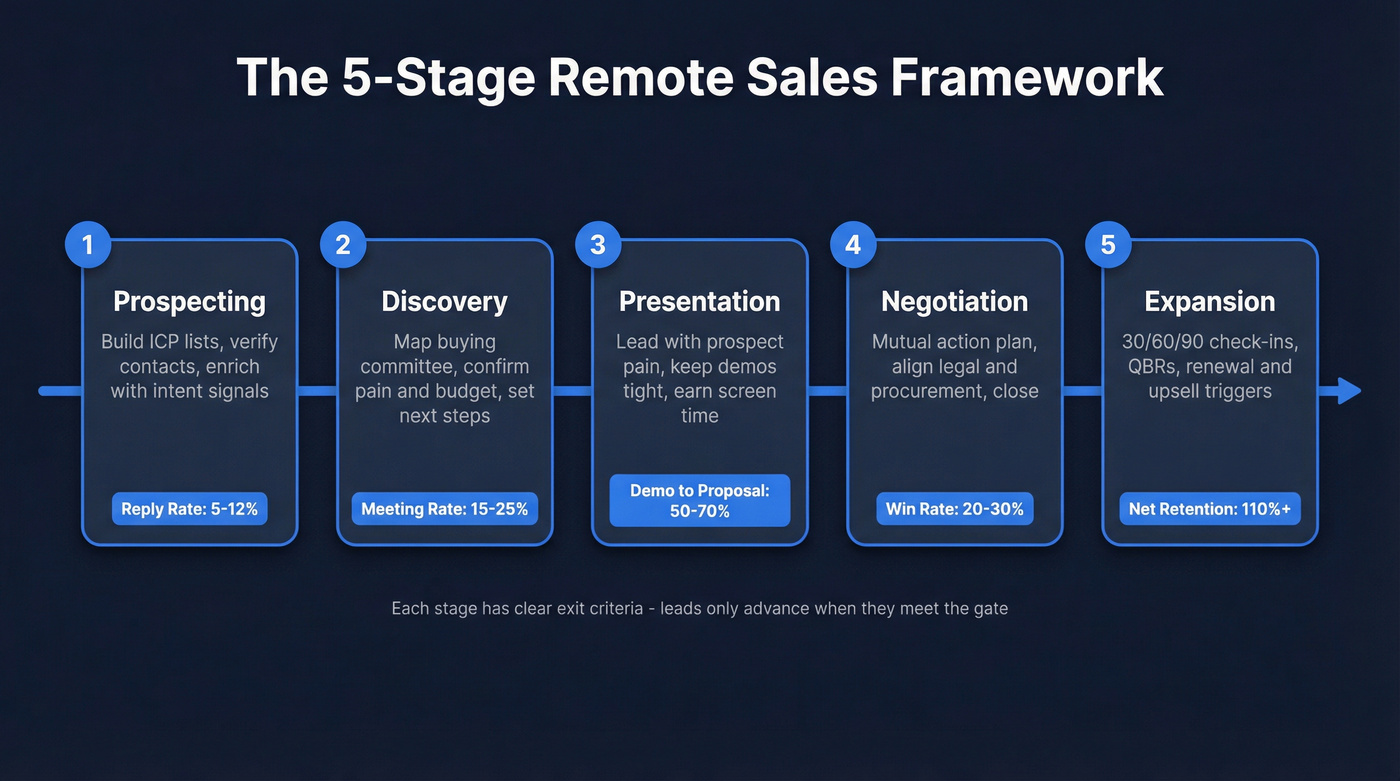
Stage 1: Prospecting and Lead Identification
Everything downstream depends on data quality. You ran 200 cold emails last week and 70 bounced. That's not a messaging problem.
It's a data problem. Snyk's 50 AEs cut bounce rates from 35-40% to under 5% after switching to Prospeo, generating 200+ new opportunities per month on 98% verified email data. When your foundation is rotten, no amount of clever copy saves you.

Activities: Build ICP-matched lists, verify contact data, enrich with intent signals, load into sequencer.
Exit criteria: Lead matches ICP, has verified contact info, shows a buying signal or fits the target account list.
KPI: Reply rate, targeting 5-12% on cold outbound.
Stage 2: Discovery and Needs Diagnosis
Ask any sales leader managing a remote team and they'll tell you: this is where most reps lose deals they don't even know they had. 87% of B2B purchases involve 4+ stakeholders, so if you're only talking to one person, you're building on sand. Multi-thread early.
Run a structured discovery call, 15-30 minutes max. Map the buying committee before the second meeting. Confirm pain, budget authority, and a next step with a date attached - not a vague "let's circle back next week." Target 40-60% discovery-to-demo conversion.
Stage 3: Value-Based Presentation
Here's the thing: 67% of attendees are distracted during virtual meetings, and 55% are checking email while you present. Buyers spend only 17% of their total purchase time with all vendors combined. Every minute of screen time is earned, not given.
Top performers keep decks tight and lead with the prospect's problem, not their feature list. If your demo is 45 minutes of product tour with 5 minutes of Q&A, flip that ratio.
Exit criteria: Champion confirms fit, introduces economic buyer, requests proposal.
KPI: Demo-to-proposal rate, targeting 50-70%.
Stage 4: Negotiation and Close
43% of sales leaders report longer cycles over the past year. Remote deals stall because there's no physical momentum - no "let's walk down the hall to legal right now" energy. You create urgency through mutual action plans, not pressure tactics.
Your close checklist:
- Proposal sent with clear pricing and timeline
- Mutual close plan shared with deadlines for both sides
- Legal and procurement aligned before the "final call"
- Signed contract, payment terms confirmed
Target 20-30% win rate on qualified pipeline.
Stage 5: Post-Sale and Expansion
The deal isn't done at signature. Remote teams that skip structured onboarding and QBRs leave expansion revenue on the table. Build renewal and upsell triggers into your CRM from day one, run 30/60/90-day check-ins, and schedule quarterly business reviews. Target 110%+ net revenue retention.
KPIs That Keep Remote Teams Honest
Organizations using sales automation see a 14.5% productivity increase and 23% higher win rates. But automation without measurement is just faster chaos.
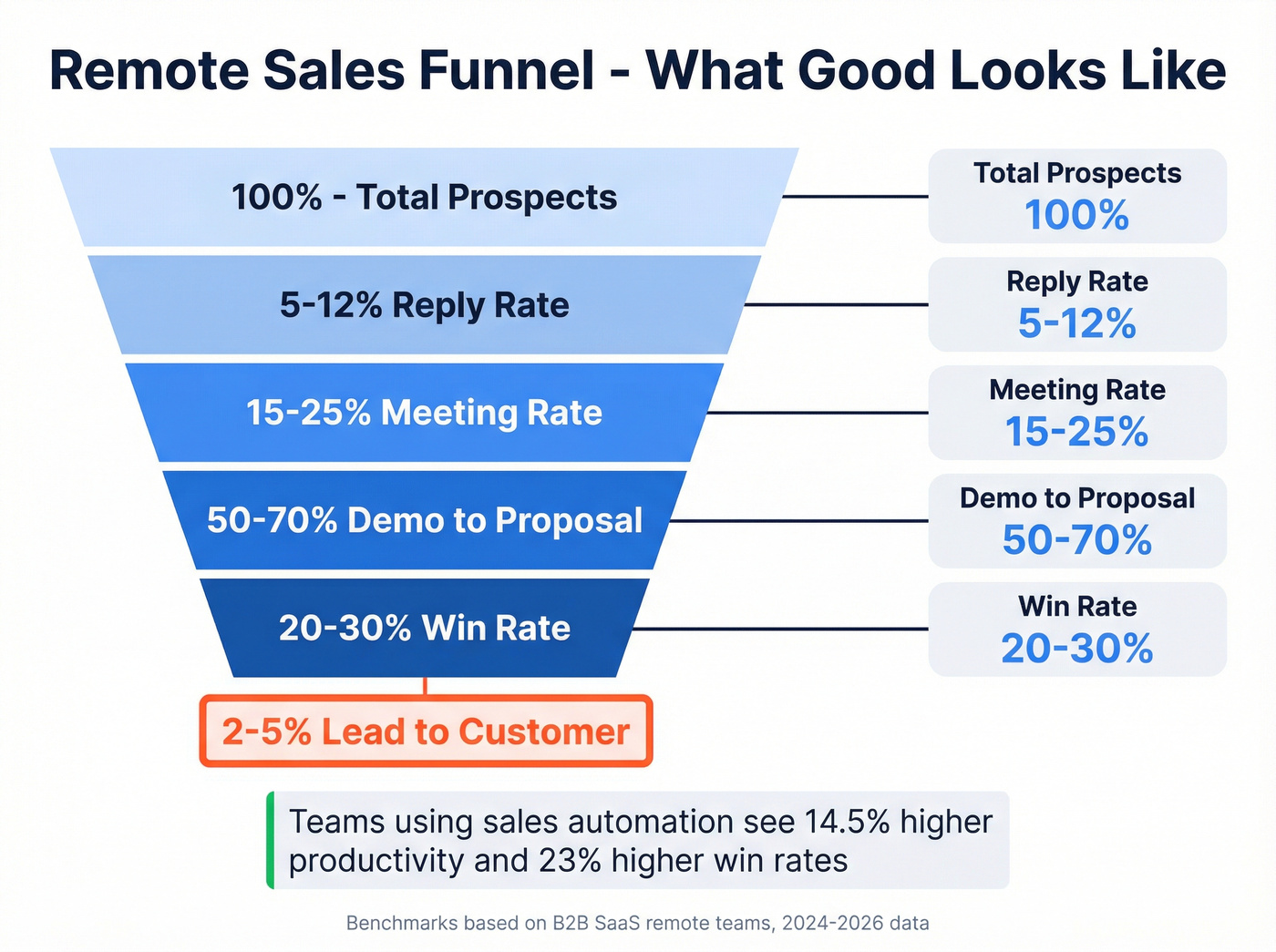
| Stage | Key Metric | Benchmark |
|---|---|---|
| Prospecting | Dials/day, reply rate | 50 dials/day, 5-12% reply |
| Discovery | Meeting rate | 15-25% of replies |
| Presentation | Demo-to-proposal | 50-70% |
| Negotiation | Win rate | 20-30% |
| Post-Sale | Net retention | 110%+ |
| Full funnel | Lead-to-customer | 2-5% |

Stage 1 of your remote sales process lives or dies on data quality. Prospeo delivers 98% verified emails on a 7-day refresh cycle - so your SDRs stop wasting cycles on bounced emails and start filling pipeline. Snyk's 50 AEs cut bounce rates from 35-40% to under 5% and generated 200+ opportunities per month.
Stop losing deals at the top of the funnel because your data is stale.
Tech Stack for Digital-First Selling
You don't need 15 tools. You need 4-5 that talk to each other. We audit our own stack twice a year and kill anything the team isn't actually using.
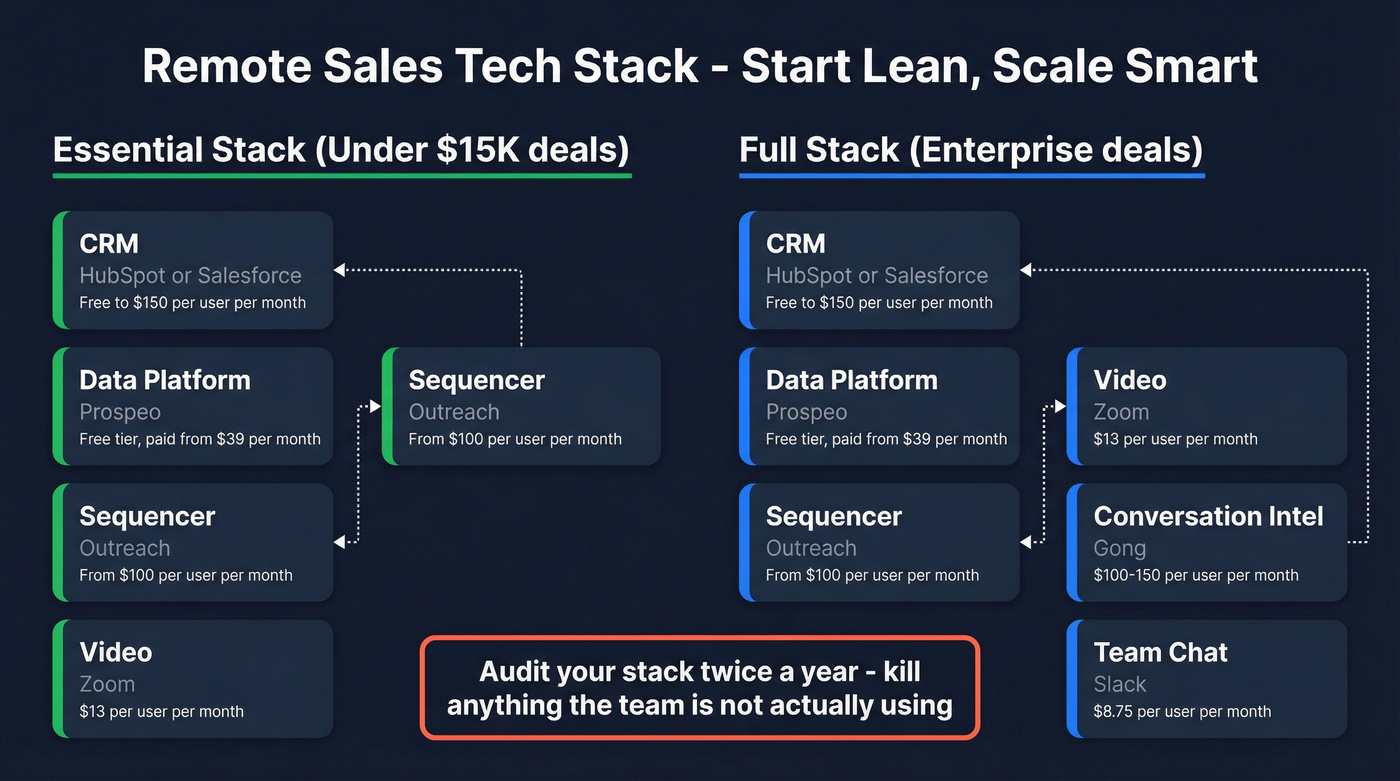
If your average deal size is under $15K, skip Gong, the deal room, and the intent data layer for now. Start with a CRM, a data provider, a sequencer, and Zoom. Prove ROI before you stack.
| Stage | Category | Example | Approx. Cost |
|---|---|---|---|
| Prospecting | Data platform | Prospeo | Free tier; paid from ~$39/mo |
| Prospecting | Sequencer | Outreach | From ~$100/user/mo |
| All stages | CRM | HubSpot / Salesforce | Free-$150/user/mo |
| Presentation | Video | Zoom | ~$13/user/mo |
| Coaching | Conversation intel | Gong | ~$100-150/user/mo |
| Collaboration | Team chat | Slack | ~$8.75/user/mo |
Mistakes That Kill Remote Deals
Monologuing on calls. If your talk ratio is above 60%, you're pitching, not selling. Record calls and review the split weekly.
Unprofessional video setup. Bad lighting, camera at nostril-level. It signals you don't take the meeting seriously. A $30 ring light and a stack of books under your laptop fix this in five minutes.
No follow-up cadence. One email after a demo isn't follow-up - it's a prayer. Build a 5-7 touch sequence across channels. 67% of people are distracted during your demo, so if you don't follow up with structure, you've already lost them.
Skipping CRM updates. Your CRM should be a GPS, not a rear-view mirror. If reps only update it for pipeline reviews, your forecast is fiction. We've seen teams where the CRM data was so stale that leadership was making hiring decisions based on pipeline numbers that were 40% air.
Manager Operating Cadence
Remote teams don't manage themselves. Let's be honest - most managers default to either micromanaging Slack activity or going completely hands-off. Neither works. By 2026, 65% of B2B sales organizations using data-driven strategies will outpace those running on gut instinct. Here's the rhythm we've seen work for teams of 5 to 50:
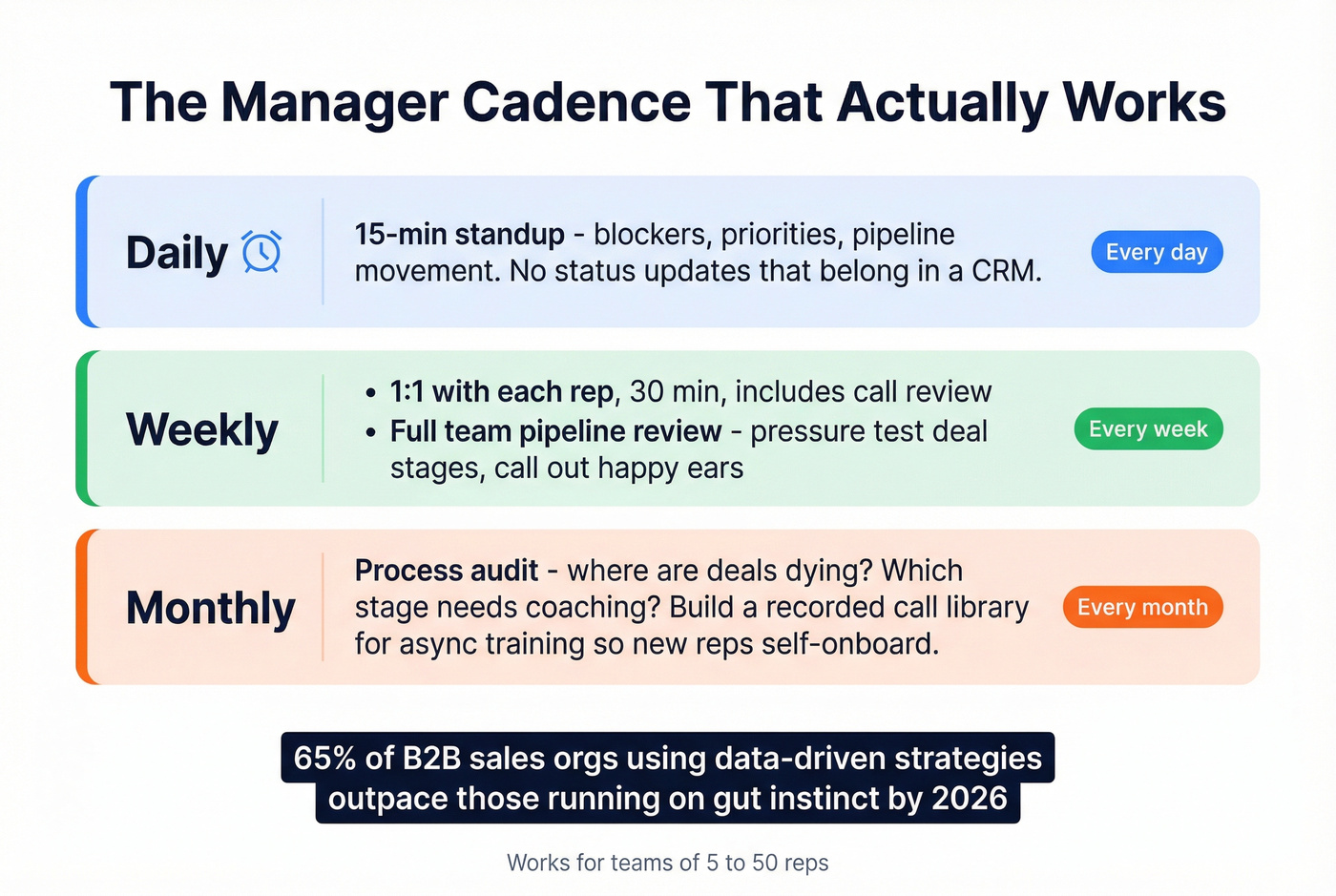
Daily: 15-minute standup covering blockers, priorities, and pipeline movement. No status updates that belong in a CRM.
Weekly: 1:1 with each rep for 30 minutes, including call review. Separate pipeline review with the full team - this is where you pressure-test deal stages and call out happy ears.
Monthly: Process audit. Where are deals dying? Which stage needs coaching? Use activity dashboards, not gut feel. Build a library of recorded calls for async training so new reps can self-onboard without shadowing someone for three weeks.
FAQ
What's the difference between remote sales and inside sales?
Inside sales is a role type - always phone-and-digital. Remote sales is broader: traditionally field-based roles now operating primarily through digital channels. The distinction matters for process design because remote selling needs its own playbook for discovery, demos, and closing that accounts for the lack of in-person cues.
How long does a remote B2B sales cycle take?
SMB deals typically close in 1-3 months, while enterprise deals often exceed 12 months. Multi-thread early and run mutual action plans to prevent stalling - remote cycles drag when only one stakeholder is engaged and everyone else is a ghost until the eleventh hour.
What tools do you need for a remote sales process?
Start with five: a CRM, a data provider with verified contacts, a sequencer, a video platform, and team chat. Prove ROI with those before adding conversation intelligence or intent layers. Skip the tool that "everyone on r/sales recommends" unless it solves a specific bottleneck you can name.
You don't need 15 tools to run a remote sales process - you need one data platform that actually works. Prospeo gives you 300M+ profiles, 30+ ICP filters, intent data across 15,000 topics, and native integrations with HubSpot, Salesforce, Instantly, and Lemlist. All starting at $0.01 per email with no contracts.
Replace your broken data stack with one platform your remote team will actually use.