

Revenue Enablement: What It Actually Is, Why It Fails, and How to Build It
Every vendor guide on this topic follows the same playbook: define revenue enablement, list five benefits, funnel you toward a demo. None tell you that 85% of enablement teams are over-scoped, there's a 45-point gap between what teams promise on analytics and what they deliver, or that only 20% of organizations describe their approach as truly unified. This guide is different.
What You Need (Quick Version)
Revenue enablement is a change management discipline, not a content library. Three things matter most:
- CSO sponsorship is non-negotiable. If your CSO isn't sponsoring the initiative, don't bother pursuing it. Without executive air cover, enablement becomes a "nice to have" that gets cut in the next budget cycle.
- Train your managers before your reps. Only 32% of organizations provided sales manager training last year. Managers are the force multiplier - skip them and your reps get training that never sticks.
- Fix your data before buying a platform. A $100K enablement platform can't help when your outbound bounce rate is 10%+. Data quality is the foundation layer most teams ignore.
What Is Revenue Enablement?
Revenue enablement equips revenue-generating and customer-facing teams - sales, customer success, marketing, partners, presales - with the skills, training, content, and coaching they need to deliver a consistent buyer experience. Gartner's definition for Revenue Enablement Platforms spans all of these functions, not just the sales floor.
The most common misconception is that this discipline means "a content library with some training modules." Content is one input. The actual work is behavior change - getting 200 reps to adopt a new methodology, getting CS teams to run expansion plays consistently, getting marketing and sales aligned on pipeline gaps. A natural extension of this thinking is buyer enablement: creating content that helps buyers make purchasing decisions internally, not just content that helps sellers pitch.
If your enablement function only touches the sales team, you're doing sales enablement. The cross-functional evolution is what distinguishes a true revenue-wide approach, and the distinction matters for how you staff, measure, and fund it.
Revenue Enablement vs. Sales Enablement vs. RevOps
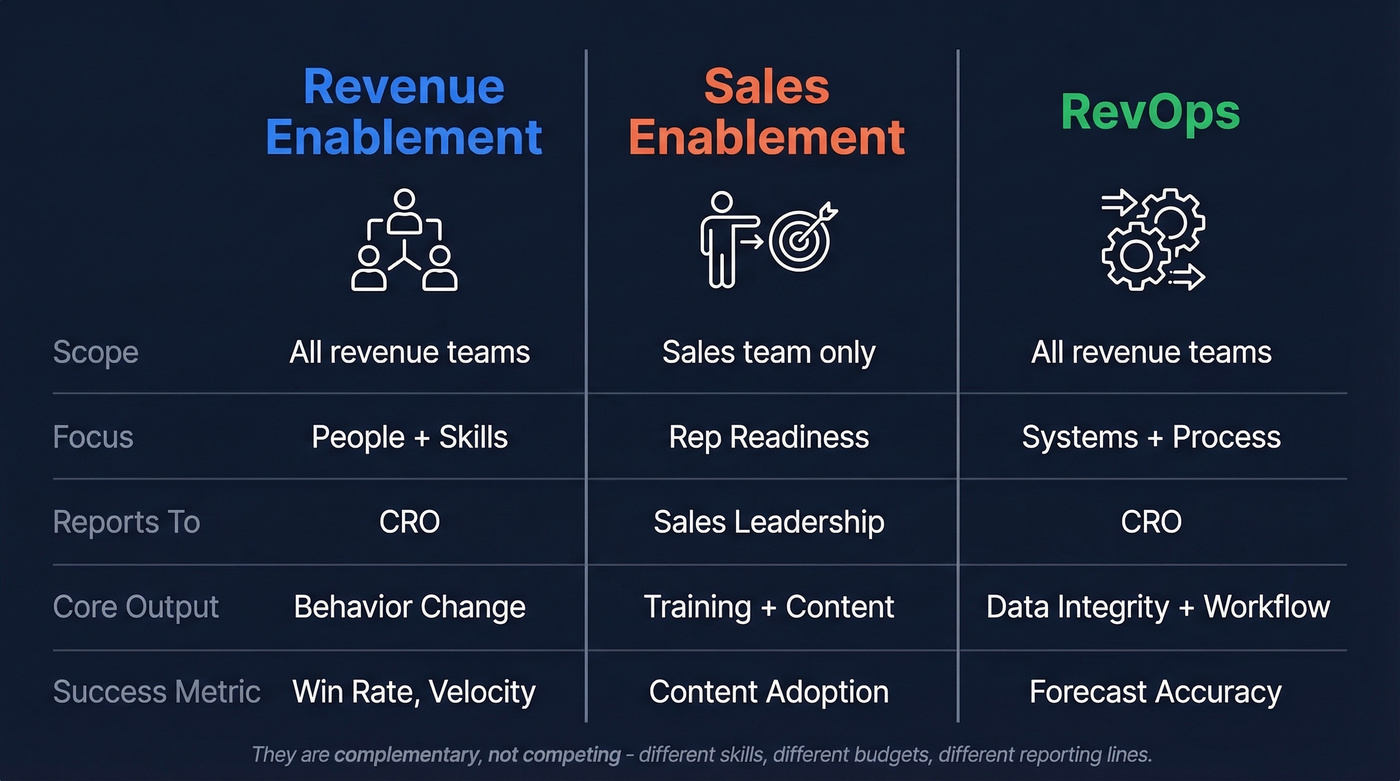
These three functions get conflated constantly. Here's how they break apart:
| Revenue Enablement | Sales Enablement | RevOps | |
|---|---|---|---|
| Scope | All revenue teams | Sales team only | All revenue teams |
| Focus | People + skills | Rep readiness | Systems + process |
| Reports to | CRO | Sales leadership | CRO |
| Core output | Behavior change | Training + content | Data integrity + workflow |
| Success metric | Win rate, velocity | Content adoption | Forecast accuracy |
RevOps focuses on tools and process. Enablement focuses on people. They're complementary, not competing - but they require different skills, different reporting lines, and different budgets.
In practice, reporting lines are messy. Enablement most often reports into RevOps (39.4%), followed by Sales (25.4%), and the C-Suite (16.6%). Marketing owns it in just 5.2% of organizations, per compiled enablement data from the 2026 landscape. The trend is clear: enablement is migrating toward unified models that sit under a CRO.
RevOps builds the data infrastructure and process rails. Enablement ensures people actually use them. When these two functions don't talk, you get the classic failure mode: a beautifully configured CRM that reps ignore because nobody trained them on why it matters.
Why Enablement Programs Fail
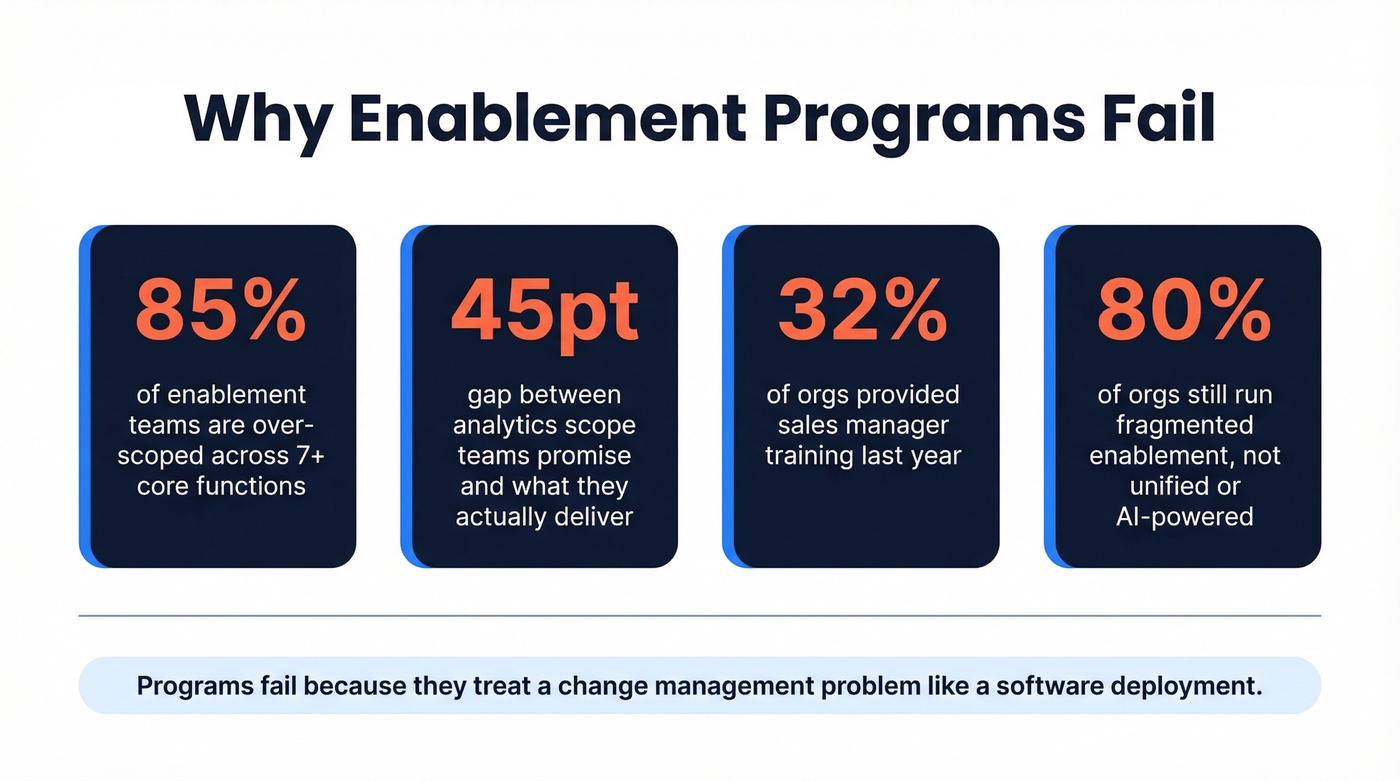
This is the section vendor blogs won't write. Programs don't fail because teams pick the wrong platform. They fail because they treat a change management problem like a software deployment.
The Proof Gap
"Ops talks in numbers. Enablement talks in vibes." That line from r/salestechniques captures the core tension perfectly. When enablement can't tie its work to revenue metrics, leadership treats it as overhead.
The change management framework from Forrester lays out three explicit phases - set the stage, put the plan in motion, make the new business as usual - with a metric maturity spectrum running from activity to feedback to adoption to impact. Most teams are stuck at level one, measuring whether reps attended a training, not whether win rates moved. The gap between "we ran a workshop" and "pipeline velocity increased 12%" is where credibility lives.
The Manager Gap
Only 32% of organizations provided sales manager training last year. That's staggering.
Managers are the primary mechanism for reinforcing behavior change. You can build the best onboarding program in the world, but if frontline managers don't coach to it daily, reps revert to old habits within weeks. We've seen this pattern play out at companies of every size, and it's always the same story: great training, zero follow-through at the manager level, and then leadership blames the enablement team.
The Analytics Gap
85% of enablement teams manage seven core functions, including analytics. The problem? There's a 45-point gap between the analytics scope teams take on and their actual ability to deliver. Teams promise dashboards and revenue attribution. They deliver training completion rates and content download counts.
This isn't just a skills gap - it's a data quality gap. When your CRM is full of stale contacts and duplicate records, every metric downstream is suspect. A campaign that "reached 5,000 prospects" means nothing if 10%+ of those emails bounced.
The Mid-Funnel Stall
Almost half of go-to-market teams say deals most often stall in the middle of the funnel. This is a direct symptom of enablement gaps: reps know how to open and close, but the nurture and expansion motions in between get no structured support. Leadership wants innovation - new plays, new approaches - not polished versions of last year's decks. Only about 20% of organizations describe their approach as truly unified or AI-powered, which means the other 80% are stitching together fragmented efforts and hoping for the best.

This article calls out the truth: a $100K enablement platform can't save you when your outbound bounce rate is 10%+. Prospeo delivers 98% email accuracy with a 7-day data refresh cycle - not the 6-week industry average. Your enablement programs deserve a data foundation that actually holds up.
Stop enabling reps with stale data. Start with 98% accuracy at $0.01/email.
How to Build a Revenue Enablement Strategy
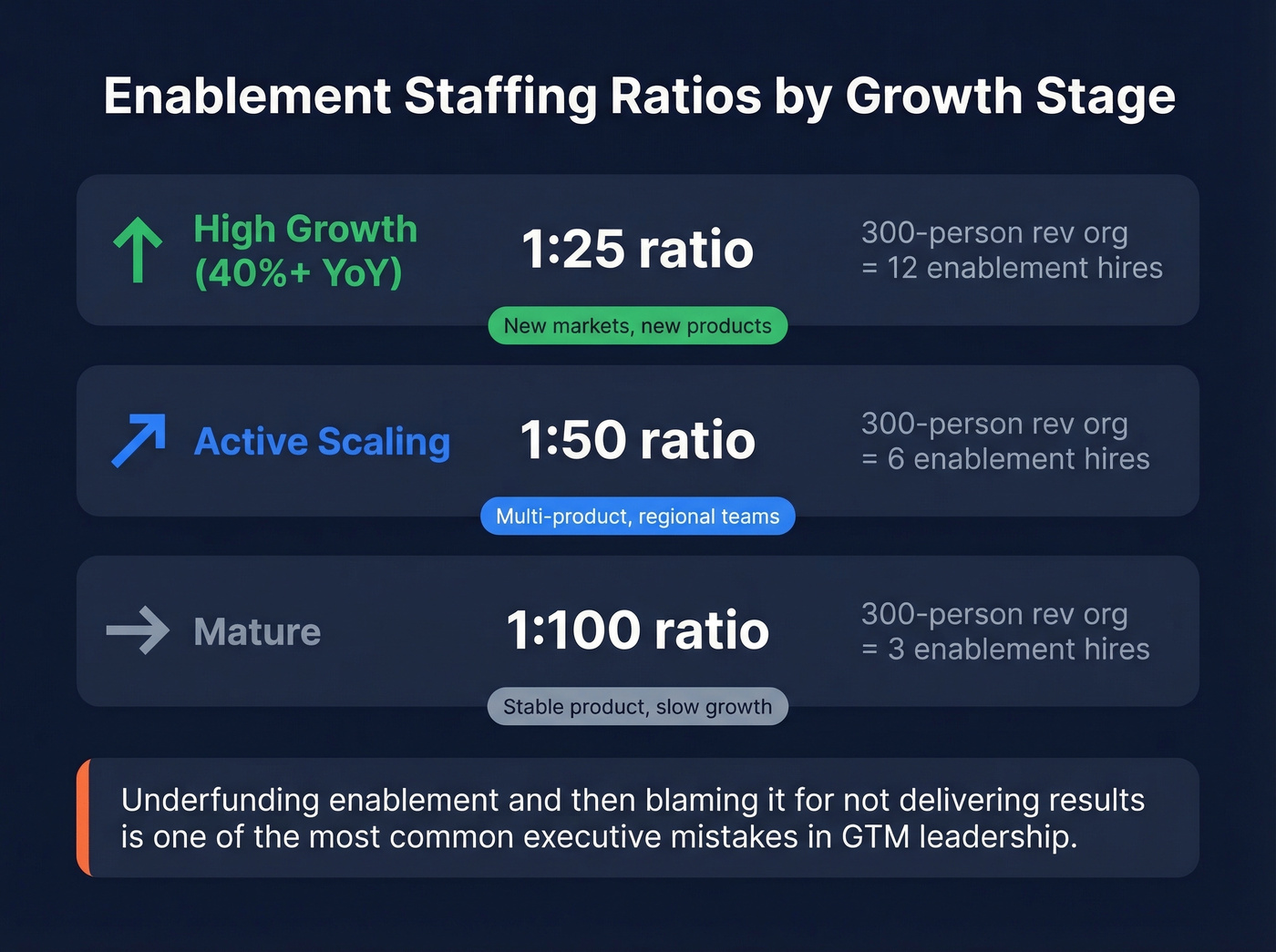
Staffing ratios matter more than org charts. Before you hire a single person, understand how your growth stage dictates team size:
| Growth Stage | Ratio | When to Use |
|---|---|---|
| High growth (>40% YoY) | 1:25 | New markets, new product |
| Active scaling | 1:50 | Multi-product, regional teams |
| Mature | 1:100 | Stable product, slow growth |
A 300-person revenue org in high-growth mode needs 12 enablement people at a 1:25 ratio, not 3. Underfunding enablement and then blaming it for not delivering results is one of the most common executive mistakes in go-to-market leadership.
For larger organizations, a pillar structure works well: a central enablement leader with dedicated pillars for onboarding, ongoing enablement by role, regional coaches, product enablement, competitive intelligence, and deal support. The key hire? An enablement leader with quota-carrying experience. Reps trust people who've carried a bag. Leaders who've only ever been in L&D face an uphill credibility battle.
Our take on reporting lines: report to the CRO. When enablement reports to Sales, it becomes sales training. When it reports to Marketing, it becomes content production. The CRO line forces cross-functional accountability across the entire customer lifecycle, which is the entire point.
The Enablement Tech Stack
What a Platform Actually Does
Gartner defines five core capabilities for Revenue Enablement Platforms: digital content management, learning, practice and coaching, engagement analytics, and AI/conversational intelligence. If a platform is missing two or more of those, it's a point solution, not a REP.
The distinction matters because point solutions create the exact tool overload that Reddit threads consistently flag as a top frustration. Nearly 60% of enablement leaders use multiple platforms, while automation maturity sits at just 5-6 out of 10. More tools haven't meant better enablement.
The Vendor Landscape in 2026
The enablement platform market is in chaos - and that's good for buyers. Seismic and Highspot announced a definitive merger in February 2026. Showpad completed its merger with Bigtincan in October 2025. Gong announced a major expansion into full enablement in early 2026. Here's where the major platforms stand on Gartner Peer Insights:
| Platform | Rating | Reviews |
|---|---|---|
| Seismic | 4.7 | 303 |
| Showpad | 4.7 | 286 |
| Highspot | 4.7 | 164 |
| Mindtickle | 4.5 | 139 |
| Allego | 4.7 | 83 |
Enterprise REPs typically run $20K-$150K+/year depending on team size and modules. Almost none publish pricing. Negotiate hard - consolidation means vendors are fighting for share.
The Foundation Layer Most Guides Skip
Here's the thing: most teams should spend $500 on data quality before spending $100K on a platform. If your CRM is full of stale contacts and your outbound bounce rate sits above 10%, no enablement platform will save you. Reps lose trust in the data, stop logging activities, and your analytics layer produces garbage metrics.
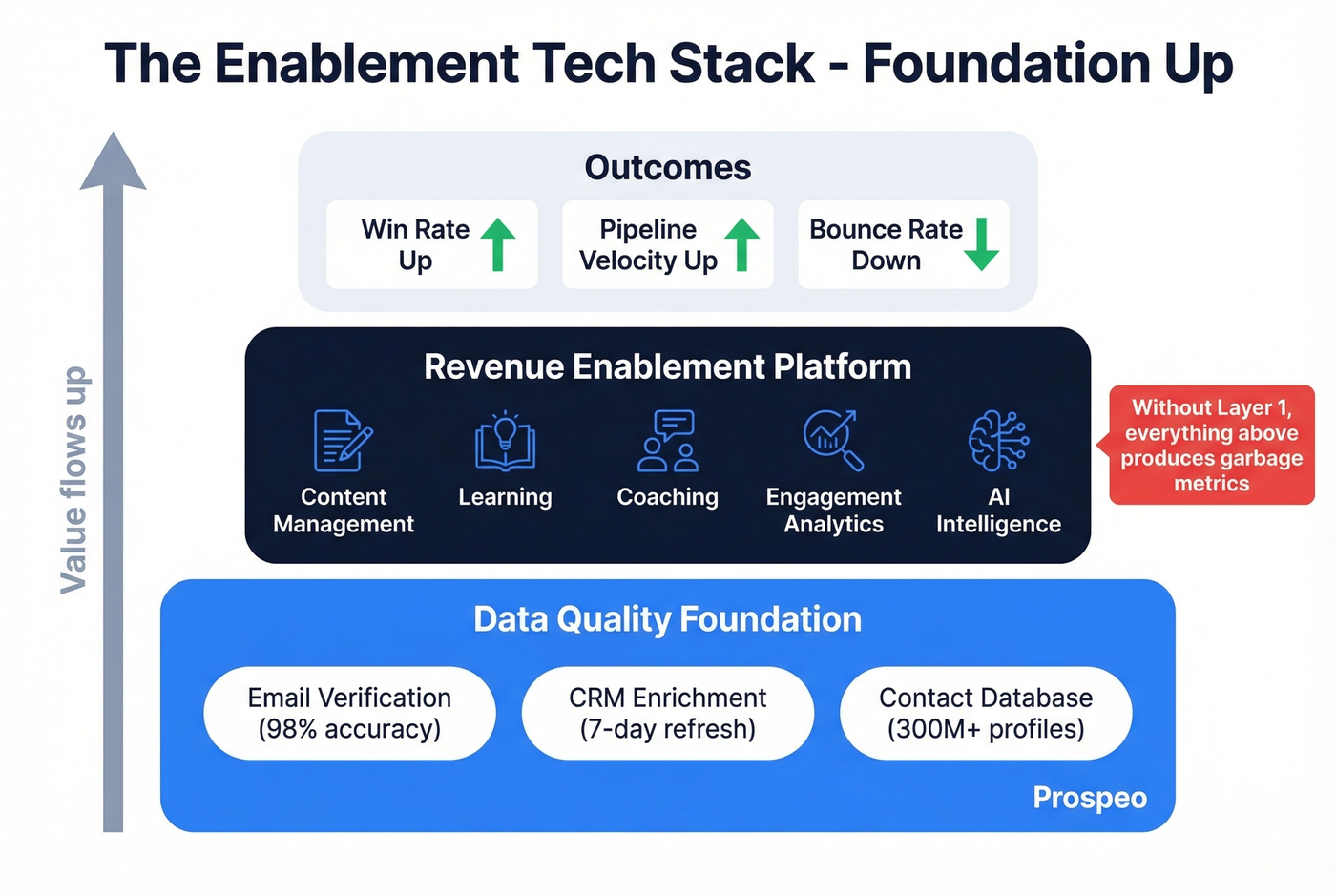
Prospeo solves this foundation layer. With 300M+ professional profiles, 98% email accuracy, and a 7-day data refresh cycle versus the six-week industry average, it keeps your CRM clean and your outbound deliverable. Native integrations with Salesforce and HubSpot mean enrichment runs automatically, and credit-based pricing starts at roughly $0.01 per email with a free tier - no contracts, no sales calls required.

The proof point worth highlighting: Snyk had 50 AEs prospecting 4-6 hours per week with a 35-40% bounce rate. After switching, bounces dropped under 5%, AE-sourced pipeline jumped 180%, and the team generated 200+ new opportunities per month. That's what clean data does for enablement outcomes.
AI in Revenue Enablement
AI adoption in enablement hit a tipping point. An Allego survey of 346 B2B revenue enablement leaders found that 100% now use GenAI - up from 62% in 2024. Universal adoption in under two years.
The outcomes are real: 47% report AI has already boosted revenue, 51% cite shorter sales cycles and faster onboarding, and 81% use AI to create content like presentations and emails. Coaching quality improved for 63% of teams, and 83% now say AI skills are essential in new hires. Vendors like Highspot and Gong are pushing "agentic AI" - autonomous agents that handle coaching follow-ups and content recommendations without human prompting. Let's be honest: the jury is still out on whether these deliver real lift or just better demos, but the direction is clear.
AAA Life Insurance deployed AI dialog simulators for scalable coaching. Their compliance team can now measure skill transfer, not just test scores - exactly the kind of impact-level measurement that separates real enablement from training theater. If you're still running enablement without AI-assisted coaching, you're already behind.
Measuring Enablement Impact
Most enablement teams measure the wrong things. Here's what teams actually track, ranked by adoption:
| Metric | % of Teams Using |
|---|---|
| Content adoption | 50.0% |
| Quota attainment | 43.1% |
| Win rate | 42.2% |
| Revenue generated | 37.9% |
| Sales cycle length | 33.6% |
| Employee NPS | 30.1% |
| Sales velocity | 27.5% |
| Pipeline growth | 23.2% |
Notice the problem? The most popular metric - content adoption - is a level-one activity metric. It tells you whether reps opened a document, not whether it helped them close a deal. The metrics that actually matter sit at the bottom of the list.
The metric maturity ladder provides the right framework: activity (did they attend?), feedback (did they find it useful?), adoption (did behavior change?), impact (did business outcomes improve?). Most teams are stuck at level one. Getting to level four requires clean data, consistent measurement, and the patience to track lagging indicators over quarters, not weeks. Productivity is the top priority for 2026 - freeing reps from admin so they can sell - and that's only measurable if your underlying data is trustworthy.
Building the Business Case
A Forrester TEI study commissioned by Salesloft found 236% ROI and $26.69M in net present value for a composite organization with $7B in revenue and a 1,500-person revenue org. Impact showed up within six months.
Those numbers are for a $7B company. For most organizations, the business case is simpler: enablement reduces ramp time, improves win rates, and increases quota attainment. Even modest improvements - two weeks off ramp time, three points on win rate - compound across a revenue team.
You don't need a platform to start. A shared CRM, Google Drive, a weekly cross-functional standup, and clean prospect data will get you further than a $100K platform with no executive sponsorship. Start with alignment, coaching, and data quality. Scale with technology.
If you're building onboarding from scratch, a simple 30-60-90 day plan for reps and managers will outperform most "enablement launches."
The analytics gap kills enablement credibility. When your CRM is full of duplicates and dead contacts, every downstream metric is suspect. Prospeo's CRM enrichment returns 50+ data points per contact at a 92% match rate - so your enablement dashboards finally reflect reality, not noise.
Enrich your CRM and close the analytics gap that's undermining your team.
FAQ
What is revenue enablement and how does it differ from sales enablement?
Revenue enablement spans all revenue-generating teams - sales, CS, marketing, partners - and typically reports to the CRO. Sales enablement focuses specifically on sales rep readiness and usually reports to sales leadership. The cross-functional scope is the key distinction for staffing, measurement, and budget.
How many people should be on an enablement team?
Use a 1:100 ratio for mature organizations, 1:50 for multi-product companies actively scaling, or 1:25 for high-growth companies entering new markets. A 300-person revenue org in growth mode needs 6-12 dedicated enablement people, not 3.
What metrics should enablement teams track?
Content adoption (50% of teams) and quota attainment (43.1%) are most common, but aim for impact-level metrics: revenue generated, sales velocity, and pipeline growth. Move beyond "did they attend?" to "did business outcomes improve?" That requires clean CRM data and quarter-over-quarter patience.
How much does an enablement platform cost?
Enterprise platforms like Seismic, Highspot, Mindtickle, and Gong typically run $20K-$150K/year depending on team size and modules. For the data quality foundation, Prospeo starts free with credit-based pricing at ~$0.01/email - often a smarter first investment than a six-figure platform.
Is revenue enablement the same as RevOps?
No. Enablement focuses on people - skills, training, coaching, and behavior change. RevOps focuses on systems - data integrity, process standardization, and tech stack management. They're complementary functions that both typically report to the CRO but require different skills and budgets.