

Revenue Ops Services: What You're Actually Buying (and What It Costs)
You hired a RevOps consultant last quarter. Three months later, you've got a 47-slide deck about "process maturity" and your reps are still manually routing leads in Slack. The gap between what revenue ops services promise and what they deliver is wider than most buyers expect.
Forrester has argued that companies that align people, process, and technology across their demand engine see stronger growth and profitability over time. And the Revenue Operations Alliance's 2026 landscape report puts a number on the other side of the story: 50.6% of RevOps teams operate with a $0 budget. Half the industry knows it needs this function and still won't fund it.
Let's be honest: that's why "RevOps services" exists as a category. It's the workaround for teams that need outcomes now, but can't (or won't) build the function in-house yet.
What RevOps Services Include
Published "best RevOps services" lists often lump together consulting firms, fractional operators, managed service shops, and software vendors. Those aren't interchangeable.
Software gives you capabilities. Services give you someone who wires those capabilities together, keeps them running, and gets your team to actually use them without turning every request into a two-week ticket.
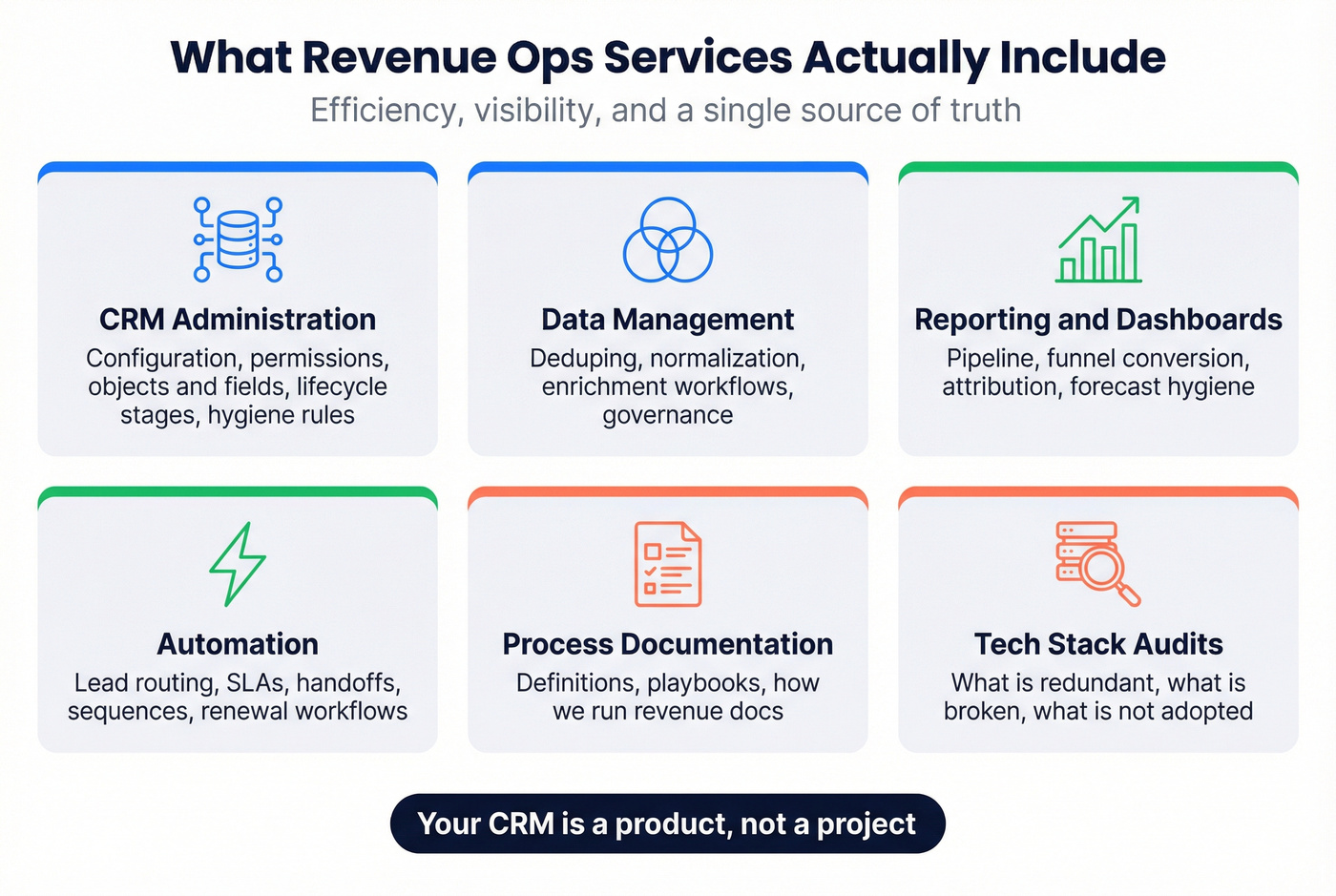
Most revenue ops services cover some mix of:
- CRM administration: configuration, permissions, objects/fields, lifecycle stages, hygiene rules
- Data management: deduping, normalization, enrichment workflows, governance
- Reporting and dashboards: pipeline, funnel conversion, attribution, forecast hygiene
- Automation: lead routing, SLAs, handoffs, sequences, renewal workflows
- Process documentation: definitions, playbooks, "how we run revenue" docs
- Tech stack audits: what's redundant, what's broken, what's not adopted
One framing we like is: efficiency, visibility, and a single source of truth. The line that sticks is "your CRM is a product, not a project." If your provider treats it like a one-time build, you'll feel good for a month and then drift right back into spreadsheet hell.
Types of Engagements
| Model | Best For | Typical Cost | Time to Value |
|---|---|---|---|
| Fractional leadership | Sub-$20M ARR, no RevOps hire | $5K-$10K/mo | 4-8 weeks |
| Managed / ROaaS | Teams needing execution | $3K-$15K/mo | 1-3 weeks |
| Project consulting | Specific initiatives | $15K-$75K | 6-12 weeks |
| Enterprise BPO | $100M+ orgs, global ops | $50K-$200K+/yr | 3-6 months |
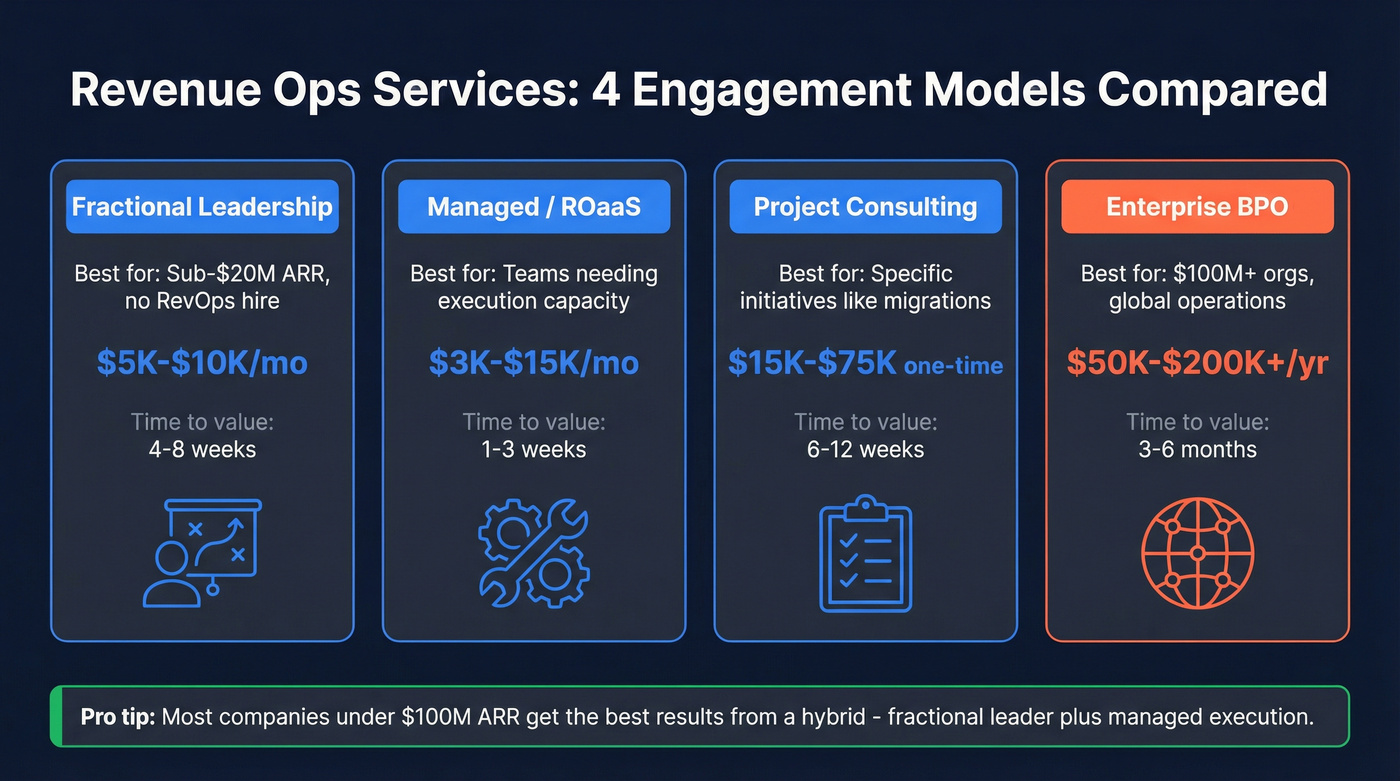
Managed services are usually the fastest to spin up because you're buying capacity and repeatable delivery, not a bespoke strategy exercise. On the enterprise end, BPO providers publish outcomes like higher lead conversion and more revenue per call, which is the kind of scale play you see when ops is treated like an industrial process across regions and business units.
How Much RevOps Services Cost
Most providers don't publish pricing. You'll talk to sales, get a "custom proposal," and still have no idea if you're paying for real execution or for a brand name and a slide template.
Here's the range we see most often:
| Engagement Type | Rate Range | Notes |
|---|---|---|
| Fractional (hourly) | $150-$300/hr | Senior operators; Clutch commonly shows ~$150-$199/hr for many consultancies |
| Fractional (retainer) | $5K-$10K/mo | Many land at $5K-$7.5K depending on access and scope |
| Managed / ROaaS | $3K-$15K/mo | Scope-dependent; varies by ticket volume and systems owned |
| Project-based | $15K-$75K | Migrations, rebuilds, attribution, lifecycle redesign |
| Enterprise BPO | $50K-$200K+/yr | Multi-function, global coverage, heavier governance |
The hourly model breaks down fast when meetings and project management eat half the hours. Retainers work better for ongoing operations, but only if scope is written in plain English.
Here's the thing: if your provider can't tell you exactly what triggers an overage (new system added, ticket volume, net-new workflows, custom objects, etc.), you're not buying a service. You're buying a surprise.

Half of RevOps teams run on a $0 budget, yet the biggest line item is always wasted time cleaning bad data. Prospeo's CRM enrichment returns 50+ data points per contact at a 92% match rate - with emails verified to 98% accuracy on a 7-day refresh cycle. That's the foundation layer your RevOps provider needs before a single dashboard gets built.
Stop paying consultants to polish garbage inputs. Fix the data first.
Outsource, Hire, or Hybrid?
Hot take: most companies under $100M ARR don't need a full-time RevOps hire or a big consulting engagement. They need a hybrid.
Use managed services when you need execution capacity fast, your scope is well-defined, or you're bridging a gap while recruiting internally. Skip managed services if nobody internal owns strategy. Managed providers execute; they don't set your GTM direction. Without a strategy owner, you'll end up with clean dashboards that measure the wrong things.
Use in-house when you need deep organizational context and cross-functional authority. Skip a first hire if your first RevOps person will be too junior to drive change, or recruiting's going to take six months and leave you stuck in place.
The hybrid wins: an internal (or fractional) leader sets direction and priorities, and a managed provider handles CRM admin, reporting, and automation. We've tested this setup with teams that were drowning in requests, and the difference is immediate: less arguing about "what matters," more shipping.
On Reddit, the consensus in threads about ops consultants is pretty consistent: lots of diagnosis, not enough follow-through. The hybrid model fixes that because execution doesn't end when the discovery deck is delivered.
First 90 Days With a Provider
In our experience, the teams that struggle most are the ones that skip mapping and jump straight to building dashboards. A good engagement follows a clear arc, and it should feel a little boring in the best way: the basics, done properly, without drama.
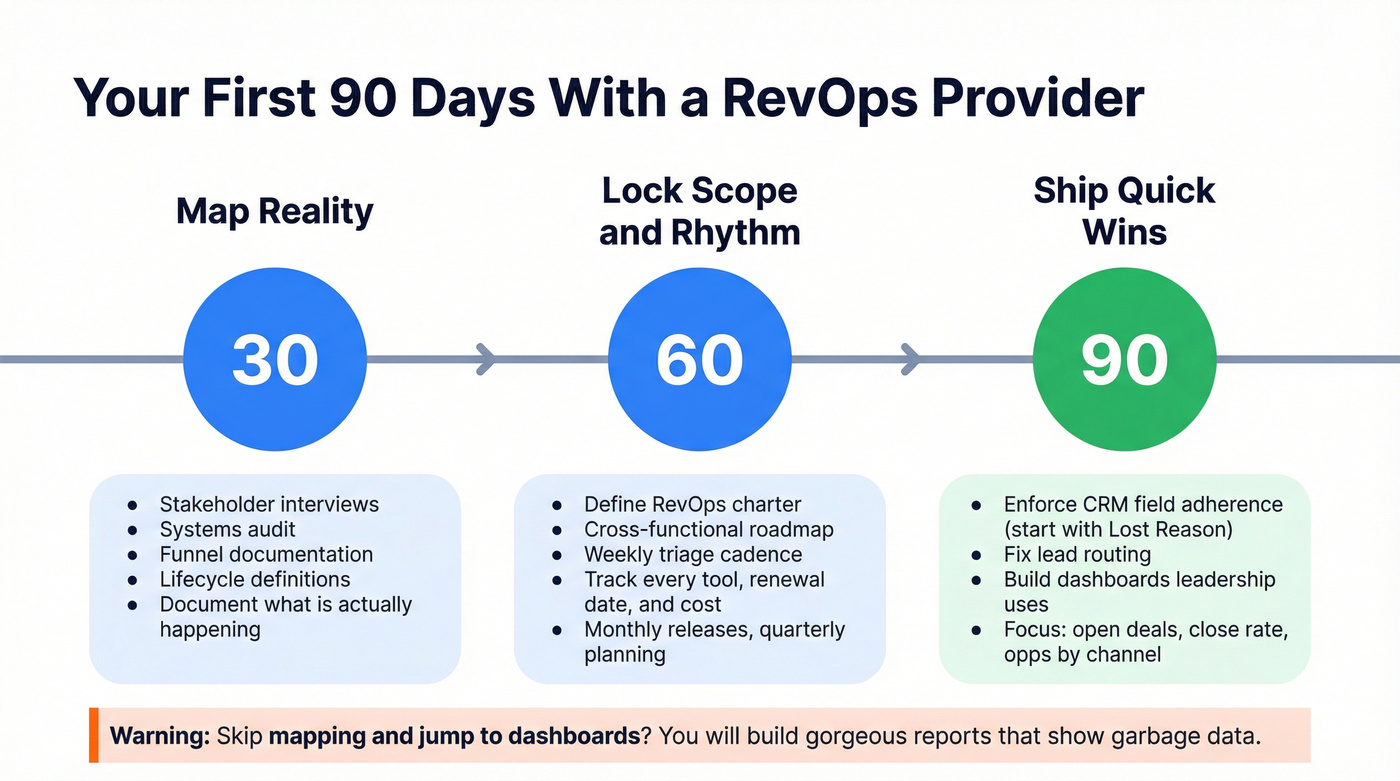
Days 1-30: map reality. Stakeholder interviews, systems audit, funnel documentation, lifecycle definitions. The goal isn't to rebuild anything yet. It's to document what's actually happening versus what leadership thinks is happening, then agree on the "one version" you'll operate from.
Days 31-60: lock scope and operating rhythm. This is where you define the RevOps charter, a cross-functional roadmap, and the cadence for changes (weekly triage, monthly releases, quarterly planning). Track every tool in your stack with its renewal date and annual cost, because you'd be shocked how many teams can't produce this list without three Slack threads and a half-day of digging.
Days 61-90: ship quick wins. Enforce CRM field-level adherence (start with Lost Reason; it's almost always broken). Fix lead routing. Build the dashboards leadership actually uses. For teams in the $1M-$5M ARR range, keep it tight: open deals, close rate, and opportunities created by channel. Metric sprawl kills early-stage RevOps because it turns every meeting into a debate about definitions instead of a decision about action.
A quick scenario we see a lot: a founder wants "better reporting," so the provider builds a gorgeous dashboard. Then the dashboard shows garbage because reps aren't logging next steps, marketing's using different lifecycle stages, and half the contacts are duplicates with dead emails. The dashboard isn't the problem. The inputs are.
Fix Your Data First

Revenue operations optimize processes. Processes run on data.
If 30% of your emails bounce and phone numbers are dead, every automated workflow pushes bad data through a good process. That doesn't just hurt outbound. It breaks routing, attribution, scoring, renewals, and forecasting because the underlying records aren't trustworthy.
One real example: at Snyk, 50 AEs were prospecting 4-6 hours per week with bounce rates between 35-40%. After switching to Prospeo for enrichment, bounces dropped under 5%, AE-sourced pipeline jumped 180%, and the team generated 200+ new opportunities per month. The RevOps infrastructure was already there; data quality was the bottleneck.
Prospeo is built for this exact layer of the stack: 98% email accuracy, a 7-day refresh cycle, and a 92% API match rate, with native Salesforce and HubSpot integrations so your provider isn't stuck building brittle custom glue code. And because it's self-serve with transparent pricing, you can get the enrichment workflow running without turning it into a procurement saga.
The article's truth bomb: gorgeous dashboards mean nothing when half your contacts are duplicates with dead emails. Prospeo's 5-step verification, catch-all handling, and spam-trap removal keep your CRM clean at $0.01 per email - so your RevOps investment actually compounds instead of decays.
Clean data is the cheapest RevOps service you'll ever buy.
How to Evaluate a Provider
Don't buy vibes. Buy deliverables.
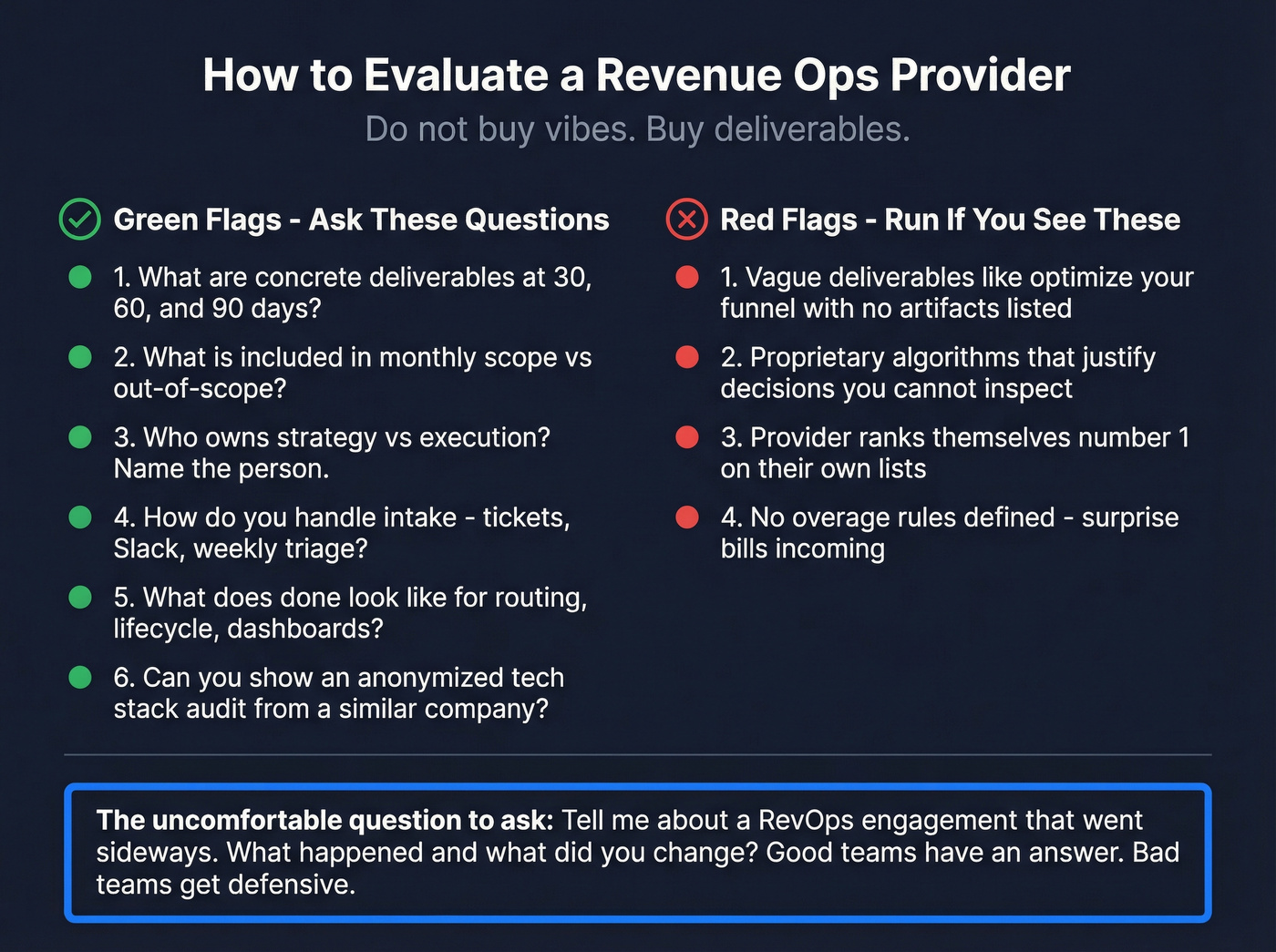
Ask for answers in writing:
- What are the concrete deliverables at 30, 60, and 90 days?
- What's included in the monthly scope, and what counts as out-of-scope?
- Who owns strategy vs execution? Name the person, not the concept.
- How do you handle intake (ticketing, Slack channel, weekly triage)?
- What does "done" look like for lead routing, lifecycle stages, and dashboards?
- Can you show an anonymized tech stack audit from a similar company?
Red flags:
- Vague deliverables ("optimize your funnel") with no artifacts listed
- "Proprietary algorithms" used to justify decisions you can't inspect
- Providers who rank themselves #1 on their own lists
- No overage rules (this one drives us nuts)
Real talk: most published RevOps agency rankings are marketing. They're fine for building a shortlist, but they're not a buying framework. Your buying framework is: outcomes, scope, operator quality, and how they behave when something breaks on a Friday.
If you want a sanity check on operator quality, ask one uncomfortable question: "Tell me about a RevOps engagement that went sideways. What happened, and what did you change?" Good teams have an answer. Bad teams get defensive.
FAQ
What's the difference between RevOps and sales ops?
Sales ops focuses on the sales team's tools, compensation, and processes. RevOps aligns sales, marketing, and customer success across the full revenue lifecycle, from first touch to renewal. It's a broader mandate with cross-functional authority.
How long before these engagements show ROI?
Most revenue ops services show measurable quick wins within 60-90 days: better routing, cleaner dashboards, tighter CRM hygiene. Strategic impact on pipeline velocity and forecast accuracy usually takes two full quarters because behavior change takes time.
Do I need clean data before hiring a provider?
Yes. Workflows run on contact data, and bad records poison every automation your provider builds.
If you want the provider's work to stick, get enrichment in place early. Tools like Prospeo keep your CRM populated with verified emails and direct dials on a 7-day refresh cycle, so routing rules and reporting aren't built on stale records.
What should a $5K-$10K/month retainer include?
Expect dedicated CRM administration, a weekly reporting cadence, lead routing and handoff automation, and a quarterly tech stack review. At this price point, you're usually buying execution, not GTM strategy. If a provider promises both, ask how many other clients share your assigned operator and how many hours you actually get.