

RevOps Alternatives: 6 CPQ & Deal Desk Tools Worth Evaluating in 2026
You just got the renewal quote - or worse, you filed a support ticket and got an AI bot. Either way, you're shopping for RevOps alternatives, and half the results are about Revenue Operations the strategy. This article is about RevOps the product and what actually replaces it.
RevOps the Product, Not the Function
Quick clarification, because the SERP is a mess. Revenue Operations is a strategic function that aligns sales, marketing, and CS around shared revenue goals. That's not what we're covering here.
RevOps is a deal desk + CPQ platform - the cross-functional hub where sales, finance, legal, and ops structure and approve complex deals. It handles CPQ-style pricing and quoting, approval workflows, built-in eSignature (with optional DocuSign integration), agreement building/templates, and CRM sync with HubSpot and Salesforce. If you're looking for Revenue Operations strategy tools, wrong article.
Why Teams Switch From RevOps
RevOps holds a 4.6/5 from 30 reviews on G2, with 83% giving five stars. The core product - Salesforce integration, flexibility, approval workflows - earns genuine praise.
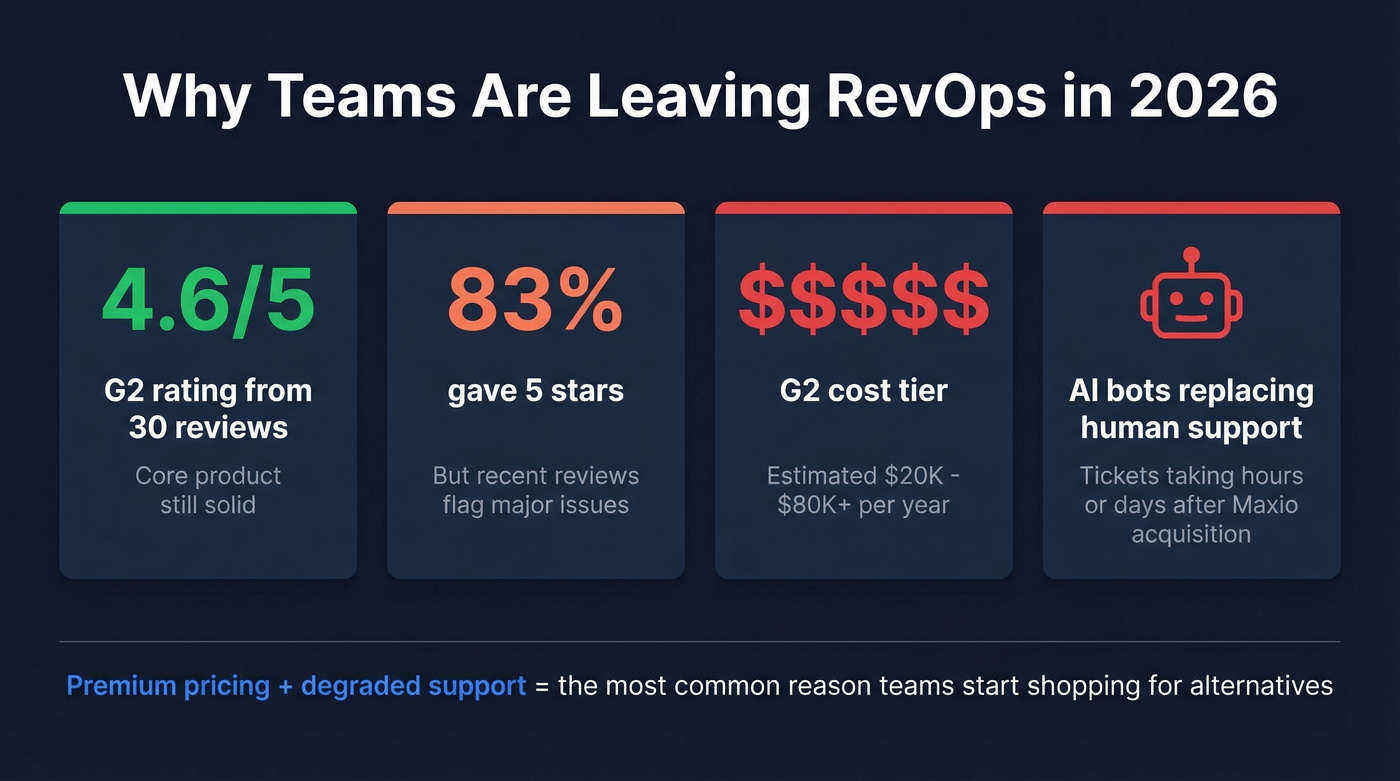
The trouble started after the Maxio acquisition. One recent G2 review describes game-breaking bugs, support being deferred to AI bots, and tickets taking hours or days. The perceived cost sits at G2's $$$$$ tier, suggesting annual spend in the $20K-$80K+ range based on comparable deal desk platforms. Premium pricing with degraded support is a deal-breaker for most teams.
A thread on r/sales titled "Deal desk has to be the worst internal process in..." captures the broader frustration well. Users describe becoming approval gates for thousands of quotes, waiting on multiple approvers, and needing engineering help for basic pricing changes. The pain isn't with deal desks as a concept - it's with tools that create bottlenecks instead of removing them.
Our Picks (TL;DR)
- Best direct replacement: DealHub - full CPQ + CLM, budget around $55K/yr (median)
- Best for smaller teams: PandaDoc - free tier for proposals and e-sign, CPQ only at Enterprise
- Best for interactive proposals: Qwilr - clean UI, starts at $35/user/mo

Switching deal desk tools fixes your quoting workflow - but the bottleneck often starts earlier. If your reps can't reach the right buyers, no CPQ will save the deal. Prospeo gives you 300M+ profiles with 98% email accuracy and 125M+ verified mobiles, refreshed every 7 days.
Fix the pipeline feeding your deal desk - start with accurate data.
Pricing at a Glance
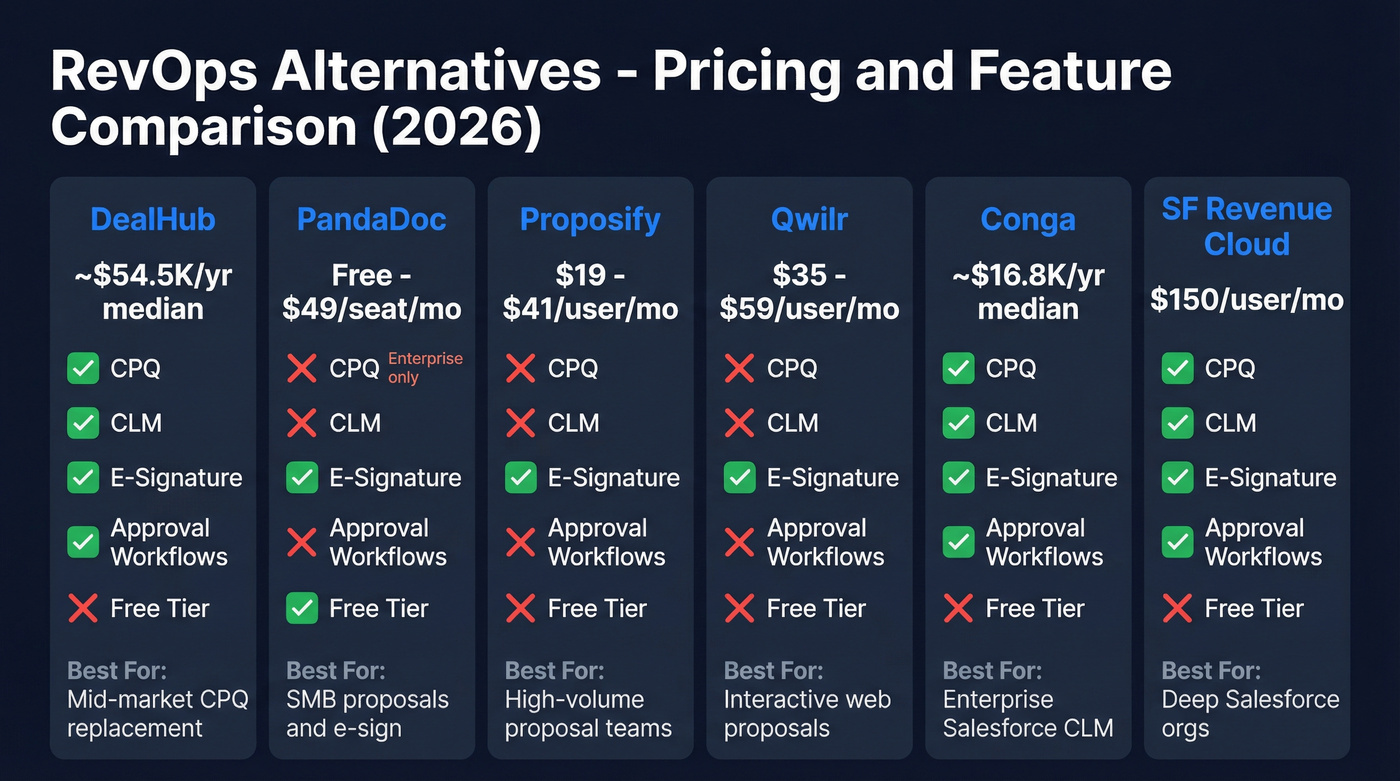
| Tool | Best For | Starting Price | Key Consideration |
|---|---|---|---|
| DealHub | Full CPQ replacement | ~$54.5K/yr median | No public pricing |
| PandaDoc | SMB proposals + e-sign | Free-$49/seat/mo | CPQ gated to Enterprise |
| Proposify | Send-heavy teams | $19-$41/user/mo | Send limits on lower tiers |
| Qwilr | Interactive proposals | $35-$59/user/mo | Salesforce needs Enterprise |
| Conga | Enterprise CLM | ~$16.8K/yr median | Implementation adds $50K+ |
| SF Revenue Cloud | Salesforce-native orgs | $150/user/mo | 8-16 week implementation |
The 6 Best RevOps Alternatives
DealHub
DealHub is the closest thing to a drop-in RevOps replacement, and it's the tool we'd point most mid-market teams toward first. The platform covers CPQ, CLM, and billing in modular packages - CPQ+, CPQ+CLM, and Quote-to-Revenue - so you buy only what you need.

What separates DealHub from proposal tools is depth. Playbook-guided selling, multi-tier approval workflows, usage-based pricing models, ramp schedules, and partner channel quoting all come standard. The CLM module includes a clause library, contract repository, and redlining - features that matter when legal is part of your deal desk.
Vendr reports a median annual cost of $54,520 across 53 purchases, ranging from $14,304 to $155,702. That's a wide band, so push hard during negotiation - the low end proves there's room. (If you want a negotiation framework, start with anchor.)
Use this if: You need real CPQ with approval chains, complex deal structures, and CLM in one platform.
Skip this if: Your budget is under $30K/yr. At that spend level, you're better served by PandaDoc or Proposify until deal complexity forces the upgrade.
PandaDoc
PandaDoc is the obvious starting point for teams that need proposals and e-signatures without committing to a full CPQ platform. The pricing is refreshingly transparent: Free ($0, unlimited seats, 60 docs/year, then $3/doc), Launch ($9/mo), Starter ($19/seat/mo), and Business ($49/seat/mo).

Here's the catch. CPQ features - configure-price-quote with workflow automation, SSO, and API access - are gated to the Enterprise plan at custom pricing. PandaDoc is genuinely great for proposals and signing, but you'll outgrow it fast if you need discount approval chains or complex ramp schedules.
Use this if: You're under 10 reps, deals are relatively standard, and you mainly need polished proposals with e-signatures.
Skip this if: You need real CPQ today. Enterprise pricing can land in the same budget zone as full CPQ tools, and DealHub's CPQ is purpose-built for that job.
Proposify
Proposify earns its spot for teams that send a high volume of proposals and want granular template control. Pricing is straightforward: Basic at $19/user/mo (10 sends/month), Team at $41/user/mo, Business starting at $3,900/yr. Overages run $0.50/send on Basic and $0.30 on Team.
If you're sending 50+ proposals monthly, do the overage math before committing. A Basic plan with 40 extra sends costs $39/mo total - at that point, Team makes more sense.
Skip this if: You need CPQ functionality. Proposify is proposal software, not a deal desk platform.
Qwilr
Qwilr takes a different approach entirely: interactive, web-based proposals that look like landing pages rather than PDFs. Embedded pricing calculators, video, and real-time analytics on viewer engagement make it the most visually impressive option on this list. The Business plan runs $35/user/mo and includes HubSpot integration.
We've seen teams use Qwilr proposals as a differentiator in competitive deals where the buying committee passes documents around internally. A slick, interactive page stands out against a static PDF attachment.
Skip this if: You're a Salesforce shop on a budget. Salesforce integration requires the Enterprise tier at $59/user/mo with a 10-user minimum (annual only) - that's $7,080/yr minimum just to connect your CRM.
Conga
The enterprise CLM play. Vendr puts median annual spend at $16,800 across 210 purchases, but a full CLM suite runs $30K-$100K+/yr with implementation adding $50K-$165K. Conga only makes sense if you're already running Salesforce at scale and need document generation plus contract lifecycle management in one stack.
For mid-market teams, the implementation cost alone often exceeds the first year of a DealHub contract. Let's be honest - if you're reading a "RevOps alternatives" article, Conga probably isn't your tier.
Salesforce Revenue Cloud
The nuclear option. Starts at $150/user/month with implementations often running 8-16 weeks and dedicated project teams costing six figures. If you're already deep in the Salesforce ecosystem, it's the path of least integration resistance.
For everyone else, it's overkill. In our experience, the implementation timeline alone kills the ROI for most mid-market teams. By the time you're live, you've burned a quarter of pipeline time on configuration calls.
The Data Layer Most Teams Ignore
Here's the thing most deal desk evaluations miss entirely: your CPQ tool matters less than the data feeding it. Bad emails mean wasted quotes. Disconnected phone numbers mean reps chasing ghosts through approval workflows. The CPQ is only as good as the contacts entering it, and this is where most deal desk workflows silently break. (If you're comparing vendors here, see our roundup of data enrichment services.)
Prospeo fixes this upstream. With 300M+ professional profiles, 143M+ verified emails at 98% accuracy, and a 7-day refresh cycle, your deal desk processes quotes for real, reachable contacts - not stale records from six weeks ago. It integrates natively with Salesforce and HubSpot, so enrichment happens before deals hit your CPQ. Snyk's 50-person AE team saw bounce rates drop from 35-40% to under 5% after switching their enrichment layer, generating 200+ new opportunities per month. The free tier gives you 75 verified emails monthly, paid plans run roughly $0.01/email, and there are no contracts. (If you're troubleshooting bounces, start with email bounce rate benchmarks and fixes.)

You're evaluating $15K-$80K/yr CPQ platforms to close deals faster. But deals stall when reps prospect with bad data. At $0.01/email with 98% accuracy, Prospeo costs less than one month of most tools on this list - and ensures every quote reaches a real buyer.
Stop quoting into the void. Reach real decision-makers first.
How to Choose the Right Tool
Most teams evaluating RevOps alternatives are mid-market. Here's the honest framework:
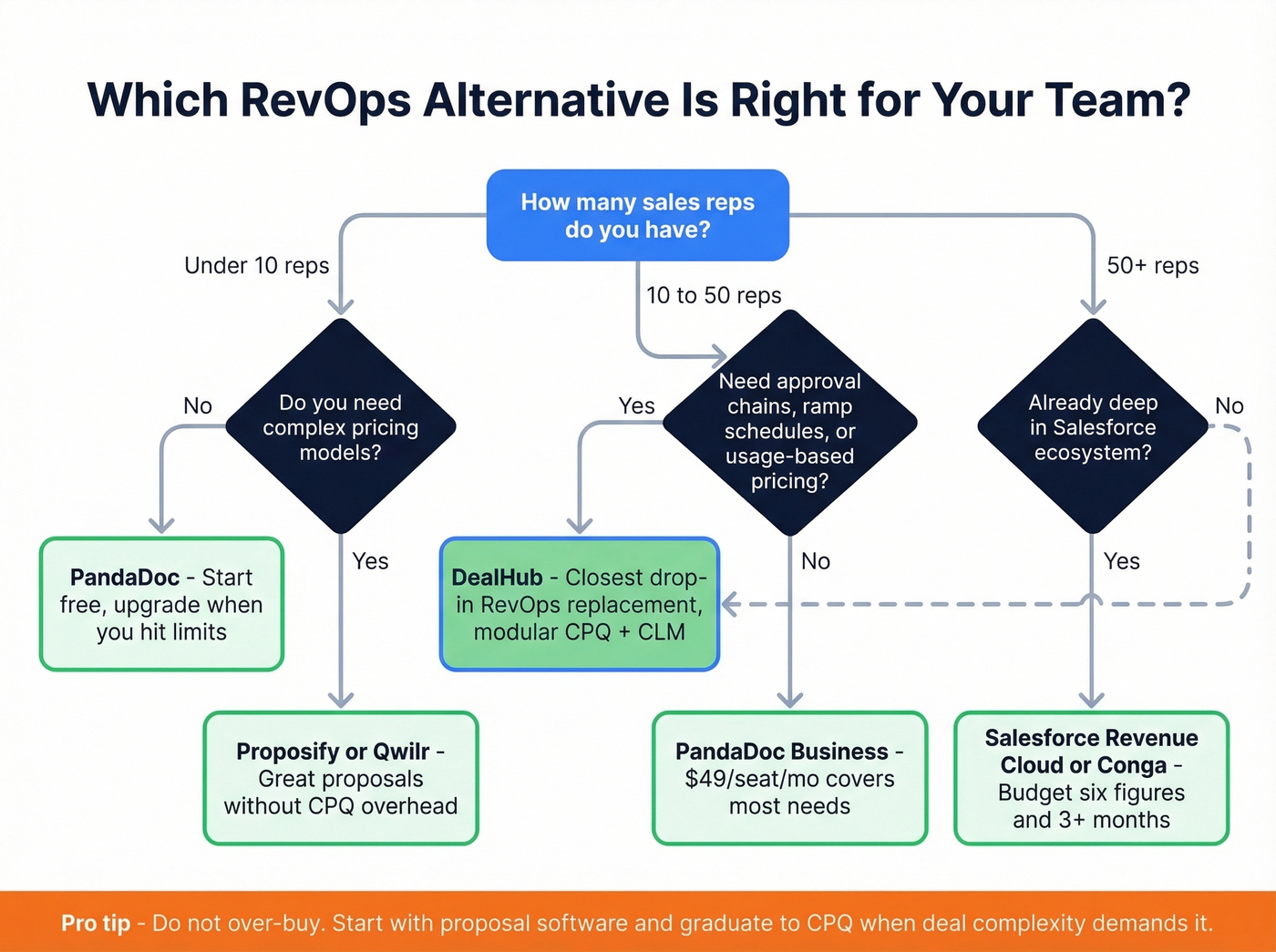
Under 10 reps, standard pricing: PandaDoc or Proposify. Start free or cheap, upgrade when you hit limits. Don't overthink it.
10-50 reps, complex pricing models: DealHub. It's the closest replacement with real CPQ depth, and the modular packaging means you're not paying for CLM if you don't need it yet.
Enterprise, Salesforce-native: Salesforce Revenue Cloud or Conga. Budget six figures and 3+ months for implementation. If that timeline makes you wince, DealHub is still the better call.
My actual advice: don't over-buy. A ~$55K CPQ doesn't help if your team of six reps sends 20 proposals a month. Start with PandaDoc, graduate to DealHub when deal complexity demands it. We've watched too many teams sign enterprise CPQ contracts and then use 15% of the features for two years. (If you're trying to pressure-test ROI, map it to pipeline health metrics.)
FAQ
Is RevOps still good after the Maxio acquisition?
The core product - templates, Salesforce sync, approval workflows - remains solid at 4.6/5 from 30 G2 reviews. The risk is support quality: a recent review flags game-breaking bugs and AI bots replacing human support. Request a live support SLA in writing before renewing.
What's the cheapest alternative with CPQ features?
PandaDoc's free tier covers proposals and e-signatures, but CPQ requires its Enterprise plan. For dedicated CPQ, DealHub's low-end annual cost shows up around $14,304 in Vendr data, with a median around $54,520/year. Teams spending under $15K/yr are typically better served by proposal tools like Proposify or Qwilr.
Do I need CPQ or just proposal software?
Standard pricing and e-signatures? Proposal software is enough. Usage-based pricing, multi-tier discounts, approval chains, or ramp schedules? You need CPQ. The distinction saves you from overspending on features you won't touch.
How do I keep deal desk data clean when switching tools?
Use a dedicated enrichment layer to verify contacts before they enter your new CPQ. Snyk cut bounce rates from 35-40% to under 5% this way with Prospeo's 98% email accuracy and 7-day refresh cycle. Most migration failures trace back to stale CRM data, not the CPQ tool itself.