

RevOps Automation: The Practitioner's Framework for Getting It Right
A RevOps lead we know spent six months building elaborate routing automations in Salesforce. Beautiful stuff - multi-branch logic, custom objects, the works. Then 30% of the leads hitting those workflows bounced on first email because the underlying contact data hadn't been cleaned in four months. That's the thing about RevOps automation: it doesn't fix bad foundations. It scales them.
What You Need (Quick Version)
The revenue operations automation market is projected to hit $10-18B by 2033, up from $3.71B in 2023. Yet 65% of sales and marketing leaders still struggle with basic cross-functional alignment. Here's the framework that works, compressed:
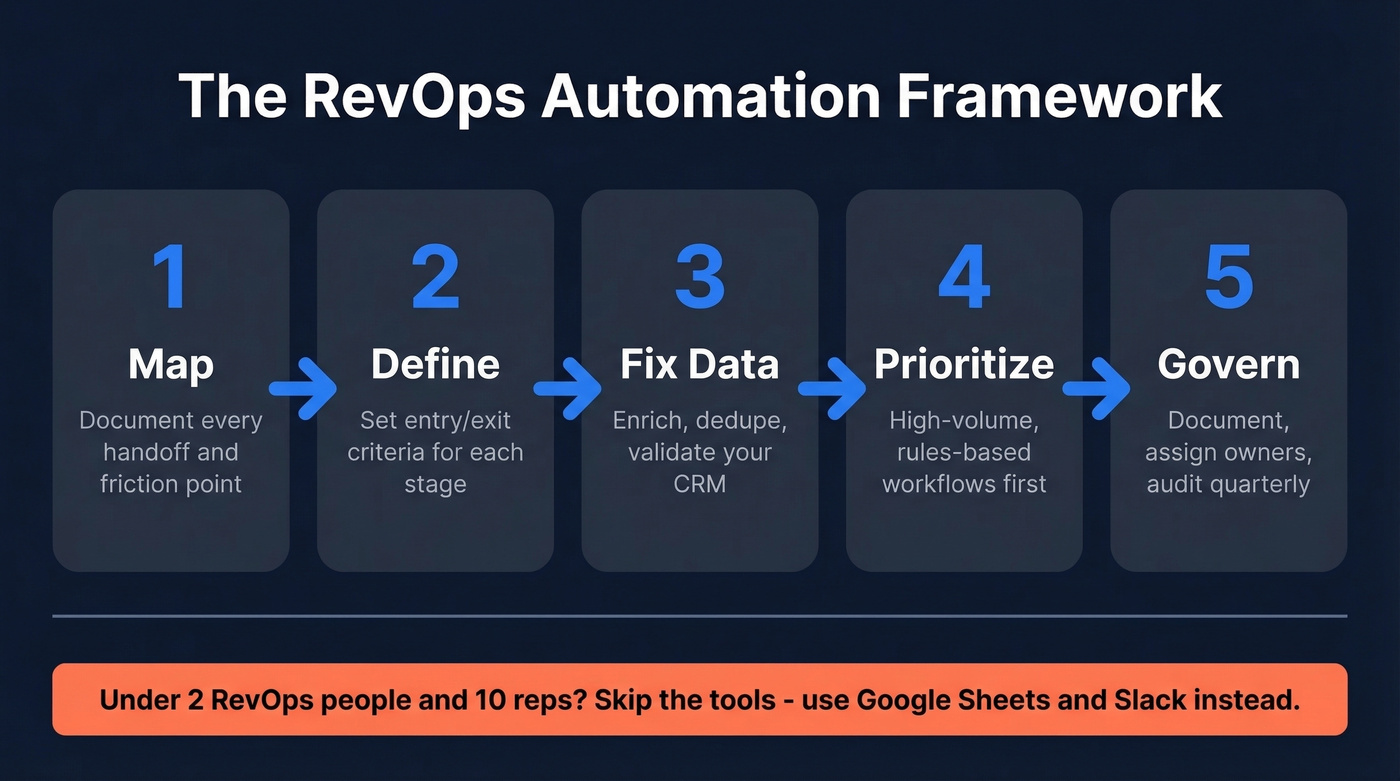
- Map your full revenue process - every handoff, every friction point.
- Define lifecycle stages with real entry/exit criteria.
- Fix the data model - enrichment, deduplication, validation.
- Prioritize high-volume, rules-based workflows first.
- Govern and iterate - documentation, ownership, review cadence.
Hot take: if you've got fewer than 2 RevOps people and 10 reps, don't buy anything. Google Sheets and Slack will outperform a half-implemented CRM automation every time.
What Revenue Operations Automation Actually Means
Automating revenue operations means building cross-functional workflows that connect marketing, sales, and customer success - from lead capture through pipeline, close, onboarding, and renewal. It sits across the pillars RevOps teams use in practice: People, Process, Data, and Technology, and draws from established models like the SiriusDecisions Demand Waterfall and HubSpot's Flywheel.
The goal isn't automating individual tasks. It's creating a system where handoffs, data capture, routing, and reporting happen on their own, accurately, every time. Only 30% of companies have a unified data strategy to support this, and that gap is where most automation projects die. Any serious effort has to start with data integrity, not tooling.
The 5-Step Framework
Step 1: Map Your Revenue Process
Document every stage from lead to renewal - and every handoff between teams. Where does marketing pass to sales? Where do deals stall? You're looking for the highest-friction workflows: places where leads sit in limbo, approvals bottleneck, or data gets lost between systems.
Don't automate yet. Just map. Most teams skip this and jump straight to building Zapier flows, which is how you end up with 15 automations nobody can explain six months later.
Step 2: Define Lifecycle Stages
Every stage needs entry criteria, exit criteria, and reason codes. "Qualified" means nothing if three teams define it differently. Automating undefined processes just scales chaos.
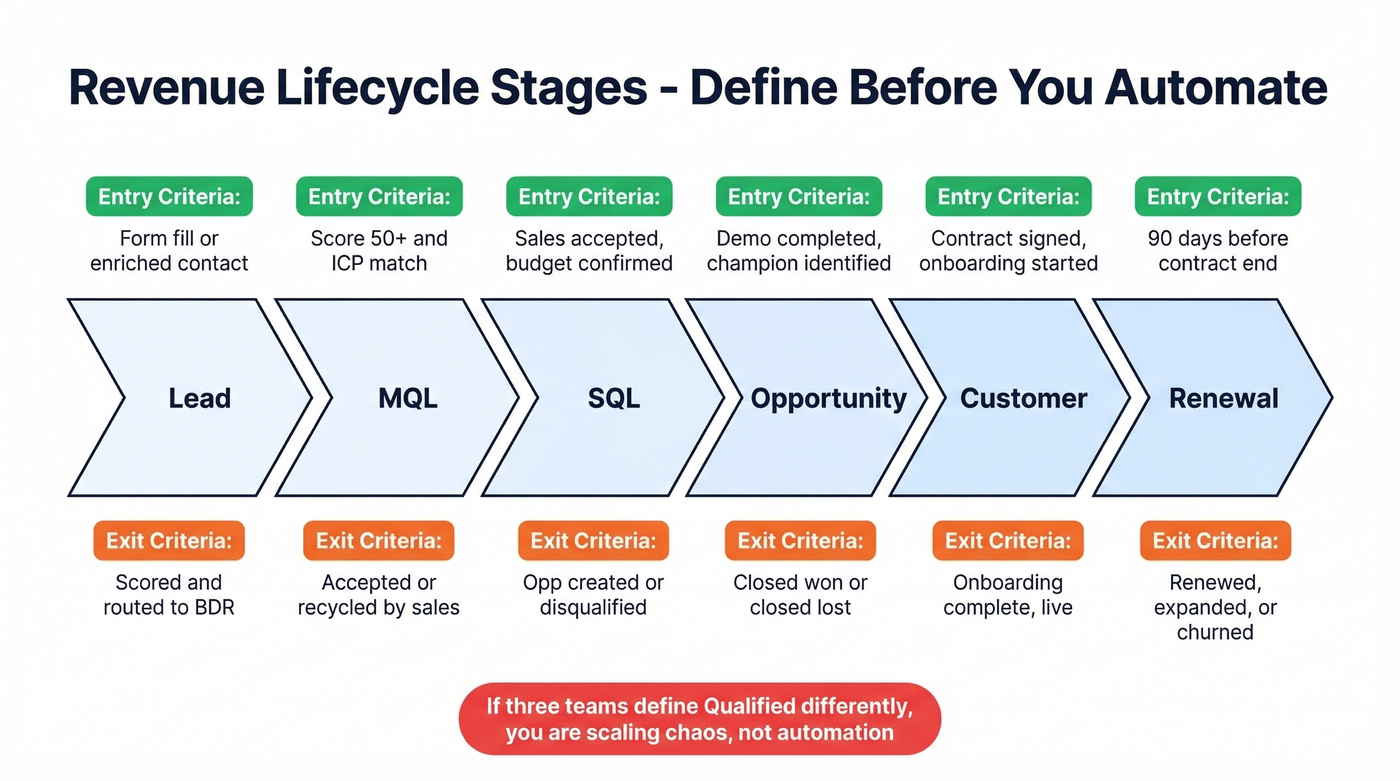
If your MQL definition is "marketing thinks they're ready," you'll route garbage to sales faster. Define the stages first. The automation becomes obvious once the definitions are clear.
Step 3: Fix the Data Model
This is where most projects should actually start. Field ownership, validation rules, dedupe/merge logic, source of truth - all of it needs to be locked down before you build anything on top.
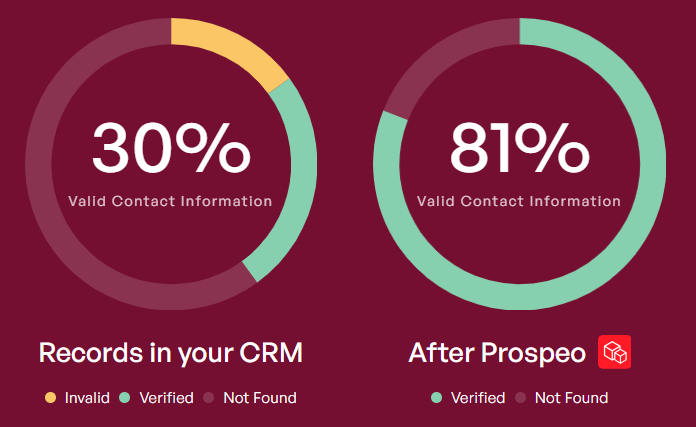
We've seen this play out dozens of times: a team invests weeks in lead scoring logic, only to realize a third of their CRM records have stale emails or missing fields. Prospeo fits here as the enrichment layer that makes everything downstream trustworthy - with 98% email accuracy and a 7-day data refresh cycle versus the six-week industry average, it catches the stale records that break routing and scoring automations. CRM and CSV enrichment returns 50+ data points per contact, which makes validation rules and required-field logic far easier to enforce.
Snyk's team saw their bounce rate drop from 35-40% to under 5% after running enrichment across their CRM. That's the kind of data hygiene that makes step 4 actually work.
Step 4: Prioritize by Impact
Automate high-volume, repeatable, rules-based workflows first. Lead routing, approval chains, data capture on form submissions, deal desk tasks. These are predictable, the rules are clear, and the time savings compound with every rep you add.
Track speed-to-lead, stage cycle time, routing accuracy, and forecast slippage. If you can't measure the improvement, you can't justify the investment.
Step 5: Govern and Iterate
James McArthur put it well: build flows so "someone with no knowledge of your system can come in, see it, and understand what's going on." Every automation needs an owner. Every flow needs documentation. And every quarter, audit what's running and kill what's broken.
Automation debt accumulates fast. Rigid foundations and siloed automations become expensive to unwind - sometimes more expensive than starting over.

Every RevOps automation in your stack depends on clean, current data - and most CRMs are full of stale records. Prospeo's enrichment returns 50+ data points per contact at a 92% match rate, with a 7-day refresh cycle that keeps your routing, scoring, and handoff automations working as designed. Snyk dropped their bounce rate from 35-40% to under 5%.
Stop scaling broken data. Start enriching at $0.01 per email.
When NOT to Automate
Jen Igartua nails this: "When your company doubles in size, you're running a new company." Heavy CRM/CPQ customization at 30 people becomes a straitjacket at 100.
CRM implementations can take 12+ months to get right, and unwinding over-engineered flows is brutally expensive. The practical threshold: at least 2 RevOps people, 10+ sales reps, and documented core processes. Below that, you're better off with spreadsheets and Slack. Automation debt is real, and it's harder to pay down than technical debt in software.
Let's be honest - the RevOps tooling market wants you to buy before you're ready. Resist that.
AI-Driven RevOps Workflows
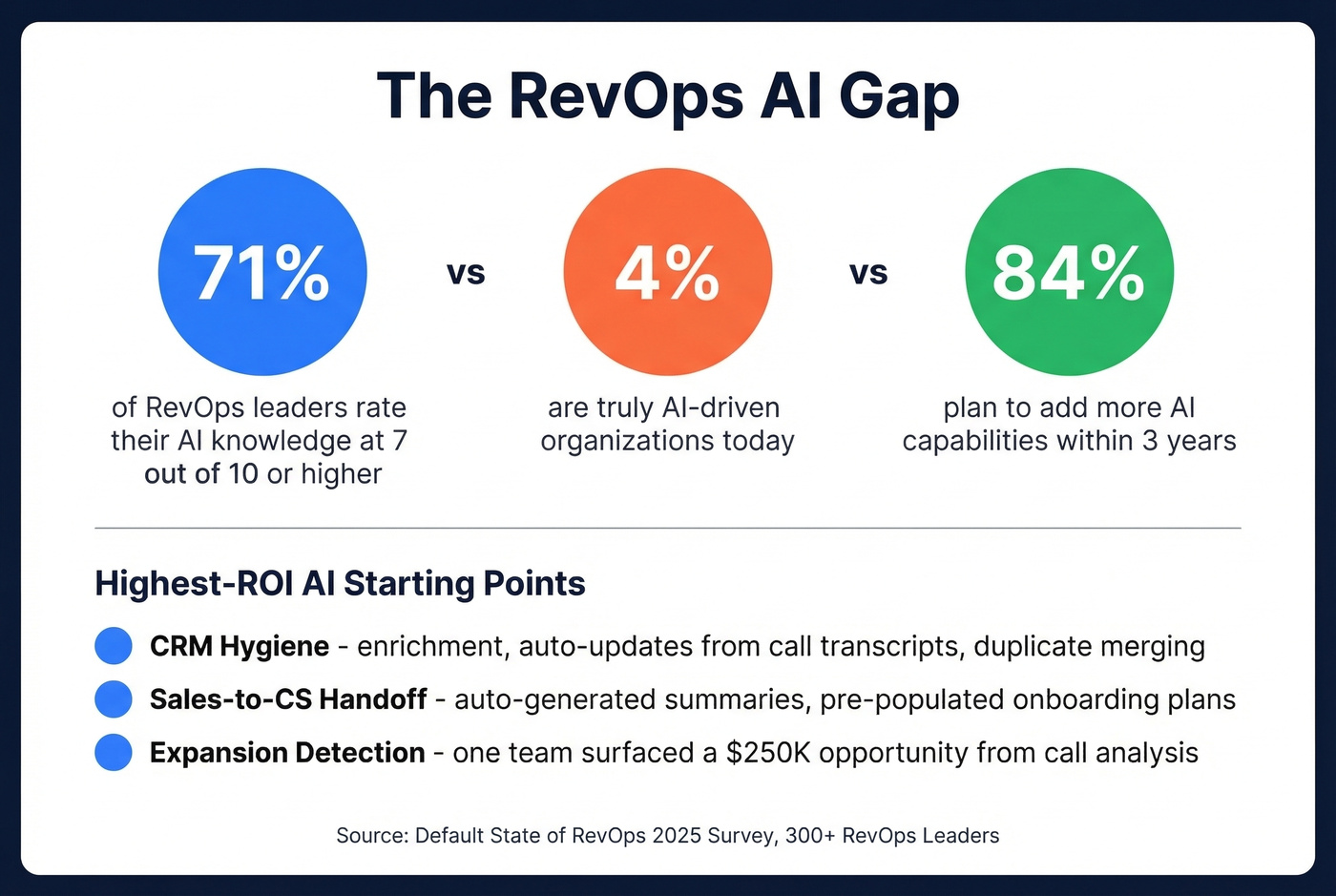
A Default survey of 300+ RevOps leaders found that 71% rate their AI knowledge at 7+, but only 4% are truly AI-driven organizations. Meanwhile, 84% plan to add more AI capabilities within three years. The gap between confidence and results is enormous.
Going deep on 1-2 workflows beats spreading thin across seven.
CRM hygiene remains the highest-ROI starting point: AI enrichment, meeting transcription to auto-update records, and duplicate detection that actually merges cleanly. If you're formalizing this, start with a clear lead status taxonomy so automations don't fight each other. As Jake Obremski puts it, "AI removes bias and ensures that CRM data reflects reality, not just a salesperson's gut feeling."
Sales-to-CS handoff is where AI shines next. Auto-generated handoff summaries, pre-populated onboarding plans, and risk flagging for expectation mismatches eliminate the "tell me everything again" problem that kills customer trust. This is also where a simple handoff email template can prevent a lot of downstream confusion.
Beyond those two, teams are seeing real results with expansion detection - one team surfaced a $250K opportunity from call analysis that would've been missed entirely - as well as case study mining through sentiment analysis and AI-driven forecasting that removes territory-planning bias.
Best Tools by Category in 2026
| Category | Tool | Starting Price | Best For |
|---|---|---|---|
| Data & Enrichment | Prospeo | Free tier; ~$0.01/email | Contact accuracy, enrichment |
| Data & Enrichment | Clay | From $134/mo | Waterfall enrichment |
| Workflow Automation | Zapier | Free; paid from ~$20/mo | Simple integrations |
| Workflow Automation | Make | Free; paid from ~$10/mo | Complex multi-step flows |
| Workflow Automation | Workato | Custom pricing (typically mid-five figures/yr+) | Enterprise iPaaS |
| Revenue Intelligence | Gong | Custom pricing | Conversation intel |
| Revenue Intelligence | Clari | Custom enterprise pricing | Forecasting & pipeline |
| Routing | LeanData | Custom pricing | Lead routing |
| Routing | Default | From $750/mo + $45/user | Inbound routing |
| CRM | Salesforce | From ~$25/user/mo | Full-stack RevOps |
| CRM | HubSpot | Free CRM; paid from ~$20/mo | SMB-to-mid-market |
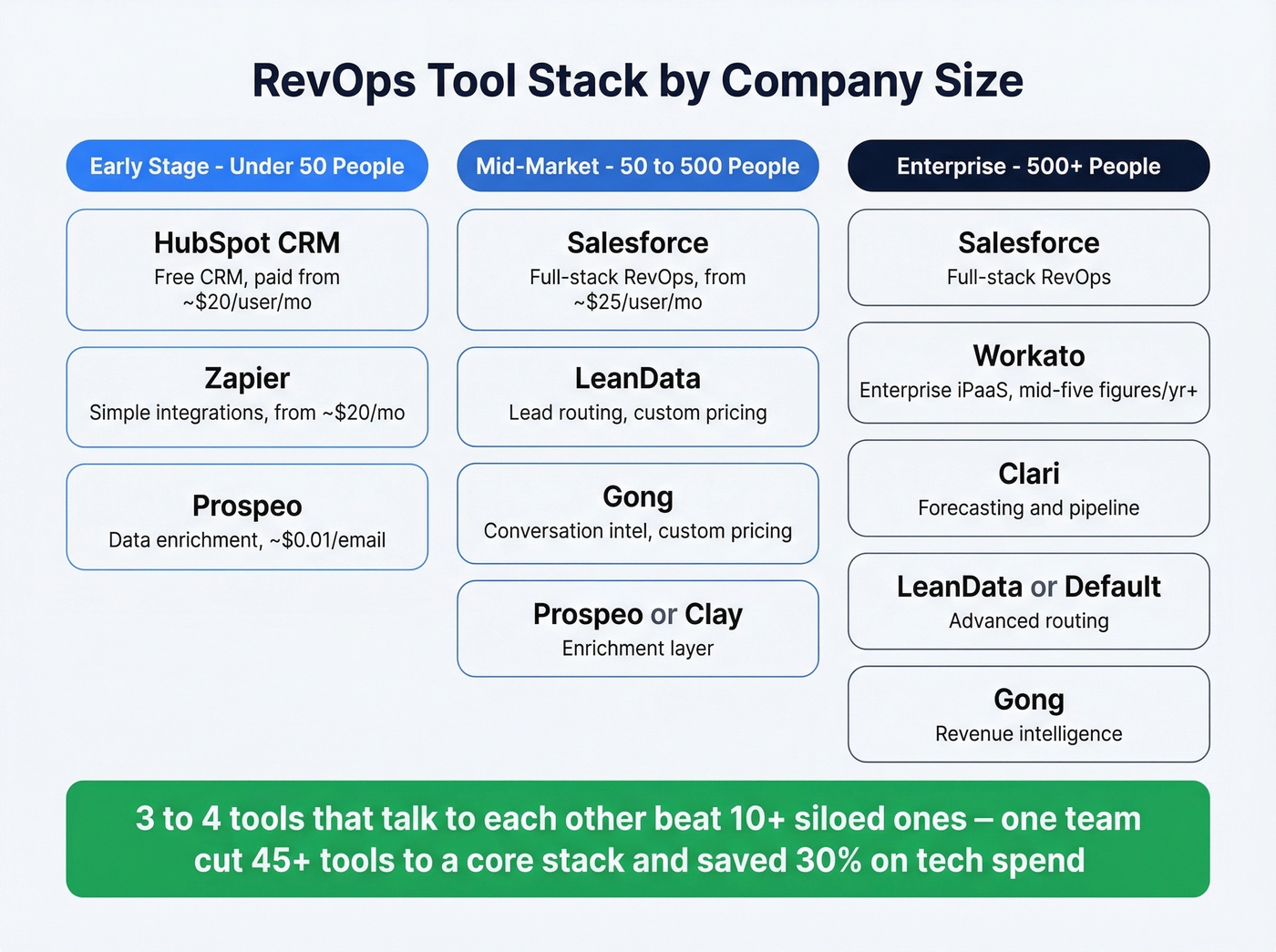
By company size: Early-stage teams under 50 people do well with HubSpot + Zapier + a data enrichment tool like Prospeo. Mid-market teams of 50-500 typically need Salesforce + a routing tool like LeanData + Gong. Enterprise stacks add Workato and Clari for orchestration and forecasting.
Here's the thing: 3-4 tools that talk to each other beat 10+ siloed ones. A 200-person, $30M ARR Boston SaaS company on r/revops consolidated from 45+ tools to a core stack and reported 30% less tech spend, 40% less manual reporting, and 15% better forecast accuracy. We see that pattern repeatedly - consolidation wins.
Skip the enterprise tools if you're under 50 people. You don't need Workato or Clari yet. You need clean data, a CRM that isn't a mess, and one workflow tool that connects them. If you're evaluating options, it helps to compare examples of a CRM and map them to your actual process.
You just mapped your revenue process, defined lifecycle stages, and prioritized workflows. None of it matters if a third of your CRM emails bounce. Prospeo delivers 98% email accuracy with catch-all verification, spam-trap removal, and weekly data refreshes - the enrichment layer that makes Steps 4 and 5 of this framework actually hold.
Build RevOps automations on data that doesn't break them.
RevOps Automation FAQ
What's the difference between automation and orchestration?
Automation puts individual tasks on autopilot - a lead gets routed, a field gets updated. Orchestration designs adaptive systems across sales, marketing, and CS that respond to changing conditions. The best RevOps teams think in orchestration terms, not isolated automations. Start by automating discrete workflows, then connect them into orchestrated sequences as your team matures.
How do I know if my team is ready?
You need at least 2 RevOps people, 10+ sales reps, and core processes documented with clear lifecycle stages. If you're still defining what "qualified" means across teams, automate with spreadsheets first. Premature tooling creates more problems than it solves, and unwinding bad automations costs more than building them right later.
What's the most common mistake?
Automating on top of bad data. If 30%+ of your CRM records have stale emails or missing fields, every downstream workflow - routing, scoring, outbound - scales bad outcomes faster. Run enrichment across your CRM before you build anything else. Snyk cut their bounce rate from 35-40% to under 5% this way, and that kind of cleanup is what separates RevOps teams that ship working automations from teams that spend quarters debugging broken ones.
How should we build our automation strategy?
Start with the five-step framework: map processes, define stages, fix data, prioritize by impact, then govern. The most common failure mode is jumping to tool selection before the first three steps are done. Align your automation roadmap to quarterly business goals, assign clear ownership for each workflow, and resist the urge to automate everything at once.