

How to Build a RevOps Program That Actually Works
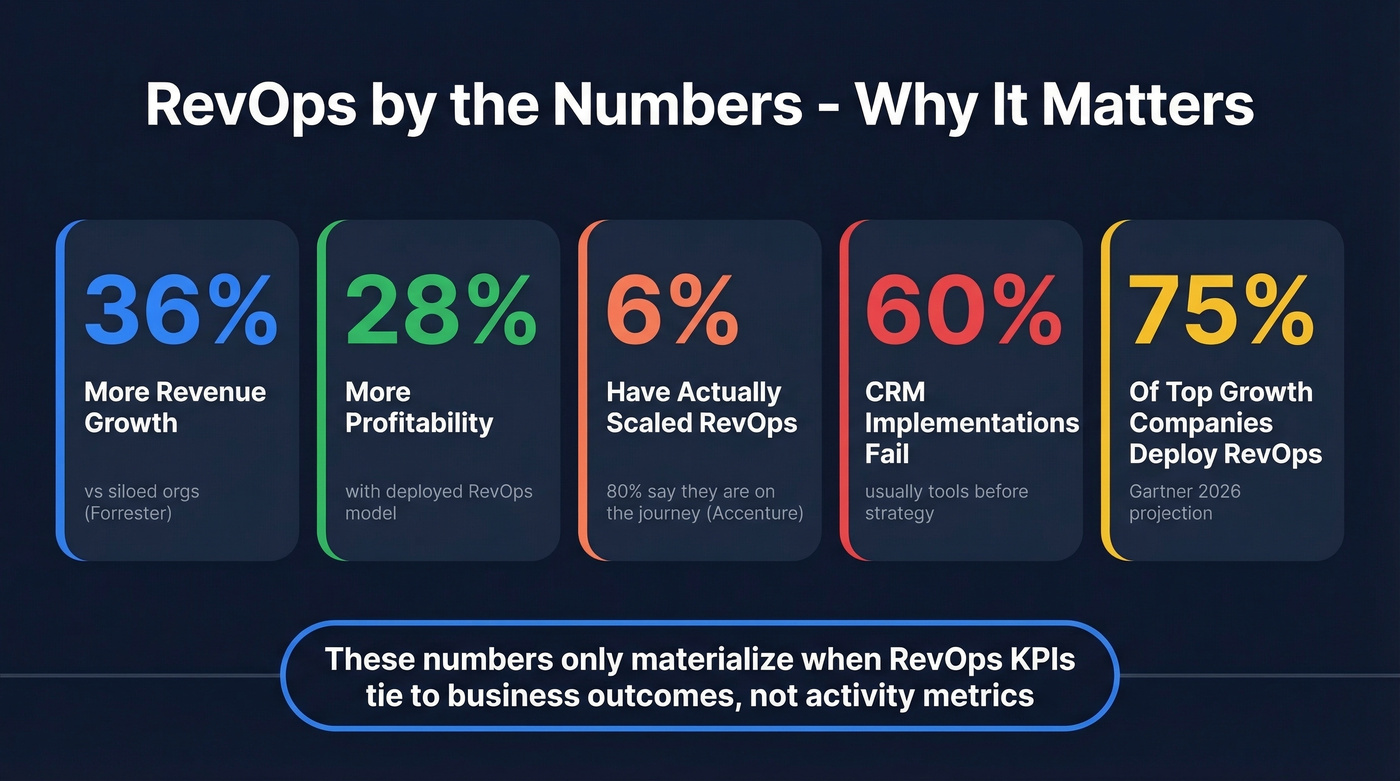
80% of organizations say they're "on the journey" toward a RevOps program. Only 6% have actually scaled one. That's not a talent problem - it's a program design problem.
Most companies hire a RevOps person and expect magic. What they actually need is a structured revenue operations function with a charter, governance, and a 90-day plan tied to real revenue outcomes. We've watched teams burn six figures on headcount and tooling only to end up with a glorified reporting team that nobody trusts. This guide is the antidote to that.
What a RevOps Program Actually Is
A RevOps program isn't a person with "RevOps" in their title. It's an organizational function that sits above Sales Ops, Marketing Ops, and CS Ops - aligning all three (plus Finance) through unified data, processes, and technology. Only 12% of companies report solid collaboration between Sales and Finance. A real revenue operations program closes that gap.
The most common failure mode? Jumping straight to dashboards and tools without tying any of it to a specific revenue outcome. 86% of revenue teams claim a shared goal, but only 59% actually track metrics against it. That disconnect is where RevOps initiatives go to die.
The skepticism on r/SalesOperations is warranted - RevOps is expensive overhead if you build it wrong. Done right, Forrester data shows 36% more revenue growth and up to 28% more profitability versus siloed orgs.
Different frameworks slice RevOps differently. Outreach uses four pillars (Operations, Enablement, Insights, Systems); Fullcast adds a compensation pillar. The framework matters less than the principle: your program must span every revenue-touching function, including how reps get paid.
Diagnose Before You Build
Before you write a single playbook, figure out where you actually stand. The HubJoy maturity model breaks RevOps into five stages. Most SaaS companies in the $5M-$15M ARR range are stuck at Stage 1 or 2.
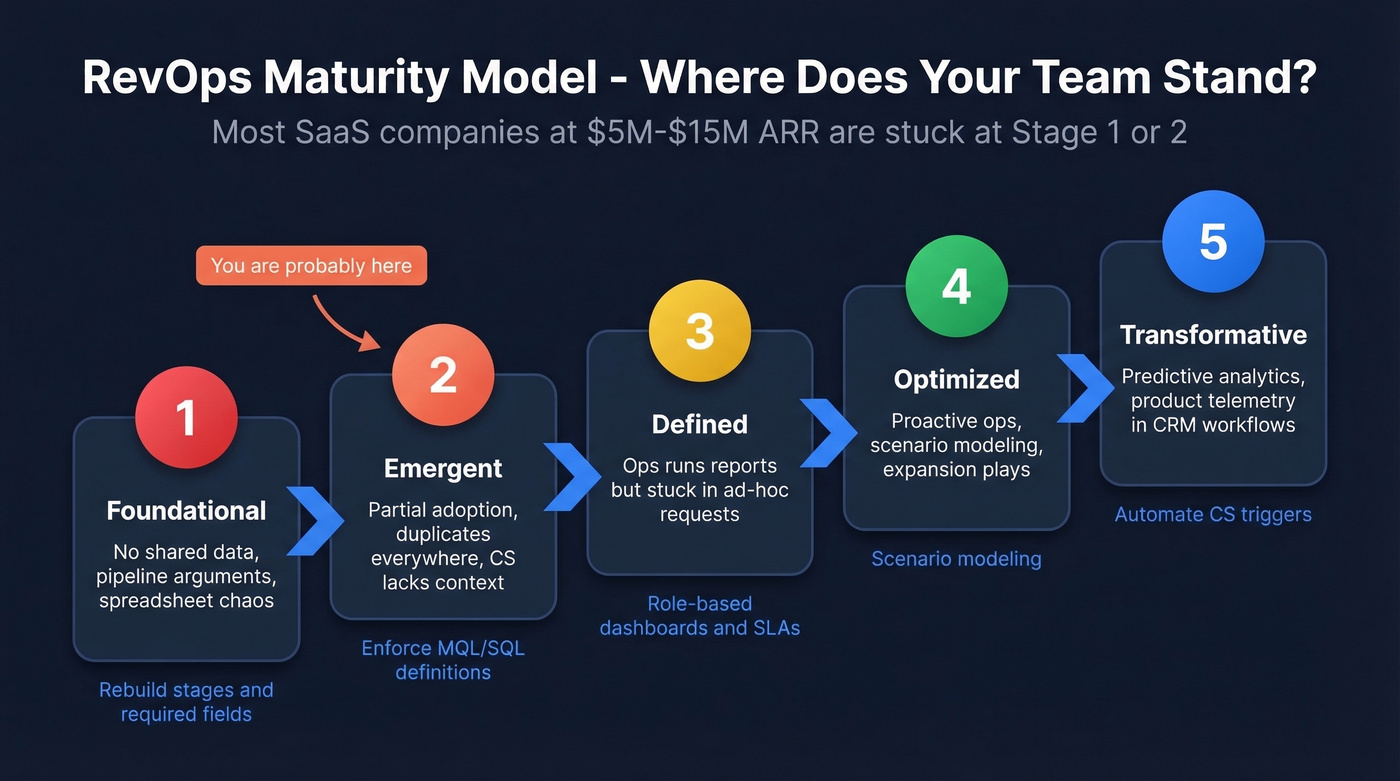
| Stage | Description | Red Flags | Fix Next |
|---|---|---|---|
| Foundational | No shared data | Pipeline arguments, spreadsheets | Rebuild stages, required fields |
| Emergent | Partial adoption | Duplicates, CS lacks context | Enforce MQL/SQL definitions |
| Defined | Ops runs reports | Ops stuck in ad-hoc requests | Role-based dashboards + SLAs |
| Optimized | Proactive ops | Forecast breaks with new segments | Scenario modeling, expansion plays |
| Transformative | Predictive | Manual CS actions | Product telemetry in CRM workflows |
Use RevPartners' metric families as graduation criteria. At Stage 1, track Volume Metrics: sessions, leads, MQLs, SQLs, opps, closed-won. By Stage 2, calculate Conversion Metrics across each handoff. If you can't measure it, you haven't graduated.
The 30/60/90-Day Launch Roadmap
Most RevOps programs fail because they try to boil the ocean in month one. Here's the thing: start with three revenue blockers, solve them, then expand scope. Momentum matters more than perfection early on.
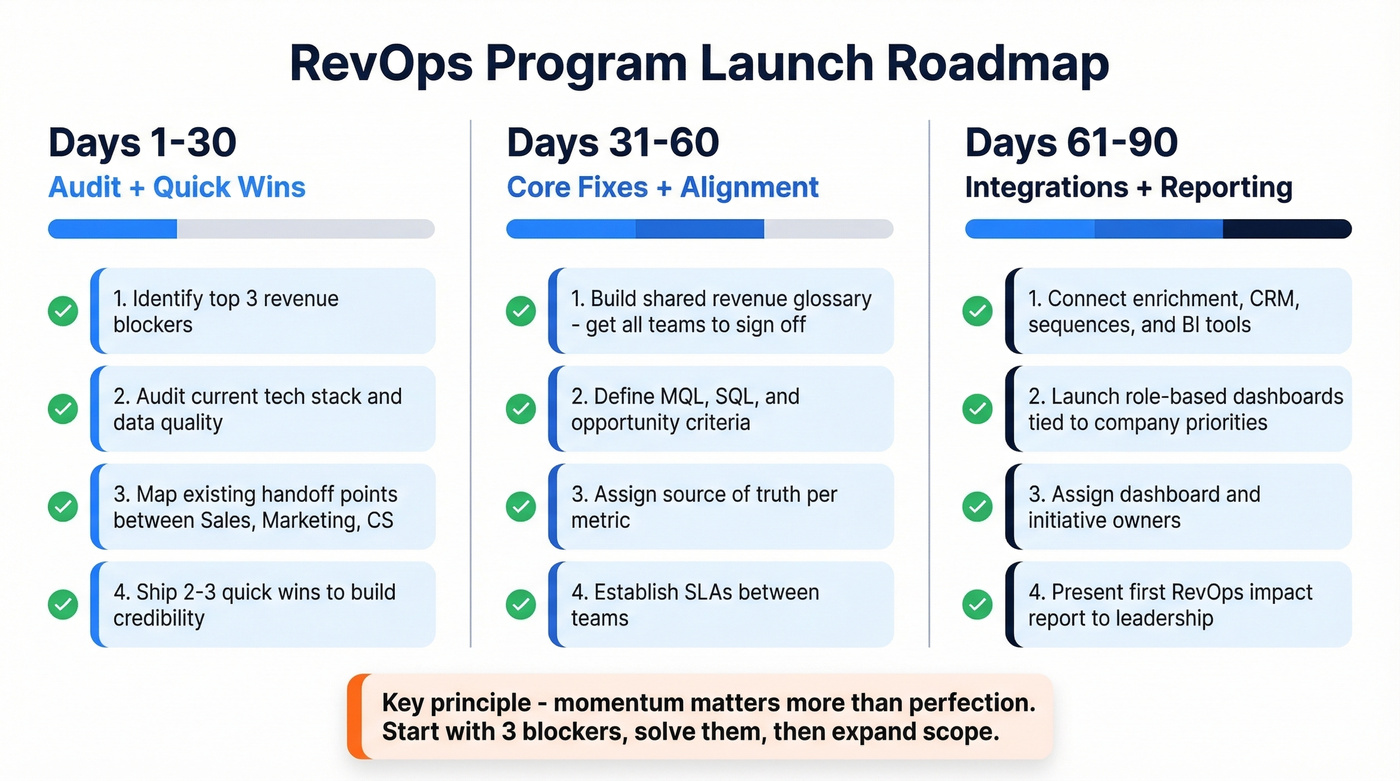
Days 1-30: Audit + Quick Wins
Days 31-60: Core Fixes + Alignment
Establish shared definitions. What's an MQL? When does an SQL become an opportunity? Get Sales, Marketing, and CS to sign off in the same room, on the same document. Build your revenue glossary and assign a source of truth per metric. If Sales says "pipeline" and Finance hears something different, you don't have alignment - you have a shared Slack channel.
Days 61-90: Integrations + Reporting
Connect your stack so data moves without manual work: enrichment, CRM, engagement sequences, BI. Launch role-based dashboards tied to the three to five company priorities you identified in month one. Assign owners to every initiative - dashboards without owners become decoration.
Team Structure and Reporting
The The Skaled model gives you a clean hierarchy: VP of RevOps at the top, functional leads in the middle (Sales Ops, Marketing Ops, CS Ops), and analysts plus technical contributors running dashboards, attribution, and integrations at the base.
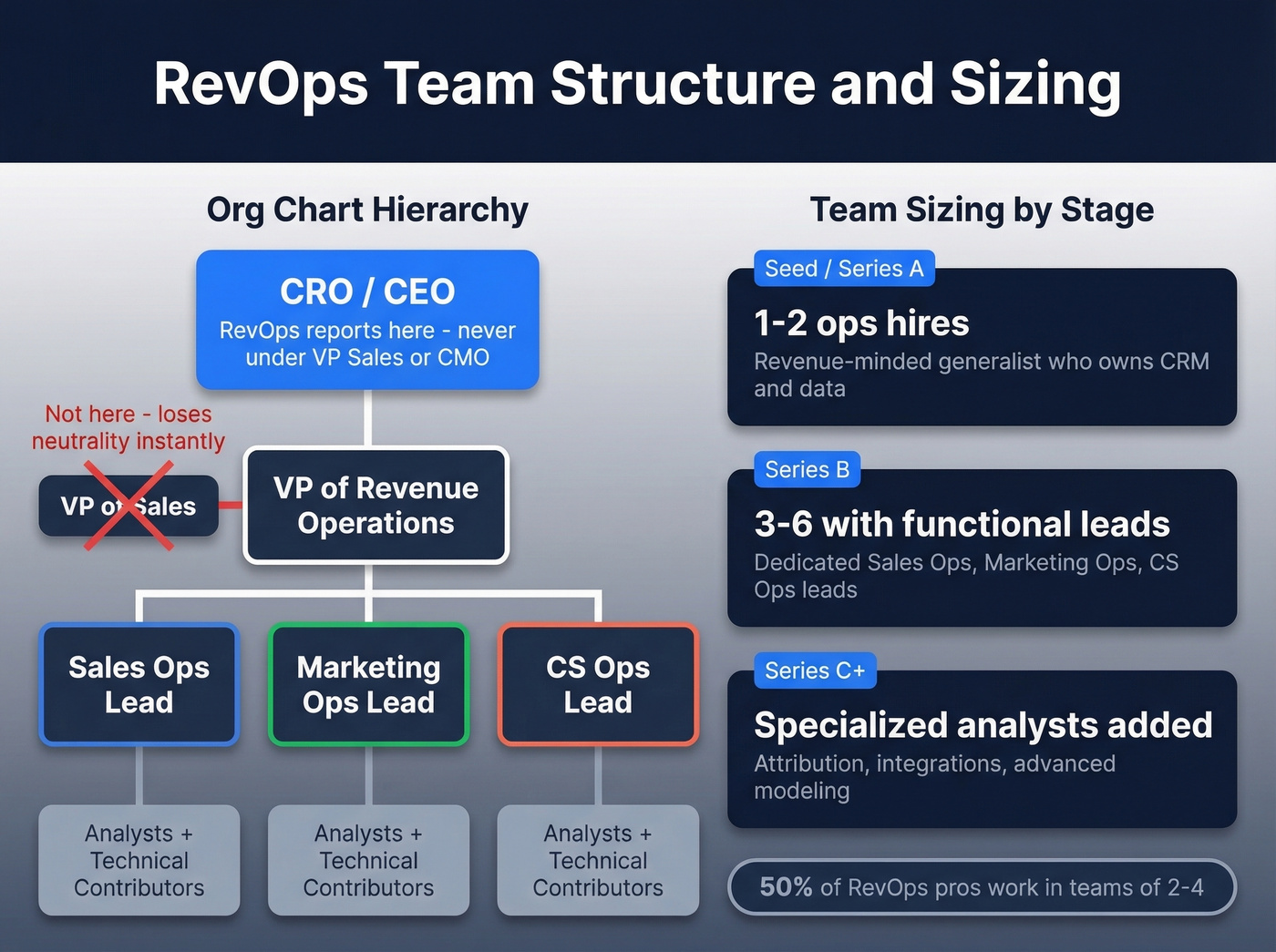
RevOps should report to the CRO. Never the VP of Sales or CMO. We've seen RevOps teams become glorified Sales Ops the instant they sit under a sales leader, fielding one team's requests while the rest of the org loses trust in the function. For sizing: one to two ops hires at seed/Series A, three to six by Series B with functional leads, and specialized analysts by Series C+. About half of RevOps pros work in teams of two to four.
Let's be honest about something: if your average deal size is under $15k and you're pre-Series A, you probably don't need a dedicated RevOps hire yet. You need a revenue-minded ops generalist who owns the CRM, data governance, and GTM alignment. Call it RevOps if you want - just don't build a three-person team before you have the revenue complexity to justify it.

A RevOps program without clean data is just a reporting team. Prospeo's CRM enrichment returns 50+ data points per contact at a 92% match rate - with a 7-day refresh cycle that keeps your pipeline from decaying between quarterly cleanups.
Stop building RevOps on stale data. Enrich your CRM today.
Your Tech Stack by Stage
The average enterprise RevOps team manages 12-18 tools, and most of them overlap in the data layer. 60% of CRM implementations fail - usually because teams buy tools before defining their revenue operations strategy. Map your sales motion first, then fill gaps.
| Stage | CRM | Engagement | Enrichment | Analytics |
|---|---|---|---|---|
| Series A | HubSpot Pro / SF Essentials | Apollo or Outreach | Prospeo + intent layer | Looker / Tableau |
| Series B+ | Salesforce Sales Cloud | Outreach / Salesloft | Prospeo + waterfall | Full BI stack |
Data quality is a day-one problem, not a scale problem - which is why the enrichment layer appears at every stage. A 7-day data refresh cycle (versus the 6-week industry average) means your CRM doesn't decay between quarterly cleanups, and native integrations with Salesforce, HubSpot, Clay, and Zapier slot directly into existing RevOps workflows without custom middleware.
Most RevOps teams manage 12-18 tools but still can't trust their data layer. Prospeo plugs directly into Salesforce, HubSpot, Clay, and Zapier - 98% verified emails at $0.01 each, no contracts, no middleware required.
Fix your RevOps data layer in minutes, not quarters.
Mistakes That Kill RevOps Programs
Treating CRM like a Rolodex. If your CRM is just contact storage with light deal tracking, you don't have a revenue system. Segment pipelines by revenue motion - net-new vs. renewals vs. expansion - and require structured fields before deals advance. Degreed consolidated four routing tools into one and saved five hours per week just by rethinking their CRM architecture.
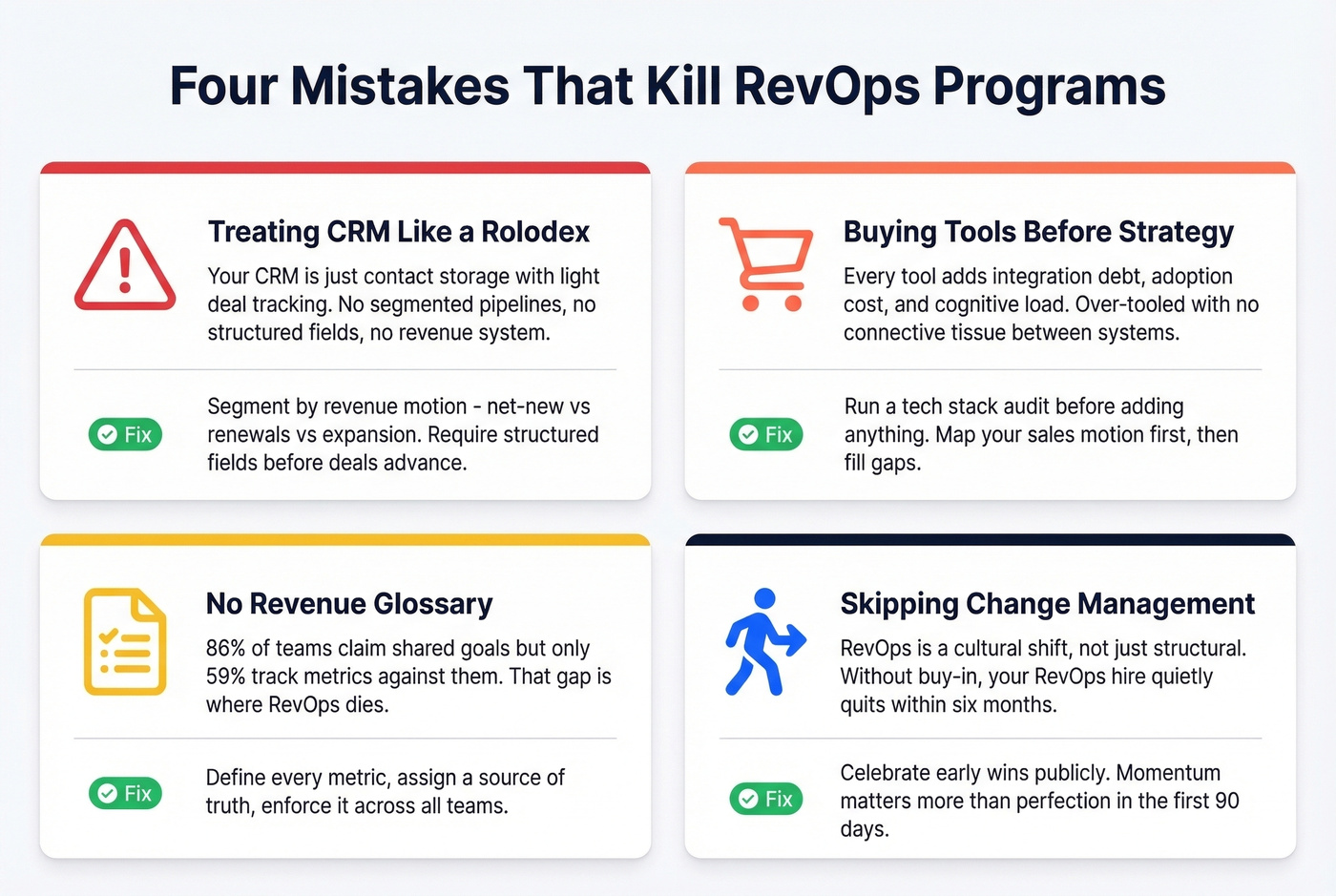
Buying tools before strategy. Every tool adds integration debt, adoption cost, and cognitive load. Run a tech stack audit before adding anything new. In our experience, the teams that struggle most aren't under-tooled - they're over-tooled with no connective tissue between systems.
No revenue glossary. Define every metric, assign a source of truth, and enforce it. The gap between teams who claim shared goals and teams who actually track them proves this isn't optional.
Skipping change management. RevOps is a cultural shift, not just a structural one. Celebrate early wins publicly. The Reddit consensus and every practitioner framework agree: momentum matters more than perfection in the first 90 days. Skip this if you want your RevOps hire to quietly quit within six months.
Certifications Worth Your Time
| Program | Price | Duration | Best For |
|---|---|---|---|
| HubSpot RevOps | Free | ~7 hours | Beginners, HubSpot shops |
| Revenue Wizards | $460-$920 | 5 weeks | Mid-career practitioners |
| RevOps Co-op ROC | $1,995 | 15 hours | Senior ops leaders |
| Salesforce Admin | $200 exam | 40-80 hrs prep | SF-heavy orgs |
| Pavilion | $2,000-$5,000/yr | Ongoing | Network + peer learning |
The HubSpot cert is free and takes a Saturday - start there. The Salesforce Admin cert appears in 60%+ of RevOps job postings at Salesforce-based companies; if that's your stack, it's one of the highest-signal credentials you can add.
Measuring RevOps ROI
Gartner projected that by 2026, 75% of the highest-growth companies would deploy a RevOps model - and the data is bearing that out. But the Forrester numbers (36% more revenue growth, 28% more profitability) only materialize if you tie RevOps KPIs to business outcomes, not activity metrics.
The Accenture GenAI gap is real: 63% of software executives say GenAI will be crucial to RevOps, but only 1 in 4 actually incorporate it. That matters - but only after the fundamentals are in place. Clean data, shared definitions, working handoffs. Your first move: run the maturity audit from the table above this week. A well-designed RevOps program follows from knowing where you actually stand. Everything else is noise.
FAQ
What's the difference between RevOps and Sales Ops?
Sales Ops optimizes the sales function alone. A RevOps program sits above Sales, Marketing, and CS Ops, aligning all three through unified data, processes, and technology. Sales Ops is a department; RevOps is a cross-functional operating model that includes Finance and enablement.
Where should RevOps report in the org chart?
RevOps should report to the CRO or CEO - never the VP of Sales or CMO. It loses neutrality the moment it reports into a single revenue function and quickly devolves into a ticket queue for one team's requests.
How big should a RevOps team be?
One to two ops hires at seed/Series A, three to six by Series B with functional leads, and specialized analysts by Series C+. About half of RevOps pros work in teams of two to four per the latest State of RevOps survey.
What tools does a RevOps team need on day one?
A CRM (HubSpot or Salesforce), a data enrichment tool for CRM hygiene and verified contacts, and native email sequences. Prospeo's free tier covers early-stage enrichment needs - 75 verified emails/month plus CRM enrichment - without adding budget pressure. Add dedicated engagement platforms and BI tools as you scale, because every tool creates integration overhead.