

RevTech: B2B Revenue Technology Guide for 2026
RevTech shares a name with motorcycle parts, a France-based heat-treatment equipment manufacturer, and a Dallas VC firm. The B2B software category it actually represents? Still waiting for its own Wikipedia page.
That's a branding problem for an entire industry. RevTech - revenue technology - has quietly become the shorthand B2B teams use for the tools that power pipeline generation, deal acceleration, and revenue forecasting. This guide breaks down what it actually means, which layers matter, and how to build a stack that works instead of one that just adds invoices.
The short version: RevTech is the collection of tools B2B teams use to find, engage, and close buyers. Starting from scratch, three tools cover 80% of what most teams need: a CRM (HubSpot or Salesforce), a data provider (Prospeo), and an outbound sequencer (Instantly or Smartlead). Total cost: $150-$500/month.
What Is RevTech?
RevTech (revenue technology) is the collection of tools, platforms, and data infrastructure B2B companies use to generate, accelerate, and retain revenue. It's not a single product category. It's an umbrella covering everything from your CRM to your email verification tool to your intent data provider, unified by one principle: every tool in the stack should connect back to pipeline and revenue outcomes.
A quick disambiguation for anyone who landed here from the wrong search result. RevTech Ventures is a Dallas-based VC firm focused on retail technology. RevTech Labs is a fintech accelerator in Charlotte. And RevTech is also a brand of motorcycle engines and parts - the Harley Davidson forums have strong opinions about those. None of that is what we're covering here.
The distinction that matters: revenue technology isn't MarTech, and it isn't SalesTech. MarTech focuses on marketing automation and demand gen. SalesTech covers the tools reps use directly - dialers, sequencers, CRMs. RevTech spans both, plus data providers, conversation intelligence, revenue operations platforms, and analytics. If a tool touches pipeline from first touch to closed-won to renewal, it belongs in this category.
Why Revenue Technology Matters Now
Five years ago, most B2B companies ran sales and marketing on separate tool stacks with separate budgets and separate reporting. Marketing owned the MAP and the website. Sales owned the CRM and the dialer. Nobody owned the data layer, and pipeline attribution was a spreadsheet exercise.
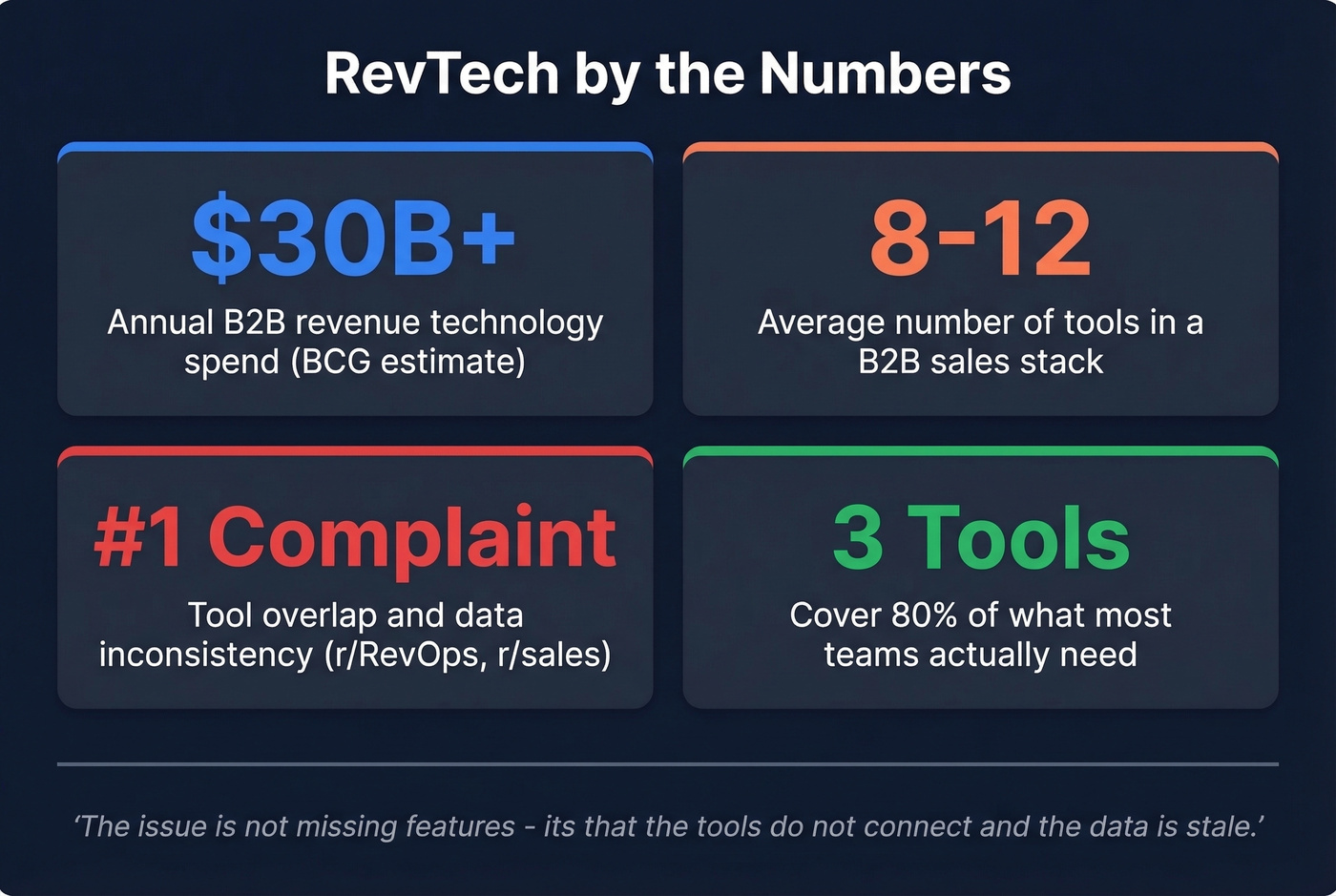
That model broke when companies started consolidating under revenue operations - a single team owning the full funnel - and created demand for tools that actually talk to each other. The market is growing fast. When you add CRM, outbound sequencing, enrichment, intent data, and conversation intelligence, BCG estimates the broader revenue technology market at $30B+ in annual spend.
Here's the thing: most teams have 8-12 tools and pipeline is still flat. On r/RevOps and r/sales, the most common complaint isn't missing features - it's tool overlap and data inconsistency. The issue isn't a lack of technology. It's that the tools don't connect, the data is stale, and nobody's accountable for the full revenue workflow. A coherent rev tech stack eliminates the gaps between "we found a lead" and "we closed the deal." The difference comes down to which layers you invest in and how clean your data is.
Core Layers of a RevTech Stack
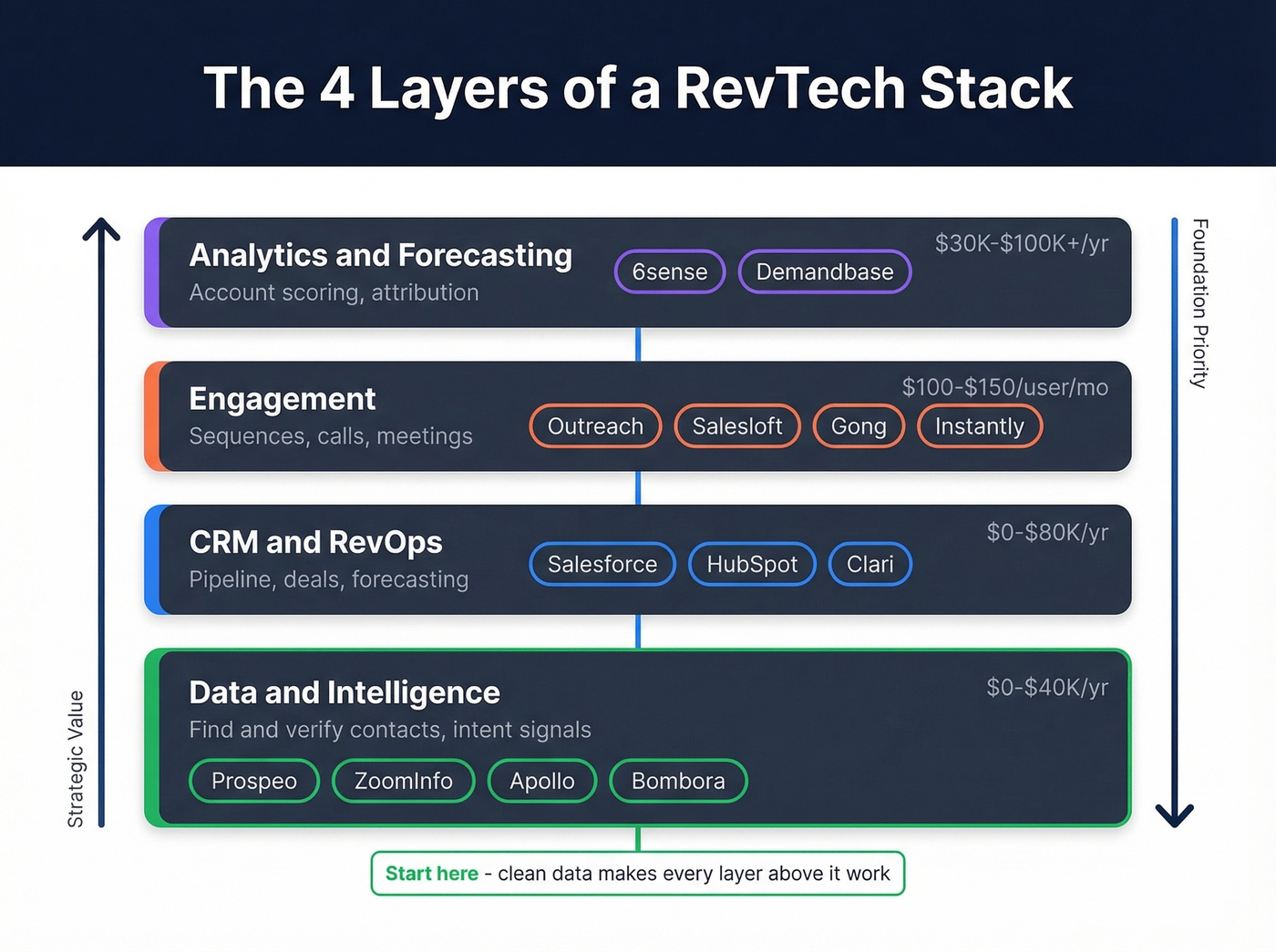
Most B2B revenue technology stacks break into four layers. The tools change depending on budget and complexity, but the layers don't.
Data & Intelligence
This is the foundation. Data providers, email finders, mobile number databases, enrichment tools, and intent data platforms all live here. Without accurate contact data, every other layer underperforms - your sequencer sends emails that bounce, your CRM fills with stale records, and your reps waste hours chasing disconnected numbers.
Prospeo covers 300M+ professional profiles with 98% email accuracy and a 7-day data refresh cycle, compared to the 6-week industry average. The 5-step verification process handles catch-all domains, strips spam traps, and filters honeypots before you ever export a record. It also layers in intent data tracking 15,000 topics via Bombora, so you can filter by in-market signals before building a list. Native integrations with Salesforce, HubSpot, Instantly, Smartlead, and more mean the data layer connects directly to your CRM and sequencer without middleware.

ZoomInfo ($15K-$40K/year) remains the enterprise default with the deepest US database and broadest feature set. Apollo has a free tier with paid plans from $49-$99/user/mo, offering strong prospecting UI for SMBs. Cognism ($15K-$50K/year) wins in EMEA with phone-verified mobile numbers and GDPR-first compliance. Bombora ($25K-$50K/year standalone) provides intent data that layers onto any provider.
CRM & RevOps
Your CRM is where pipeline lives, deals progress, and forecasting happens. Salesforce dominates enterprise at roughly $25-$330/user/mo depending on edition. HubSpot offers a genuinely useful free CRM and Sales Hub starting around $20/user/mo - it's the obvious choice for teams under 50 people who don't need Salesforce's complexity.
Clari ($30K-$80K/year) layers on top of CRM for revenue forecasting and pipeline inspection. RevTech.ai is a newer RevOps platform focused on consolidating revenue workflows, with pricing typically landing around $1K-$5K/month for mid-market teams.
Engagement
This is where outbound actually happens. Sequencers, conversation intelligence platforms, and meeting schedulers turn data into conversations.
Outreach and Salesloft ($100-$150/user/mo each) are the incumbents for multi-channel sequencing. Gong ($100-$150/user/mo) owns conversation intelligence - call recording, deal analysis, coaching insights. For teams running high-volume cold email, Instantly and Smartlead ($30-$97/mo) offer dedicated sending infrastructure at a fraction of the cost. We've seen teams run 5,000+ emails/day through Instantly with solid deliverability when the data feeding it is clean.
Analytics & Forecasting
The strategic layer. Account-level intent scoring, pipeline attribution, and predictive analytics help leadership decide where to invest.
6sense and Demandbase ($30K-$100K+/year each) are the two dominant platforms, both offering account identification, intent signals, and ABM orchestration. Clari also plays here with pipeline forecasting. These are enterprise purchases - skip them if you're under 200 employees.
| Layer | What It Does | Key Tools | Typical Cost | Start Here |
|---|---|---|---|---|
| Data & Intelligence | Find/verify contacts, intent | Prospeo, ZoomInfo, Apollo | $0-$40K/yr | Prospeo |
| CRM & RevOps | Pipeline, forecasting | Salesforce, HubSpot, Clari | $0-$80K/yr | HubSpot |
| Engagement | Sequences, calls, meetings | Outreach, Salesloft, Gong | $100-$150/user/mo | Instantly |
| Analytics & Forecasting | Account scoring, attribution | 6sense, Demandbase | $30K-$100K+/yr | Skip until 200+ employees |

Every RevTech layer - CRM, sequencer, analytics - underperforms when the data feeding it is stale. Prospeo refreshes 300M+ profiles every 7 days (not 6 weeks), verifies emails to 98% accuracy, and layers in Bombora intent data across 15,000 topics. It's the data foundation your entire stack depends on.
Fix the data layer and every other tool in your stack starts working.
Data Quality - The Weakest Link
Your SDR team just sent 500 cold emails. 180 bounced. Your domain reputation took a hit, your sequencer flagged the campaign, and the 320 emails that did land are now competing against a sender score that's dropping by the day. This isn't a hypothetical - it's what happens when the data layer fails.
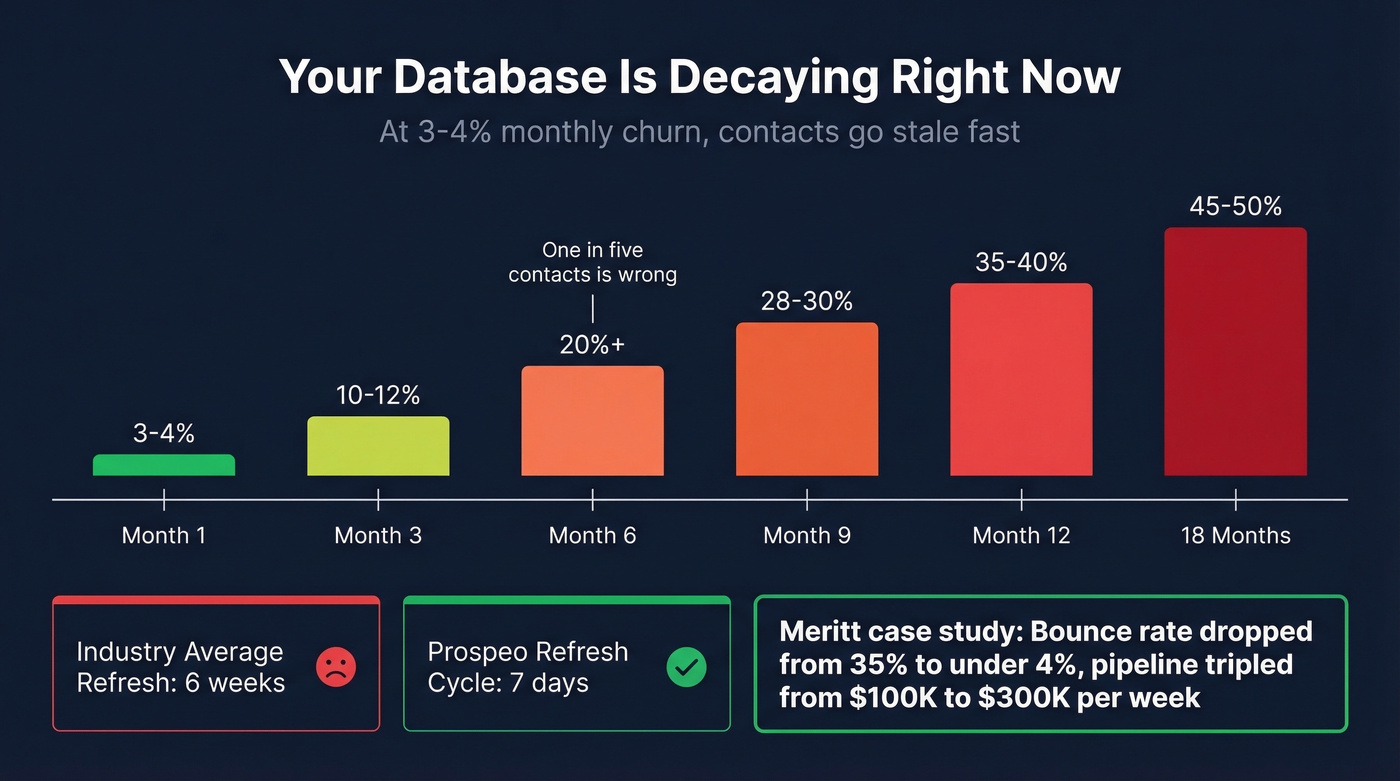
People change jobs roughly every 2-3 years, which means about 3-4% of your database goes stale every month. In six months, around 20%+ of your contacts are wrong. In a year, you're sending to ghosts. Every tool downstream - your sequencer, your CRM, your attribution model - underperforms when the data feeding it is bad. In our experience, the single biggest ROI lever in any revenue technology stack is data accuracy. The engagement layer can't fix a data problem. Neither can the CRM.
Let's be honest: if your average deal size is under $10K, you probably don't need ZoomInfo-level data spend. A $500/month stack with clean, frequently refreshed data will outperform a $10K/month stack built on stale records every single time. The industry has convinced too many teams that they need more tools, when what they actually need is better data flowing through fewer tools.
When evaluating data providers, four criteria matter more than database size: accuracy rate, refresh cycle, verification methodology (do they handle catch-all domains or just skip them?), and spam-trap removal. When Meritt switched their data layer, bounce rates dropped from 35% to under 4% and pipeline tripled from $100K to $300K per week. That's not a tool upgrade - that's a revenue jump driven entirely by data quality.

You read it above: three tools cover 80% of what most teams need. Prospeo is the data layer - 30+ search filters, 125M+ verified mobiles, native integrations with HubSpot, Salesforce, Instantly, and Smartlead. Total cost starts at $0.01 per email. No contracts, no sales calls.
Build a RevTech stack that generates pipeline, not just invoices.
Build Your Stack by Company Size
Startups & SMBs (Under 50)
Keep it lean. Three to four tools cover 80% of what you need:
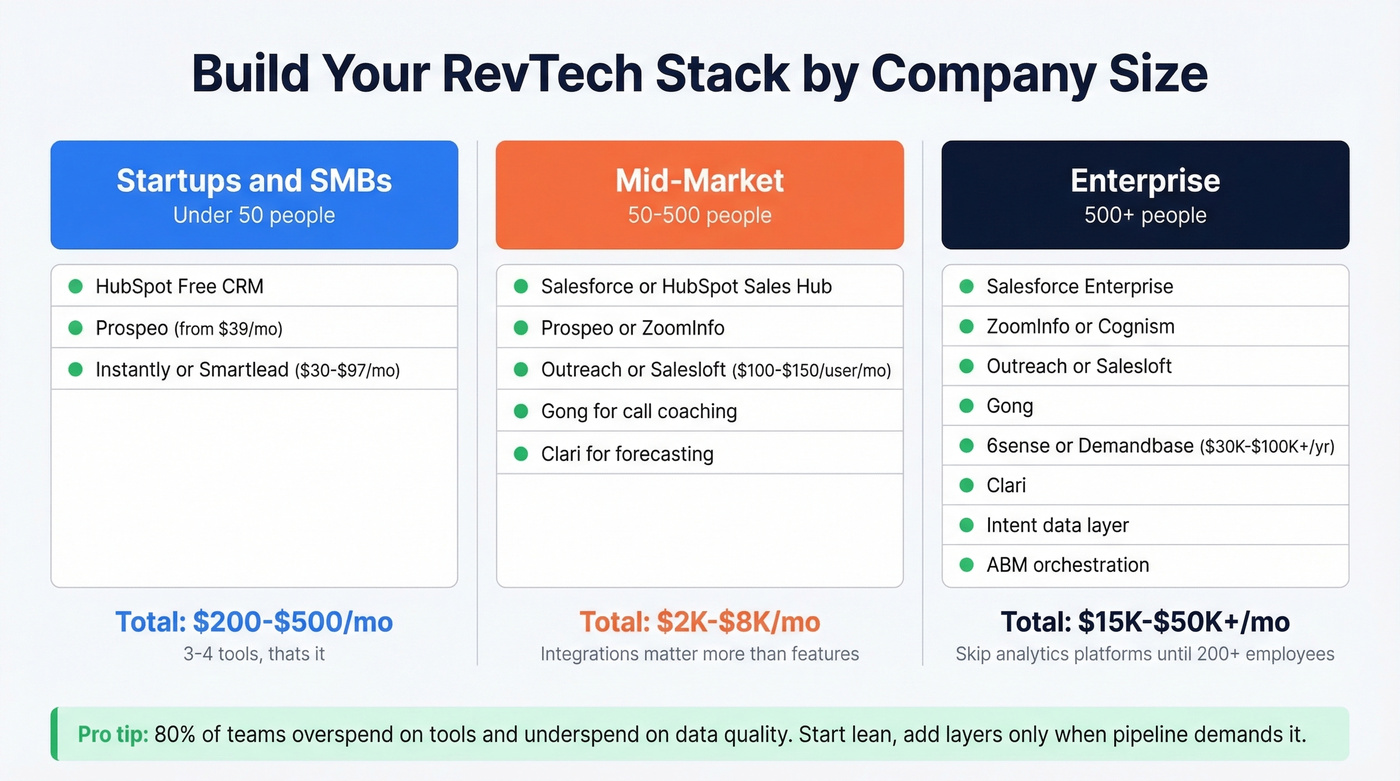
- HubSpot free CRM for pipeline management
- Prospeo for verified emails and mobile numbers (free tier to start, paid plans from ~$39/mo)
- Instantly or Smartlead for cold email sequencing ($30-$97/mo)
Total monthly cost: $200-$500. That's a functional outbound machine. You don't need intent data, conversation intelligence, or a forecasting platform at this stage. You need accurate contacts, a place to track deals, and a way to send sequences. Everything else is a distraction until you've got repeatable pipeline. Stack Optimize used exactly this kind of lean setup to go from $0 to $1M ARR while maintaining 94%+ deliverability and sub-3% bounce rates across all clients.
Mid-Market (50-500 People)
This is where the stack expands to 5-7 tools and integrations start mattering more than individual features. The typical mid-market setup runs Salesforce or HubSpot Sales Hub as the CRM backbone, adds a dedicated data provider for the intelligence layer, and layers on Outreach or Salesloft for multi-channel sequences at $100-$150/user/mo.
Gong becomes worth the investment here because coaching insights compound as your team scales - we've helped teams cut rep ramp time from 8-10 weeks to 4 by combining clean data with Gong's call analysis. Clari ($30K-$80K/year) handles pipeline forecasting once your deal volume makes spreadsheet tracking unreliable.
Budget: $2K-$8K/month depending on team size. This is also where you need a dedicated RevOps hire. Someone has to own the data flow between tools and keep the CRM from turning into a junk drawer.
Enterprise (500+ People)
| Component | Tool | Budget |
|---|---|---|
| CRM | Salesforce | ~$25-$330/user/mo |
| Data Layer | ZoomInfo (US) or Cognism (EMEA) | $15K-$50K/yr |
| Sequencing | Outreach | $100-$150/user/mo |
| Call Intelligence | Gong | $100-$150/user/mo |
| Intent & ABM | 6sense or Demandbase | $30K-$100K+/yr |
| Forecasting | Clari | $30K-$80K/yr |
Total budget: $50K-$150K+/year. The ROI math works at this scale because the cost of bad data or missed pipeline visibility is measured in millions, not thousands.
Stack Audit Checklist
Before adding another tool, run through these five questions. If you can't answer "yes" to all five for your current stack, fix what you have before buying something new.
- Can you trace a lead from first touch to closed-won in under 60 seconds? If not, your CRM and engagement tools aren't properly connected.
- Is your email bounce rate under 5%? Above that, your data layer is the bottleneck - not your copy, not your sequencer.
- Do all your tools share a single source of truth for contact data? Duplicate records across platforms mean conflicting pipeline numbers.
- Can your RevOps team pull a pipeline attribution report without a spreadsheet? If attribution requires manual work, your analytics layer is missing or misconfigured.
- Has every tool earned its renewal? The most upvoted advice on r/sales about revenue technology stacks is brutally simple: cut any tool that doesn't directly contribute to pipeline. If you can't point to a specific workflow it powers, cancel it.
Revenue Technology Trends in 2026
AI-Native Tools Are Mainstream
The RevOps trends that Skaled tracked heading into 2026 - AI-driven lead scoring, automated enrichment, predictive sequencing - have gone mainstream. Tools without an AI layer are getting left behind.
Consolidation Is Accelerating
Point solutions are being absorbed into platforms. Outreach has expanded into features that used to require separate tools. HubSpot keeps pushing into territory once dominated by Outreach or Gong. Expect fewer vendors and bigger bundles.
Intent Data Is Table Stakes
Two years ago, intent was a premium add-on. Now every serious data provider includes some form of buyer intent signals. The differentiation has shifted from "do you have intent data" to "how fresh and actionable is it."
Data Freshness Is the Battleground
A 6-week refresh cycle used to be acceptable. It's not anymore. When reps can tell the difference between a 7-day-old record and a 6-week-old record by their bounce rates, freshness becomes a competitive differentiator - not a nice-to-have.
FAQ
What does RevTech stand for?
RevTech stands for revenue technology - the tools and platforms B2B companies use to generate, accelerate, and retain revenue across sales, marketing, and customer success. The category spans data providers, CRMs, sequencers, conversation intelligence, and analytics platforms.
How is RevTech different from MarTech?
MarTech focuses on marketing automation and campaign management. Revenue technology is broader - it includes MarTech plus sales tools, data providers, conversation intelligence, and revenue operations platforms, all unified around pipeline outcomes.
How much does a RevTech stack cost?
Startups spend $200-$500/month with self-serve tools like HubSpot, Prospeo, and Instantly. Mid-market teams budget $2K-$8K/month. Enterprise stacks with ZoomInfo, Salesforce, and 6sense run $50K-$150K+/year.
What's the most important layer to invest in first?
Data quality. Every other tool - your CRM, sequencer, intent platform, forecasting engine - depends on accurate, fresh contact data. Start with a verified data provider, then build outward. Teams that fix data first see the fastest pipeline gains.
What's the difference between RevTech and SalesTech?
SalesTech covers tools salespeople use directly - CRMs, dialers, sequencers. Revenue technology encompasses SalesTech plus the data layer, analytics platforms, and cross-functional tools connecting sales to marketing under a single revenue framework.