

SaaS Discovery Call Questions That Actually Win Deals
You just ran a 30-minute discovery call, asked 22 questions, felt great - and the prospect ghosted. That's the problem with most SaaS discovery call questions: more doesn't mean better. Data from 326K analyzed calls shows won deals average 15-16 questions while lost deals average around 20. Meanwhile, 25% of sellers admit discovery is their top weakness, and 96% of buyers have already researched your category before they pick up the phone.
The bar is higher than most reps think.
Quick version: Target 43% talk / 57% listen. Ask 15-16 questions, not 20+. Research the prospect's tech stack and intent signals before the call. Use SPICED for SMB, MEDDIC for enterprise.
The Numbers Behind Great Discovery
The 326K-call dataset paints a clear picture. The average rep talks 60% of the call, and once you cross 65% talk time, win rates drop measurably. The golden ratio is 43/57 - and it's non-negotiable.
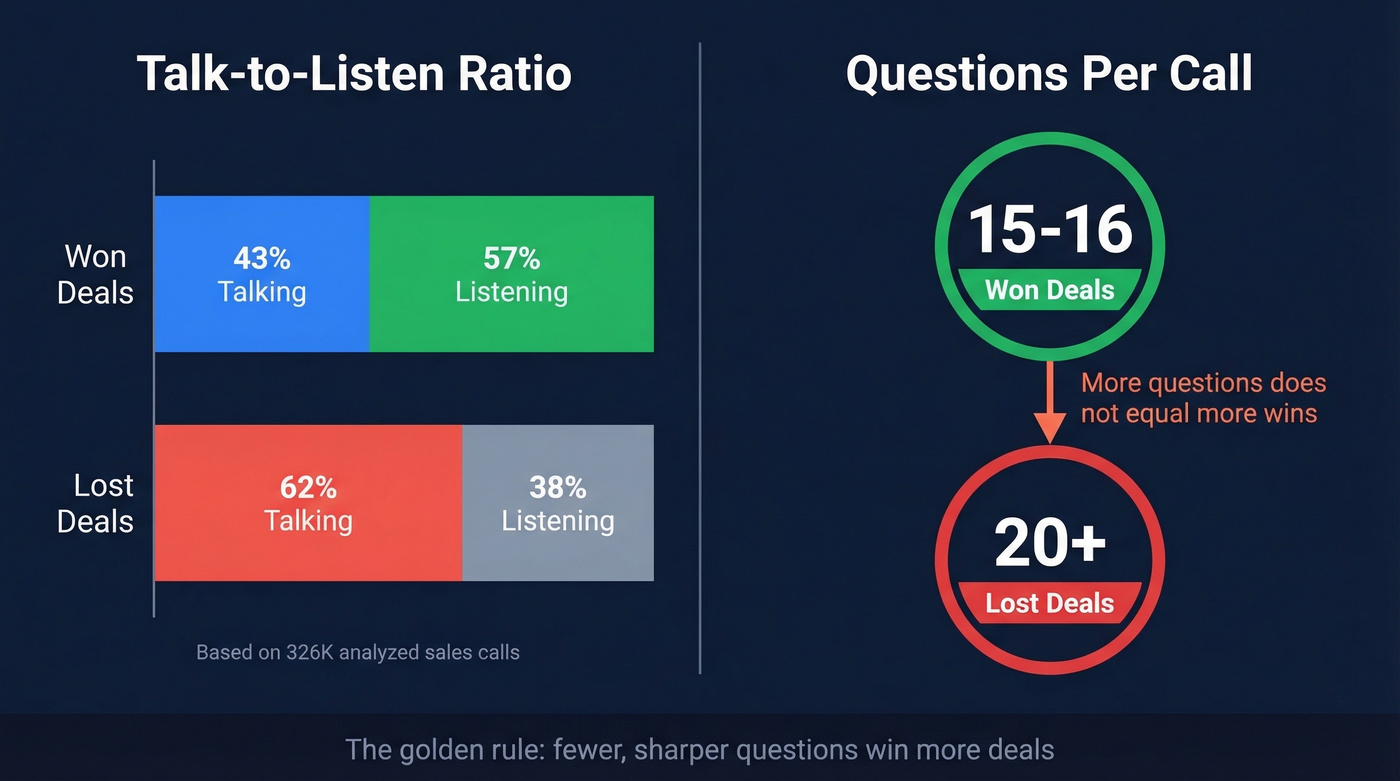
One nuance worth flagging: in Gong's data, closed-won calls still average more seller talk than the golden ratio suggests (57% talk vs. 62% in lost deals). The takeaway holds regardless. The more you turn discovery into a monologue, the worse your outcomes get.
Here's the counterintuitive part: won deals involve fewer questions. Reps who closed asked 15-16 on average; reps who lost asked around 20. Past a certain threshold, discovery stops feeling like a conversation and starts feeling like an interrogation. If your deal's LTV is under $1,500, keep the call to 15 minutes and ask 10-12 sharp questions. Higher-value deals justify 30 minutes and the full 15-16.
5 Questions Most Reps Skip (That Save Deals)
A practitioner on r/SaaSSales analyzed 500 discovery calls and found five questions reps routinely skip - each one mapping to a deal-killing blind spot.
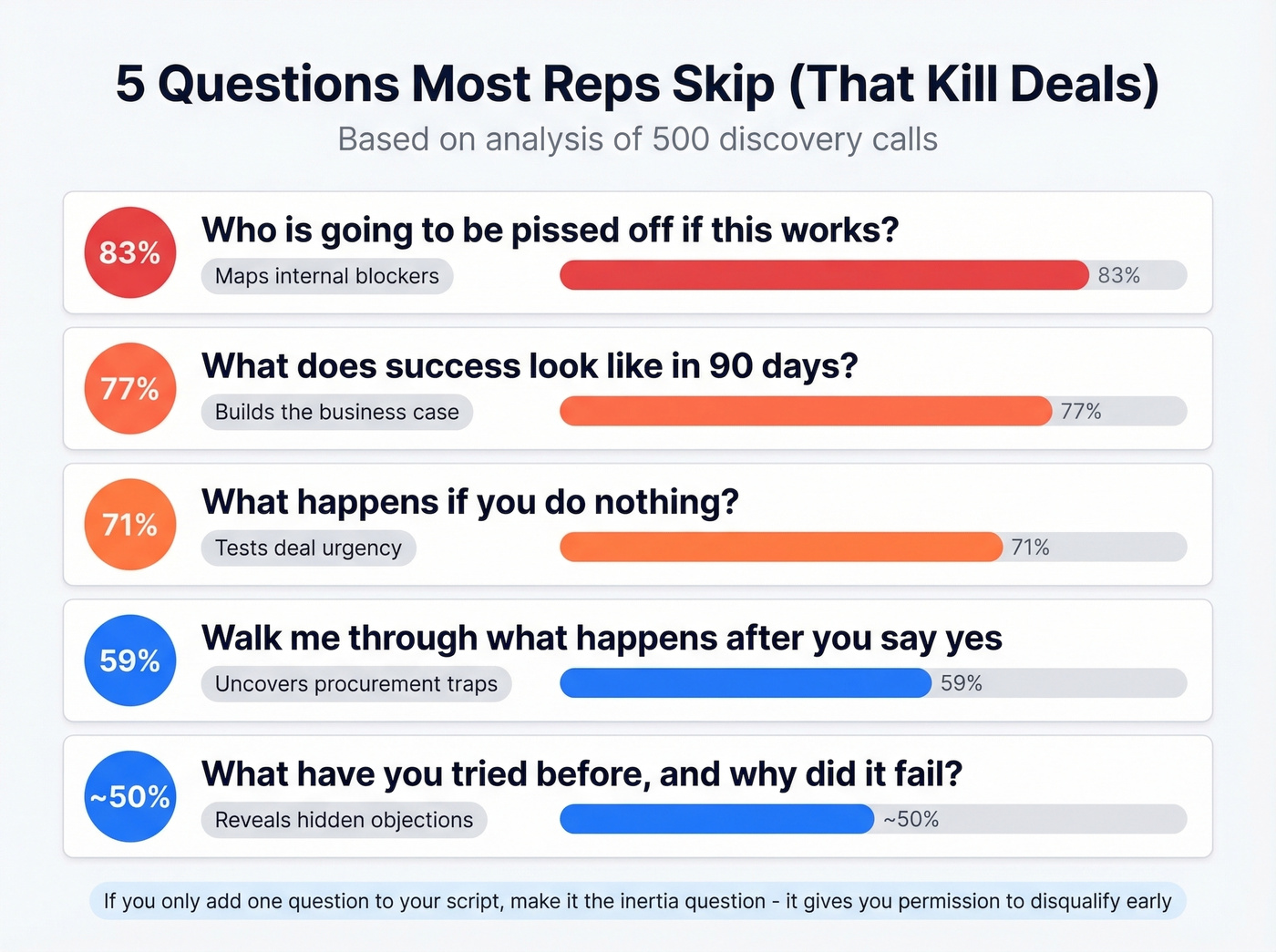
"Who's going to be pissed off if this works?" - 83% skip rate. Every new tool creates internal losers. If you don't map them, they'll kill the deal in a committee meeting you're not invited to.
"What does success look like in 90 days?" - 77% skip rate. Without near-term outcomes, your champion can't build an internal business case. This is the question that turns vague interest into a quantified proposal.
"What happens if you do nothing?" - 71% skip rate. This is the inertia question. If the cost of inaction is tolerable, there's no deal - and you have permission to disqualify. Better to walk away now than after three demos and a security review.
"Walk me through what happens after you say yes." - 59% skip rate. Legal, procurement, security questionnaires, board approval - the "verbal yes to stuck in legal" gap kills more deals than competitors do.
"What have you tried before, and why didn't it work?" Past attempts reveal hidden objections, budget history, and political landmines. We've seen this single question uncover blockers that would have surfaced three months into a stalled deal.
Discovery Questions by Category
Stop collecting questions. Start deleting them. Every question below earns its spot by qualifying the deal, surfacing hidden pain, or mapping the buying process. If a question doesn't serve one of those three goals, cut it.
Situation and Current State
Your buyer already knows the category. Skip "tell me about your company" and go straight to priorities.
- "What are your top 2-3 priorities this quarter? Stack rank them."
- "What tools are you using today for [problem area], and what's working vs. not?"
- "What's driving this to be a priority now vs. six months ago?"
For inbound leads, try the "go back in time" technique. Start where the buyer is:
You: "Which vendor impressed you most so far? Why?" Prospect: "We liked X's reporting, but their onboarding looked painful." You: "Got it. Take me back - what triggered this search in the first place?"
This rewinds past the feature-shopping phase and into the original pain.
Pain and Challenges
The best pain question we've encountered is the "awkward question" pattern from PClub's discovery framework. You ask: "Mind if I ask an awkward question?" - then follow with: "What ripple effect is this having on you personally?"
The word "personally" gets past corporate-speak and into real motivation. Pair it with "How long has this been a problem, and what have you tried?" and you'll surface more in two questions than most reps get in ten. These kinds of B2B discovery questions separate average reps from top performers because they force the prospect to articulate stakes, not just symptoms.
Impact and Urgency
- "How much has this cost you in the last 12 months - in dollars, time, or missed targets?"
- "If we fixed that, what would the impact look like for your team?"
- "What metric would prove this was the right call?"
That last one is sneaky effective. The word "metric" forces specificity and gives you the exact success criteria you'll reference in your proposal.
Solution Fit and Decision Process
- "What are your must-haves vs. nice-to-haves?"
- "What integrations are non-negotiable?"
- "Who else needs to weigh in before this moves forward?"
- "Walk me through your typical procurement process for a tool like this."
- "Is there a specific event or deadline driving the timeline?"
- "Who's the economic buyer, and have they signed off on evaluating solutions?"
Locking Down Next Steps
Don't end with "I'll send over some info." That's not a next step - it's a slow death.
Frame the next decision explicitly and make it binary: "Based on what we've discussed, the logical next step is a 20-minute technical deep-dive with your ops lead. Does Thursday work, or is there something we should address first?" If they can't commit to a concrete next step, the deal probably isn't real. That's useful information too.

The article says 96% of buyers research you before the call. Shouldn't you research them too? Prospeo gives you tech stack, intent signals, and verified contact data across 300M+ profiles - so every discovery question lands with context, not guesswork.
Walk into every discovery call knowing more than your prospect expects.
MEDDIC vs SPICED - Pick Your Framework
BANT is outdated for most SaaS teams. Let's break down what actually works in 2026.
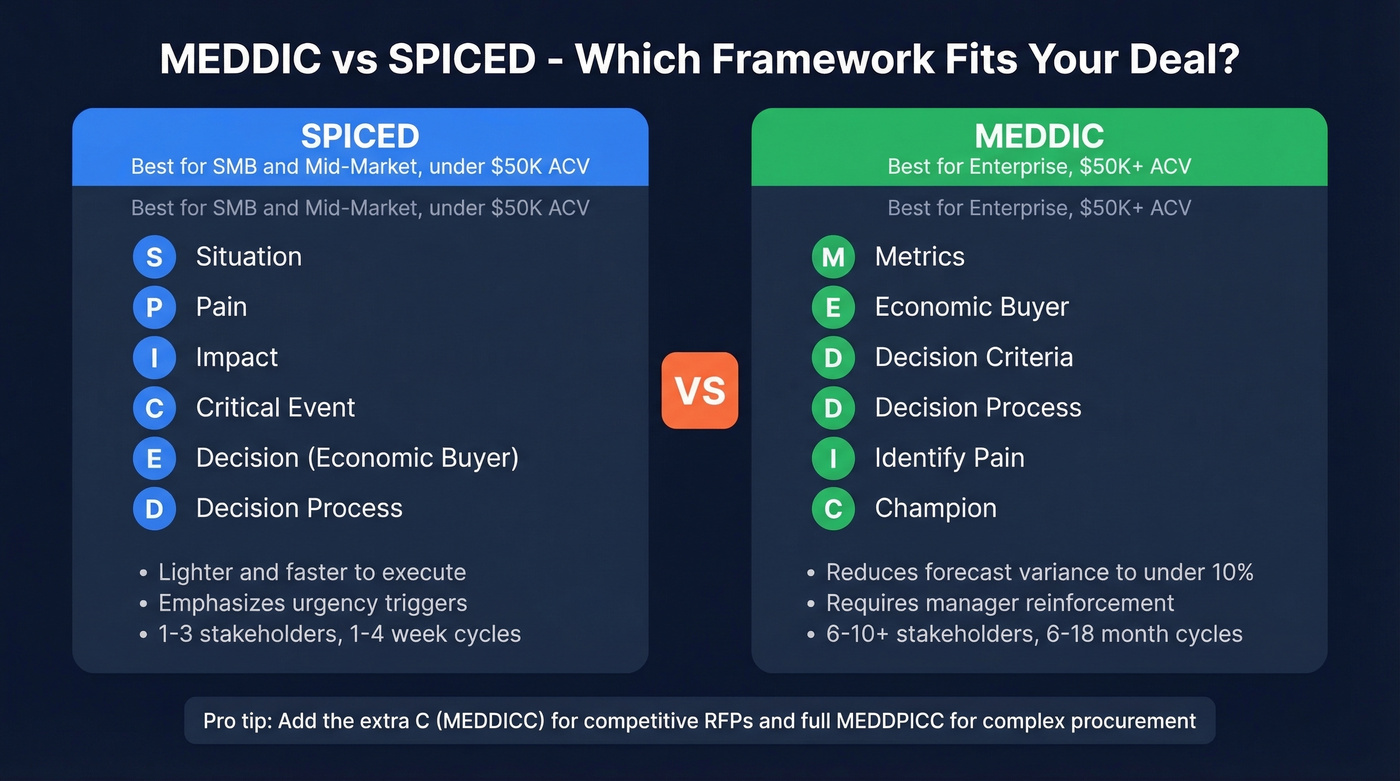
| Element | MEDDIC | SPICED |
|---|---|---|
| Context | (implicit) | Situation |
| Pain | Identify Pain | Pain |
| Quantification | Metrics | Impact |
| Urgency | (implicit) | Critical Event |
| Stakeholders | Economic Buyer + Champion | Decision |
| Process | Decision Process + Criteria | Decision |
MEDDIC originated at PTC in the 1990s and reduces forecast variance from 30-50% down to under 10% for enterprise deals. The catch: without reinforcement, adherence decays 40-50% within six months. Frameworks only work if managers actually inspect for them.
Here's the thing: use SPICED for anything under $50K ACV. It's lighter, emphasizes urgency triggers, and maps naturally to consultative selling. Step up to MEDDIC for $50K+ enterprise. Add the extra C (MEDDICC) for competitive RFPs, and the full MEDDPICC when complex procurement is involved. If you're selling $15K deals with two stakeholders, MEDDIC is overkill. Skip it.
Adapt Questions by Deal Size
| Dimension | SMB ($1.2K-$25K) | Enterprise ($50K-$500K+) |
|---|---|---|
| Cycle length | 1-4 weeks | 6-18 months |
| Stakeholders | 1-3 | 6-10+ |
| Discovery calls | 1 (15 min) | 3-5 (multi-call) |
| Opp-to-close | ~30-45 days | ~120 days |
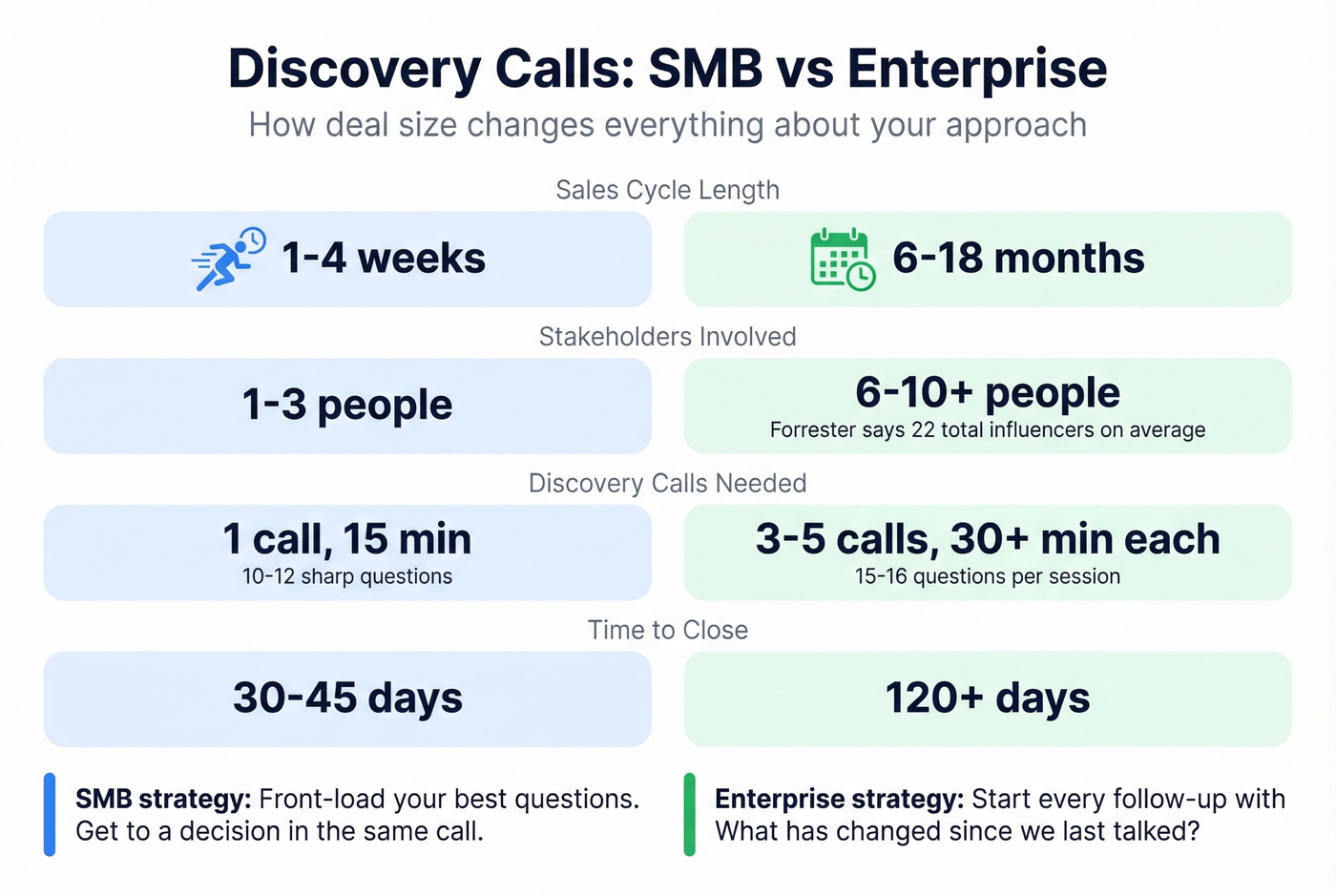
Forrester puts the average B2B buying decision at 22 total influencers - 13 internal, 9 external. For enterprise, discovery isn't an event. It's a process that evolves as new stakeholders surface, each with their own priorities and objections. Start every follow-up with: "What's changed since we last talked?" That single question resets context and catches political shifts before they derail your deal.
For SMB, the opposite applies. You've got one shot. Front-load the highest-impact questions and get to a decision in the same call if you can.
Pre-Call Research That Sharpens Every Question
If 96% of buyers have already researched your category, showing up with generic questions wastes everyone's time. Five minutes of pre-call research lets you skip 3-4 surface-level questions and go straight to pain.
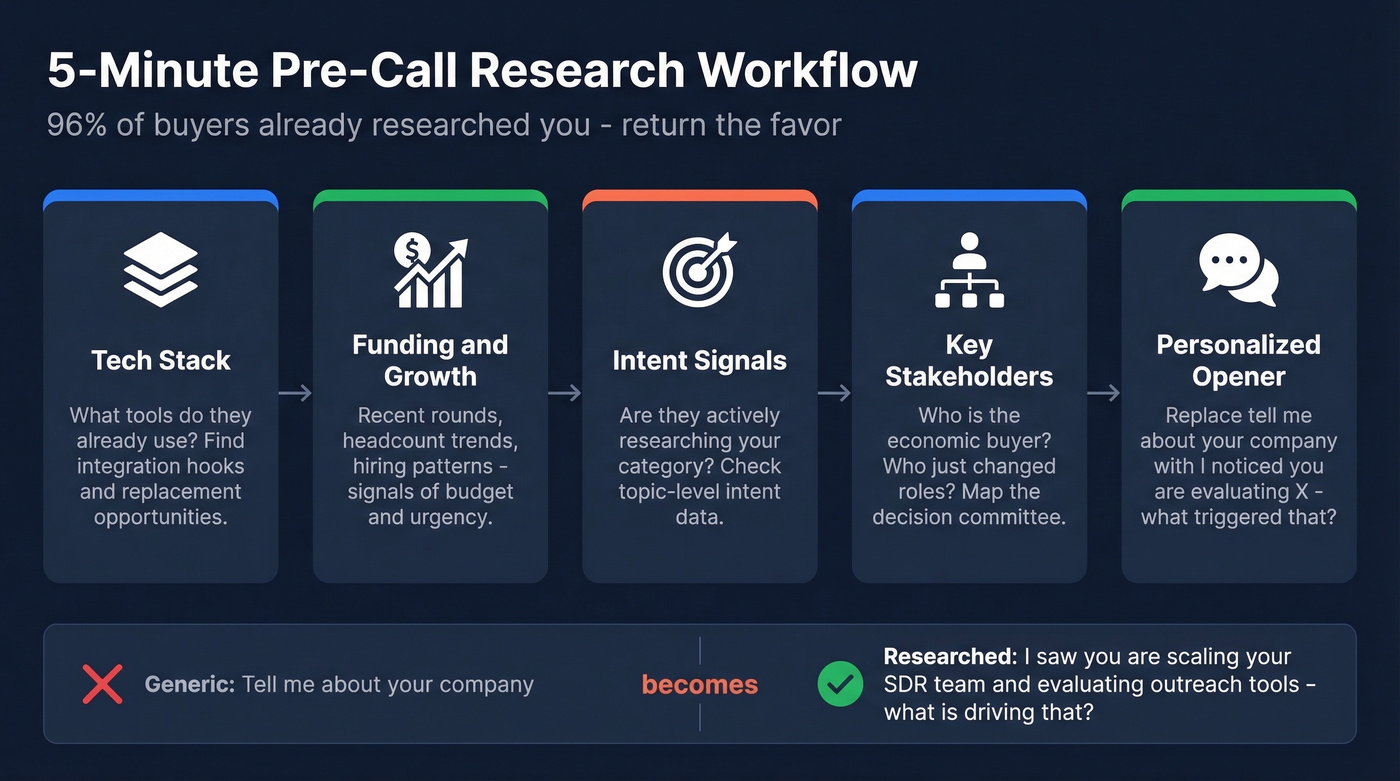
What to check: their tech stack, recent funding, headcount trends, key roles, and intent signals. We've found that reps who spend even five minutes on this consistently run tighter calls and close at higher rates - not because the research itself is magic, but because it lets you ask questions the prospect actually wants to answer instead of ones they've already answered six times this week.
Prospeo makes this fast with intent data across 15,000 topics, technographics, company growth signals, and verified contacts refreshed every 7 days. That's the difference between "tell me about your company" and "I noticed you're evaluating [category] - what triggered that?"
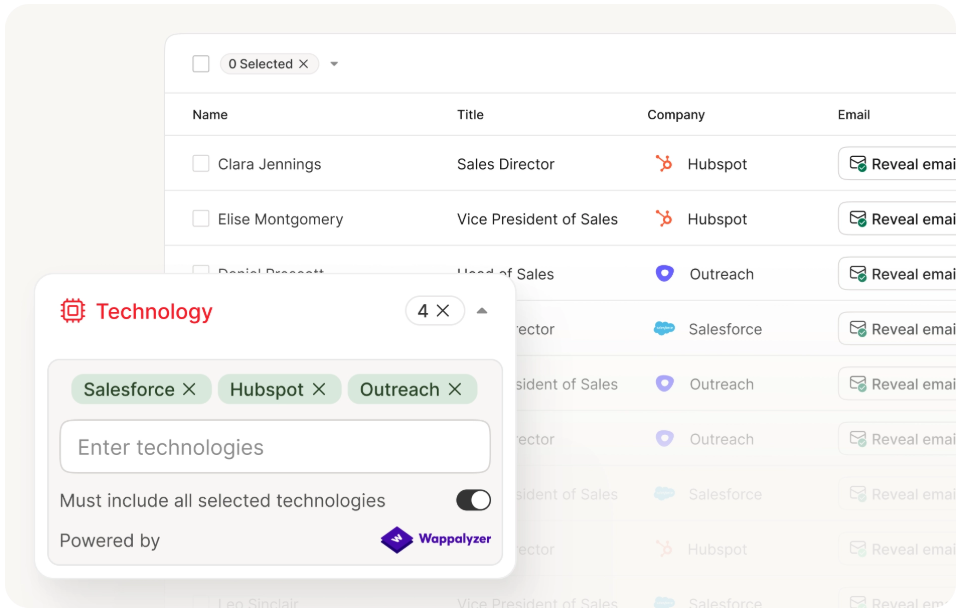
Great discovery questions are useless if you're calling the wrong person. Prospeo's 30+ filters - buyer intent, job changes, department headcount - let you reach the economic buyer directly with 98% email accuracy and 125M+ verified mobiles.
Stop discovering dead ends. Start discovering decision-makers.
FAQ
How many questions should I ask on a discovery call?
15-16 questions correlate with won deals in Gong's 326K-call dataset. More than 20 correlates with losses. Every question should qualify the opportunity, surface pain, or map the buying process - cut anything that doesn't serve one of those three goals.
How long should a SaaS discovery call last?
15-30 minutes depending on deal complexity. For deals under $2K in annual value, cap it at 15 minutes and ask 10-12 sharp questions. Complex enterprise evaluations with 6+ stakeholders justify 30-60 minutes spread across multiple sessions.
What's the best discovery framework for SaaS in 2026?
SPICED for SMB and mid-market deals under $50K ACV - it's lighter and emphasizes urgency triggers. MEDDIC for enterprise with 6+ stakeholders and complex procurement. Both give structure without turning the conversation into a rigid checklist.
How do I research prospects before a discovery call?
Check their tech stack, recent funding rounds, headcount trends, and buyer intent signals. Tools like Prospeo track intent across thousands of topics and refresh data weekly, so you can identify in-market accounts and skip surface-level questions entirely. Pair that with a quick scan of recent job postings and press releases for context on what's changing inside the organization.