

SaaS Objection Handling: Scripts That Actually Work in 2026
Your best demo just ended. The prospect loved it - nodded at the ROI slide, asked about implementation timelines. Then they said "Let me think about it" and went dark.
Here's the problem with most SaaS objection handling advice: it treats objections like arguments to win. Reps debate, rebut, and pull up the ROI calculator while talking faster. Meanwhile, 67% of B2B buyers already prefer a rep-free experience, and average B2B win rates hover around 20-21%. The reps who close aren't the ones with the best comebacks. They're the ones who diagnose what's actually going on.
You need one diagnostic technique (elicitation + silence), one framework (LAER), and six prepared scripts - one per objection type. That's the entire playbook.
Stop Debating, Start Diagnosing
The single most important shift you can make isn't learning a new framework. It's shutting up.
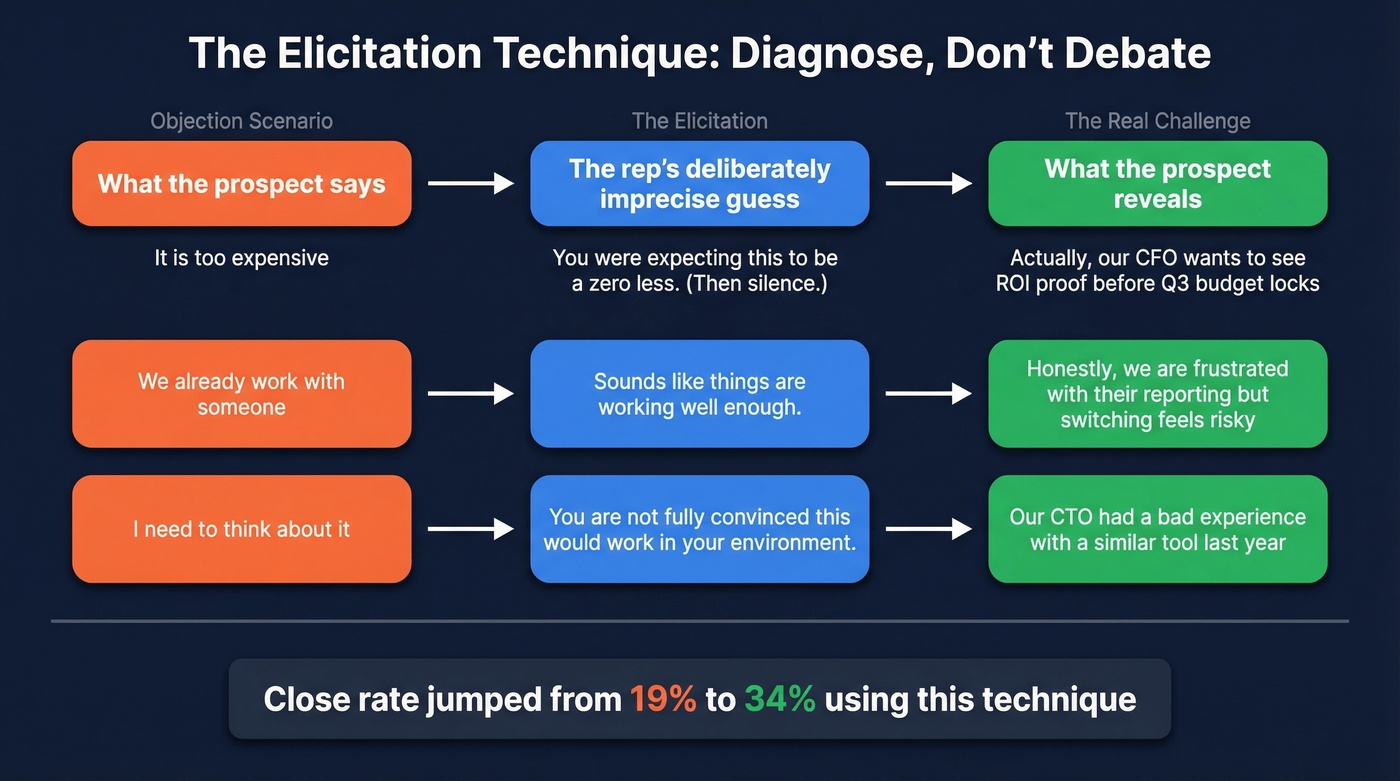
A practitioner on r/b2b_sales stopped trying to handle objections and started eliciting the real ones. The technique: make a calm, deliberately imprecise guess about what's behind the objection, then go silent. People are hardwired to correct inaccurate assumptions. The truth lives in the pause.
- "It's too expensive." → "You were expecting this to be a zero less." (Then silence.)
- "We're already working with someone." → "Sounds like things are working well enough."
- "I need to think about it." → "You're not fully convinced this would work in your environment."
The prospect corrects you, and in correcting you, they reveal the real concern - budget timing, a skeptical CTO, a bad experience with a similar tool. That practitioner reported his close rate jumping from 19% to 34%. The numbers are self-reported, but the underlying psychology is well-documented: people can't resist correcting a wrong assumption.
One important distinction: true objections can be resolved with information. Obstructions - like a genuine budget freeze or a binding contract with a competitor - can't. If you suspect pure smokescreen, try this: "Moving that aside for a second, what are your thoughts on [your product]?" If concerns remain, you've found the real ones.
The 6 SaaS Sales Objections (and Scripts)
Only 23% of pricing objections are genuinely about budget. The other 77% mask something else entirely. That pattern holds across every objection type, which is why overcoming sales objections in SaaS starts with understanding what's really being said.
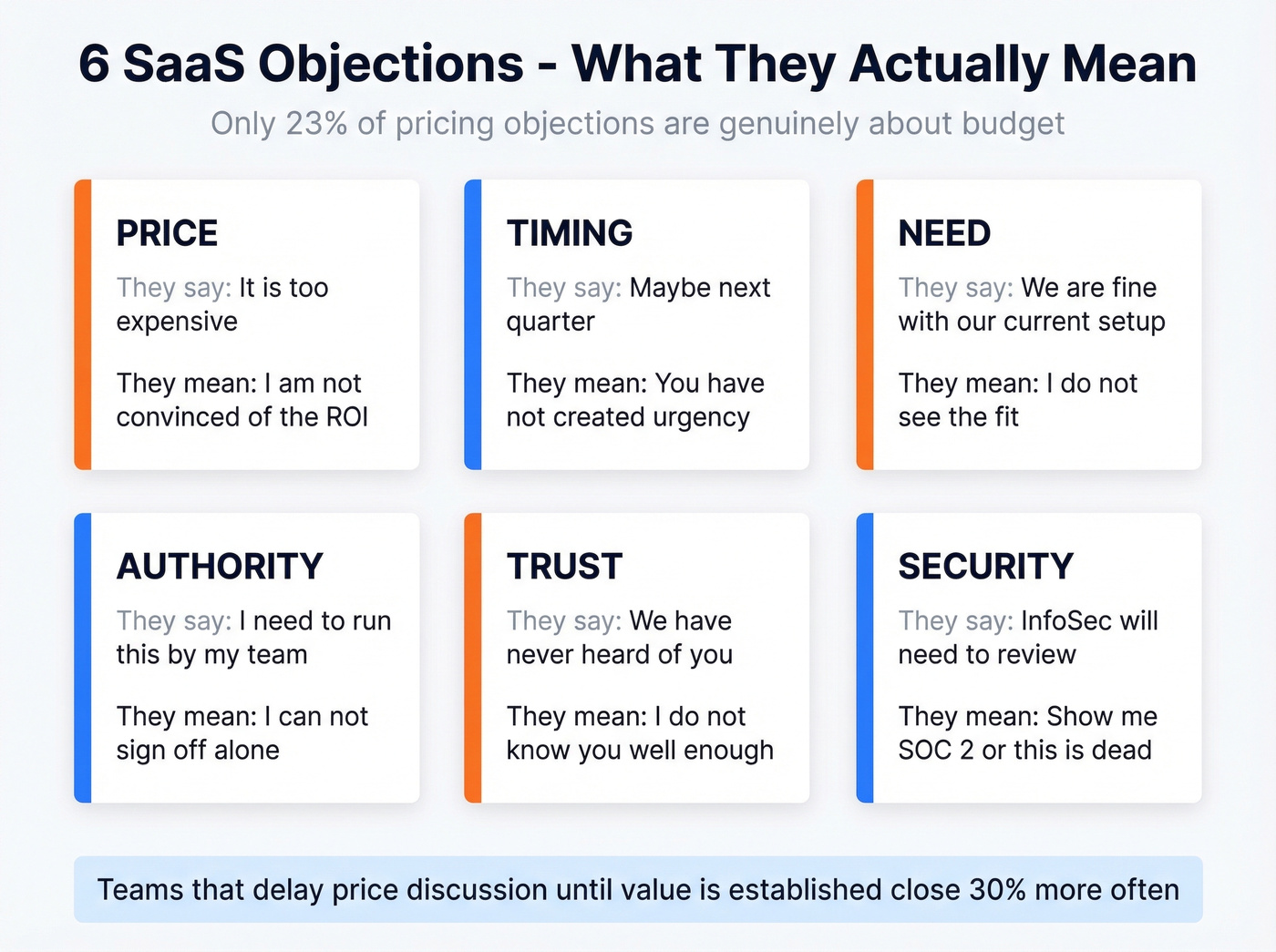
| Objection | What They Mean | Script |
|---|---|---|
| Price | "I'm not convinced of the ROI" | "What would the cost be of not solving this for another quarter?" |
| Timing | "You haven't created urgency" | "What changes between now and Q3 that makes this easier?" |
| Need | "I don't see the fit" | "Walk me through how you're handling [pain point] today." |
| Authority | "I can't sign off alone" | "Who else needs to feel good about this before you move?" |
| Trust | "I don't know you well enough" | "We helped [similar company] cut [metric] by X%. Want the case study?" |
| Security | "InfoSec will block this" | "Here's our SOC 2 report. Can I connect our compliance teams?" |
On pricing: don't forget that budget often hides in plain sight. Failing tools have embedded budgets. Execs have discretionary spend. The money is usually there - the conviction isn't.
Security deserves extra attention because it's often a binary gate in enterprise deals. SOC 2 compliance isn't a nice-to-have; it's a prerequisite. Your response needs specific certifications, data residency details, and an offer to connect InfoSec teams directly. Vague reassurances about "taking security seriously" won't cut it.
Teams that delay price discussion until value is established close 30% more often. The same principle applies to security: lead with proof, not promises.
Pick a Framework
Every objection-handling framework reduces to three moves: validate, diagnose, respond.
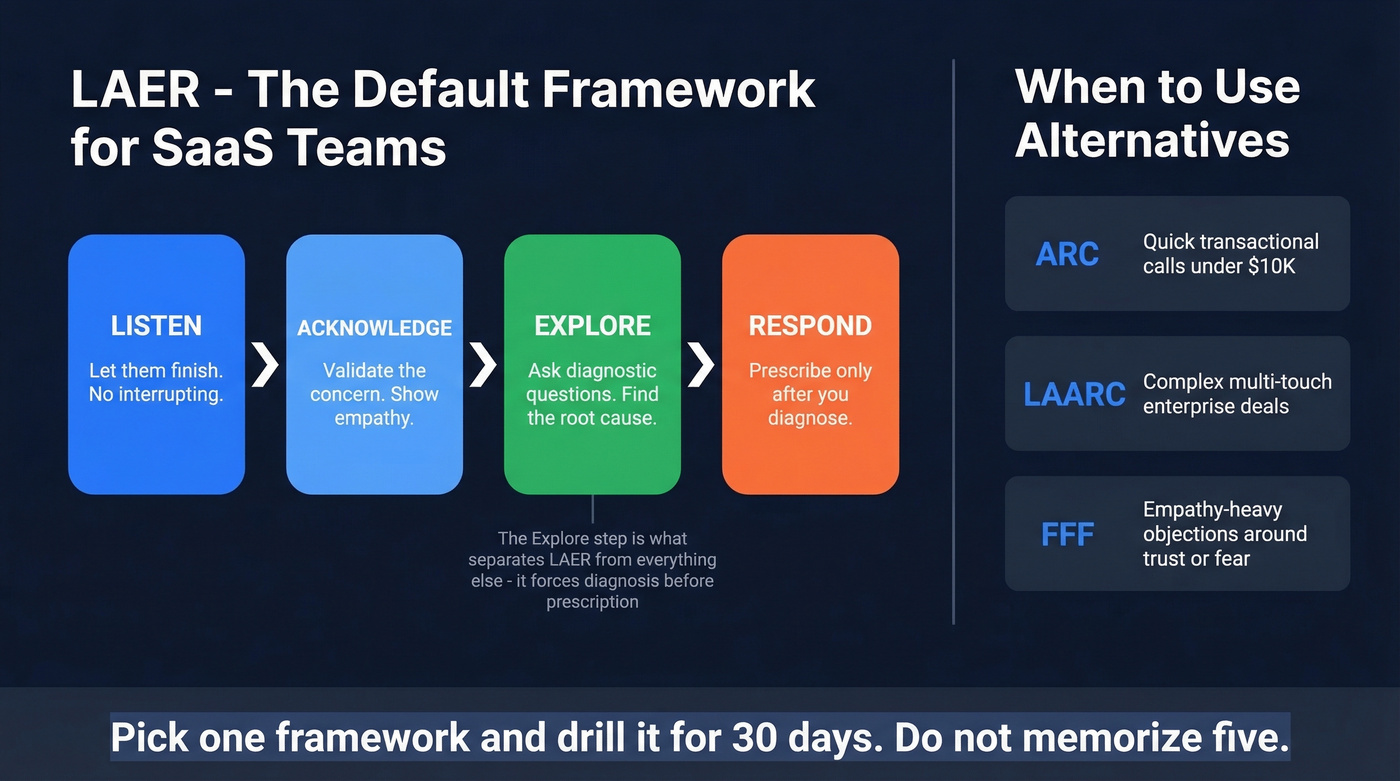
| Framework | Steps | Best For |
|---|---|---|
| ★ LAER | Listen → Acknowledge → Explore → Respond | Most SaaS teams (SMB-mid-market) |
| ARC | Acknowledge → Respond → Close | Quick transactional calls |
| LAARC | Listen → Acknowledge → Assess → Respond → Confirm | Complex multi-touch deals |
| FFF | Feel → Felt → Found | Empathy-heavy objections (trust, fear) |
LAER is the default. In our experience, teams that pick LAER and drill it for 30 days see measurable improvement - it's simple enough to memorize, flexible enough for everything from a $5K SMB deal to a $50K mid-market contract, and the "Explore" step forces reps to diagnose before prescribing. For enterprise qualification, layer MEDDICC on top to make sure you're qualifying hard enough that fewer objections catch you off guard.
Pick one framework and drill it. Don't memorize five.

You just built a framework, drilled scripts, and trained your team on LAER. None of it matters if your sequences hit dead inboxes. Prospeo's 98% email accuracy and 7-day data refresh mean every objection-handling touchpoint reaches a real person - not a bounce notification.
Stop perfecting scripts that land in the void.
SMB vs. Enterprise: Different Beasts
The deal size changes everything.
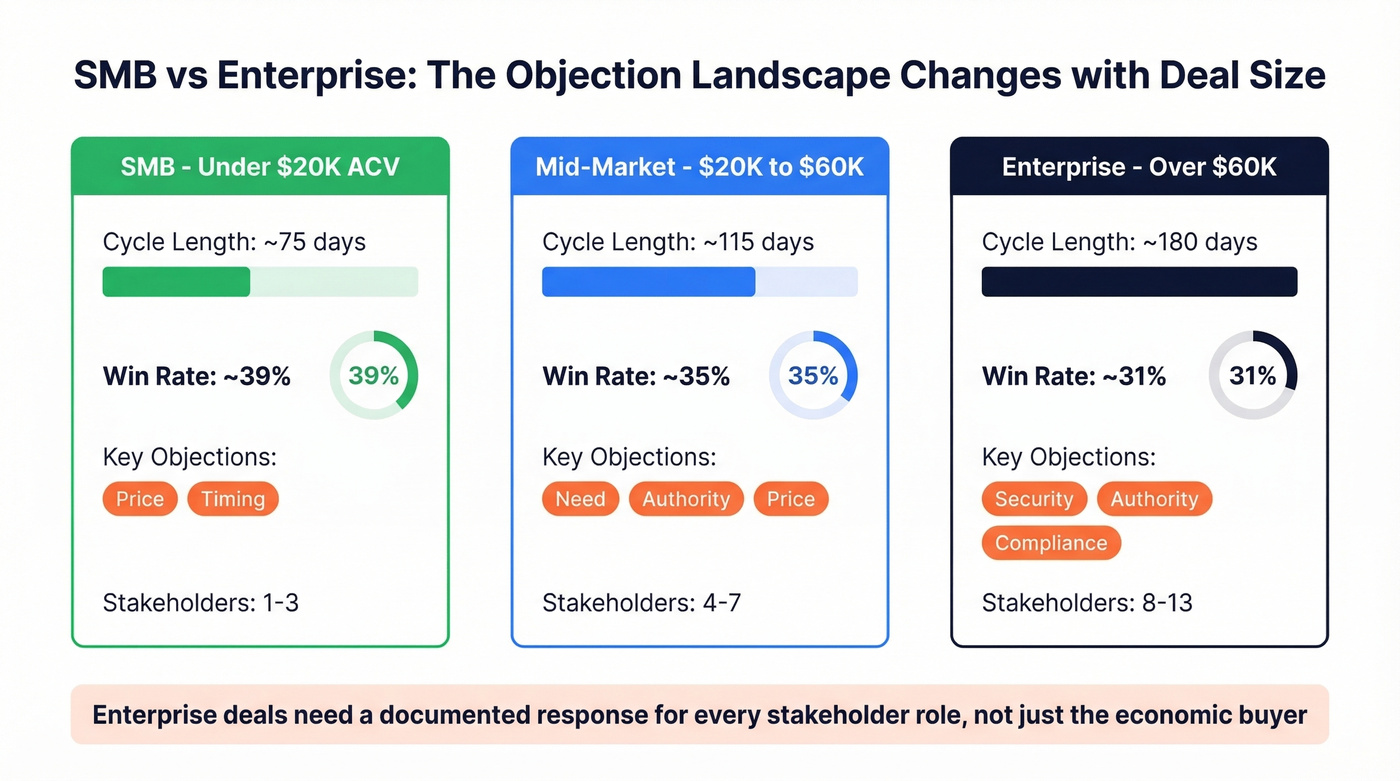
| ACV Tier | Cycle Length | Key Objections |
|---|---|---|
| <$20K | ~75 days | Price, timing |
| $20K-$60K | ~115 days | Need, authority, price |
| >$60K | ~180 days | Security, authority, compliance |
SMB deals close at roughly 39% opportunity-to-close, while enterprise drops to 31%. That gap reflects the stakeholder math - enterprise deals involve 8-13 stakeholders, each with their own objections. A VP of Engineering cares about integration. A CISO cares about SOC 2. A CFO cares about multi-year commitment structure and whether the vendor will still exist in three years. If you're selling deals above $60K, you need a documented response for every stakeholder role, not just the economic buyer.
Let's be honest: most teams skip this work because it's tedious. They build one generic battle card and wonder why enterprise deals stall at the security review.
Five Mistakes That Kill Deals
1. Treating the surface objection as the real one. "It's too expensive" almost never means "we literally don't have the money." Six out of ten people say no four times before saying yes - dig deeper before you respond.
2. Responding before you understand the root cause. The elicitation technique exists for a reason. Those first three seconds of silence feel eternal, but they're where deals get saved.
3. Arguing or getting defensive. The moment you push back, the prospect's guard goes up and stays up. Acknowledge first, always. This isn't weakness; it's strategy.
4. Offering discounts before establishing value. Discounting before the prospect understands ROI trains them to negotiate harder every time. You're not just losing margin on this deal - you're setting a precedent for every renewal conversation.
5. Sending scripts to bad data. We've seen teams build a beautiful objection playbook, load it into their sequencer, and watch 30% of emails bounce. All that preparation, wasted on invalid addresses. Prospeo's real-time email verification at 98% accuracy and 7-day data refresh cycle keeps your sequences landing where they belong.
Enterprise deals stall when you can't reach the 8-13 stakeholders who each hold a veto. Prospeo gives you verified emails and direct dials for every buyer in the room - VP of Engineering, CISO, CFO - so you handle objections with the right person, not a gatekeeper.
Reach every stakeholder in the deal for $0.01 per email.
Build Your Objection Playbook
Don't build a 47-page Notion doc nobody reads.
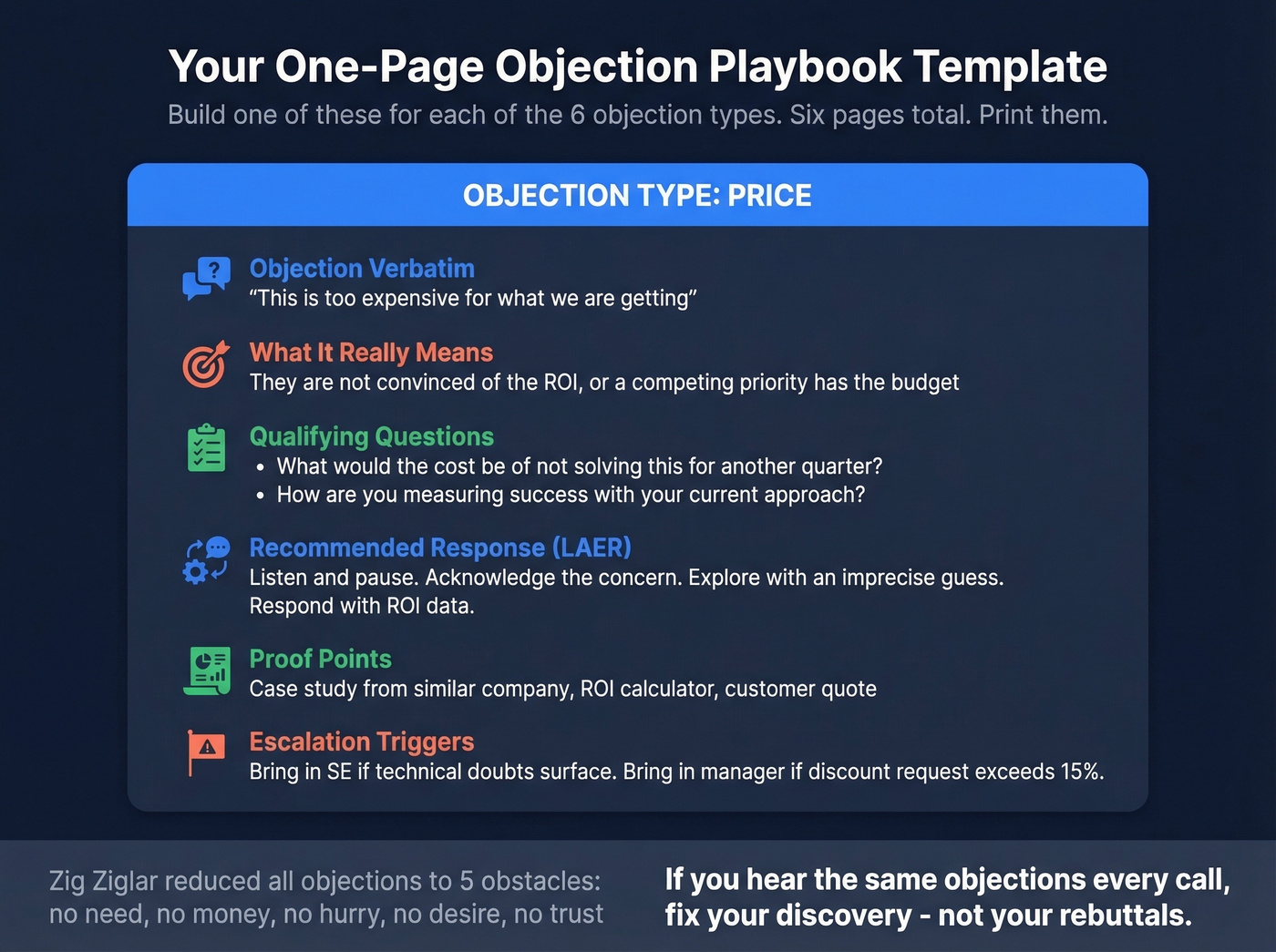
Build a one-page cheat sheet per objection type - six pages total, one for each objection in the table above. Use the LAER framework as the backbone for each response script. Six fields per page:
- Objection verbatim - the exact words prospects use
- What it really means - the underlying concern
- Qualifying questions - 2-3 diagnostic questions to confirm root cause (steal a few from these discovery questions)
- Recommended response - your scripted reply using elicitation + framework
- Proof points - case studies, ROI data, certifications
- Escalation triggers - when to bring in a manager, SE, or compliance team
Zig Ziglar boiled every sales objection down to five obstacles: no need, no money, no hurry, no desire, no trust. Six pages covers all of them. Print it. Tape it next to your monitor. The reps who close aren't winging it - they've internalized their SaaS sales objection handling playbook until the responses feel natural.
Here's our hot take: most teams don't need better objection-handling skills. They need better discovery. If you're hearing the same objections on every call, your discovery process is broken - not your rebuttals. Fix the front of the conversation and the back takes care of itself.
FAQ
What's the best objection-handling framework for SaaS?
LAER (Listen → Acknowledge → Explore → Respond) works for most SaaS teams from SMB through mid-market. It's simple enough to memorize in a day and flexible enough for deals from $5K to $50K+. For enterprise cycles with 8+ stakeholders, layer MEDDICC on top for harder qualification.
How do you handle "it's too expensive" in SaaS sales?
Don't defend the price. Make a calm guess - "You were expecting this to be a zero less" - then stay silent. Nine times out of ten, the real concern is ROI clarity or a competing priority, not the dollar amount. Only 23% of pricing objections are genuinely about budget.
What's the difference between an objection and an obstruction?
An objection can be resolved with information - unclear ROI, missing case studies, security questions. An obstruction is a hard blocker like a binding competitor contract or a genuine budget freeze. Diagnose which you're facing before responding; no script overcomes a real obstruction.
How does contact data quality affect objection handling?
If your contact data is wrong, your scripts never reach the prospect. Teams like Snyk saw bounce rates drop from 35-40% to under 5% after switching to verified data sources, which meant more live conversations where objection-handling skills actually matter. No framework fixes a bounced email.