

Sales Leads: Find, Qualify, and Convert in 2026
A 10.1-month average buying cycle. First contact happening when the buyer is already 61% through their journey. And the winning vendor sitting on the buyer's day-one shortlist 95% of the time. That's the reality of sales leads in 2026, and it means most teams are chasing the wrong ones, too late.
What Are Sales Leads?
A sales lead is any person or company that could become a customer. That's the textbook answer. The useful answer is more specific: a lead is someone who fits your ideal customer profile or has signaled interest in what you sell. Sometimes both. Sometimes neither - and that's where pipelines go to die.
Let's get the vocabulary straight, because these terms get used interchangeably and they shouldn't.
A lead is the broadest category. Someone downloaded your whitepaper, visited your pricing page, or showed up in a sales prospecting database search matching your ICP filters. You know they exist. You don't know if they're worth pursuing.
A prospect is a lead you've qualified. You've confirmed they have a real problem you solve, some authority to buy, and a timeline that isn't "maybe next year." Prospects get sequences and calls. Leads get scored.
An opportunity is a prospect actively in a buying process - they've taken a meeting, requested a proposal, or entered a formal evaluation. This is where pipeline math starts.
The temperature taxonomy matters too. Cold leads haven't interacted with you at all - names from a database or a purchased list. Warm leads have engaged somehow: opened emails, attended a webinar, visited your site. Hot leads are showing buying signals right now - requesting demos, asking about pricing, or matching intent data triggers.
Here's the uncomfortable stat: 85% of B2B marketers say lead generation is their number-one challenge. Not closing. Not retention. Just finding the right people to talk to.
What You Actually Need
Three things separate teams that convert from teams that churn through leads:
Clean data. Verified emails, accurate phone numbers, fresh records. Bad data doesn't just waste time - it damages your sender reputation and tanks deliverability. Phone verified leads with confirmed direct dials consistently outperform generic office numbers on connect rates.
A qualification framework. BANT, CHAMP, or MEDDIC - pick one and actually use it. Most teams skip this step and wonder why sales rejects 80% of marketing's leads.
A scoring model. Not every lead deserves a call. Score them by fit and behavior, then route the top 20% to reps.
The minimum viable stack: Prospeo for verified contact data, HubSpot or Salesforce for CRM, and Instantly or Lemlist for outbound sequences. Three tools. A real pipeline.
Types of Sales Leads
Not all leads carry the same weight. The type determines your conversion expectations, follow-up cadence, and acquisition budget.
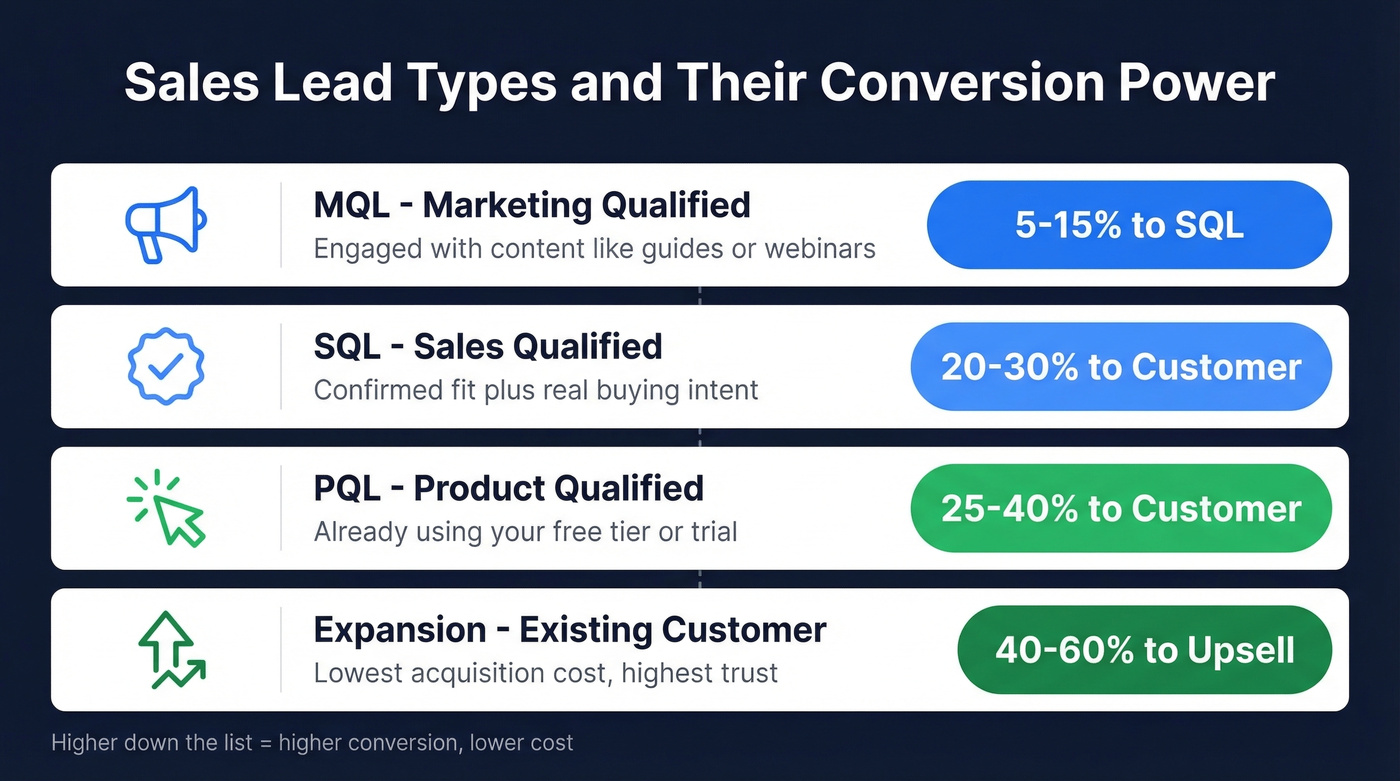
| Lead Type | Definition | Typical Conversion | Notes |
|---|---|---|---|
| MQL | Marketing-qualified | 5-15% to SQL | Engaged with content |
| SQL | Sales-qualified | 20-30% to customer | Confirmed fit + intent |
| PQL | Product-qualified | 25-40% to customer | Used free tier/trial |
| Expansion | Existing customer | 40-60% to upsell | Lowest acquisition cost |
MQLs sit at the top of the funnel - they've done something like downloading a guide or attending a webinar, but haven't been vetted by sales. The 5-15% conversion to SQL is why marketing and sales alignment matters so much.
SQLs have passed a qualification check. A rep has confirmed budget, authority, need, or some combination. These convert at 20-30% to closed deals, which is why protecting rep time from unqualified leads is the whole point of scoring.
PQLs are the darling of product-led growth. Someone's already using your product and experienced value firsthand. That 25-40% conversion rate reflects the power of "try before you buy."
Expansion leads are the most overlooked category. Retaining a customer costs less than one-third of acquiring a new one, and existing customers generate roughly 10% more revenue on average. If your team isn't systematically mining expansion opportunities, you're leaving the easiest revenue on the table.
Why Quality Beats Quantity
We've run head-to-head tests where the team with fewer leads outperformed the team with 3x the volume - simply because their data was cleaner and their targeting was tighter. The best leads aren't the ones that fill your CRM fastest. They're the ones that actually close.
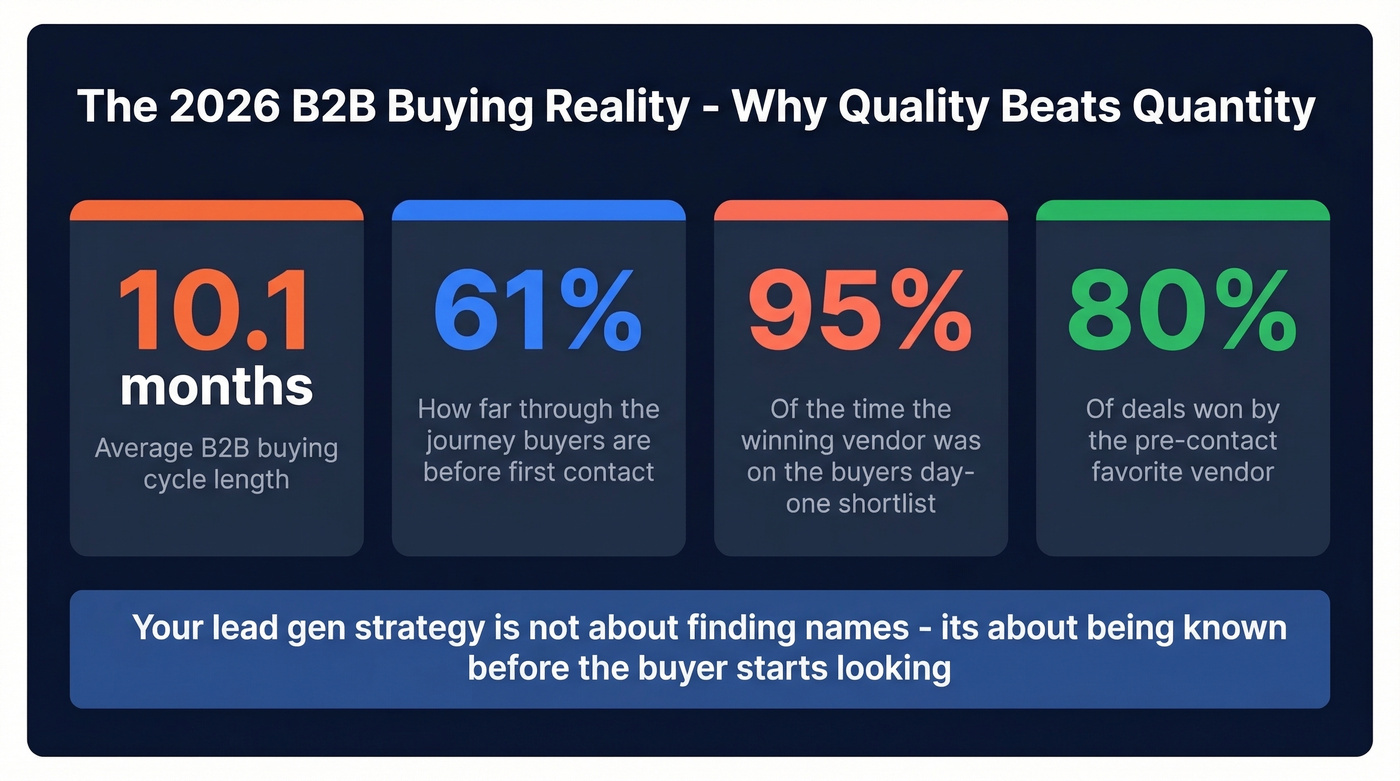
The numbers back this up. The average B2B buying cycle runs 10.1 months. Buyers make first contact at 61% of their journey, and 41% already have a preferred vendor before formal evaluation even begins - with the pre-contact favorite winning roughly 80% of deals. Your lead generation strategy isn't just about finding names. It's about being known before the buyer starts looking.

Here's where data quality becomes the bridge between strategy and execution. You can have the perfect ICP definition, the right messaging, and a killer sequence - but if 35% of your emails bounce, none of it matters. Your domain reputation tanks, deliverability drops, and suddenly even your good leads aren't seeing your outreach. When Meritt switched to verified contact data, their bounce rate dropped from 35% to under 4%, and their pipeline tripled from $100K to $300K per week.
The consensus on r/sales echoes this: the top advice in 2026 isn't about tactics - it's about clarity, relevance, and reducing friction. Modern buyers abandon forms quickly and ignore generic outreach. Quality targeting and clean data are the baseline, not a competitive advantage.
Funnel Benchmarks
Knowing your conversion rates at each stage is the difference between forecasting and guessing. Here are B2B SaaS benchmarks drawn from data spanning 2017-2025, across a client base that's roughly 65% B2B.
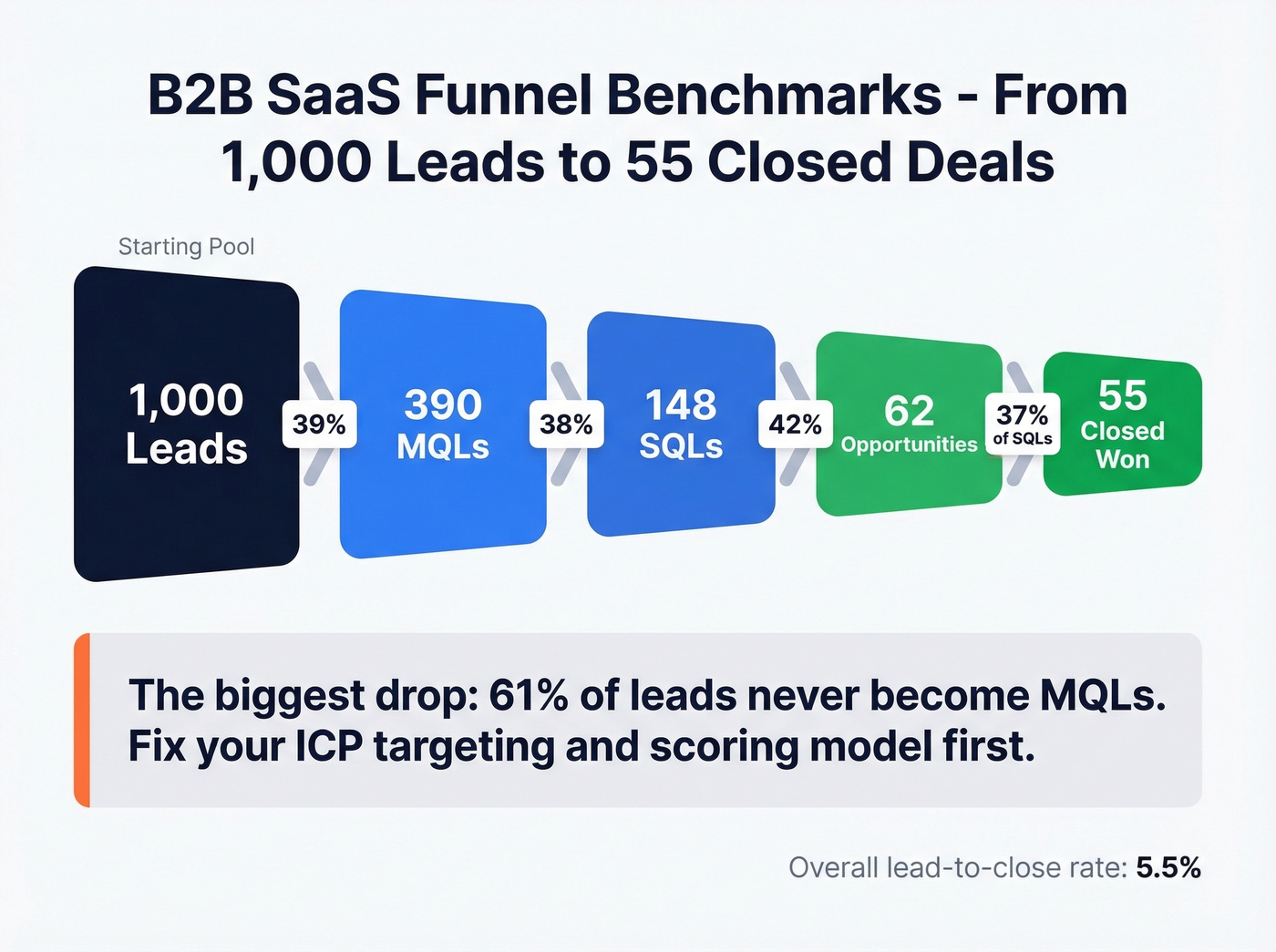
| Funnel Stage | Conversion Rate |
|---|---|
| Lead to MQL | 39% |
| MQL to SQL | 38% |
| SQL to Opportunity | 42% |
| SQL to Closed Won | 37% |
SQL to Opportunity and SQL to Closed Won are parallel metrics from the same stage, not sequential steps. They measure different outcomes from the SQL pool.
Start with 1,000 leads. You'll get roughly 390 MQLs and 148 SQLs. Of those SQLs, 62 become active opportunities and 55 eventually close. That's a 5.5% lead-to-close rate - which sounds low until you realize most teams don't even measure it.
The biggest drop happens between Lead and MQL. That 39% pass-through means 61% of your leads don't meet basic qualification criteria. This is where scoring models and ICP targeting pay for themselves - not by generating more leads, but by ensuring a higher percentage are worth pursuing. If your MQL-to-SQL conversion is below 30%, the problem isn't lead gen. It's qualification. If SQL-to-Closed is below 25%, look at sales execution or product-market fit.
How to Generate Sales Leads
No single channel works for everyone. But principles hold across all of them: clarity in your offer, relevance to the buyer's actual problem, and minimal friction between interest and action. Eight tactics worth your time in 2026.
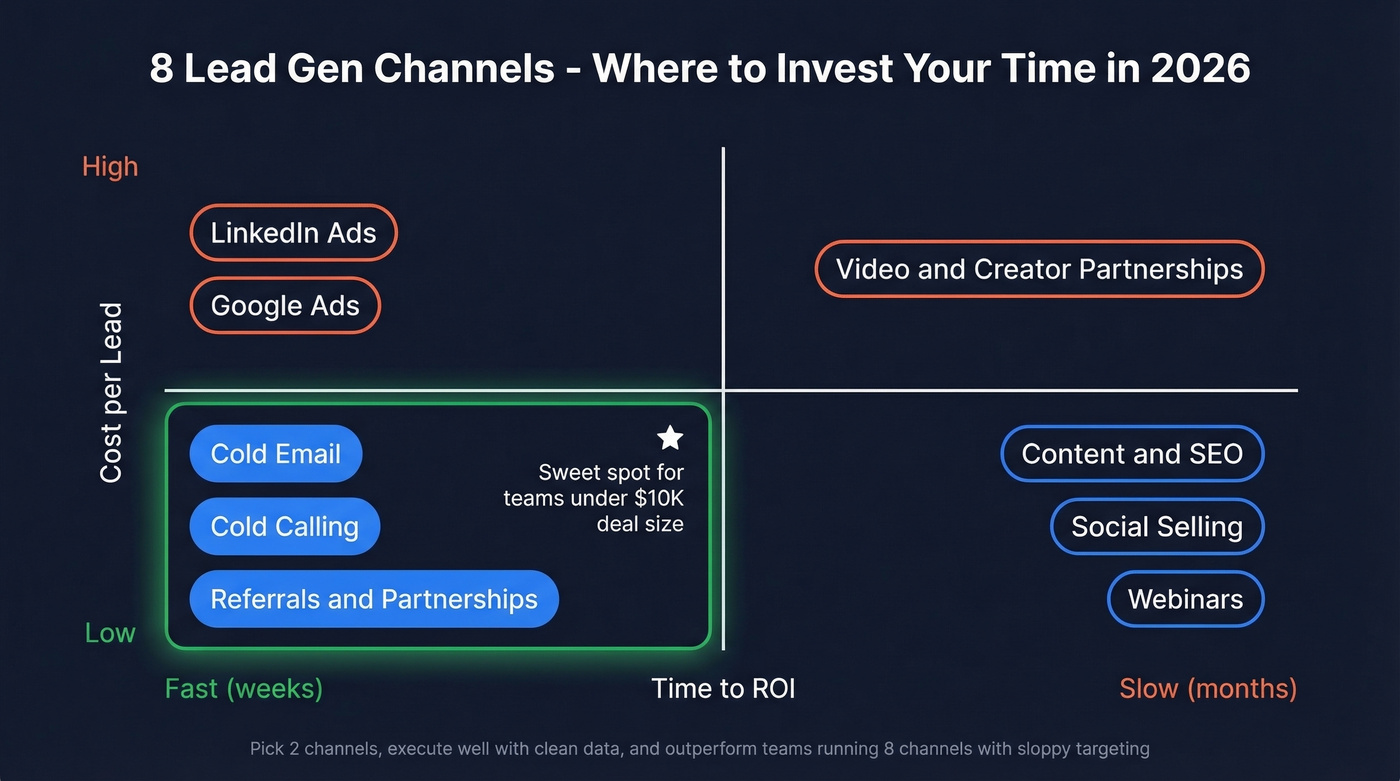
1. Content marketing and SEO. Create content that answers the questions your buyers are already asking. Blog posts, comparison guides, and ROI calculators pull in leads who are actively researching. The compounding returns make this the highest-ROI channel over 12+ months. 9+ demo views correlate with 8-10x higher close rates, so depth of engagement matters more than breadth of traffic.
2. Webinars and virtual events. Live sessions with genuine expertise convert better than gated PDFs. The key is specificity - "How We Reduced Churn by 40% in Q3" beats "Best Practices for Customer Retention" every time. Registration data gives you qualified leads with clear intent signals.
3. Cold email. Still works when done right. Verified data, personalized first lines, a clear value prop, and a low-friction CTA. "Worth a 15-minute call?" outperforms "I'd love to schedule a demo of our platform." Keep sequences to 4-5 touches.
4. Cold calling. Direct dials to decision-makers - especially phone verified leads with confirmed mobile numbers - remain one of the fastest paths to a conversation. Call with context: reference a trigger event, a mutual connection, or a specific pain point. Still alive, still effective.
5. Paid ads on Google and LinkedIn. Google Ads captures existing demand; LinkedIn targets by job title, company size, and industry. Both work, but LinkedIn's $110+ average CPL means you need tight targeting and strong landing pages. 87% of B2B decision makers look for honest reviews before purchasing - make sure your ads lead somewhere credible.
6. Social selling. Not "posting on LinkedIn and hoping." Real social selling means engaging with prospects' content, sharing relevant insights, and building familiarity before outreach. It directly supports the "be on the day-one shortlist" strategy.
7. Video and creator partnerships. 78% of B2B marketers now use video, and 55% partner with industry voices. Combining video with creator credibility makes you 2.2x more likely to be trusted. This isn't a trend - it's a channel shift.
8. Referrals and partnerships. The highest-converting lead source for most B2B companies, and the most underinvested. Structured referral programs with clear incentives consistently outperform paid channels on cost-per-acquisition. If you're not asking happy customers for introductions, start today.
Here's the thing: if your average deal size is under $10K, you probably don't need a complex multi-channel lead gen engine. Pick two channels from this list, execute them well with clean data, and you'll outperform the team running eight channels with sloppy targeting.

Your leads are only as good as the data behind them. Prospeo delivers 98% email accuracy, 125M+ verified mobiles, and a 7-day refresh cycle - so your pipeline isn't built on stale records that bounce.
Meritt tripled their pipeline to $300K/week after switching. Your move.
How to Qualify Leads
Your SDR burned through 200 cold calls last week. Twelve picked up. Three took meetings. One was actually qualified. That's not a calling problem - it's a qualification problem.
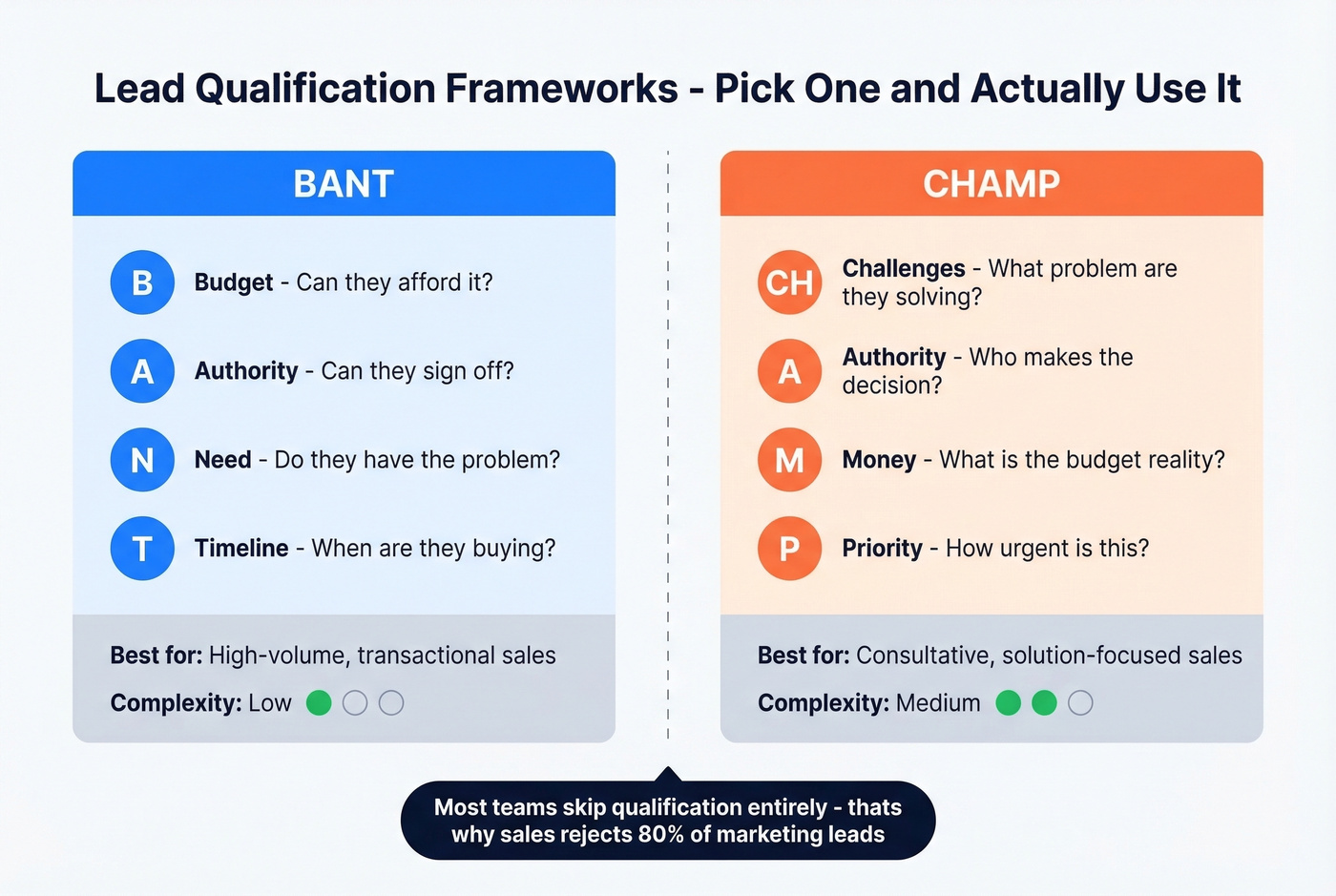
| Framework | Stands For | Focus | Best For | Complexity |
|---|---|---|---|---|
| BANT | Budget, Authority, Need, Timeline | Buyer readiness | High-volume, transactional | Low |
| CHAMP | Challenges, Authority, Money, Priority | Buyer pain | Consultative sales | Medium |
| MEDDIC | Metrics, Econ. Buyer, Decision Criteria, Process, Pain, Champion | Deal mechanics | Enterprise, complex | High |
BANT has been around since IBM introduced it in the 1950s, and it's still the right choice for high-velocity sales. If you're selling a $5K/year SaaS product, you don't need to map the decision process across seven stakeholders. You need to know: can they pay, can they decide, do they need it, and when?
CHAMP flips the script by leading with challenges. Instead of asking about budget first - which can kill a conversation - you start with the prospect's pain. This works well for consultative sales where value isn't obvious until you've diagnosed the problem. Schneider Electric took a similar challenge-first approach with their "digital opportunity factory," leading with customer pain points and seeing 30% faster time to close.
MEDDIC is the enterprise framework. When you're dealing with an average of seven stakeholders in a B2B purchase, you need to understand decision criteria, the decision process, and who your internal champion is. For six-figure deals with 6+ month cycles, it's the gold standard.
The prescriptive guidance is simple. Sub-$10K products at volume? BANT. Mid-market consultative deals? CHAMP. Enterprise with procurement committees? MEDDIC. Pick one and enforce it consistently.
How to Score and Prioritize
Marketing generated 500 MQLs last month. Sales accepted 47. That's a 9.4% acceptance rate - 90% of marketing's output went nowhere. Lead scoring fixes this by ranking leads before they hit a rep's queue.
The model combines demographic fit with behavioral signals and negative indicators. Here's a scoring rubric you can steal:
| Criteria | Points | Category |
|---|---|---|
| C-level decision maker | +30 | Demographic |
| Target industry match | +25 | Demographic |
| Pricing page visit | +20 | Behavioral |
| Demo request | +40 | Behavioral |
| Personal email (B2B) | -15 | Negative |
| Competitor employee | -50 | Negative |
| Email unsubscribe | -25 | Negative |
| Wrong company size | -20 | Negative |
Set your MQL threshold at the top 20% of leads by score - typically 50-75 points on a 100-point scale. Lead scoring models increase close rates by up to 30%, and AI-powered prioritization can nearly double conversion rates from 1.8% to 3.0% in just 12 weeks.
One detail most teams skip: score decay. A lead who visited your pricing page six months ago isn't the same as one who visited yesterday. Reduce scores by 25% monthly without new activity. This keeps your pipeline current and prevents reps from chasing ghosts.
What Leads Cost
Every channel has a different cost-per-lead, and most teams don't track it granularly enough. Here are the paid digital benchmarks for 2026:
| Channel | Average CPL | Notes |
|---|---|---|
| Google Ads | $70.11 | Captures existing demand |
| LinkedIn Ads | $110+ | 57% higher than Google |
| Meta/Facebook | ~$50-80 | Better for retargeting |
| Content syndication | ~$40-75 | Volume play, lower quality |
| B2B average | $84 | Paid digital only |
These numbers cover paid digital channels only - organic content, SEO, events, and referrals aren't included. The healthy benchmark is an LTV:CAC ratio of at least 3:1. If you're spending $84 per lead and your average deal is $500, the math doesn't work unless your conversion rates are exceptional.
Real talk: LinkedIn's $110+ CPL is the most commonly wasted budget in B2B marketing. Without rigorous LTV tracking, teams pour money into LinkedIn lead gen forms and celebrate the volume without ever confirming those leads turned into revenue. Track through to closed-won or stop spending.
Best Tools for Sales Leads
The right stack depends on your stage, budget, and workflow. Here's what we've seen work in 2026.
| Tool | Best For | Starting Price | Key Differentiator |
|---|---|---|---|
| Prospeo | Verified contact data | Free (75 emails/mo) | 98% email accuracy |
| HubSpot | CRM + marketing | Free CRM; paid from $15/mo | All-in-one for SMBs |
| Salesforce | Enterprise CRM | $25/user/mo | Ecosystem + scale |
| Apollo | Prospecting + sequences | Free tier; ~$49/mo | Database + outreach |
| ZoomInfo | Enterprise data | ~$15K-40K+/yr | US database depth |
| LinkedIn Sales Nav | Relationship selling | $99-$179/user/mo | Network-based prospecting |
| Instantly | Cold email at scale | ~$30-$100/mo | Deliverability focus |
| Lemlist | Personalized outreach | ~$39-$160/mo/user | Multichannel sequences |
Prospeo
The go-to when you need verified emails and mobile numbers that actually connect - without paying enterprise prices. The database covers 300M+ professional profiles with 98% email accuracy and 125M+ verified mobiles hitting a 30% pickup rate. A 7-day data refresh cycle means you're not emailing people who changed jobs two months ago.
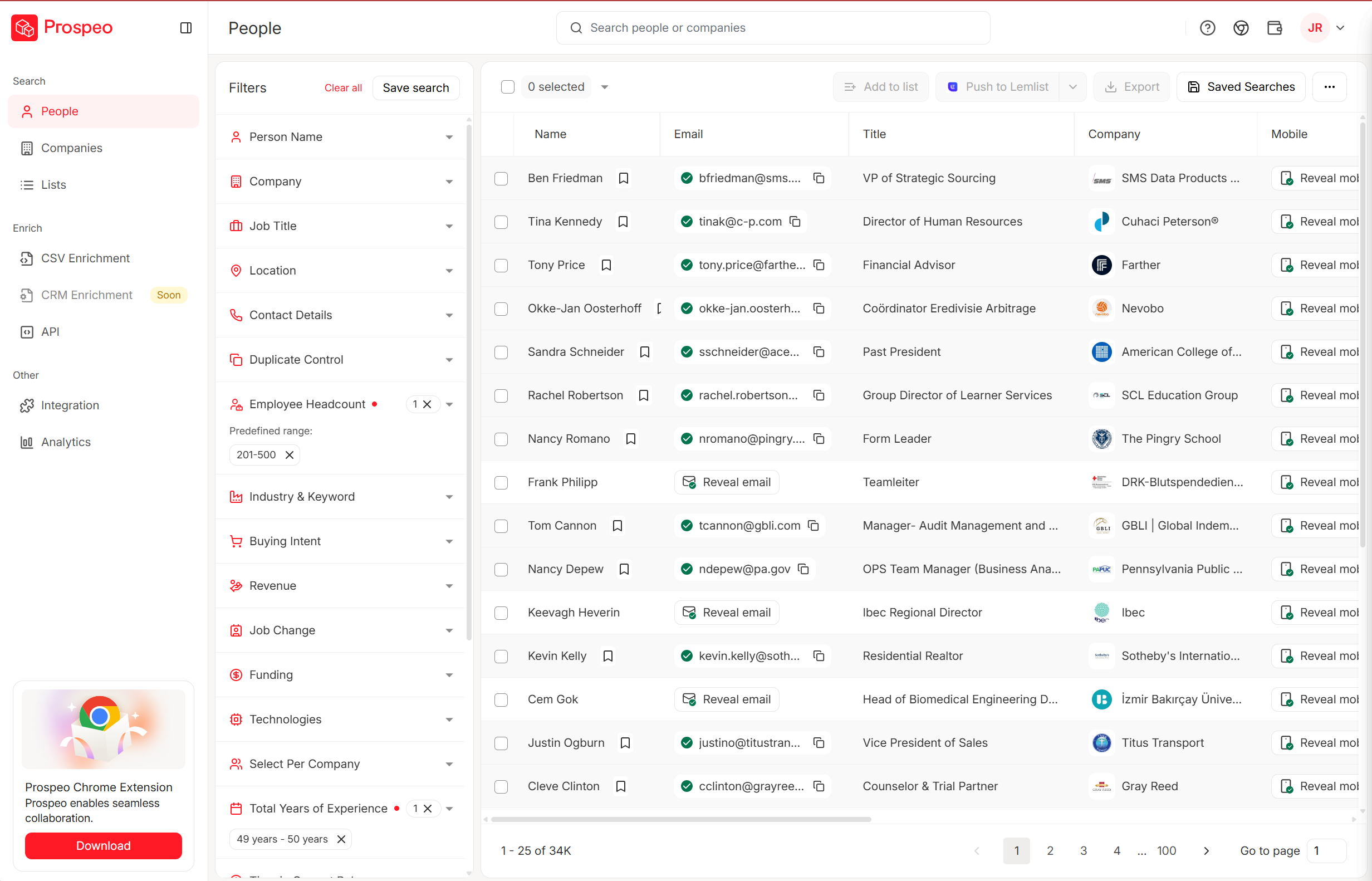
The 30+ search filters include buyer intent powered by Bombora across 15,000 topics, technographics, job changes, headcount growth, and funding signals. The Chrome extension has 40,000+ users and works across company websites and CRMs. Native integrations with Salesforce, HubSpot, Smartlead, Instantly, Lemlist, Clay, Zapier, and Make mean your data flows directly into whatever sequencer or CRM you're already using. Whether you're an outbound agency scaling client campaigns, a founder building pipeline solo, or a RevOps team running enrichment workflows via API - this is the data layer. Snyk's 50 AEs saw bounce rates drop from 35-40% to under 5%, with AE-sourced pipeline up 180% and 200+ new opportunities per month.
Pricing runs about $0.01 per email. Free tier gives you 75 verified emails per month plus 100 Chrome extension credits. No contracts, no sales calls required.
61% of leads never qualify as MQLs because targeting is off and data is bad. Prospeo's 30+ search filters - intent data, technographics, funding, headcount growth - let you start with leads that actually fit your ICP.
Better leads in, better pipeline out. At roughly $0.01 per email.
HubSpot
Use this if you're an SMB that wants CRM, marketing automation, and sales tools in one platform without stitching together five vendors. HubSpot's free CRM is genuinely useful - contact management, deal tracking, and basic reporting at zero cost.
Skip this if you need deep customization or you're running a 200-person sales org. Enterprise tiers ($800-$3,600/mo) compete with Salesforce on price without matching it on flexibility. The sweet spot is teams of 5-50 reps who value ease of use over configurability.
Salesforce
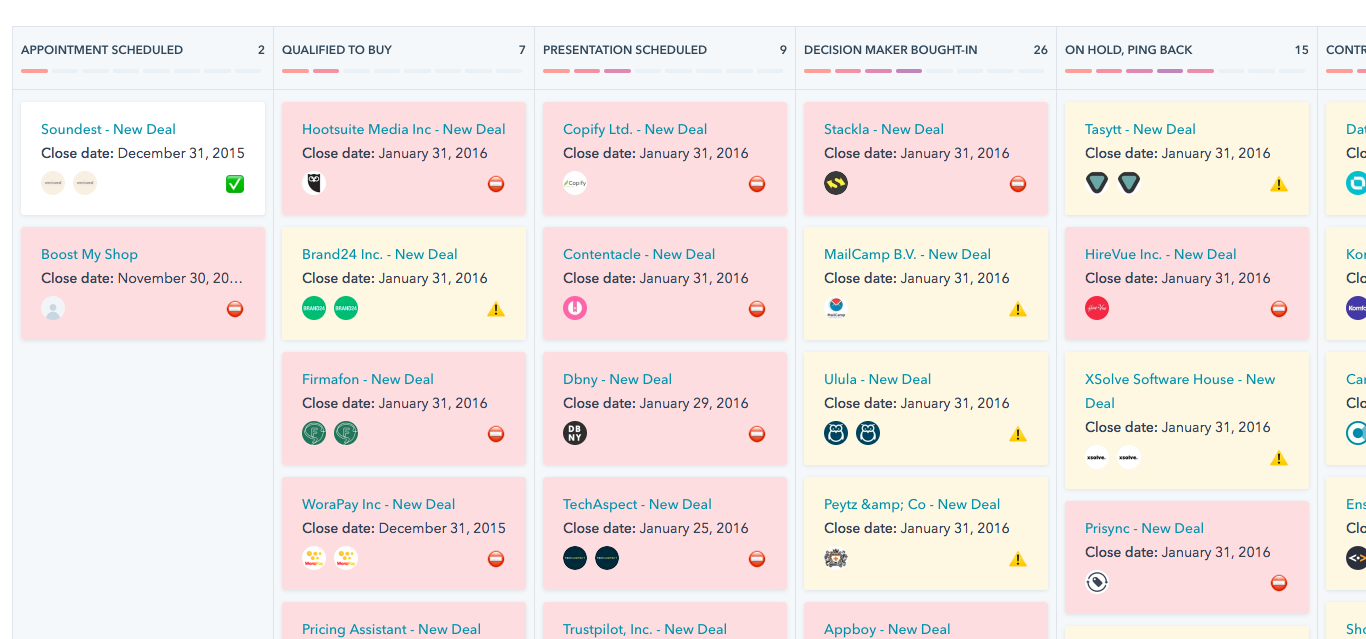
The enterprise standard for a reason - the ecosystem of integrations, the AppExchange, and the reporting depth are unmatched. Pricing runs $25-$500/user/mo depending on edition.
Skip this if you're a team of five and nobody wants to own the admin work. Salesforce without an admin is like a sports car without a mechanic - powerful in theory, frustrating in practice. Expect 2-4 months to get it configured properly. For teams selling into enterprise with complex deal cycles, though, it's the CRM most likely to grow with you.
Apollo
The obvious starting point for teams that want prospecting and sequencing in one tool without a big budget. The free tier is generous, and paid plans run ~$49-99/user/mo. Built-in email sequences save you from buying a separate outreach tool.
The tradeoff is data accuracy. Apollo's email verification runs around 79%, which means roughly one in five emails bounces. That gap translates directly into domain reputation damage when you're sending thousands of emails per week. For teams prioritizing volume over precision, Apollo works. For teams where every bounced email costs them, pair Apollo's prospecting with a dedicated verification layer.
ZoomInfo
The incumbent for a reason: US database depth is unmatched, intent data is mature, and workflow breadth covers everything from prospecting to conversation intelligence. A 10-seat contract with intent data and mobile numbers runs $15,000-$40,000+ per year.
Email accuracy sits around 87%, and the cost difference versus specialized tools is stark - roughly $1/lead versus $0.01/lead. For enterprise teams already embedded in the ecosystem, switching costs are high. For everyone else, the ROI math increasingly favors specialized tools that deliver better data at a fraction of the price.
LinkedIn Sales Navigator
Built for relationship-based selling, not volume prospecting. At $99-$179/user/mo, it's best for reps who work named accounts and need to map org charts, track job changes, and warm up prospects through mutual connections. Think of it as a research layer, not a data export tool.
Instantly and Lemlist
Instantly (~$30-$100/mo) handles cold email at scale - unlimited email accounts, deliverability optimization, and inbox rotation. The sequencer of choice for agencies and high-volume outbound teams.
Lemlist (~$39-$160/mo per user) focuses on personalized multichannel sequences - email, calls, and social touches with custom images and dynamic landing pages. Both are sequencers, not data sources, so pair them with a verification tool for contacts.
Building High-Converting Lists
Five patterns that repeatedly destroy conversion rates:
Over-reliance on purchased lists. Bought lists have high bounce rates, damage sender reputation, and often violate GDPR/CCPA. The best lists are built from ICP-filtered databases with verified contact data, not bulk purchases.
Ignoring qualification. Passing every inbound lead to sales without scoring wastes rep time and erodes trust between marketing and sales. We've seen teams where the sales-marketing relationship was so broken that reps stopped following up on any marketing leads at all - even the good ones.
No follow-up system. Only about 20% of leads ultimately turn into sales, and most require multiple touches. Without automated sequences and clear ownership, leads die in the gap between "interested" and "contacted." (If you need copy, start with these follow-up templates.)
Weak lead magnets. A generic ebook nobody reads isn't a lead magnet - it's a form-fill tax. Offer calculators, benchmark reports, or templates that deliver immediate value.
Sending to unverified emails. A 35% bounce rate doesn't just waste that campaign - it poisons future campaigns by damaging your domain reputation. This one's entirely preventable.
Compliance Essentials
The penalties for getting this wrong can kill a startup.
| Regulation | Penalty | Scope |
|---|---|---|
| GDPR | Up to EUR 20M or 4% of revenue | EU/EEA data subjects |
| CCPA | Up to $7,500 per violation | California consumers |
| TCPA | $500-$1,500 per infraction | US phone/SMS outreach |
Twenty US states now have comprehensive privacy laws, and 140+ countries enforce some form of data privacy regulation.
Practical steps that keep you compliant: double opt-in for all inbound forms, consent audit trails documenting when and how each contact opted in, DNC scrubbing before every calling campaign, calling hours restricted to 8am-9pm local time per TCPA, and clear opt-out mechanisms in every email. The fact that CCPA penalties run $7,500 per individual violation - not per campaign - should make every marketing leader pay attention. A single unclean list of 10,000 contacts could theoretically expose you to $75 million in fines.
Lead Gen Trends in 2026
Trust is the differentiator. 94% of senior B2B marketers agree trust is the key factor in vendor selection. Brand building isn't a luxury - it's pipeline insurance.
AI referral traffic converts higher. 58% of marketers say traffic from AI-generated answers shows higher purchase intent than traditional search. Optimizing for AI citations is becoming a real channel.
Organic search is declining. 49% of marketers report declining traditional search traffic due to AI answers cannibalizing clicks. Diversifying lead sources beyond SEO is no longer optional.
Video and creator partnerships are scaling. Combining video with industry creator partnerships makes brands 2.2x more likely to be trusted. B2B is finally catching up to what B2C figured out years ago.
Technology sales leads are surging. As SaaS and IT budgets rebound, teams selling into technology verticals report shorter cycles and higher intent scores - making technology-sector contacts some of the most competitive to acquire right now.
Fewer, better leads. The consensus on r/b2bmarketing is shifting from volume to precision. Teams report better conversations and higher close rates by narrowing their ICP and investing in data quality over list size.
FAQ
What's the difference between a lead and a prospect?
A lead is anyone who fits your ICP or has shown initial interest - a form fill, a database match, a webinar attendee. A prospect is a lead you've actively qualified: confirmed need, buying authority, and a reasonable timeline. Leads get scored; prospects get sequences and calls.
How many leads does it take to close one deal?
In B2B SaaS, roughly 1,000 leads produce 148 SQLs and about 55 closed deals based on benchmark conversion rates. A 50:1 lead-to-close ratio is a reasonable planning assumption, though your numbers will vary by industry, deal size, and cycle length.
Is buying lead lists worth it?
Rarely. Purchased lists carry high bounce rates, damage your sender reputation, and violate GDPR/CCPA if contacts didn't consent. Build your own lists using ICP-filtered databases, or verify purchased data before it touches a sequence. The upfront savings aren't worth the deliverability damage.
What's a good cost per lead?
The B2B average across paid digital channels is $84 - Google Ads averages $70.11 and LinkedIn averages $110+. The number that actually matters is your LTV:CAC ratio; aim for at least 3:1. A $200 CPL is fine if your average deal is $25K.
Where can I find the best leads for my industry?
Start with a database that lets you filter by industry, company size, technographics, and intent signals. For US-focused teams, platforms with deep North American coverage and verified contact data will give you the best starting point. The key is layering firmographic and behavioral filters to surface contacts who are actively in-market - generic searches produce generic results.