

Sales Acceleration: What It Actually Takes to Compress Your Sales Cycle
Opportunities closed within 50 days carry a 47% win rate. After 50 days, that number drops to 20% or lower. Every extra week in your pipeline isn't just a delay - it's a compounding tax on revenue.
The difference between a team that closes in 45 days and one that closes in 90 isn't better reps or fancier tools. It's a sales acceleration system designed for speed from the ground up.
What Sales Acceleration Actually Means
Sales acceleration is the practice of using technology, process design, and people development to move prospects through your pipeline faster while improving conversion rates. That definition holds up because it captures the three forces that actually matter.
Most teams treat this as a software problem. They buy an engagement platform, bolt it onto a messy CRM, and wonder why cycles don't shrink. Real acceleration happens when technology, process, and people reinforce each other - when your data feeds clean contacts into a well-designed workflow executed by reps who know how to run a discovery call.
Here's what the shift from traditional to accelerated selling looks like in practice:
| Dimension | Traditional Sales | Accelerated Sales |
|---|---|---|
| Cycle length | 90-180+ days | 30-90 days |
| Lead gen | Manual, event-driven | Data-driven, continuous |
| Decision-making | Gut + spreadsheets | Analytics + intent signals |
| Engagement | Periodic check-ins | Multi-channel sequences |
| Tech usage | CRM as a database | Integrated stack |
| Success metrics | Revenue, quota | Velocity, LTV, pipeline |
The table looks clean. The reality is messier.
The Three Things You Need
Pipeline acceleration runs on three levers:
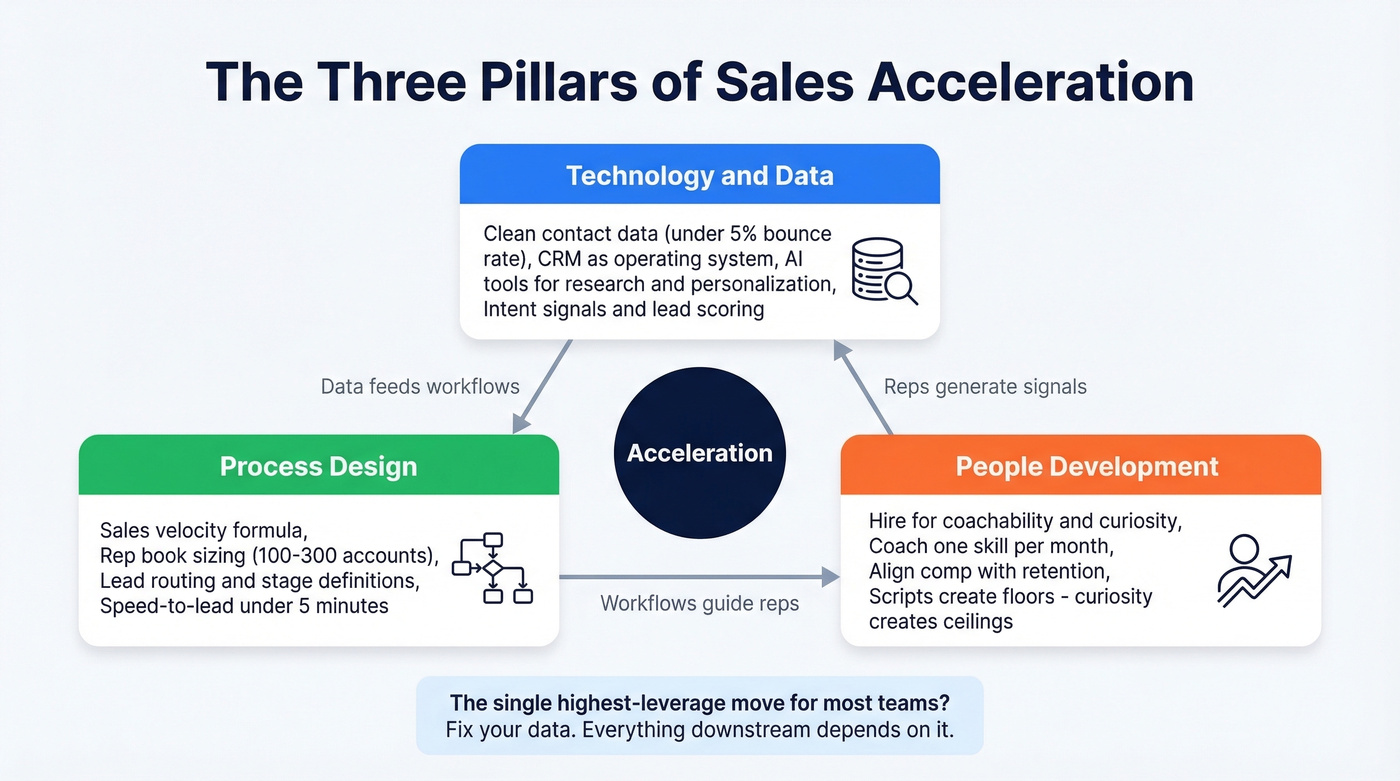
- Technology & data: Your stack is only as good as your contact data. If your bounce rate is above 5%, fix that before buying anything else.
- Process: Use the sales velocity formula to find your bottleneck. Then design workflows that attack it - book sizing, lead routing, qualification criteria.
- People: Hire for coachability and curiosity. Coach one skill per month. Align comp with retention, not just closed-won.
The velocity formula: (Opportunities x Deal Size x Win Rate) / Cycle Length = Revenue per Day. The single highest-leverage move for most teams? Fix your data. Everything downstream depends on it.
Why Speed Matters
The sales acceleration market hit $124.4B in 2024 and continues to grow because the math is brutal. Speed isn't a nice-to-have. It's a survival metric.
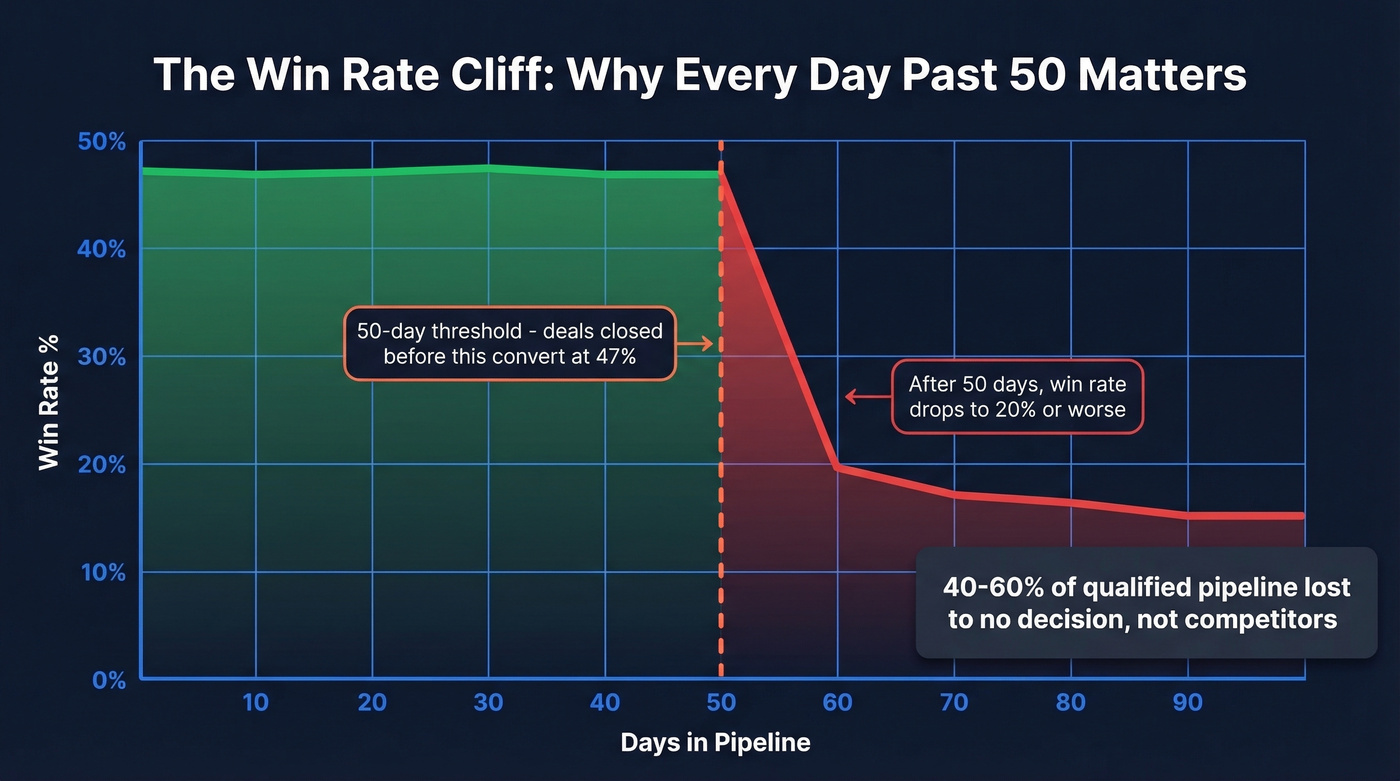
34% of revenue teams report average sales cycles of 1-2 quarters - the most common range, and it means most B2B companies are living in the danger zone where deals stall, champions change jobs, and committees lose urgency. Across B2B, 40-60% of qualified pipeline is lost to "no decision." Not to competitors. To inertia.
The win-rate cliff is the number that should keep sales leaders up at night. Deals closed within 50 days convert at 47%. Push past that threshold and you're looking at 20% or worse. That's not a gradual decline - it's a cliff, and every day past the inflection point, your probability of winning drops measurably.
6sense data adds another dimension: 4 out of 5 deals are won by the pre-contact favorite. Speed isn't just about closing faster; it's about being the first credible option in the buyer's mind. Show up late, and you're fighting uphill against an incumbent the buyer already trusts.
Most teams know their cycles are too long. They just don't know which lever to pull, so they default to buying tools because tools feel like progress. But a $100/user/month engagement platform sending sequences to bad email addresses isn't acceleration - it's expensive noise.
Lever 1: Data & Technology
Sellers spend about 25% of their time actually selling. The rest goes to research, data entry, admin, and chasing down contact information. Bain's research shows AI can double that selling time by absorbing the surrounding work - but only if the underlying data is clean.
This is the part most teams get backwards. They invest in engagement platforms, conversation intelligence, and AI coaching tools before ensuring the foundation is solid. 45% of teams now run a hybrid AI-SDR model, and AI coaching tools shave 11 days off sales cycles on average while boosting win rates by up to 10 percentage points on deals over $50K. Sellers using AI tools cut research and personalization time by 90%, and early AI deployments are driving 30%+ improvements in win rates according to Bain. Those are real numbers - but Bain's warning is equally real: automating a broken process just breaks it faster. They call the result "micro-productivity," small efficiency gains that never compound because the underlying system is flawed.
Tools in this space fall into six categories: CRM, sales engagement, lead scoring and prospecting, demo automation, conversation intelligence, and analytics/forecasting. You don't need all six on day one. You need the ones that address your specific bottleneck.
But before any of those categories matter, you need data quality. This is the invisible acceleration killer. If 35% of your emails bounce - and we've seen teams running exactly those numbers before cleaning up their data - your engagement platform is burning your domain reputation with every sequence. Your intent signals are pointing at contacts who'll never receive your message. Your AI coaching tool is optimizing conversations that never happen.
Snyk's 50-person AE team dropped bounce rates from 35-40% to under 5% after switching to Prospeo, and their AE-sourced pipeline jumped 180%. GreyScout saw similar results: bounce rates from 38% down to under 4%, pipeline up 140%. Your $100/user/month engagement platform is worthless if a third of your emails never arrive.

Use a data platform if: Data quality is your bottleneck and you want self-serve access to verified contacts without a $15K+ annual contract.
Skip the tech lever entirely if: Your process is undefined. No tool fixes a pipeline that doesn't have clear stages, qualification criteria, or routing logic.
Lever 2: Process Design
This formula should be tattooed on every RevOps leader's whiteboard:
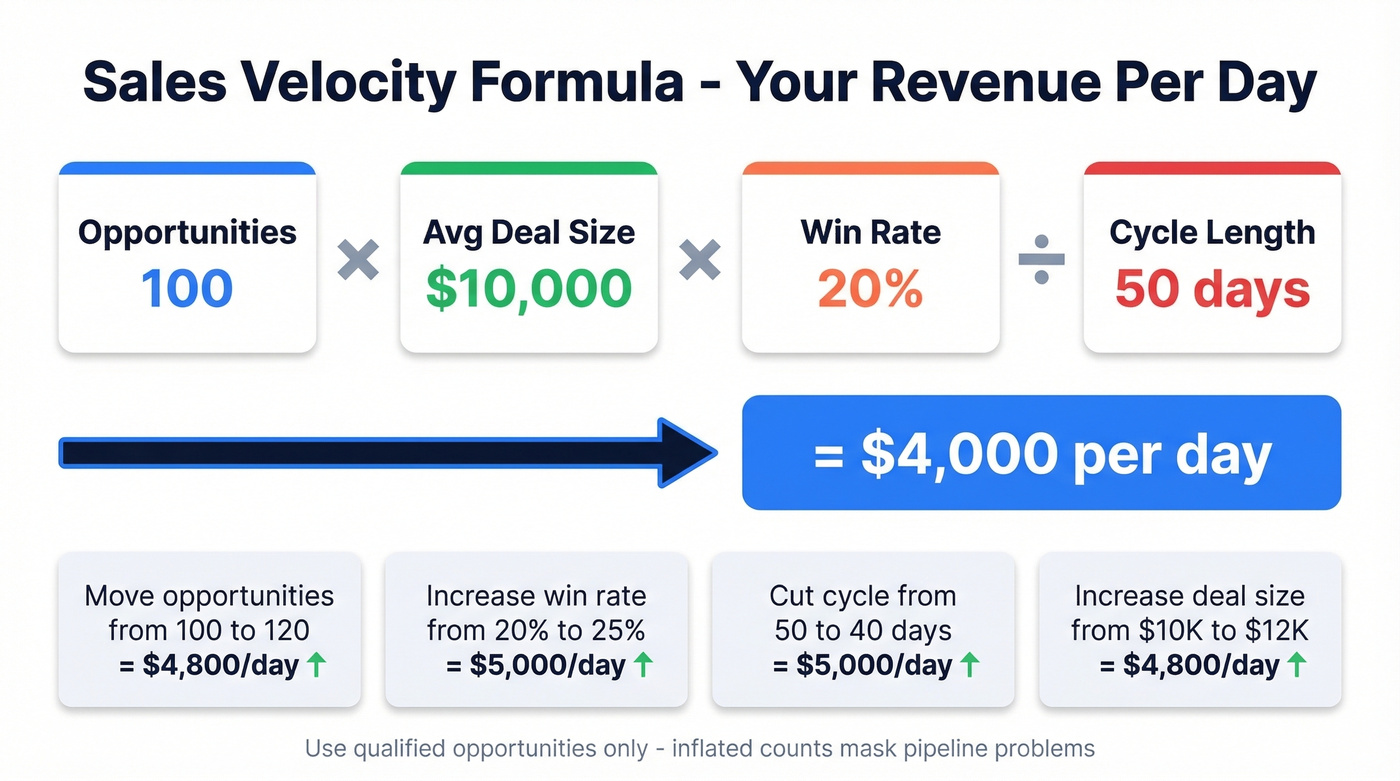
Sales Velocity = (Number of Opportunities x Average Deal Size x Win Rate) / Sales Cycle Length
Let's run a worked example. Say your team generates 100 qualified opportunities per quarter, with an average deal size of $10,000, a 20% win rate, and a 50-day average cycle:
(100 x $10,000 x 0.20) / 50 = $4,000/day
Every lever in that formula is something you can move. But the key word is qualified. Use qualified opportunities only, or your velocity calculation gets distorted. An inflated opportunity count paired with a depressed win rate gives you a number that looks healthy but masks a pipeline full of junk.
One of the most underrated process changes is rep book sizing. Gradient Works' 2026 CRO benchmarks recommend 100-300 active accounts per rep, refreshed every 30-60 days. Box runs their reps at 200-250 high-potential accounts. Another company in that same dataset cut books to 300-400 accounts and watched win rates climb from 13% to over 20% in under a year.
The logic is simple: a rep with 1,000 accounts works none of them well. A rep with 200 can actually multi-thread into the 6-10 decision-makers that typical B2B deals involve. Smaller books mean deeper engagement, which means faster cycles and higher conversion. It's the cheapest acceleration lever you can pull - it costs nothing but discipline.
Process also means lead routing, stage definitions, content enablement, and handoff protocols. Contacting a new lead within 5 minutes makes the lead far more likely to qualify than waiting 30 minutes. Speed-to-lead is a process choice, not a tool feature.

Every day past 50 days kills your win rate. The fastest fix? Clean data. Prospeo delivers 98% email accuracy with a 7-day refresh cycle, so your sequences actually reach buyers. Snyk's 50 AEs saw pipeline jump 180% after dropping bounce rates to under 5%.
Stop accelerating into a wall of bounced emails.
Lever 3: People
Mark Roberge scaled HubSpot's sales org from zero to $100M in revenue over seven years - 450 sales and support personnel, 10,000+ customers across 60 countries. His framework for the people side comes down to three systems: hiring, coaching, and compensation.
On hiring, Roberge identified five traits that predicted success: coachability, curiosity, intelligence, track record of past success, and work ethic. The method matters as much as the traits. Build a scorecard, interview against it, then compare your top performers to the scorecard after six months and iterate. Most sales orgs hire on gut feel and wonder why half their reps miss quota.
Coaching is where most acceleration investments die. Roberge's approach is deliberately narrow: focus on one skill per month rather than overwhelming reps with a laundry list. Rep self-reflection paired with a mutual development plan between rep and manager. This is the opposite of buying Gong, recording every call, and never actually reviewing them - which we see far too often.
On comp, Roberge's split-commission model aligns incentives with retention: half the commission at close, half after the customer stays four months. This prevents the "close and coast" behavior that inflates top-line numbers while destroying LTV.
The practitioner community on r/salestechniques pushes back on framework-heavy approaches. One popular post argues that switching frameworks "almost doesn't matter" compared to verbiage, tone, and genuine curiosity. The poster calls question-based selling "super powerful" and outlines a 7-step call structure built around exploring emotional friction and future-pacing outcomes. The takeaway isn't that frameworks are useless - it's that no framework survives contact with a rep who can't ask good questions and actually listen to the answers.
Scripts create floors. Curiosity creates ceilings. The best teams combine both.
Sales Cycle Benchmarks
Before you can accelerate, you need to know where you stand. These benchmarks are directional - your product complexity, buyer sophistication, and competitive dynamics will shift the numbers. But if your cycle is significantly longer than your benchmark, you've got a problem worth diagnosing.
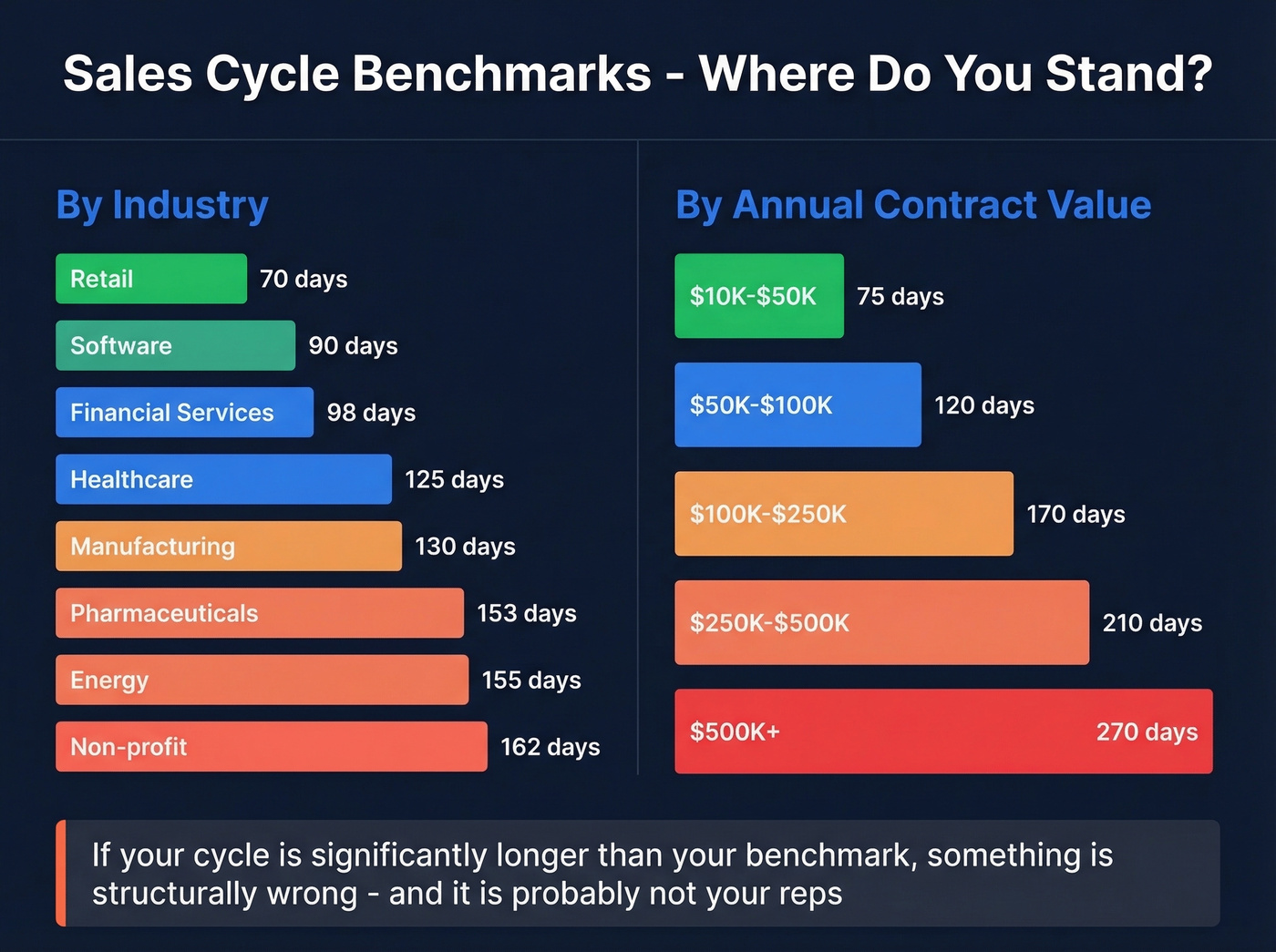
By Industry:
| Industry | Avg. Cycle (Days) |
|---|---|
| Retail | 70 |
| Software | 90 |
| Financial Services | 98 |
| Healthcare | 125 |
| Manufacturing | 130 |
| Pharmaceuticals | 153 |
| Energy | 155 |
| Non-profit | 162 |
By Company Size (Prospect):
| Employee Count | Avg. Cycle (Days) |
|---|---|
| 1-10 | 38 |
| 11-50 | 57 |
| 51-200 | 77 |
| 201-500 | 95 |
| 10,001+ | 185 |
By Annual Contract Value:
| ACV Range | Avg. Cycle (Days) |
|---|---|
| $10K-$50K | 75 |
| $50K-$100K | 120 |
| $100K-$250K | 170 |
| $250K-$500K | 210 |
| $500K+ | 270 |
A software company selling $50K deals to mid-market should expect roughly 90-120 day cycles. If you're running 180+, something is structurally wrong - and it's probably not your reps. Look at data quality, qualification criteria, and whether you're multi-threading into the full buying committee.
Here's the thing: if your average contract value sits below $25K, you probably don't need a $15K/year data platform or a $50K conversation intelligence deployment. A clean contact database, a well-configured CRM, and reps who can run a tight discovery call will get you 80% of the way there. Save the enterprise stack for enterprise deals.
Sales Acceleration Tools With 2026 Pricing
Match the tool to the bottleneck. Don't buy an all-in-one you won't use.
| Tool | Category | Starting Price | Best For |
|---|---|---|---|
| Apollo | Data & Engagement | Free; paid $49/user/mo | SMB prospecting + sequences |
| HubSpot Sales Hub | CRM + Engagement | Free; paid from $20/seat/mo | Growing teams, free CRM |
| Salesforce Sales Cloud | CRM | ~$25/user/mo | Enterprise workflows |
| Outreach | Sales Engagement | ~$100/user/mo (annual) | Sequence-heavy outbound |
| Salesloft | Sales Engagement | ~$100-150/user/mo | Multi-channel cadences |
| Gong | Conversation Intel | ~$120-250/user/mo | Call coaching + deal intel |
| ZoomInfo | Data + Intent | ~$15K+/year | Large US databases |
| Cognism | Data (EMEA focus) | ~$1,000-3,000/mo | European compliance |
| Lusha | Data (lightweight) | From $39/mo | Quick lookups, small teams |
If you had to pick three tools and build a stack from scratch, here's where we'd start: Prospeo for data (98% email accuracy, 300M+ professional profiles, at roughly $0.01/lead), HubSpot Sales Hub for CRM since the free tier is genuinely usable, and Outreach for engagement where the AI coaching alone justifies the cost for teams running 50+ sequences. That stack typically lands around $140-$160 per user/month before add-ons and covers the full cycle from prospecting through closed-won.
HubSpot scales with your team size - $20/seat at Starter, $100 at Professional, $150 at Enterprise. Outreach's ~$100/user/month price tag often comes with implementation costs of $1K-8K, and its AI coaching is associated with an 11-day reduction in sales cycles on average.
Gong is powerful but expensive. At 10 seats, $120-250/user/month is $14.4K-$30K/year in seat costs, plus platform fees that can range from $5K-$50K before implementation, which often runs $15K-$65K. Worth it if you're actually building a coaching culture. A waste if the recordings just sit there.
Five Mistakes That Kill Momentum
1. Tool sprawl without process change. Bain calls this the "micro-productivity" trap. You buy five tools, each saves 10 minutes a day, and you declare victory. Meanwhile, your pipeline stages are undefined, your lead routing takes 48 hours, and reps are still qualifying by gut feel. Tools amplify process. They don't replace it.
2. Bad data poisoning everything downstream. A 35% bounce rate doesn't just mean 35% of your emails fail - it means your domain reputation degrades, your engagement metrics become unreliable, and your AI tools train on garbage signals. Fix the data layer first.
3. Over-automation that strips humanity from outreach. When every touchpoint is templated and every follow-up is automated, prospects can tell. The Reddit consensus is clear: curiosity and genuine questions beat polished scripts. Automate the admin. Keep the conversations human.
4. Buying conversation intelligence without coaching infrastructure. Gong, Chorus, and similar tools are recording every call. The question is whether anyone's reviewing them. Without a structured coaching cadence - one skill per month, not a firehose - you're paying $120-250/user/month for a very expensive call recorder.
5. Optimizing speed over qualification. Accelerating unqualified deals into your pipeline just produces faster losses. If your win rate is below 15%, the problem isn't speed - it's that you're working the wrong opportunities. Fix qualification before you fix velocity.
Your sales velocity formula is only as strong as the contacts feeding it. Prospeo gives you 300M+ verified profiles with 30+ filters - intent data, technographics, headcount growth - at $0.01 per email. No $15K contracts. No stale data.
Compress your cycle with contacts that actually connect.
Scaling Without Breaking
Once your acceleration system works for one team, the temptation is to scale immediately. Roberge's framework provides a useful brake: before scaling, define your leading indicator.
The structure is simple - P% of customers do E events within T time. Typical ranges are P at 60-80% and T at 30-60 days. HubSpot's version was specific: 80% of customers use 5+ features out of 25 within 60 days. If your leading indicator is healthy, you've got product-market fit worth scaling. If it's not, you're accelerating toward a cliff.
The go-to-market fit gates are equally concrete. Roberge targets LTV:CAC above 3 and payback period at or under 12 months. If your unit economics don't clear those bars, adding reps and tools just burns cash faster. We've seen teams double their SDR headcount while their LTV:CAC sat at 1.5 - that's not acceleration, it's subsidized pipeline.
The scaling sequence matters: fix data quality first, then process, then hire. Most teams reverse this order and wonder why their 20th rep performs worse than their 5th. The system has to work before you pour people into it. Sales acceleration isn't a single tool purchase or a one-time process overhaul - it's the compounding effect of clean data, tight workflows, and reps who can actually sell. If you want a tighter operating model, start with sales process optimization and measure pipeline health weekly.
FAQ
What's the difference between sales velocity and sales acceleration?
Sales velocity is the metric - revenue generated per day, calculated as (Opportunities x Deal Size x Win Rate) / Cycle Length. Sales acceleration is the broader system of strategies, tools, and process changes designed to increase that velocity over time. One measures; the other moves the number.
What is the sales acceleration formula?
Mark Roberge's sales acceleration formula is a data-driven framework that breaks growth into three interdependent systems: a predictable hiring methodology, a scalable coaching program, and compensation aligned with customer retention. It's not a single equation - it's a repeatable playbook for building a sales org that compounds performance as it grows.
What's the best tool for small teams?
Start with HubSpot's free CRM and a verified data platform like Prospeo where the free tier includes 75 emails/month at 98% accuracy. Add an engagement tool only after your data and process are solid. Three tools, under $200/user/month total, covers prospecting through closed-won.
How long does it take to see results?
Process changes like book sizing and lead routing show measurable improvement in 30-60 days. Tool implementations typically need 60-90 days for full adoption. Expect a full quarter before you can confidently measure velocity gains across your pipeline.
Does AI actually shorten sales cycles?
Yes. AI coaching cuts cycles by 11 days on average, and early deployments are driving 30%+ win-rate improvements. But automating a broken process just breaks it faster. Fix the workflow first, then layer in AI to amplify what already works.