

Sales Accepted Lead: The Most Overlooked Pipeline Stage
A RevOps lead we know ran a pipeline audit last quarter and found that 40% of marketing-qualified leads never got a single touchpoint from sales. Not rejected. Not disqualified. Just forgotten. The culprit wasn't lazy reps or bad leads - it was a missing handoff stage that nobody had bothered to formalize.
That missing stage is the sales accepted lead.
What a SAL Actually Is
A sales accepted lead is a formal step where sales reviews and accepts an MQL as worth pursuing, based on criteria both teams agreed to in a marketing-sales SLA. It's the moment ownership transfers from marketing to sales, and it starts the clock on follow-up.
Your SAL acceptance rate should be 90% or higher. Anything below 70% is a red flag that marketing and sales don't agree on what "qualified" means.
Three things you need to implement SAL today: a shared lead definition both teams sign off on, a follow-up SLA with escalation paths, and a lead scoring threshold that triggers the handoff automatically. Most SAL failures aren't process problems - they're data problems. Leads get rejected because the email bounces, the job title is outdated, or the phone number is dead. Fix the data and the process fixes itself.
SAL vs MQL vs SQL
These three stages get conflated constantly, and the confusion creates real pipeline leakage.
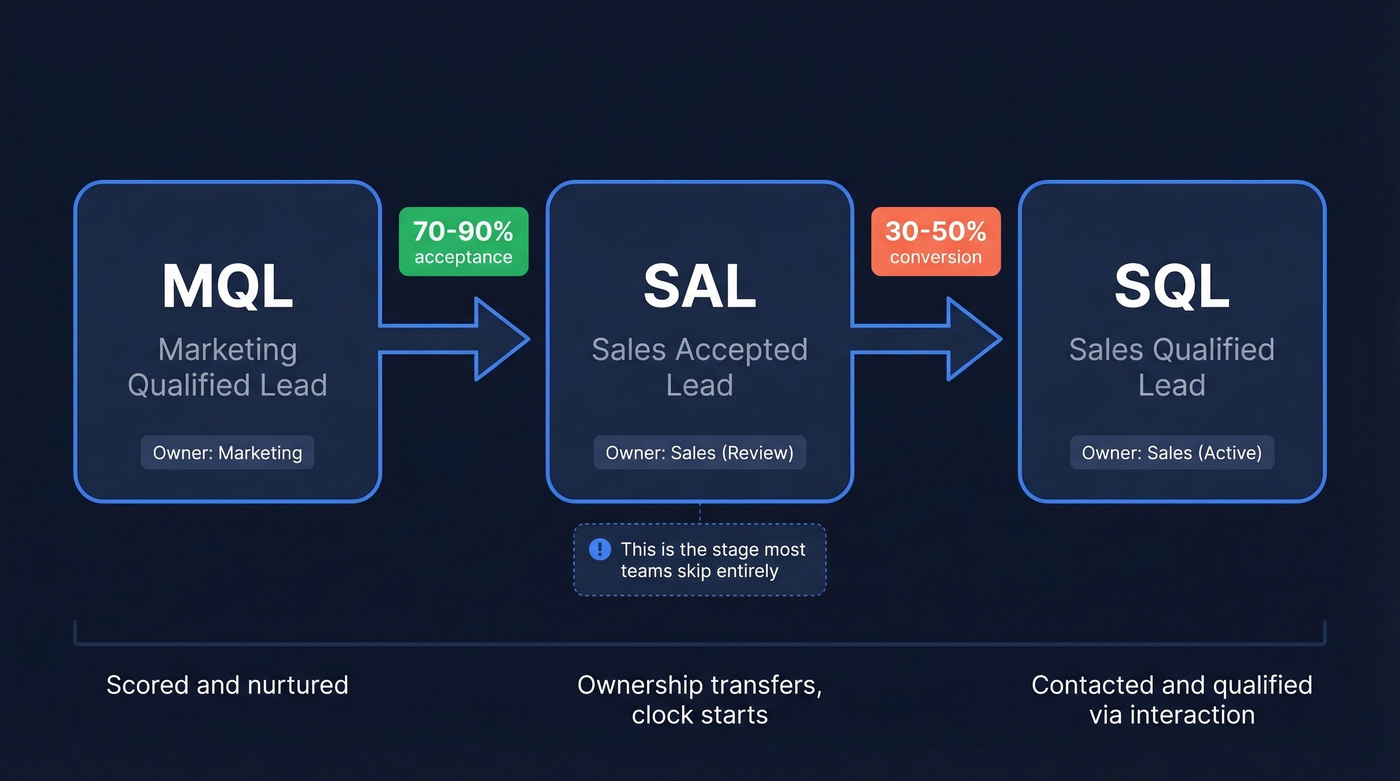
| Stage | Definition | Owner | Key Action |
|---|---|---|---|
| MQL | Shows intent + fits ICP | Marketing | Scored, nurtured |
| SAL | MQL reviewed and accepted | Sales | Ownership transfers |
| SQL | Contacted and qualified via interaction | Sales | Actively worked |
Typical conversion ranges tell the story. MQL-to-SAL acceptance runs 70-90% in healthy organizations - meaning most MQLs should pass the acceptance bar if your scoring model is calibrated right. SAL-to-SQL conversion drops to 30-50%, because that's where real qualification happens: sales talks to the prospect and learns whether there's genuine interest, budget, and timeline.
The gap between those two numbers is where pipeline discipline lives.
Why This Stage Gets Skipped
Most B2B orgs don't have a SAL stage at all. They jump straight from MQL to SQL, which means "accepted by sales" and "qualified by sales" get treated as the same event. They're not.
The numbers paint an ugly picture. Only 22% of organizations say marketing and sales are tightly aligned, while 58% rate their alignment as "poor." Just 43% have any SLA at all, and a mere 11% manage it jointly. In RevOps communities on Reddit, the most common complaint about MQL handoffs isn't lead volume - it's that the two teams can't agree on what "qualified" means in the first place.
Without a formal SAL stage, leads enter what we call "lead oblivion." Marketing marks them qualified. Sales doesn't review them for days. By the time a rep opens the record, the prospect has already taken a demo with a competitor. An 8-hour accept/reject window forces a decision: yes, I'll work this lead - or no, here's why, and it goes back to marketing.
SAL Benchmarks by Industry
Benchmarks vary wildly by industry, which is why copying someone else's SAL criteria rarely works. Here are conversion rates from First Page Sage's multi-year dataset to give you a baseline.
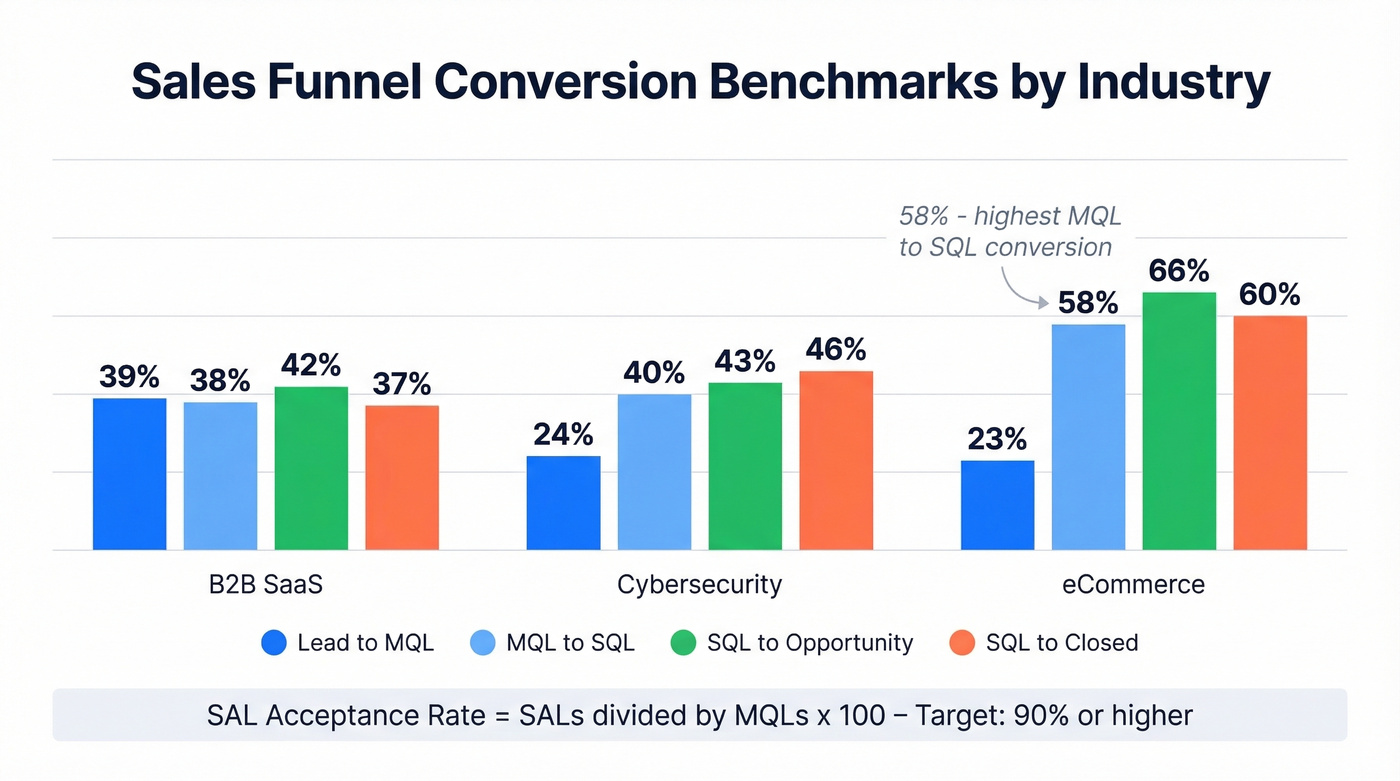
| Industry | Lead to MQL | MQL to SQL | SQL to Opp | SQL to Closed |
|---|---|---|---|---|
| B2B SaaS | 39% | 38% | 42% | 37% |
| Cybersecurity | 24% | 40% | 43% | 46% |
| eCommerce | 23% | 58% | 66% | 60% |
Notice the spread. eCommerce converts MQL-to-SQL at 58% while B2B SaaS sits at 38%. That doesn't mean SaaS marketing is worse - it means the qualification bar is different. SaaS deals involve more stakeholders, longer cycles, and more complex buying criteria.
Your SAL acceptance rate formula: SALs / MQLs x 100. Forrester's target is 90%+. If you're consistently below that, the problem isn't sales being picky - it's that marketing and sales haven't agreed on what a qualified lead looks like.
Here's the thing: if your average deal size is under $15K and your acceptance rate already tops 85%, you probably don't need a more complex qualification framework. You need faster follow-up. The bottleneck for most mid-market teams isn't lead quality - it's speed.
A useful back-calculation we've used with our own pipeline: if your average deal is $50K, your close rate is 20% of SQLs, and your SAL-to-SQL conversion is 40%, then to hit $1M in a quarter you need 20 closed deals, 100 SQLs, and 250 SALs. Work backward from revenue to set your SAL volume goals. Once accepted leads convert to SQLs, the next milestone is the sales qualified opportunity - the point where a qualified lead becomes a real deal with a projected close date and revenue value attached.

You just read it: most SAL failures aren't process problems - they're data problems. Leads bounce, titles are outdated, phones are dead. Prospeo's 98% verified emails and 7-day data refresh mean your MQLs arrive with accurate contact data, so reps accept them instead of rejecting them.
Stop losing SALs to bad data. Start with 75 free verified emails.
How to Define Your SAL Criteria
Choosing a Qualification Framework
The framework you pick shapes what "sales-ready" means for your team.
| Framework | Best For | Core Focus | Weakness |
|---|---|---|---|
| BANT | SMB, high-volume | Budget, authority, need, timing | Too shallow for enterprise |
| CHAMP | Consultative sales | Challenges first, then authority | Slower to implement |
| MEDDIC | Enterprise, 6+ stakeholders | Decision process, champion, metrics | Overkill for transactional |
BANT alone is inadequate for any deal involving more than two decision-makers. Modern B2B buying groups often include 6-10+ stakeholders, and if your reps are selling into enterprise accounts while still qualifying on "do you have budget?", you're leaving pipeline on the table. CHAMP or MEDDIC forces reps to map the buying committee and understand the decision process before advancing a lead to SQL.
Skip MEDDIC if you're running a transactional motion with deal sizes under $20K. It'll slow your reps down without adding proportional insight.
Building a Lead Scoring Model
Use a 0-100 scale with a threshold that triggers the SAL handoff. A starting model:
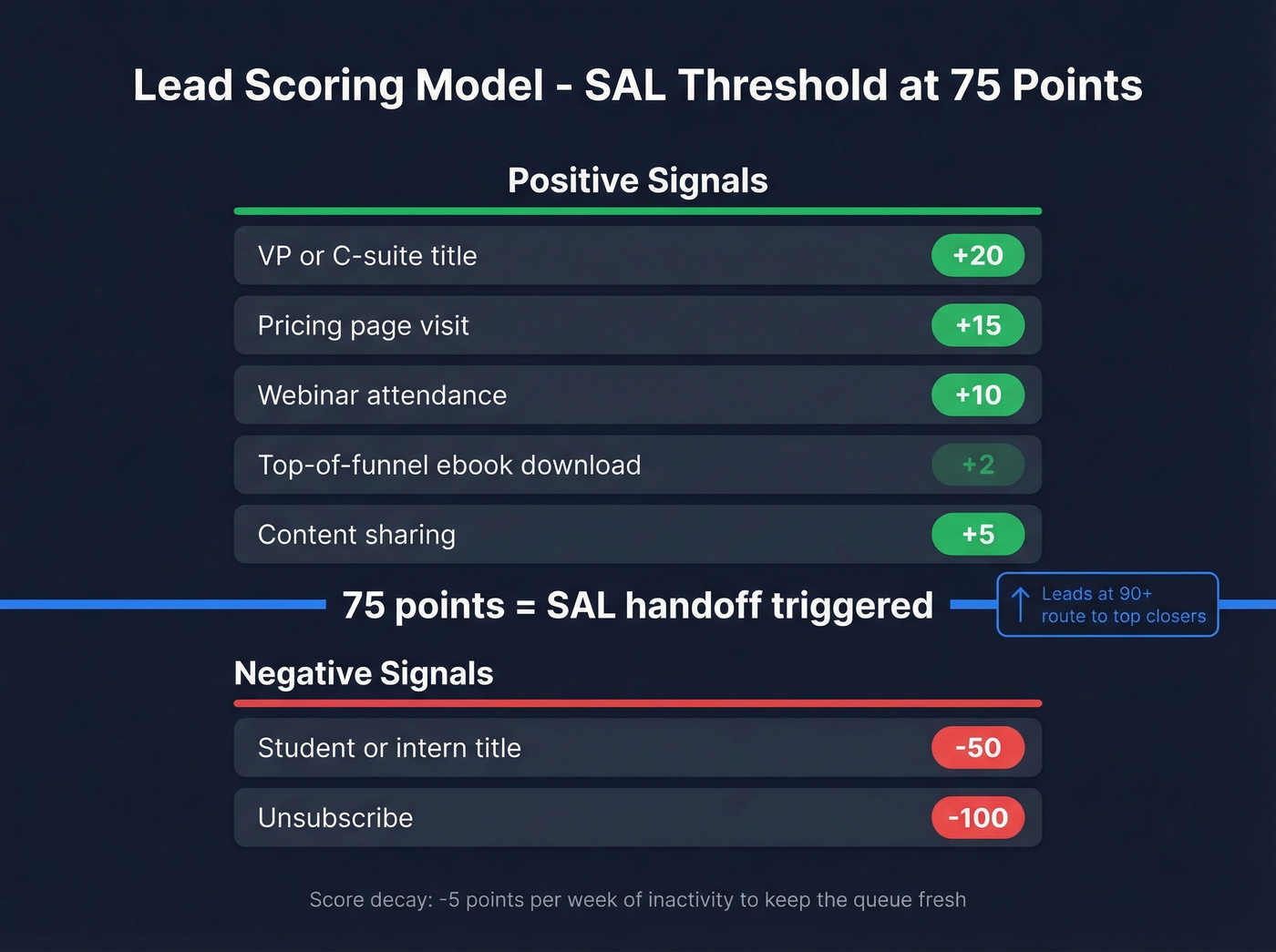
- VP or C-suite title: +20 points
- Pricing page visit: +15 points
- Webinar attendance: +10 points
- Top-of-funnel ebook download: +2 points
- Student or intern title: -50 points
- Unsubscribe: -100 points
Set your SAL threshold at 75 points. Leads scoring 90+ are high-potential and should route to your best closers. Build in score decay - drop 5 points per week of inactivity so stale leads don't clog the queue.
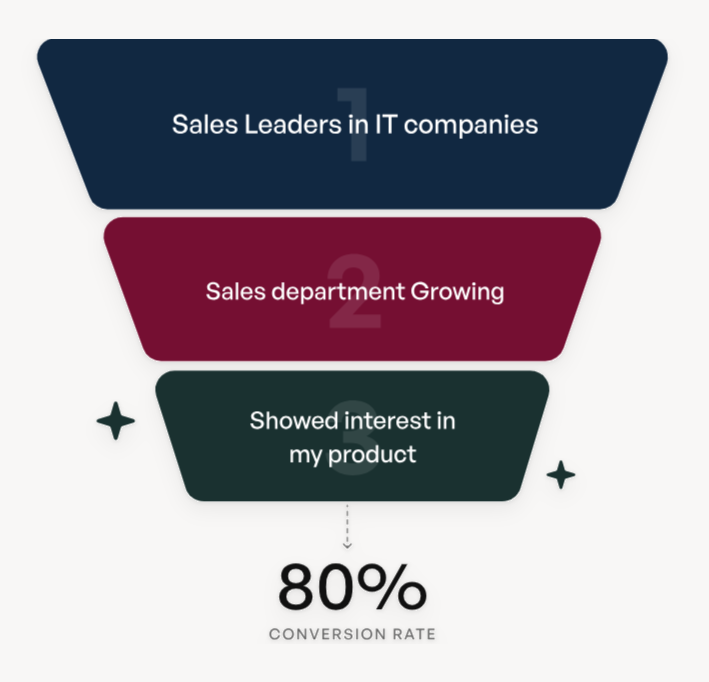
Companies with formal lead scoring see a 77% increase in lead generation ROI. The scoring model is what makes the SAL stage objective rather than vibes-based.
The SAL SLA Template
An SLA without teeth is just a suggestion.
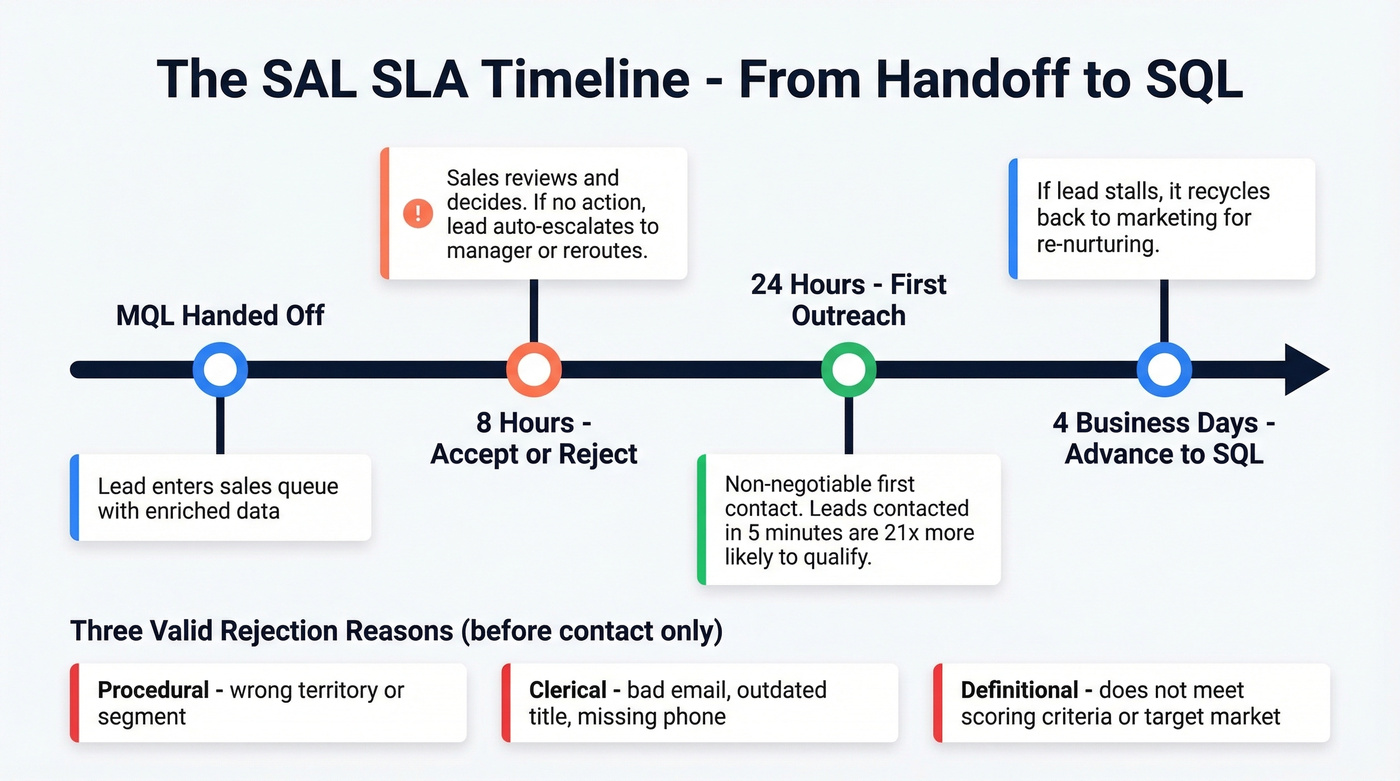
Acceptance window: Sales reviews and accepts or rejects each lead within 8 hours. If the window expires, the lead escalates to the sales manager, gets rerouted, or returns to marketing for re-nurturing.
Advance-to-SQL commitment: Once accepted, sales has 4 business days to advance the lead to SQL. If the lead stalls, it recycles back to marketing.
Follow-up timeline: First outreach within 24 hours of acceptance. Non-negotiable. Leads contacted within 5 minutes are 21x more likely to qualify than those contacted after 30 minutes - a SAL SLA is how you make that speed structural rather than aspirational. If you lack historical data, start with a 1.5% lead-to-revenue assumption and calibrate quarterly.
Three valid rejection reasons - and only three:
- Procedural: Lead was incorrectly routed (wrong territory, wrong segment).
- Clerical: Record is incomplete or inaccurate - wrong email, outdated title, missing phone number. If reps keep rejecting leads for bad contact info, the fix isn't a better SLA. It's better data. Run leads through enrichment before handoff so sales never wastes their SLA window hunting for a working email address.
- Definitional: Lead doesn't meet the agreed target market, activity threshold, or scoring criteria.
Rejection happens before contact. Disqualification happens after contact, when sales learns there's no genuine interest, need, or budget. Rejected leads recycle to marketing. Disqualified leads exit the funnel. Let's be honest - treating these as the same thing is one of the most common SLA mistakes we see, and it wrecks your reporting.
6 Mistakes That Kill Your SAL Process
1. No shared lead definition. Marketing says "downloaded a whitepaper and has 50+ employees" is qualified. Sales says "requested a demo and has budget confirmed." Neither wrote it down. Co-create the definition in a single document, review it quarterly, and tie it to your scoring model.
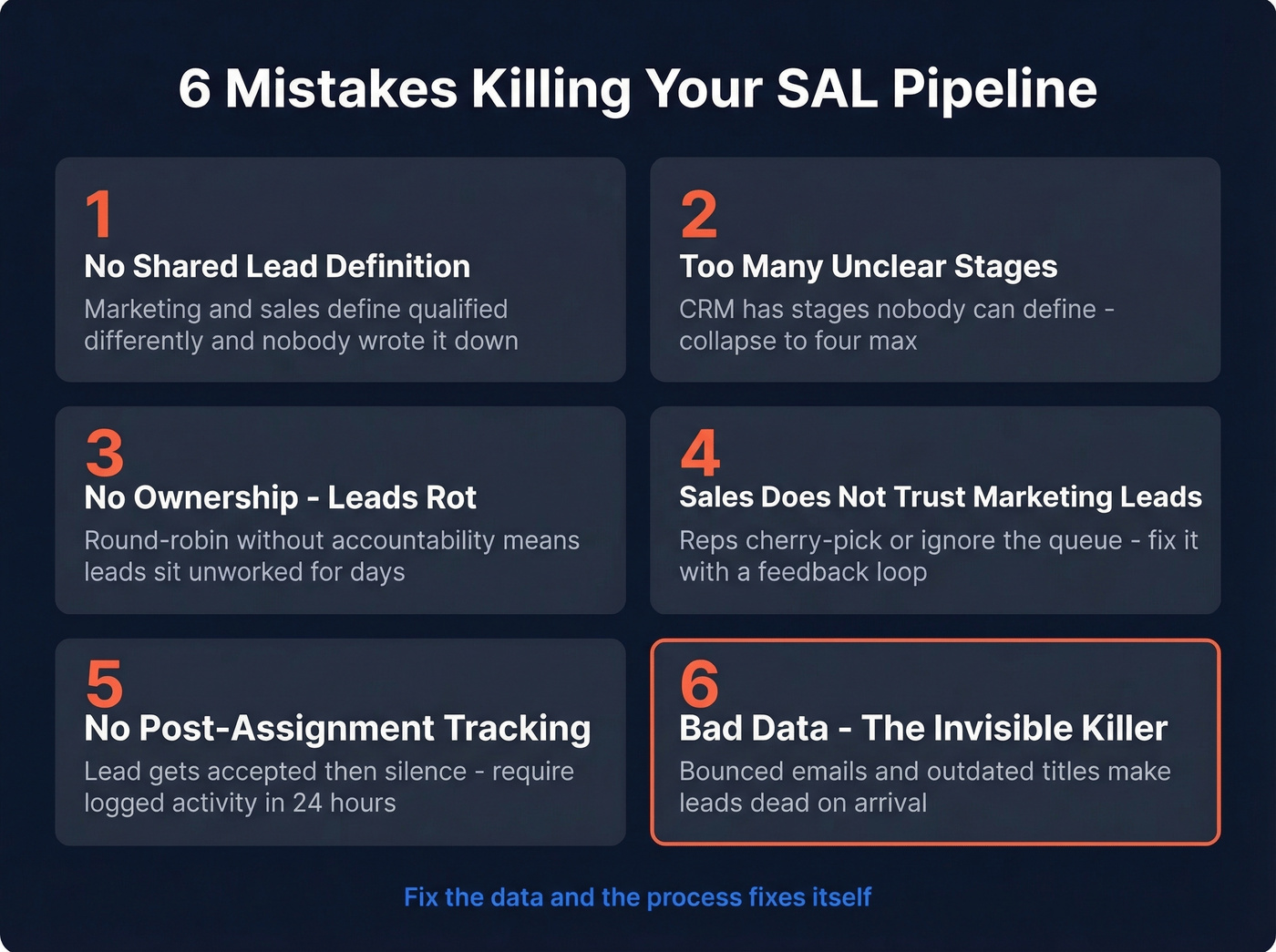
2. Too many unclear stages. If your CRM has Lead, MQL, SAL, SQL, Opportunity, and three custom stages nobody can define, you've got reporting chaos. Collapse to four stages max - each with a single, unambiguous entry criterion.
3. No ownership - leads rot. Round-robin assignment without accountability means leads sit unworked for days. Assign every SAL to a named rep with a timestamped SLA. If the clock runs out, auto-reassign. We've seen teams cut their average response time from 36 hours to under 4 just by adding auto-reassignment rules.
4. Sales doesn't trust marketing leads. When reps believe marketing leads are garbage, they cherry-pick or ignore the queue entirely. The fix is a feedback loop: sales tags rejection reasons, marketing reviews them monthly and adjusts scoring. Trust builds when both teams see the data improving over time.
5. No post-assignment engagement tracking. A lead gets accepted, and then silence. No logged calls, no emails, no activity. Require at least one logged activity within 24 hours of acceptance. No activity triggers auto-escalation.
6. Bad data - the mistake nobody talks about. A rep opens a lead, sees a bounced email or a job title from two years ago, and mentally disqualifies it without logging a rejection. The lead just dies. This is the most frustrating failure mode because it's invisible in your CRM reporting - the lead looks "accepted" but it's actually dead on arrival.

If leads keep getting rejected for bounced emails or wrong titles, enrich your records before handoff. Prospeo returns 50+ data points per contact with a 98% email accuracy rate and refreshes every 7 days, so sales never rejects a lead because the data was stale.
Your back-of-napkin math needs 250 SALs to hit $1M. That math breaks when 35% of emails bounce. Prospeo's 5-step verification and 143M+ verified emails keep your bounce rate under 4% - so every accepted lead actually converts to a conversation.
Build a pipeline that survives the MQL-to-SAL handoff.
From SAL to SQO: Tracking What Matters
Getting leads accepted is only half the battle. The real revenue signal comes when those accepted leads convert into sales qualified opportunities - deals with a projected close date and revenue value attached. SQO metrics help both teams understand which lead sources produce pipeline that actually closes, not just pipeline that looks good in a dashboard.
For teams that optimize for MQL volume without tracking SQO conversion downstream, the result is predictable: lots of activity, very little revenue. Connect your SAL data to closed-won outcomes, and you'll finally have the feedback loop that makes the whole system self-correcting.
FAQ
What's the difference between a rejected lead and a disqualified lead?
A rejected lead is turned back before sales makes contact - for procedural, clerical, or definitional reasons. A disqualified lead is one sales spoke with and determined there's no fit. Rejected leads recycle to marketing; disqualified leads exit the funnel entirely.
What's a good MQL-to-SAL acceptance rate?
Forrester recommends 90%+. Below 70% signals that marketing and sales fundamentally disagree on what qualified looks like. Fix the shared definition before optimizing the funnel.
How do you prevent leads from getting rejected for bad contact data?
Run leads through a data enrichment tool before the handoff. Prospeo's enrichment returns 50+ data points at an 83% match rate with 98% email accuracy, eliminating clerical rejections so reps spend their SLA window contacting prospects instead of hunting for working addresses.
What's the difference between a marketing accepted lead and a sales accepted lead?
A marketing accepted lead is one marketing has vetted against basic ICP criteria before MQL scoring kicks in. A sales accepted lead is the next gate: sales reviews that scored MQL and formally agrees to work it. The distinction creates accountability on both sides of the handoff.