

Sales and Marketing Alignment Best Practices That Actually Work
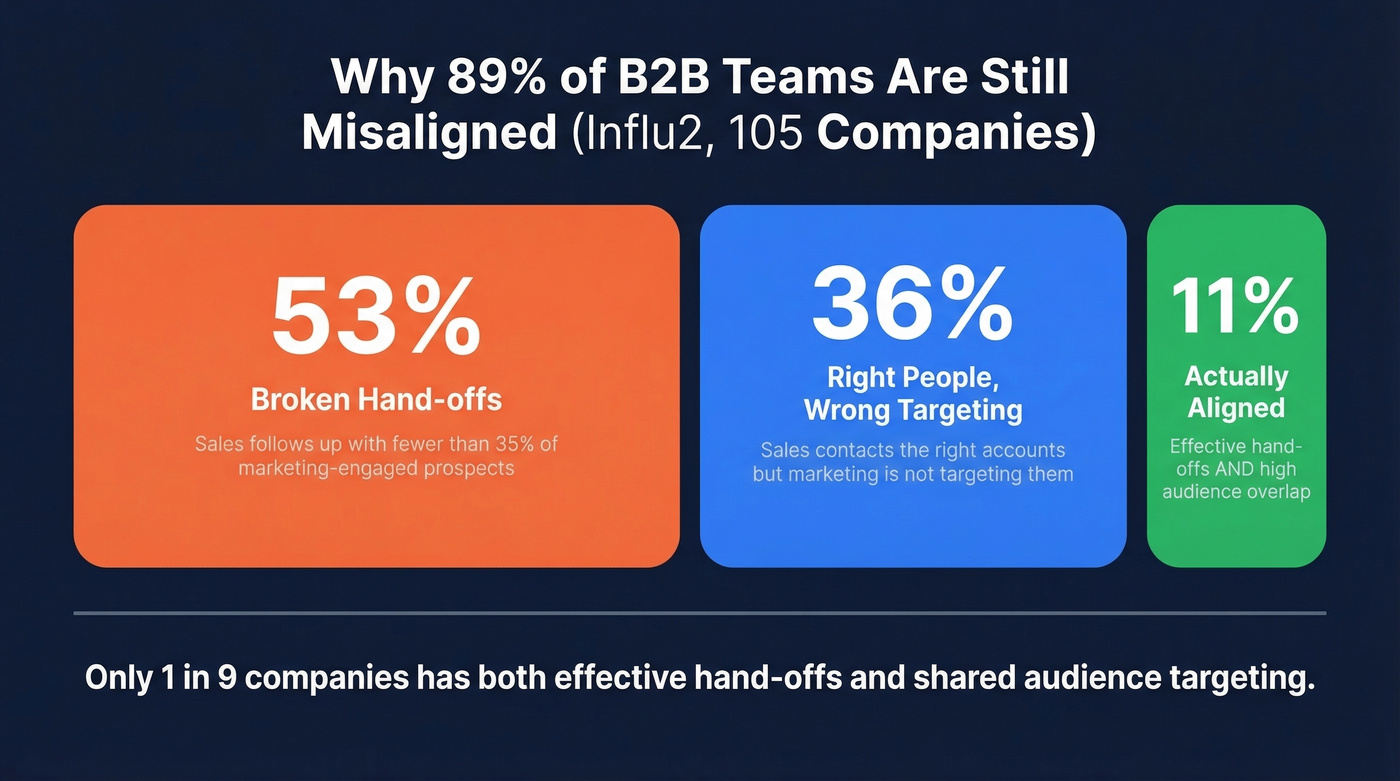
There's a phrase that keeps showing up on r/marketing: the "black hole between MQL and closed-won." Marketing delivers leads into a CRM, sales ignores them, and nobody can explain what happened in between. An Influ2 study of 105 companies found that 53% have broken hand-offs - meaning sales follows up with fewer than 35% of marketing-engaged prospects.
That's not a communication problem. It's an infrastructure failure.
If you're tired of alignment advice that boils down to "communicate more," this is the piece that replaces platitudes with operational commitments - SLA templates, scoring models, and the data-quality fix nobody wants to talk about.
The Three Things That Matter Most
If you only implement three things from this article, make it these:
- A lead handoff SLA with time-based terms and automatic revert rules
- A lead scoring model with actual point values both teams agree on
- A monthly 45-minute feedback meeting with a fixed agenda - not a free-form gripe session
Sales teams in aligned organizations are 103% more likely to exceed their goals. These three artifacts solve 80% of alignment problems because they replace vague goodwill with operational commitments.
Why Alignment Is Still Broken in 2026
The Influ2 data tells a stark story. Only 11% of companies studied had both effective hand-offs and high audience overlap between sales and marketing. The other 89% fell into two buckets: teams where sales contacts the right people but marketing isn't targeting them (36%), and teams where the hand-off is simply broken (53%).
The root causes haven't changed much - different lead definitions, disjointed tech stacks, competing KPIs, and no regular communication cadence. But here's the thing: most alignment articles stop at "build trust." That's like telling a leaky pipe to try harder. You need infrastructure, not intentions.
There's a 2026 wrinkle worth naming. AI built on fragmented tools and siloed data gets trained on incomplete information, which leads to conflicting recommendations across teams. If you're planning to layer AI onto a broken alignment foundation, you're automating chaos. Fix the shared data layer first.
Let's build the infrastructure instead.
8 Strategies That Drive Revenue
1. Shared Revenue Goals, Not Separate KPIs
Stop measuring marketing on MQL volume and sales on closed-won revenue. These KPIs create opposing incentives - marketing optimizes for quantity, sales cherry-picks, and both claim victory while pipeline stalls.
Replace them with a journey-wide scorecard: SQL acceptance rate, opportunity creation, pipeline value, win rate, and cycle time. Crossbeam does this well - their company-wide OKRs auto-post to Slack daily so there's nowhere to hide. Infrastructure, not trust falls.
2. Unified ICP and Buyer Personas
If marketing is targeting "VP of Engineering at mid-market SaaS" and sales is calling "Director of IT at enterprise manufacturing," you don't have an alignment problem. You have a targeting problem. McKinsey research shows only 8% of B2B organizations are set up for highly personalized marketing, but three-quarters of those grew market share.
Sit both teams down and build one ICP document. Alyce did this with ABM tiering and opened 60% of their 50 tier-1 accounts in a single quarter. One definition, one target list, one motion.
3. Lead Scoring With Actual Point Values
Most lead scoring models are either nonexistent or so vague they're useless. "Engaged" isn't a score. Here's an example scoring model inspired by Belkins' framework:
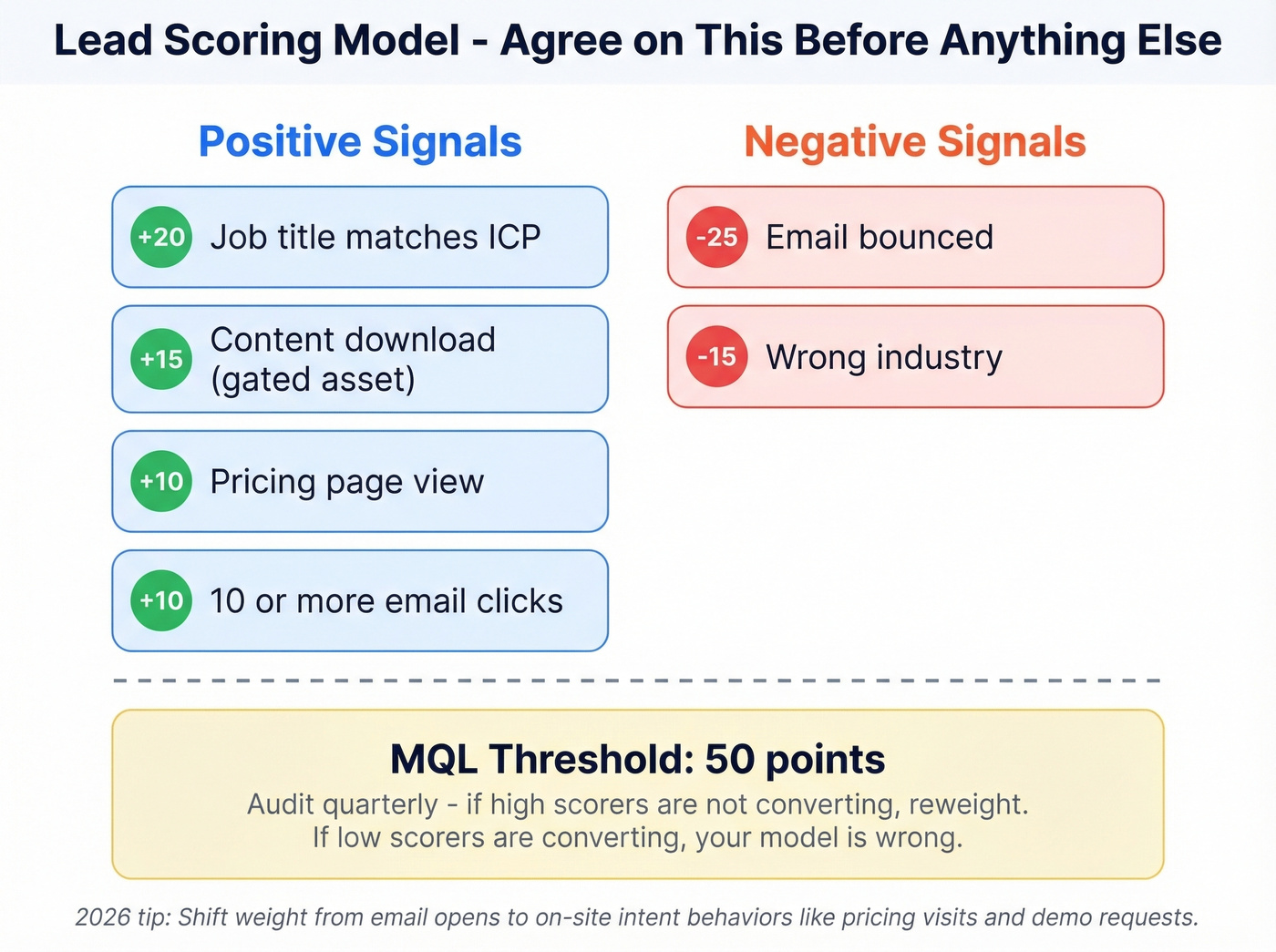
| Signal | Points |
|---|---|
| Pricing page view | +10 |
| Content download | +15 |
| 10+ email clicks | +10 |
| Email bounced | -25 |
| Job title match | +20 |
| Wrong industry | -15 |
One important shift for 2026: email open rates are unreliable thanks to privacy changes like Apple MPP and proxy opens. Move your scoring weight toward on-site intent behaviors - pricing page visits, demo requests, form submissions.
If high scorers aren't converting, audit the criteria. If low scorers are converting, reweight your signals. In our experience, teams that run quarterly scoring audits completely reshape their pipeline quality within two cycles. A shared scoring model forces both teams to agree on what "qualified" actually means - and that agreement alone is worth the exercise.
4. A Lead Handoff SLA With Teeth
An SLA without enforcement is a suggestion. Here's a template with actual teeth:
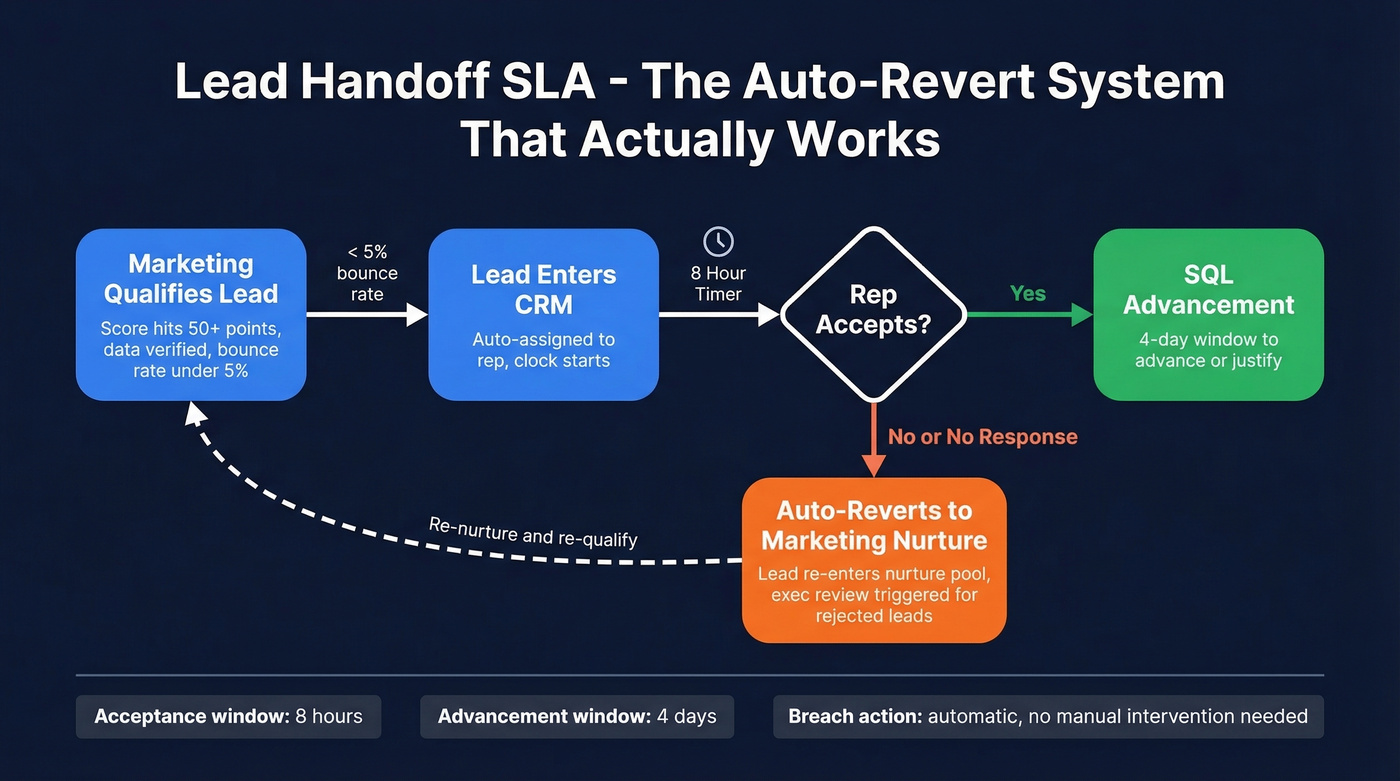
| SLA Term | Commitment | If Breached |
|---|---|---|
| Lead acceptance | 8 hours | Auto-reverts to marketing |
| SQL advancement | 4 days | Auto-reverts to marketing |
| Marketing lead volume | Monthly target | Escalation meeting |
| Data quality | <5% bounce rate | Source audit triggered |
The revert mechanism is what gives this teeth - and it's the single most effective enforcement tool I've seen in practice. When a lead automatically returns to marketing's nurture pool after 8 hours of silence, reps start paying attention. Some teams add an executive review step for rejected leads, a "judiciary process" that prevents reps from dismissing leads without justification.
Enforce this in your CRM. Salesforce workflows or HubSpot automation can flag breaches in real time. RenderTribe offers a free downloadable SLA workbook in PDF and PowerPoint - one of the few ready-to-use templates out there.
5. Monthly Feedback With a Fixed Agenda
A 45-minute monthly meeting with a locked agenda:
- Objections heard on calls this month
- Which marketing assets reps actually used (and which they ignored)
- Content gaps - what do reps wish they had?
- Lost-deal patterns - what's killing deals post-SQL?
This isn't optional. SmartBug Media implemented this cadence and saw a 17.4% month-over-month increase in inbound-qualified leads, with a 47.73% pipeline conversion rate. The feedback loop is what makes every other practice on this list compound over time. Of all the sales and marketing alignment best practices we can share, this one has the highest long-term return.
6. Shared Content Strategy
Marketing creates content in a vacuum. Sales ignores it and writes their own one-pagers. Sound familiar?
The fix is a frontstage/backstage model: sales provides the raw material - real objections, customer language, competitive intel from calls - and marketing turns it into polished content. Track content utilization as a shared KPI. If sales isn't using the case studies marketing built, either the content's wrong or the distribution is broken. Start by having reps record the top three objections they hear each week. That alone generates a quarter's worth of battle cards and blog topics.
7. Unified Tech Stack With CRM as Source of Truth
Your CRM - whether it's Salesforce or HubSpot - needs to be the single source of truth. Not your MAP. Not the "shadow pipeline" your VP of Sales keeps in a Google Sheet.
Integrate your marketing automation platform with your CRM so lead score, last touch, and intent behaviors surface where reps actually work. For data enrichment and verification, Prospeo integrates natively with both Salesforce and HubSpot, enriching CRM records with 50+ data points per contact at a 92% API match rate. Clean data in the CRM means both teams trust what they're looking at - and that trust is the foundation every alignment initiative depends on.
8. Data Quality - The Silent Alignment Killer
Here's the practice nobody talks about, and it's the most important one on this list.
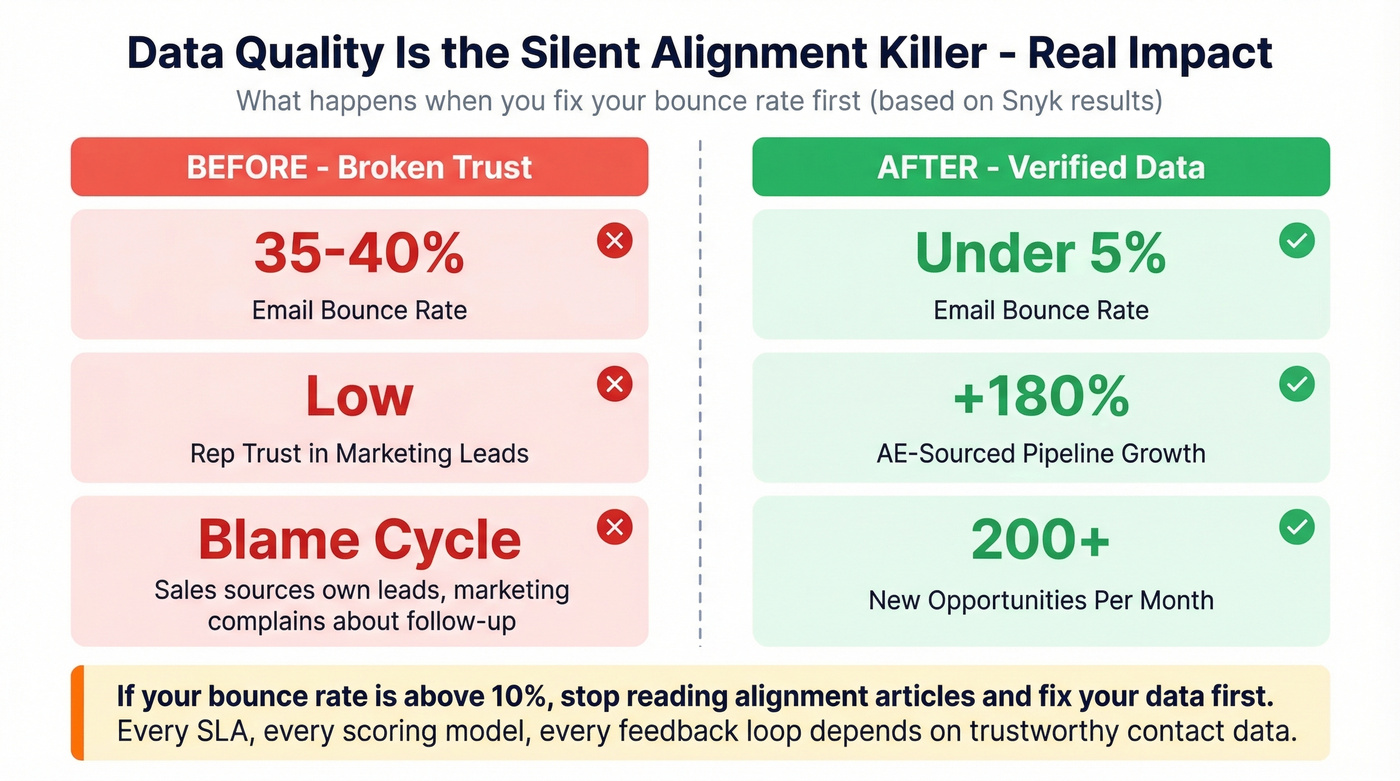
When 30%+ of marketing's emails bounce, sales stops trusting marketing's leads. Full stop. No SLA, no meeting cadence, no shared KPI dashboard will fix that trust erosion. Reps go back to sourcing their own leads, marketing complains about follow-up rates, and you're right back in the blame cycle. This matches the "black hole" dynamic called out on r/marketing - once trust breaks, nobody believes the downstream numbers.
The fix happens at the data layer. Before any lead hits the handoff SLA, verify it. Snyk saw exactly this dynamic play out: bounce rates dropped from 35-40% to under 5% after implementing proper verification, AE-sourced pipeline jumped 180%, and the team generated 200+ new opportunities per month. That behavioral shift - reps actually trusting and working marketing leads - is worth more than any alignment workshop.
If your bounce rate is above 10%, stop reading alignment articles and fix your data first. Every practice on this list assumes the underlying contact data is trustworthy. Bad data poisons every metric, every SLA, every feedback loop.

Your SLA says <5% bounce rate. Your data provider says 'good luck.' Prospeo's 5-step email verification delivers 98% accuracy - turning your lead handoff SLA from a suggestion into a system that works. When marketing passes leads with verified contact data, sales follows up instead of complaining.
Stop the blame cycle. Start with data both teams trust.
Alignment Mistakes That Guarantee Failure
| Mistake | Fix |
|---|---|
| Fighting over KPIs - marketing celebrates MQL volume, sales complains about quality | Journey-wide scorecard: SQL acceptance, pipeline value, win rate |
| No clear lead definition - MQL and SQL mean different things to each team | Define MQL, SAL, and SQL together, in writing, with examples |
| No sales feedback loop - marketing guesses what content to create | Monthly 45-minute meeting with a fixed agenda |
| Disjointed tech stack - data lives in five places, nobody trusts any of it | CRM as single source of truth, integrated with MAP and enrichment tools |
| Misaligned incentives - marketing bonused on leads, sales on deals | Balanced scorecard: SQL acceptance, influenced pipeline, content utilization |
When Alignment Isn't Enough - The RevOps Alternative
Sometimes alignment initiatives keep failing because the underlying structure is wrong. Two separate teams with separate leaders, separate budgets, and separate tools will always drift apart.
RevOps tears down the sales/marketing boundary entirely. Instead of coordinating two teams, you build one revenue team with shared metrics, shared leadership, and shared accountability. It's the ultimate infrastructure play - and it's where organizations land when process alignment keeps reverting to old habits. Think of it as marketing and sales coordination taken to its logical conclusion: if you can't keep the bridge standing, tear down the wall.
How to Measure If It's Working
Track these metrics on a shared dashboard both teams can see:
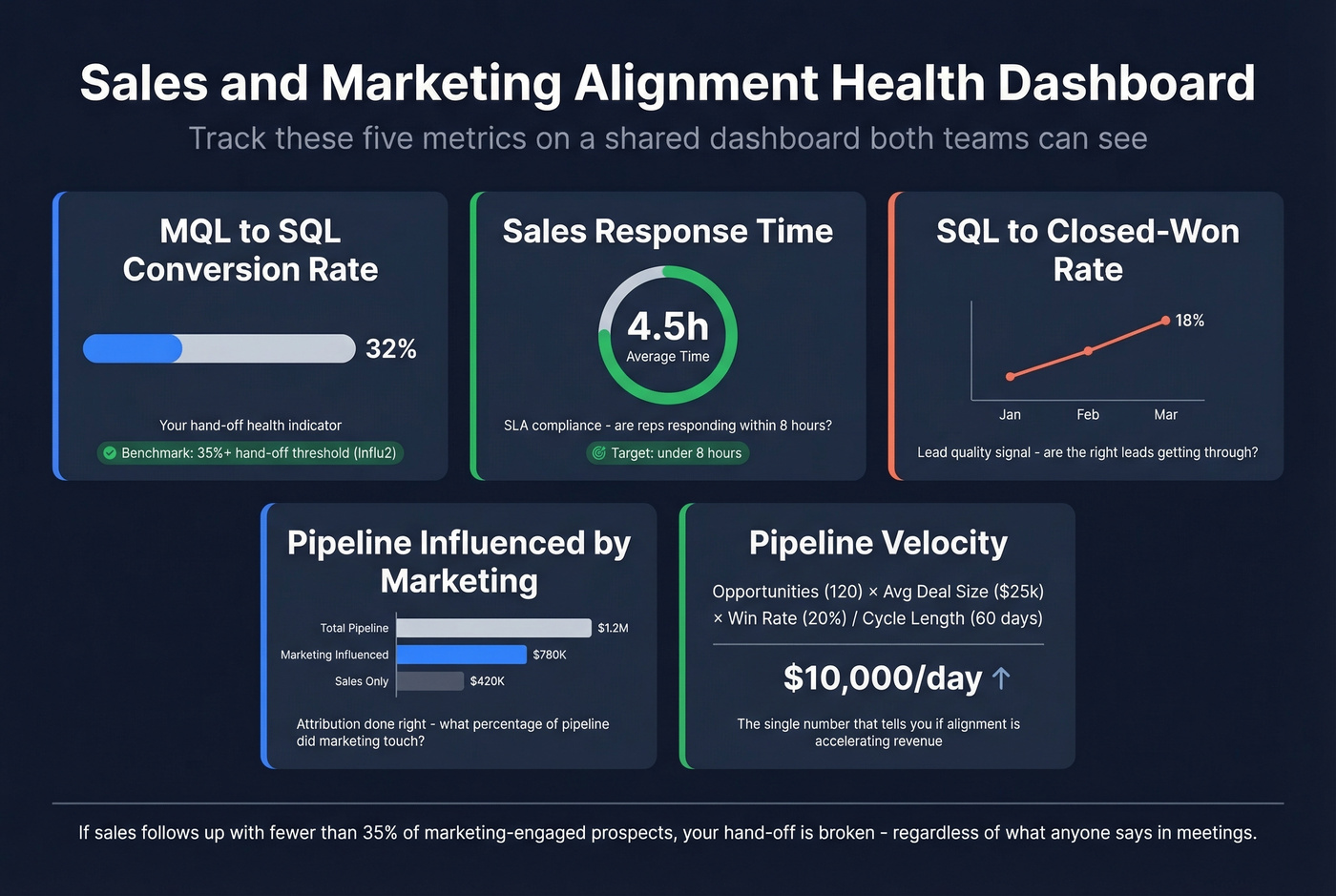
- MQL-to-SQL conversion rate - your hand-off health indicator
- Sales response time - SLA compliance
- SQL-to-closed-won rate - lead quality signal
- Pipeline influenced by marketing - attribution done right
- Pipeline velocity - opportunities x average deal size x win rate / cycle length
Use Influ2's 35% hand-off threshold as your diagnostic benchmark. If sales is following up with fewer than 35% of marketing-engaged prospects, your hand-off is broken - regardless of what anyone says in meetings. SmartBug's 47.73% pipeline conversion rate gives you a north star for what good looks like.
We've found that teams fixate on MQL volume when they should be watching SQL acceptance rate. That single metric tells you whether the hand-off is working, whether lead definitions are aligned, and whether data quality is holding up. Start there.
Alignment breaks when sales can't reach the leads marketing sends. Prospeo refreshes 300M+ profiles every 7 days - not every 6 weeks - so your shared ICP list stays current. Enrich your CRM with 50+ data points per contact at $0.01/email and give both teams one source of truth.
Shared goals need shared data. Get verified contacts for every lead.
FAQ
What's the difference between alignment and RevOps?
Alignment is process coordination between two separate teams - shared goals, SLAs, regular meetings. RevOps is structural unification under shared metrics, leadership, and tooling. Think of alignment as a bridge between two buildings; RevOps tears down the wall entirely. When alignment initiatives keep reverting to old habits, RevOps is typically the next step.
How long does it take to see results?
An SLA and scoring model can show measurable hand-off improvement within 60-90 days. Cultural shift takes longer - two to three quarters for most organizations. SmartBug Media saw a 17.4% month-over-month increase in inbound-qualified leads after implementing structured practices. Start with the three core artifacts and measure weekly.
What tools help with sales and marketing alignment?
Your CRM (Salesforce or HubSpot) is the foundation - everything flows through it. Add Slack for real-time feedback between teams, and a data verification platform so both teams trust the same contact data. The tool stack matters less than ensuring every tool feeds the same source of truth.
Which practices have the highest impact?
The three highest-impact practices are a lead handoff SLA with automatic revert rules, a lead scoring model with explicit point values both teams agree on, and a monthly feedback meeting with a fixed agenda. These replace vague goals with operational infrastructure - and they're the fastest path to measurable improvement.
How does bad data break alignment?
When bounce rates exceed 10%, sales reps stop trusting marketing-sourced leads and revert to self-sourcing - destroying every downstream metric. Snyk experienced 35-40% bounce rates before switching to verified data; after fixing it, AE-sourced pipeline jumped 180%. Verify contacts before they hit the handoff SLA, and alignment practices actually stick.