

The Sales and Marketing Meeting Agenda That Actually Fixes Alignment
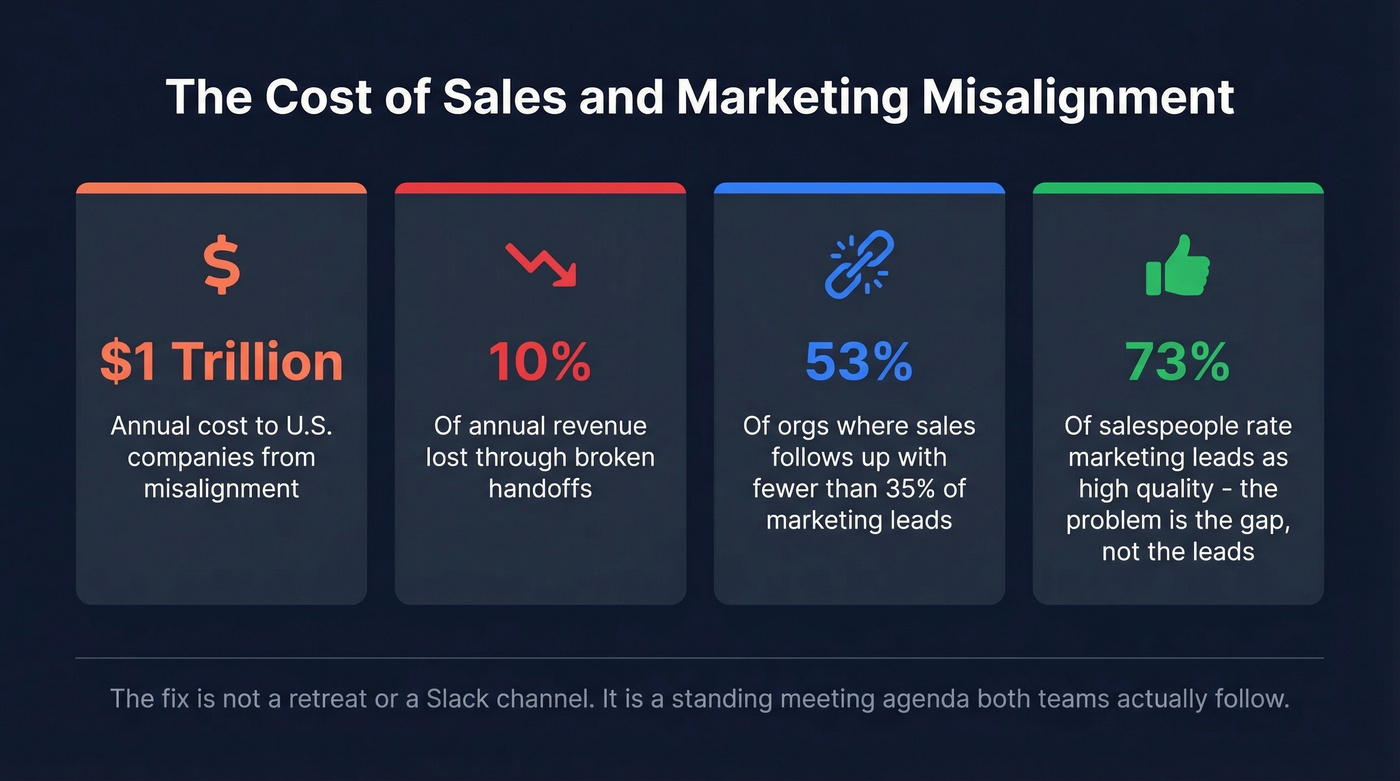
Sales and marketing misalignment costs U.S. companies an estimated $1 trillion annually. Organizations without tight alignment see roughly 10% of annual revenue slip away through broken handoffs and finger-pointing. Yet 53% of organizations still operate with a broken handoff where sales follows up with fewer than 35% of marketing-engaged prospects. The fix isn't a retreat, a Slack channel, or a new CRM. It's a standing sales and marketing meeting agenda that both teams actually follow.
The Quick Version
A 60-minute biweekly meeting with one spokesperson from each team, anchored to a shared SLA. The copy-paste agenda template below covers seven sections from icebreaker to action items. If you only track three KPIs, make them speed to lead, handoff rate, and pipeline coverage.
Here's the part most people get wrong: 73% of salespeople already rate marketing leads as high quality. The problem isn't lead quality - it's the operational gap between generating a lead and working it. That gap lives in the meeting you're not running, or running badly.
Before You Build the Agenda
Most alignment meetings fail because they're designed wrong from the start. One Reddit user put it bluntly: these meetings become "absurdly unproductive" without structure and ground rules.
Five non-negotiables before you send a single calendar invite:
- One spokesperson per team, equal authority. Not the whole department. The spokesperson gathers feedback beforehand and represents it. Too many attendees turns alignment into a town hall.
- Biweekly cadence to start. Weekly is too frequent for most teams; monthly lets problems fester. Adjust based on your sales cycle length.
- Send the agenda 2-3 days in advance. People need time to pull numbers and gather field intel. A surprise agenda produces a venting session, not an alignment meeting.
- Print the SLA. Literally bring it. Every discussion should anchor back to the shared SLA - if someone raises a concern that doesn't tie to a specific SLA metric, table it.
- Document everything. The average VP of Sales stays 17 months. The average CMO lasts 24. When leadership turns over - and it will - the meeting cadence and its documented decisions are what survive.

Broken handoffs don't just come from bad process - they come from bad data. When 50% of your lead list has stale emails or dead numbers, even a perfect SLA falls apart. Prospeo's 7-day data refresh and 98% email accuracy keep both sales and marketing working from records they can trust.
Stop letting stale data sabotage your alignment meetings.
The 60-Minute Agenda Template
Copy this. Paste it into your meeting doc. Adjust the prompts to your business.
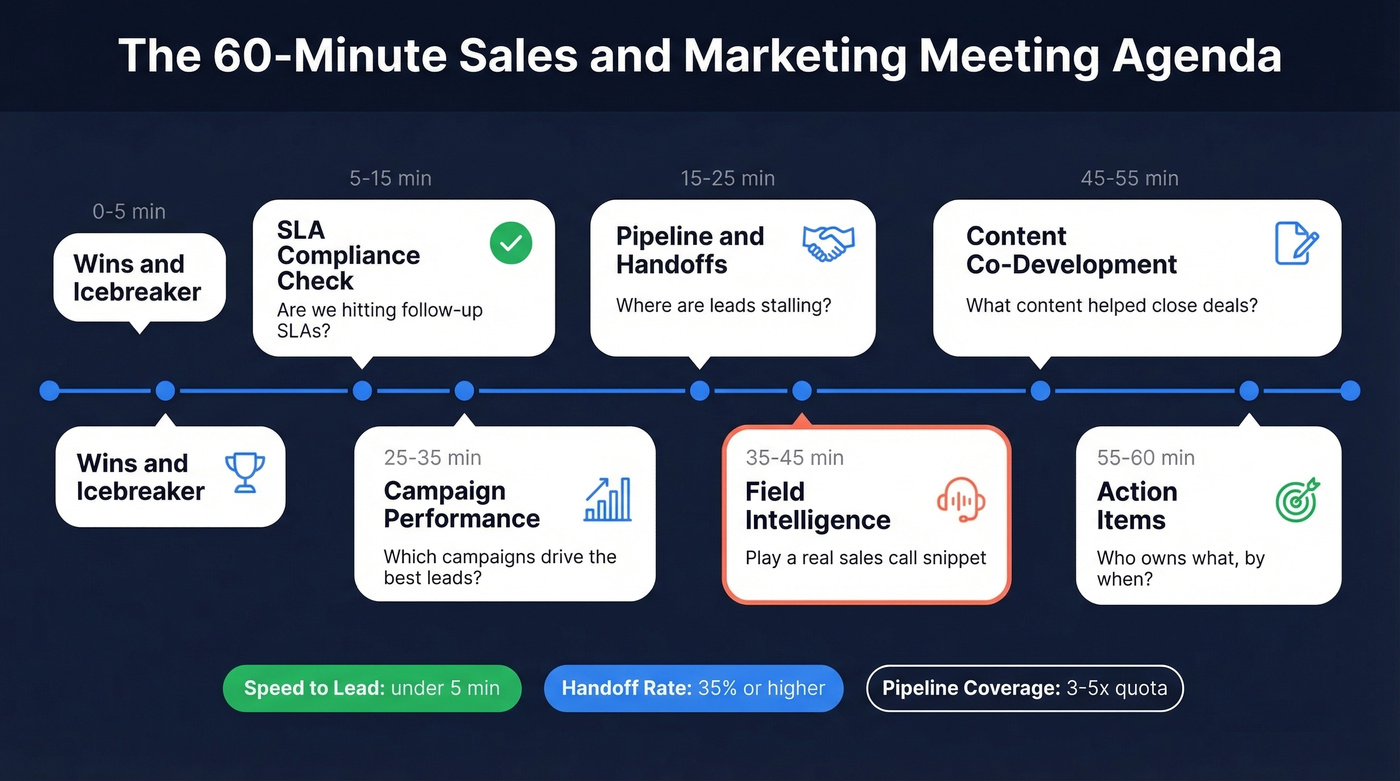
| Time | Section | Prompt Questions | KPI to Review |
|---|---|---|---|
| 0-5 min | Wins & icebreaker | What closed this week? Any shared wins? | - |
| 5-15 min | SLA compliance | Are we hitting follow-up SLAs? Where are the gaps? | SLA compliance %, 24-hr MQL follow-up |
| 15-25 min | Pipeline & handoffs | What's our handoff rate? Where are leads stalling? | Handoff rate (>=35%), speed to lead (<5 min) |
| 25-35 min | Campaign performance | Which campaigns drive the best leads? What are we testing? | MQL-to-SQL conversion, pipeline by source |
| 35-45 min | Field intelligence | Play a sales call snippet. What are prospects actually saying? | Objection themes, messaging gaps |
| 45-55 min | Content co-development | What content helped close deals? What's missing? | Content utilization rate |
| 55-60 min | Action items | Who owns what? By when? | - |
Routing or assigning new leads in under five minutes improves conversion significantly. The 24-hour MQL follow-up SLA is your safety net: if a rep can't engage within five minutes, they must make contact within 24 hours. Pipeline coverage should sit at 3-5x quota per rep each quarter. And that 35% handoff rate threshold comes from Influ2's analysis of 105 companies - below it, you're in "broken handoff" territory alongside the majority of B2B orgs.
Let's talk about the field intelligence section, because that's where breakthroughs happen. We've seen teams transform their messaging overnight by having a sales rep play a 60-second snippet from a recent call. Marketing hears the actual language buyers use, the objections that surface, and the gaps in positioning - and suddenly the next batch of content sounds like it was written by someone who's actually talked to a customer. This single practice does more for content quality than any quarterly content audit.
KPIs for Your Shared Dashboard
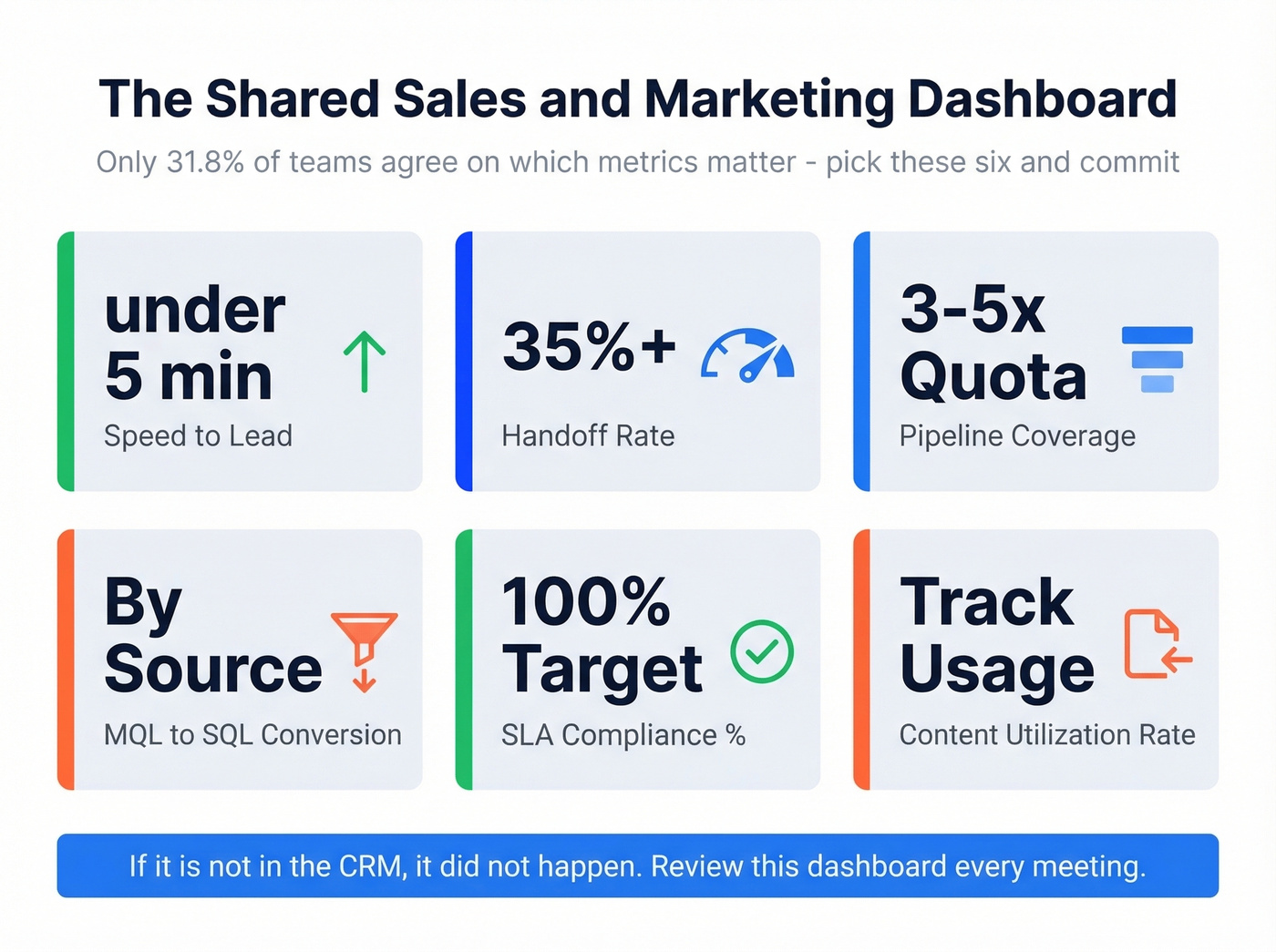
Don't track 20 metrics. Only 31.8% of sales and marketing teams even agree on which analytics matter, so pick a handful and commit.
The essentials:
- Speed to lead - under 5 minutes
- Handoff rate - 35% or higher
- Pipeline coverage - 3-5x quota
- MQL-to-SQL conversion by source
- SLA compliance percentage
- Content utilization rate
One HubSpot practitioner described the ideal setup: "Sales and I spend one meeting every week looking at one, shared dashboard - and that's what keeps us honest." That's the goal. If it's not in the CRM, it didn't happen. In our experience, teams tighten up follow-up and improve MQL-to-SQL conversion just by making this dashboard visible to both sides and reviewing it every meeting. Move toward behavior-based handoffs - pricing page visits, mid-funnel content engagement, demo page returns - rather than relying purely on point-based lead scoring. The signals are more honest, and they give RevOps a closed-loop reporting trail.
Mistakes That Kill Alignment Meetings
Marketing speaks marketing. If you're talking impressions and CTR in an alignment meeting, you've lost the room. Speak in pipeline, win rate, SQL acceptance, and time-to-close.
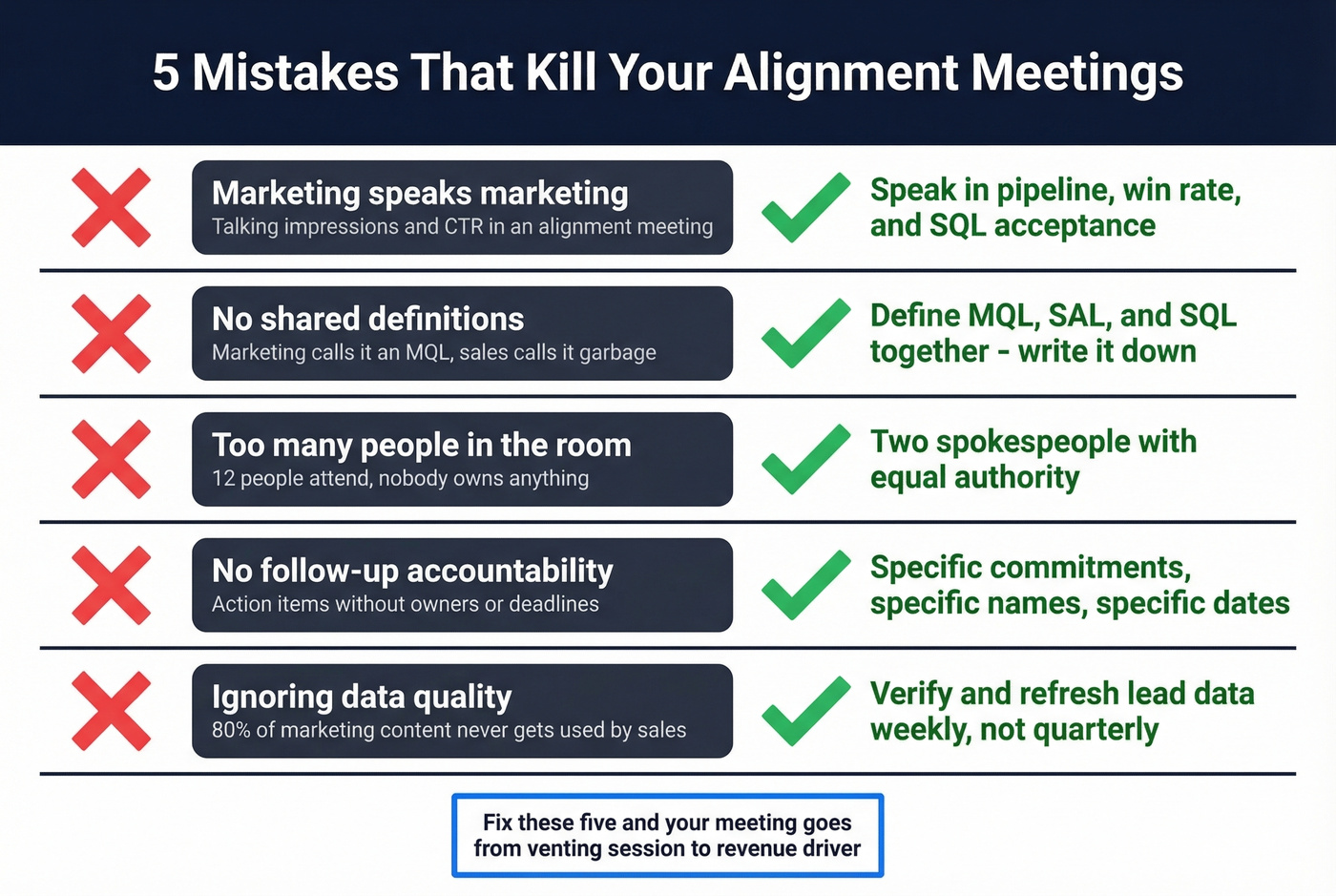
No shared definitions. If marketing calls something an MQL and sales calls it garbage, you don't have an alignment problem - you have a vocabulary problem. Define MQL, SAL, and SQL together. Write it down. Tape it to the wall if you have to.
Too many people in the room. Two spokespeople with equal authority, backed by their teams' input, is the right structure. When 12 people attend, nobody owns anything.
No follow-up accountability. Action items without owners and deadlines are wishes. Close every meeting with specific commitments, specific names, and specific dates. Review them at the top of the next meeting.
Ignoring data quality. Here's the thing: 80% of marketing content never gets used by sales, and 42% of marketers rarely include sales in content development. But even when both teams align on process, bad contact data quietly undermines everything. Marketing attribution breaks when emails bounce. Sales wastes follow-up time chasing dead numbers. We've watched teams run a perfect alignment meeting, agree on next steps, and then lose a week because half the lead list was stale. A verification layer with a fast refresh cycle - something like Prospeo's 7-day data refresh versus the six-week industry average - keeps both teams working from clean, current records so marketing trusts its attribution and sales trusts its lists.
If you're standardizing what happens after the meeting, use a consistent handoff email and keep a set of sales follow-up templates ready for reps.
FAQ
How often should sales and marketing meet?
Start biweekly. If your sales cycle is under 30 days, go weekly. Longer enterprise cycles (90+ days) can sustain monthly once the SLA is mature and both teams trust the shared dashboard. Consistency matters more than frequency - skip one meeting and the habit unravels fast.
Who should attend the alignment meeting?
One spokesperson from each team with equal decision-making authority - typically a sales manager and a demand gen lead. They gather feedback beforehand and represent it. Full-department attendance kills productivity and turns decisions into debates.
What if we don't have a shared dashboard yet?
Start with a spreadsheet tracking three KPIs: speed to lead, handoff rate, and pipeline coverage. That's enough to drive accountability in your first sales and marketing meeting agenda cycle. Upgrade to CRM-native dashboards as your process matures, but don't let tooling be the reason you skip the meeting.
How do we fix bad contact data that derails follow-up?
Run your lead lists through a verification tool before every campaign push. For teams that need both accuracy and freshness, look for providers that verify in real time and refresh records on a weekly cycle rather than monthly or quarterly. Pair verification with CRM enrichment to fill in missing fields that cause routing failures - job title, department, direct dial - so leads actually reach the right rep.
Your shared dashboard is only as good as the data feeding it. Marketing attribution breaks on bounced emails. Sales burns follow-up hours on disconnected numbers. Prospeo delivers 143M+ verified emails and 125M+ verified mobiles - refreshed weekly, not every six weeks like the industry average.
Give both teams data clean enough to actually hold each other accountable.