

Sales Call Automation: What It Means, What It Costs, and What's Legal in 2026
Cold email is getting harder. The phone? It's back in a big way - [37% of sales reps](https://www.getaccept.com/blog/sales-closing-statistics) say phone calls generate their best leads, and outbound teams that leaned too hard on email-only sequences are scrambling to rebuild their calling muscle. Sales call automation is how you scale that channel without grinding reps into dust, but most guides bury calling inside broader "sales automation" content and hand-wave at the details. This one doesn't.
Phone Is Back, But Manual Calling Isn't
Here's the thing: a lot of content on automating calls focuses on email sequences and CRM workflows, then gives the phone channel about two paragraphs. That's useless if calling is a real revenue driver for your team.
Cold calling is in revival mode. 45% of teams already run a hybrid AI-SDR model where AI handles research and prep while humans handle the live conversation. Parallel dialers and voicemail drops make volume manageable, but the real edge is still live conversation skill - no tool replaces a rep who can read tone and pivot on an objection in real time. Founders and operators are actively debating whether AI can replace human callers entirely. Spoiler: not legally.
If your average deal size is under $10K, you probably don't need a $750/month-per-rep calling stack. A power dialer and clean data will outperform a bloated sales tech stack with dirty numbers every time.
What You Need (Quick Version)
- Clean phone data - verified mobile numbers before anything hits the dialer
- A fast dialer - Orum or Nooks for parallel dialing at scale
- Call capture - Gong or Lindy for transcription and summaries
Budget $300-400/month per rep for a solid stack. And read the compliance section before you deploy anything with AI voice.
Three Layers of Automated Calling
Stop evaluating dialers. Start evaluating your data. Most teams over-invest in the middle layer while ignoring the first, and that's where the money leaks.
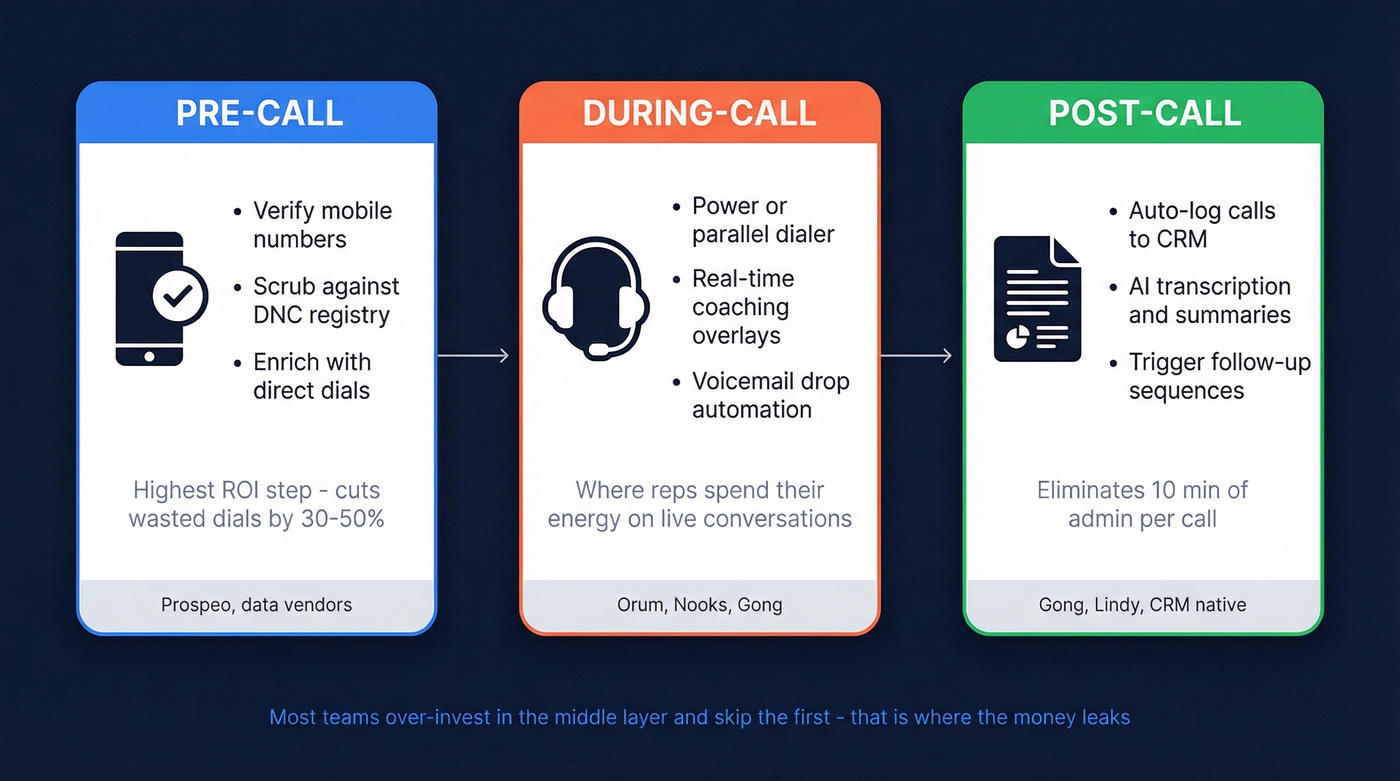
Pre-Call: Verify Before You Dial
This is the highest-ROI step most teams skip entirely. Dialing unverified numbers means a huge chunk of dials - typically 30-50% - go to voicemail boxes, disconnected lines, and wrong numbers. That's not a productivity problem. It's a math problem.
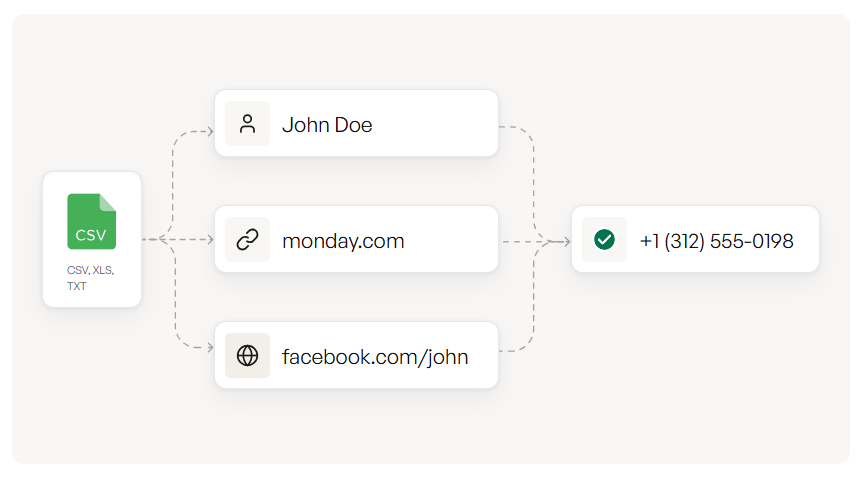
Prospeo covers 125M+ verified mobile numbers and delivers a 30% pickup rate, refreshed every 7 days (the industry average refresh cycle is six weeks). You only pay when a number is found, at roughly $0.01 per lead. We've seen teams cut wasted dials in half just by running their lists through verification before loading them into the dialer - and the connect rate improvement compounds from day one because reps spend their energy on live conversations instead of dead air.
During-Call: Dialers, Coaching, and Voicemail Drop
Once your data is clean, the dialer layer matters. Let's break down the options.
Power dialers call one number at a time automatically, advancing through your list without manual input. Solid for smaller teams. Parallel dialers ring 5-10 lines simultaneously and connect the rep to whichever prospect picks up first - dramatically faster, but pricier. Predictive dialers use algorithms to dial ahead of agent availability, which is powerful but creates more compliance complexity than the other two.
Orum and Nooks are the current standard for outbound teams running serious volume. Salesfinity delivers up to 150 dials per hour and claims 5.2x more live conversations. Real-time coaching overlays from Gong or Dialpad - which has analyzed over five billion minutes of business conversations - can surface talk tracks and objection-handling prompts mid-call, pulling from frameworks like BANT, SPIN, or SPICED. Many teams also configure push notifications so reps get alerted the moment a warm lead picks up or returns a call, keeping response times under a minute.
Post-Call: Logging, Summaries, and Follow-Ups
The fastest way to kill call automation ROI is making reps spend 10 minutes logging every call. That adds up to hours per week of pure admin.
Automated call logging solves this by syncing outcomes, durations, and dispositions directly to your CRM without any manual input. Modern conversation intelligence tools transcribe calls and generate AI summaries so reps can move to the next call immediately. Speed matters here: deals closed within 50 days hit a [47% win rate](https://www.getaccept.com/blog/sales-closing-statistics), compared to 20% or lower after that threshold. Outreach's AI coaching tool shaves 11 days off the average sales cycle and delivers roughly a 10-point win-rate lift on deals over $50K.
If you want the broader system around this (cadences, tasks, and handoffs), it helps to think in terms of sales process automation rather than "just a dialer."

Every wasted dial costs your reps time and momentum. Prospeo's 125M+ verified mobile numbers deliver a 30% pickup rate - refreshed every 7 days, not every 6 weeks. At ~$0.01 per lead, you pay only when a number is found.
Stop dialing dead air. Start every session with numbers that actually ring.
Tools and Pricing Compared
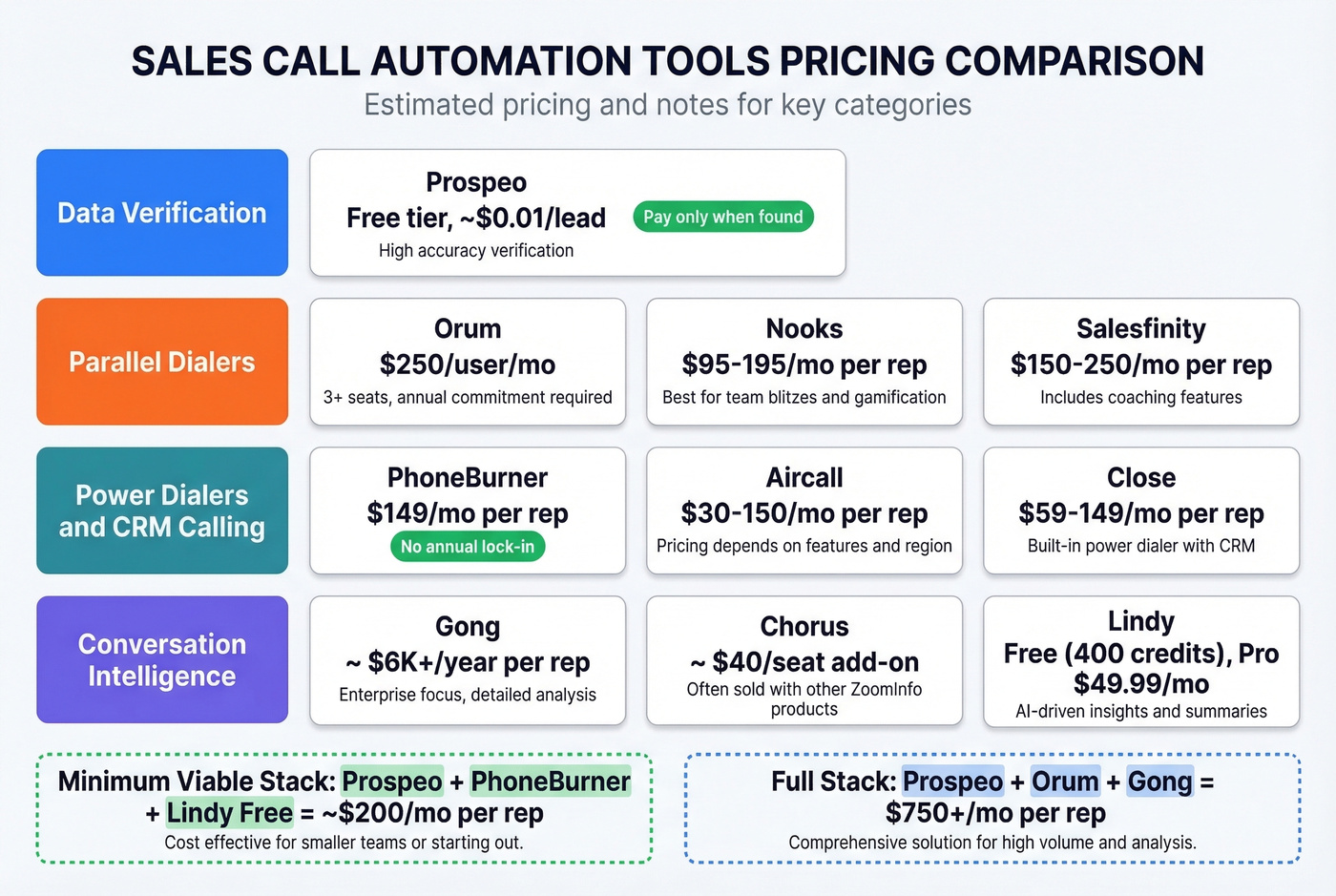
Most dialer vendors won't publish pricing. That tells you something about how they want to negotiate. Here's what we've pinned down:
| Tool | Category | Price | Notes |
|---|---|---|---|
| Prospeo | Data verification | Free tier; ~$0.01/lead | Pay only when found. No contracts. |
| Orum | Parallel dialer | $250/user/mo (3+ seats) | Annual contract; up to 5 lines |
| Nooks | Parallel dialer | $95-195/mo per rep | Best for team blitzes |
| Salesfinity | Parallel dialer | ~$150-250/mo per rep | SEP-like workflow focus |
| PhoneBurner | Power dialer | $149/mo per rep | No annual lock-in |
| Aircall | CRM-native calling | $30-150/mo per rep | Better for support-heavy teams |
| Close | CRM-native calling | $59-149/mo per rep | Built-in power dialer |
| Gong | Conversation intel | ~$6K+/year per rep | Platform fees additional |
| Chorus | Conversation intel | ~$40/seat add-on | Typically sold as a ZoomInfo add-on |
| Lindy | AI call workflows | Free (400 credits); Pro $49.99/mo | Lightweight AI option |
| SalesCloser.ai | Autonomous AI caller | Not public | Read compliance section first |
| VocBee | Autonomous AI caller | Not public | Claims TCPA/GDPR compliance |
A minimum viable stack - Prospeo for data, PhoneBurner for dialing, and Lindy's free tier for call summaries - runs about $200/month per rep. Scale up to Orum plus Gong and you're at $750+/month per rep, but the conversation volume and intelligence justify it for teams running serious outbound.
If you're trying to rationalize spend across channels, it’s worth benchmarking against the cost of sales tech stack by team size.
FCC Rules You Can't Ignore
Most tool vendors are pretending this didn't happen. Don't follow their lead.
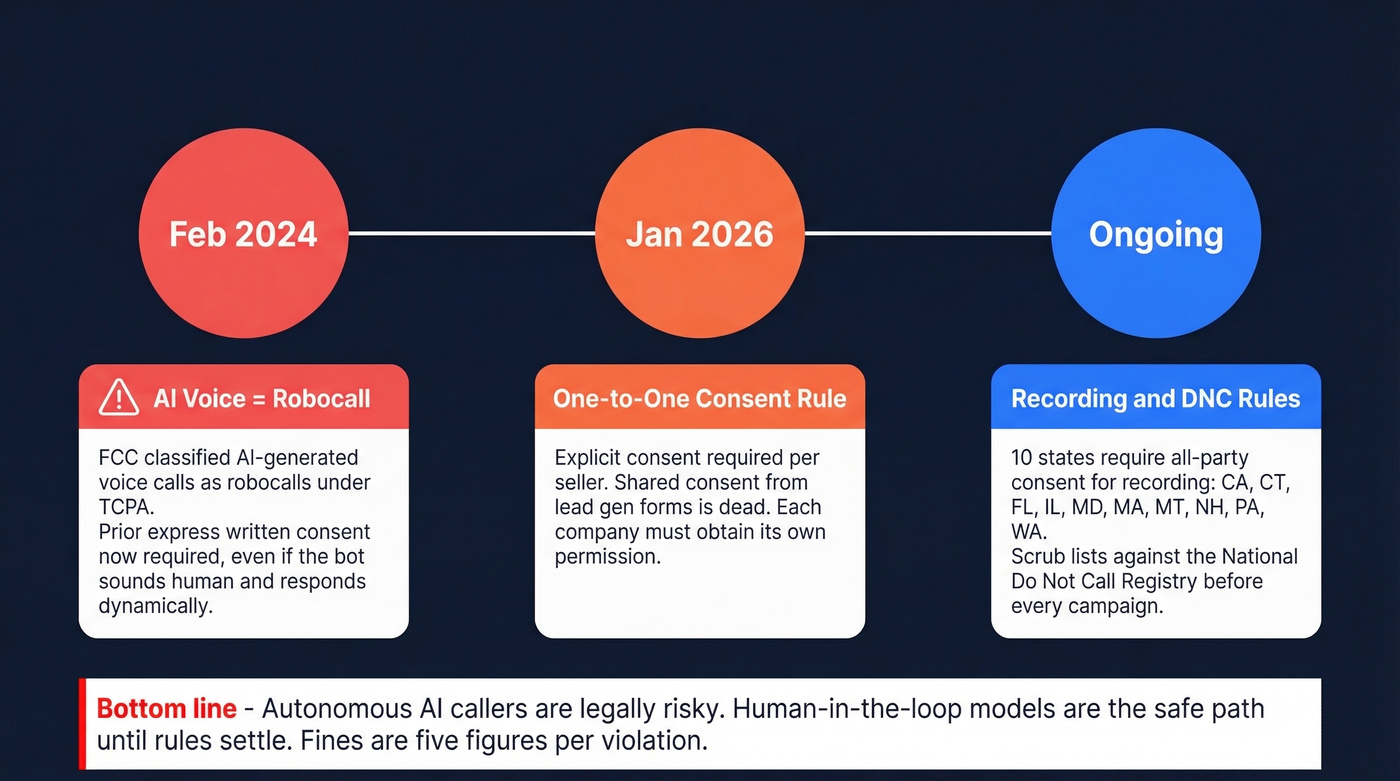
Three rules that reshaped sales call automation in 2026:
1. Feb 2024: The FCC classified AI-generated voice calls as robocalls under TCPA. Prior express written consent is required. Even if your bot sounds human and responds dynamically, it's still a robocall.
2. Jan 27, 2026: The one-to-one consent rule took effect. Explicit consent is now required per seller. Shared consent from lead gen forms is dead.
3. Recording + DNC: Ten states require all-party consent for recording (CA, CT, FL, IL, MD, MA, MT, NH, PA, WA). You must also scrub your lists against the National Do Not Call Registry before every campaign - violations can trigger five-figure fines per call.
Autonomous AI callers like SalesCloser.ai and VocBee are interesting technology, but they're legally risky right now. The FCC's February 2024 ruling didn't leave much ambiguity. Human-in-the-loop models - where AI assists a live rep rather than replacing them - are the safer path until the rules settle. Skip fully autonomous calling tools unless your legal team has explicitly signed off.
If you're automating outreach across regions, align your policies with a dedicated GDPR sales automation checklist too.
Mistakes That Kill ROI
Dialing unverified numbers. We've watched teams waste 30-50% of their dials on bad numbers, then blame the dialer. The dialer isn't the problem. Fix: verify every list before it touches the dialer.
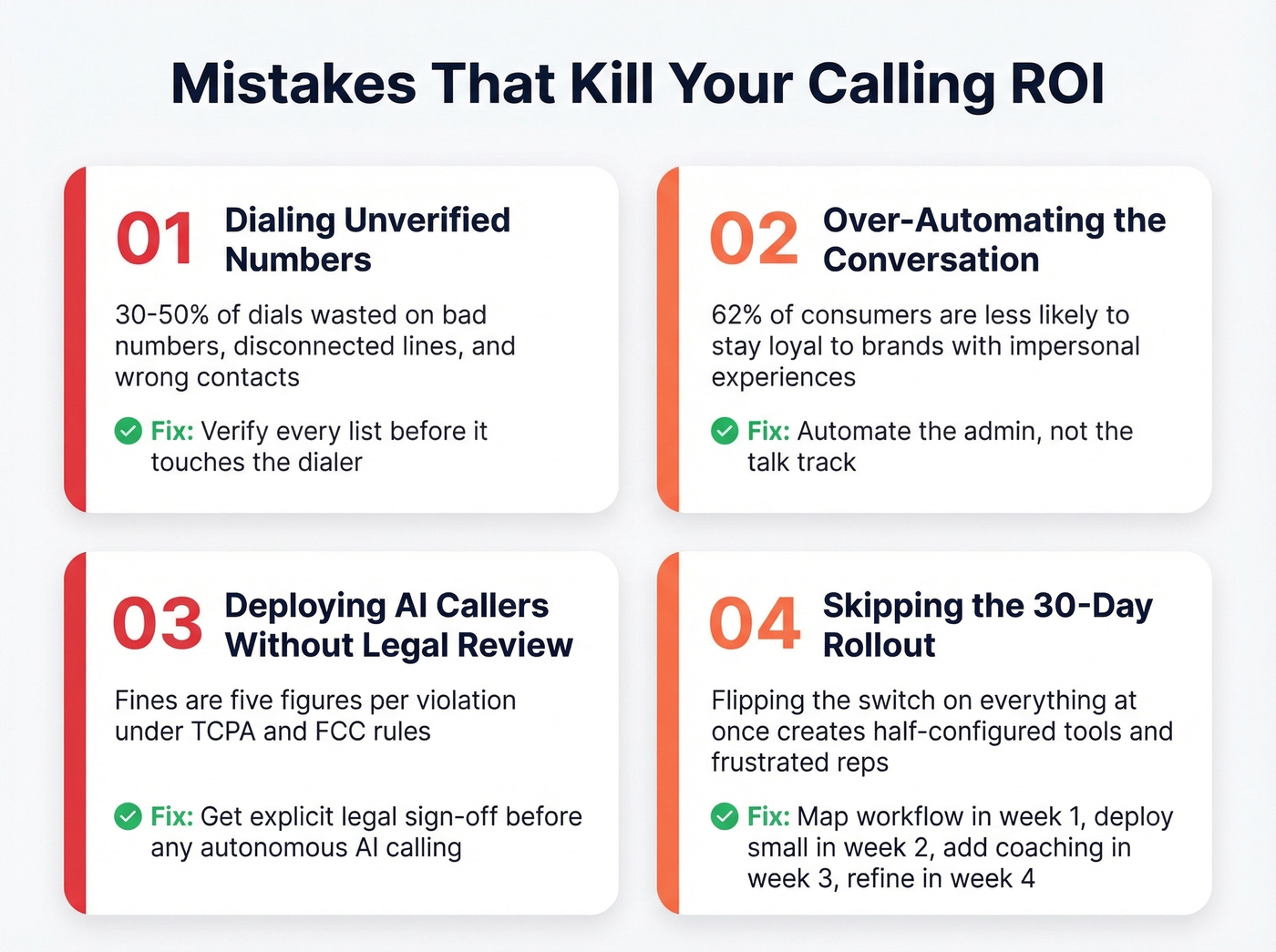
Over-automating the conversation. 62% of consumers are less likely to stay loyal to brands that deliver impersonal experiences. Automate the admin, not the talk track. The consensus on r/sales is pretty clear on this - reps who sound like they're reading a script get hung up on faster than reps who wing it with bad data.
If your team needs structure without sounding robotic, keep a few flexible sales pitch scripts on hand and iterate from call recordings.
Deploying autonomous AI callers without legal review. The fines aren't theoretical. They're five figures per violation.
Skipping the 30-day rollout. Week 1: map your workflow. Week 2: deploy the dialer with a small team. Week 3: add coaching and transcription. Week 4: refine based on connect rates. Teams that try to flip the switch on everything at once end up with a mess of half-configured tools and frustrated reps.
This rollout is also where sales activity automation pays off most - so reps don’t drown in admin while you test.
A $750/month dialer stack means nothing if half your numbers are disconnected. Teams using Prospeo cut wasted dials in half and compound their connect rates from day one - because reps spend energy on live conversations, not voicemail boxes.
Fix the data layer first. Everything downstream gets cheaper.
FAQ
What types of dialers are used in sales call automation?
Power dialers call one number at a time automatically. Parallel dialers ring 5-10 lines simultaneously and connect the rep to whichever picks up first. Parallel options like Orum ($250/user/mo) and Nooks ($95-195/mo) are faster but cost more than power dialers like PhoneBurner ($149/mo).
Can I use AI to make sales calls legally?
Only with prior express written consent per seller. The FCC classified AI-generated voice as a robocall under TCPA in February 2024, and the one-to-one consent rule took effect January 2026. Human-in-the-loop models - AI assists, human talks - are the compliant path.
How do I verify phone numbers before calling?
Upload your list to a mobile verification tool before it hits the dialer. Prospeo verifies against 125M+ mobile numbers with a 30% pickup rate at ~$0.01/lead. This single step cuts wasted dials by 30-50% and improves connect rates from day one.
What does post-call automation handle?
Post-call automation covers call transcription, AI-generated summaries, CRM logging, and follow-up task creation - everything after the rep hangs up. Tools like Gong and Lindy eliminate manual data entry so reps move to the next conversation immediately instead of spending 10 minutes on admin.