

Stop Building a Sales Tech Stack. Build a Workflow.
66% of sales reps say they feel swamped by their own tools. That tracks. The average B2B sales tech stack runs 8.3 tools, and 73% of teams report overlap wasting $2,340/rep/year - while reps still spend [60% of their time](https://www.salesforce.com/news/stories/sales-research-2023/) on non-selling tasks. You don't have a tool shortage. You have a workflow problem.
One Reddit practitioner put it bluntly: they run an annual audit because "multiple tools evolved to do the same thing." Another described the experience as "fighting with the tech" instead of selling. The fix isn't another listicle of 30 tools you'll never evaluate. It's mapping every tool to a workflow step - prospect, qualify, close - and cutting everything that doesn't earn its seat.
What You Need (Quick Version)
If you're short on time, here's the toolkit by budget tier.
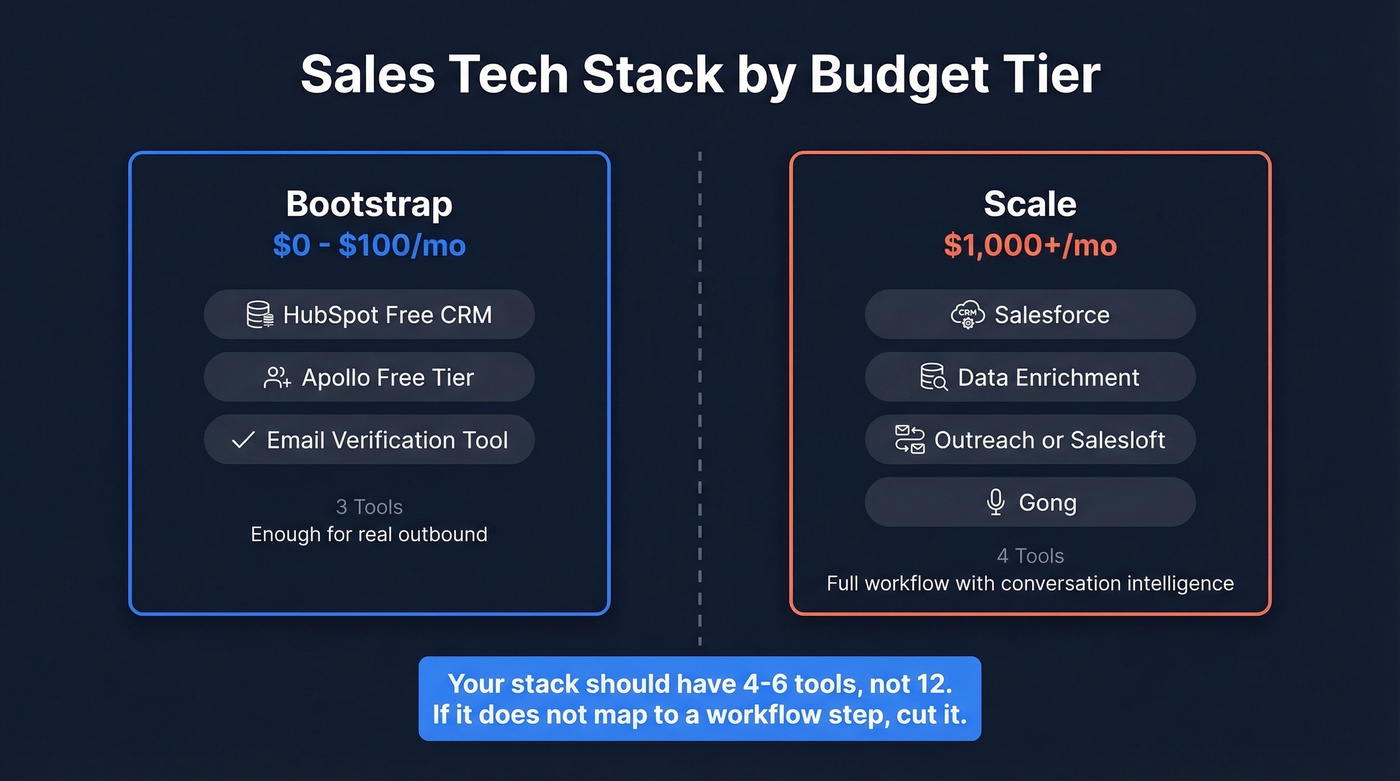
Bootstrap ($0-$100/mo): HubSpot Free CRM + Apollo free tier + a free or very low-cost email verification tool. Three tools, under $100/mo, enough firepower to run real outbound.
Scale ($1,000+/mo): Salesforce + dedicated data enrichment + Outreach or Salesloft + Gong. The full workflow, integrated bidirectionally, with conversation intelligence layered on top.
Here's the thing: your stack should have 4-6 tools, not 12. If a tool doesn't map to a specific workflow step, cut it. Every tool you add is another integration to maintain, another login for reps to ignore, and another line item your CFO will question at the next QBR.
Essential Categories
Some frameworks list 18+ categories of sales technology. Most teams need six.
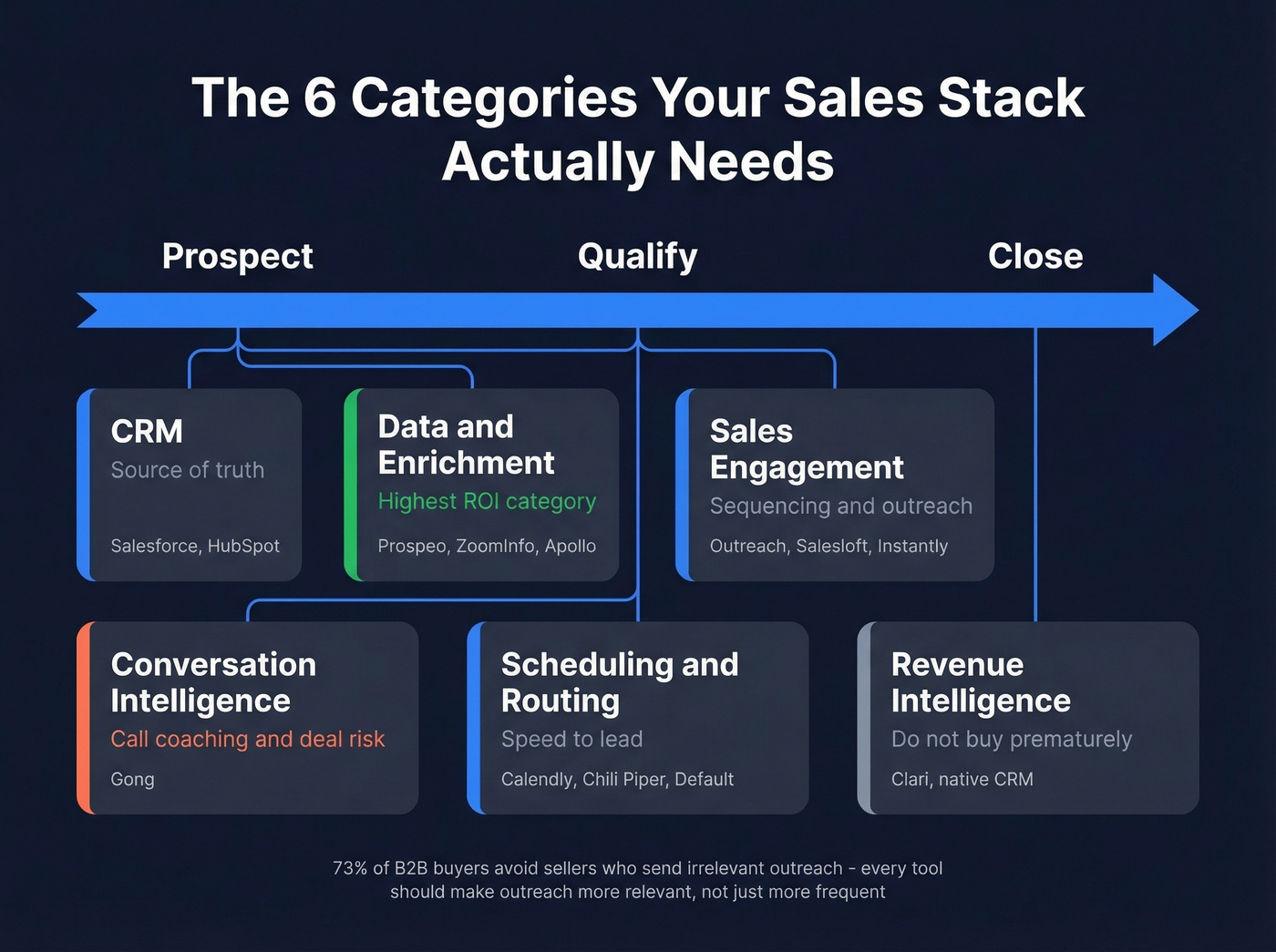
CRM. Your source of truth. Salesforce if you're scaling past 50 reps or need heavy customization. HubSpot if you want faster time-to-value and a gentler learning curve. Everything else syncs here. (If you’re still comparing options, see examples of a CRM.)
Data & Enrichment. The layer that determines whether your outbound actually reaches people. This is the highest-ROI category in your stack and the one most teams underspend on. Get this wrong and nothing downstream works - we'll go deep on this in the next section.
Sales Engagement / Sequencing. Outreach and Salesloft own the enterprise segment. Instantly and Smartlead handle high-volume cold email at a fraction of the price. For multi-channel outreach across email, phone, and social, go with Outreach or Salesloft. If you're email-heavy, Instantly wins on cost. (More on sequence management if you’re standardizing plays.)
Conversation Intelligence. Gong is the default. It records calls, surfaces deal risk, and gives managers coaching data without sitting in on every call. Worth the investment once you have enough call volume to analyze - skip it if your team runs fewer than 20 calls a week.
Scheduling & Routing. Calendly handles basic booking. Chili Piper or Default add inbound lead routing, round-robin, and speed-to-lead automation. Default bundles routing, scheduling, and enrichment into one layer starting at $500/mo + $20/mo per scheduling seat.
Revenue Intelligence / Forecasting. Clari if you need standalone forecasting. Native CRM forecasting if you're not ready for another platform. Don't buy this prematurely. (If you are evaluating vendors, start with sales forecasting solutions.)
AI SDRs are carving out a seventh category, which we'll cover separately. But here's the filter: [73% of B2B buyers](https://www.gartner.com/en/newsroom/press-releases/2025-06-25-gartner-sales-survey-finds-61-percent-of-b2b-buyers-prefer-a-rep-free-buying-experience) actively avoid sellers who send irrelevant outreach. Every category above exists to make your outreach more relevant, not just more frequent.
The Data Layer Everyone Ignores
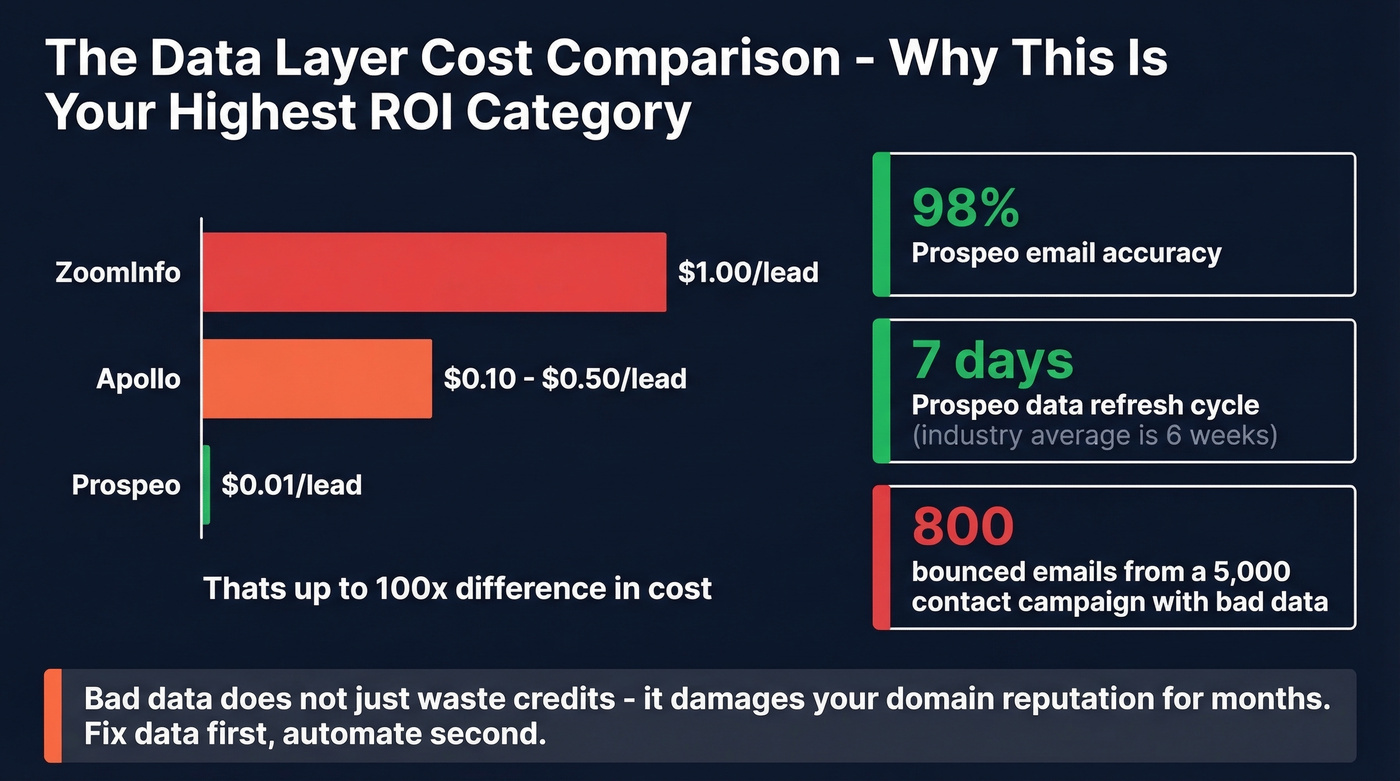
Your SDR team runs a 5,000-contact campaign. 800 bounce. 200 hit spam traps. Your domain reputation is damaged for months - not because of your sequencing tool, but because of your data.
We've watched this pattern destroy outbound programs. The engagement platform gets blamed, the messaging gets rewritten, the SDR manager gets fired. The actual problem was a data quality issue nobody prioritized. It's the most expensive mistake in sales tech because it's invisible until the damage is done.
The math matters: Prospeo runs roughly $0.01/lead. Legacy providers like ZoomInfo charge closer to $1/lead. You're paying 100x more for data that's often less accurate and refreshed less frequently. (If you want a broader vendor landscape, start with B2B company data.)

800 bounced emails don't just waste credits - they torch your domain reputation for months. Prospeo's 5-step verification delivers 98% email accuracy at $0.01/lead, with data refreshed every 7 days instead of the 6-week industry average. Teams using Prospeo book 26% more meetings than ZoomInfo and 35% more than Apollo.
Stop paying 100x more for data that bounces.
How to Build a Stack That Actually Works
The principle is simple: CRM as the central hub, everything else syncing bidirectionally. Every tool should read from and write back to your CRM. If a tool can't do that reliably, it creates a data silo - and data silos are where pipeline goes to die.

Implementation sequence matters more than most teams realize. Start with email and calendar sync. Layer in your engagement platform, then conversation intelligence, then forecasting. Run data reconciliation tests between systems at each step. Don't turn everything on at once - we learned this the hard way watching teams spend months untangling broken integrations they could've caught in week one.
One RevOps community warns that without experienced CRM ownership, you end up with a "Frankenstack" - a tangle of half-configured integrations where nobody trusts the data. And 70% of platforms need consulting partners just to solve integration issues. That's an industry-wide problem, not a you problem. (If you’re building the function, see what a RevOps Manager actually owns.)
Here's a stat that should change how you prioritize: deals closed within 50 days show a 47% win rate, versus just 20% beyond 50 days. Your stack architecture directly impacts deal velocity. Every extra click, every manual data transfer, every broken sync adds friction that stretches your sales cycle. (Related: common sales pipeline challenges that tech can’t fix alone.)
Let's be honest - "consolidate to one platform" is vendor marketing. The realistic target is 4-6 integrated platforms. Anyone selling you an all-in-one is selling you lock-in.
The AI Layer - What's Real
AI SDRs are the hottest category in sales technology right now. 94% of sales leaders using AI agents say they're already essential to their workflow. The economics are compelling on paper:
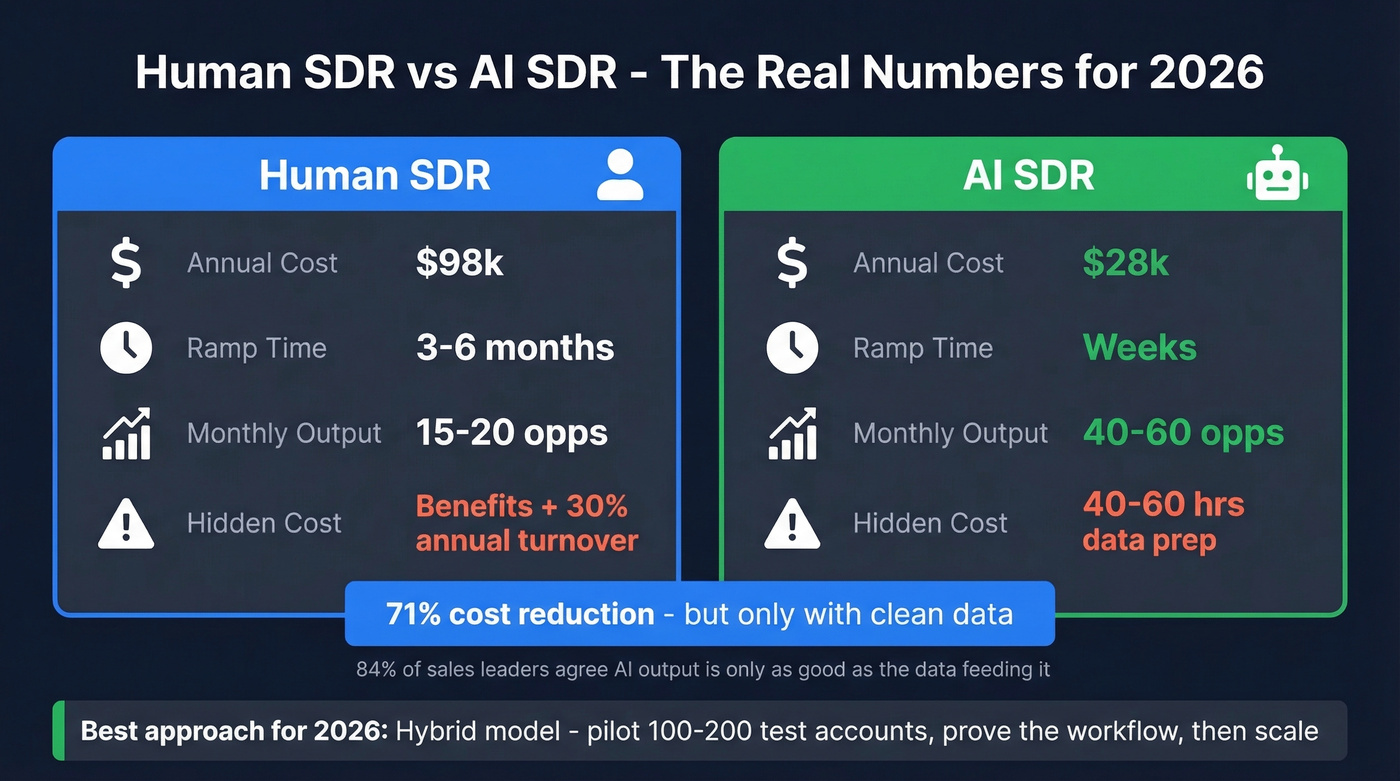
| Human SDR | AI SDR | |
|---|---|---|
| Annual cost | ~$98k | ~$28k |
| Ramp time | 3-6 months | Weeks |
| Output | 15-20 opps/mo | 40-60 opps/mo |
| Hidden cost | Benefits + ~30% annual turnover | 40-60 hrs data prep |
That's a 71% cost reduction - if everything goes right. The "if" is doing a lot of work.
AI SDRs need 40-60 hours of data preparation before launch. Someone has to clean, enrich, and segment your contact data. Someone has to monitor output daily so you don't send robotic, off-brand messages at scale. Expect 3-6 months to positive ROI with clean data, longer if you're starting from scratch. (If you’re shopping, start with SDR tools.)
The stat that should anchor your AI strategy: 84% of sales leaders agree that AI outputs are only as good as the data feeding them. A $28k/year AI SDR running on stale, unverified contacts will burn your domain just as fast as a human SDR would. Fix your data layer first, then automate. (If deliverability is already shaky, use an email deliverability guide before scaling volume.)
45% of high-performing teams have adopted hybrid human-AI SDR models. That's the right move for most orgs in 2026 - pilot with 100-200 test accounts, prove the workflow, then scale.
Our hot take: Cold email volume is declining. Multiple practitioners report that "cold emails really dropped off in the last year." The teams winning aren't sending more emails - they're sending fewer, better-targeted messages powered by intent data and verified contacts. If your AI SDR strategy is "blast 10x more volume," you're already behind.
Pricing Reference
Here's what you'll actually pay when assembling a stack at different stages:
| Tool | Category | Starting Price | Best For |
|---|---|---|---|
| HubSpot CRM | CRM | Free; paid from ~$20-$30/user/mo | SMB to mid-market |
| Salesforce | CRM | ~$25-$165/user/mo | Enterprise |
| Close CRM | CRM | ~$49-$149/user/mo | SMB outbound |
| Prospeo | Data/Enrichment | Free tier; ~$0.01/lead | Verified data at scale |
| Apollo | Data/Engagement | Free; $59-$149/user/mo | All-in-one on a budget |
| ZoomInfo | Data/Intent | ~$20k-$40k/yr | Enterprise intent data |
| Cognism | Data/Enrichment | ~$1,000-3,000/mo | EMEA coverage |
| Outreach | Engagement | Custom (~$100+/user/mo) | Multi-channel enterprise |
| Salesloft | Engagement | Custom (~$100+/user/mo) | Multi-channel enterprise |
| Instantly | Cold Email | ~$30-97/mo | High-volume cold email |
| Gong | Conversation Intel | Custom (~$100-$150/user/mo) | Call coaching at scale |
| Chili Piper | Scheduling/Routing | $45/seat/mo + platform fee | Inbound lead routing |
| Default | Routing/Scheduling | $500/mo + $20/mo per seat | Bundled routing stack |
| Clari | Forecasting | Not public | Enterprise forecasting |
For a 10-rep growth-stage team, a lean stack often lands around $300-$800/mo depending on seats, email volume, and whether you're paying per-user or per-lead. A full enterprise setup can hit $5,000-$8,000/mo for a small team - and much more as you add seats and modules. In our experience, the delta is enormous and doesn't always correlate with results.
Stack Audit in 15 Minutes
Open your billing dashboard right now. For each tool, answer four questions - the 4R framework:
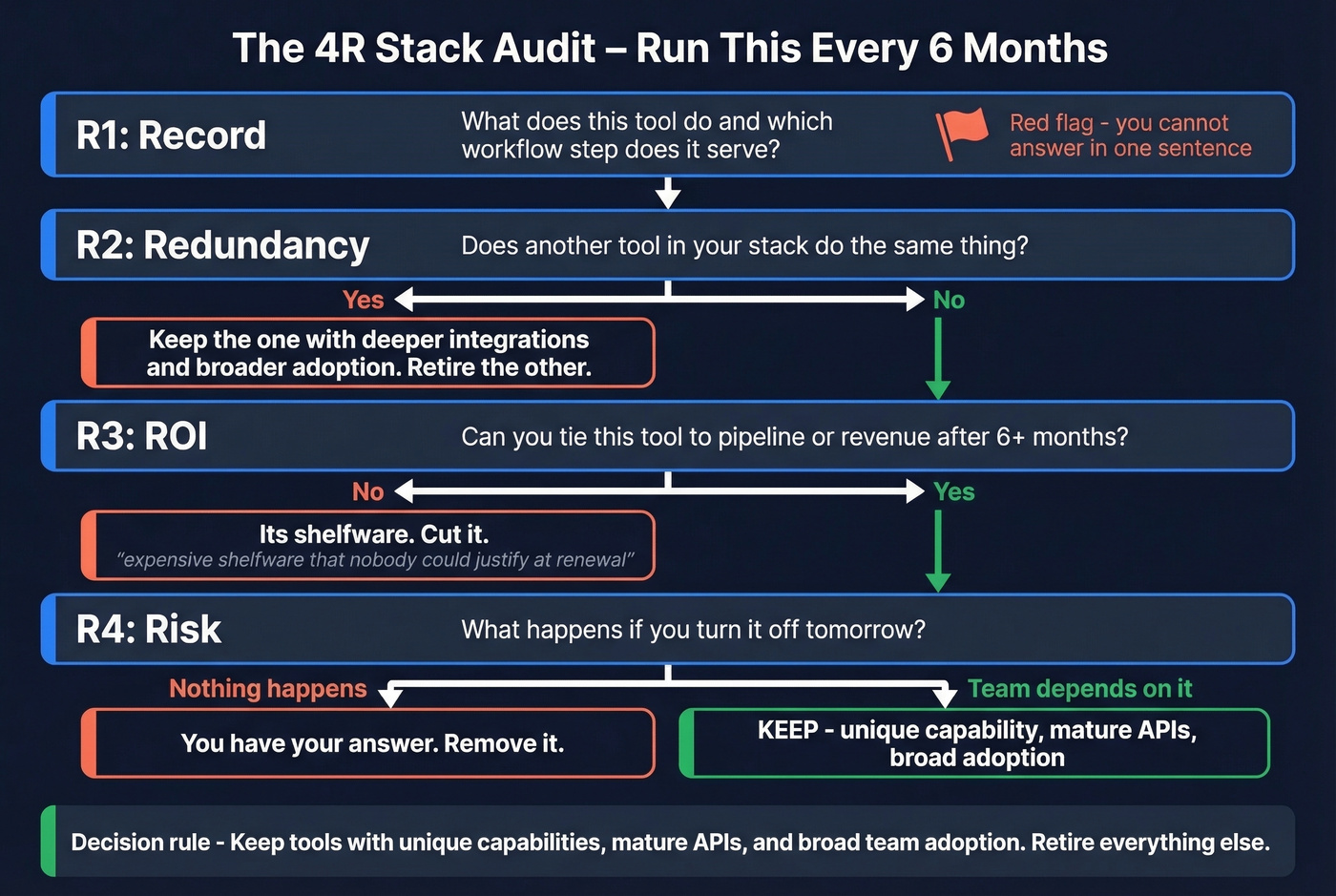
Record. What does this tool do, and which workflow step does it serve? If you can't answer in one sentence, that's a red flag.
Redundancy. Does another tool in your stack do the same thing? If two tools overlap, keep the one with deeper integrations and broader team adoption. Retire the other.
ROI. What's the cost per rep per month, and can you tie it to pipeline or revenue? If a tool has been live for 6+ months and nobody can quantify its impact, it's shelfware. One Reddit practitioner described this exact scenario: "expensive shelfware" that nobody could justify come renewal time. We've seen this at companies spending $40k/year on tools that three people use.
Risk. What happens if you turn it off tomorrow? If the answer is "nothing" - you have your answer.
Run this audit twice a year. The decision rule is straightforward: keep a tool if it has a unique capability, mature APIs, and broad team adoption. Retire it if the capability is duplicated, it creates persistent data silos, or its cost exceeds its differentiation.
The highest-ROI tool in your stack isn't your CRM or sequencer - it's your data layer. Prospeo gives you 300M+ profiles, 30+ search filters including buyer intent and technographics, and native integrations with Salesforce, HubSpot, Outreach, Instantly, and Smartlead. One platform that plugs into every workflow step.
Build the data layer your entire stack depends on.
FAQ
How many tools should be in a sales tech stack?
Most teams need 4-6 core platforms. The average is 8.3, and 73% report overlap wasting $2,340/rep/year. Map each tool to a workflow step - prospect, qualify, close - and cut anything without a clear home.
How much does a sales tech stack cost per rep?
Plan for $150-$250/rep/month depending on company stage. The industry benchmark sits around $187/rep/month ($2,244/year), with enterprise stacks running significantly higher once you add intent data and conversation intelligence.
What's the most important tool in a sales stack?
Your CRM is the foundation, but your data layer determines whether everything else works. Bad contact data silently destroys outbound performance regardless of how good your engagement platform is. Prospeo's 98% email accuracy and 7-day refresh cycle make it a strong starting point - especially at $0.01/lead versus $1/lead at legacy providers.
Should I replace my SDRs with AI?
Not yet - pilot a hybrid model first. AI SDRs cost ~71% less ($28k vs $98k/year) but need 40-60 hours of data prep and 3-6 months to show ROI. Start with 100-200 test accounts and verified contact data before scaling.
How do I fix bad data in my stack?
Run your existing contact list through a dedicated verification tool before your next campaign. Most teams see bounce rates drop from 35%+ to under 5%. The key is choosing a provider with a fast refresh cycle - weekly rather than monthly - so records stay accurate over time.