

Sales Call Planning: How to Win in 10 Minutes or Less
It's 9:47 AM. Your call's at 10:00. You've got the prospect's name, a vague idea of what their company does, and a CRM note from three months ago that says "seemed interested." You're about to wing it - and statistically, you're about to lose.
Sales reps spend 60% of their time on non-selling tasks, and unstructured calls are where most of that waste hides. Even 10 minutes of focused sales call planning is the difference between a productive conversation and a wasted dial. Opportunities closed within 50 days hit a 47% win rate; past that window, it drops below 20%.
The gap between reps who plan and reps who don't isn't talent. It's a 10-minute habit.
The Quick Version
If you only do three things before every call: define a specific objective, write down three discovery questions, and verify the contact info is current. Everything else is bonus.
What Is Pre-Call Planning?
Pre-call planning is the structured prep work between "meeting booked" and "dial tone." It's not winging it - which prospects sense immediately - and it's not over-scripting, which makes you sound like a robot reading a teleprompter.
Sandler's framework breaks it into two phases: before first outreach and after a meeting is set. Before first outreach, you define your target, map decision-makers and influencers, and identify trigger events. After a meeting is set, you confirm the agenda via the invite, plan your ideal next step, and prepare a backup if the conversation goes sideways.
The sweet spot is a repeatable process that takes under 10 minutes for a standard call and scales up for enterprise deals. Anything longer, and reps won't use it. That's the real test.
Why Preparation Matters More Than Ever
Opportunities closed within 50 days convert at 47%. Past that window, win rates crater. Every unprepared call that stalls a deal pushes you further past that threshold.
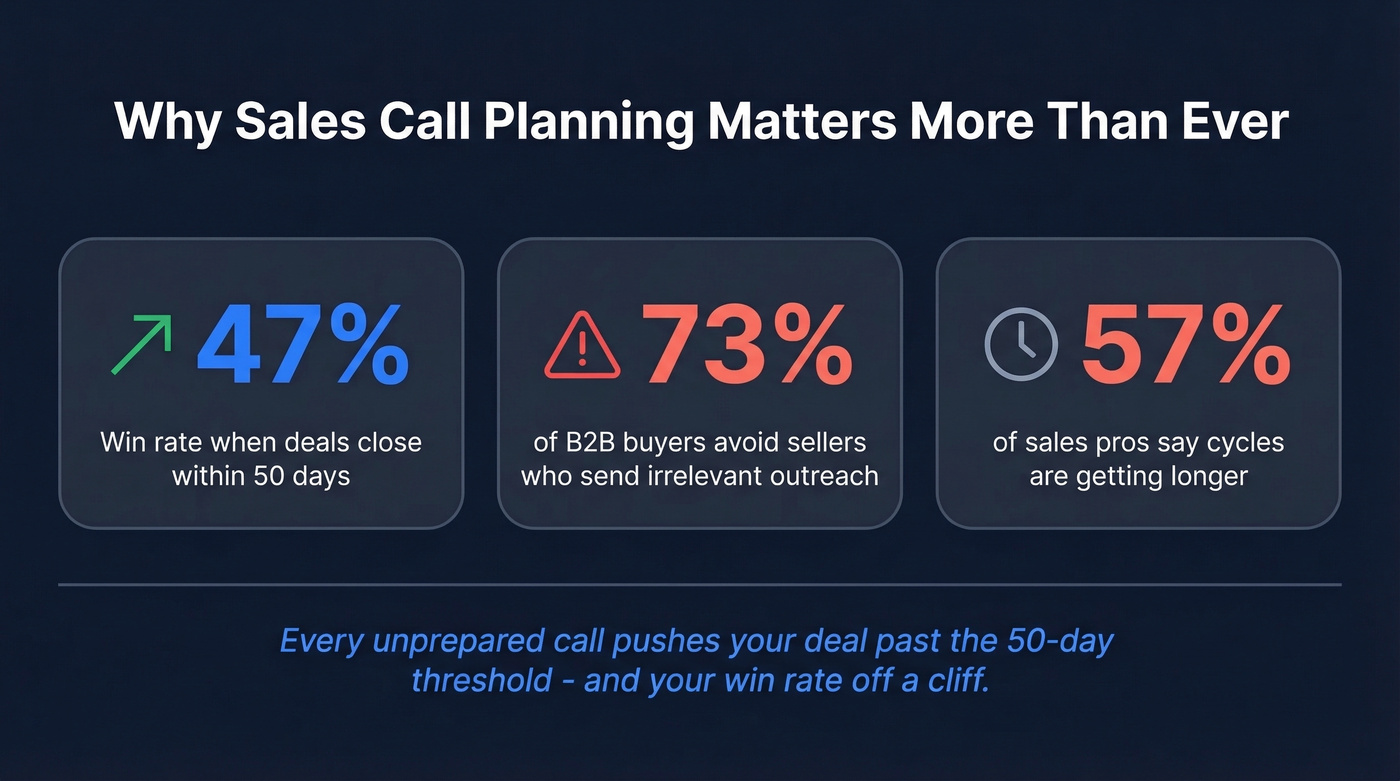
Meanwhile, 73% of B2B buyers actively avoid sellers who send irrelevant outreach. And 57% of sales professionals say cycles are getting longer. When buyers are harder to reach and slower to close, every conversation has to count.
Here's the thing: the problem isn't that reps don't know how to plan. It's that every guide makes it look like a 45-minute homework assignment. Research the company. Read the 10-K. Map the org chart. Study their tech stack. By the time you're done, you've missed the call window. Good pre-call planning isn't exhaustive - it's targeted. You need enough context to ask smart questions and enough structure to steer toward a specific outcome.
How to Plan a Sales Call
Research the Buyer and Account
Here's what "research" actually looks like when it's done right - not a 30-minute deep dive, but a focused scan:
- Trigger events: Recent funding, leadership change, expansion, layoffs, product launch. These give you a reason to call that isn't "I saw your name in a list."
- Role context: What does this person own? What are they measured on? A VP of Sales cares about pipeline velocity. A CFO cares about cost per acquisition.
- Company news: One headline from the last 90 days. That's it.
A trigger gives you relevance. Without one, you're just another cold call.
Define a Stage-Appropriate Objective
Every call needs a specific objective - and "qualify" isn't specific enough. There are four outreach goals worth planning around: keep a current account, attain a new logo, recapture a lost account, or expand wallet share.
A first discovery call? Your objective is to confirm pain and secure a second meeting. A late-stage call? You're confirming decision criteria and timeline. Trying to close on a discovery call is the fastest way to lose trust. Match the ask to the moment.
Choose Your Qualification Framework
BANT is fine for simple deals. Stop using it for enterprise.
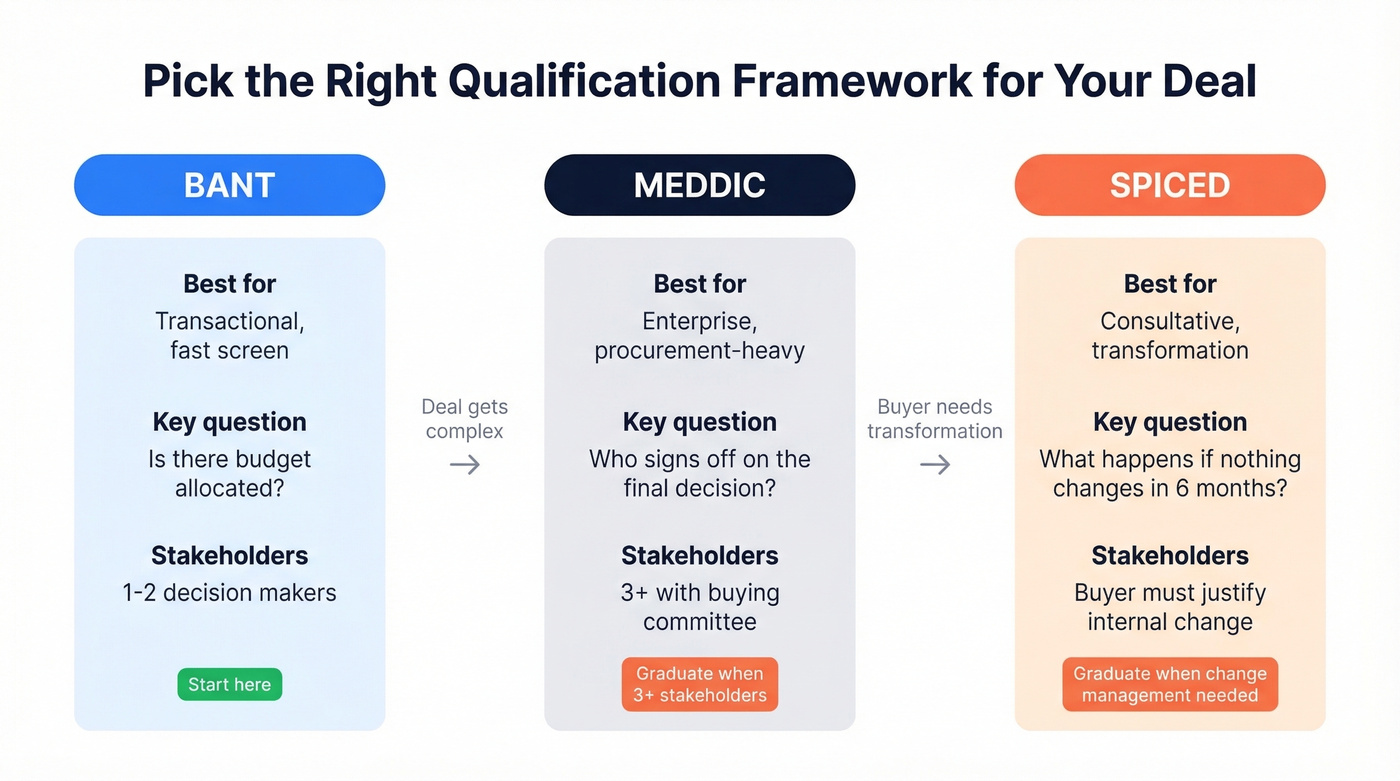
| Framework | Best For | Example Question | Graduate When... |
|---|---|---|---|
| BANT | Transactional, fast screen | "Is there budget allocated?" | 3+ stakeholders or procurement |
| MEDDIC | Enterprise, procurement-heavy | "Who signs off on the final decision?" | You need to map a buying committee |
| SPICED | Consultative, transformation | "What happens if nothing changes in 6 months?" | Buyer must justify internal change |
Start with BANT to screen. Graduate to MEDDIC or SPICED based on deal complexity. Most teams we've talked to run a hybrid - BANT filters fast, then the heavier frameworks do the real qualification work.
Build Your Agenda and Opener
The first 10 seconds determine whether the prospect stays engaged or starts looking for an exit. Use the ACE framework:
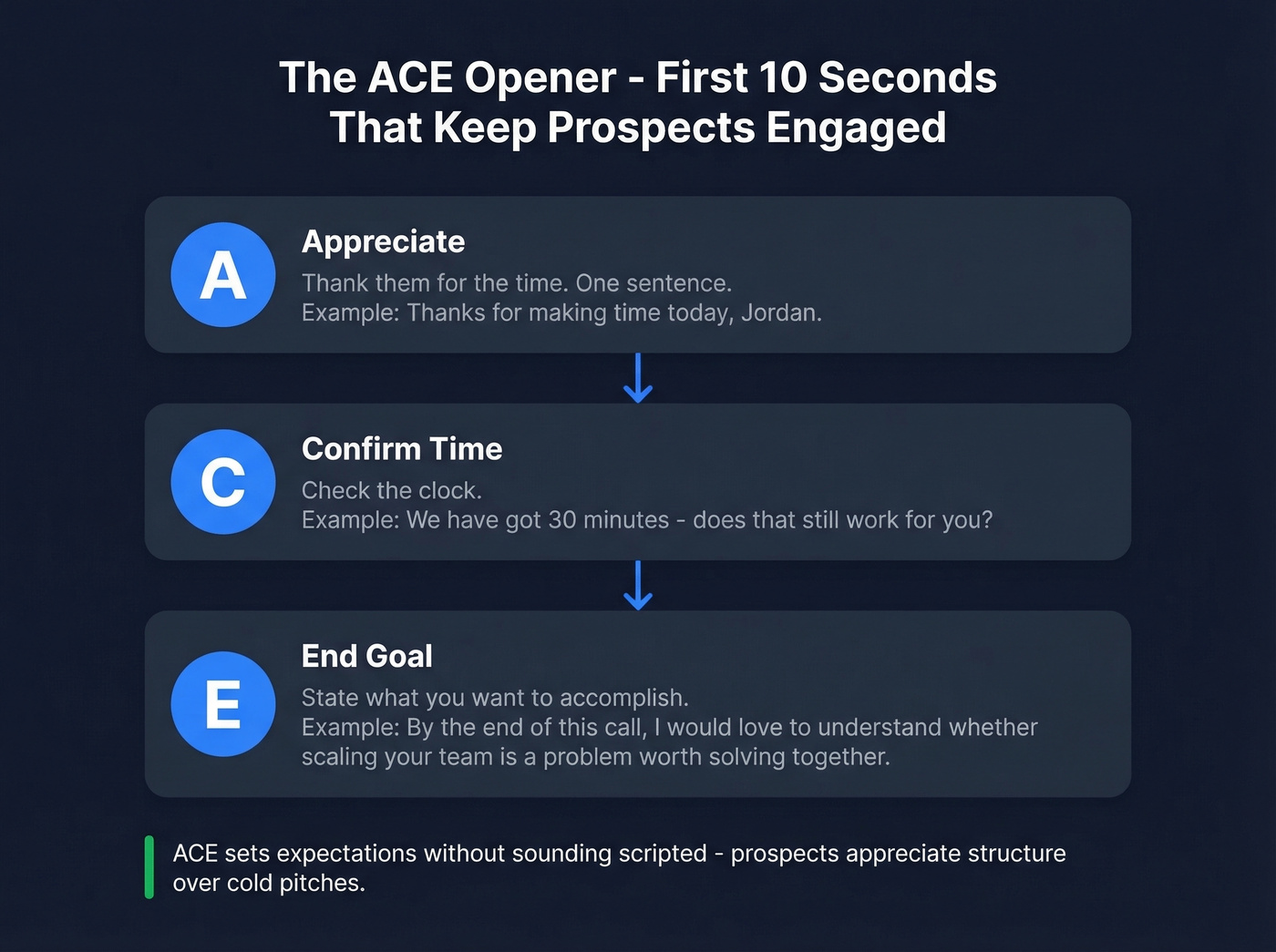
- Appreciate: Thank them for the time. One sentence.
- Confirm time: "We've got 30 minutes - does that still work?"
- End goal: State what you'd like to accomplish. "By the end of this call, I'd love to understand whether [specific problem] is something worth solving together."
ACE gives you structure without sounding scripted. It also sets expectations, which prospects appreciate more than a cold pitch.
Prepare 5-7 Discovery Questions
Open-ended questions tied to your chosen framework are the engine of a good call. Don't prepare 15 - you won't get through them. Five to seven is the sweet spot, and you should aim for roughly a 60/40 listen-to-talk ratio. Your questions should do the heavy lifting, not your pitch.
Three that work across frameworks:
- "Walk me through how your team handles [specific process] today."
- "What's the cost of doing nothing for another six months?"
- "If you could change one thing about your current setup, what would it be?"
Tie each question back to the qualification criteria you're trying to uncover. If you're running MEDDIC, at least two questions should surface the economic buyer and decision process.
Anticipate Top 2-3 Objections
Every deal has predictable friction points. Before you dial, write down the two or three objections most likely to come up and prepare a response for each.
NetSuite's research on common sales mistakes flags "failing to prepare for objections" as a top deal-killer. If you know the prospect's industry, role, and deal stage, you can predict most of their pushback. Budget concerns, timing, internal buy-in - these aren't surprises. They're patterns.
Verify Your Contact Data
You nailed the research. You've got a sharp opener, five discovery questions, and a clear objective. Then you dial - and the number's disconnected.
Data decays fast. People change roles, companies switch phone systems, and that "verified" number from six months ago is now a dead line. In our experience, stale data is the single most common reason good prep goes to waste. Prospeo verifies contact data in real time - 98% email accuracy and 125M+ verified mobile numbers with a 30% pickup rate, all on a 7-day refresh cycle. Upload your call list, verify in bulk, and stop wasting prep on dead numbers.
Plan Your Next Steps Before the Call
This sounds counterintuitive - planning next steps before the call happens. But the model is clear: define your ideal next step and a backup before you dial.
Your ideal next step might be booking a demo with the technical evaluator. Your backup might be sending a case study and scheduling a follow-up. Having both ready means you never end a call with "I'll send you some info" - the vaguest, most deal-killing phrase in sales.

You just spent 10 minutes on flawless call prep - trigger event, sharp opener, five discovery questions. Then you dial a disconnected number. Prospeo's 125M+ verified mobiles hit a 30% pickup rate, refreshed every 7 days. Your prep deserves a live person on the other end.
Stop losing deals to dead numbers. Verify before you dial.
The 10-Minute Call Planning Template
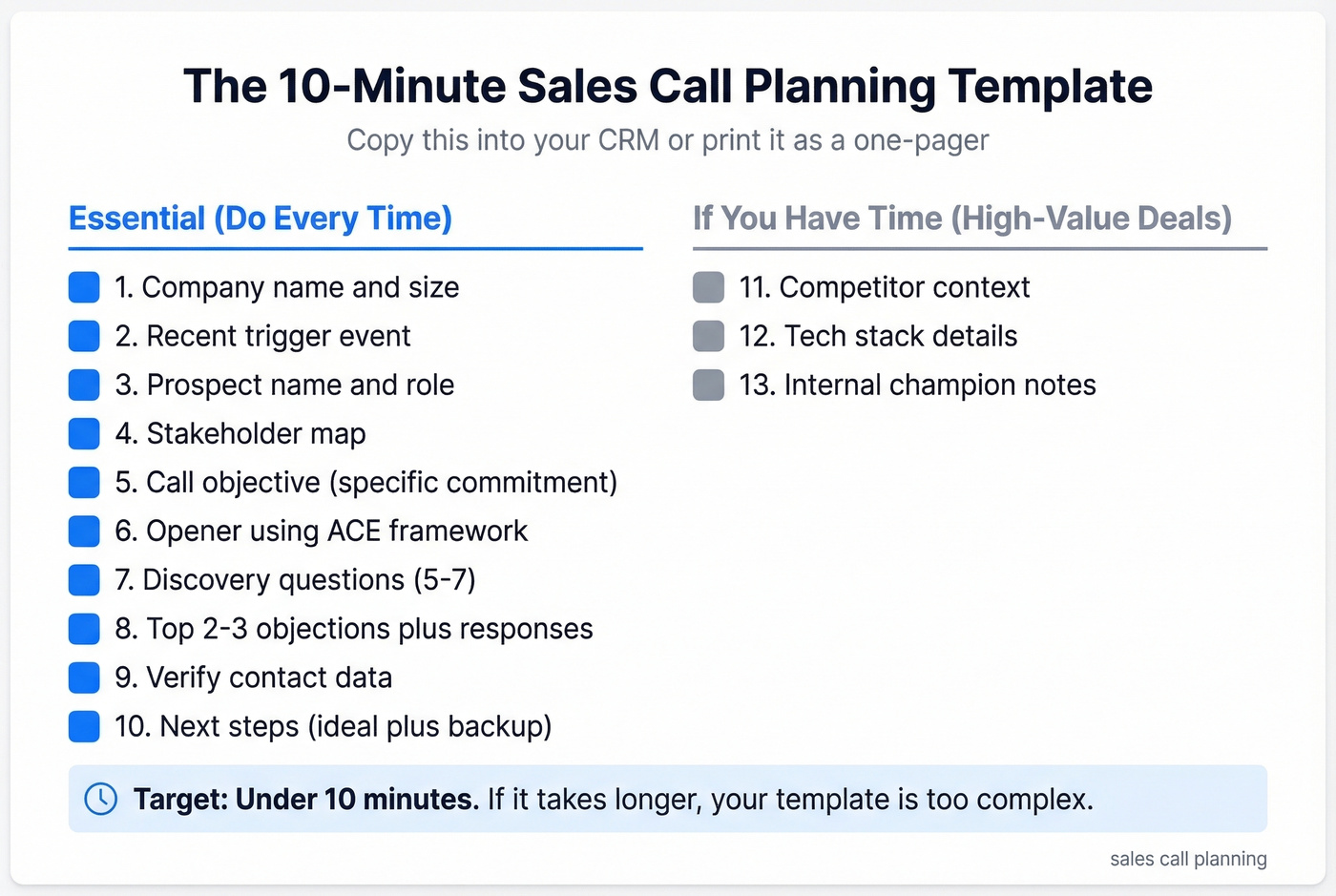
Here's the template we use internally, split into Essential fields and If-You-Have-Time fields for high-value calls. Copy it into your CRM or save it as a one-pager.
Blank Template
| Field | Category |
|---|---|
| Company | Essential |
| Recent trigger event | Essential |
| Prospect name & role | Essential |
| Stakeholder map | Essential |
| Call objective (specific commitment) | Essential |
| Opener (ACE) | Essential |
| Discovery questions (5-7) | Essential |
| Top 2-3 objections + responses | Essential |
| Verify contact data | Essential |
| Next steps (ideal + backup) | Essential |
| Competitor context | If you have time |
| Tech stack | If you have time |
| Internal champion notes | If you have time |
Filled-Out Example
Scenario: AE calling VP of Sales at a 200-person fintech that just closed Series B.
| Field | Entry |
|---|---|
| Company | PayFlow (200 employees, Series B, $40M raised) |
| Trigger | Series B closed 3 weeks ago; hiring 8 AEs |
| Prospect | Jordan Chen, VP Sales |
| Stakeholder map | Jordan (champion), CFO (economic buyer), RevOps lead (technical evaluator) |
| Objective | Confirm pain around rep ramp time; secure demo with RevOps |
| Opener (ACE) | "Thanks for making time, Jordan. We've got 25 minutes - still work? I'd love to understand how you're ramping the new AEs and whether we can help compress that timeline." |
| Discovery Qs | 1. How are you onboarding the new hires? 2. What's your current ramp-to-quota timeline? 3. What breaks first when you scale the team this fast? |
| Objections | "We're still evaluating" - Ask about timeline and decision criteria. "Budget is locked post-raise" - Reframe as ROI on faster ramp. |
| Contact verified | Mobile and email confirmed via Prospeo |
| Next steps | Ideal: Book demo with RevOps lead. Backup: Send case study + schedule follow-up in 5 days. |
The whole thing takes under 10 minutes. If it takes longer, your template is too complex.
Planning by Call Type
Cold calls live and die in the first 10 seconds. Focus on the trigger event, the opener, and one sharp question. Skip the full stakeholder map - your objective is earning enough interest to book a real conversation. Five minutes of prep is plenty.
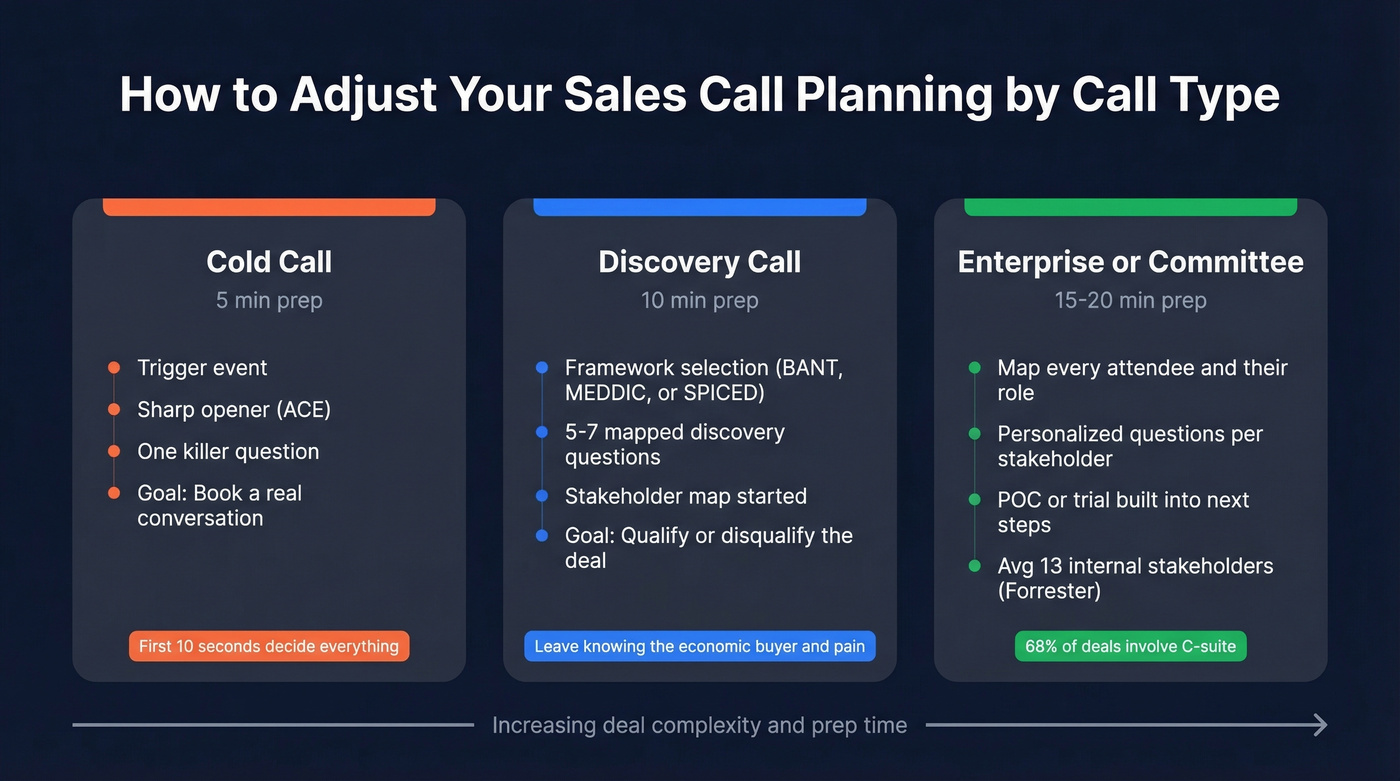
Discovery calls are where framework selection matters most. This is the call where you're qualifying - or disqualifying - the opportunity. Map your five to seven questions directly to your framework's criteria. If you're running MEDDIC, you need to leave the call knowing the economic buyer, the decision process, and the measurable pain.
Enterprise and multi-stakeholder calls require a fundamentally different approach. Forrester's State of Business Buying report puts the average B2B purchase at 13 internal stakeholders and 9 external participants. Procurement is a decision-maker in 53% of deals. C-suite is involved in 68%. Over 60% of enterprise buyers now require a trial or POC before committing - build that into your next-step planning.
Before a committee call, map every attendee:
| Field | What to Capture |
|---|---|
| Name | Full name |
| Role | Economic buyer, champion, technical evaluator, coach, blocker |
| Priorities | What they care about |
| Influence (1-5) | Decision weight |
| Last interaction | Most recent touchpoint |
Use the Align - Impact - Commit structure instead of presenting slides to a room. Align on the problem, demonstrate impact with their metrics, and commit to specific next steps before the call ends.
Mistakes That Kill Deals
Five planning failures that map directly to lost revenue:
Calling without lead context. No trigger, no role context, no prior interaction history. The prospect knows you're unprepared within 15 seconds. Three minutes of research prevents this entirely.
Weak first 10 seconds. A robotic opener or unclear reason for calling tanks engagement immediately. Use ACE. Script the opener, not the whole call.
Inconsistent follow-up. Forgetting callbacks, relying on memory instead of CRM notes, letting warm leads go cold. Plan your next steps before the call, not after. The consensus on r/sales is that follow-up discipline separates top performers from everyone else - and they're right.
Not tracking call outcomes. No disposition logged, no notes, no next steps recorded. If it's not in the CRM, it didn't happen.
Treating every lead the same. A cold inbound from a free trial signup doesn't get the same call plan as a warm referral from an existing customer. Skip the full template for low-stakes calls; go deep for high-value ones.
AI Tools That Speed Up Planning
Let's be honest: AI won't replace call preparation, but it's compressing it dramatically. Outreach reports its AI tools cut research and personalization time by 90%, shaving 11 days off sales cycles on average. For deals over $50K, that can lift win rates by up to 10 percentage points. Sellers using AI sales tools are 3.7x more likely to meet quota.
Tools like Gong surface conversation intelligence that feeds directly into your next pre-call plan. Outreach and HubSpot are building AI prep assistants into their sequencing platforms. The practical move isn't to pick one AI tool - it's to layer AI into the research and question-prep steps of your existing workflow. Let AI handle the data gathering. You handle the judgment calls.
Our hot take: if your average deal size is under $15K, you probably don't need a $30K/year conversation intelligence platform. A solid template, verified contact data, and 10 minutes of focused prep will outperform any AI tool bolted onto a broken process.
The fastest way to compress sales cycles past that 50-day win-rate cliff? Never waste a call. Prospeo gives you 98% accurate emails and verified direct dials at $0.01 per lead - so every minute of pre-call planning actually reaches the buyer.
Make every planned call count with data that's never more than 7 days old.
FAQ
How long should sales call planning take?
Five to ten minutes for standard calls; 20-30 minutes for high-value enterprise deals with multiple stakeholders. If your template takes longer than 10 minutes for a routine call, simplify it - reps won't use an overly complex process consistently.
What's the best qualification framework for call prep?
Start with BANT for transactional deals under $25K. Use MEDDIC for complex enterprise sales involving procurement. Use SPICED for consultative selling where the buyer must justify internal change. Most teams run a hybrid - BANT screens fast, then heavier frameworks handle real qualification.
Should I script my entire sales call?
No. Script your opener and prepare 5-7 discovery questions - nothing more. Prospects detect scripted delivery within seconds, and it kills trust. A structured agenda with flexible delivery outperforms rigid scripting every time.
How do I plan for a call with multiple stakeholders?
Map every attendee before the call: name, role, priorities, influence level, and last interaction. Use the Align - Impact - Commit structure. The average B2B purchase involves 13 internal stakeholders - plan for each person in the room, not just the one who booked the meeting.