

=== CURRENT ARTICLE (slug: sales-call-structure-best-practices) ===
Sales Call Structure Best Practices for 2026: Templates, Benchmarks, and the Mistakes Killing Your Pipeline
A 6.7% success rate. That's the benchmark for cold calls converting to booked meetings. Meanwhile, 82% of buyers have accepted meetings from strategic cold outreach, and 69% say they're open to hearing from new providers. The gap between opportunity and execution is enormous - and it almost always comes down to how you structure your calls.
Most reps don't have one call structure problem. They have four. A cold call isn't a discovery call. A discovery call isn't a demo. And a closing call with six stakeholders on the line requires a completely different playbook than a 90-second cold open. Yet most teams run one vague framework across all four and wonder why conversion stalls.
Let's break down each type with templates, benchmarks, and the mistakes that kill pipeline.
Benchmarks: What Good Actually Looks Like
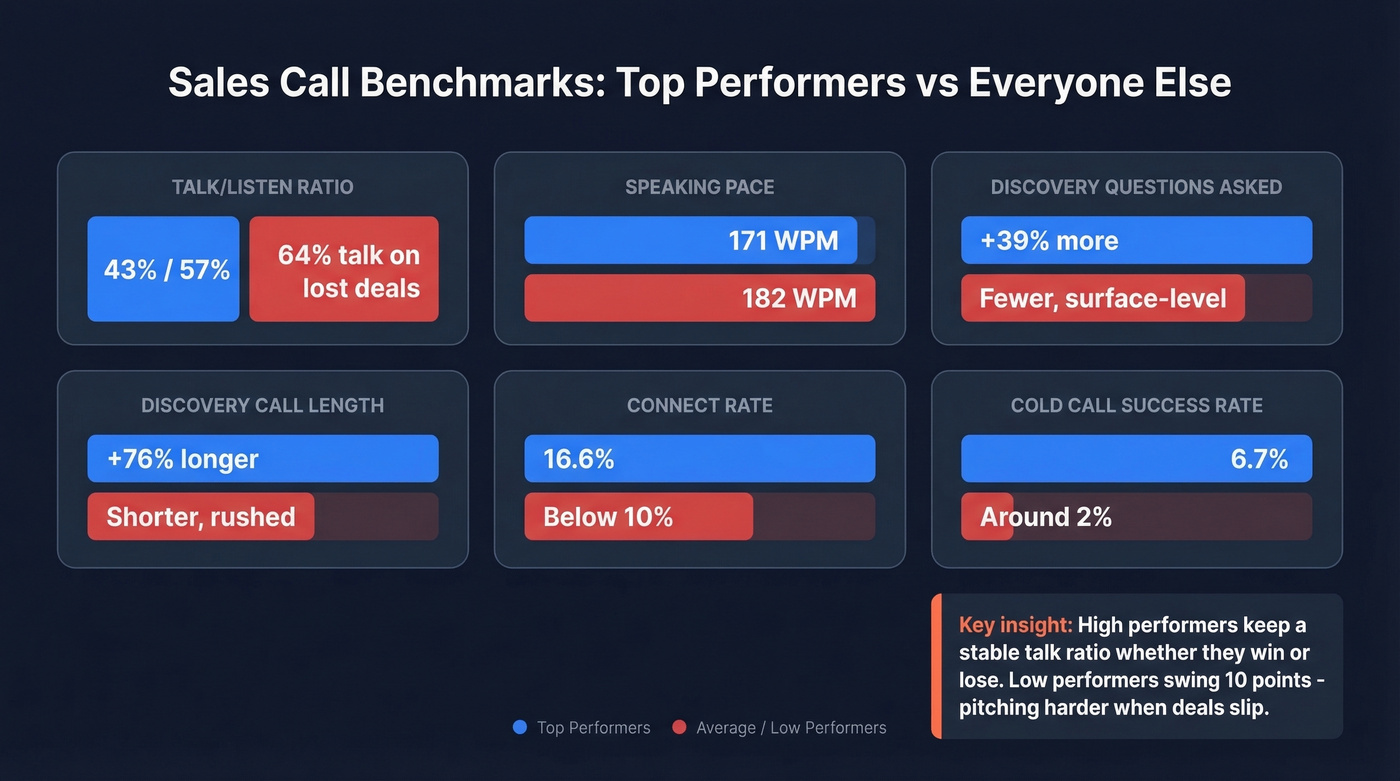
Before getting into templates, here are the numbers that separate top performers from everyone else. These aren't aspirational - they're diagnostic. If your numbers don't match, they tell you exactly where to focus.
| Metric | Top Performers | Average / Low Performers |
|---|---|---|
| Talk/listen ratio | 43% / 57% | 54% talk on won deals; 64% on lost |
| Speaking pace | 171 WPM | 182 WPM |
| Discovery questions | +39% more | Fewer, surface-level |
| Discovery call length | +76% longer | Shorter, rushed |
| Connect rate | 16.6% | Below 10% = data issue |
| Cold call success rate | 6.7% | ~2% (2023 baseline) |
| Attempts to reach | 8 calls | Most quit at 2-3 |
| Avg conversation length | 93 seconds | - |
The consistency finding is the one that sticks with us. High performers keep a stable talk ratio whether they win or lose. Low performers swing roughly 10 points - 54% talk on won deals, 64% on lost ones. That swing means they're pitching harder when they sense a deal slipping, which is exactly the wrong instinct.
Call Structures by Type
Cold Call (3 Minutes)
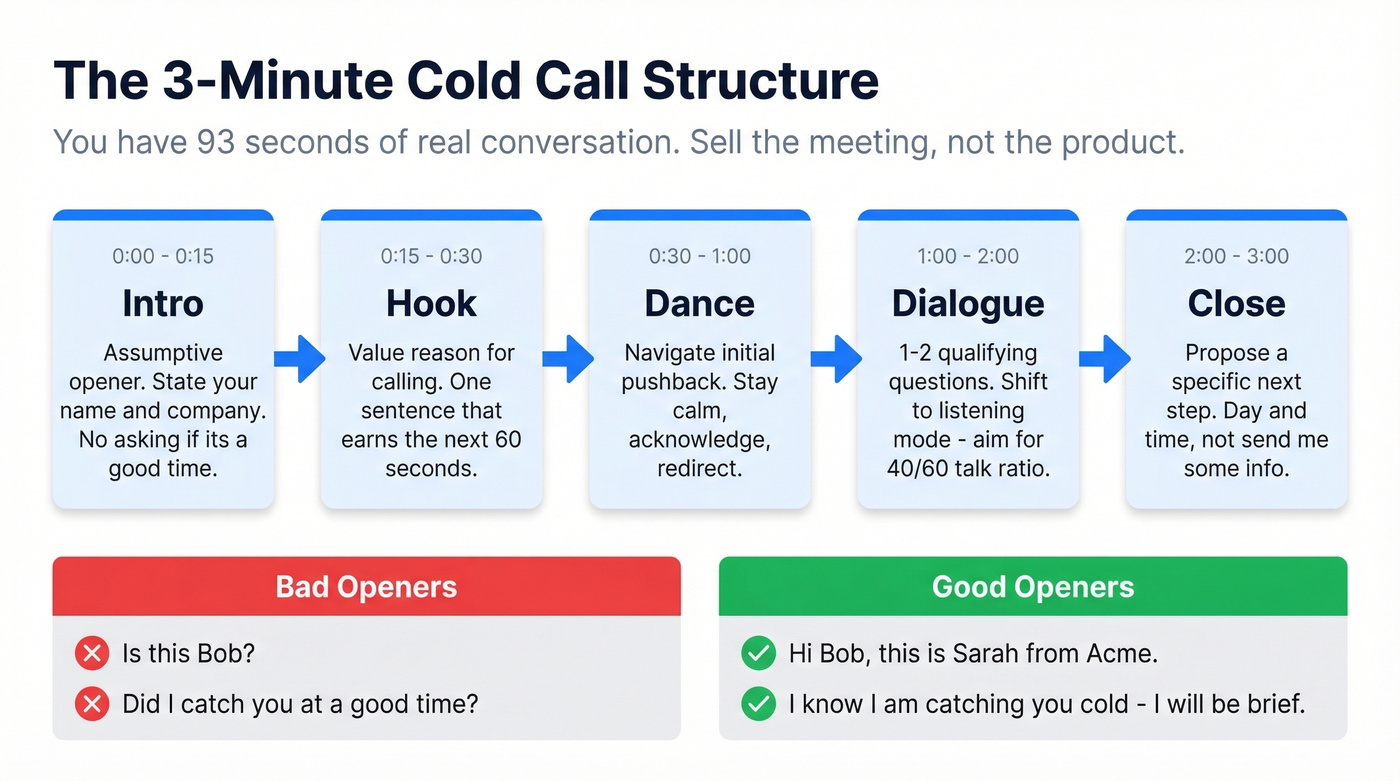
You have 93 seconds of actual conversation on average. That's not a pitch window - it's a meeting-booking window. Sell the meeting, not the product.
Here's why the channel still works: 57% of C-level and VP buyers prefer phone contact over email or social. You're not interrupting. You're using their preferred channel.
The framework that works best is a five-part flow:
| Phase | Time | What Happens |
|---|---|---|
| Intro | 0:00-0:15 | Assumptive opener, name + company |
| Hook | 0:15-0:30 | Value reason for calling |
| Dance | 0:30-1:00 | Navigate initial pushback |
| Dialogue | 1:00-2:00 | 1-2 qualifying questions |
| Close | 2:00-3:00 | Propose specific next step |
The first 10 seconds matter more than anything else.
Bad: "Is this Bob?" - Triggers defensiveness. They're already wondering who you are. Good: "Hi Bob, this is Sarah from Acme." - Assumptive, confident, moves forward.
Bad: "Did I catch you at a good time?" - You're handing them an exit. Good: "I know I'm catching you cold - I'll be brief." - Acknowledges the interruption, signals respect, gets to value fast.
Time your dials for :45 to :59 past the hour. Executives are between meetings and more likely to pick up. Aim for a 40/60 talk-to-listen split. If you're monologuing past the one-minute mark, you've already lost.
Discovery Call (30 Minutes)
Discovery is where deals are won or lost. Top reps' discovery calls run 76% longer than their peers' - not because they're rambling, but because they ask better questions and let prospects talk.
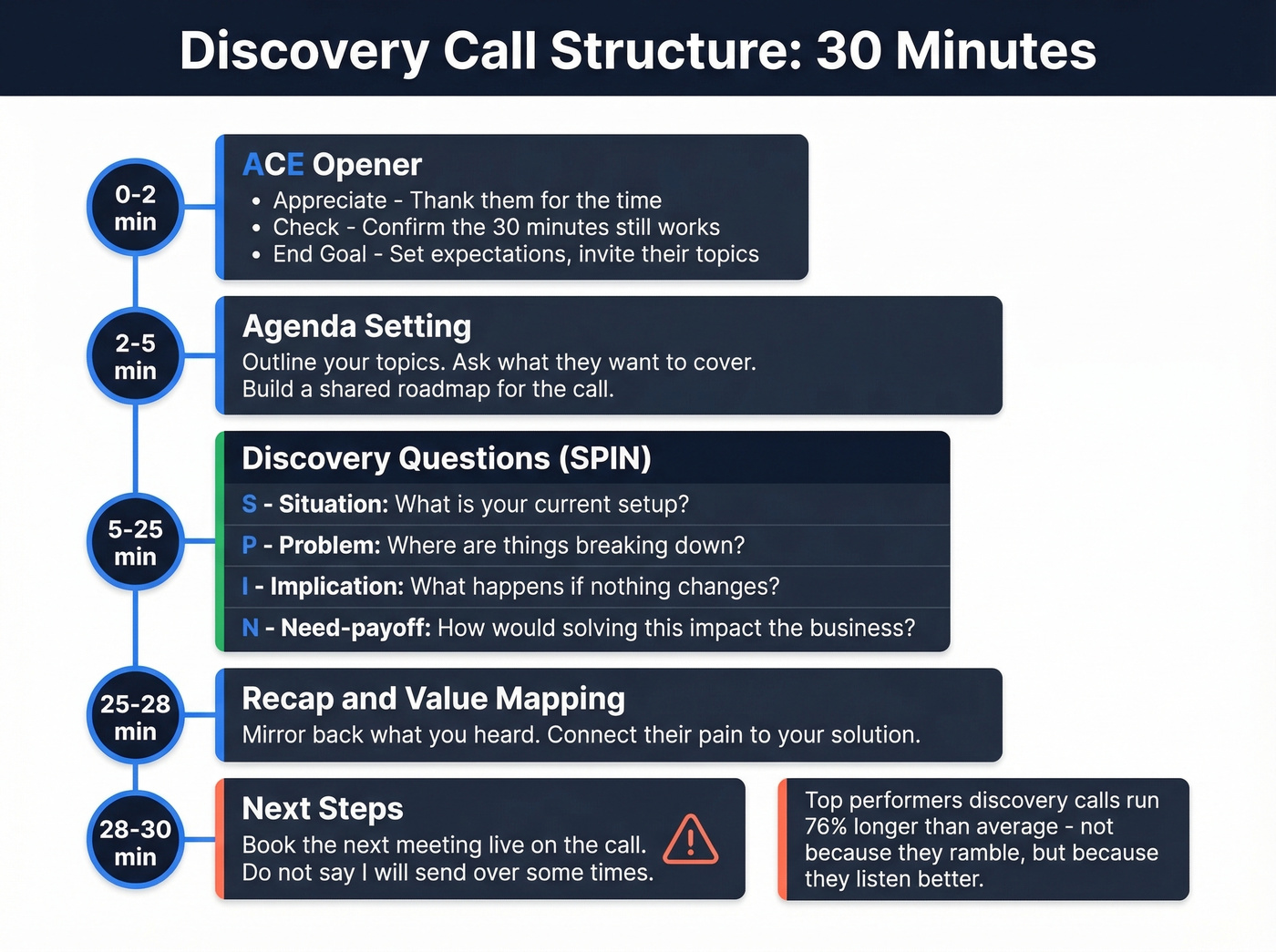
Open with the ACE framework: Appreciate the time. Check the time - confirm the 30 minutes still works. End goal - set expectations for what you'll cover and invite them to add topics.
| Phase | Time | What Happens |
|---|---|---|
| ACE opener | 0:00-2:00 | Thank, confirm time, set agenda |
| Agenda setting | 2:00-5:00 | Outline topics, invite additions |
| Discovery questions | 5:00-25:00 | SPIN sequence, pain mapping |
| Recap + value mapping | 25:00-28:00 | Mirror back, connect to solution |
| Next steps | 28:00-30:00 | Specific date/time, action items |
The critical mistake is treating discovery as a Q&A session followed by a pitch. Weave your questions throughout the conversation. When they share a pain point, dig deeper before moving on. The SPIN sequence - Situation, Problem, Implication, Need-payoff - gives you a natural escalation path from surface-level facts to the business impact that justifies a deal.
Here's the thing: I see this constantly. Reps end discovery calls with "I'll send over some times" instead of booking the next meeting right there on the call. Don't leave the calendar to email. Lock it down live. This single habit will move the needle more than any script change.
Demo Call (45 Minutes)
Forget the feature tour. The Challenger approach works here because buyers don't need a walkthrough - they need to learn something they didn't know. Teach an insight about their problem, Tailor the demo to the specific pain points from discovery, Take Control of next steps. Xerox reported a 17% sales increase and $65M in contract value after implementing this approach.
Skip this section if your deal size is under $5K. At that price point, your demo should be a 15-minute screen share, not a 45-minute production.
| Phase | Time | What Happens |
|---|---|---|
| Context recap | 0:00-5:00 | Confirm pain points from discovery |
| Tailored demo | 5:00-30:00 | Show only what matters to them |
| Objection handling | 30:00-40:00 | Address concerns directly |
| Pricing + next steps | 40:00-45:00 | Ballpark, propose timeline |
For SMB deals, 30-45 minutes is the sweet spot. Enterprise demos run 45-60 minutes, especially when technical stakeholders are involved. Bringing in a sales engineer for enterprise demos increases win rates by 30% - don't try to solo the technical deep-dive if you don't have to.
Closing Call (30-60 Minutes)
Closing isn't a one-person show. 77% of deals involve multiple contacts, and multi-threading boosts win rates by 130% on deals over $50K. For enterprise, buying groups average 17 contacts. Selling teams on closed-won deals are 67% larger than on lost deals.
| Phase | Time | What Happens |
|---|---|---|
| Stakeholder alignment | 0:00-10:00 | Confirm each person's concerns |
| Value summary | 10:00-20:00 | ROI, timeline, risk mitigation |
| Terms + negotiation | 20:00-40:00 | Pricing, contract, legal |
| Commitment + timeline | 40:00-60:00 | Sign-off path, implementation |
The structure here depends entirely on who's in the room. If procurement is on the call, lead with ROI and risk. If it's the champion plus their boss, lead with the business case the champion has already bought into. This isn't a script - it's a framework you adapt to the audience.
After every call - closing or otherwise - log notes within 5 minutes, review your talk ratio data, and send a follow-up email within 24 hours summarizing next steps and owners. The reps who skip this step lose deals to ambiguity, not competitors.
Common Mistakes That Kill Your Pipeline
Six patterns that destroy pipeline, with the fix for each.
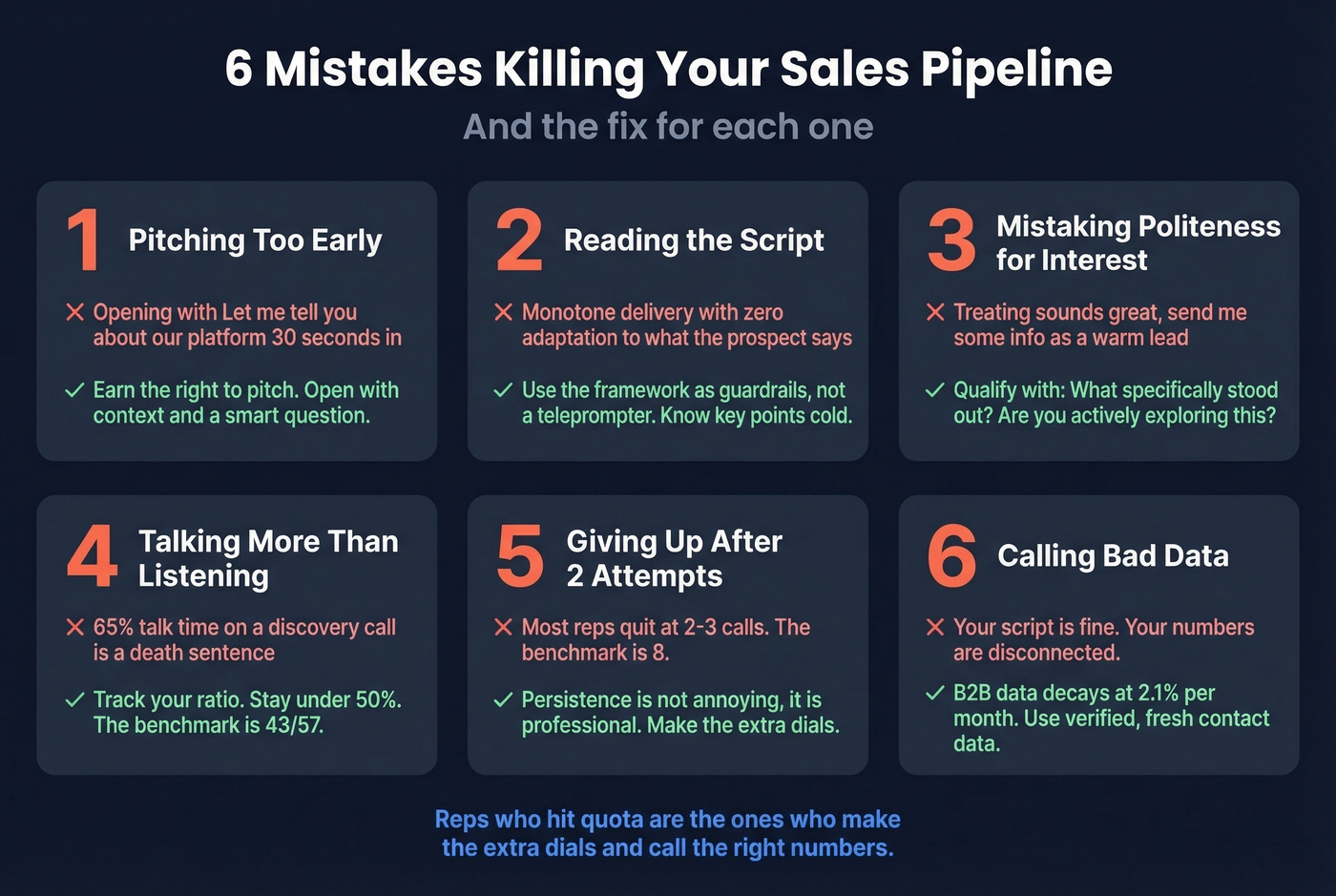
1. Pitching too early. You open with "Let me tell you about our platform..." 30 seconds in, and the prospect mentally checks out. Earn the right to pitch by opening with context and a smart question.
2. Reading the script. Monotone delivery with zero adaptation to what the prospect says. Use the framework as guardrails, not a teleprompter. Know your key points cold so you can riff.
3. Mistaking politeness for interest. "Sounds great, send me some info" is not a warm lead. Qualify with "What specifically stood out?" or "Are you actively exploring this, or is this more general interest?"
4. Talking more than listening. 65% talk time on a discovery call is a death sentence. Track your ratio. The 43/57 benchmark exists for a reason - if you're over 50%, you're pitching when you should be listening.
5. Giving up after 2 attempts. The benchmark is 8 attempts. Most reps quit at 2-3. Persistence isn't annoying - it's professional. The consensus on r/sales backs this up: the reps who hit quota are the ones who make the extra dials.
6. Calling bad data.

A connect rate below 10% is a data problem, not a script problem. Prospeo gives you 125M+ verified mobile numbers with a 30% pickup rate - so your perfectly structured cold call actually reaches the right person.
Fix your connect rate before you fix your script.
Match Methodology to Call Type
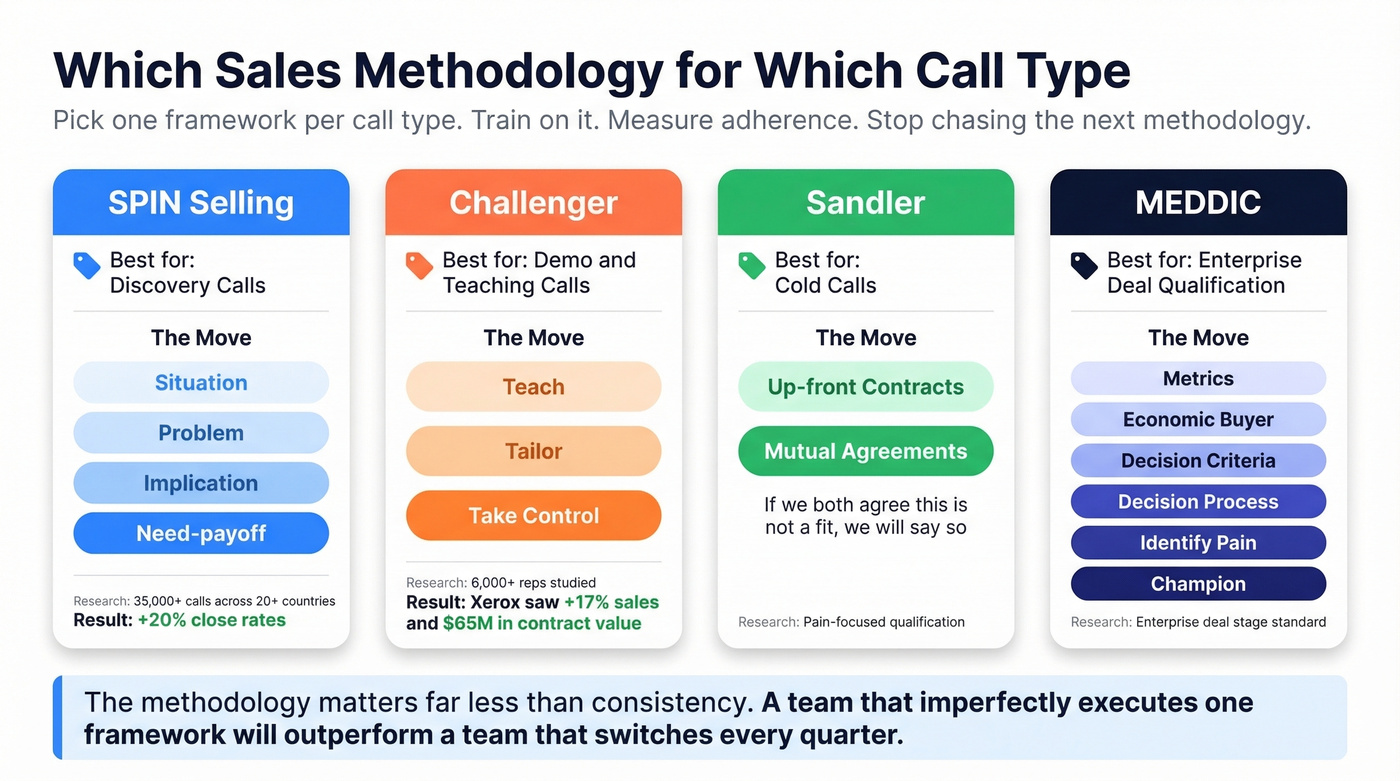
You don't need to adopt a methodology religiously. You need to know which one fits which call type.
| Methodology | Best For | Key Move | Research Basis |
|---|---|---|---|
| SPIN | Discovery calls | Situation - Problem - Implication - Need-payoff | 35,000+ calls, 20+ countries |
| Challenger | Demo / teaching calls | Teach, Tailor, Take Control | 6,000+ reps; Xerox: +17% sales |
| Sandler | Cold calls | Up-front contracts, mutual agreements | Pain-focused qualification |
| MEDDIC | Complex deal qualification | Metrics, Economic Buyer, Decision Criteria | Enterprise deal stages |
SPIN is the most research-backed framework for discovery - Rackham's research found that a structured questioning strategy increases close rates by 20%. Challenger maps naturally to demos where you're teaching the prospect something they didn't know. Sandler's up-front contract concept - "If we both agree this isn't a fit, we'll say so" - is perfect for cold call openings. MEDDIC is the standard for enterprise deals where you need to map the buying committee.
Real talk: the methodology matters far less than consistency. A team that imperfectly executes SPIN on every discovery call will outperform a team that switches between SPIN, Challenger, and MEDDIC every quarter. Pick one framework per call type, train on it, and measure adherence. Stop chasing the next methodology.
Pre-Call Prep Checklist
The five minutes before a call determine more than the 30 minutes during it.
- Company context: Recent funding, earnings, hiring signals, product launches
- Role context: How long in the role, previous company, likely priorities
- Tech stack: What they're already using - this reveals integration angles and competitive displacement opportunities
- Trigger events: Job changes, expansion, new leadership, anything that creates urgency
Speed matters too. Calling within the first minute of an inbound lead improves conversion by nearly 400%. Every minute you wait, the lead cools.
None of this prep matters if you're calling a number that's been disconnected for six months. B2B data decays at 2.1% per month, which means roughly a quarter of your list is wrong by year's end. We've seen teams fix their connect rate overnight just by switching to fresher data - tools like Prospeo refresh 300M+ profiles every 7 days compared to the 6-week industry average, with 98% email accuracy and 125M+ verified mobile numbers.

Tools That Make Structure Measurable
Conversation intelligence tools turn your call structure from theory into measurable practice. They track talk ratios, filler words, question frequency, and methodology adherence automatically. Sellers who frequently use AI tools generate 77% more revenue across 7.1M analyzed opportunities - not because AI makes calls for them, but because it surfaces the patterns that separate good calls from bad ones.
| Tool | Starting Price | Best For |
|---|---|---|
| Prospeo | Free tier; ~$0.01/email | Verified contact data for call lists |
| Gong | Custom (typically ~$100-150/user/mo) | Enterprise conversation intelligence |
| Avoma | $29/user/mo | Mid-market conversation intelligence |
| Fireflies | From $18/user/mo | Budget-friendly transcription |
| Grain | From $15/user/mo | Clip-based coaching |
| Fathom | Free plan available | Solo reps, startups |
Multi-threading boosts win rates by 130%, but only if you can reach every stakeholder. Prospeo's 300M+ profiles with 30+ filters let you map entire buying committees - with verified emails and direct dials - before your closing call.
Stop selling to one contact when the deal needs seventeen.
FAQ
How long should a sales call be?
Cold calls run 2-3 minutes with a goal of booking a meeting, not pitching. Discovery calls last 15-30 minutes, with top performers trending longer. Demos take 30-45 minutes for SMB and 45-60 for enterprise. Closing calls with multiple stakeholders run 30-60 minutes depending on deal complexity.
What's a good talk-to-listen ratio?
The benchmark is 43% talk, 57% listen across all call types. For cold calls specifically, aim closer to 40/60. Low performers swing 10 points between won and lost deals, while top performers stay consistent - that stability matters more than hitting the exact number.
How many attempts before moving on?
Eight attempts is the research-backed benchmark. Most reps quit after 2-3 dials, abandoning prospects right before the typical connection point. If your connect rate stays below 10% after 8 attempts, the issue is data quality - a tool with verified mobiles and a 30% pickup rate fixes this at the source.
What's the best framework for each call type?
Use Sandler's up-front contracts for cold calls, SPIN questioning for discovery, the Challenger teach-tailor-control model for demos, and MEDDIC for complex enterprise closing. The common thread across all four is maintaining a 43/57 talk-to-listen ratio and booking the next step before you hang up.
How do new reps build good call habits?
Start by mastering cold call structure before moving to discovery or demos. Record every call, review your talk ratio against the 43/57 benchmark, and debrief with a manager weekly. In our experience, reps who improve fastest treat every dial as a data point, not just a task to check off - conversation intelligence tools accelerate this feedback loop significantly.