

Sales Closing Techniques: What Actually Works in 2026
You've read five articles listing the same 12 techniques with the same one-liner examples. None of them told you what a good close rate looks like for your industry, and none addressed the real reason deals die - you're single-threading into a buying committee of seven people and hoping your champion does the selling for you.
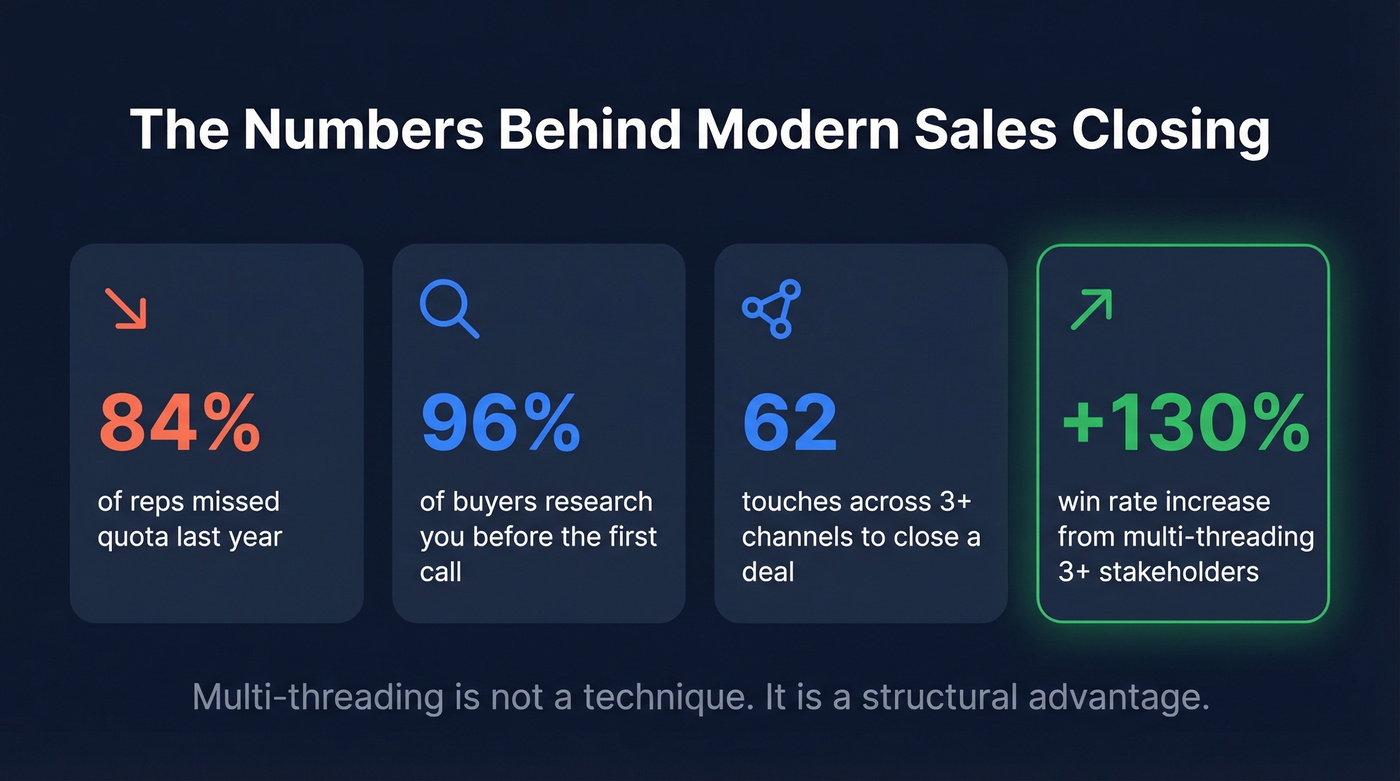
Here's the reality: 84% of reps missed quota last year. 96% of buyers research you before they ever take a call. The average deal requires 62 touches across at least three channels before it closes. Against that backdrop, memorizing 21 closing methods is like rearranging deck chairs on the Titanic.
You need three sales closing techniques, a process for multi-threading stakeholders, and contact data that actually works. 81% of revenue leaders say deals are more complex than ever, and buyers now use 10 interaction channels on average - up from 5 in 2016. The old playbook of charm-plus-persistence doesn't scale in this environment.
The Short Version
If you're pressed for time:
- Warm deals with confirmed fit: Assumptive close. Stop asking for permission and start scheduling implementation.
- Stalled deals where the prospect's gone quiet: Takeaway close. "Maybe we're not the right fit" triggers more urgency than any discount ever will.
- Enterprise deals with 7+ stakeholders: Mutual Action Plan. A shared document with milestones, owners, and dates replaces "closing lines" with a process.
The single stat that reframes everything: multi-threading - engaging three or more stakeholders in the buying committee - increases win rates by roughly 130%. That's not a technique. That's a structural advantage.
Close Rate Benchmarks by Industry
A 15% close rate in enterprise software is solid. A 15% close rate in insurance means something's broken. We compiled close-rate ranges across 12 industries because context matters more than averages.
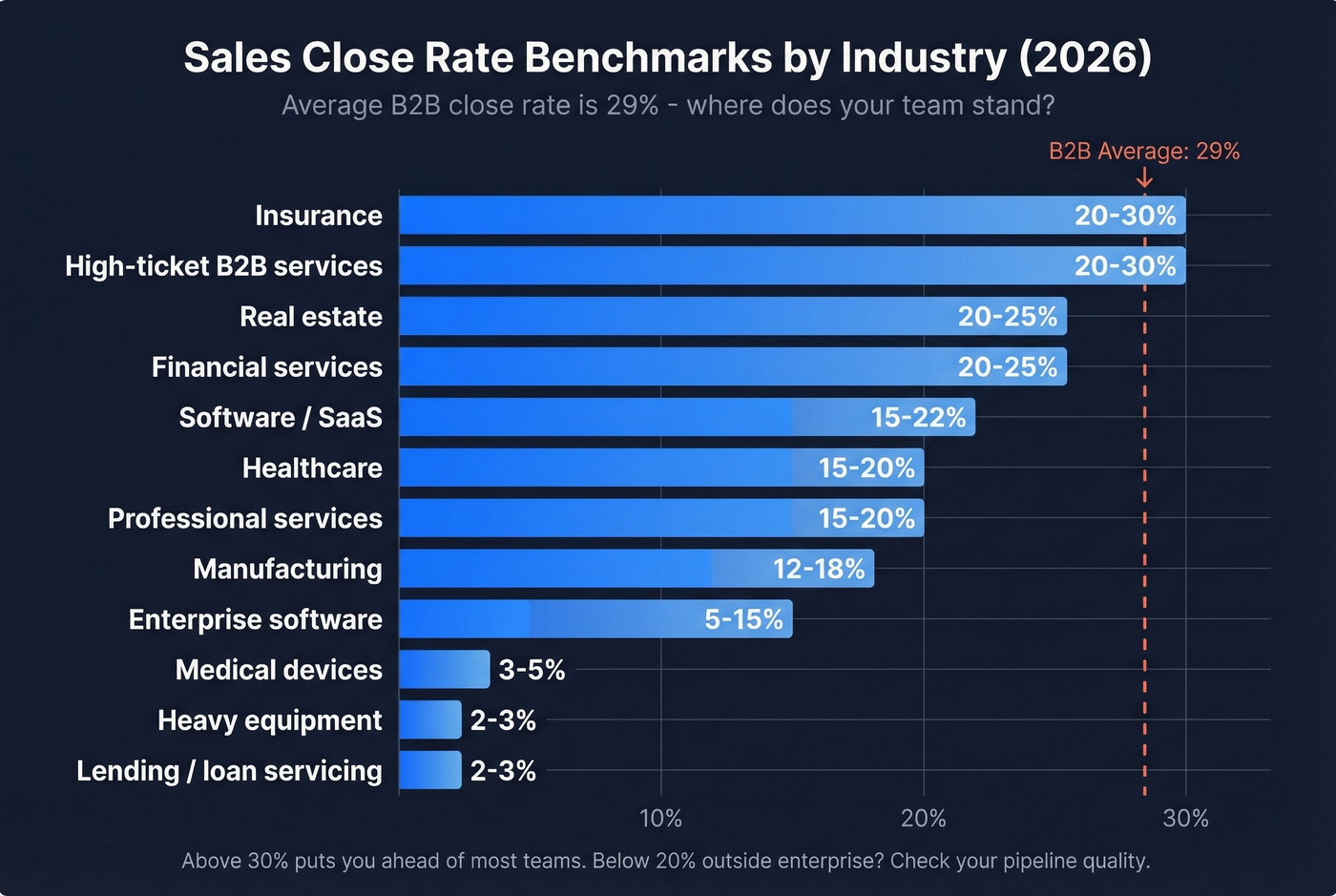
The average B2B close rate sits around 29%, with win rates closer to 21% when measured from opportunity creation to closed-won. Anything above 30% puts you ahead of most teams. But these averages hide massive variation.
| Industry | Close Rate Range |
|---|---|
| Insurance | 20-30% |
| High-ticket B2B services | 20-30% |
| Real estate | 20-25% |
| Financial services | 20-25% |
| Software / SaaS | 15-22% |
| Healthcare | 15-20% |
| Professional services | 15-20% |
| Manufacturing | 12-18% |
| Enterprise software | 5-15% |
| Medical devices | 3-5% |
| Heavy equipment | 2-3% |
| Lending / loan servicing | 2-3% |
Enterprise software's 5-15% range isn't a sign of bad selling - it reflects procurement complexity, 12-18 month cycles, and buying committees that can stall deals at any stage. 89% of B2B buyers had a deal stall in the past year, often due to budget freezes or stakeholder changes. For a mid-market gut-check: one SaaS rep selling £25k ARR deals reported an 8% discovery-booked-to-closed-won rate from cold outbound, which is a useful benchmark for teams in that range.
If your close rate is below 20% and you're not selling into enterprise or heavy industry, the problem isn't your closing approach. It's your pipeline quality.
12 Techniques Reps Actually Use
Every technique below includes a buyer-type fit and a deal-stage trigger. Analytical buyers respond to different approaches than relationship-driven ones, and matching the method to the buyer matters more than memorizing scripts.
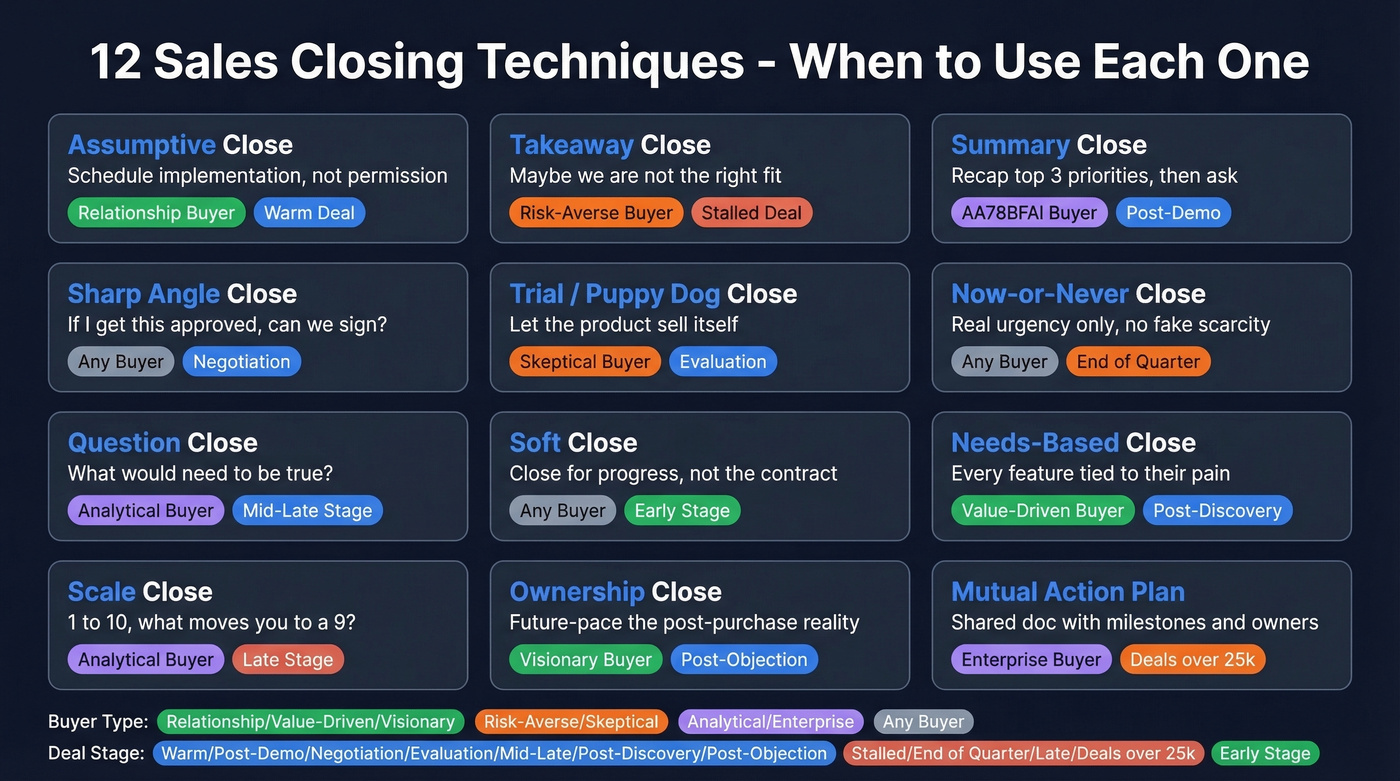
One data point to keep in mind: pricing discussions convert best in two windows - minutes 13-20 and minutes 40-49 of a sales call. Bringing up pricing outside those windows correlates with lower close rates.
Assumptive Close
Works best with warm deals where discovery confirmed mutual fit. Deploy when the prospect starts asking implementation questions - that's your signal they've mentally bought.
Instead of asking "Would you like to move forward?" you say: "Let's get the kickoff scheduled for the week of the 14th - does Tuesday or Thursday work better for your team?"
You're not being presumptuous. You're removing friction for a buyer who's already decided. Best for relationship buyers who want a guide, not a salesperson.
Takeaway Close
This is a popular low-pressure close on r/sales, and for good reason. Here's how a real conversation plays out:
Rep: "Based on what you've told me, I'm not sure we're the right fit for where you are right now." Prospect: "Wait - what do you mean? We've been evaluating this for weeks." Rep: "I just want to make sure you're not forcing a decision that doesn't align with your timeline. If the urgency isn't there, it might make sense to revisit next quarter."
FOMO does the rest. The prospect who was dragging their feet suddenly has to articulate why they do want this. Deploy when a deal has stalled for 2+ weeks with no clear blocker. Best for risk-averse buyers and deals where nothing else is moving the needle.
Summary Close
For complex deals where you've discussed fifteen features across four demos, the buyer's head is spinning. Recap the three things that matter most to them - tied directly to their stated pain points - then ask for commitment.
"You mentioned onboarding speed, API flexibility, and SOC 2 compliance were your top priorities. We've covered all three. What does the approval process look like on your end?"
Deploy after the final demo or technical review. Best for analytical buyers who need the logic laid out cleanly.
Sharp Angle Close
When a prospect asks for a concession - extra seats, a discount, faster implementation - you turn it into a conditional commitment.
Prospect: "Can you throw in an extra quarter of support?" Rep: "If I can get that approved, can we sign the agreement this week?" Prospect: "I'd need to check with my VP, but from my side, yes." Rep: "Great - let's get a 15-minute call with your VP on Thursday so we can finalize together."
This only works if you have the authority to make the concession. Deploy when the prospect is negotiating terms, not questioning value - that distinction matters.
Trial / Puppy Dog Close
Skip this if your product requires heavy onboarding or doesn't deliver value within 14 days. But if your product can speak for itself, a pilot or proof-of-concept removes the risk of commitment and shifts the conversation from "should we buy?" to "this is already working."
The key is setting clear success criteria upfront. "If bounce rates drop below 5% during the pilot, we move to annual." Without that criteria, trials become indefinite free usage. Best for skeptical and analytical buyers who don't trust demos.
Now-or-Never Close
Legitimate time-bound offers - end-of-quarter pricing, limited implementation slots, a promotion that genuinely expires. The emphasis is on legitimate. Fake urgency is the fastest way to lose a deal when 96% of buyers have already researched you before the first call. They can smell manufactured scarcity. Deploy only when the constraint is real and verifiable.
Question Close
Rep: "What would need to be true for you to move forward this quarter?" Prospect: "Honestly, I'd need to see the ROI model hold up with our actual numbers, and my CFO would need to sign off." Rep: "Let's build that model together this week. And I'd love to walk your CFO through it directly - can we get 20 minutes on her calendar?"
This isn't a closing line. It's a diagnostic tool. The answer tells you exactly what's blocking the deal - budget, timing, a missing stakeholder, or a competitor. Deploy mid-to-late stage when you sense hidden objections. Best for analytical buyers who won't respond to pressure but will respond to a genuine question.
Soft Close
Low-commitment next step that advances the deal without asking for a signature. "Would it make sense to loop in your CFO for a 15-minute call next week?" You're closing for progress, not the contract. Deploy early in the decision process when asking for a signature would be premature.
Needs-Based Close
Every feature you mention ties back to a specific pain point the buyer raised during discovery. "You told me your team wastes six hours a week on manual data entry - this integration eliminates that entirely." Deploy after discovery when you can map every claim to something the buyer actually said. Best for value-driven buyers who need to justify the purchase internally.
Scale Close
Rep: "On a scale of 1 to 10, how confident are you that this solves your team's problem?" Prospect: "I'd say a 6." Rep: "What would move you from a 6 to a 9?" Prospect: "If I knew the integration with our CRM wouldn't require a dedicated engineer for three months." Rep: "It doesn't. Let me show you - our average integration takes 11 days with one part-time resource."
Anything below an 8 surfaces hidden objections. Deploy when a prospect seems positive but won't commit - the number forces specificity.
Ownership Close
Future-pacing language that puts the buyer in a post-purchase reality. "When your team is running sequences with verified data next quarter, the first thing they'll notice is the bounce rate dropping below 5%." Deploy after you've addressed all objections and the prospect is in evaluation mode. Best for visionary and relationship-driven buyers who make decisions based on outcomes, not features.
Mutual Action Plan Close
This isn't a line you deliver - it's a process artifact. A shared document with milestones, owners, dates, and internal steps like security review, legal redline, procurement approval, and executive sign-off. You build it collaboratively with your champion, and it replaces the awkward "so, are we good to go?" with a structured path to close.
Deploy for any deal over $25k with more than two stakeholders. This technique bridges directly into the most important closing concept in B2B today.

Your close rate tanks when emails bounce and direct dials go to voicemail. Prospeo delivers 98% email accuracy and 125M+ verified mobile numbers with a 30% pickup rate - so every touchpoint in your closing sequence actually reaches a real person.
Stop losing deals to bad contact data. Start closing them.
Multi-Threading: The Structural Advantage
Let's be honest about a scenario we've all lived through. It's Thursday afternoon. Your champion calls and says, "Great news - we're moving forward. But my CFO needs to approve anything over $50k, and she has questions about ROI." You've never spoken to the CFO. You don't have her direct email. Your champion is now your unpaid, untrained sales rep, and the deal is in her hands.
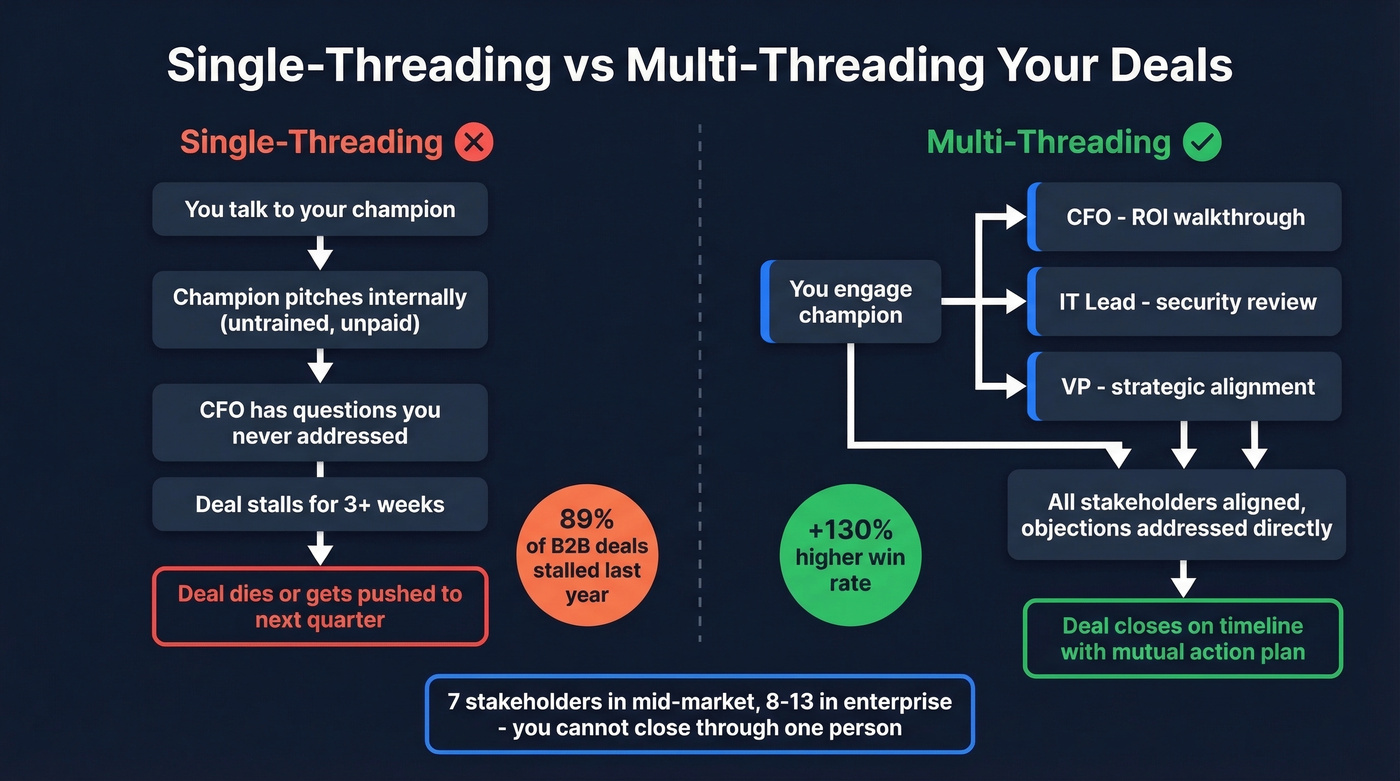
This is where most enterprise deals go to die. And it's entirely preventable.
Buying committees now include 7 stakeholders for mid-sized firms and 8-13 for mid-to-large enterprise deals. Engaging three or more of those stakeholders lifts win rates by roughly 130%. That's the difference between a 20% win rate and a 46% win rate.
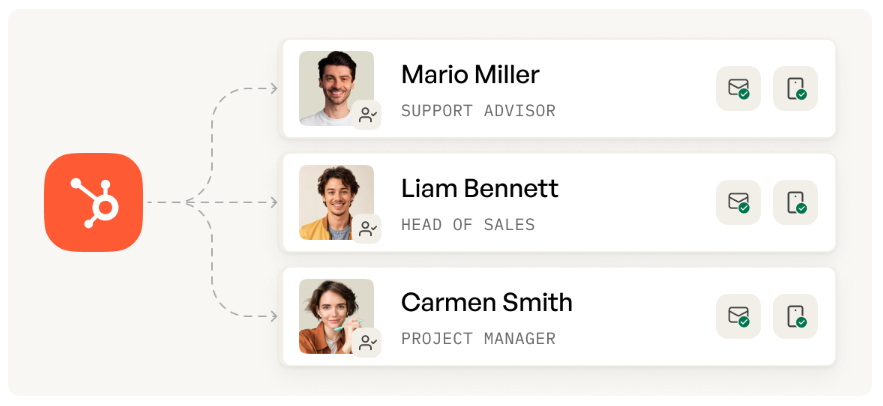
The Mutual Action Plan is the operational backbone of multi-threading. It's a shared document - Google Doc, Notion page, whatever your buyer uses - that maps every step from "verbal yes" to "signed contract." When you build a MAP collaboratively, you naturally surface every stakeholder who needs to be involved. Then you engage them directly. No matter which closing methods you prefer, multi-threading is the structural layer that makes them effective at the enterprise level.
Here's an angle most sales content misses: in consulting and enterprise services, the real close often happens before the RFP. By helping shape the scope of work and success criteria during the evaluation phase, you've effectively won the deal before competitors even submit a proposal. The MAP is what makes this possible - it embeds you into the buying process early enough to influence it.
The best teams we've seen make multi-threading a stage-exit criterion. No deal advances to proposal or commit stage without at least three engaged roles in the buying committee. It forces reps to build relationships across the org instead of relying on a single champion.
To multi-thread effectively, you need verified contact data for every stakeholder in that committee. When your champion mentions the CFO needs to sign off, you should already have the CFO's direct dial and verified email - not a generic info@ address. Tools like Prospeo, with 300M+ professional profiles and 98% email accuracy on a 7-day refresh cycle, exist precisely for this moment. That's the difference between a deal that closes and one that stalls for six weeks while your champion plays telephone.
Closing in Virtual Environments
70%+ of B2B decision-makers are open to making purchases over $50,000 remotely. 27% would spend $500,000 or more without meeting anyone in person. The "we need to fly out for this one" threshold has moved dramatically upward, and 80% of B2B sales interactions now happen through digital channels.
This isn't a trend. It's the operating reality.
Your closing approach needs to work asynchronously. Video proposals that the buying committee can watch on their own time. Digital deal rooms where every stakeholder can access the business case, ROI model, and contract in one place. The close doesn't happen in a single call anymore - it happens across a dozen micro-interactions spread over weeks, and your MAP becomes the connective tissue between all those touchpoints.
One timing detail: weekend connect rates drop to 45% of weekday rates. Schedule your critical closing conversations for Tuesday through Thursday when engagement peaks.
Hot take: If your average deal size is under $15k, you probably don't need a 12-step closing methodology. A clean demo, a strong follow-up email, and verified contact data for the decision-maker will close more deals than any framework. Save the MAPs and multi-threading for deals where the complexity justifies the process.
Deal-Killing Mistakes
Replace urgency tactics with data-backed proposals. Bryan Vasquez, Head of Sales at LinkBuilder.io, saw a 20% win-rate increase over two quarters after dropping manufactured scarcity in favor of tailored value maps. Fake urgency doesn't work when buyers have already researched you before the first call.
Stop single-threading. This is the #1 enterprise deal-killer, full stop. If your champion is the only person you've spoken to, you haven't closed anything - you've created a single point of failure.
Follow up persistently across multiple channels. 80% of sales require at least five follow-ups, but nearly half of reps give up after one touch. The average deal takes 62 touches across at least three channels, and 75% of B2B buyers are taking longer to decide than they were two years ago. 28% of reps cite "sales process taking too long" as the #1 reason prospects back out. Persistence isn't pestering - it's the cost of doing business in a world where buyers control the timeline.
Don't pitch before you've earned the right. Nitesh Gupta, a sales leader featured in HubSpot's research, points to premature pitching as one of the most common deal-killers. Sending a pitch deck two minutes into a call tells the buyer you don't care about their problem. Buyers spend only 17% of their buying time meeting with suppliers. Waste that window on a premature pitch and you won't get another one.
Verify your contact data before you start a sequence. Here's the invisible deal-killer nobody talks about: you've sent three follow-up emails to the VP of Sales, gotten no response, and marked the deal as "gone dark." Then you check your CRM and realize the email was a generic info@ address that nobody monitors. If your emails are bouncing or landing in switchboard inboxes, your closing technique is irrelevant. In our experience, teams that verify contacts before sequencing see bounce rates drop from 30%+ to under 5% - and that alone changes close rates.
Multi-threading 3+ stakeholders boosts win rates 130%, but only if you can actually reach them. Prospeo's 300M+ profiles with 30+ filters let you map the entire buying committee and pull verified emails and direct dials for every decision-maker - at $0.01 per email.
Reach the full buying committee, not just your champion.
Methodologies That Support Closing
These aren't closing techniques - they're the operating systems that make your techniques work.
SPIN Selling was developed by Neil Rackham after studying 35,000+ sales calls across 20+ countries. The framework - Situation, Problem, Implication, Need-Payoff - is built for consultative, mid-market sales where the buyer needs to discover the cost of inaction before they'll commit. If you're selling solutions where the pain isn't obvious, SPIN gives your reps a structured way to surface it.
The Challenger Sale came from research across 6,000 reps at 90 companies. The core model - teach, tailor, take control - works best in competitive displacement scenarios where you need to reframe how the buyer thinks about their problem. It's aggressive but effective when your product genuinely changes the category.
MEDDIC is the enterprise qualification checklist: Metrics, Economic Buyer, Decision Criteria, Decision Process, Identify Pain, Champion. It doesn't tell you how to close - it tells you whether the deal is closeable. If you can't fill in every letter of MEDDIC, you don't have a qualified opportunity. You have a hope.
Most teams don't need all three. Pick the one that matches your deal complexity and buyer sophistication, then layer the closing techniques from this article on top of it. If you want a deeper qualification layer, start with MEDDIC (and the more detailed MEDDICC).
FAQ
What's a good close rate in B2B sales?
The average B2B close rate is around 29%, with win rates closer to 21% when measured from opportunity creation. Anything above 30% puts you ahead of most teams. Rates vary dramatically by industry - enterprise software averages 5-15%, while insurance and high-ticket B2B services can hit 20-30%.
How many follow-ups does it take to close a deal?
The average B2B deal requires 62 touches across at least three channels. 80% of sales need five or more follow-ups, yet nearly half of reps stop after one. Spread touches across email, phone, and video for the best results.
Why do deals stall at the last minute?
Usually because a stakeholder you've never engaged suddenly enters the picture - procurement, legal, or a CFO who wasn't looped in. Multi-threading (engaging 3+ roles early) reduces this risk dramatically and lifts win rates by approximately 130%. Build a Mutual Action Plan to surface these stakeholders before they become blockers.
Do high-pressure closing tactics still work?
Rarely in B2B. 96% of buyers research you before the first call, and 71% prefer independent research over talking to a rep. One sales leader saw a 20% win-rate increase after replacing urgency tactics with data-backed value proposals. Trust outperforms pressure in every modern sales environment.
How do I reach the decision-maker to close?
Start with verified contact data - not a generic company address. When your champion mentions the CFO or VP who needs to sign off, you need their direct dial and verified email immediately. Prospeo's 300M+ profile database with 98% email accuracy lets you pull verified contacts for every stakeholder and multi-thread from day one.