

Sales Coaching Strategies That Actually Work for Small Businesses
A RevOps lead we know spent $1,200 on a sales training course last year. His two reps loved it for a week, then went back to winging discovery calls and guessing at follow-up timing. Training teaches skills. Coaching makes them stick.
Sales coaching strategies matter more for small businesses because you don't have a bench - every rep counts, every deal matters, and the founder is usually the only person who knows what "good" looks like.
The Quick Version
- Run a 30-minute weekly 1:1 with each rep using the 10/10/10 structure outlined below.
- Review one real call per rep per week. Behavior change comes from specific feedback on specific moments, not pipeline numbers.
- Fix your prospect data before coaching technique. Reps can't improve if half their emails bounce and their dials go to disconnected numbers.
The Founder-Led Sales Trap
A small business owner - an attorney, a contractor, an agency founder - builds the company on their own sales ability. They close deals through relationships and instinct. Then they hire a rep or two, and everything stalls.
The problem isn't the reps. It's that the founder's sales knowledge is trapped in their head. No documented sales process, no call framework, no shared language for what a good discovery conversation sounds like. One Reddit thread on r/smallbusiness captures this perfectly - an attorney at a respected firm openly asking for sales coaching because they've never been trained to sell. That's the reality for most small business leaders.
The shift from "Chief Closer" to coach is uncomfortable. But it's the only way to scale past yourself, and adopting a deliberate coaching strategy early prevents the knowledge bottleneck from becoming permanent.
Does Coaching Actually Work?
The short answer: yes, and the data isn't close.
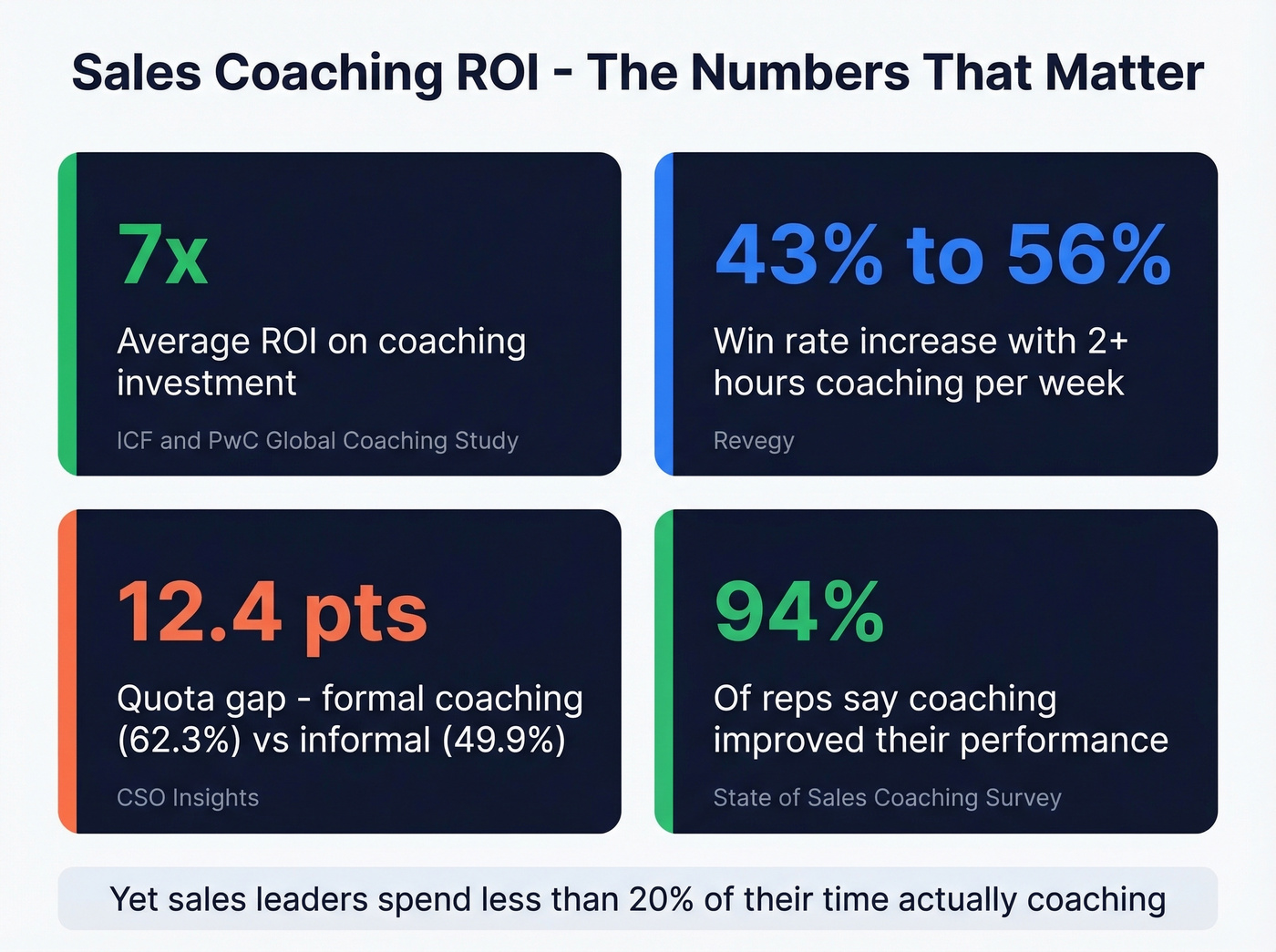
ICF and PwC's Global Coaching Client Study found an average 7x ROI on coaching investment. Revegy data shows win rates climbing from 43% to 56% when coaching time increases from under 30 minutes per rep per week to over 2 hours. CSO Insights found that teams with formal coaching programs hit 62.3% quota attainment versus 49.9% for informal approaches - a 12-point gap. The Sales Management Association adds another angle: companies providing sufficient coaching achieve 7% greater annual revenue growth.

From the rep side, the State of Sales Coaching survey by My Sales Coach and Aircall found 94% of reps said coaching improved their performance, and 96% of sales leaders said coaching influenced quota attainment. The gap isn't whether coaching works. It's whether it happens - sales leaders spend less than 20% of their time actually coaching.
7 Methods That Move the Needle
Get Your Process Out of Your Head
Before you coach anyone, document what you already know. Write down your discovery questions, your objection responses, your qualification criteria. A two-page Google Doc beats the invisible process living in your brain.
This is the single biggest win for founder-led teams. When the methodology is written down, reps can practice it, you can coach against it, and you stop being the bottleneck for every deal that needs "the founder's touch."
Use the GROW Framework
GROW stands for Goal, Reality, Options, and Will. Sir John Whitmore and Graham Alexander developed it in the 1980s, and it's still the most practical coaching framework for small teams because it requires zero special training.
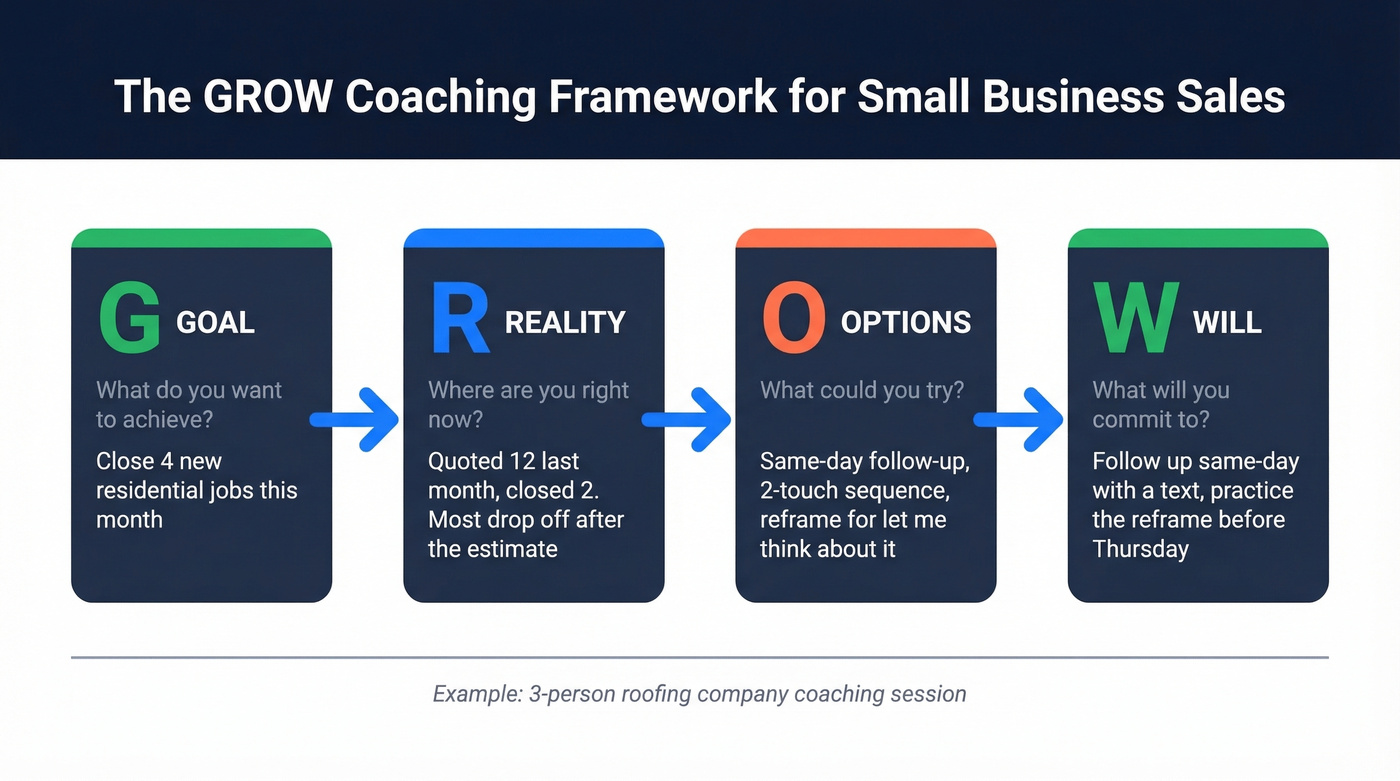
Here's how it works for a 3-person roofing company. Goal - "Close 4 new residential jobs this month." Reality - "We quoted 12 last month and closed 2. Most drop off after the estimate." Options - "We could follow up same-day, add a 2-touch sequence, and tighten how we handle 'let me think about it.'" Will - "Follow up same-day with a text, and practice the reframe before Thursday's estimates."
Simple. Specific. Repeatable.
Run Weekly 1:1s, Not Monthly Reviews
Monthly check-ins are too late. By the time you review a deal that went sideways, the rep has already repeated the mistake three more times.
Weekly 30-minute sessions using the 10/10/10 structure give you enough frequency to catch patterns and correct them in real time. The common complaint on sales forums is that 1:1s become "pipeline interrogation." Flip the ratio - 20% inspection, 80% coaching.
Review Real Calls, Not Just Numbers
Pipeline metrics tell you what happened. Call recordings tell you why. Pick one call per rep per week - ideally one they lost or one where the prospect went quiet - and review it together. Don't critique the whole call. Pick one moment: how they handled the pricing objection, whether they asked for next steps, how they opened the conversation.
If you don't have recordings yet, roleplay the scenario instead. Have the rep replay the conversation from memory while you play the prospect. It's less precise than a recording, but it still surfaces blind spots reps can't see on their own. This kind of targeted coaching - zeroing in on a single moment rather than grading the entire call - is what actually changes behavior.
Diagnose Before You Coach
Before jumping into technique, figure out what's actually holding a rep back. The diagnostic boils down to three categories: Skill (they don't know how - trainable), Will (they're not motivated - a management conversation), or Hill (the environment is blocking them - bad territory, broken tools, unreachable prospects).
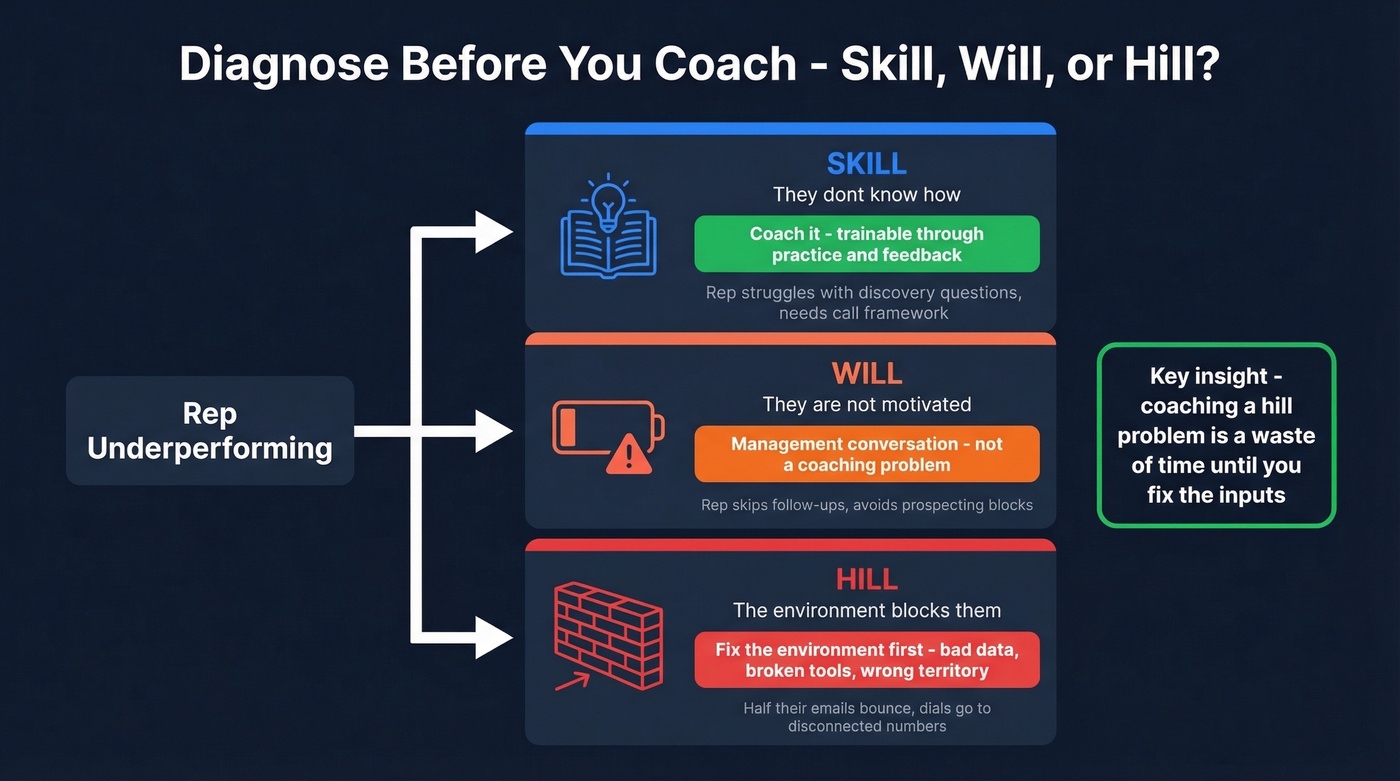
Coaching a skill problem works. Coaching a motivation problem doesn't. And coaching an environmental problem is a waste of everyone's time until you fix the environment.
Here's the thing: if your average deal size is under five figures and your reps spend more time hunting for contact info than actually selling, you don't have a coaching problem. You have a data problem. Fix the inputs before optimizing the technique.
Coach the Middle, Not the Bottom
Your bottom 10% often have fundamental fit issues that coaching won't fix. Your top 10% are already self-correcting. But your middle performers? That's where structured coaching produces the biggest gains, and CEB (now part of Gartner) found that effective salesforce coaching can drive around a 19% improvement in performance among this group.
On a small team, "the middle" might be one or two people. Coach them hard.
Make Coaching a Habit, Not an Event
The State of Sales Coaching survey found that 43% of leaders don't even realize their reps want more coaching. Meanwhile, RAIN Group's research shows sellers are 63% more likely to be top performers when they receive regular coaching from an effective manager.
Weekly is the right cadence. Every two weeks is the floor. Block it on the calendar like a client meeting - because the moment coaching becomes "when I have time," it stops happening. For remote teams, remote teams video 1:1s with screen-shared call recordings work just as well as in-person sessions.

You read it above: if reps spend more time hunting for contact info than selling, you don't have a coaching problem - you have a data problem. Prospeo gives your small team 98% verified emails and 125M+ direct dials so every coached rep actually reaches the right buyer.
Stop coaching reps past bad data. Fix the inputs at $0.01 per email.
The 10/10/10 Coaching Template
This is a copy-paste agenda for a 30-minute weekly 1:1. We've used variations of this across multiple teams, and the structure does the heavy lifting so you don't need formal coaching training.
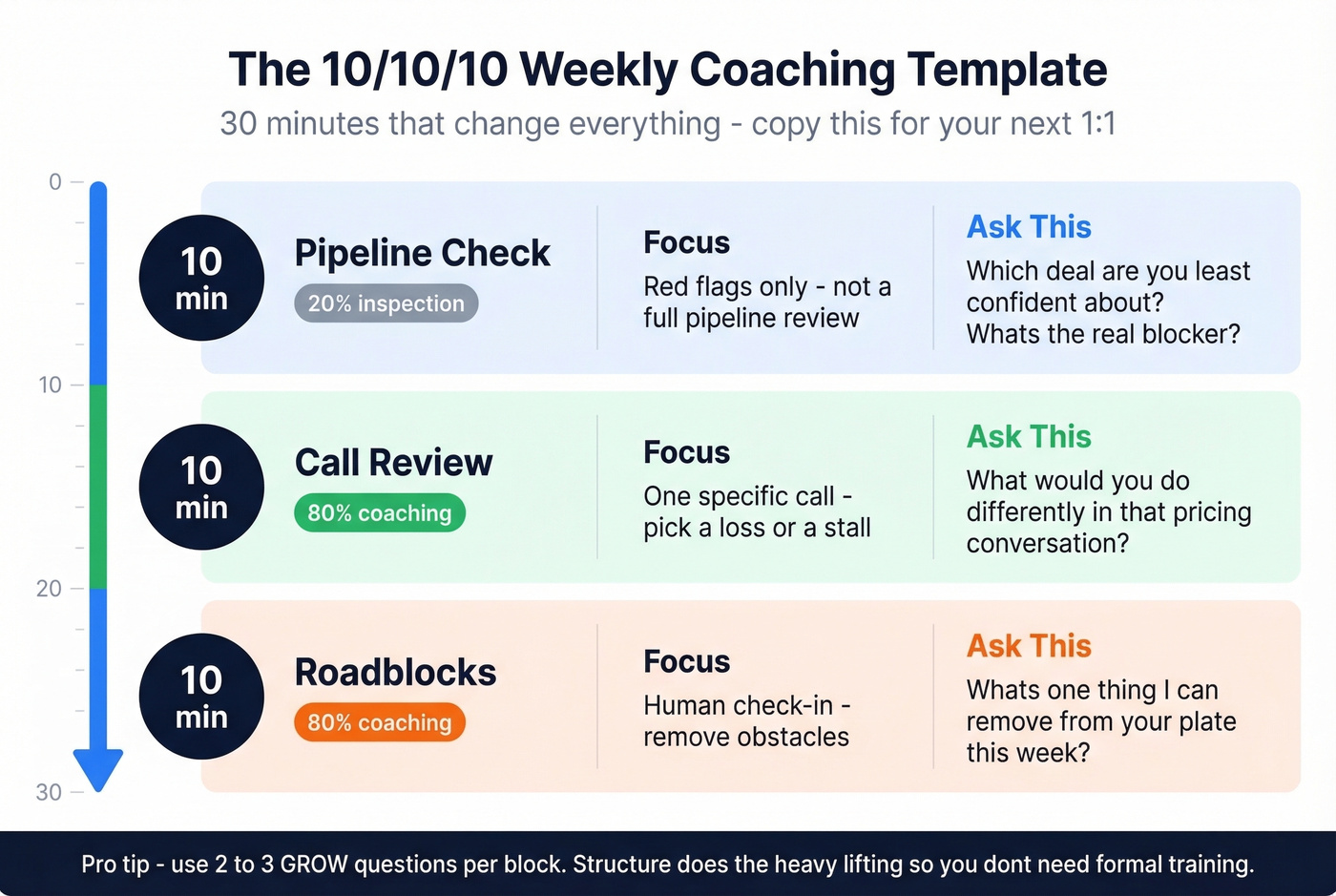
| Block | Time | Focus | Example GROW Questions |
|---|---|---|---|
| Pipeline Check | 10 min | Red flags only | "Which deal are you least confident about? What's the real blocker?" |
| Call Review | 10 min | One specific call | "What would you do differently in that pricing conversation?" |
| Roadblocks | 10 min | Human check-in | "What's one thing I can remove from your plate this week?" |
Spend 20% of the meeting inspecting pipeline numbers and activity metrics, and 80% coaching - asking questions, reviewing moments, removing obstacles. Two to three GROW questions per block keep the conversation structured without making it feel like an interrogation.
This tactical rhythm is what separates teams that improve quarter over quarter from teams that flatline.
5 Mistakes That Kill Small Teams
Mistake 1: Coaching once a month or less. Bad habits bake in fast. Weekly 30-minute 1:1s are the minimum. Every two weeks is the absolute floor.
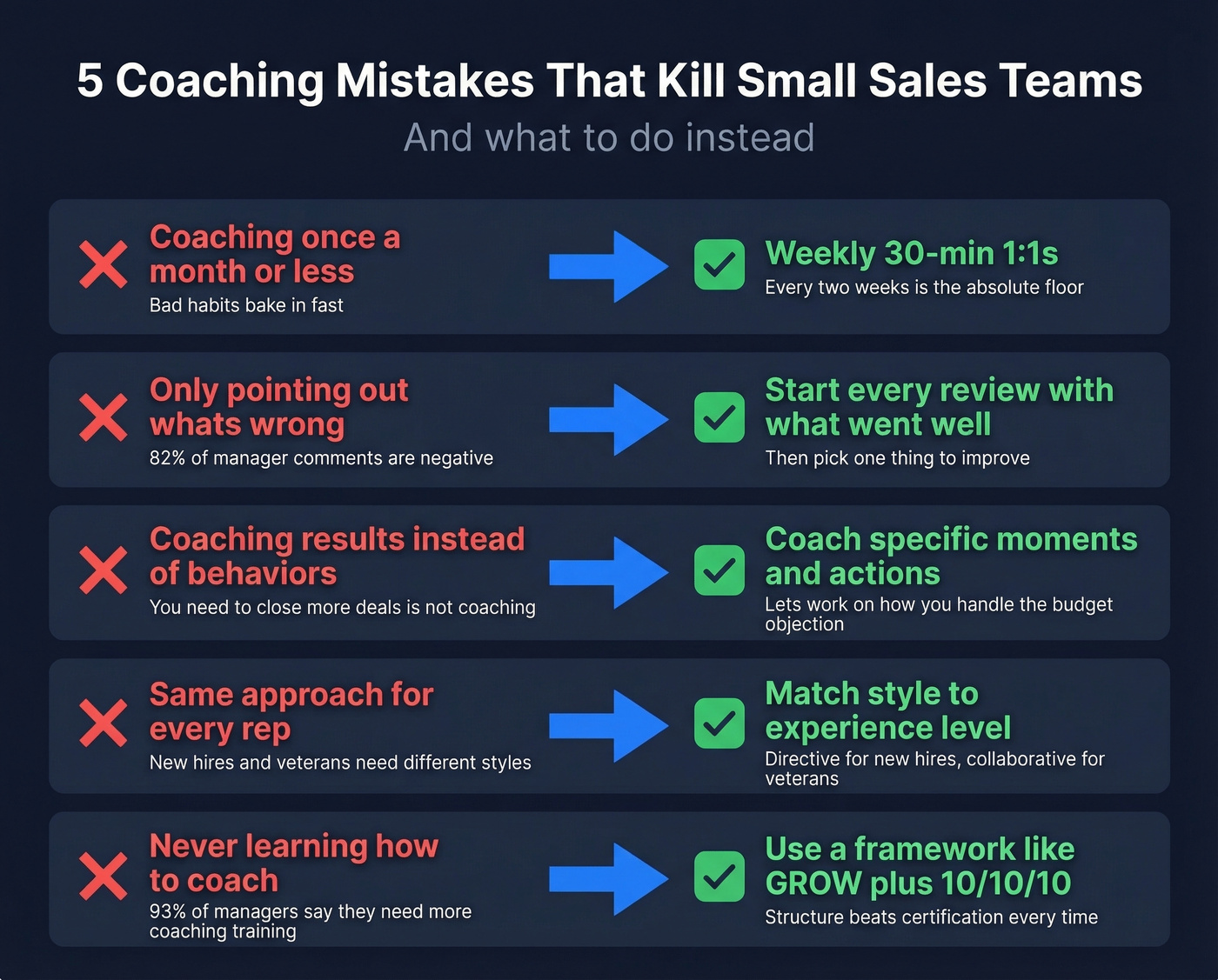
Mistake 2: Only pointing out what's wrong. In one study, 82% of sales manager comments were negative - even when managers were asked to balance feedback. Start every call review with what the rep did well.
Mistake 3: Coaching results instead of behaviors. "You need to close more deals" isn't coaching. "Let's work on how you handle the budget objection in the first call" is.
Mistake 4: Using the same approach for every rep. Your experienced rep needs collaborative refinement. Your new hire needs directive fundamentals. Match the coaching style - directive, collaborative, or non-directive - to the rep's experience level.
Mistake 5: Never learning how to coach. A Globoforce/Workhuman study found 93% of managers believe they need more training on coaching. The 10/10/10 template and GROW framework above are your starting point. You don't need a certification - you need a structure.
Affordable Tools for Small Teams
Enterprise enablement platforms often run $25K+/year, and some contracts land around $91K/year. You don't need them. Start with what's free or close to it.
| Tool | What It Does | Price | Best For |
|---|---|---|---|
| Prospeo | Verified emails + mobiles | Free tier; ~$0.01/email | Clean data before reps dial |
| Fathom | Call recording + transcripts | Free; paid from ~$20/user/mo | Call review on zero budget |
| Fireflies.ai | AI call notes + summaries | Free; from ~$10/user/mo | Automated meeting notes |
| HubSpot CRM | Pipeline + activity tracking | Free; paid from ~$15/user/mo | CRM for teams under 5 |
| Pipedrive | Visual pipeline management | $14-99/user/mo | Pipeline-first small teams |
| Gong | Conversation intelligence | ~$100-150/user/mo | Teams with AI coaching budget |
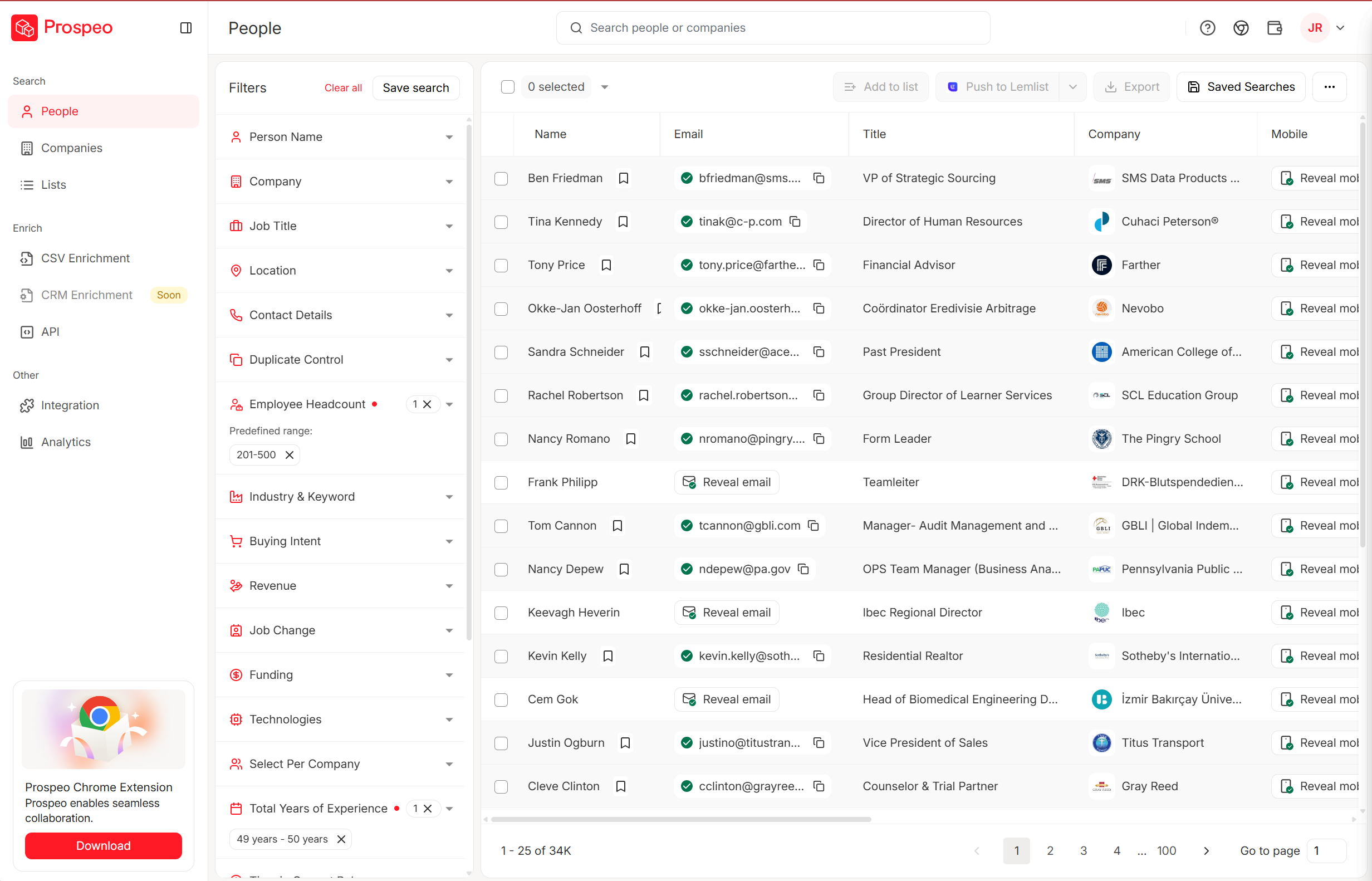
The stack that handles most small team needs: Prospeo for verified prospect data (98% email accuracy, 125M+ verified mobiles), Fathom for call recordings, and HubSpot's free CRM for pipeline visibility. Total cost to start: $0. That's a different universe from the $45K Mindtickle contract nobody on a 5-person team needs.
Skip Gong unless you've got the budget and at least 5 reps generating enough call volume to make the AI insights worthwhile. For teams under that threshold, Fathom's free tier covers what you actually need.
Coaching the middle of your team only works when they have real prospects to call. Prospeo's 7-day data refresh means your reps never dial disconnected numbers or bounce emails - so every skill you coach gets applied to live opportunities.
Give your reps data worth coaching on. 75 free emails to start.
What to Budget
Small business owners on Reddit typically budget $500-$1,500 for a one-time sales training course. External coaches charge $200-500 per hour. The real investment is your time - 2 to 4 hours per week spent coaching reps, reviewing calls, and running 1:1s.
That time investment is free in dollars but expensive in attention. Protect it. Kornferry's research on building the business case for sales coaching emphasizes treating coaching as a real operating cadence - not something that happens "when there's time" - because that's how you actually get the return.
Let's be honest: most small business founders won't hire an external coach. And they don't need to. The GROW framework, the 10/10/10 template, and clean prospect data so reps spend time selling instead of searching - that's the playbook. Consistency and structure beat expensive programs every time.
FAQ
How often should a small business coach its sales reps?
Weekly 30-minute 1:1s are the minimum effective cadence. Win rates jump from 43% to 56% when coaching exceeds 2 hours per rep per week. Every two weeks is the absolute floor - anything less and bad habits compound faster than you can correct them.
What's the best coaching framework for small teams?
GROW - Goal, Reality, Options, Will. It's been proven since the 1980s, requires no certification, and works whether you have 2 reps or 20. Pair it with the 10/10/10 template for a complete weekly structure that takes 30 minutes per rep.
How do I coach reps without formal training?
Use the 10/10/10 template: 10 minutes pipeline red flags, 10 minutes call review, 10 minutes roadblocks. Ask open-ended questions, listen more than you talk, and focus on changing one specific behavior per session rather than grading everything at once.
Can small teams coach effectively without expensive software?
Yes. Fathom (free call recording), HubSpot's free CRM, and Prospeo's free tier for verified prospect contact data cover the essentials. Add paid tools only after outgrowing the basics.
What's the ROI of sales coaching?
ICF/PwC research shows an average 7x return on coaching investment. CSO Insights found formal programs achieve 62.3% quota attainment versus 49.9% for informal approaches. Even a modest close-rate improvement means tens of thousands in additional quarterly revenue for a small team.