

Sales Coaching Tips That Actually Work in 2026
Your best rep just got promoted to manager, and they're about to discover that generic sales coaching tips won't cut it. Six weeks in, every 1:1 looks the same: "Walk me through your pipeline." Deal by deal. Row by row. The rep talks, the manager nods, occasionally jumps in to sell the deal for them.
That's not coaching - that's pipeline interrogation.
Challenger calls it the "double jump" problem: star seller leaps to manager, skips the part where they learn to develop people, and ends up doing the rep's job instead of building the rep's skills. We've watched it happen across dozens of teams, and the pattern is always the same - the manager defaults to what made them successful instead of figuring out what makes each rep tick.
Here's a framework that fixes it in 30 minutes a week.
What You Actually Need
- The 10/10/10 agenda: 10 minutes pipeline red flags, 10 minutes game tape, 10 minutes the human stuff. Template below.
- The 20/80 rule: spend 20% of your 1:1 on pipeline inspection, 80% on actual coaching. If the ratio's flipped, you're interrogating.
- One structured framework (PAUSE) to stop telling reps what to do and start coaching them to figure it out.
Why Coaching Matters More Than Ever
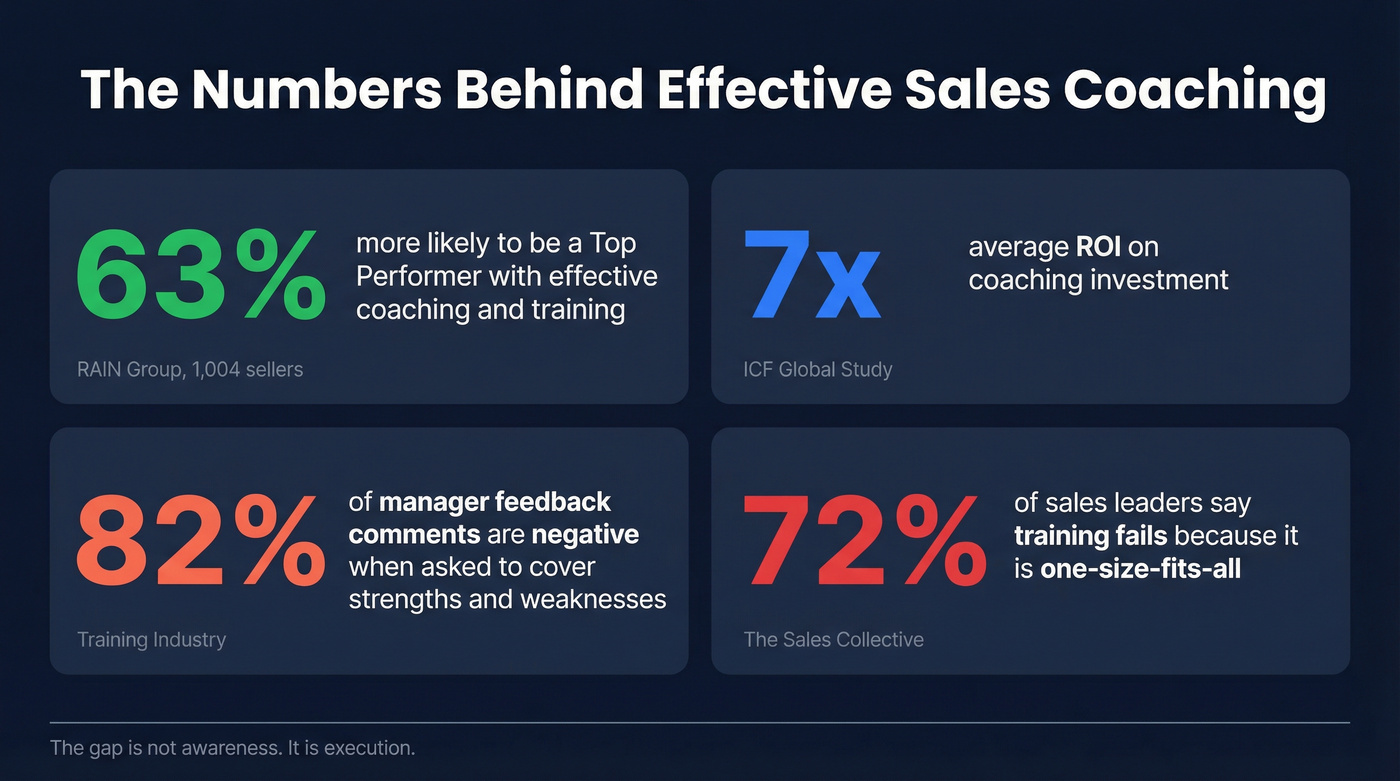
A [RAIN Group study of 1,004 sellers](https://www.rainsalestraining.com/sales-research/the-top-performing-seller) found reps are 63% more likely to be a Top Performer when they have an effective manager, regular coaching, and solid training. The ICF pegs the average ROI on coaching investment at 7x. And yet 72% of sales leaders say training fails because it's one-size-fits-all - which means most organizations know coaching matters but still deliver it badly.
The gap isn't awareness. It's execution. The best advice for your team isn't motivational platitudes - it's structural changes to how managers spend their 1:1 time.
8 Techniques That Change Behavior
1. Follow the 20/80 Rule
If your 1:1 is mostly "tell me about the Acme deal," you're running an inspection, not a coaching session. HBR research confirms what most reps already feel: managers think they're coaching when they're actually telling people what to do. Cap pipeline review at 20% of your meeting time. The pipeline will improve as a byproduct.
2. Use the 10/10/10 Agenda
This is the single most practical change you can make. Structure every 30-minute 1:1 into three blocks:
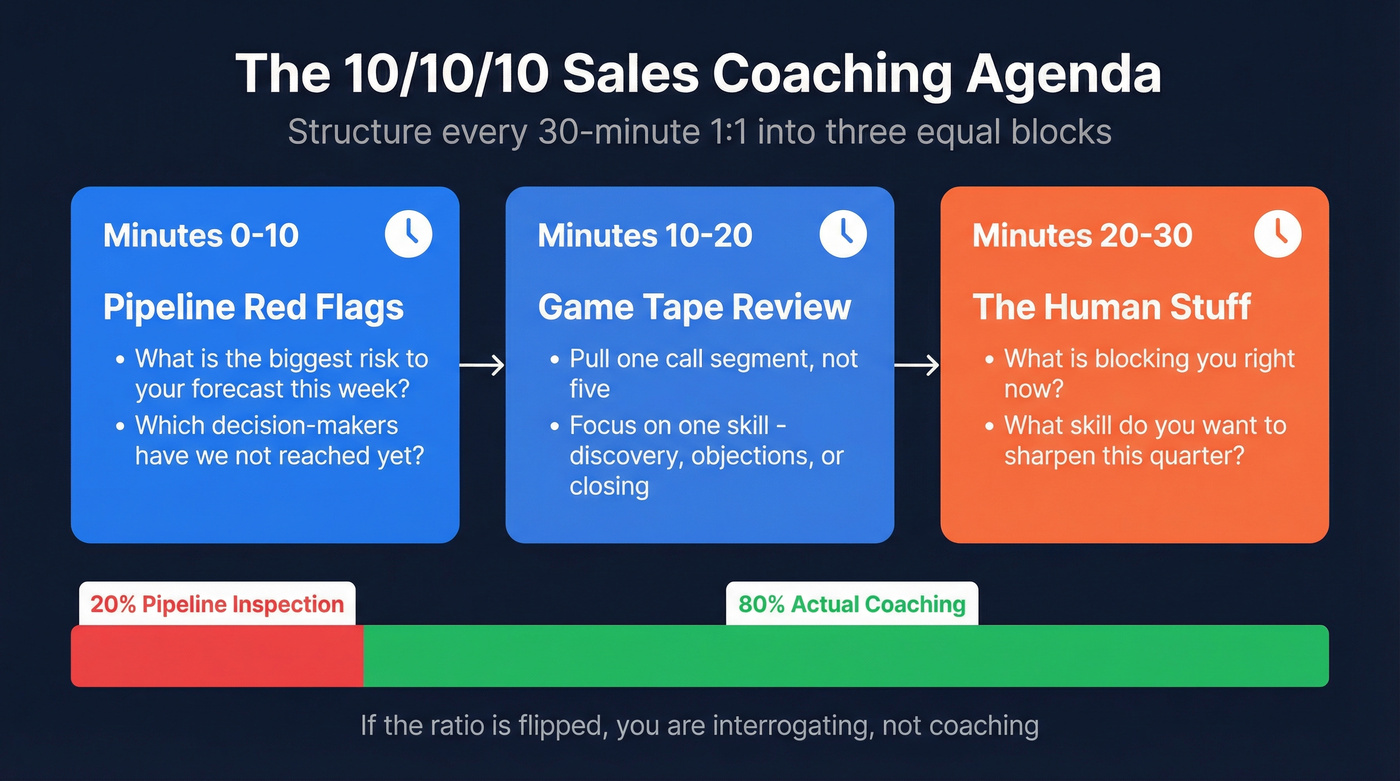
- 10 min - Pipeline red flags. Don't walk every deal. Ask: "What's the biggest risk to your forecast this week?" and "Which decision-makers haven't we reached?"
- 10 min - Game tape. Pull one call segment. Focus on one skill per session - discovery, objection handling, or closing language. Not five.
- 10 min - The human stuff. "What's blocking you?" "What support do you need from me?" "What skill do you want to sharpen this quarter?"
This structure is adapted from Nomi's 1:1 framework. It works because it forces discipline - and 42% of best-in-class companies use structured playbooks versus 14% of laggards.
3. Coach Behaviors, Not Outcomes
Here's the thing: when Training Industry ran an experiment asking managers to comment on both strengths and weaknesses, 82% of the comments were negative. Managers default to what went wrong.
Instead of "you missed quota by 15%," try "your discovery calls are running 8 minutes - let's get them to 15 and see what happens to your close rate." Coach the input, not the scoreboard.
4. Coach the Role, Not the Rep
An SDR and an AE need completely different coaching. SDRs get measured on connect rate, meeting quality, and show rate. AEs need coaching on stage conversion, win rate, and cycle length. 58% of SDRs juggle 75+ accounts per quarter - coaching someone carrying that load the same way you'd coach an AE closing six-figure enterprise deals makes no sense.
5. Let AI Coach the Deal, You Coach the Person
A 2025 neuroscience study found sellers receiving AI-generated feedback remembered 50% more information after 48 hours compared to human-coached feedback. But human coaching produced greater motivation and emotional well-being.
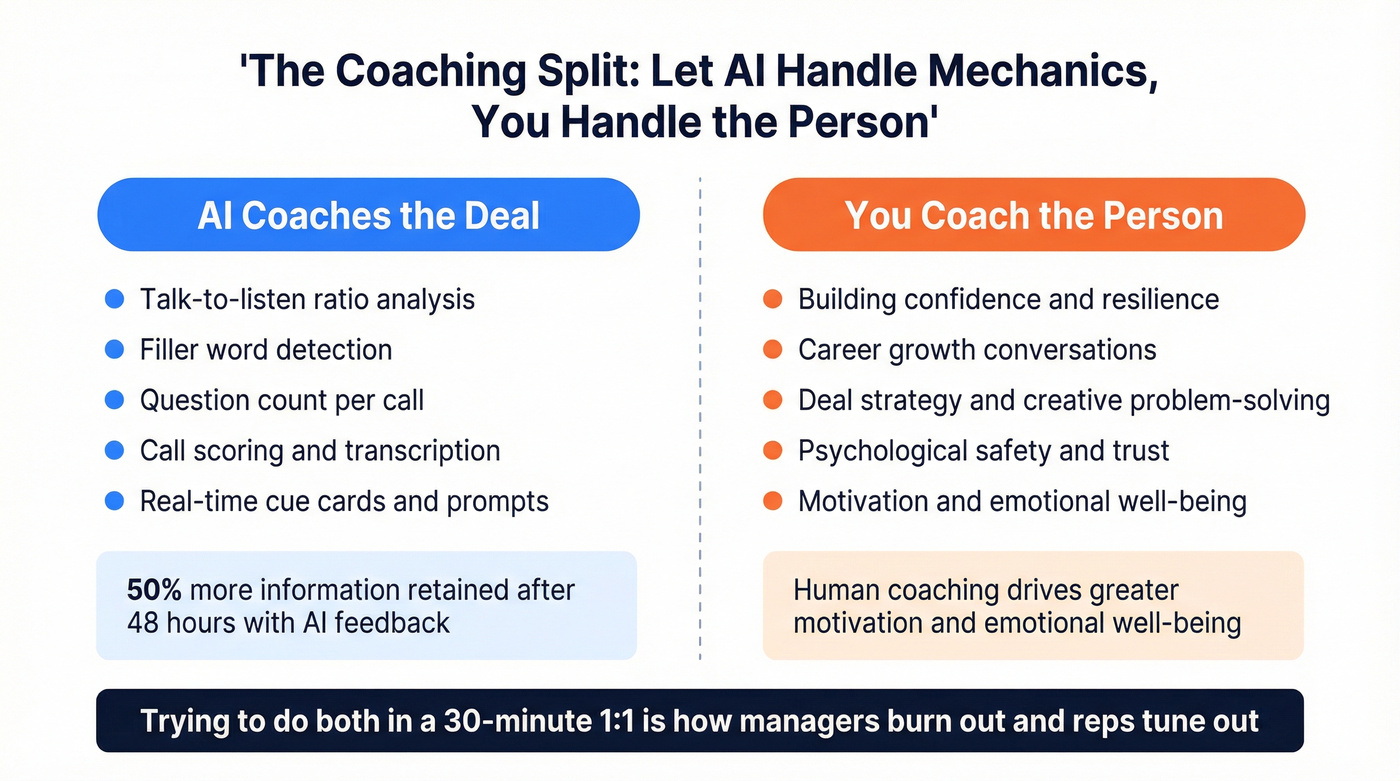
The split is clean: let AI handle call mechanics - talk-to-listen ratio, filler words, question count. You handle the person - confidence, career growth, deal strategy, psychological safety. Trying to do both in a 30-minute 1:1 is how managers burn out and reps tune out.
6. Create Psychological Safety
If reps hide bad news from you, you're coaching blind. You'll forecast deals that are already dead and miss pipeline gaps until it's too late. HBR's "Feedback Fallacy" makes the case that constant critical feedback shuts people down. Trust isn't a soft skill - it's the prerequisite for honest pipeline conversations.
7. Fix the Data Before You Coach the Dial
8. Follow Up or It Doesn't Stick
End every 1:1 with one specific behavior change and a date to review it. "Next Tuesday, I want to hear the first 90 seconds of your discovery call with Datadog - we're working on your opening question." That's the "Embed" step in the PAUSE framework below. Without it, nothing sticks. 70% of reps report increasingly complex sales processes - they need clear, narrow action items, not a list of twelve things to improve.

Tip #7 says fix the data before you coach the dial - and it's the one most managers skip. When reps dial wrong numbers and bounce emails, no amount of coaching fixes their connect rate. Prospeo gives your team 98% accurate emails and verified mobiles with a 30% pickup rate, so coaching conversations focus on skills, not bad data.
Stop coaching around data problems. Eliminate them.
The PAUSE Framework
When you need a repeatable structure for coaching conversations, Challenger's PAUSE framework is the cleanest one we've found:
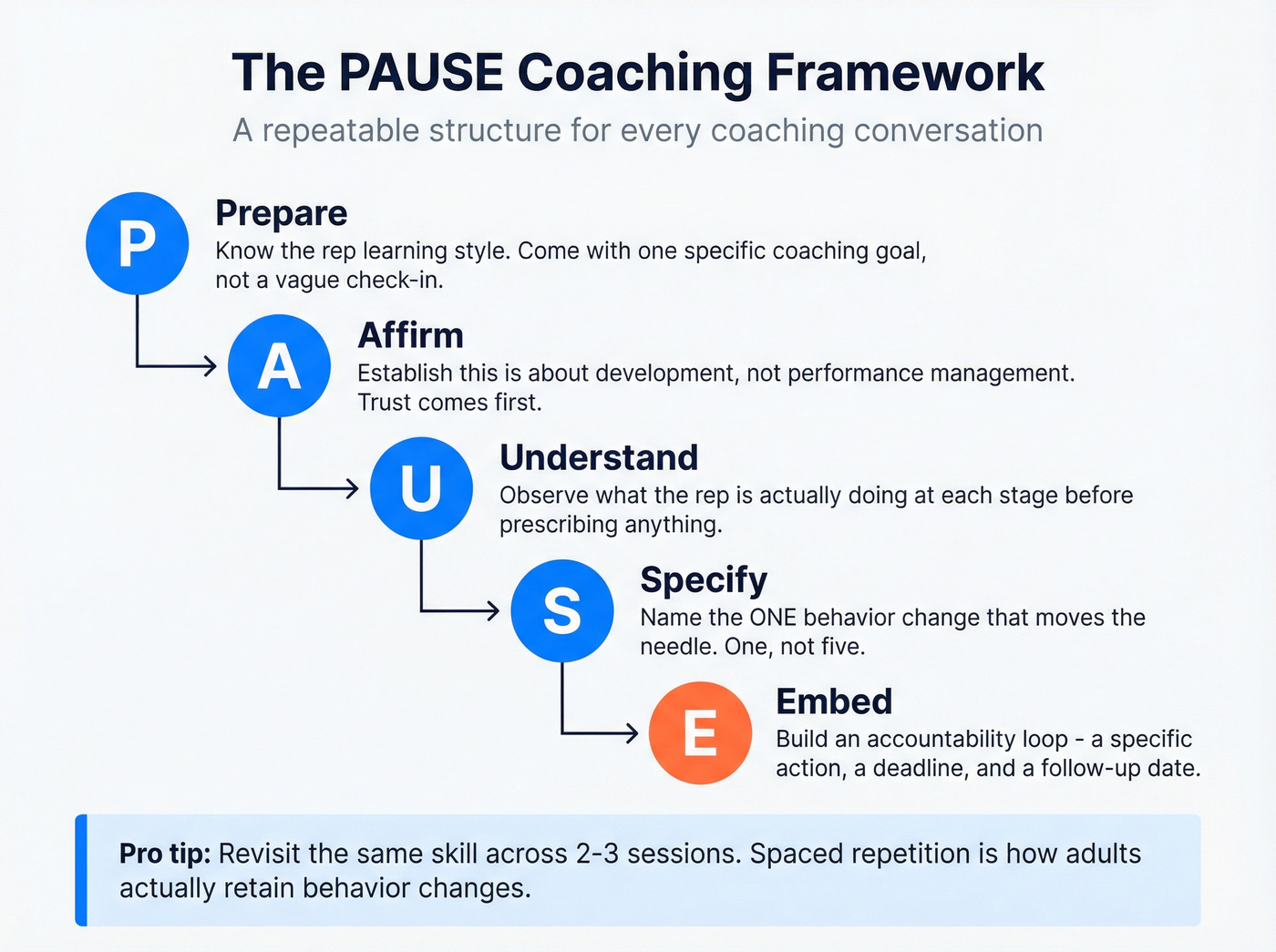
- Prepare: Know the rep's learning style and come with a specific coaching goal - not a vague "let's check in."
- Affirm: Establish that this is about development, not performance management. Trust first.
- Understand: Assess what the rep is actually doing at each stage - observe before prescribing.
- Specify: Name the one behavior change that'll move the needle. One, not five.
- Embed: Build an accountability loop - a specific action, a deadline, and a follow-up date.
One angle most coaching frameworks miss: spaced repetition. Don't coach a skill once and move on. Revisit the same skill across two or three sessions until it's automatic. That's how learning science says adults actually retain behavior changes.
Let's be honest: most managers don't need a coaching framework. They need to stop talking. The best coaching session I ever observed was 80% silence - the manager asked three questions, the rep talked through the problem, and arrived at the answer herself. PAUSE works because it forces you to shut up long enough for that to happen.
And if you manage frontline managers? Coach your coaches. Sit in on their 1:1s quarterly. The "double jump" problem doesn't fix itself - it cascades down the org chart and compounds with every new hire.
5 Mistakes That Kill Performance
Confusing coaching with training. Training teaches new skills in a group. Coaching applies those skills one-on-one, on the job. If your "coaching session" is a lecture, you're training - and probably doing it badly. (If you need the training side too, pair this with a lightweight sales training cadence.)
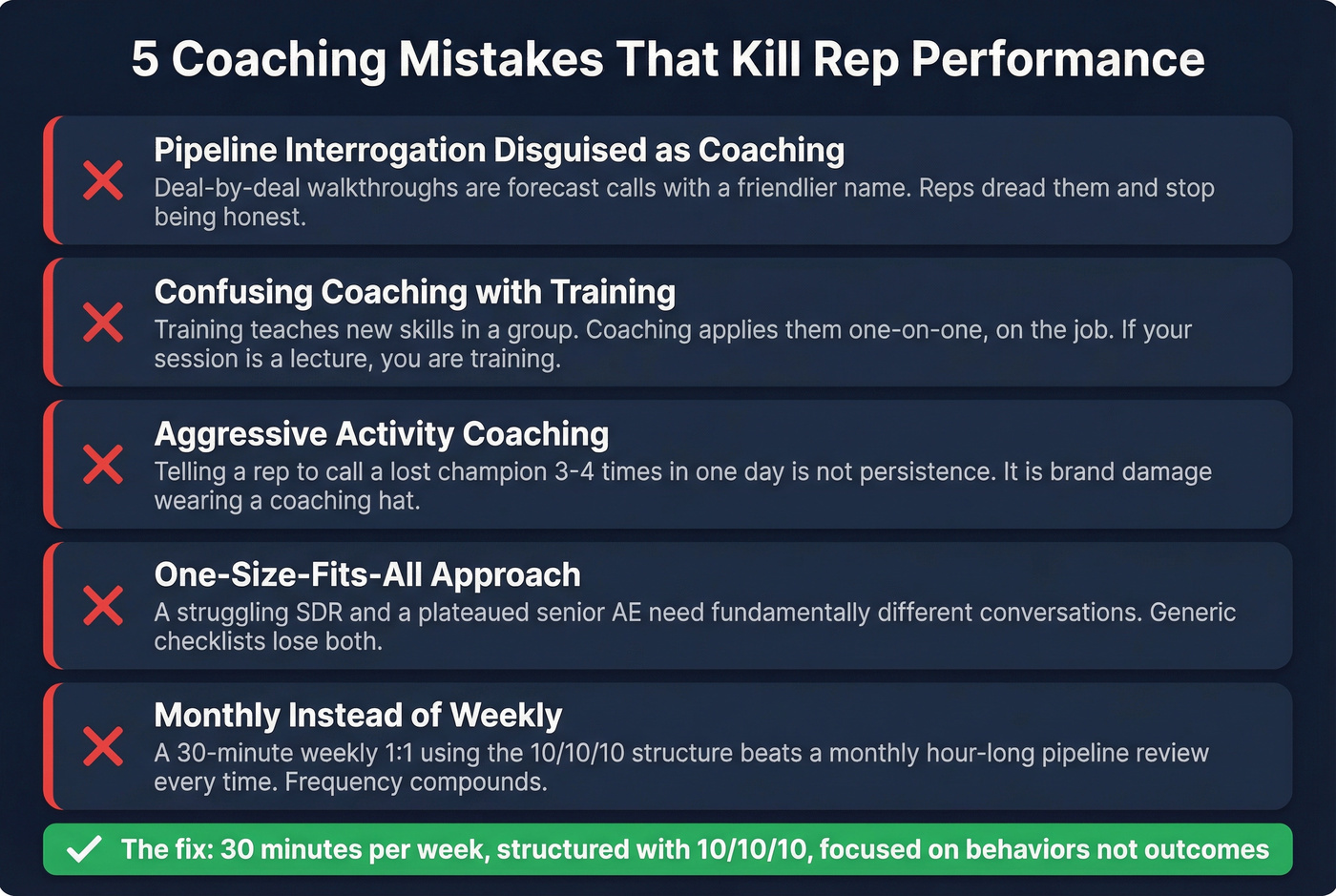
Pipeline interrogation disguised as coaching. Deal-by-deal walkthroughs aren't coaching. They're forecast calls with a friendlier name. Reps dread them, and the consensus on r/sales is that these sessions are the number one reason reps stop being honest about their pipeline.
Activity coaching that crosses into aggression. One Reddit thread tells the story perfectly: a manager instructed a rep to call a champion 3-4 times in a single day after the deal was lost. The prospect's response? "I felt like I was being chased." That's not persistence - it's brand damage wearing a coaching hat.
One-size-fits-all approach. A struggling SDR and a plateaued senior AE need fundamentally different conversations. Treat them the same and you'll lose both. Skip the generic competency checklist - Jill Konrath has long argued that coaching should match the seller's current challenge, not a standardized rubric.
Coaching monthly instead of weekly. Less than 20% of a sales leader's time goes to coaching. A 30-minute weekly 1:1 using the 10/10/10 structure beats a monthly hour-long pipeline review every time. Frequency compounds.
Tools Worth the Money
| Tool | Best For | Starting Price |
|---|---|---|
| Prospeo | Data quality foundation | Free / ~$0.01/email |
| Gong | Teams with 10+ reps | ~$5K-$50K/yr platform + ~$1,600/user/yr |
| Clari Copilot | Real-time call coaching | ~$60-$110/user/mo |
| Mindtickle | Sales readiness at scale | ~$5,918/yr |
| Saleshood | Coaching enablement | $45/user/mo |
None of these coaching platforms matter if your reps are dialing wrong numbers and emailing invalid addresses. Fix the data layer first - the free tier at Prospeo gives you 75 verified emails per month, paid plans run about a penny per email, and there's no contract. (If you're evaluating vendors, start with a quick scan of data enrichment services and what they actually improve.)
If none of these tools are in the budget, the 10/10/10 template costs nothing and gets you 80% of the way there.
Your reps are juggling 75+ accounts per quarter. They can't afford to waste discovery calls on contacts who never pick up. Prospeo's 125M+ verified mobile numbers and 7-day data refresh mean every dial your team makes is worth coaching on - because they're actually reaching decision-makers.
Give your reps contacts worth coaching on - starting at $0.01 per email.
Weekly Rituals to Reinforce Coaching
You don't need to overhaul your entire coaching program at once. Start with three rituals that take less than 20 minutes total:
Monday morning game tape. Share one call clip in Slack before your first 1:1. It primes reps to think about skill development, not just pipeline, and it normalizes the idea that everyone's work gets reviewed - including yours.
One theme per week. Pick a single coaching focus - discovery questions, objection handling, multi-threading - and make every 1:1 revolve around it. When the whole team sharpens the same skill simultaneously, reps start coaching each other in the hallway, which is where the real magic happens.
Friday voice note. End the week with a two-minute voice message to each rep recapping their win and the one behavior to carry into next week. It takes five minutes for a team of three. It takes fifteen for a team of eight. Either way, it's the highest-ROI fifteen minutes you'll spend all week. (If you want a written version, keep a few sales follow-up templates handy.)
Treating coaching as a weekly rhythm rather than a quarterly event is what separates teams that hit quota from teams that hope for it. The best sales coaching tips aren't complicated - they're consistent.
FAQ
What's the difference between sales coaching and sales training?
Training teaches new skills in a group setting; coaching applies those skills one-on-one with feedback tied to real deals and real calls. Most managers default to training mode - lecturing instead of asking questions - which is why reps tune out.
How often should you coach sales reps?
Weekly, minimum. A 30-minute 1:1 using the 10/10/10 structure beats a monthly hour-long pipeline review every time. Consistency compounds - skills don't develop in monthly check-ins.
What are the best sales coaching tips for new managers?
Start with the 20/80 rule: cap pipeline review at 20% of your 1:1 time and spend 80% on skill development. Use the PAUSE framework to structure conversations and coach one behavior per session, not five.
How do I fix low connect rates before coaching technique?
Verify your contact data first - bad numbers and bounced emails waste coaching time. Once reps are actually reaching real prospects, you can coach technique instead of troubleshooting list quality.
How can a weekly coaching theme keep my team sharp?
Pick one micro-skill each Monday - a better opening question, a reframe for stalled deals, a new objection response - and make it the focus across all 1:1s that week. A single focused theme gives reps something concrete to practice rather than a vague directive to "do better."