

Sales Culture Is an Operating System, Not a Vibe - Here's How to Build One That Works
A new CRO walks in. She's charismatic, data-driven, and has a cult following from her last company. Within six weeks, the comp plan changes, the coaching cadence disappears, and "win at all costs" replaces everything your team built over two years. Ten months later, almost everyone you used to work with is gone.
The average head of sales lasts roughly 18 months - barely enough time to build a sales culture, let alone sustain it. And when culture is just one person's personality, their departure collapses everything. Real culture isn't the energy on the floor or the motivational Slack messages from leadership. It's the documented processes, coaching rhythms, and incentive structures that survive a leadership change.
Here's the test: if you can't point to documented processes, coaching cadences, and comp structures that shape behavior independent of any single leader, you don't have culture. You have a collection of individual habits. Take Action Selling's free 10-minute assessment to surface whether your team shares a common language, then use the diagnostic checklist and change framework below to start fixing what's broken.
What Sales Culture Actually Means
The best definition we've encountered comes from CMM Online: it's "routineization." The daily habits - CRM updates, follow-up behaviors, coaching ride-alongs, consistent execution - that become non-negotiable norms rather than suggestions. When those routines are shared and enforced, you have culture. When they're optional, you have chaos wearing a name badge.
The Sales Collective uses a striking benchmark: only 14% of companies have a documented sales process. If you're in the other 86%, you're confusing chaos with culture. A real sales team culture means everyone who touches customers operates from a common language, from the SDR making first contact to the AE running discovery to the CSM handling renewal.
The Business Case
Culture isn't soft. It's measurable.
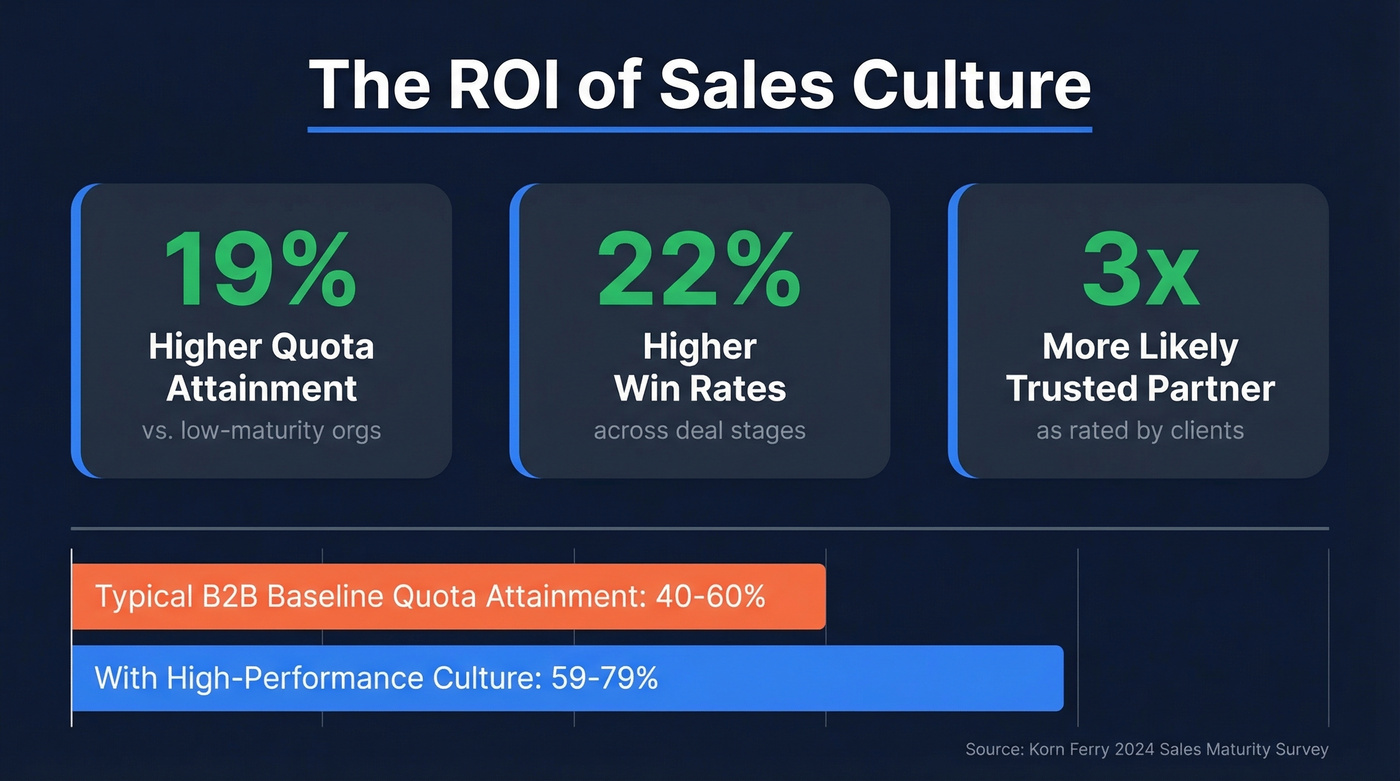
Korn Ferry's 2024 Sales Maturity Survey found that orgs with high-performance cultures see 19% higher quota attainment, 22% higher win rates, and are 3x more likely to be considered a trusted partner by clients. HubSpot's 2025 Sales Trends Report reinforces this from the rep side: trust in leadership and career development opportunities rank among the top motivators for strong team environments.
Baseline quota attainment across B2B sales typically runs 40-60%. A 19% lift on a 50% baseline is the difference between a growing org and one bleeding reps at 25-35% annual turnover because nobody believes the number is achievable. For B2B sales leaders trying to justify investment in culture initiatives, those numbers make the ROI case without any hand-waving.
Red Flags: Toxic Sales Culture
Before you can build, you need to know what broken looks like. The consensus on r/sales is remarkably consistent:
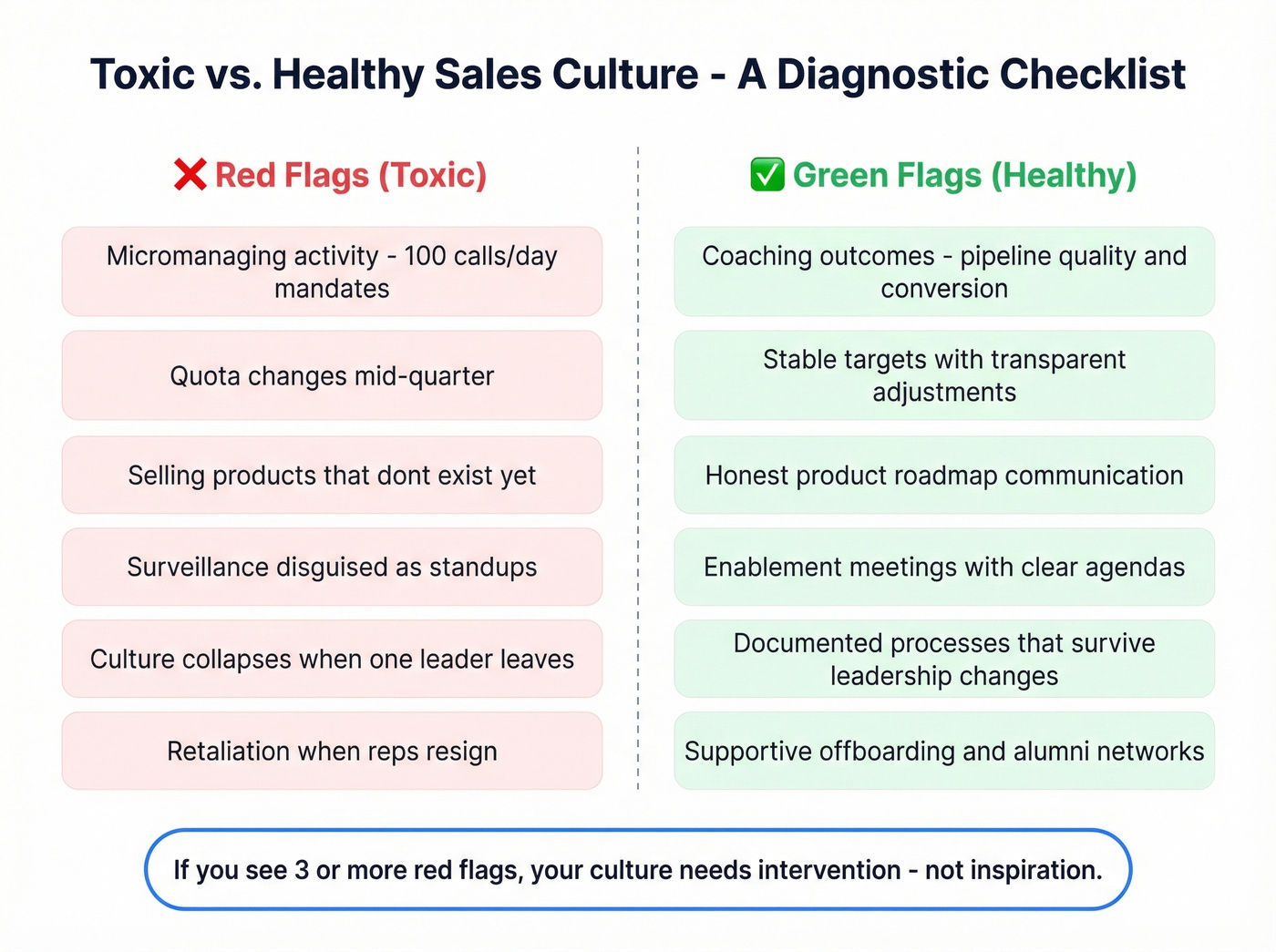
- Micromanagement of activity over outcomes. Leadership obsesses over 100 calls/day instead of pipeline quality or conversion rates.
- Constantly shifting goals. Quota changes mid-quarter. Territory realignments every few months. Reps can't build momentum because the ground keeps moving.
- Selling vaporware. You're told to sell products that don't exist yet, and leadership can't deliver what was promised.
- After-hours surveillance disguised as standups. The 8:45 AM meeting that's really about control, not enablement.
- Cult-of-leader dynamics. A CRO whose departure would collapse the entire environment - because the environment is that person.
- Retaliatory behavior on resignation - leadership questioning your colleagues separately, sandbagging your deals on the way out.
- Harassment, discrimination, or coercion disguised as "hustle." These aren't red flags. They're exit signs.
One Reddit poster put it perfectly: "HR's job is not to protect you - it's to protect the company from you." If that resonates, you already know the answer.
If you're already inside a toxic environment: document everything in writing, build relationships with leadership outside your direct chain, and don't be invisible to HR. Wait for a pattern of incidents before escalating - but don't wait so long that you normalize what shouldn't be normal.
Assess Before You Join
Due diligence isn't optional. Here's the framework we recommend:
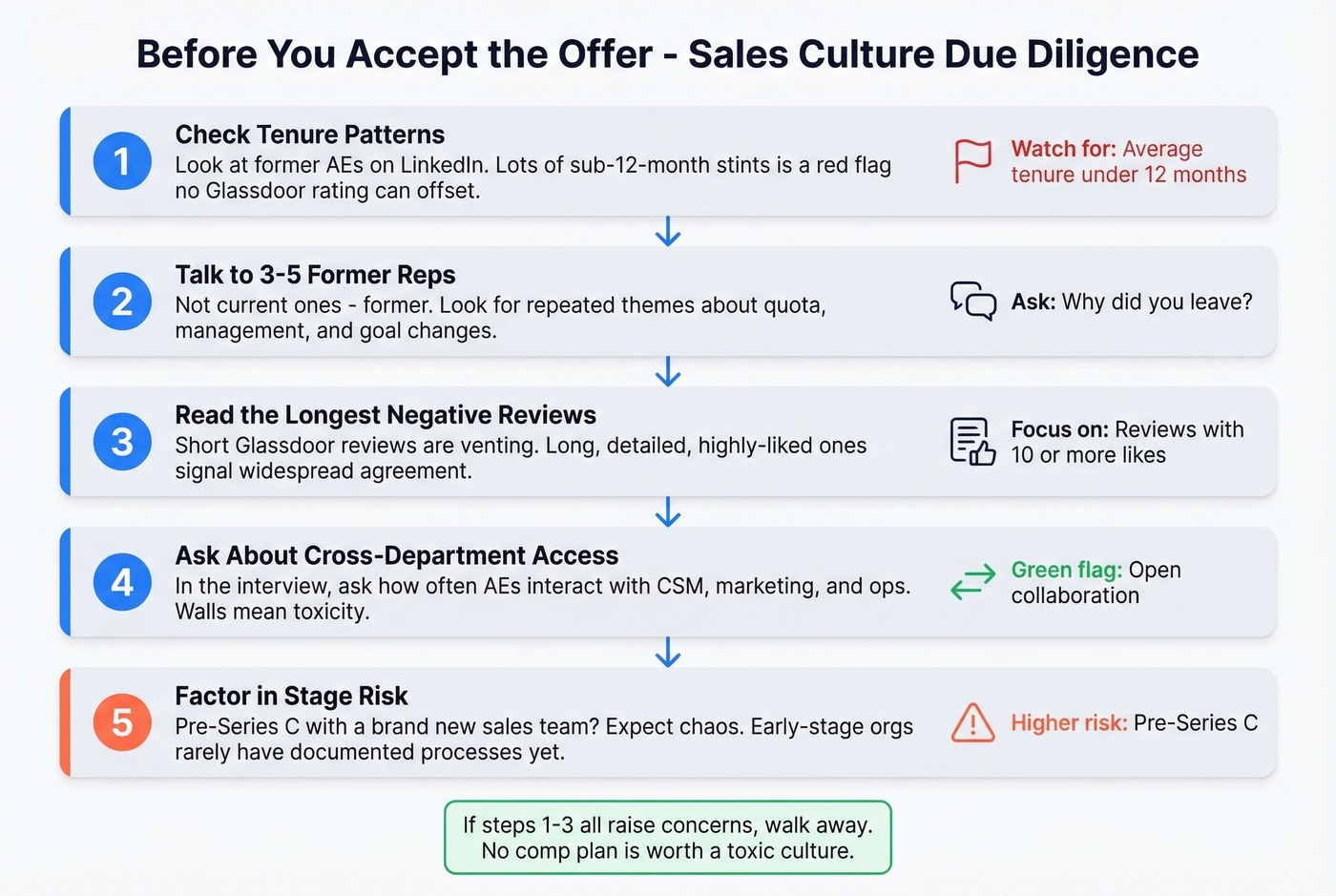
- Check tenure patterns. Look at former AEs on professional profiles. Lots of sub-12-month stints is a red flag that no Glassdoor rating can offset.
- Talk to 3-5 former reps. Not current ones - former. Look for repeated themes: "nobody hit quota," "manager was absent," "goals changed constantly."
- Read the longest negative Glassdoor reviews. Short ones are venting. Long ones are detailed, and high-liked negative reviews signal widespread agreement.
- Ask this in the interview: "How often do AEs interact with other departments?" Toxic managers put up walls. Healthy orgs build bridges with CSM, marketing, legal, and ops.
- Factor in stage risk. Below Series C with a brand-new sales team? That's the ultimate startup toss-up - early-stage orgs rarely have the documented processes to sustain culture through rapid hiring.

A strong sales culture means reps spend time selling, not questioning their data. Prospeo's 98% email accuracy and 7-day refresh cycle eliminate bounced emails and wasted dials - so your team builds trust in the process, not frustration. When reps consistently connect with real buyers, quota attainment follows.
Stop letting bad data erode the culture you're building.
Measure Your Current Culture
Two tools worth knowing.
Action Selling's free assessment focuses on whether your team shares a common sales language and common processes. It's a quick diagnostic, not a deep audit, but it surfaces the right questions fast.
For something more structured, MarshBerry's Sales Culture Assessment benchmarks your org against their proprietary database across four dimensions: sales manager leadership, performance management, people development, and technology. It's included for Connect Members; non-members can request pricing. The framework is geared toward insurance but translates well to any B2B sales org.
Beyond formal assessments, track these proxy metrics quarterly: eNPS, rep turnover rate, quota attainment percentage, average ramp time, and coaching session frequency. If any of those are trending the wrong direction, your culture is eroding - regardless of what the Slack channel energy feels like.
How to Build a Sales Culture That Lasts
Culture change in a sales org operates on a quarterly clock. Here's John Kotter's change framework adapted for how sales teams actually work:
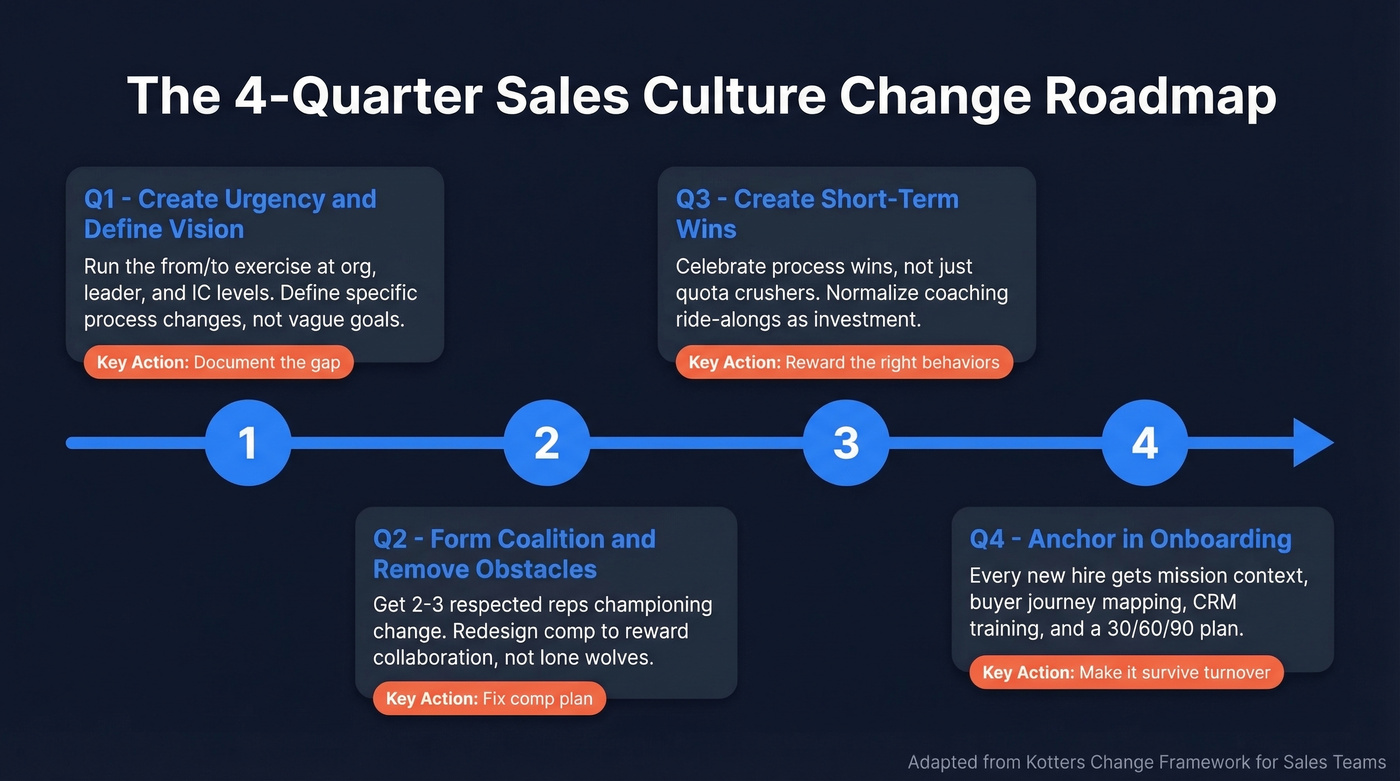
Quarter 1 - Create urgency and define the vision. Run the "from/to" exercise at org, leader, and IC levels. Be specific: "From: reps freelancing their own process. To: every rep follows the same discovery framework with documented next steps." Anchor this vision in core values your team actually believes, not platitudes from a corporate offsite.
Quarter 2 - Form a coalition and remove obstacles. Get 2-3 respected reps (not just managers) championing the change. If your comp plan rewards lone-wolf behavior, no amount of "collaboration" messaging will fix it. Add team components to comp and design accelerators that drive the behaviors you want. Sales manager effectiveness during this phase is the single biggest predictor of whether the change sticks.
Quarter 3 - Create short-term wins and anchor them. Celebrate the rep who followed the new process and closed a deal, not just the rep who crushed quota through sheer force of will. Make coaching ride-alongs normal - observation isn't punishment, it's investment.
Quarter 4 - Anchor in culture through onboarding. Every new hire should experience:
- Mission/values context and ICP clarity
- Buyer journey mapping and documented process training
- CRM/tech stack onboarding
- A 30/60/90-day success plan covering more than just revenue targets
Let's be honest: perks are not culture. Free lunch doesn't fix a manager who pings you at 9 PM. Comp design, coaching cadences, and documented processes are culture. Everything else is decoration.
Remote & Hybrid Teams Need Intentional Norms
The work model you choose is a culture signal - especially when it's vague. "Hybrid" with no specifics loses candidates and erodes trust.
| Role | Work Model (2026) | OTE Range |
|---|---|---|
| SDR/BDR | Remote (standard) | $83K-$90K |
| AE | Hybrid (dominant) | $300K+ (major metros) |
| VP Sales | Onsite 3+ days | $500K-$650K |
The biggest gap in remote teams is the loss of informal learning. New reps don't overhear how a senior AE handles an objection. They don't absorb process through osmosis. Your coaching and documentation have to be twice as intentional because the hallway conversations aren't happening. In our experience, managers who build trust through regular one-on-ones and transparent communication close this gap faster than any collaboration tool.
AI's Role in Sales Culture
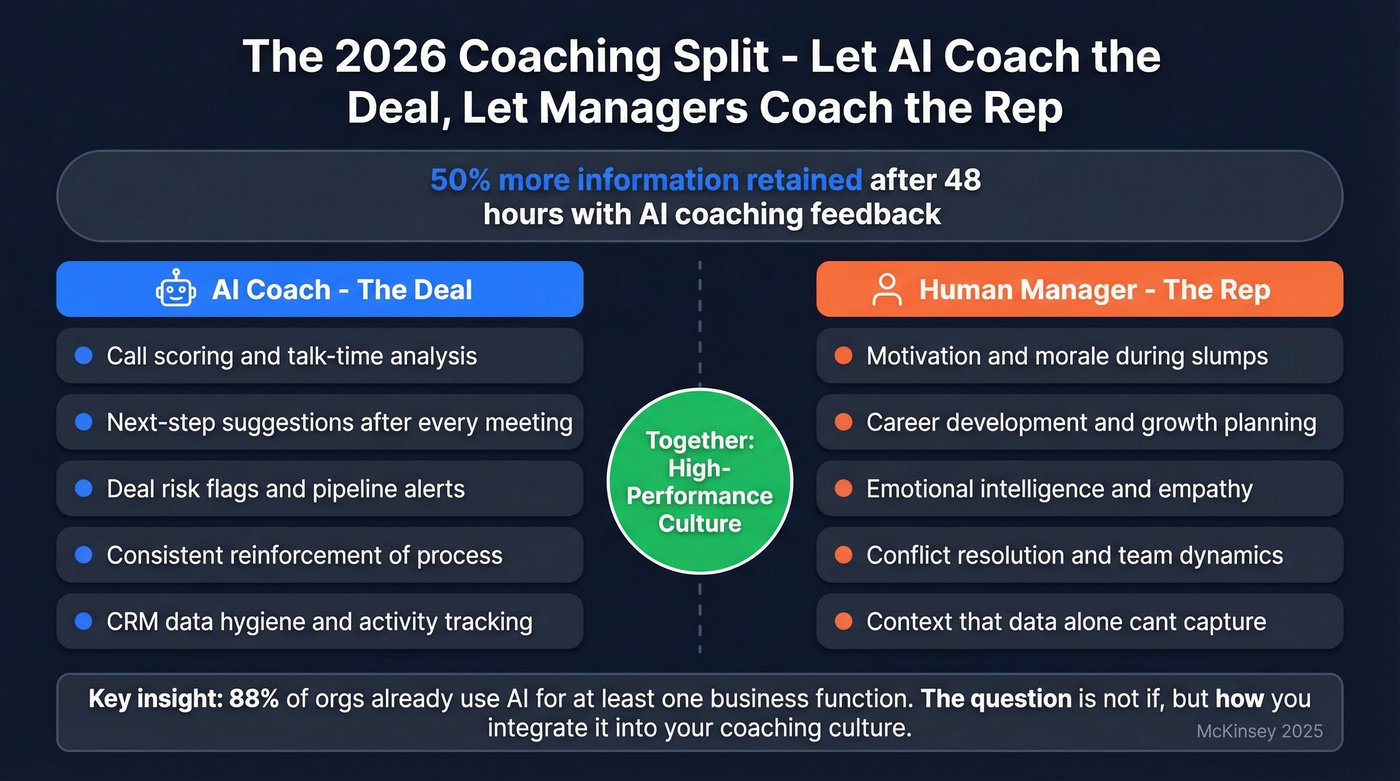
88% of respondents in McKinsey's late-2025 survey use AI for at least one business function. Sales isn't exempt. A 2025 neuroscience study found that sellers receiving AI-coach feedback remembered 50% more information after 48 hours than those receiving only human feedback. That's not a marginal edge - it's the difference between a rep who retains coaching and one who forgets it by Thursday.
Split it this way: let your AI coach the deal, let your manager coach the rep. AI handles consistent reinforcement - call scoring, next-step suggestions, deal risk flags. Managers handle motivation, career development, and the emotional intelligence that AI can't replicate. A high-performing team in 2026 treats AI as infrastructure, not a threat. If you're building this into your stack, start with generative AI sales tools that support coaching and execution.
Data Quality as a Culture Lever
Your SDR team's bounce rate just hit 35%. The manager's instinct? "They're not working hard enough. More calls. More emails." But the real problem isn't effort - it's infrastructure. Reps are dialing disconnected numbers and emailing addresses that bounce. They lose trust in the tools, then the process, then the org.
Here's the thing: most problems that get blamed on "lazy reps" or "bad managers" are actually data infrastructure failures. In three of the last five teams we've consulted with, the "lazy reps" problem turned out to be a garbage data problem. Snyk's 50-person AE team saw bounce rates drop from 35-40% to under 5% after switching to Prospeo, with AE-sourced pipeline up 180%. When reps trust the data, they trust the process. That's building culture from the ground up.

You can't build a high-performance sales culture on unreliable contact data. Teams using Prospeo book 26% more meetings than ZoomInfo users and 35% more than Apollo - because 300M+ verified profiles, 125M+ mobile numbers, and 30+ intent filters mean reps reach real decision-makers on the first try.
Give your reps data worth building a culture around.
FAQ
What's the difference between sales culture and sales strategy?
Strategy is what you sell and to whom. Culture is how your team behaves while executing that strategy - the coaching cadences, accountability norms, and comp structures that shape daily decisions. You can have a brilliant strategy and a toxic culture, and the culture will win every time.
How long does it take to change a sales culture?
Expect 1-2 quarters for visible behavioral shifts using the Kotter framework with deliberate short-term wins. Full transformation takes 3-4 quarters. Leadership consistency is the bottleneck - not time. One quarter of backsliding resets the clock.
What causes a toxic sales culture?
Three things, almost always: misaligned comp plans that reward the wrong behaviors, absent or inconsistent coaching, and bad data infrastructure that burns reps out before they get a chance to sell. Fix those three and you've addressed 80% of culture problems.
How do you maintain team culture during rapid growth?
Document everything before you scale. The processes, coaching frameworks, and onboarding playbooks that work for a 10-person team need to be codified so they survive doubling headcount. Culture breaks down when new hires outnumber tenured reps and there's no written system to absorb them. Assign culture carriers - senior reps who model the norms - to every new cohort.
What tools help fix data-driven culture problems?
Start with data quality: tools like Prospeo (75 free credits/month, 98% email accuracy) eliminate the bad-data frustration that erodes rep trust. Pair that with a CRM hygiene cadence and call-scoring AI to close the loop between data quality, coaching, and performance accountability.