

Sales Cycle Forecasting: Formulas, Benchmarks, and Pitfalls Nobody Else Covers
Four in five sales and finance leaders missed a quarterly forecast in the past year. Over half missed two or more. Only 43% of sales leaders forecast within 10% accuracy, and 10% regularly miss by more than 25%.
That means most teams are flying blind on revenue calls - and the root cause isn't bad formulas. It's bad inputs. Stale pipeline data, zombie deals sitting at 300 days, one blended average pretending a $5K SMB deal behaves like a $200K enterprise contract. Let's fix that.
The Quick Version
- The formula: Total Qualified Pipeline / Average Cycle Length = Monthly Forecast
- The #1 mistake: Using a single average cycle length across all deal sizes
- The fix: Segment by ACV, use median instead of mean, and verify your pipeline contacts are actually reachable
The Core Forecasting Formula
Two formulas matter. The first is straightforward cycle-length forecasting:
Monthly Forecast = Total Qualified Pipeline / Average Cycle Length (months)
If your qualified pipeline is $800K and your average cycle runs 4 months, you're looking at $200K/month in expected revenue. Simple, useful, and wrong the moment you stop segmenting.
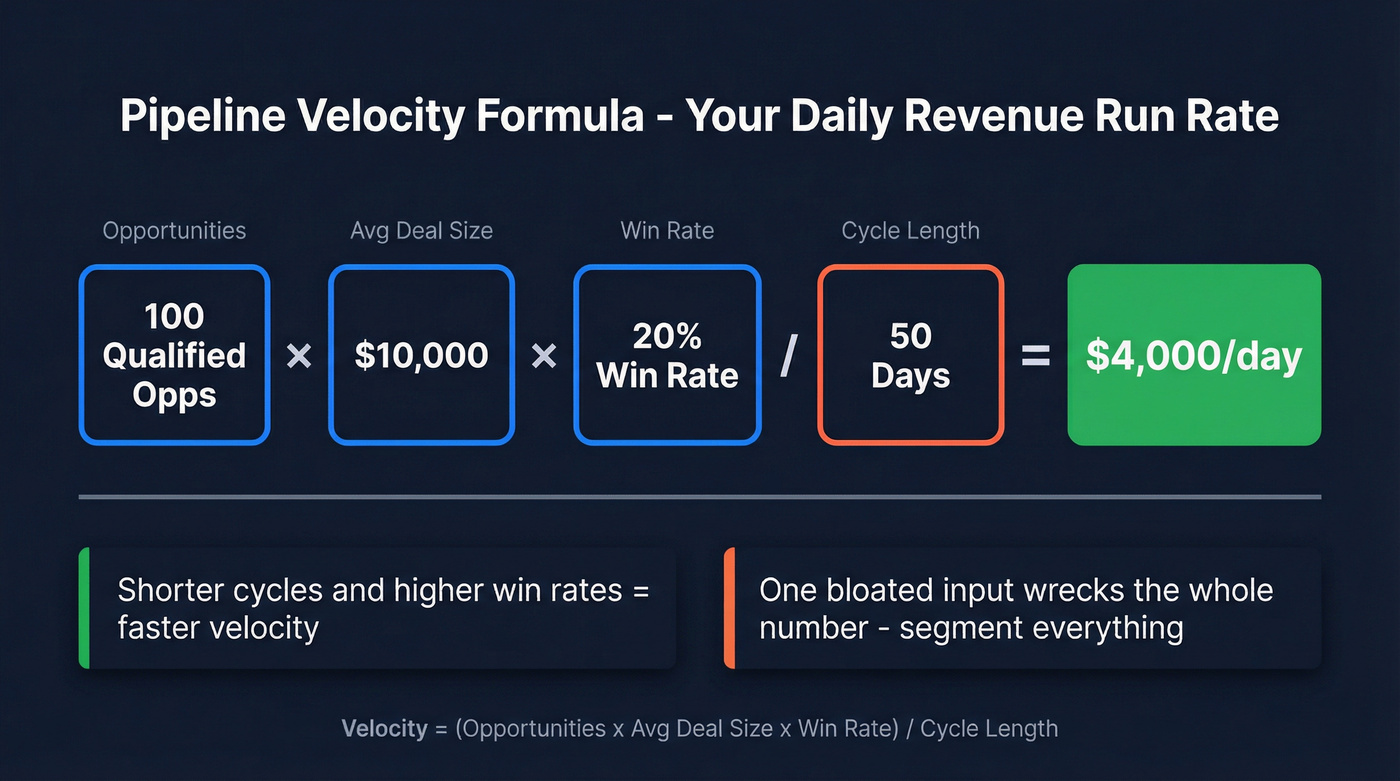
The second is pipeline velocity - a daily revenue run rate:
Velocity = (Opportunities x Avg Deal Size x Win Rate) / Cycle Length
Worked example: 100 qualified opps x $10,000 x 20% win rate / 50 days = $4,000/day. This is the formula that actually tells you whether your pipeline is accelerating or stalling, and it's the one we come back to most often in our own pipeline reviews.
The key word in both formulas is "qualified." If your opportunity count includes contacts who've never responded to an email, your forecast is fiction.
2026 Cycle Length Benchmarks
Sales cycles have lengthened 22% since 2022, per a study of 939 B2B SaaS companies. The median B2B SaaS cycle now sits at 84 days, buying committees average 6.3 stakeholders, and 58% of B2B professionals say cycles got longer over the past year.
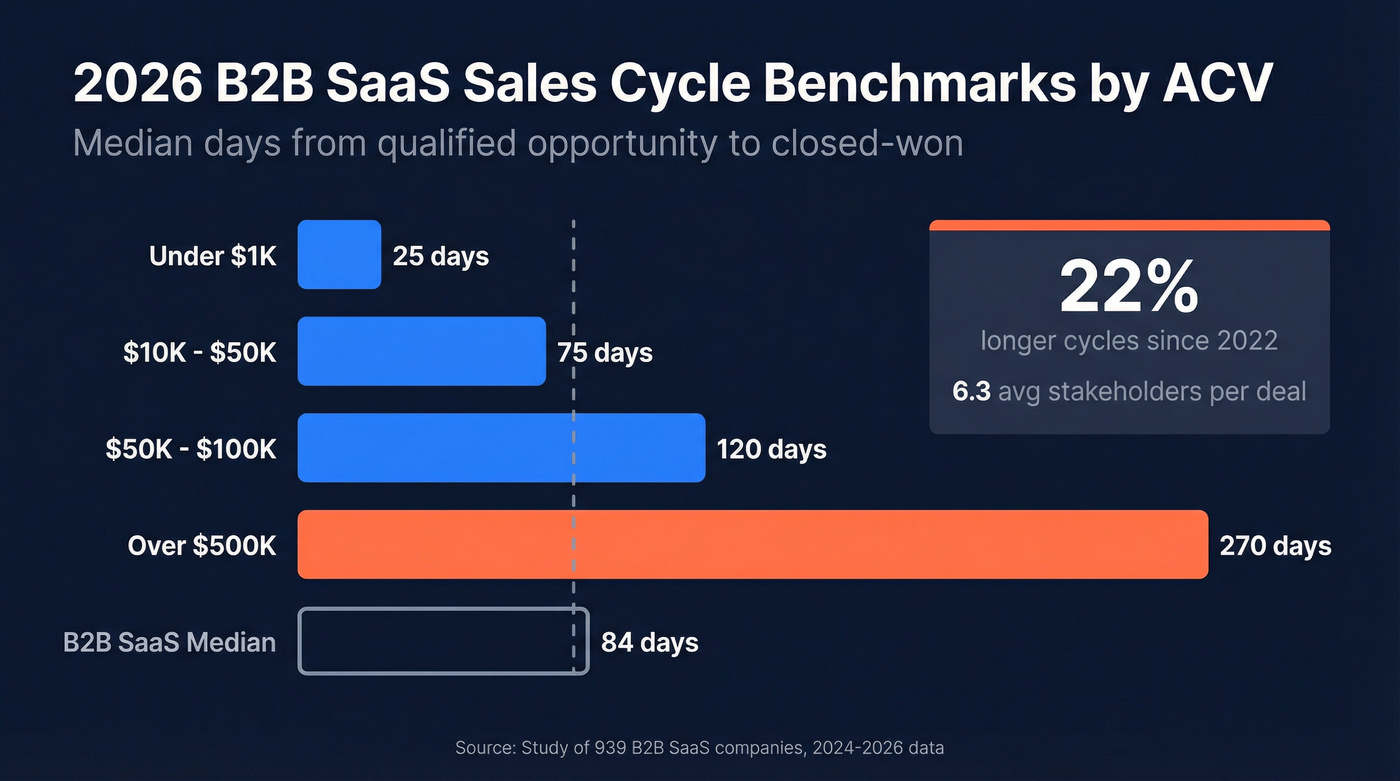
By industry:
| Industry | Cycle (days) |
|---|---|
| Retail | 70 |
| Software | 90 |
| Financial Services | 98 |
| Manufacturing | 130 |
| Pharmaceuticals | 153 |
By ACV:
| ACV Range | Cycle (days) |
|---|---|
| < $1K | 25 |
| $10K-$50K | 75 |
| $50K-$100K | 120 |
| > $500K | 270 |
By company size:
| Company Size | Cycle (days) |
|---|---|
| 1-10 employees | 38 |
| 201-500 | 95 |
| 10,001+ | 185 |
These are benchmarks, not gospel. But if your internal averages diverge wildly and you can't explain why, something's off in your data.

Stale contacts silently inflate your cycle length and wreck your forecast. Prospeo's 7-day data refresh cycle catches bounced emails and job changes before they become zombie deals - 98% email accuracy, 300M+ verified profiles.
Stop forecasting on dead contacts. Verify your pipeline now.
How to Build a Cycle-Length Forecast
1. Segment by ACV, source, and market. A referral that closes in 20 days and a cold-outbound deal that takes 60 days can't share the same baseline. In enterprise deals, negotiation-to-close alone eats 35-40% of total cycle time. A simple spreadsheet with columns for deal ID, ACV segment, source, stage entry date, and close date is all you need to start.
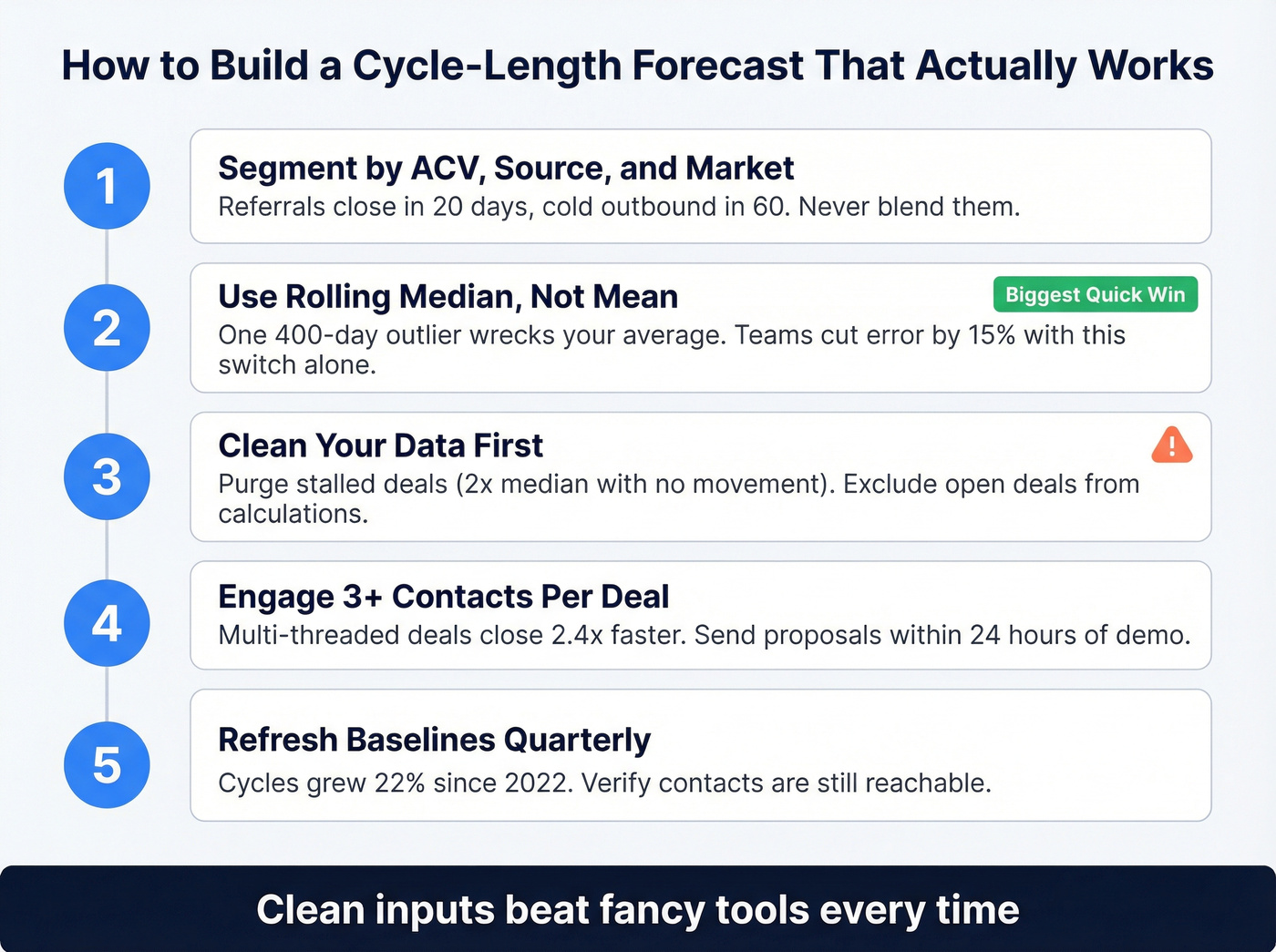
2. Use rolling median, not mean. One 400-day outlier will wreck your average. We've seen teams cut forecast error by 15% just by switching from mean to median - it's the single easiest fix in pipeline analytics.
3. Clean your data before you calculate. Stalled deals and open deals both distort your numbers. Define "stalled" as 2x your segment's median with no stage movement, then purge or close-lost those ghosts. Don't include open deals in your cycle-length calculation either - they haven't finished yet, so they artificially shorten your average. This is called right-censoring, and most teams ignore it completely.
Here's the thing: stalled-deal contamination is one of the biggest reasons cycle-length forecasts miss. Picture this - your CRM shows 200 active deals, but 60 haven't moved stages in six months. Your "average" cycle length is now a fantasy number that's wrong for every segment.
4. Engage multiple contacts and move fast. Deals with 3+ contacts engaged close 2.4x faster. Proposals sent within 24 hours of a demo close 35% faster. Those two stats are the strongest levers most teams aren't pulling. If you're only emailing one stakeholder per account, you're leaving speed on the table. (If you need a system for this, start with account-based selling.)
5. Refresh baselines quarterly. Cycles lengthened 22% since 2022, which means your 2023 baselines are dangerously stale. While you're at it, verify your pipeline contacts are still reachable - if 30% of your emails bounce, those deals are dead weight. Prospeo's real-time email verification on a 7-day refresh cycle catches this before stale contacts silently inflate your averages.
Mistakes That Break Your Forecast
One average for all deals. A $5K SMB deal and a $200K enterprise contract have completely different dynamics. Blending them produces a number that's wrong for both.
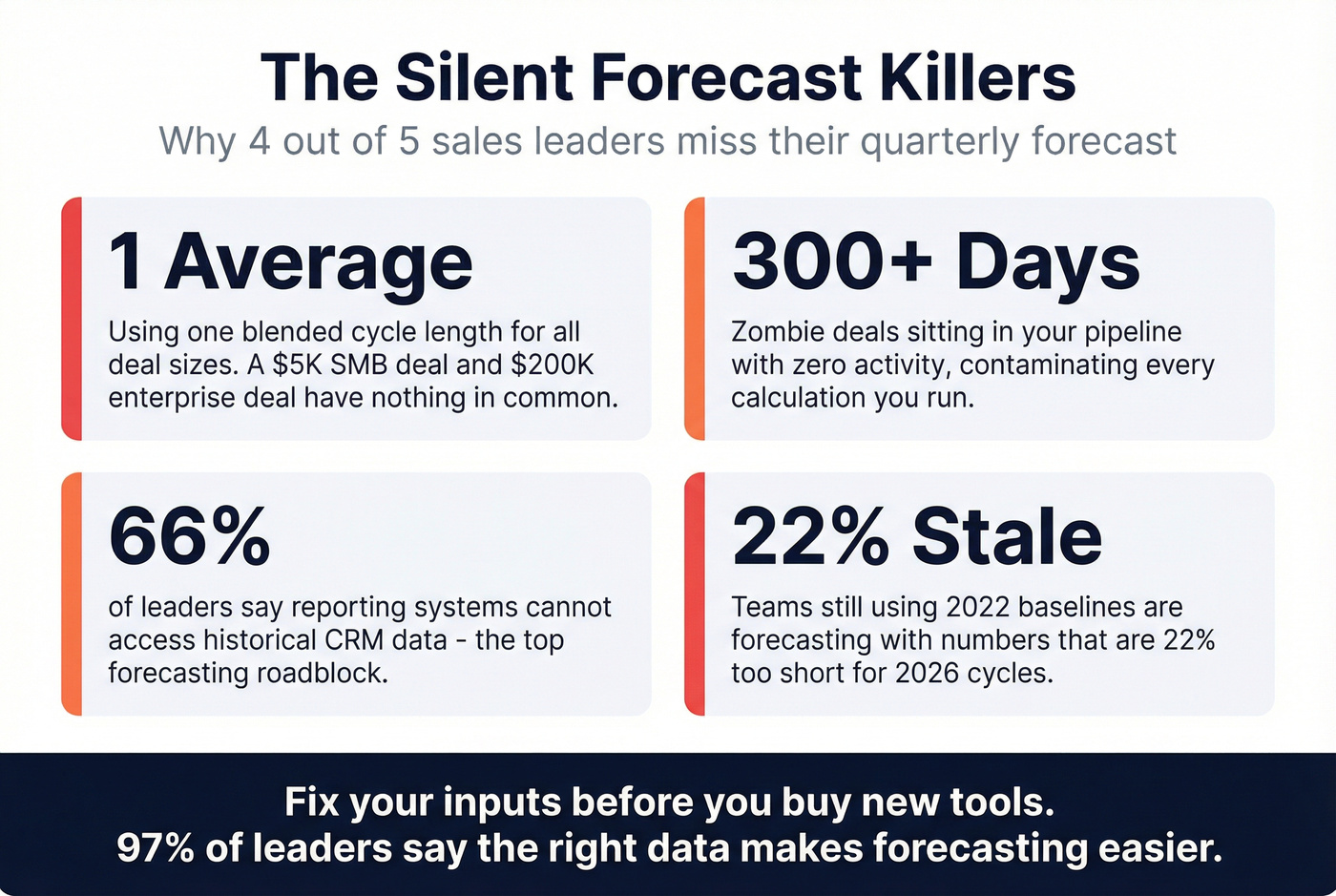
Zombie deals. That opportunity at 300+ days with no activity isn't "still in play" - it's contaminating every calculation. Purge it.
Ignoring lead-source shifts. Referrals close in roughly 20 days, cold outbound closer to 60. When your inbound mix changes, your baseline changes with it, and most teams don't notice until the quarter's already blown.
Dirty CRM data undermines everything. 66% of leaders cite reporting systems that can't access historical CRM data as a top roadblock, and 97% say the right data would make forecasting easier. Inconsistent stage definitions, duplicate contacts, and unverified emails all corrupt the inputs. In our experience, fixing data quality does more for forecast accuracy than switching formulas or buying new tools. Skip the shiny AI forecasting platform if your CRM is a mess - clean your inputs first. (If you want a checklist, start with data enrichment and lead enrichment.)

Not updating baselines. If you're still using 2022 cycle-length data in 2026, you're forecasting with numbers that are 22% too short. The consensus on r/sales echoes this constantly - teams that recalculate quarterly outperform those running on annual assumptions.
Cycle-Length vs. Other Methods
Three forecasting methods dominate in 2026:
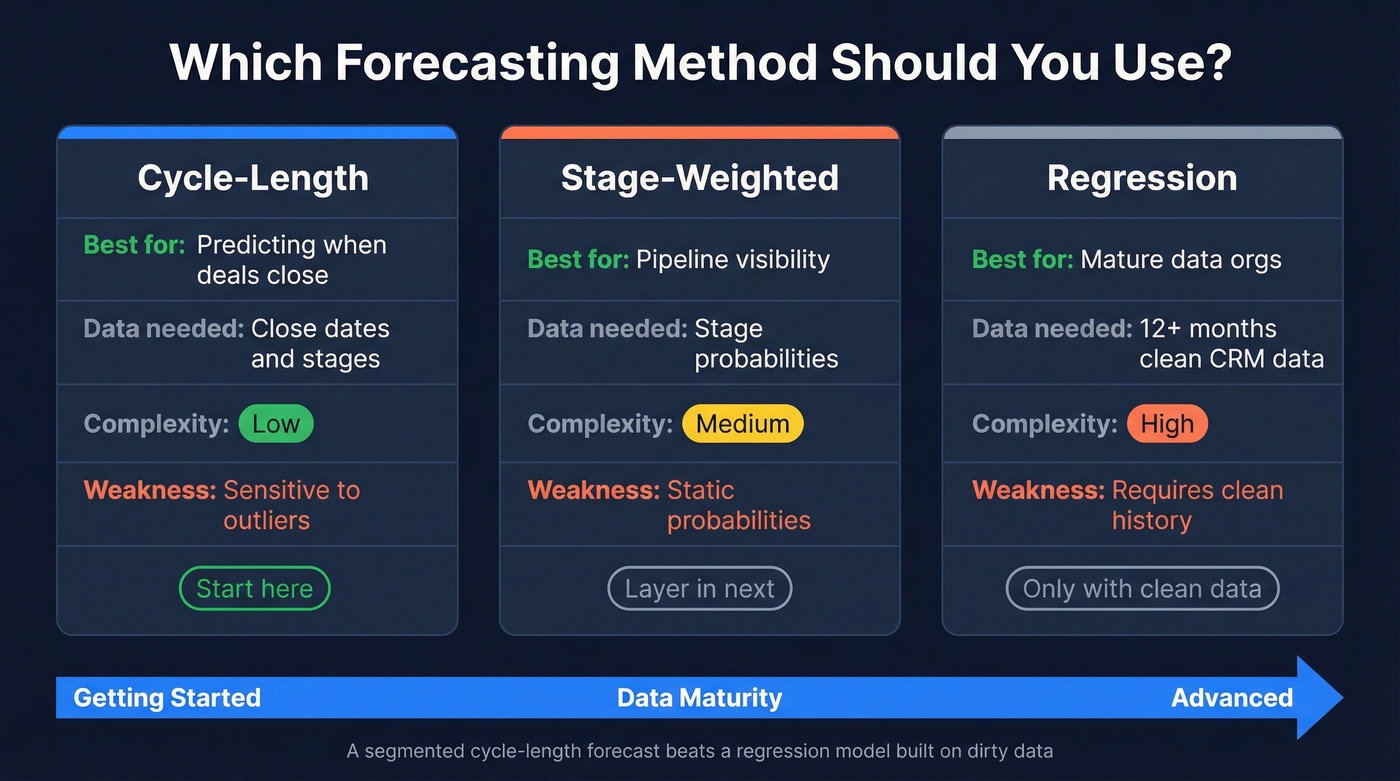
| Cycle-Length | Stage-Weighted | Regression | |
|---|---|---|---|
| Best for | Predicting when | Pipeline visibility | Mature data orgs |
| Data needed | Close dates, stages | Stage probabilities | 12+ months CRM data |
| Complexity | Low | Medium | High |
| Weakness | Sensitive to outliers | Static probabilities | Requires clean history |
Start with cycle-length forecasting and layer in stage-weighted methods as your CRM data matures. Regression models are powerful but need at least 12 months of clean, consistent data to justify the effort. For teams just getting started, don't overthink it - cycle-length forecasting with proper segmentation will outperform a fancy regression model built on dirty data every single time.
Tools Worth Considering
Look - most teams don't need a $100K/year forecasting platform. They need clean data and disciplined segmentation. I've watched companies buy Clari or Gong and still miss forecasts because their pipeline was full of bounced emails and ghost deals.
For CRM-native forecasting, HubSpot (free/$15/user/mo), Pipedrive ($14/user/mo), Zoho CRM ($14/user/mo), and Salesforce ($25-$300/user/mo depending on edition) all handle basic cycle-length tracking. Dedicated platforms like Gong (~$50/user/mo) and Clari (~$100-$125/user/mo) add AI-driven deal inspection and call analysis - worth it once your data is solid.
Before any of that, make sure your pipeline reflects reality. If 30% of your "active" contacts have bounced emails, no forecasting tool will save you. Tools like Prospeo (98% email accuracy, 7-day refresh cycle) catch stale contacts before they silently inflate your pipeline numbers. If you're evaluating options, compare sales forecasting tools and sales forecasting solutions.
Engaging 3+ contacts per deal closes 2.4x faster - but only if those contacts are real. Prospeo finds and verifies emails for every stakeholder in the buying committee at $0.01 per email, so your multi-threaded deals actually move.
Multi-thread every deal with verified decision-maker emails.
FAQ
What's a good average sales cycle length?
SMB deals under $15K close in 14-30 days. Mid-market runs 30-90 days. Enterprise above $100K averages 90-180+ days. Segment by deal size and source - a single blended number is useless.
How often should I recalculate cycle-length baselines?
Quarterly at minimum. B2B cycles lengthened 22% since 2022, so annual updates leave you forecasting with stale assumptions. Treat baseline recalculation as part of your regular revenue-operations cadence.
Why do cycle-length forecasts keep missing?
Dirty data. Stalled deals inflate your average, bounced emails mean "active" deals are dead, and inconsistent CRM stages make every calculation unreliable. Fix inputs first - that's where the real accuracy gains live.