

The Best Sales Dialers for 2026 (With Real Pricing)
Cold calling is still a volume game - and most of that volume gets wasted on ringing, voicemail, and disconnected numbers. The bottleneck usually isn't the sales dialer. It's the data feeding it.
Reps spend just [30% of their time](https://www.salesforce.com/news/stories/sales-research-2023/) actually selling, with the rest lost to admin, manual dialing, and chasing bad numbers. A good outbound dialer automates the dead time between conversations. But even the fastest one can't fix a list full of dead numbers.
Our Picks
| Category | Pick | Why | Starting Price |
|---|---|---|---|
| Best data layer | Prospeo | 125M+ verified mobiles, 30% pickup rate | ~$0.10/mobile |
| Best power dialer | PhoneBurner | Tier 1 network, ARMOR spam protection | $140/user/mo |
| Best value dialer | JustCall | Multiple modes, AI coaching | $29/user/mo |
PhoneBurner is the gold standard for power dialing if budget isn't your primary constraint. JustCall covers 90% of what most teams need at a price that won't trigger a CFO conversation.
Here's the thing: most teams agonize over which dialer to buy when the real difference-maker is the data. A $29/month dialer with verified numbers will outperform a $250/month parallel dialer running stale lists. Every single time. Spend your energy on data quality first, then pick a tool that fits your workflow.
Sales Dialer Types Explained
Before you pick a tool, you need to pick a dialer type. They aren't interchangeable, and the wrong choice creates compliance headaches or wasted spend.
Power vs. Predictive vs. Parallel
Power dialers call one number at a time per rep. The rep finishes a call, the system dials the next. Expect around 40-70 calls per hour depending on voicemail rates. Low compliance risk, steady pacing, and no awkward silences when someone picks up. This is the workhorse for most B2B teams.
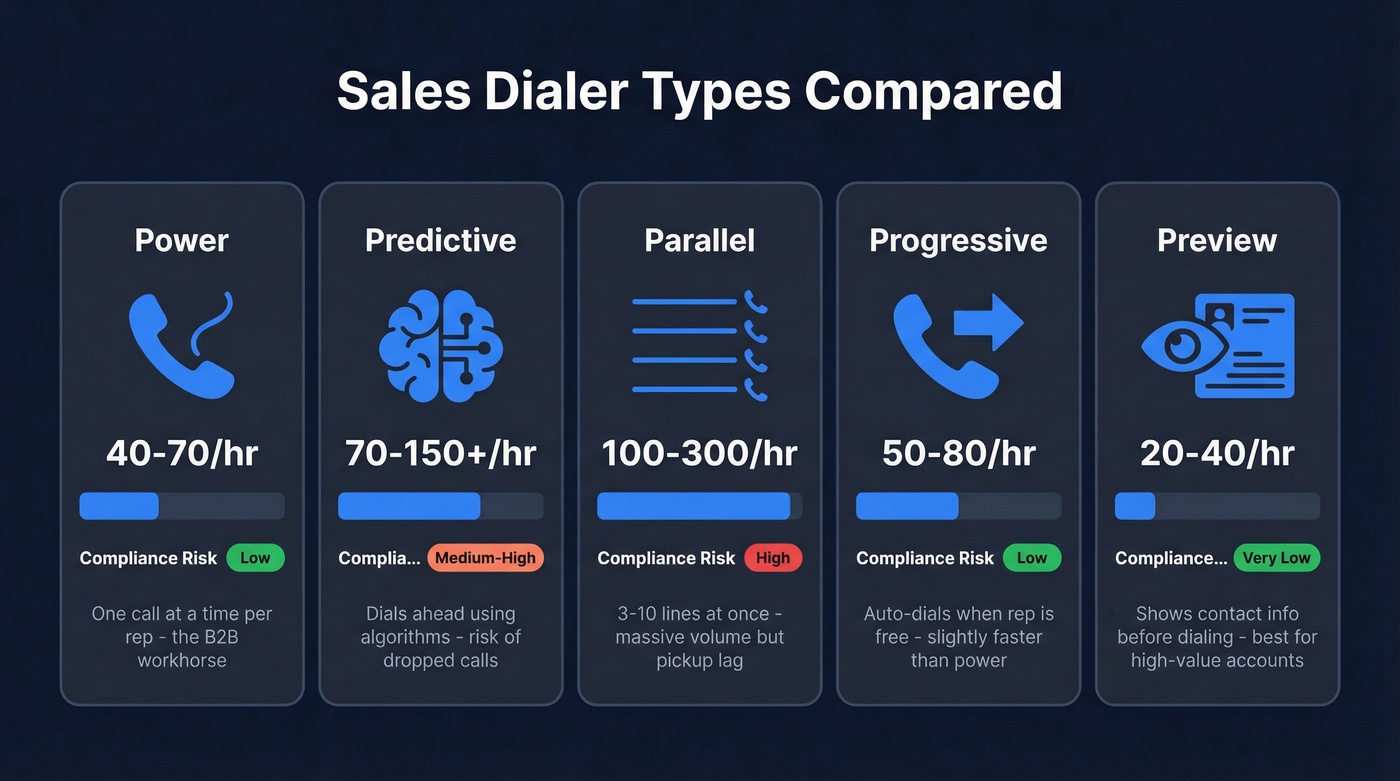
Predictive dialers use algorithms to dial ahead of agent availability, anticipating when reps will be free. Volume can jump to 70-150+ calls per hour, but the tradeoff is real: if the algorithm miscalculates, the prospect picks up to silence - or worse, gets dropped entirely. That's an abandoned call, and it's a compliance problem under TCPA.
Parallel dialers fire 3-5 (sometimes up to 10) lines simultaneously per rep. The first live answer gets connected; the rest get dropped. Volume is massive - around 100-300 attempts per hour - but there's often a brief lag when the connection transfers. That lag signals "robocall" to a lot of prospects, and reps commonly complain it ruins the first few seconds of the conversation.
Progressive dialers auto-dial the next number when a rep becomes available, similar to power but slightly faster. Preview dialers show the contact record before dialing so the rep can prep - ideal for high-value accounts where personalization matters more than volume.
Which Type Fits Your Team
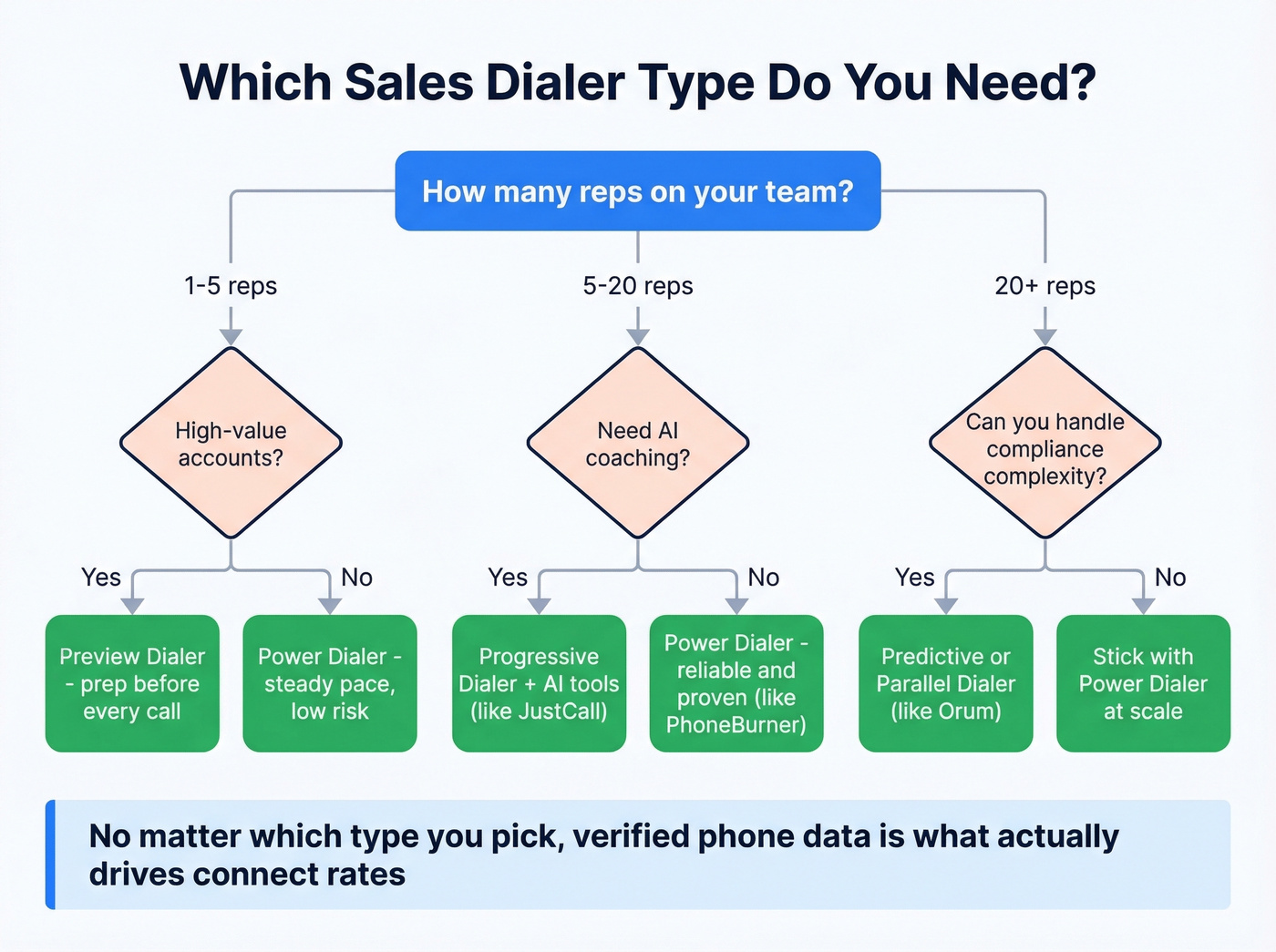
| Team Size | Daily Calls/Rep | Compliance Sensitivity | Recommended Type |
|---|---|---|---|
| 1-5 reps | 30-80 | High | Power or preview |
| 5-20 reps | 80-150 | Medium | Power or progressive |
| 20+ reps | 150-300+ | Lower (call center) | Predictive or parallel |
Prospects are 4x more likely to answer local numbers. Whatever outbound dialer you pick, make sure it supports local presence dialing.
9 Best Sales Dialer Tools for 2026
Prospeo - Best Phone Data Layer
Prospeo isn't a dialer. It's the data layer that determines whether your dialer actually connects. Your dialer dials the numbers - Prospeo's Mobile Finder makes sure they're worth dialing.
The platform covers 125M+ verified mobile numbers with a 30% pickup rate and 98% email accuracy across 143M+ verified addresses. For teams comparing providers, it helps to understand the broader landscape of B2B company data. For context, ZoomInfo's mobile pickup rate runs around 12.5%, and Apollo sits at roughly 11%. That gap isn't marginal - it's the difference between a productive calling block and an afternoon of voicemails and disconnected tones.
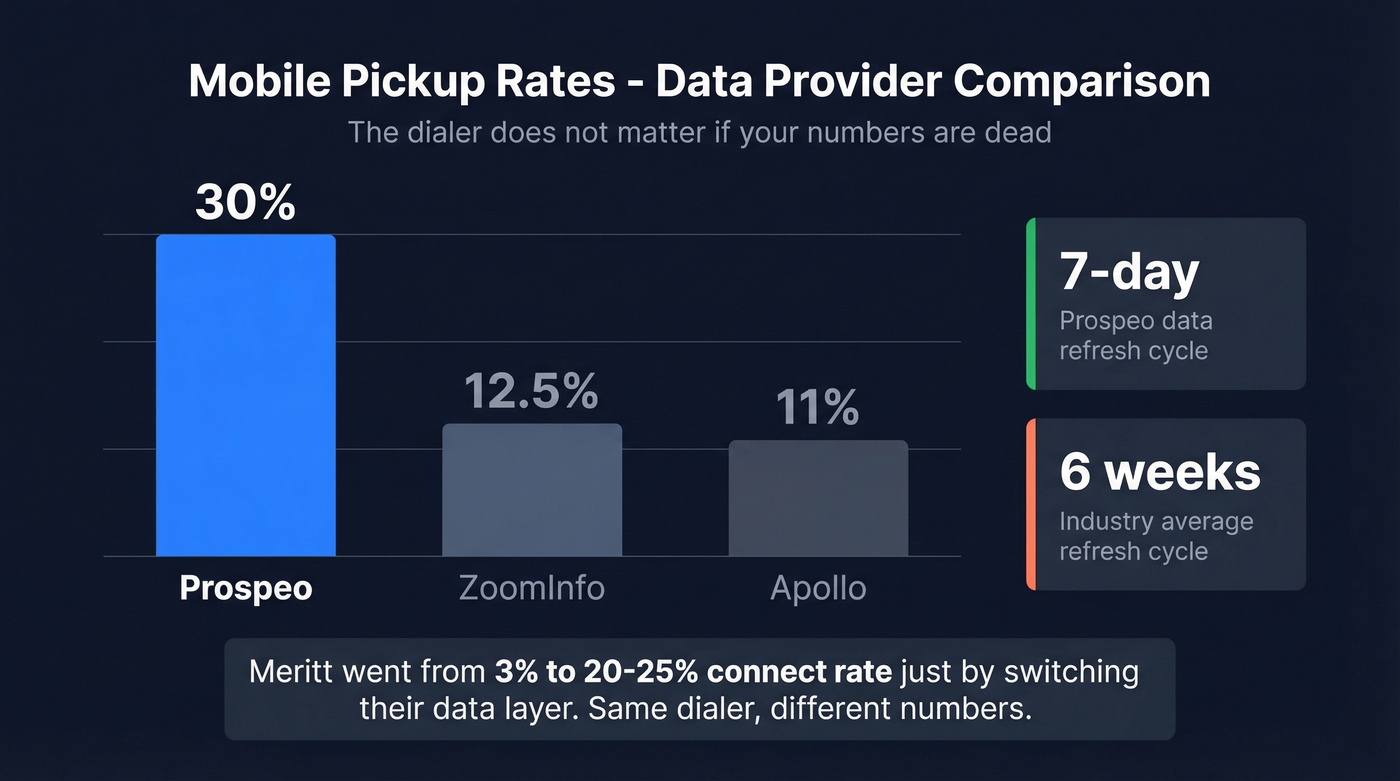
Numbers refresh on a 7-day cycle, compared to the 6-week industry average. If you're evaluating vendors beyond phone data, these data enrichment services can help fill gaps across your stack. Meritt went from a 3% connect rate to 20-25% after switching their data layer. GreyScout cut their bounce rate from 38% to under 4%. The dialer didn't change. The data did.
Stack it with: Any dialer on this list. Pair with JustCall for a budget-friendly stack, or PhoneBurner for maximum connect rates. If you're building a full outbound stack, this fits neatly into a broader cold calling system. Pricing: ~$0.01/email, $0.10/mobile. Free tier available. No contracts.
PhoneBurner - Best Power Dialer
The best pure power dialer on the market. You pay a premium, but you know exactly what you're paying for - and that's increasingly rare in this space.
PhoneBurner is the only dialer to place calls on a Tier 1 network prioritized by carriers. Their ARMOR add-on helps keep numbers clean and reduce "Spam Likely" flags, and Connect Scores uses real-world carrier signals to score numbers in real time so reps can skip disconnected or low-likelihood pickups. These features are what separate PhoneBurner from cheaper alternatives that lack carrier-level intelligence.

Pricing is fully transparent: $140/user/mo (Standard, annual), $165 (Professional), $183 (Premium). Monthly billing runs $25-32 higher per tier. SMS is only available on Premium - 1,000 outbound messages per month, with $15 per additional 1,000.
Use this if: You want the most reliable power dialer with built-in spam protection and don't mind paying for quality. Skip this if: You're a small team under 5 reps - the per-seat cost adds up fast.
JustCall - Best Value
JustCall covers multiple dialing modes in a single platform, starting at $29/user/mo. That price point alone makes it worth a serious look for teams that aren't ready to spend $140+ per seat.

AI coaching is baked into the higher tiers - real-time call scoring, sentiment analysis, and moment detection. JustCall also integrates with Salesforce, HubSpot, and Pipedrive. If you're comparing adjacent tools in this category, see our breakdown of CallHippo vs JustCall. Spam protection is included, though it's not as sophisticated as PhoneBurner's system.
The catch: advanced features like predictive-style dialing and AI coaching are gated to the $49-89/user/mo tiers. The $29 plan is a capable starting point, but you'll hit walls quickly if you need more.
Use this if: You need a versatile dialer that won't blow your budget. Great for teams of 5-20 reps. Skip this if: You need enterprise-grade spam remediation or high-volume parallel dialing.
Orum - Best Parallel Dialer
Impressive technology, brutal cost structure, and a polarizing reputation among the reps who actually use it daily.
Orum fires up to 5 parallel lines on the Launch plan and up to 10 on Ascend, which means massive call volume. But every advantage comes with a tradeoff: the pickup lag is real, and you get very little prep time between connects. We've heard from SDR teams on r/sales that the lag kills their opening line - prospects hear a beat of silence and immediately assume it's a robocall. That first impression is hard to recover from.
Orum is phone-only, so you'll still need Outreach or Salesloft for sequencing, plus a separate data provider. The 200 enrichment credits per rep per month won't cover a serious outbound operation. Pricing starts at $250/user/mo billed annually, with Ascend commonly landing in the $400-500+/user/mo range.
Use this if: You have 20+ reps, high daily call targets, and the budget to absorb $250+/seat plus your sequencer and data stack. Skip this if: Your team is under 10 reps, you sell complex deals that need personalized openers, or you can't commit to annual billing.
Dialpad Sell
Dialpad's strength is AI - real-time transcription, live coaching prompts, and sentiment analysis baked into every call. It includes a built-in dialer and CRM integrations, but the dialer isn't really the point. You're buying call intelligence. If you're weighing options, these Dialpad alternatives are worth a look.
Sell-style packages commonly land in the $60-100/user/mo range on annual billing. Best for teams that value coaching and conversation analytics over raw dialing speed. Skip this if you need a standalone dialer - Dialpad wants to be your entire comms stack.
CloudTalk
Budget-friendly with strong international coverage. CloudTalk starts at $19/user/mo and supports local numbers in 160+ countries, which makes it an obvious pick for teams calling into EMEA or APAC. We've seen it work well for distributed teams under 20 reps who need global reach without enterprise pricing. Multiple dialer modes are included, and the onboarding is straightforward.
Aircall
Clean UX, 100+ integrations, and a setup process that takes hours instead of weeks. Aircall starts around $30-40/user/mo depending on plan and billing, and it does the basics well - click-to-dial, call routing, CRM sync, and basic analytics. It's the dialer for teams that prioritize simplicity over power. If your reps make 50-80 calls a day and you want something that just works, Aircall delivers. Need more horsepower? Look elsewhere. If you're deciding between the two, see our Aircall vs CloudTalk comparison.
SalesLoft
Salesloft isn't really a dialer company - it's a calling tool that happens to live inside a full engagement platform. The built-in dialer works well for teams already running Salesloft sequences, and having everything in one platform eliminates integration headaches. Custom pricing often lands around $100-150/user/mo on annual contracts. Best for enterprise teams already committed to the Salesloft ecosystem. Don't buy this if you're shopping for a dialer first - you'd be paying for a full engagement suite to get a phone tool.
RingCentral RingCX
Enterprise-grade contact center platform with built-in dialer functionality and four dialing modes: preview, progressive, predictive, and voice broadcast. Plans with dialer functionality start around $60/user/mo. RingCX is overkill for a pure outbound sales team, but it's the right call for organizations that need inbound and outbound under one roof with serious reliability guarantees.
Honorable Mentions
Kixie runs strong caller ID reputation tools and integrates tightly with HubSpot and Pipedrive. Expect $50-95/user/mo based on tier. Solid mid-market option if PhoneBurner's price tag is too steep.
Nooks is an AI-powered parallel dialer with a virtual sales floor concept. Enterprise-only, estimated $150-300/user/mo. We haven't tested it deeply enough to recommend confidently, but it's on our radar for teams that want Orum-style volume with a more collaborative interface.

Even the fastest parallel dialer can't fix a list full of dead numbers. Prospeo's 125M+ verified mobiles deliver a 30% pickup rate - nearly 3x ZoomInfo's 12.5%. Numbers refresh every 7 days, not 6 weeks.
Stop paying $140/seat to dial disconnected numbers.
Pricing Comparison
| Tool | Starting Price | Billing | Free Trial | Contract |
|---|---|---|---|---|
| Prospeo (data) | $0.10/mobile | Monthly | Free tier | None |
| PhoneBurner | $140/user/mo | Annual or monthly | Yes | None |
| JustCall | $29/user/mo | Annual | 14-day | None |
| Orum | $250/user/mo | Annual only | Demo required | Annual |
| Dialpad Sell | ~$60-100/user/mo | Annual | 14-day | Annual |
| CloudTalk | $19/user/mo | Annual | 14-day | None |
| Aircall | ~$30-40/user/mo | Annual | 7-day | Annual |
| Salesloft | ~$100-150/user/mo | Annual | Demo required | Annual |
| RingCentral RingCX | ~$60/user/mo | Annual | Demo required | Annual |
| Kixie | ~$50-95/user/mo | Annual | 7-day | Varies |
| Nooks | ~$150-300/user/mo | Annual | Demo required | Annual |
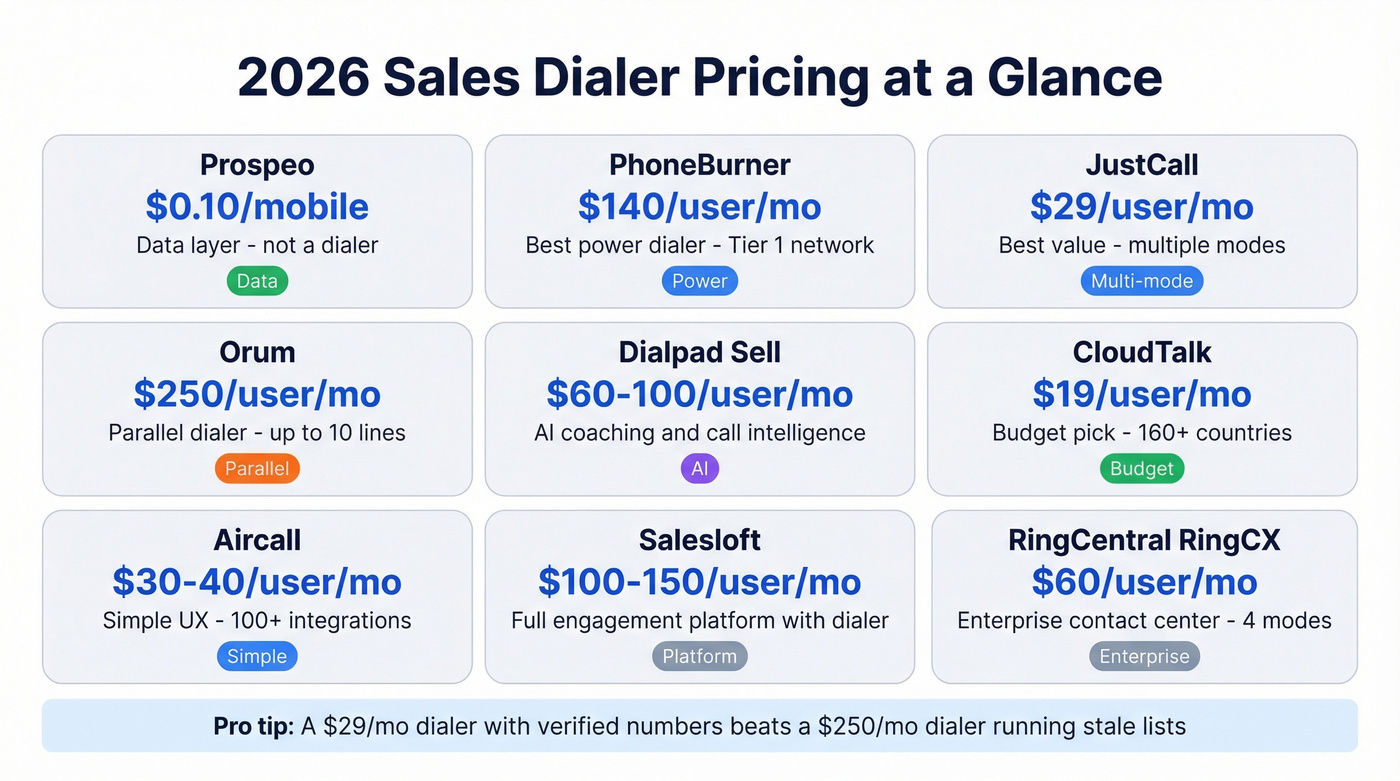
Notice a pattern? The tools that don't publish pricing are almost always the most expensive. That's not a coincidence.
Caller ID Reputation and Spam Labeling
You can buy the best dialing software on the market and still watch your connect rates crater if your numbers get flagged as spam. 80% of customers block calls from numbers they don't recognize, and carrier analytics engines are getting more aggressive every quarter.
The damage is real. 81% of businesses have lost revenue due to incorrect spam flagging, and 15% lost over $100,000.
Most teams assume STIR/SHAKEN solves this. It doesn't. STIR/SHAKEN authenticates that the caller ID is legitimate - it doesn't tell carriers whether the call is wanted. A TNS report analyzing recent traffic data found that while 85% of voice traffic between Tier-1 carriers is now signed and verified, only 17.5% of traffic between smaller carriers gets the same treatment. Worse, up to 13% of traffic using invalid numbers still receives A-level attestation. The system has gaps.
And there's a newer barrier: AI-powered call screening. Carriers and phone manufacturers are rolling out AI assistants that screen unknown calls in real time, asking callers to state their purpose before connecting. Branded caller ID - where your company name and call reason display on the prospect's screen - is becoming the primary countermeasure. If your dialer or carrier doesn't support branded caller ID registration, you're fighting an uphill battle against these screening tools.
Several practices actually protect your numbers:
- Keep outbound volume under 100-150 calls per number per day
- Maintain a healthy inbound/outbound ratio - aim close to 1:1
- Rotate numbers and monitor reputation with tools like PhoneBurner's ARMOR or Kixie's reputation management
- Register your numbers with STIR/SHAKEN (necessary but not sufficient)
- Scrub against the National DNC registry before every campaign
If your dialer doesn't offer built-in number reputation monitoring, you're flying blind. Ask about it before you sign.
TCPA Compliance in 2026
TCPA violations run $500-$1,500 per call. Per call. A 500-dial campaign with compliance issues can generate six-figure liability before anyone notices.
The rules tightened significantly in 2025, and they're expanding further this year. As of April 11, 2025, consumers can revoke consent by any reasonable means - not just texting "STOP." A voicemail, an email, a chat message, even a verbal request on a call all count. Your team has 10 business days to honor the opt-out.
Starting April 11, 2026, these revocation rules expand across message types and business units. If a prospect opts out of marketing texts from your SDR team, that opt-out applies more broadly across your organization.
Your dialer stack needs to support automatic DNC list scrubbing before every campaign, calling hours enforcement in the prospect's local time zone (8am-9pm), opt-out tracking across channels and business units, consent documentation with audit trails, and one confirmation message allowed after SMS opt-out within 5 minutes containing no marketing content.
Let's be honest: most dialers handle the basics. The gap is usually in cross-channel opt-out syncing and the speed of DNC updates. Ask your vendor specifically how fast opt-outs propagate.
Why Data Quality Matters More Than Your Dialer
Cold calling converts at roughly 2-3% on average - but that number assumes your data is clean. Most teams' data isn't.
We've run bake-offs where the expensive parallel dialer lost to a basic power dialer - not because the technology was worse, but because the team feeding it had verified, fresh numbers while the parallel dialer team was burning through a list that was 60 days stale. Connect rates in outbound sales typically run 5-10% as a baseline. Teams that verify phone numbers before loading them into a dialer consistently hit 20-25%. If you're looking to improve the rest of the outbound motion too, these sales prospecting techniques pair well with higher connect rates.
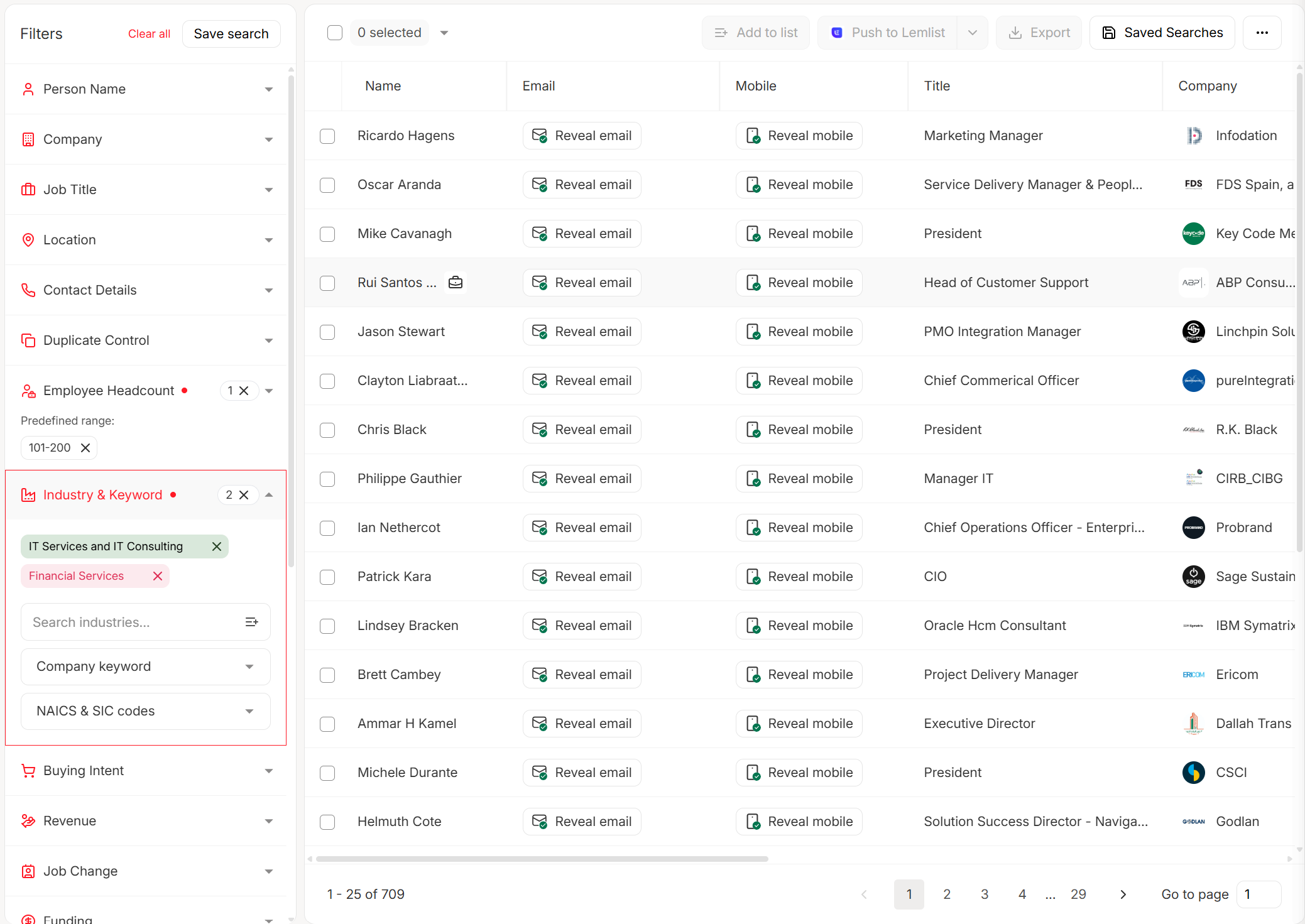
Meritt's results tell the story: connect rates jumped from 3% to 20-25% after switching to verified data refreshed weekly. GreyScout cut bounce rates from 38% to under 4%. Same dialer, different data, completely different outcomes.
When you're calculating total cost of ownership for your calling stack, don't just compare dialer prices. The real equation is dialer + data + sales engagement platform. A $29 JustCall seat plus verified mobiles will outperform a $250 Orum seat running on unverified data from a provider that refreshes quarterly. Adding a voice channel to your multichannel sequences only works when the numbers you're calling are live. If you're standardizing your team workflow, a clear set of sales activities helps keep output consistent across reps.
Meritt tripled their connect rate to 20-25% without changing their dialer - they changed their data. Prospeo pairs with every dialer on this list at ~$0.10/mobile, no contracts.
Stack verified data under any dialer and watch pickup rates climb.
FAQ
How much does a sales dialer cost?
Most mid-market teams spend $29-89/user/mo, with budget options like CloudTalk starting at $19 and premium parallel dialers like Orum reaching $250+/user/mo. Factor in data costs too - verified mobile numbers run about $0.10 each through Prospeo, and that investment often matters more than the dialer itself.
What's the difference between a power dialer and a predictive dialer?
A power dialer calls one number at a time per rep, advancing automatically after each call ends - steady, compliant, around 40-70 calls per hour. A predictive dialer uses algorithms to dial multiple numbers ahead of agent availability, pushing volume to 70-150+ calls per hour but risking abandoned calls and TCPA issues if the pacing algorithm misfires.
How do I stop my numbers from getting flagged as spam?
Keep outbound volume under 100-150 calls per number per day and maintain a healthy inbound/outbound ratio near 1:1. Register with STIR/SHAKEN, use reputation monitoring tools like PhoneBurner's ARMOR, and scrub lists against the National DNC registry before every campaign. No single step is enough - it's the combination that protects you.
Do I need a dialer if my team makes fewer than 30 calls a day?
Probably not. Below 30 daily dials, a click-to-call feature in your CRM handles the workflow fine. Dialers add real value when reps consistently need 50+ calls per day - that's where automation, disposition logging, and pacing features justify the cost.
What's the most important factor in cold call connect rates?
Data quality. The best sales dialer in the world can't connect you to a disconnected number. Teams that verify phone numbers before loading them into any dialer consistently see 2-3x higher connect rates compared to teams dialing unverified lists.