

7 Sales Enablement Challenges That Actually Matter in 2026
Your reps spend 60% of their day on admin. Your CFO wants receipts on what all that enablement spend actually produced. And your last methodology rollout? Forgotten within a month. 43% of sales leaders reported longer cycles last year. 44% saw no-decision losses climb. These aren't new problems - but most programs keep throwing tools at issues that need foundations.
What You Need (Quick Version)
Most enablement failures trace back to three broken foundations: bad data, disconnected tools, and training that doesn't change behavior. Fix them in that order - data, then onboarding, then content, then AI - because layering sophistication on top of rot just creates expensive rot.
The 7 Challenges
1. Bad Data Undermines Everything
We're putting this first because every other challenge on this list gets worse when your data is rotten. 73% of B2B buyers actively avoid sellers who send irrelevant outreach. If your reps are emailing invalid addresses or calling disconnected numbers, no playbook fixes that. And 74% of AI-using sales teams now prioritize data hygiene as their top enabling investment - because they learned this lesson the hard way.
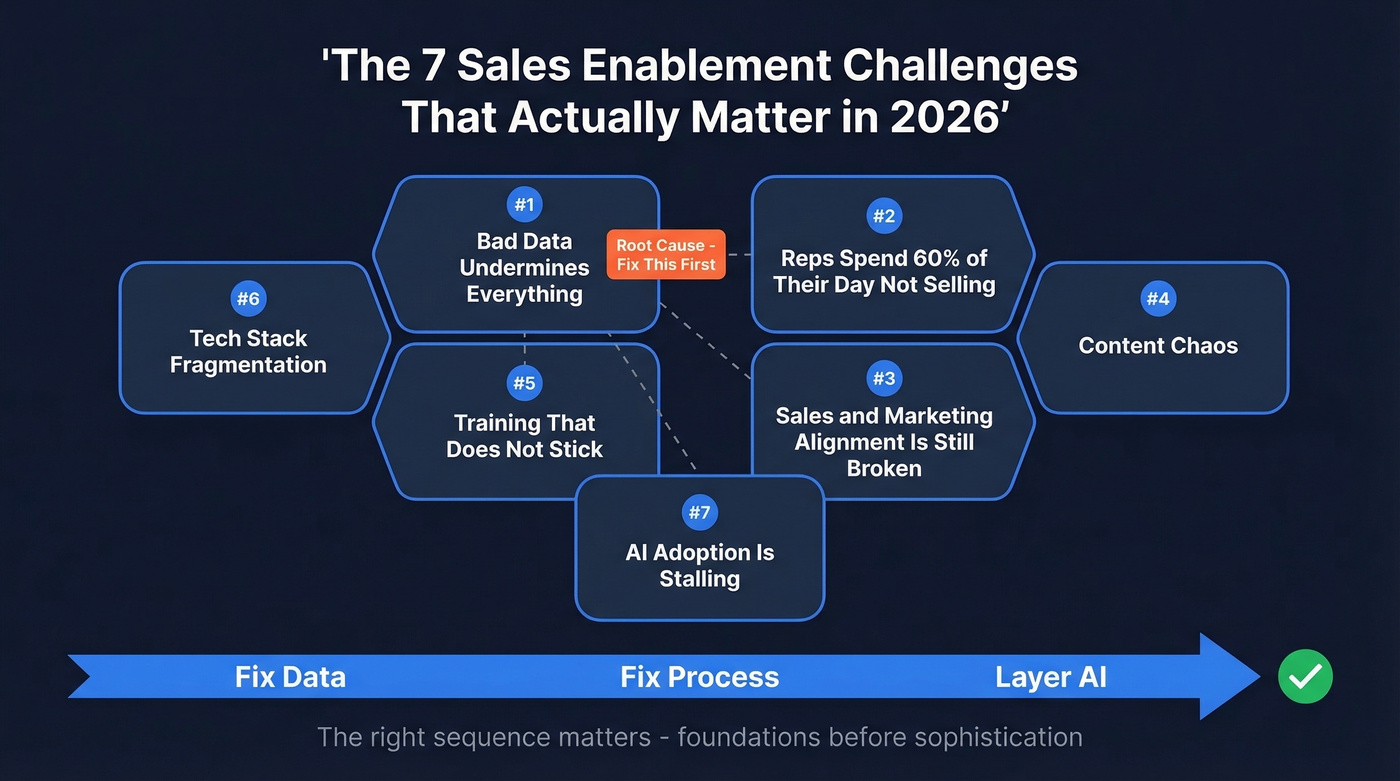
Here's the thing: if your bounce rate is above 10%, stop buying enablement software and fix your contact data first. Everything else is downstream.
2. Reps Spend 60% of Their Day Not Selling
Salesforce's State of Sales data puts it bluntly: reps spend 60% of their time on non-selling tasks. Bain's research is grimmer - sellers spend roughly 25% of their day actually selling once you strip out CRM updates, internal meetings, content hunting, and admin. That's not a training problem. That's a systems problem.
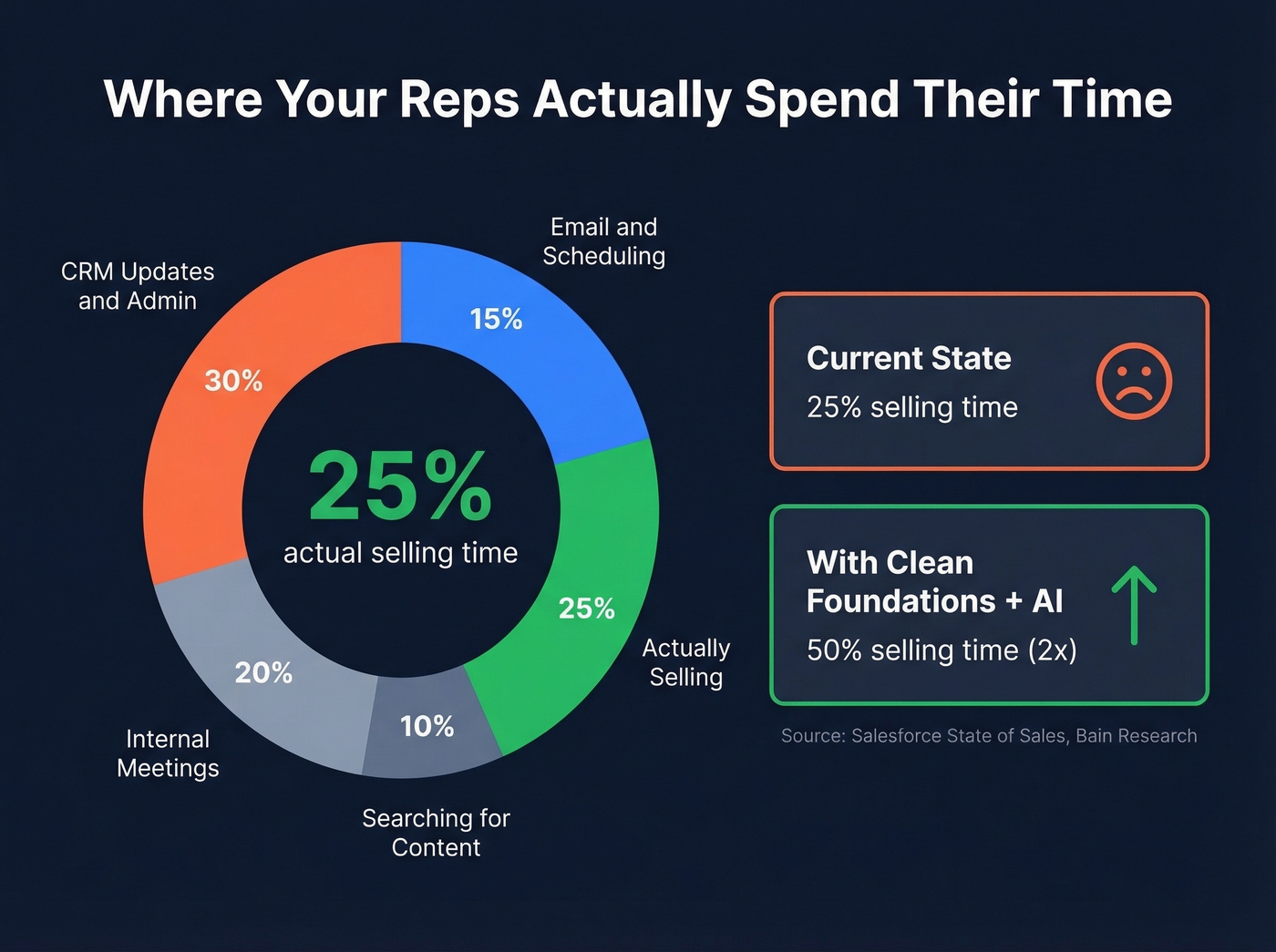
Every hour a rep spends searching for a case study is an hour they're not moving pipeline. Bain says AI can double that selling time, but only after the underlying fragmentation is resolved. Of all the obstacles enablement teams face, this time drain is the most universal - and the most fixable once you stop treating it as a discipline issue and start treating it as a workflow design problem.
3. Sales and Marketing Alignment Is Still Broken
What if the real alignment problem isn't cultural but structural? Only 30% of marketing-created content gets used by sales. Reps recreate existing content 40% of the time because they can't find it or don't trust it.
The gap is operational: marketing builds assets in a vacuum, sales ignores them, and nobody owns the handoff. The emerging fix is buyer enablement - equipping champions with the content they need to sell internally - which reframes alignment around the buyer instead of the org chart. We've seen this shift firsthand with teams that stopped arguing about MQL definitions and started co-building champion decks instead.
4. Content Chaos
Revenue teams burn 440 hours per year searching for or creating content. Content adoption is the #1 metric enablement teams track, yet actual usage is abysmal. Most companies don't have a content shortage. They have a content findability crisis.
Reps won't dig through a SharePoint graveyard to find a battlecard that's six months stale. If an asset hasn't been touched in 90 days, archive it. Fewer, fresher assets beat a bloated library every time.
5. Training That Doesn't Stick
Let's be honest about what happens after most methodology rollouts: a company invests six figures, runs a two-day workshop, and three weeks later reps are back to winging it. Gartner found that B2B sellers forget 70% of learning within a week of training. Half of leaders cite inconsistent rep behavior as the biggest enablement hurdle - even when the stack gets bigger.
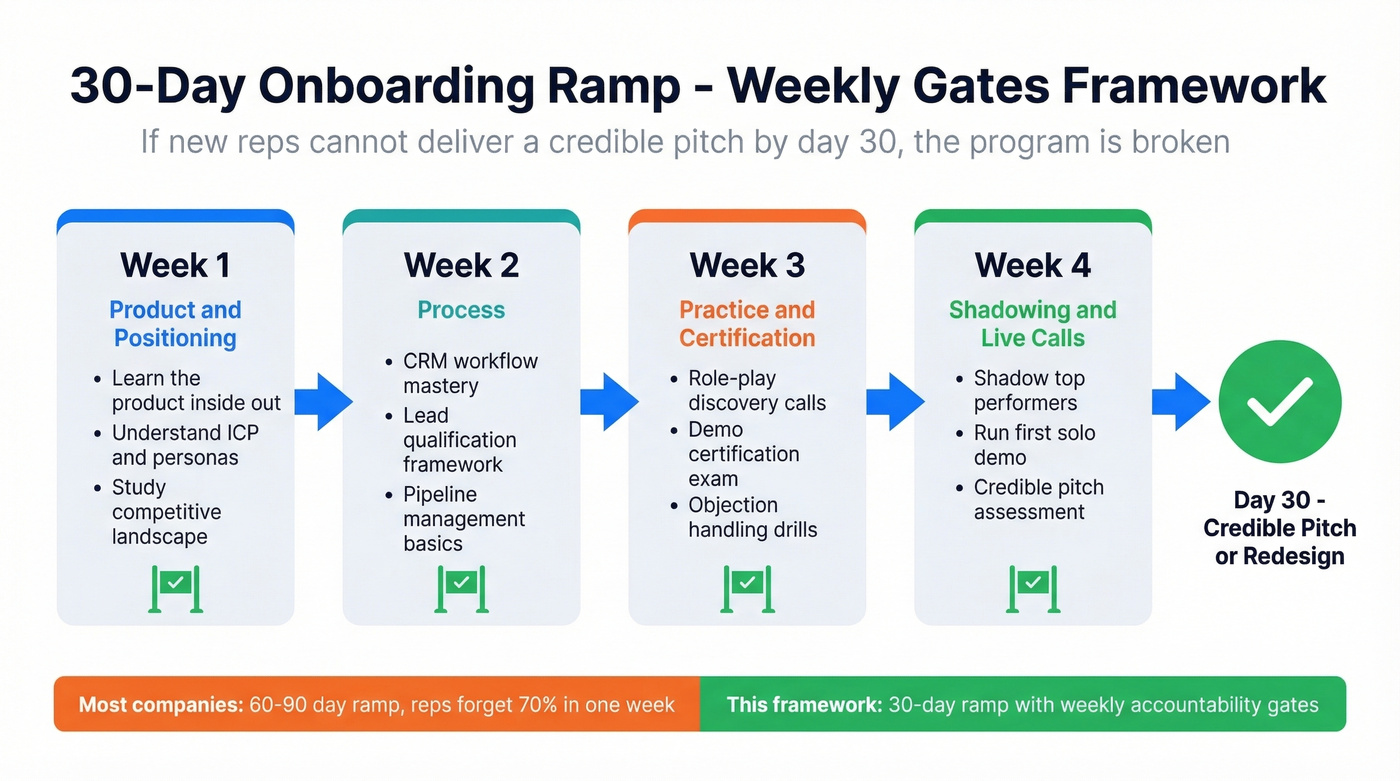
The GTM Playbook framework offers a tight 4-week onboarding structure: product and positioning in week one, process in week two, practice and certification in week three, shadowing and live calls in week four. If new reps can't deliver a credible pitch by day 30, the program is broken. Most companies stretch onboarding to 60-90 days and wonder why ramp time kills their unit economics.
Skip the two-day offsite. Build a 30-day ramp with weekly gates instead.
6. Tech Stack Fragmentation
Per SiftHub's stats, 91% of sales orgs use at least three enablement tools. The average stack runs 10+ solutions. And 43% of those tools sit underutilized with adoption below 50%.
Enterprise enablement platforms - Seismic, Highspot, Mindtickle - commonly run $50K-$250K+ per year, and Seismic is often positioned as a $100K+/year budget line item. That's real money for tools that often overlap and create the exact fragmentation they promised to solve. The consensus on r/sales echoes this frustration: too much tech, not enough flow. If your team isn't using a tool weekly, cut it.
7. AI Adoption Is Stalling
Sellers who partner with AI tools are 3.7x more likely to hit quota. But 51% of sales pros say data security concerns halt AI initiatives, and another 51% say tech silos delay or limit them.
Bain's analysis explains why: the seller's day is so fragmented that no single AI use case moves the needle. Automating broken processes just creates faster bottlenecks. The teams getting real AI ROI fixed their data and workflows first - then layered automation on clean foundations.

You just read that 73% of buyers avoid sellers with irrelevant outreach - and that bounce rates above 10% mean your enablement stack is built on rot. Prospeo delivers 98% email accuracy with a 7-day refresh cycle, so your reps stop wasting selling time on dead contacts. At $0.01 per email, fixing your data costs less than one month of that underused enablement tool.
Stop enabling reps with bad data. Start with contacts that actually connect.
How to Measure Enablement ROI
Most enablement teams can't prove their impact because they never agreed on what to measure. The sales velocity formula is the cleanest framework: (opportunities x average sales price x win rate) / average sales cycle length. Move any lever and you've got a measurable result.
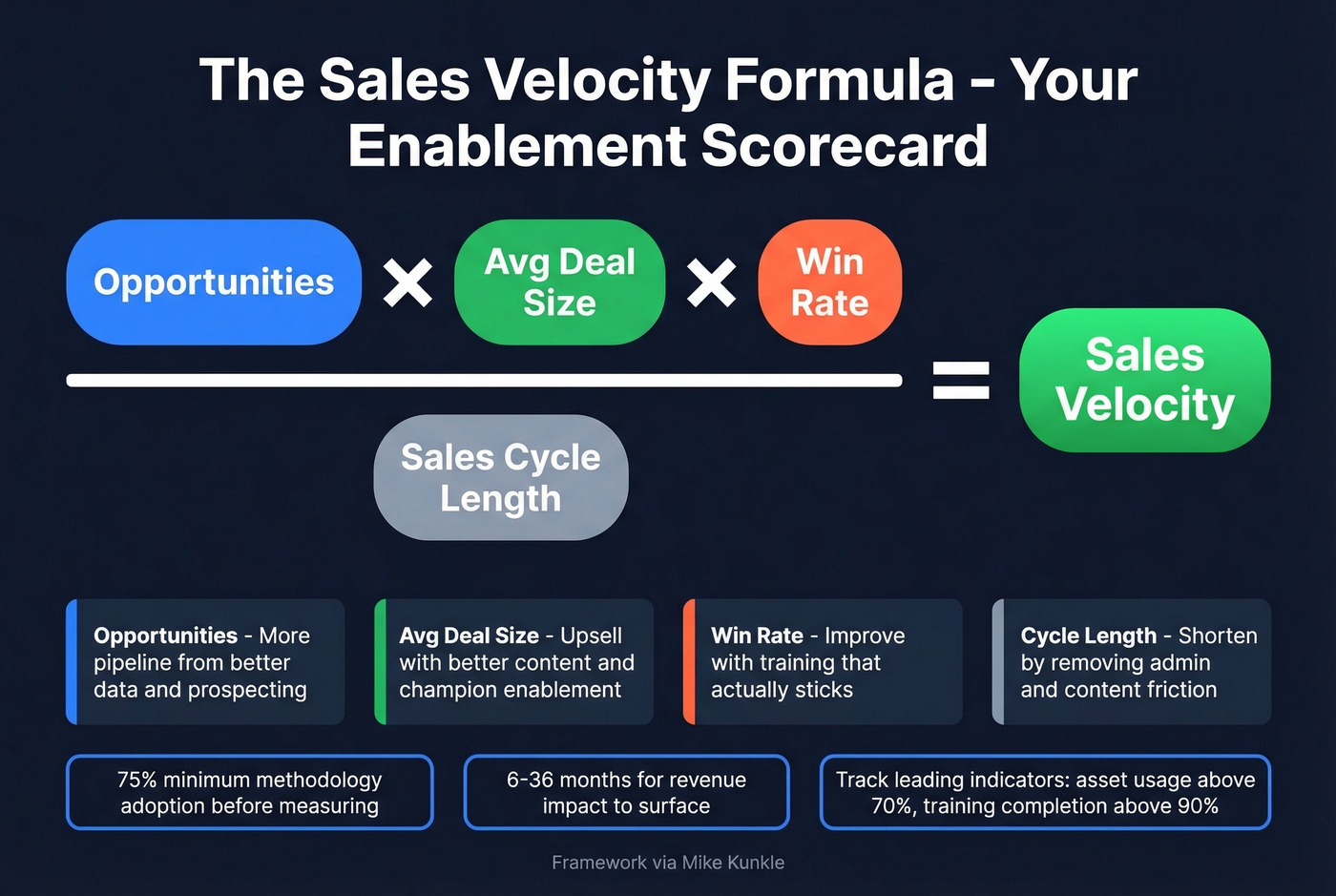
Methodology adoption lift takes 6-36 months to show up in revenue. You need 75% adoption minimum before you can detect a signal. One company spent nearly half a million on a sales methodology and gained $200K in revenue at 35% margin - leaving them $430K in a hole in year one.
Part of the measurement problem is structural: enablement reports to RevOps in 39.4% of orgs, Sales in 25.4%, and Marketing in others. When nobody owns the metric, nobody proves the ROI.
Track leading indicators while you wait for lagging ones: asset usage above 70%, training completion above 90%, and time-to-first-deal.
The Fix-It Sequence
Stop buying tools. Fix your foundations.
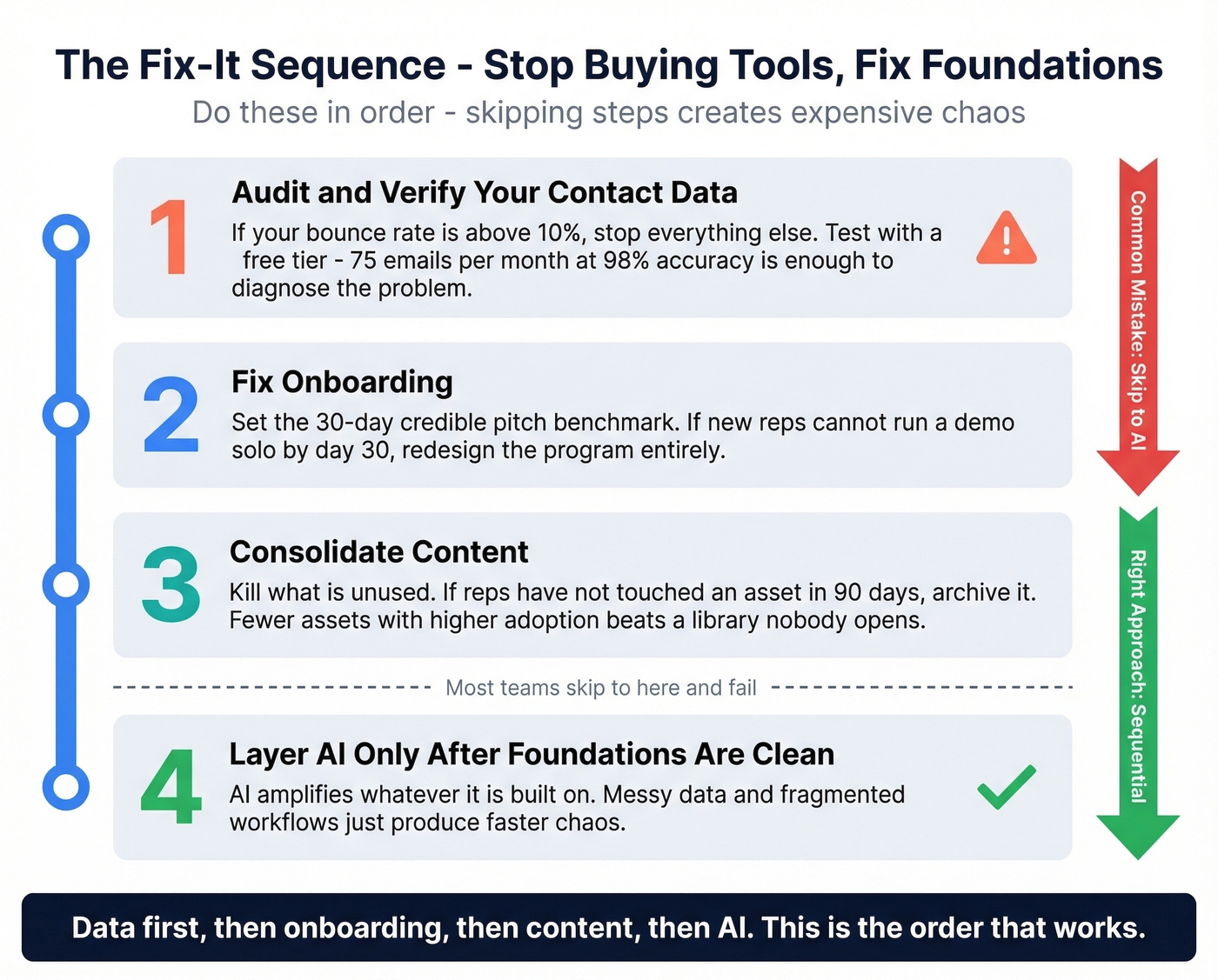
Step 1: Audit and verify your contact data. Prospeo's free tier covers 75 emails/month with 98% accuracy - enough to test whether bad data is your bottleneck before spending another dollar.
Step 2: Fix onboarding. Set the 30-day credible pitch benchmark. If new reps can't run a demo solo by day 30, redesign the program.
Step 3: Consolidate content. Kill what's unused. If reps haven't touched an asset in 90 days, archive it. Fewer assets with higher adoption beats a library nobody opens.
Step 4: Layer AI only after foundations are clean. AI amplifies whatever it's built on - messy data and fragmented workflows just produce faster chaos.
Solving sales enablement challenges isn't about adding more software. It's about fixing the foundations in the right order, measuring what matters, and resisting the urge to skip steps.
Your reps already lose 60% of their day to non-selling tasks. Don't make list-building one of them. Prospeo's 30+ search filters - including buyer intent, technographics, and headcount growth - let reps find verified decision-makers in minutes, not hours. One click in the Chrome extension pulls 40+ data points per contact, straight into your CRM.
Give your reps their selling time back. Clean data, zero guesswork.
FAQ: Sales Enablement Challenges
What's the biggest enablement challenge in 2026?
Rep productivity. Reps spend 60% of their time on non-selling tasks, compounded by tech fragmentation and bad data. 44% of leaders saw no-decision losses increase, suggesting programs aren't translating into buyer action.
How do you measure sales enablement ROI?
Use the sales velocity formula: opportunities x average sales price x win rate / cycle length. You need 75% minimum methodology adoption before measuring impact, and meaningful results take 6-36 months to surface.
How does data quality affect enablement outcomes?
73% of B2B buyers avoid irrelevant outreach entirely. Reps armed with perfect playbooks but invalid contact data still fail. Fixing data quality at the source - verified emails, fresh records, catch-all handling - often improves pipeline metrics faster than any new training program.