

Sales Enablement Planning: A Step-by-Step Guide That Works
Your VP just asked you to "build out enablement." Your first deliverable is due in two weeks. You've got a half-finished content library, no baseline metrics, and a CRM full of contacts that haven't been verified since last fiscal year. Most sales enablement planning efforts die right here - not from bad strategy, but from no strategy at all.
The numbers paint a brutal picture. 61% of B2B buyers now prefer a rep-free buying experience, according to a Gartner survey of 632 B2B buyers. Another 73% actively avoid suppliers who send irrelevant outreach. And 69% report inconsistent experiences between what they see on a vendor's website and what they hear from reps. The bar for enablement isn't "give reps more content." It's "make every rep interaction so valuable that buyers choose to engage."
Why Enablement Planning Matters Now
Those three stats converge on one conclusion: buyers have options, and they'll ghost reps who waste their time. Sales readiness isn't a training initiative anymore - it's a revenue function. Without a structured enablement plan, teams become reactive order-takers, churning out battle cards and one-pagers that nobody uses while pipeline stagnates.
Here's the minimum viable plan if you're short on time:
- Current-state audit. You can't improve what you haven't measured. Audit performance, pipeline, operations, people, and market position before touching a single deliverable.
- Written charter with measurable targets. Not a slide deck. A document that says: "We'll move win rate from 22% to 28% in 12 months, and here's how we'll know."
- Clean prospect data. Every other investment - training, content, coaching - falls apart if reps are working stale lists with bounced emails and disconnected numbers.
Those three things before anything else. 30.3% of enablement practitioners say their metrics barely reflect the value they create. Don't join that group. The 7-step framework below expands on each pillar, including the data quality step that almost no other enablement guide covers.
The 7-Step Framework
1. Audit Your Current State
Run a five-dimension audit before you build anything: performance (revenue, win rate, sales cycle, conversions), pipeline health (benchmark coverage at 3-4x your revenue target), operations (CRM hygiene, manual work), people (skills, capacity, ramp time), and market/buyer dynamics.
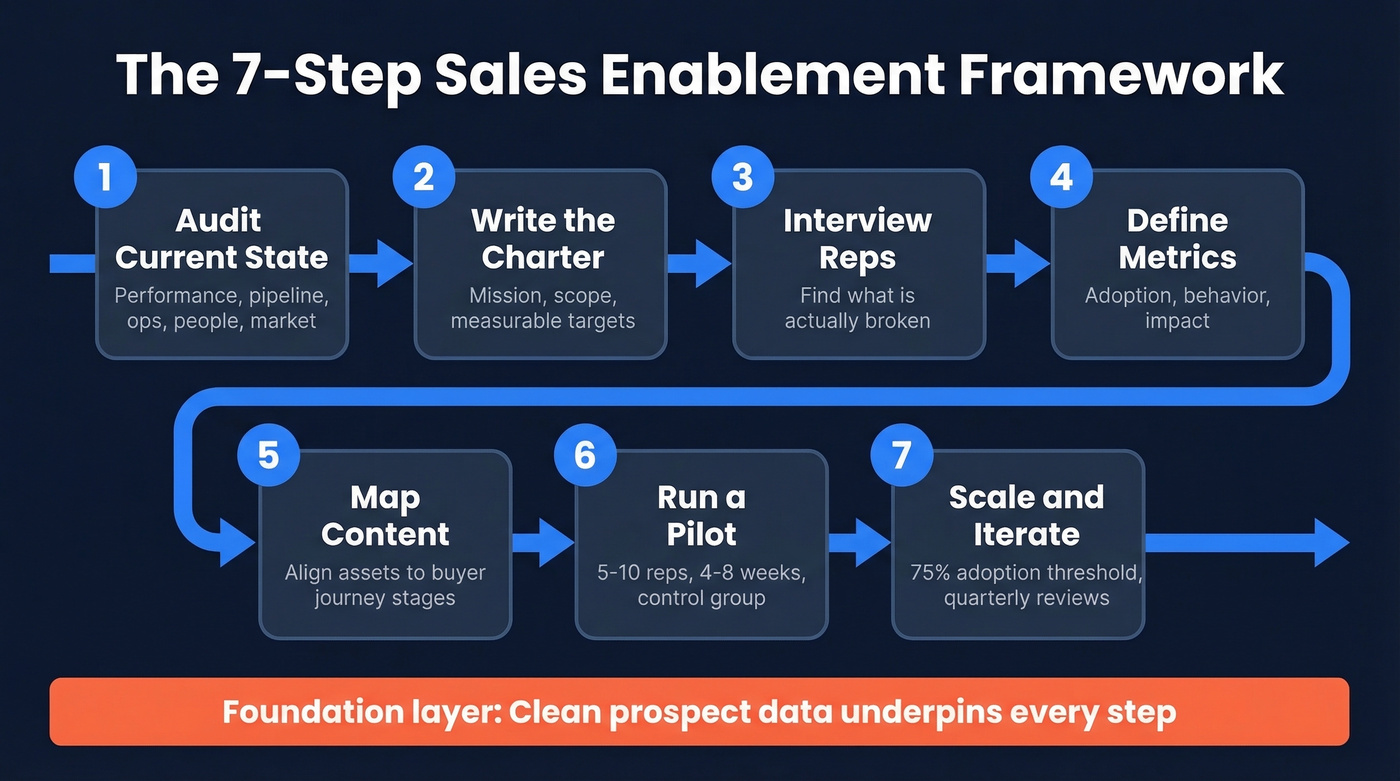
Use a truth table for each dimension: Continue (what's working), Stop (what's wasting time), Do differently (what needs redesign). Run a pre-mortem while you're at it - ask "If this enablement program fails in 12 months, what killed it?" and plan against those risks. We've seen teams skip the audit and end up building programs that solve problems nobody actually has. That's a quarter of budget and credibility you don't get back.
2. Write the Enablement Charter
The charter is your contract with leadership: mission statement, scope, ownership model, what's explicitly in and out of scope, and year-one success criteria with numbers attached. Think of it as the backbone of every enablement initiative - without it, every stakeholder invents their own definition of success.
Fill-in-the-blank targets work well. Win rate: 22% to 28%. Playbook access: 80% of reps monthly. Quota attainment: 75% of reps hitting number. These aren't aspirational - they're the benchmarks you'll be measured against. If you don't define "good" upfront, someone else will define it for you in Q2, and you won't like their version.
3. Interview Reps and Managers
Your charter tells you where you're going. Rep interviews tell you what's actually broken.
Build a prioritized needs list: where do deals stall? What playbook content do reps wish they had but can't find? What skills gaps show up in lost-deal reviews? The pattern we see repeatedly is that enablement teams build content libraries based on what marketing thinks reps need, not what reps actually ask for. Thirty minutes with your top five and bottom five reps will teach you more than any strategy deck ever will.
4. Define Your Metrics
This is where most enablement programs go sideways. Course completions and content downloads are vanity metrics. Use a three-level framework instead:
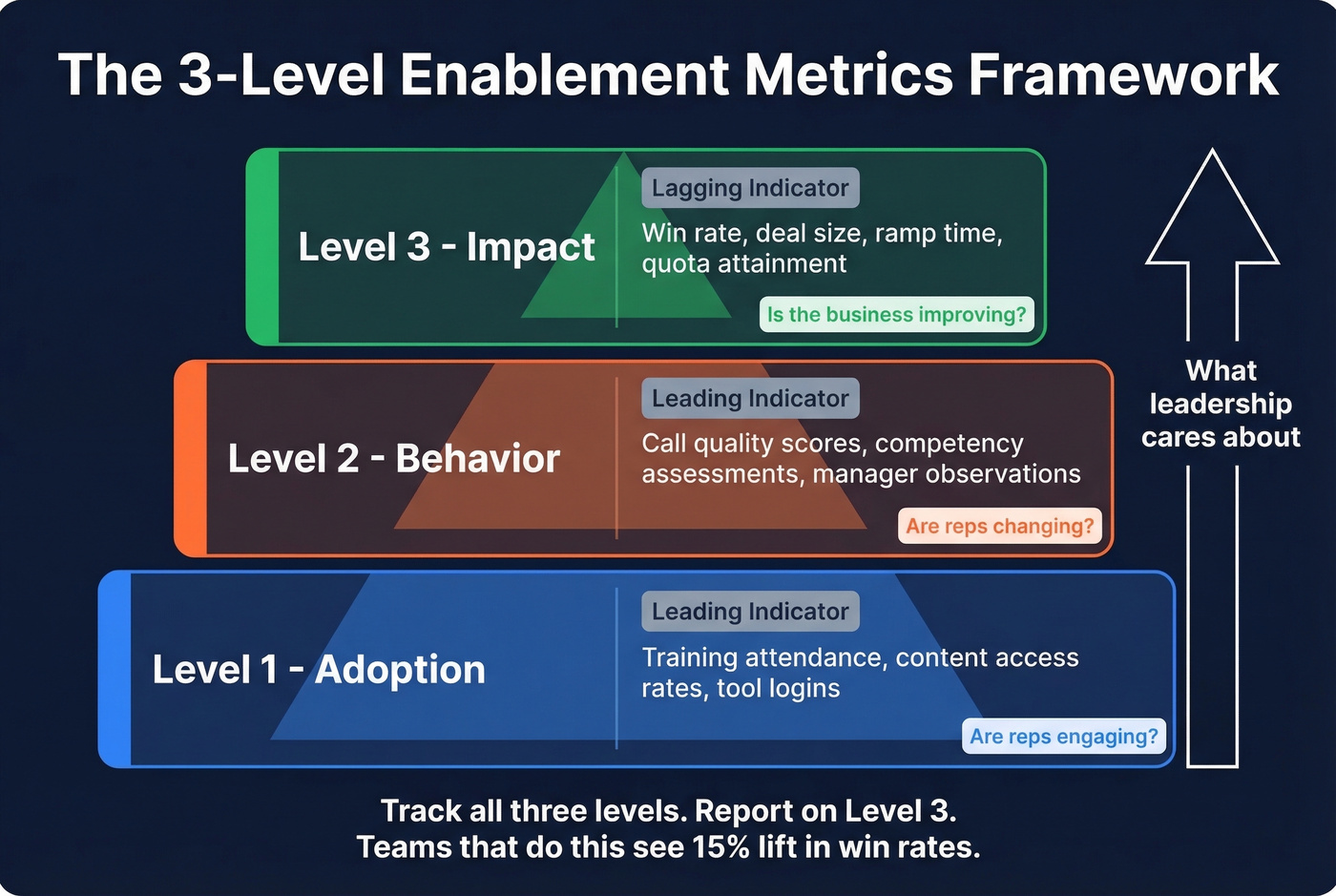
- Level 1 - Adoption: Are reps using the materials? Training attendance, content access rates, tool logins.
- Level 2 - Behavior: Are reps doing things differently? Call quality scores, competency assessments, manager observations.
- Level 3 - Impact: Is the business improving? Win rate, deal size, ramp time, quota attainment.
Levels 1 and 2 are leading indicators. Level 3 is what leadership actually cares about. Track all three, report on Level 3.
5. Map Content to the Buyer Journey
That 69% inconsistency stat isn't just a branding problem - it's a deal killer. Buyers see one thing on your website and hear something different from your reps. Content mapping fixes this by aligning every asset to a specific stage.
| Stage | Content Types |
|---|---|
| Awareness | Industry reports, blog posts, problem-framing decks |
| Consideration | Case studies, ROI calculators, competitive battle cards |
| Decision | Proposals, implementation guides, security docs |
| Retention | Onboarding playbooks, QBR templates, expansion talk tracks |
Every piece of content needs a stage, an owner, and a refresh date. Anything without all three gets archived. No exceptions.
6. Run a Pilot With 5-10 Reps
Don't roll out to the full org. Pick 5-10 reps, run the program for 4-8 weeks, and compare their metrics against a control group. This cohort testing approach is the most defensible way to show impact before you've scaled.
Mix tenures, territories, and performance levels. If you only pick your best reps, you'll prove nothing.
7. Scale and Iterate
Once the pilot shows signal, expand in waves. Set adoption thresholds: 75% minimum adoption before expecting meaningful lift, and results get statistically better around 90%. Review quarterly, not annually. Kill what isn't working.
Here's the thing about timelines: methodology adoption takes 6-36 months to produce measurable business impact. Anyone who tells you otherwise is selling you something. Buyer enablement, digital sales rooms, and AI personalization all matter - after you've nailed the foundation. Set the timeline expectation with your executive sponsor on day one.
How to Measure Enablement ROI
The three-level framework deserves a deeper look, because measurement is where enablement programs live or die.
| Level | Type | Metrics | Signal |
|---|---|---|---|
| 1: Adoption | Leading | Training attendance, content usage, tool logins | Reps are engaging |
| 2: Behavior | Leading | Call scores, competency assessments, manager feedback | Reps are changing |
| 3: Impact | Lagging | Win rate, deal size, ramp time, quota attainment | Business is improving |
One company spent roughly $500K on methodology adoption and generated $200K in incremental revenue at 35% margin. That's about $430K negative in year one. The program wasn't bad - the timeline expectations were. They pulled the plug before adoption hit critical mass.
Use cohort testing to build your attribution case. Teams that treat enablement as an ROI engine see 15% lift in win rates and 12% higher quota attainment. But you need the data to prove it and the patience to let adoption compound.

Step 3 of your audit just flagged stale CRM data. That's the enablement killer most guides ignore. Prospeo refreshes 300M+ profiles every 7 days - not every 6 weeks - so your reps work verified emails (98% accuracy) and direct dials that actually connect.
Clean data is the foundation. Build your enablement plan on it.
Five Mistakes That Kill Programs
Becoming a reactive order-taker. Sales leadership asks for a battle card. Marketing wants a one-pager. CS needs an onboarding deck. You say yes to everything, lose strategic alignment, and never prove impact. Set prioritization criteria and say no to requests that don't map to your charter.
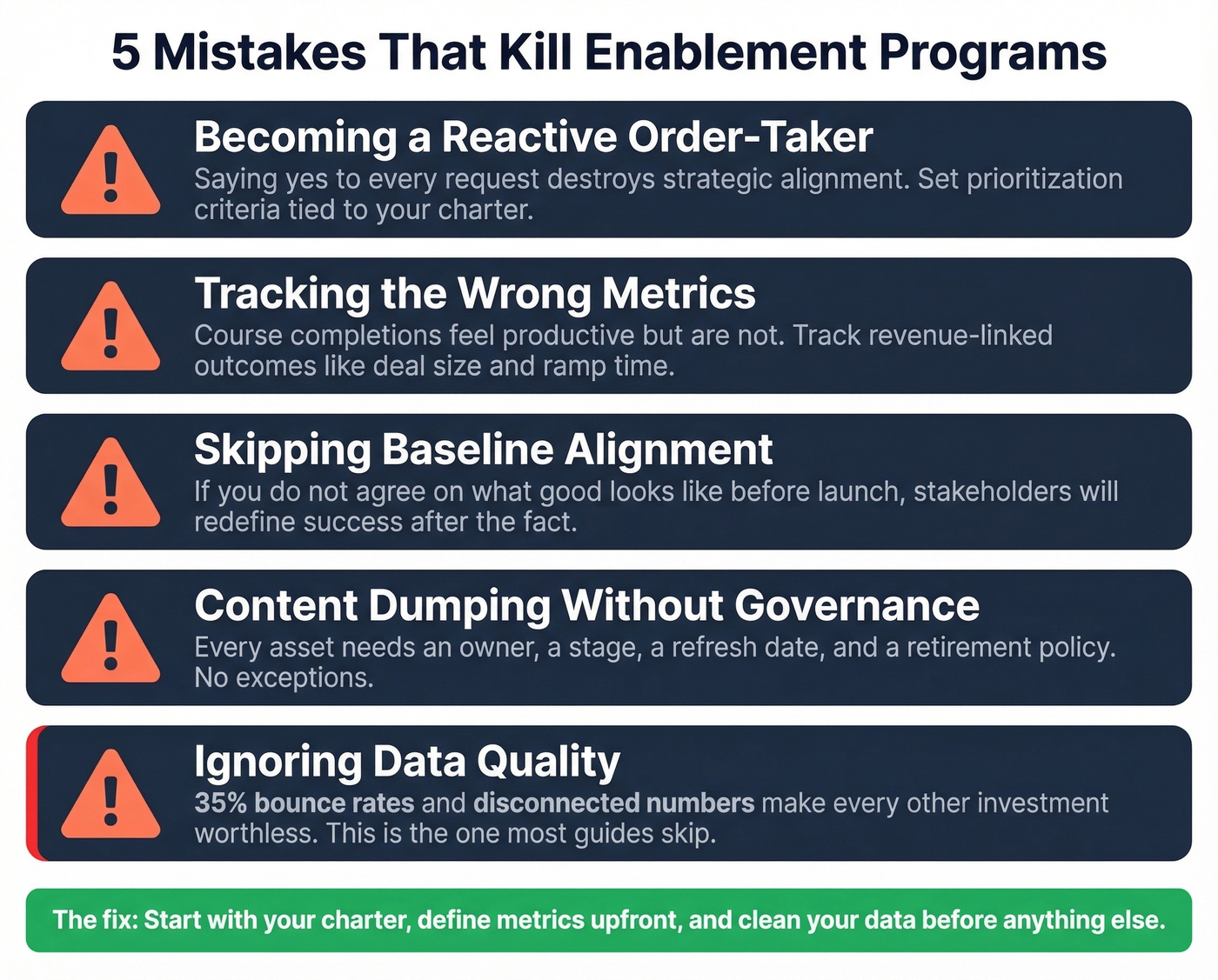
Tracking the wrong metrics. Course completions feel productive. They aren't. Track revenue-linked outcomes - deal size, sales cycle length, stage conversion rates, ramp time. If a metric doesn't connect to revenue, drop it.
Skipping baseline alignment. If you don't agree upfront with leadership on what "good" looks like, stakeholders will pick apart your analysis after the fact. Align before you launch.
Content dumping without governance. Uploading 200 assets to a shared drive isn't enablement. Every piece needs an owner, a stage, a refresh date, and a retirement policy. Content without governance becomes content nobody trusts.
Ignoring data quality. Your plan covers training, content, and coaching - but if reps are working lists with 35% bounce rates and disconnected numbers, none of that investment lands. Data quality is the unsexy foundation that makes everything else work, and almost nobody plans for it. We'll dig into this below.
Building Your Enablement Tech Stack
Most enablement plans fail because they're content plans disguised as strategy. Another common failure? Buying a $100K+ platform before proving the process works.
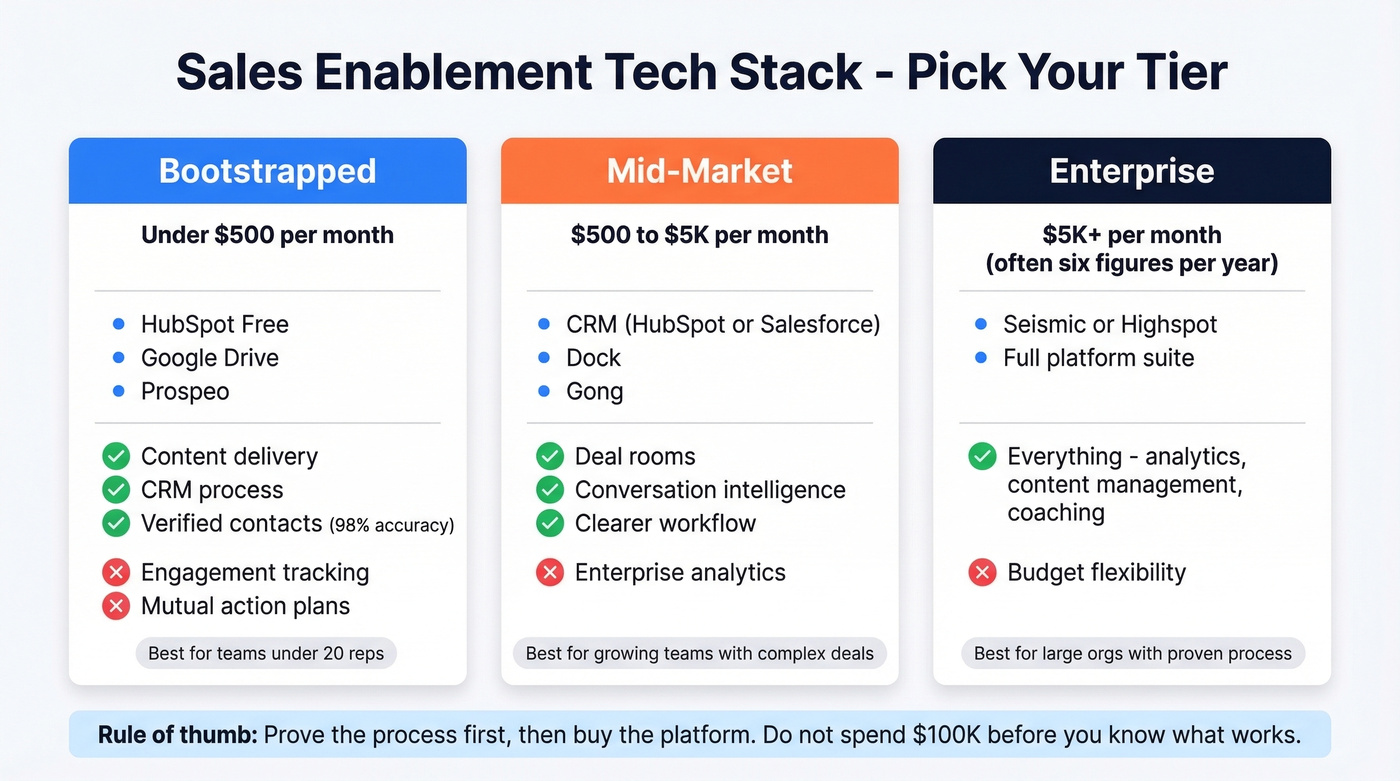
Let's be honest: enterprise enablement platforms are overkill for many teams. If your average deal size is under $15K and your sales org is under 20 reps, a bootstrapped stack will outperform a six-figure platform that nobody fully adopts.
| Tier | Monthly Cost | Stack | You Get | You Lose |
|---|---|---|---|---|
| Bootstrapped | Under $500 | HubSpot Free + Google Drive + Prospeo | Content delivery, CRM process, verified contacts | Engagement tracking, MAPs |
| Mid-Market | $500-5K | CRM + Dock + Gong | Deal rooms, convo intel, clearer workflow | Enterprise analytics |
| Enterprise | $5K+ | Seismic or Highspot (often six figures/year) | Everything | Budget flexibility |
The bootstrapped stack works. Reddit practitioners back this up - one user summed it up well: Google Drive or SharePoint handles content, your CRM handles process, and a data quality tool handles contact accuracy. You lose buyer engagement tracking and mutual action plans, which matter for complex enterprise deals. Tools like Trumpet and Aligned fill that gap when you're ready. But prove the process first, then buy the platform.
The Data Quality Pillar Nobody Plans For
Every enablement guide talks about content and training. Nobody addresses the fact that reps waste hours chasing bounced emails and dead phone numbers. If 73% of buyers avoid suppliers who send irrelevant outreach, imagine what happens when your outreach doesn't even arrive.
A 35% bounce rate means your sequence never lands. The rep loses confidence. The pipeline dries up. No amount of coaching or battle cards fixes that.
Skip this step if your existing data provider already delivers sub-5% bounce rates consistently. But in our experience testing dozens of tools, that's rare - most teams don't even measure bounce rate at the enablement planning level, which is exactly the problem. (If you want benchmarks and fixes, start with bounce rate and email deliverability.)

You can nail the charter, map content to every buyer stage, and run a flawless pilot - but if reps are calling disconnected numbers and bouncing emails at 35%, none of it matters. Prospeo delivers 125M+ verified mobiles with a 30% pickup rate and emails at $0.01 each.
Stop letting bad data sabotage your enablement investment.
FAQ
How long does enablement take to show ROI?
Expect 6-36 months for methodology adoption to produce measurable business lift. Adoption needs to hit 75%+ before results become meaningful, and outcomes improve significantly around 90%. Set this expectation with leadership on day one - not after they ask why the numbers haven't moved.
Do I need a platform to start?
No. A CRM, a shared content repository, and a data quality tool cover most of what you need for under $500/month. Add a dedicated platform like Dock (~$350/month) or Highspot after you've proven the process with a pilot and have the metrics to justify the spend.
What's the top reason enablement programs fail?
Becoming a reactive order-taker. When enablement accepts every content request without prioritization criteria, it loses strategic alignment, burns through bandwidth on low-impact work, and never builds the measurement infrastructure needed to prove value. Set boundaries in your charter before you launch.
How do I connect my plan to business objectives?
Map each initiative to a specific outcome - revenue growth, market expansion, or customer retention. Your charter should explicitly connect every deliverable to a measurable objective so leadership sees the through-line from activity to impact. If an initiative doesn't ladder up, cut it.
What separates a sales enablement plan from a revenue enablement plan?
A sales enablement plan arms your sales team with content, training, and data to close deals. A revenue enablement plan broadens scope to include marketing, customer success, and post-sale teams - anyone influencing the revenue lifecycle. Most organizations start sales-focused and expand as they mature. The same framework applies; the stakeholder map just gets wider.